A tale of two communities
Woodlawn and North Lawndale are two inner-city communities within Metropolitan Chicago. Despite rather similar populations and economic problems, they chose differing approaches to development and revitalization, and therein lies a story about the influence of social capital on health. The story was observed close-up in a three-year research project by a Petris Center scholar (Ivester, 2006), who also analyzed census, real estate, and mortgage lending data. In essence, Woodlawn sought to attract funding and an influx of higher-income people from outside the community, while Lawndale worked on improving the outlook for its own residents. Both neighbourhoods won praise for their successes. From 1980 to 2000, Woodlawn’s median family income jumped ahead; its poverty rate, high school drop-out rate, and population density all fell. A process of gentrification replaced many lower-income residents with more affluent ones. Meanwhile, across the city in Lawndale, local institutions got to work salvaging condemned buildings and rehabbing them for resale to local residents. Organizations found ways to partner with Lawndale’s own citizens in community improvement and enhancing access to health care. Lawndale’s economic picture improved, but far less than Woodlawn’s. Which community was more successful? It would appear to be Woodlawn, except for one thing. On numerous measures of health – from infant mortality to heart disease, tuberculosis, stroke, and even homicide – Lawndale did far better. The officeholders and unofficial leaders of Lawndale made use of the ‘bonding’ power of social capital to energize its own residents around civic revitalization, including health services.
This is a greatly simplified illumination of social capital at work. Economist Victor Fuchs provided another in his 1974 book Who Shall Live? (Fuchs, Reference Fuchs1998). In it he pointed out that the contiguous states of Nevada and Utah have many similarities, including demographics, income, access to medical care, education, and climate. Yet mortality data for Utah are far better than for Nevada. Fuchs noted that Utah’s population – some 70% Mormon – were less likely to smoke, drink alcohol, or engage in risky sexual activity. One apparent result of Utahans’ widely accepted social norms was significantly better health than that of their neighbours. Fuchs’ insights added lifestyle and behaviours as important inputs to health production. The health production function was formalized in Grossman’s 1972 paper (Grossman, Reference Grossman1972), where he described a human capital model of the demand for health. The Grossman model views health as a durable capital stock whose output is healthy time. His thesis is that people start out with a certain amount of this stock, and that it depreciates with age, but can be added to by investment. He uses the household production function model of consumer behaviour to account for the difference between health as an output and medical care as an input.
The preceding stories about two communities and two states with highly different health outcomes illuminate different aspects of social capital that require different approaches to measurement. The Lawndale/Woodlawn example is focused on health outcomes, while the Utah/Nevada example is all about social norms and behaviour. This duality is at the centre of a controversy that we shall address in this brief introduction to social capital and health from an economic perspective.
What is social capital?
The forces of social capital – the advantage derived from a structure of relationships – have always been an integral part of societies, although the term itself has come into widespread use only recently. It is a core concept in many social science fields, including business, organizational behaviour, political science, and sociology – as well as economics. The various fields of study have used a number of inter-locking descriptions. Modern use of the term social capital is often traced to the 1960s work of Jane Jacobs, who used it in referring to the value of networks (Jacobs, Reference Jacobs1961). In her influential book on urban revitalization, Jacobs argued that individuals networking together are far more effective than top–down efforts of governments or large corporations. Pierre Bourdieu published formulations of the term social capital in 1972 and 1984 (Bourdieu, Reference Bourdieu1972, 1984). James Coleman (Reference Coleman1988) adopted Glenn Loury’s (1977) definition in developing and popularizing the concept. Gary Becker, who ran the Seminar on Rational Choice in the Social Science with James Coleman, transformed and added to the concept of social capital using economic theory, ultimately publishing a book on the topic (Becker, Reference Becker,1996; Becker and Murphy, Reference Becker and K.2000). By the late 1990s, when the World Bank devoted a research programme to social capital, the concept had become respectable within economics. With the publication of Robert Putnam's Reference Putnam2000 book, Bowling Alone, social capital became broadly popularized.Footnote 1
Despite its growing usage, not all economists are in synch with the definition of social capital or its precise measurement. Glaeser et al., described it as ‘the institutions, relationships, and norms that shape the quality and quantity of a society's social interactions. It is not just the sum of the institutions that underpin a society, it is the glue that holds them together’ (Glaeser et al., 2000). Steven Durlauf (Reference Durlauf2002) described social capital as the ‘individual’s social characteristics that enable private returns via interaction with others. Total social capital is an aggregation that takes into account all externalities.’ Martin Paldam (Reference Paldam2000) said it is ‘a set of mechanisms in which groups implicitly enforce certain behaviors among their members’. And Charles and Kline (Reference Charles and P.2006) referred to social capital as the ‘interaction of trust-cooperation complexes and networks’. Trust, they contend, makes cooperation easier. Therefore, ‘the larger the trust network, the larger the private return’. Rothstein (Reference Rothstein2005) significantly expanded the discussion of the generation of trust and factors that inhibit it.
Some economists think of social capital as a subcategory of the overarching term ‘human capital’, while others see it as distinct; still others think it is not a form of capital. The controversy regarding use of the term ‘social capital’ particularly concerns the word ‘capital’, which is an economics term. At least two prominent economists take issue with the terminology. Kenneth Arrow, a Nobel Laureate from Stanford University, rejects the term social capital because ‘the essence of social networks is that they are built up for reasons other than their economic value to the participants’. Robert Solow of MIT, another Nobel Laureate, comments, ‘I do not see how dressing this set of issues in the language and apparatus of capital theory helps much one way or another’ (Solow, Reference Solow, Dasgupta and Serageldin2000).
Nevertheless, the literature on social capital is growing in the fields of economics and health (see Figure 1, below). To create the graph, we did a search on the terms ‘social capital’ in the title and abstract by year in EconLit and PubMed from 1996 to 2005. Then we looked for both the terms ‘social capital’ and ‘health’ in title and abstract in EconLit by year to create the third series on the graph (labeled EconLit-Health). One sees a change in the slope of increase in about the year 2000, and a fall in EconLit papers using the term social capital in 2006. The PubMed search continues to grow at a rapid pace. Articles that directly link economics and health have just started to appear in the literature. This special issue, it is hoped, will continue to fill this gap.
Papers published on social capital

Whether or not one agrees with the term social capital, most concur that there is a social effect being measured, which has determined to be an input into many different aspects of life. Economists have applied the principles of social capital to a number of subjects, including carpooling and micro-financing (Charles and Kline, Reference Charles and P.2006; Gomez, Reference Gomez2001). Authors widely agree that social capital has characteristics of bridging or bonding (Putnam, Reference Putnam2000). Bridging SC brings different groups within the community together, whereas bonding SC makes each group internally more cohesive. Bonding social capital is based on linkages among people who are similar in some way, such as age, ethnicity, economic class, or even interest in dogs, for example. Bridging social capital, on the other hand, cuts across such groupings. Both of these concepts may generate positive or negative externalities in that even individuals who are not involved in the activities/organizations that define social capital may be affected. For example, uninvolved community members may still benefit from higher levels of bridging and/or bonding social capital that are present in their community.
In this issue, we specifically focus on the relationship between social capital and health, and the mechanisms by which social capital affects health-related behaviours and outcomes.
The mechanism
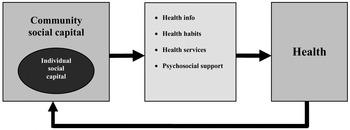
The mechanisms that link social capital with health are depicted in Figure 2. Social capital makes information available to community members, helping to improve their decisions related to health, such as diet or exercise, or selecting a physician or a hospital. In addition social capital may impact the social norms in a community, for example, encouraging individuals to lose weight, to be vaccinated, or to avoid or give up smoking (Brown et al., Reference Brown2006). It may enhance the health care services and their accessibility in the community. And, finally, social capital offers psychosocial support networks, which may mitigate stress and enhance health. This is especially important in the area of mental health (Scheffler et al., Reference Scheffler, Brown and Rice2007: note 31; Scheffler and Paringer, 1979).
Mechanisms linking social capital to health

These four mechanisms often interact with each other to produce a synergistic effect on health. The direction of causality is difficult to determine, in that social capital and enhanced health may be mutually reinforcing. We can see that social capital works through information and norms to improving health, but we also see that health can have a direct link to social capital. Sorting out the causation is therefore a complex problem.
Religious organizations may play a special role in social capital in the sense that they help bond members of the community, and may provide health information and affect social norms. Furthermore, across faith traditions and denominations, the purpose of human life is viewed as not merely personal enjoyment, but as fundamentally involving service to others. Thus, religious organizations generally foster a stewardship ethic, of maintaining bodily health to enable one to serve others. Individual religious organizations may express a stewardship ethic in diverse ways, ranging from proscriptive norms against unhealthy behaviours, to positive programs such as parish nurses, or nutrition or athletic programmes.
In some cases, social capital has a differential impact by income and by education. Lower-income individuals may be more likely to benefit from social capital because they have less ability to directly purchase information and find social support that would otherwise be provided through social capital. Similarly, people with higher levels of education are more able to find and understand information on their own rather than to receive it via social capital.
Approaches to social capital measurement
A number of approaches have been used to measure social capital. Robert PutnamFootnote 2 tracked what he considered to be a weakening of social ties in communities over the last generation, and examined the consequences, including deteriorating physical health. He developed the Social Capital Community Benchmark Survey (SCCBS) in order to study social capital through community membership in voluntary organizations. The survey was comprised of a national sample of 3,000 respondents and representative samples in 40 communities (across 29 states) covering an additional 26,200 respondents.Footnote 3 Building on Putnam’s work, the Petris Social Capital Index (PSCI) looks at community voluntary organizations using public data available for the entire United States. Similar to the SCCBS, the PSCI relies on US Census data, specifically County Business Patterns, to measure employment in voluntary organizations (per 1,000 population). It overlaps the types of entities included in the SCCBS: for example, organizations affiliated with religion, veterans groups, and labor unions are all included. The population-weighted correlation of the PSCI with Putnam’s measure of membership in voluntary organizations (from the SCCBS) is 0.60 (p < 0.001).
PSCI and individual versus community social capital
Social capital has two distinct levels that are generally agreed upon. Individual social capital (ISC) can be defined as the level of trust, networking, group membership, and/or cooperation that an individual has in and with the larger society. Questions used to measure trust include such things as whether an individual would allow a neighbour to look after his or her children, or how much an individual trusts people in the community. ISC is thought to serve individual self-interest; it is a private good (Coleman, Reference Coleman1988). Community social capital (CSC) can be defined as the extent and density of trust, cooperation, and associational links and activity within a given population. It is thought to have wider effects on the community as a whole, as well as individuals within it, and is therefore a public good. CSC also creates externalities; it is hypothesized that even those who do not participate in community activities and organizations (such as religious institutions, social clubs, and athletic organizations provided by the community or neighborhood) will benefit from their existence. A common critique of ISC measures is that they do not adequately capture social capital as a group-level phenomenon. Therefore, there is a push in current research to identify community-level indicators of social capital that are not merely aggregations of individual data (and thus not subject to the fallacy of composition).
The Petris Social Capital Index provides a CSC indicator that overcomes this critique. The PSCI is an actual measure of the level of organizational resources within a community and is not derived by aggregating individual survey responses. An additional feature of the PSCI is that it is based on data that are systematically collected on an ongoing basis by the US Census Bureau and are therefore available free of charge nationwide. The data are available over time and at the zip code, county, and Metropolitan Statistical Area (MSA) level. Similar information exists in other countries as well,Footnote 4 allowing comparable research internationally. The PSCI was constructed in a series of steps. First, Putnam’s SCCBS was used to develop a list of voluntary organizations that he considers important to community-level social capital.Footnote 5 Because 17 of the 18 categories listed in the SCCBS were linked to NAICS (North American Industry Classification System) industry code 813 as used in annual data collected by the US Census: County Business Patterns (CBP) (US Census Bureau, 2005a), this category is used as a structural measure of social capital. The only category that could not be matched is ‘any group which meets over the Internet’.
Although membership in associations is frequently used as an indictor of individual social capital, the PSCI is a community measure of structural social capital. As such, the PSCI measures the density of associations available in a particular area for individuals to join. Since the CBP does not contain actual membership data, but does contain data on paid employment in voluntary organizations, the number of paid employees as a percentage of the population was used to measure CSC. The data behind this measure are highly accurate because CBP data are gathered from census collections and administrative records of the entire universe of organizations. The data therefore represent the population as a whole (US Census Bureau, 2005b).
Studies in social capital
The PSCI has been used in a number of recent studies of social capital. Research in the United States has focused on smoking, psychiatric distress, and heart disease. One study using the PSCI found that smokers use fewer cigarettes in areas where there are higher levels of social capital (Brown et al., Reference Brown2006). Related research shows a positive relationship between social capital and smoking cessation (Brown, 2008). Research in the US finds that increases in CSC are associated with reduced psychological distress in lower-income families as CSC moves from its lowest point up to its median level (Scheffler et al., Reference Scheffler, Brown and Rice2007). This suggests that social capital is effective in improving mental health. In another study, community social capital and the recurrence of acute coronary syndrome were examined. The findings show that among individuals living in areas where household income is below the median, higher levels of CSC, as measured by the PSCI, are associated with a lower recurrence of acute coronary syndrome (Scheffler et al., Reference Scheffler, Brown, Syme, Kawachi, Tolstykh and Iribarren2008). Finally, research done in Indonesia looks at outcome variables in overall health and mental health. The types of organizations in a community were counted, including pharmacy gardens and save-and-borrow groups. The study finds a robust positive association between community-level social capital and good health. There is also evidence for some of the health measures examined of an interrelationship between human and social capital and mental health (Miller et al., Reference Miller, R., S., R. and A.2006). Less educated populations appear to benefit more from community measures of social capital.
The purpose of this issue
This special issue of HEPL looks at interesting new research linking social capital and health from an economic perspective. The four articles that follow were among those written by participants in the Global Social Capital Workshop in Berkeley, CA held in October, 2006.Footnote 6
Folland presents a model of health production that tests the relationship of community social capital (CSC) with behaviours that result in poor health, and the relationship between health expenditures and CSC. Using a weighted sum of six of Putnam’s social capital indicators to measure CSC, he finds a positive correlation between health expenditures and CSC, and negative correlations between CSC and cocaine use, and between CSC and smoking.
Iversen’s study is unique because he examines the relationship between four varying measures of CSC using a Petris-type index and self-reported health status using a multilevel ordered probit approach. The varying measures of CSC allow him to break down the relationship at various levels of analysis and concentrate on which groups are important to improving health status. He finds mixed associations depending on the way he measures social capital. Religious activity at an individual level is not significantly associated with better health, while at the community level, the number of people attending church services is associated with better general health in the cross-sectional survey. Increased voting participation was positively correlated with health at the community level. He did not find membership in sports organizations at the community level to be a significant indicator of health.
Jusot, Grignon, and Dourgnon particularly focus on the psychosocial determinants of health and are one of the first to use a complete set of psychosocial factors at the individual level to test the respective impacts of different types of resources. Using data from the 2004 Health, Health Care, and Insurance Survey and logistic regressions, they study the impact of subjective perception of social capital, social support, sense of control, and self-esteem on self-assessed health status. They find that sense of control at work is the most important determinant of health status within psychosocial resources. In addition, they find that civic engagement and social support are also important determinants of health. To a lesser extent, a sense of being lower in the social hierarchy is associated with poorer health status.
Laporte, Nauenberg, and Shen study the effects of social capital on utilization of health services in Canada. They use a two-part model with a Heckman correction for sample selection and a variable to control for access to a regular physician, which mitigates the endogeneity problem between utilization of health services and social capital. This study is particularly interesting in the Canadian setting, where there is universal health insurance. They use a measure of social capital equivalent to the Petris Index for Canada and survey data from the Canadian Community Health Survey. They find that the relationship between CSC and the probability of visiting a physician is negative and significant for those over 65, but positive and significant for individual social capital. This leads us to believe that individual social capital impacts individuals differently than community factors. They found that the effect of CSC is most prominent in the middle ranges of utilization, while individual social capital is most important for those over 65 and at the lower end of the utilization distribution.
Policy implications
As the articles make clear, there is a systematic and growing set of empirical literature by economists documenting the relationship between social capital and health. The association is between health behaviour and measures of health status. These relationships are found across countries as well.
What are the policy implications? Suppose one looks at two communities that are identical in terms of income, education, age structure, and other sociodemographic characteristics. They have the same amount of resources to invest. Community A puts its resources only into projects and investments that will improve the economy and the income of its inhabitants. Community B divides its investment between social capital and economic enhancements. Which community will be better off? The answer depends on the definition of ‘better off’, but Community B will almost certainly see a higher rate of return in health than Community A.
Governments can foster the development of social capital in pursuance of health in two ways. One is to provide funding and/or tax subsidies that allow social capital to be more easily formed (along with in-kind subsidies such as providing space for voluntary groups to meet). The second way is to generate enthusiasm among communities and their leaders to develop social capital. The exact form of each of these policy tools will of course need to fit the culture and history of the community. From the research perspective, there is much work to be done. The next steps are to continue testing the mechanisms; to look for natural experiments, such as the one in Chicago described in the introduction to this paper; and to find better public policies to foster social capital.
The opportunity to benefit health through the enhancement of social capital lies partly in factors that resist measurement by any means, but can be glimpsed in community stories. Efforts in Chicago’s Lawndale, over about 30 years, turned a neighbourhood that had been considered almost irreclaimable into one of the city’s most promising. A crucial initial spark was lent by a local minister who saw that the community needed a sit-down restaurant so that families could go out at night, and he made it happen. Later came a gym and a health centre. Housing, investment, and businesses came too. And the original spark was caught by other leaders and moved ahead in a positive direction that continues to support good health today.