INTRODUCTION
What do young children understand about the syntax of sentences they hear and speak? While controversy remains active, evidence from multiple methodologies is beginning to converge on the conclusion that children are capable of abstract syntactic generalization by the age of three, and perhaps much sooner (Brooks & Tomasello, Reference Brooks and Tomasello1999; Bunger & Lidz, Reference Bunger, Lidz, Brugos, Micciulla and Smith2004; Conwell & Demuth, Reference Conwell and Demuth2007; Demuth, Moloi & Machobane, Reference Demuth, Moloi and Machobane2010; Fisher, Gertner, Scott & Yuan, Reference Fisher, Gertner, Scott and Yuan2010; Huttenlocher, Vasilyeva & Shimpi, Reference Huttenlocher, Vasilyeva and Shimpi2004; Snedeker & Thothathiri, Reference Snedeker, Thothathiri, Sekerina, Fernández and Clahsen2008). The production of novel sentences has been critical in the debate over the nature of early syntactic representations. Under a late generalization view (Tomasello, Reference Tomasello2000, Reference Tomasello2005), children's early syntactic representations are based around individual lexical items rather than abstract linguistic categories (e.g., kicker KICKS kick-ee). This changes when children begin to notice similarities in the structure and semantics of individual ‘islands’ and generalize toward something more like an adult verb category. Under an early generalization view (cf. Fisher, Reference Fisher2002), children are able to represent abstract relationships such as subject–verb–object in sentences from very early in development. This view predicts that children should be able to extend what they know about one verb to others which appear in the same construction.
Implicit in the debate over the development of syntactic representations is the related question of the nature of early semantic representations. Under a late generalization approach, semantic parallels may help the child begin to build larger and more abstract categories of sentence constructions. Early generalization approaches tend to assume that young children not only have structural information available to them, but also semantic expectations about these structures – when children hear a novel verb in a familiar sentence, they prefer certain scenes over others (Naigles, Reference Naigles1990). Under both theories, understanding exactly what expectations children have about the meanings of verbs in different constructions is critical for understanding how their developing grammars operate.
Children's ability to produce novel verbs in new sentences has long been considered a strong test for abstract representations. While a few studies have suggested that this ability is present before the age of three, several critical questions remain. First is the extent or abstractness of their syntactic representations. The specific generalizations that children in these studies make have been argued not to reflect truly abstract representations. For instance Tomasello (Reference Tomasello2000) discounts transitive sentences that two- to three-year-old children produced without a subject, or with pronouns in place of full nouns, because such sentences might rely on ‘weak schemas’ or lexicalized frames such as He__it that facilitate comprehension and allow for limited generalization (Abbot-Smith, Lieven & Tomasello, Reference Abbot-Smith, Lieven and Tomasello2004, Reference Abbot-Smith, Lieven and Tomasello2008). Clarifying the flexibility of children's generalization thus remains an important area of study.
Much work also remains to clarify the semantic content of children's representations above the level of the word. Adult language is characterized by systematic semantic regularities in the verbs that may appear in particular sentence frames (Levin, Reference Levin1993). To reach adult-like competence, children must not only be able to generalize a newly learned verb to a new syntactic frame, but also to constrain this generalization to semantically appropriate verbs. While studies of children's novel verb comprehension and ratings of novel verbs have taken advantage of syntax/semantics associations (cf. Ambridge, Pine, Rowland & Young, Reference Ambridge, Pine, Rowland and Young2008; Naigles, Reference Naigles1996), relatively little is known about children's use of event information in their own generalizations. Children must learn to constrain verb alternations to appropriate event types, limiting their generalizations to appropriate syntax–semantics links.
Finally, different syntactic structures may become available at different points in development. The syntactic alternations examined in novel-verb production studies have been numerous, but comparisons between structures have been hampered by widely varying experimental paradigms ranging from single-session studies to long-term training studies involving six to eight visits (Abbot-Smith et al., Reference Abbot-Smith, Lieven and Tomasello2004; Akhtar & Tomasello, Reference Akhtar and Tomasello1997; Brooks & Tomasello, Reference Brooks and Tomasello1999; Childers & Tomasello, Reference Childers and Tomasello2001; Conwell & Demuth, Reference Conwell and Demuth2007; Dodson & Tomasello, Reference Dodson and Tomasello1998; Olguin & Tomasello, Reference Olguin and Tomasello1993; Tomasello & Brooks, Reference Tomasello and Brooks1998). By conducting parallel studies with different syntactic alternations and comparing children's generalization to patterns in child-directed speech, we can begin to understand how emerging syntactic structures reflect learning from the input.
Transitive/Intransitive alternations
Young children's acquisition of intransitive sentences provides an opportunity to explore all of these themes. English has two types of intransitive verbs, which differ on both structural and semantic grounds. This presents a considerable challenge: children must learn to distinguish between two constructions with identical ‘NP V’ surface structure. The patient intransitive, or unaccusative, is exemplified by verbs like break and drop (Perlmutter, Reference Perlmutter and Jaeger1978):
(1) Kim is dropping the box
(2) The box is dropping
(3) *Kim is dropping
This alternation is also known as the causal/inchoative alternation, and accordingly the semantics of the transitive variations indicate that the effect or event taking place with the patient of the transitive is brought about by the subject of the sentence.
In contrast, agent intransitive verbs are those which alternate with the transitive in another way, and include verbs like eat and paint:
(4) Kim is painting the box
(5) Kim is painting
(6) *The box is painting
Many of the intransitive verbs which participate in this kind of alternation with the transitive can be classed as omitted-object intransitives: the sentence Kim is painting means that she is painting some unspecified object.
While the linguistic concepts of unaccusativity and unergativity have broader syntactic implications, we focus here on the learning problem that children face in deciding which argument of the transitive to preserve in the intransitive. For this reason we refer to the two types of intransitives as ‘agent’ and ‘patient’ intransitives for the remainder of the paper. This syntactic difference is reflected by differences in the semantic entailments of the verbs: paint describes the action taken by Kim (the agent), whereas drop describes the result – the motion of the box (the patient). Critically, children must come to recognize that these apparently identical constructions are distinct. To use intransitive verbs in an adult-like way, children must learn the structural representations and semantic constraints that characterize each construction.
Intransitive verb alternations thus provide an important avenue for exploring how and when young children's abstract representations develop. While the initial evidence for constrained, island-base representations comes from Tomasello's (Reference Tomasello1992) diary study, making inferences about syntactic creativity from naturalistic speech is challenging. For instance, a study of the Manchester corpus (cf. Lieven, Behrens, Speares & Tomasello, Reference Lieven, Behrens, Speares and Tomasello2003) reports much less flexible verb use than a similar diary study by Naigles, Hoff, and Vear (Reference Naigles, Hoff and Vear2009), which found that the majority of verbs studied were used in multiple frames within the first ten usages. The dense focus on a smaller set of verb types or the exact definition of a syntactic frame may account for the greater flexibility found by Naigles et al. (Reference Naigles, Hoff and Vear2009). Perhaps more critically, diary studies can establish the range of utterances that children produce in naturalistic settings, but cannot fully relate these utterances to the input children may have received for those verbs. For this reason, experimental studies with entirely novel verbs have been critical in this area.
The semantic contrast between agent and patient intransitive alternations has been used in multiple comprehension studies to examine children's abstract knowledge of intransitive verbs. Bunger and Lidz (Reference Bunger, Lidz, Brugos, Micciulla and Smith2004) found that two-year-old children mapped a novel verb participating in the patient intransitive alternation with the ‘result’ component of a causative event: after learning that The girl's pimming the ball/The ball's pimming referred to a girl bouncing a ball with her hand, they looked longer at a ball bouncing on its own than to a girl patting an immobile ball. In contrast, when children of the same age heard a novel verb in the agent intransitive alternation (The boy is pimming the ball/The boy is pimming), they associated the novel verb with the agent's action rather than the outcome of the event (Bunger & Lidz, Reference Bunger, Lidz, Tauberer, Eilam and MacKenzie2008). More recent studies have found that children can make inferences about transitive and intransitive verb meaning even when sentences are presented in isolation and must be mapped to a subsequent novel event (Arunachalam & Waxman, Reference Arunachalam and Waxman2010; Scott & Fisher, Reference Scott and Fisher2009; Yuan & Fisher, Reference Yuan and Fisher2009). Together these results suggest that children are able to use the semantic content predicted by abstract verb frames to distinguish between possible verb meanings.
Evidence from comprehension methodologies suggests that young children use abstract syntactic knowledge in a variety of tasks. Because these studies rely on children using semantic regularities to guide their processing of the relevant syntactic structures, they also provide an important source of evidence that children are aware of these mappings. However, less is known about whether such representations are sufficient for guiding adult-like syntactic production.
Abbot-Smith et al. (Reference Abbot-Smith, Lieven and Tomasello2004) have made the important point that abstract representations need not be all-or-none: children may possess ‘weak schemas’ that support limited generalization but are not fully adult-like. In addition, these syntactic representations may not be sensitive to the same semantic restrictions as adults.
Several production studies have examined transitive/patient intransitive alternations (Abbot-Smith et al., Reference Abbot-Smith, Lieven and Tomasello2004; Childers & Tomasello, Reference Childers and Tomasello2001; Tomasello & Brooks, Reference Tomasello and Brooks1998). Tomasello and Brooks (Reference Tomasello and Brooks1998) presented two groups of children (ages 2;0 and 2;6) with one verb in a patient intransitive frame (The car's pilking) and one in a transitive frame (Elmo's meeking the car.) Only a few of the children aged 2;0 made generalizations to new frames, while over half of those aged 2;6 made generalizations of some kind. Tomasello and Brooks argue that the difference in generalization between the older and younger children provides evidence for gradually developing abstract verb schemas. However, although only a few of the children aged 2;0 in Tomasello and Brooks (Reference Tomasello and Brooks1998) produced generalizations, they also produced fewer utterances overall. In fact, the proportion of creative utterance tokens to modeled utterances was similar in both age groups −12% for the younger children and 10% for the older group. If the younger children had been given more time to use these verbs in the experimental context, it is reasonable to expect that more of them would have used verbs in a novel frame.
Other studies have suggested that the majority of children aged 2;6 can generalize across the transitive/patient intransitive alternation after training with known verbs (Abbot-Smith et al., Reference Abbot-Smith, Lieven and Tomasello2004; Childers & Tomasello, Reference Childers and Tomasello2001). In particular, Childers and Tomasello (Reference Childers and Tomasello2001) point out that children may begin with representations of pronoun-based sentence frames like He___it in addition to ‘verb islands’ like ___ kick ___ (Lieven, Pine & Rowland, Reference Lieven, Pine and Rowland1998). These pronoun frames might then facilitate abstract representations by highlighting similarities between verbs in the input. Childers and Tomasello (Reference Childers and Tomasello2001) gave children aged 2;6 three sessions of exposure to a series of sixteen novel transitive verbs paired with novel events, using either only noun models or a mix of nouns and pronouns. Children who were trained using both noun and pronoun models significantly outperformed children who heard only noun models on a generalization task.
In contrast to the transitive/patient intransitive alternation, there has been relatively little research on children's generalizations with agent intransitive verbs. While no novel-verb production studies have explicitly addressed the transitive/agent intransitive alternation, some evidence can be drawn from studies of argument omission and addition (Akhtar & Tomasello, Reference Akhtar and Tomasello1997; Olguin & Tomasello, Reference Olguin and Tomasello1993). The children in these studies (aged 2;0 and 3;0–3;6) were taught novel verbs in sentences that omitted the subject or object (resulting in subjectless sentences like Kradding Cookie Monster! and agent intransitive sentences like Mickey's pilking!). Each child was exposed to a series of novel verbs over several weeks of training, and the experimenters observed whether children ever added arguments to the input they heard for each verb, either spontaneously or in response to neutral questions like What happened?
Two-year-olds did not tend to add omitted arguments to the novel verbs (Olguin & Tomasello, Reference Olguin and Tomasello1993), but the three-year-olds' results were somewhat more complex (Akhtar & Tomasello, Reference Akhtar and Tomasello1997). In particular, three-year-olds sometimes produced intransitives with the patient of the action as the subject. The caused-motion scenes used in this study may be described with either type of intransitive (e.g., The box is dropping vs. Kim is pushing). In order to understand what children know about the two intransitive alternations separately, it will be necessary to explore children's generalization behavior across different event/intransitive pairings. The present studies thus aim to examine children's awareness of these two types of intransitives.
Motivation for the present studies
The present studies were designed to discover whether children below the age of three can not only represent but also use abstract syntactic representations to produce adult-like generalizations, providing the first direct comparison between the two intransitive alternations. Comprehension studies have suggested that children below the age of three may distinguish between agent and patient intransitive structures (Bunger & Lidz, Reference Bunger, Lidz, Brugos, Micciulla and Smith2004, Reference Bunger, Lidz, Tauberer, Eilam and MacKenzie2008; Naigles, Reference Naigles1996). The present studies test whether these children can also access these syntactically and semantically distinct representations in production. We also explore the types of generalizations children make, with particular attention to the flexibility of their generalizations, and to whether these sentences respect adult-like semantic constraints.
Study 1 explores the input frequency of the syntactic constructions under examination. The relative frequency of different syntactic structures in the input has been shown to influence the timing of acquisition – for instance, relatively late acquisition of the passive by English-speaking children initially may be influenced in part by its infrequent use in child-directed speech (Demuth, Reference Demuth1989; Gordon & Chafetz, Reference Gordon and Chafetz1990; Kline & Demuth, Reference Kline and Demuth2010). This corpus analysis thus provides a baseline for interpreting the studies that follow.
Two production studies were conducted to examine the extent and flexibility of children's productivity with novel intransitive verbs. Study 2 involved the patient intransitive alternation (Joey's pilking the sock/The sock's pilking), and Study 3 examined children's production of verbs that participate in the agent intransitive alternation (Joey's gorping the sock/Joey's gorping). In both studies, the event types chosen for the novel verbs create constraints on the allowable syntactic structure. Study 2 features verbs of caused sound-emission, which describe events that may allow either agent or patient intransitive alternations. In contrast, Study 3 used verbs of contact which could only support agent intransitives. This allowed us to examine whether children respect semantic constraints in the sentences they produce with novel intransitive verbs. If children do not represent the two constructions as syntactically separate, their behavior was expected to be similar in both studies; if they are aware of the distinct constraints on the two separate syntactic alternations, then their generalization patterns were expected to follow adult constraints.
In addition to examining these semantic constraints, we also analyze the specific generalizations that children make in Studies 2 and 3. Lieven et al. (Reference Lieven, Pine and Rowland1998) propose that young children have access to verb-general pronoun schemas such as He___it in addition to verb-specific frames. Childers and Tomasello (Reference Childers and Tomasello2001) show that training with pronoun exemplars improves novel-verb comprehension and generalization performance. One natural prediction from the pronoun-frame hypothesis is that children might initially succeed with generalizing novel verbs into an existing pronoun schema, before acquiring the ability to represent a fully abstract transitive construction. If children do rely on pronoun schemas for early generalization, we would expect to see an over-representative number of pronouns in their grammatical generalizations. Analyses of noun and pronoun usage by the experimenter and participants were therefore conducted in order to evaluate the flexibility of children's generalizations.
STUDY 1 – INTRANSITIVE VERBS IN CHILD-DIRECTED SPEECH
Before examining how young children use transitive and intransitive verbs, it is important to establish how these constructions are used in adult speech. Adult speech both provides the input that children use in language learning, and constitutes the endpoint of acquisition that children must reach. In addition to analyzing the overall frequency of these constructions, the present study also explores what evidence young children have for how verbs alternate between transitive and intransitive frames. It is possible that verbs that may appear in multiple syntactic contexts are in fact attested in only one in child-directed speech. Conwell and Morgan (Reference Conwell, Morgan, Caunt-Nulton, Kulatilake and Woo2007) found that words like play and drop, which can be used as either nouns or verbs, tend to be restricted to a single category in speech to children. Any difference between the two alternations was expected to influence how well children would perform in the novel-verb production experiments (Studies 2 and 3).
METHODS
Database
Maternal speech was analyzed from the six children in the Providence Corpus (Demuth, Culbertson & Alter, Reference Demuth, Culbertson and Alter2006; see CHILDES database: http://childes.psy.cmu.edu/). The data included bimonthly audiovisual recordings of spontaneous speech between mothers in southern New England and their one- to three-year-old children. These recordings represent naturalistic conversations in a variety of interactions (mealtimes, playtime, etc.) between mother and child, which were recorded in the families' homes for about one hour every two weeks for the duration of the study. For each child, all maternal utterances were examined from two 2- to 3-hour samples when the children were aged 2;0 and 2;6 (26 hours total). This provided a measure of the input children hear both at and before the age tested in Studies 2 and 3.
Coding
We first identified the verbs used in sentences in which a full transitive or intransitive frame was overtly available. A modified version of the criteria used by Scott and Fisher (Reference Scott, Fisher, Sun and Miyake2006) was used to identify verbs that had potential transitive and intransitive frames. To do this, the data were part-of-speech tagged using the MOR and POST utilities of the CLAN software (MacWhinney, Reference MacWhinney2000). Then, all maternal utterances were matched against a general NP-V-(NP) template, allowing for intervening adjectives, adverbs, and function words such as tense markers and auxiliary verbs.
All utterances were then checked by hand to catch mis-tagged sentences and remove instances that were not simple declarative transitive or intransitive frames. Questions were not included in this analysis since they involve movement of arguments or auxiliaries. Verbs had to occur in the context of an independent clause: I help Daddy cook was not counted as an intransitive instance of cook. No restrictions were placed on the length or type of the NP in either subject or object position: The food you brought is cooking and I'm cooking the food you brought counted as intransitive and transitive instances of cook. Verbs that had any arguments besides agent and patient noun phrases were not included (e.g., all ditransitive frames as well as other arguments in sentences like You're making me crazy).
All remaining verb tokens were then marked as transitive, agent intransitive, or patient intransitive. The classification of verbs as agent or patient intransitive was made on a token-by-token basis, since some verbs appeared in both constructions (e.g., Daddy's cooking/The food's cooking). These decisions were based on discourse context.
RESULTS
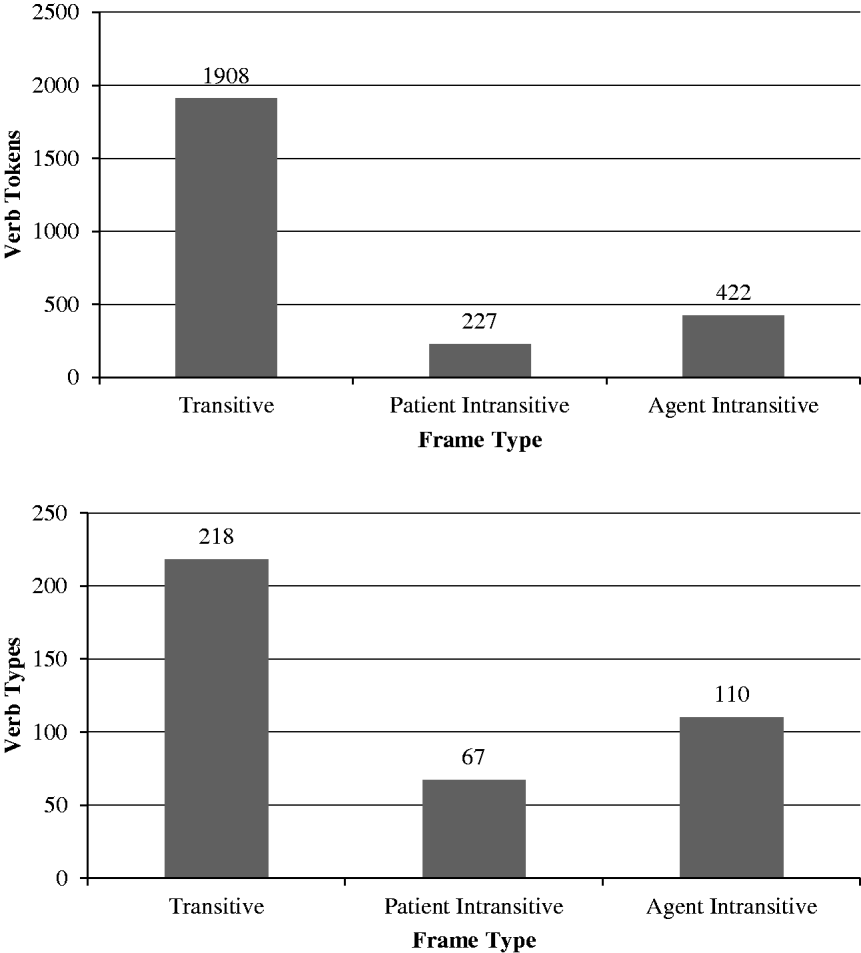
From 7,744 maternal utterances in these transcripts, a total of 2,557 verbs (1,270 at 2;0 and 1,287 at 2;6) belonged to one of the three frame types. No distributional differences were found in the speech to children at the two age groups, so all further analysis is reported together. Calculating by verb token, transitive verbs were significantly more common than either type of intransitive (patient intransitive: Χ2 (1, N=2,135)=1,323·45, p<·001, ϕ=·79; agent intransitive: Χ2 (1, N=2,330)=947·72, p<·001, ϕ=·64). The same pattern was found calculating by verb type: transitives were more frequent than either intransitive (patient intransitive: Χ2 (1, N=285)=80·00, p<·001, ϕ=·53; agent intransitive: Χ2 (1, N=328)=35·56, p<·001, ϕ=·33). Agent intransitives were also significantly more frequent than patient intransitives, calculating both by token (Χ2 (1, N=649)=58·59, p<·001, ϕ=·30) and type (Χ2 (1, N=177)=10·45, p<·005, ϕ=·24). These results are summarized in Figure 1.
Frequency of transitive, patient intransitive, and agent intransitive verbs in speech directed to two-year-olds, by token (top) and type (bottom).

In terms of raw frequencies, it appears that child-directed speech provides more evidence for the agent intransitive construction. However, it is also important to consider how verbs in each intransitive construction alternate with the transitive. Hearing such alternations may help children to learn the structural relationships between these grammatical constructions. For this measure, frequencies were normalized by the total number of agent or patient intransitive verbs (rather than total transitive verbs), to avoid confounds from the difference in the two intransitive base rates. Thus, this analysis examined whether a child who heard the sentence You're painting heard all instances of the verb paint in similar agent intransitive sentences, or if they also heard this verb in transitive sentences like I'm painting the paper. The parallel analysis was conducted for patient intransitive verbs.
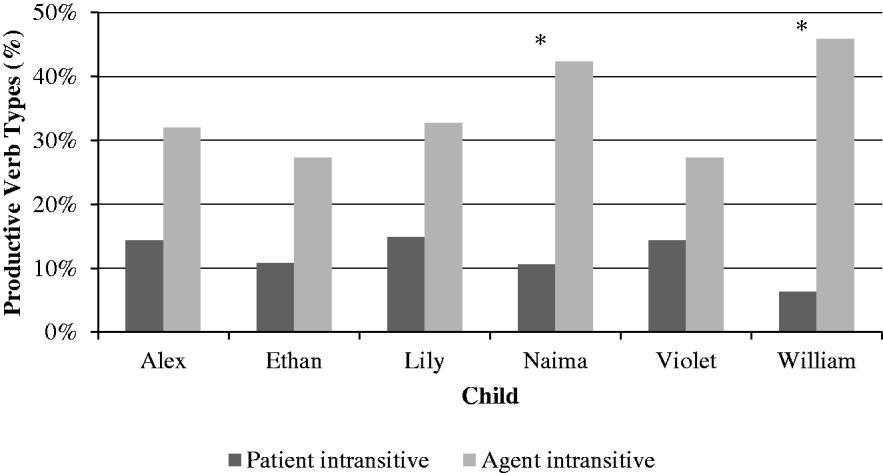
This measure could only sensibly be calculated on a within-subjects level – cumulative verb counts could not be used, as each child might have heard particular verbs in different sets of frames. In other words, pooling the input from all parents for this measure would have made it impossible to distinguish the situation where Parent A used a verb only transitively and Parent B used it only intransitively from the situation where both Parent A and Parent B used the verb in both frames. The average number of verb types in each category that alternated with the transitive was therefore used to compare the productivity of agent versus patient intransitives across children. Averaging across input to all children, 34% of agent intransitives were also used in transitive frames. In contrast, only 12% of patient intransitives also appeared as transitives. Thus, in addition to being more frequent, agent intransitive verbs were more likely to be used in transitive/intransitive alternations than patient intransitives were. This difference was not significant for the group average (Fisher's exact test, N=48·8, p=·17, ϕ=·25). However, input to all six children showed the same trend, with two input samples reaching significance (Fisher's exact test, Naima: N=45, p<·05, ϕ=·35; William: N=40, p<·05, ϕ=·42). These results are summarized in Figure 2.
Percent of patient intransitive and agent intransitive verb types in speech directed to two-year-olds that also occurred in a transitive frame.
DISCUSSION
This corpus study reveals several patterns in children's exposure to transitive, agent intransitive, and patient intransitive frames. Transitive frames were significantly more frequent than either type of intransitive. Agent intransitive frames (e.g., Kim is painting) were also significantly more common than patient intransitive frames (The box is dropping). Furthermore, the majority of verbs found in the patient intransitive occurred only in that frame, while the verbs used in the agent intransitive were often used in transitive frames as well.
These results suggest that the input that children hear may more strongly facilitate acquisition of agent intransitive alternations. In addition to raw frequency differences, hearing the same verb used in multiple frames could also help children notice the structural relationship between alternating forms.
Of course, many other factors may influence the course of acquisition. However, these corpus results establish that there is at least one factor, input frequency, which puts children on an uneven footing with respect to the two intransitive alternations. It is possible that this imbalance might lead children to generalize at an earlier age with agent intransitives, or might increase their likelihood of spontaneously making agent-intransitive alternations when verb semantics make it available.
The following two studies looked at the types of generalizations children aged 2;6 make with novel intransitive verbs. In particular, we explore whether their syntactic generalizations are flexible with respect to referents and noun/pronoun usage, and whether they are distinct and constrained with respect to adult-like semantic mappings.
STUDY 2 – CHILDREN'S TRANSITIVE/PATIENT INTRANSITIVE ALTERNATIONS
The goal of Study 2 was to evaluate whether and to what extent children aged 2;6 make productive generalizations across the transitive/patient intransitive alternation (Kim is dropping the box/The box is dropping). This study also provided a base for comparison with the less-studied transitive/agent intransitive alternation (Study 3).
The present study moves beyond the caused-motion events most commonly used in previous work. For this study, the stimuli were novel verbs of sound emission caused by an agent. Examples of English verbs of this type are like honk or rustle. This is a semantic class commonly described using patient intransitives like The paper rustled (Abbot-Smith et al., Reference Abbot-Smith, Lieven and Tomasello2004; Levin, Reference Levin1993). However, it is important to bear in mind that the emission of sound is not the only interpretation of a verb used to describe this type of event. Because the events in this study were always caused by an agent performing a stereotyped action, a listener who heard a new transitive verb (Joey's tamming the boot) might reasonably infer that the verb tam referred to the agent's action (e.g., Kim squeezed (the tube) until toothpaste came out).
In addition, the class of sound emission verbs has been subject to multiple syntactic and semantic analyses; for instance, they have been classified both as semantically unaccusative and as unergative (Levin & Rappaport Hovav, Reference Levin and Rappaport Hovav2005; Perlmutter, Reference Perlmutter and Jaeger1978). Their syntactic behavior is also not uniform in English or in other languages such as Northern East Cree (Johansson & Brittain, Reference Johansson and Brittain2012): some verbs lack transitive usages (e.g., glow, squeak), while others can participate in the agent intransitive alternation, as in Kim honked (her horn) at the jaywalker. Folli and Harley (Reference Folli and Harley2008) suggest that the class of emission verbs may be characterized by semantic agents which are inanimate but possess internal characteristics allowing the sound to be produced. The semantic markedness of inanimate but causally capable participants might relate to the varying patterns of syntactic realization for this class. However, although the class of sound emission verbs exhibits syntactic diversity, the presence of additional patient intransitive verbs and the discourse context used in Study 2 (e.g., using focus questions such as What happened with the sock?) encouraged generalization to patient, rather than agent, intransitives. The events used in this study also provided a basis for comparing children's generalization ability with this variable class of verbs to a class of actions that is felicitous only with transitive/agent intransitive alternations (Study 3).
We expected that many children would use the novel verb in unmodeled frames, using English constructions that are appropriate to the discourse and scenes they saw. If children have adult-like abstract knowledge about this alternation, they should be able to use a novel verb in either patient intransitive or transitive frames (when given felicitous event, linguistic, and discourse contexts). While each verb was presented in only one syntactic frame, all children heard one verb in the transitive alternation and one in the patient intransitive alternation. The presence of both sentence types in the same experimental setting has been shown to increase rates of syntactic generalization (Brooks & Tomasello, Reference Brooks and Tomasello1999).
However, if children lack this knowledge, they might only use the novel verbs in the form they hear modeled, or might make generalizations limited to existing pronoun schemas. Childers and Tomasello (Reference Childers and Tomasello2001) observed in a novel verb training study that children produced proportionally more pronouns than the experimenters during test sessions. One reason for this might be that the experimenter showed multiple enactments and descriptions of events with the same participants before asking the child to produce the novel verb, a context that makes pronouns very felicitous. The present study's test phase was much briefer and included frequent participant switches in demonstrations. If children's early syntactic generalizations draw on their familiarity with frequent frames like (He___it), they might still produce more pronouns when using novel verbs in new syntactic frames. However, if the distribution of pronouns and nouns depends on the discourse context, we might expect children in this study to use similar proportions of pronouns as the adult experimenter's models.
METHODS
Participants
Sixteen children (2;5–2;7, mean age 2;5·27, 9 girls) were recruited from Rhode Island birth records, advertisements, and a local preschool. Twenty additional children were excluded from the analysis for failure to cooperate or produce the target words in any sentence frame (14), vocabulary sizes below the 5th percentile on the short form of the MacArthur Communicative Development Inventory – IIA (MMCDI; Fenson, Pethick, Renda, Cox, Dale & Reznick, Reference Fenson, Pethick, Renda, Cox, Dale and Reznick2000) (3), experimenter error (2), and parental interference (1). The average raw MCDI score for the children included in the analysis was 82 (average percentile 47%), while the score for the children excluded (apart from those dropped for low MCDI scores) was 80, average percentile 49%. There was no significant difference in the MCDI percentile scores between the two groups, excluding children who were dropped for low CDI (t(30)=0·20, p=·58, 1-tailed; Cohen's d=·07). Gender was not significantly related to whether children met the inclusion criteria (Fisher's exact test, N=36, p=·50, ϕ=·16), and there was no difference in age between the two groups (907·6 vs. 912·8 mean days old, t(30)=1·06, p=·85, 1-tailed, Cohen's d=·39). All children who participated received a picture book or a T-shirt at the end of the session.
Stimuli
Stimuli and verb presentation were designed both to encourage generalization to new syntactic frames, and to ensure that the utterances produced were fully interpretable. The two novel actions in this study were both sound-emission verbs. A toy plastic castanet was sewn inside a brightly colored sock; pilking referred to the event of tapping the sock with a hand to produce the noise. Tamming was used to refer to an infant-sized rain boot emitting a squeaking noise when stepped on by an agent. A hand puppet (Joey, a boy in a striped shirt and jeans) was also used to provide an additional agent for the novel actions. All test sessions were recorded using a tripod-mounted video camera and a floor microphone. Sessions were transcribed and tagged with movie clips using the CLAN software package (MacWhinney, Reference MacWhinney2000).
Procedure
After completing the MacArthur MCDI, the parent and child were invited into the test room. Parents were asked to keep their own speech to a minimum and avoid use of the novel verbs. The session began with approximately five minutes of book reading with the experimenter; the child was invited to name animals in a lift-the-flap book and describe the scenes. The experimenter then introduced the puppet (Joey) and invited the child to interact with it. Finally, the experimenter brought out the sock and the boot, revealing that ‘these ones are special’, demonstrating both sound emission actions without using the novel verbs and giving the child the opportunity to do the same.
Next, the child participated in a training sequence for each verb. Every child heard one verb in the transitive and one in the patient intransitive, with syntax/event pairing and order of presentation counterbalanced across children. The training sequence for each novel verb began with the experimenter bringing out the toy corresponding to the verb, demonstrating and labeling the action (e.g., Look, this is called pilking), and then describing the action using the novel verb in the appropriate sentence frame (e.g., Joey's pilking the sock). The agent of the action was varied according to the child's interests (e.g., the child him/herself, their parent, the experimenter, or the puppet Joey). The experimenter continued to model the verb in the appropriate frame, eliciting production (e.g., Tell me what's happening) and repetition (Say, I'm pilking the sock) from the child. Noun and pronoun referents were alternated freely in a naturalistic fashion, such that children heard both noun and pronoun models for all events (e.g., Look, Joey's pilking the sock. He's pilking it! Do you want another turn now? <Child>, you're pilking it!) This continued until children had heard at least twelve sentence models of the novel verb, or up to twenty-four for children who were reluctant to produce the verbs (mean 14·2 models). The training sequence was then repeated with the second verb and toy.
At test, the first toy was brought out again. The experimenter invited the child to demonstrate the relevant action, and elicited bare repetitions of the verb to make sure that the child remembered the name of the action. The child then saw the event using three different actors again chosen according to the child's interest (e.g., the child, Joey, the experimenter). For each, they were asked neutral questions (e.g., Tell me what's happening) and then ‘switch’ questions (e.g., What's happening with the sock?) to encourage a change of focus on the event and a generalization to a new syntactic frame. Children heard both types of prompt for each actor; prompts were repeated when the child replied with an off-topic response or did not use the novel verb (means: 3·3 neutral questions; 3·5 switch questions).
After the first action had been tested with the three actors, the testing procedure was repeated with the second verb, using the appropriate switch question. The switch questions and target generalizations for the two verbs presented in this experiment are summarized in Table 1. Finally, the child was allowed to engage in free play with both toys, with the experimenter giving only bare models of the two novel verbs (e.g., Wow, pilking!) The entire procedure (warm-up, training, test, and free play) took approximately 20 minutes to complete.
‘Switch’ questions used to encourage generalization of novel verbs across the transitive/patient intransitive alternation (Study 2)

Coding
All child utterances containing novel verbs were coded as transitive (agent–verb–patient or verb–patient), patient intransitive (patient–verb), agent intransitive (agent–verb), or other (bare utterances as well as a few novel noun and adjective uses like I want the pilk sock and Where's the pilk?). Only transitive and intransitive utterances (of either type) were analyzed. Four of the sixteen children's data were re-transcribed by a second coder who was blind to the experimental hypothesis. Accuracy was compared over all multiword utterances judged by either coder to contain a novel verb. Reliability at the level of argument structure was at 93% (n=25 out of 27); disagreements were resolved by discussion.
In addition, all experimenter and child utterances containing a novel verb were transcribed to allow for an analysis of possible pronoun schemas in children's speech. All of these utterances were coded to reflect whether they had a noun or pronoun in subject and object position, and the nature of the referent in subject position (first, second, third (person), third (object), subject omitted).
RESULTS
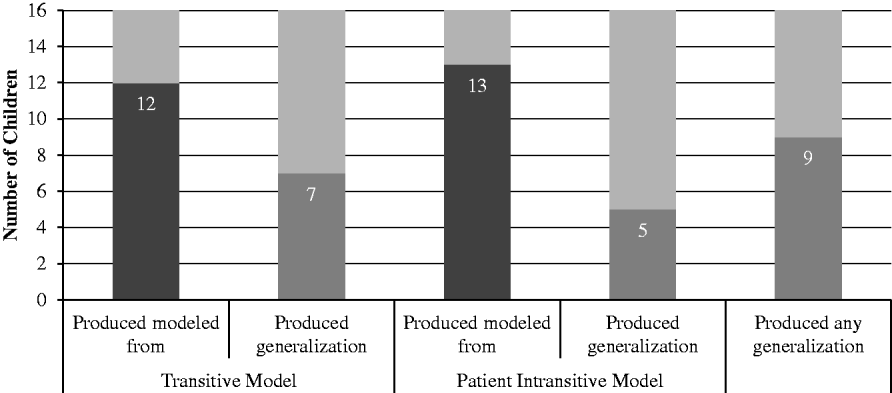
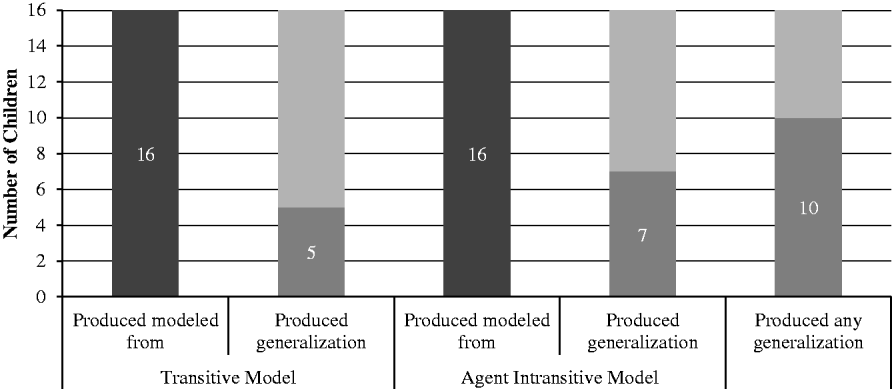
The majority of children produced each verb at least once in the original (modeled) frame. Twelve of the 16 produced a modeled transitive verb and 13 produced a modeled patient intransitive verb. In addition, 9 out of 16 children made generalizations, producing at least one verb in a syntactic structure that the experimenter had not modeled. The results for each verb frame are summarized in Figure 3 (each column shows the stacked histogram of responses for all children). There were a total of 22 generalizations produced by children in this experiment. All but one of these generalizations included the subject, and 12 of the 22 contained at least one lexical noun phrase. A list of all generalizations made in Study 2 is given in the ‘Appendix’.
Number of children producing utterances following the adult model (transitive or patient intransitive), compared to the number producing generalizations. The rightmost bar shows the number of children who made at least one generalization.
Because the verbs used in this study were potentially felicitous in agent intransitive constructions, it was predicted that children might make generalizations to both types of intransitive. Six of the nine children who made syntactic generalizations spontaneously produced agent intransitives such as Joey's pilking, which had not been modeled with either verb. In comparison, four of the nine generalizing children produced the expected patient intransitives.
The average raw MCDI scores for the children in this study ranged between 45 and 100, with an average of 82. There was no significant difference between MCDI scores of children who made generalizations and children who did not (42nd vs. 52nd percentile, t(14)=0·696, p=·75, 1-tailed, Cohen's d=·37), nor was there a significant difference between numbers of male and female generalizers (Fisher's exact test, N=16, p=·61, ϕ=·17).
Utterance analysis
Considerable debate has centered on the question of ‘weak schemas’, a type of abstract syntactic representation that can support syntactic processing only during tasks with low demands on the child (Abbot-Smith et al., Reference Abbot-Smith, Lieven and Tomasello2008). In particular, generalization to existing frequent pronoun frames like He___it might support generalization before the child is able to make other types of syntactic alternations with novel verbs. As mentioned above, over half of children's utterances in the present study used at least one noun. However, both this result and previous characterizations of children's speech are difficult to interpret without comparison to the experimenter's models.
We therefore first examined the tendency of children to produce sentences with themselves as the referent. Such sentences are guaranteed to include at least one pronoun (no children referred to themselves in the third person), and it is important to separate this factor from a tendency to avoid possible noun referents in general. To establish this baseline, we ask whether children use an elevated number of first-person referents with transitive novel verbs relative to the adult experimenter. We restrict the analysis to transitive utterances since first person referents are not used with patient intransitives; subject-drop sentences were excluded since the referent could not always be conclusively determined. Children produced a significantly higher proportion of first-person sentences than the experimenter: 54% of the children's utterances (21/39) had a first person referent, compared to 27% (64/238) for the experimenter (Χ2(1, N=277)=10·21, p<·002, ϕ=·19). However, this finding may simply reflect the facts of the experiment: during the four training ‘turns’ children were always allowed to take a second turn performing the action, which they usually desired to do. In addition, children asked to perform actions themselves much more frequently than they dictated that another person take a turn. Thus, the children were describing more events (or potential events) in which a first person pronoun was the appropriate subject.
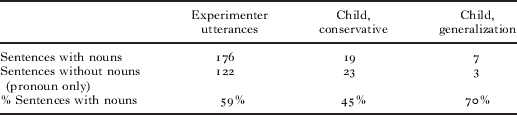
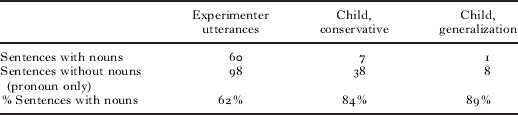
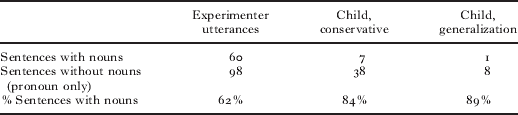
To explore whether children's generalizations are biased toward pronouns (possibly indicating limited generalization), we then examined the distribution of pronouns and nouns in third-person sentences. For this analysis, we compared the percentage of novel-verb sentences containing at least one noun in experimenter, child conservative, and child generalization sentences (see Table 2). There was no significant difference in the number of sentences with lexical nouns between children's conservative vs. generalized sentences (Fisher's exact test, N=52, p=·29, ϕ=·20); the difference between children's generalizations and adult novel verb sentences was also non-significant (Fisher's exact test, N=308, p=·75, ϕ=·04). Furthermore, these non-significant differences actually trend in the opposite direction, with a high proportion of children's generalizations including full nouns. This analysis suggests that children are not limited to pronoun schemas in this task.
Third-person, novel-verb sentences containing at least one full noun (Study 2)
Comparison with previous studies
The design of the present study was most similar to that of Tomasello and Brooks (Reference Tomasello and Brooks1998), which tested the transitive/patient intransitive alternation with caused motion scenes. Although fewer children in the present study produced an unmodeled sentence with either of the novel verbs, they were also given fewer linguistic models and a shorter window of time in which to generalize. They were also given many fewer direct discourse prompts to shift to a new syntactic frame – six questions per verb in the present study as compared to twenty-five to thirty in the paradigm used by Tomasello and Brooks. Overall, Tomasello and Brooks recorded a total of 512 novel verb tokens from children aged 2;6, while the present study recorded 89.
However, despite the shorter training, the percent of children's novel verb uses that were generalizations was similar to that found in Tomasello and Brooks' study. For the verb modeled in a transitive frame, 10% of the utterances in Tomasello and Brooks (Reference Tomasello and Brooks1998) were generalizations to an unmodeled frame, compared to 16% in the present study. For the verb modeled in the patient intransitive frame, significantly more novel generalizations were produced in the present study: 9% of children's utterances in Tomasello and Brooks (Reference Tomasello and Brooks1998) were in an unmodeled frame, compared with 31% in the data presented here. These ratios suggest that children's tendency to generalize novel verbs may be comparable across differences in semantic category, exposure, and opportunities to produce generalizations.
DISCUSSION
The results of this study confirmed our predictions: the majority of children aged 2;6 generalized to an unmodeled syntactic frame. This finding constitutes evidence in favor of children's early access to abstract syntax, and is in line with patterns found by Tomasello and Brooks (Reference Tomasello and Brooks1998). In addition, these results call into question concerns about the flexibility of children's generalizations. Tomasello (Reference Tomasello2000) discounted the majority of creative transitive utterances from Tomasello and Brooks (Reference Tomasello and Brooks1998) because the sentences did not include a subject (e.g., Pilking Big Bird). In the present study, only one child produced a single novel transitive utterance without a subject. This difference may be due to the different discourse pressures in the two studies: children in Tomasello and Brooks (Reference Tomasello and Brooks1998) heard many more questions which even in adult speech are felicitously answered with a truncated form (e.g., What is Joey doing with the boot? Tamming it.)
In addition, a close analysis of children's productions addresses concerns about children's use of pronouns in novel verb generalization. While children were more likely than adults to produce sentences with first-person referents, over half of children's generalizations used at least one full noun. Within third-person productions (where nouns are possible in both subject and object position), there was no difference in noun frequency between the experimenter's utterances and children's generalizations. These findings suggest that by 2;6 children's representations are robust enough to allow for flexible and adult-like generalization.
The results of this study also provide evidence that children may be aware of some of the abstract syntax/semantics regularities that exist in English. First, children's ability to generalize across the transitive/patient intransitive alternation is not limited to caused-motion verbs, but extends to verbs of emission as well. While Abbot-Smith et al. (Reference Abbot-Smith, Lieven and Tomasello2004) established that children aged 2;6 could generalize with verbs of emission after extensive training with known verbs, the present results show that children can do this after only brief exposure to novel verbs. Furthermore, the fact that children made generalizations to both patient intransitive and agent intransitive frames suggests that they are already aware of the types of constructions that can be used with such scenes.
In Study 1, the corpus study of child-directed speech revealed that children around the age of 2;0–2;6 hear fewer patient intransitives than agent intransitives. The results of Study 2 are in line with this, suggesting that children aged 2;6 may have an easier time generalizing to agent intransitive frames. Although they heard no such constructions with either novel verb in this experiment, six children used one of the novel verbs in an agent intransitive frame. Despite discourse conditions favoring patient intransitives, children's agent intransitive representations were robust enough that several produced (semantically appropriate) sentences of that type instead.
However, these results alone are also consistent with the analysis that children do not distinguish clearly between patient and agent intransitives, or do not respect semantic restrictions on each alternation. Study 3 tests children's knowledge of abstract structure with an event class that permits only agent intransitives. If young children treat these two alternations separately and use verb semantics to constrain syntactic generalizations, their use of novel verbs should be limited to agent intransitive alternations alone. On the other hand, if children do not represent the two types of intransitives as separate structures with differing semantic restrictions, their generalizations should be very similar to those in Study 2.
STUDY 3 – CHILDREN'S TRANSITIVE/AGENT INTRANSITIVE ALTERNATIONS
The goal of Study 3 was to investigate how children's generalizations with agent intransitive/transitive alternations (Kim is painting/Kim is painting the box) compared with the patient intransitive alternations examined in Study 2. While this alternation is critical for understanding how children come to successfully represent transitive and intransitive verbs in an adult-like way, it has not been tested in novel-verb production studies. As in Study 2, if children at age 2;6 have abstract knowledge about the relevant syntactic structures, they should be able to generalize novel verbs from one frame to another. Study 1 found that the agent intransitive alternation is more frequent than the patient intransitive alternation in the input. Since children aged 2;6 showed strong evidence of generalization with the less frequent patient intransitive alternation in Study 2, we predicted that they would do the same in Study 3 with agent intransitives.
In addition, Study 3 allows an analysis of how children use the semantics of a verb to constrain its generalization. The stimuli in the present experiment involved novel ‘contact’ events on a single salient object, which would allow for either an activity verb analysis (describing the actor's action), or an implicit-object intransitive analysis (Broman Olsen & Resnik, Reference Broman Olsen, Resnik, Singer, Eggert and Anderson1997; Resnik, Reference Resnik1996). On the other hand, these events could not be described by a patient intransitive construction – the patient of the event is not permanently affected by the action, and does not undergo a change of state (Bunger & Lidz, Reference Bunger, Lidz, Brugos, Micciulla and Smith2004). If children are aware of this regularity, they should only make intransitive generalizations to agent intransitive frames (e.g., Joey's pilking and not The sock's pilking).
METHODS
Participants
The participants in this study were a new set of sixteen children recruited from Rhode Island birth records, advertisements, and a local preschool, aged between 2;5 and 2;7, mean age 2;6·2, eight girls and eight boys. Twelve additional children were excluded from the analysis due to uncooperativeness or failure to produce the target words in any sentence frame (10) or experimenter error (2). The average raw MCDI score for the children included in the analysis for this study was 81 (average percentile 53%), while the average score for the children excluded was 68 (average percentile 29%). There was a significant difference in MCDI scores between these two groups (t(25)=1·95, p<·05, 1-tailed; Cohen's d=·78). However, the MCDI scores of the children aged 2;6 included in Studies 2 and 3 were not significantly different (t(30)=0·48, p=·64, 2-tailed; Cohen's d=·18). Gender was not significantly related to whether children met the inclusion criteria in Study 3 (Fisher's exact test, N=27, p=1, ϕ=·04), and there was no difference in age between the two groups (911·7 vs. 907·4 mean days old, t(25)=0·71, p=·24, 1-tailed, Cohen's d=·28). All children who participated received a picture book or a T-shirt at the end of the session.
Stimuli
The two novel actions in this study described instrument-mediated contact between agent and patient. Gorping referred to using a large brightly colored feather on a stick to brush an object (a sock). Meeking described a bubble wand suspended from a pivot swinging down to tap a toy boot. The sock and boot were identical to those used in Study 2, but did not contain noise-makers. The actions were designed to leave the patient unaffected, with the verbs referring to the ongoing action by the agent.
Procedure
The design for this study paralleled that used in Study 2. Each child heard one verb in a transitive frame (e.g., Joey's gorping the sock) and one in an agent intransitive frame (Joey's meeking). Counterbalancing, agent and patient participants, and use of pronouns were identical to Study 2. The same warm-up procedure was also used for this experiment, with a slight variation in introducing the experimental materials. Children first saw and named the sock and boot, and then saw and had the opportunity to manipulate the ‘two cool machines’ described above. The training and test procedures proceeded as in Study 2. The ‘switch’ questions used to encourage generalization across the transitive/agent intransitive alternation are shown in Table 3.
‘Switch’ questions used to encourage generalization of novel verbs across the transitive/agent intransitive alternation (Study 3)

Coding
All child utterances containing one of the novel verbs was coded as transitive ((agent)–verb–patient), patient intransitive (patient–verb), agent intransitive (agent–verb), or other (bare utterances as well as noun and adjective uses like I want the meeking one). Only transitive and intransitive utterances were analyzed. One child (who also made correct generalizations) produced four unmodeled transitive utterances that referred to the incorrect action; these were excluded from the generalization count. Experimenter and child utterances were coded to allow for discourse and pronoun/referent analysis as in Study 2.
Data from four children were re-transcribed by a second coder who was blind to the experimental condition. Accuracy was compared over all multiword utterances that were judged by either coder to contain a novel verb. Reliability (at the level of argument structure) was at 96% (n=49 out of 51). Disagreements were resolved by discussion.
RESULTS
Children's patterns of generalization are summarized in Figure 4. All 16 children produced both verbs in the modeled frame. As predicted, the majority of children (10 out of 16) also produced at least one novel verb in a syntactic structure that the experimenter had not modeled for that verb. Out of 26 total generalized utterances, 6 were produced without a subject (e.g., Gorping the sock). However, all four of the children who produced these sentences also generalized to full (subject–verb–object) transitive frames. In addition, 19 of the creative utterances used at least 1 noun. A full list of the generalizations produced in Study 3 is given in the ‘Appendix’.
Number of children producing utterances matching the adult model (transitive or agent intransitive), compared to the number producing generalizations. The rightmost bar shows the number of children who made at least one generalization.
The average raw MCDI scores for the children in this study ranged between 52 and 100, with an average of 81. There was no significant difference between MCDI scores of children who made generalizations and children who did not (62nd vs. 37th percentile, t(14)=1·47, p=·08, 1-tailed, Cohen's d=·79), nor was there a significant difference between numbers of male and female generalizers (Fisher's exact test, N=16, p=·61, ϕ=−·26).
Utterance analysis
We again analyzed the specific generalizations that children produced to address the types of representations that might underlie their productivity with the novel verbs. In line with Study 2, we first examined novel-verb transitive sentences produced by the experimenter and by the participants to compare the prevalence of first-person subjects; it is important to separate this factor from a general tendency to avoid noun arguments. As in Study 2, children produced a significantly higher proportion of first-person sentences compared to the experimenter: 51% of children's utterances (36/71) had a first person referent, compared to 31% (70/225) for the experimenter (X2(1, N=296)=8·18, p<·01, ϕ=·16).
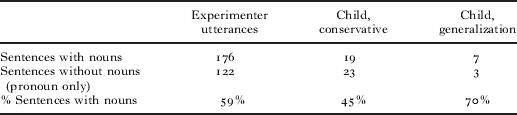
To explore whether children's generalizations are biased toward pronouns, we therefore examine the distribution of pronouns and nouns in third-person sentences. Again, we use as our measure the percentage of third-person sentences containing at least one full noun (see Table 4). There was no significant difference in the number of noun-phrase sentences between children's conservative and generalized sentences (Fisher's exact test, N=54, p=1, ϕ=·05); the difference between children's generalizations and adult novel verb sentences was also non-significant, with children using slightly more sentences with nouns (Fisher's exact test, N=167, p=·16, ϕ=·13). Thus, we do not find evidence for weak schemas or pronoun-based frames in children's generalizations.
Third-person, novel-verb sentences containing at least one full noun (Study 3)
Comparison with Study 2
Based on the input frequency patterns found in Study 1, we predicted that children would show clearer evidence of generalization with the agent intransitive alternations tested in the present study. Approximately the same numbers of children made syntactic generalizations in Studies 2 and 3 (Fisher's exact test, N=32, p=1, ϕ=·06). However, in Study 2 (transitive/patient intransitive alternation), six children produced at least one agent intransitive, even though they had never heard that frame with either novel verb. In contrast, the children in Study 3 never produced patient intransitives (Fisher exact test, N=32, p<·05, ϕ=·48). Patient intransitives would have been anomalous in Study 3, akin to a sentence like The picture is painting. This suggests that by age 2;6 children may have an awareness of syntactic restrictions with different classes of intransitive verbs.
DISCUSSION
The results of this study confirmed our initial prediction: the majority of children aged 2;6 were able to generalize across the transitive/agent intransitive alternation with a novel verb. In addition, the findings of Studies 2 and 3 suggest that children may be aware of semantic restrictions on syntactic generalization. Children in Study 2 (patient intransitives) were willing to describe sound emission events with agent intransitives, even though these constructions were never modeled or elicited by the experimenter. In contrast, children in Study 3 (agent intransitives) never spontaneously used patient intransitives to describe the contact events. These alternation patterns reflect the way such events are treated in adult English speech, and suggest that children treat patient and agent intransitives as separate constructions with separate semantic constraints.
The results also support the conclusion that children are more inclined to perform alternations with the agent intransitive, in accord with the input frequency patterns found in Study 1. Recall from Study 2 that children produced agent intransitives even in conditions specifically designed to elicit patient intransitives. This suggests that the transitive/agent intransitive alternation relationship is easier for children to represent. Study 3 confirms that children make generalizations robustly with this alternation, using a variety of noun and pronoun arguments.
The agent intransitive verb that children heard in this study had at least two possible semantic analyses – He's gorping could describe the agent's movement (e.g., swinging the bubble wand pivot), yielding an activity intransitive verb that in English usually does not participate in the transitive alternation. On the other hand, He's gorping could refer to the contact event involving the object (e.g., toy boot). The event was repeated with varying agents and a constant object, which is consistent with Resnik's (Reference Resnik1996) information-theoretic account of the implicit object intransitive – the object may be dropped because it can be inferred from the verb. Independent corpus evidence suggests that young children are aware of selectional restrictions on this kind of transitive/agent intransitive alternation (Medina, Reference Medina2007). The fact that children did produce transitive sentence alternations suggests that they learned from the pattern of events they saw; we might predict that children would produce fewer transitive utterances if the pattern of events did not support this implicit-object analysis.
Study 3 provides clear evidence of children's willingness to alternate creatively between transitive and agent intransitive structures. The majority of children were able to use a novel verb in an un-modeled form after participating in only a single session, using events in a semantic category (‘contact’ events) that has not previously been used to test children's production. These findings add to converging evidence from observation, comprehension, and production studies that children as young as 2;6 have access to abstract syntactic representations which allow for very flexible generalizations. These results also suggest that children may be using syntax–semantic linkages to constrain their generalizations. Further research will be necessary to clarify how children's syntactic generalizations are guided by input frequency, semantics, and other sources of information.
GENERAL DISCUSSION
The present studies make several new contributions to the investigation of children's knowledge of abstract linguistic structure. Specifically, the findings presented here highlight the fact that children must learn to generalize over and distinguish between two types of abstract transitive–intransitive alternations (patient intransitives Kim is dropping the box/The box is dropping and agent intransitives Kim is painting the box/Kim is painting). This contrast has not been addressed in any other developmental production study. In addition, we provide an analysis of the specific generalizations and conservative utterances that children produce, which allows for exploration of the range and productivity in children's syntactic generalizations.
Study 1 established that children aged 2;0–2;6 hear both intransitive constructions, but that they hear agent intransitives more often than patient intransitives. In addition, the majority of verb types in patient intransitive frames appeared only in that construction, whereas agent intransitive verbs were more likely to be used in transitive sentences as well. These patterns clarify the evidence that children have available for acquiring these constructions, and identify differences in input frequency which may influence acquisition.
Study 2 confirmed previous findings that children aged 2;6 can generalize between transitive and patient intransitive novel verbs after hearing the verb modeled in only one frame (Abbot-Smith et al., Reference Abbot-Smith, Lieven and Tomasello2004; Childers & Tomasello, Reference Childers and Tomasello2001; Tomasello & Brooks, Reference Tomasello and Brooks1998). Children produced both patient and agent intransitives, though the latter were never modeled with any novel verbs in this study. Critically, these intransitives were semantically appropriate: at least some sound emission verbs (like honk) can appear in agent intransitive frames (I honked (my horn) at the jaywalker), and the contrasting manners of action (highlighting the agents' causative roles) in this study may have supported this interpretation. Analysis of children's generalizations also revealed no effects of high-frequency pronoun schemas (Childers & Tomasello, Reference Childers and Tomasello2001).
Study 3 extended evidence for the syntactic productivity of children aged 2;6 to a new structure: agent intransitive verbs. Children's production of this construction had previously been examined only incidentally for two- and three-year-olds by Olguin and Tomasello (Reference Olguin and Tomasello1993) and Akhtar and Tomasello (Reference Akhtar and Tomasello1997). Study 3 established that the majority of children aged 2;6 were able to generalize to or from the agent intransitive construction. This study thus supports the conclusion that at least as early as 2;6, the majority of children are capable of manipulating the abstract structure required to comprehend and produce these sentences. An utterance analysis parallel to Study 2 established that children's generalizations were as flexible as their conservative productions, without limitation to particular referents or pronoun frames.
A possible objection to the results of Studies 2 and 3 is that children aged 2;6 have already moved away from initial lexically based constructions. A number of studies have found that more children in older age groups generalize a newly learned verb to an un-modeled frame (cf. Abbot-Smith et al., Reference Abbot-Smith, Lieven and Tomasello2004; Childers & Tomasello, Reference Childers and Tomasello2001; Tomasello & Brooks, Reference Tomasello and Brooks1998). However, these results are complicated by the fact that younger children also tend to produce fewer utterances overall. It is still possible that the present studies miss an earlier period of grammatical conservatism. If this is the case, it is nevertheless critical to establish the extent and nature of schema formation and growth as it relates to other aspects of language acquisition.
Taken together, the findings from Studies 2 and 3 also allow for insight into how toddlers may use semantics to guide syntactic generalization with English intransitive verbs. Children in Study 3 (the agent intransitive condition) only generalized between the two modeled constructions, never producing inappropriate patient intransitives. In contrast, children in Study 2 sometimes generalized to semantically appropriate agent intransitive, in addition to the patient intransitive. These patterns are consistent with the idea that children recognize distinct correspondences between syntactic structure and event semantics for the two different alternations (i.e., that patient intransitive verbs are not used to describe contact events). This interpretation suggests that abstract syntax–semantics links may be available to these children.
However, it is also possible that the differences in generalization resulted solely from the presence of different types of intransitive in each experiment: although Studies 2 and 3 were not designed as priming studies, there is some evidence that children are sensitive to the other sentence structures they have recently heard when making syntactic generalizations with novel verbs (Brooks & Tomasello, Reference Brooks and Tomasello1999). Study 1 suggests a possible developmental advantage for agent intransitive verbs. If agent intransitive representations are more robust, this advantage may have partially overridden the effect of the presence of patient intransitives, leading to the observed mixed generalization in Study 2. If this interpretation is correct, the different patterns of generalization observed in Studies 2 and 3 still point toward children representing agent and patient intransitives as separate abstract structures that affect patterns of generalization.
The degree to which children use semantic information to constrain verb generalization remains an open question, and a critical area of research for understanding language development. Ongoing studies are beginning to clarify the richness of the semantic content that young children link to their early abstract syntactic representations (Kline, Snedeker & Schulz, Reference Kline, Snedeker, Schulz, Carlson, Hölscher and Shipley2011). In addition to adding to the evidence that children as young as 2;6 rely on robust abstract representations to produce syntactic alternations, the present studies point toward the ways that these syntactic representations interact with the semantics of events. Despite their surface similarity, children treat these two alternations differently, and their patterns of generalization are in accord with adult semantic restrictions. It will remain to be seen how these cues interact as children make creative syntactic generalizations.
The present studies also show the value of directly measuring children's performance on comparable syntactic generalizations. Such comparisons can reveal what children may know about semantic regularities, and can begin to establish the relative ages at which they make creative generalizations with different constructions. Any differences discovered can further guide our understanding of the course and nature of language acquisition.
APPENDIX: GENERALIZATIONS MADE BY CHILDREN IN STUDIES 2 AND 3
Each letter indicates a single participant (e.g. all (A) sentences were spoken by the same child.)
STUDY 2
Generalizations from transitive model (He's VERBing it).
This one tam (A)
I'm tamming (B)
It's tamming (C)
I tam (D, ×2)
I'll tam (E)
I say Mommy pilk (F)
I pilk (G)
Generalizations from patient-intransitive model (It's VERBing).
Sally's pilking (A)
I pilk it (E)
I pilk you Mom (E) Child pressing noisemaker on mother's knee
I pilking this (E)
I pilk that sock (E)
I show my Daddy pilk that thing (E)
I tam boot (G)
I tam the boot (G)
Tam the boot (G)
Joey tamming (G, ×2)
Joey tam the boot (G)
He's tamming it (H)
He's pilking it (I)
Study 3
Generalizations from transitive model (He's VERBing it).
I'm gorping (J, ×2)
Mommy gorping (K)
I'm gorping (L)
You gorping (M)
Mommy's meeking (N)
My Mommy wants to meek (N)
Generalizations from agent-intransitive model (She's VERBing).
Meeking this boot (L)
Mommy meeking the boot (L)
I'm meeking the boot (L, ×2)
You're meeking the boot (L)
She's gorping the sock (N)
Gorping it (O)
He's gorping it (O)
Gorping sock (O)
Gorping the sock (O)
Tommy gorp that (P)
I gorping that (Q)
Meeking the boot (R, ×3)
I'm meeking that boot (R)
That boy meeking the boot (R)
Joey's meeking the boot (S)
Meeking the boot (S)