

Introduction
Hedyotis L., Oldenlandia L. and Kohautia Cham. & Schltdl. are three closely related genera of the Rubiaceae traditionally referred to the tribe Hedyotideae Cham. & Schltdl. ex DC. (Verdcourt, Reference Verdcourt1958; Bremekamp, Reference Bremekamp1966; Robbrecht, Reference Robbrecht1988). However, molecular data have shown that the tribe Spermacoceae Cham. & Schltdl. ex DC. sensu stricto makes the Hedyotideae paraphyletic. Spermacoceae has been expanded to include most of the former Hedyotideae genera, including Hedyotis, Oldenlandia and Kohautia (Kårehed et al., Reference Kårehed, Groeninckx, Dessein, Motley and Bremer2008; Groeninckx et al., Reference Groeninckx, Dessein, Ochoterena, Persson, Motley and Kårehed2009). The three genera have a tropical and subtropical distribution with most species in the Old World. Globally the complex comprises just over 400 species of which 112 are in Hedyotis, 262 in Oldenlandia and 36 in Kohautia (Govaerts et al., Reference Govaerts, Ruhsam, Andersson, Robbrecht, Bridson and Davis2006). Superficially, the three genera are very similar, sharing a herbaceous habit, relatively small flowers, and dry, usually capsular fruits with few to many small seeds. In Nepal, the complex is represented by 13 species (Neupane, Reference Neupane2006).
The circumscriptions and classifications of Hedyotis, Oldenlandia, Kohautia and numerous related genera such as Neanotis W.H.Lewis and Houstonia L. have been the focus of much taxonomic debate and confusion. Some taxonomists (‘lumpers’; e.g. Lamarck, 1792; Torrey & Gray, Reference Torrey and Gray1841; Dutta & Deb, Reference Dutta and Deb2004) have favoured wide circumscriptions of the genera by proposing an all-inclusive Hedyotis or by recognising two to three large genera Hedyotis, Oldenlandia and Houstonia. Others (‘splitters’; e.g. Willdenow, Reference Willdenow1798; de Candolle, Reference Candolle1830; Bremekamp, Reference Bremekamp1952; Terrell, Reference Terrell2001a, Reference Terrell2001b) have favoured recognising many, often small, genera, sister to Oldenlandia, Houstonia and Hedyotis (see taxonomic history section below).
There are no global studies of the Hedyotis–Oldenlandia–Kohautia complex. Only partial revisions are available, so far all based on non-Asiatic species. The present paper aims to shed light on the morphological variation observed among the Nepalese representatives of the complex in order to contribute to a clearer delimitation of the genera involved.
Brief taxonomic history of Hedyotis–Oldenlandia–Kohautia and related genera
Since the description of Hedyotis and Oldenlandia by Linnaeus in Species Plantarum in 1753, there has been confusion, discussion and disagreement over the delimitation of the two genera (Halford, Reference Halford1992). Linnaeus (Reference Linnaeus1753) described Hedyotis as a genus of three Asian species (H. auricularia L., H. fruticosa L. and H. herbacea L.) and Oldenlandia with four species (O. biflora L., O. corymbosa L., O. umbellata L. and O. uniflora L.); he also described a third exclusively American genus, Houstonia L., containing two species (Houstonia caerulea L. and H. purpurea L.), related to Hedyotis and Oldenlandia. This last genus has also been the subject of debate (for an overview see Terrell, Reference Terrell1996; Church, Reference Church2003), but will not be discussed in detail here. Lamarck (1792) considered Oldenlandia and Hedyotis congeneric and used the name Hedyotis for the resulting unit. This opinion was followed by Wight & Arnott (Reference Wight and Arnott1834), Torrey & Gray (Reference Torrey and Gray1841) and others. Other authors, however, maintained Oldenlandia as a distinct genus (Willdenow, Reference Willdenow1798; Roxburgh, Reference Roxburgh1820; de Candolle, Reference Candolle1830). Gray (Reference Gray1859) stated that, based on fruit dehiscence and seed structure, ‘all three Linnaean genera (Oldenlandia, Houstonia and Hedyotis) equally merit restoration’.
The taxonomic discussion over the generic delimitation of Oldenlandia and Hedyotis was further complicated by a controversy concerning the type of Hedyotis. The problems began when Linnaeus in Genera Plantarum (1754) described Hedyotis as a genus with dehiscent fruits whereas Hedyotis auricularia had been described earlier by him in Species Plantarum (1753) as having indehiscent fruits. Hedyotis was first lectotypified by Chamisso & Schlechtendal (1829) with H. auricularia. However, Bremekamp (Reference Bremekamp1952) proposed Hedyotis fruticosa as its lectotype because the indehiscent capsules of H. auricularia did not comply with Linnaeus's (Reference Linnaeus1754) generic description of Hedyotis. The issue was recently resolved by selecting Hedyotis fruticosa as a conserved type (Jarvis, Reference Jarvis1992; see also McNeill et al., Reference McNeill, Barrie, Burdet, Demoulin, Hawksworth and Marhold2006, App. III).
The third genus under discussion, Kohautia, with the type species K. senegalensis Cham. & Schltdl., was proposed by Chamisso & Schlechtendal (1829) in their newly erected suprageneric Hedyotideae. Kohautia is easily separated from Hedyotis and Oldenlandia by having a style which always overtops the anthers. Although generally accepted as a well-defined group, Kohautia has sometimes been included in Hedyotis (Wight & Arnott, Reference Wight and Arnott1834) or Oldenlandia (Hooker, Reference Hooker, Bentham and Hooker1873; Schumann, Reference Schumann, Engler and Prantl1891).
Bremekamp (Reference Bremekamp1952), in his revision of the African Oldenlandia species, accepted both Hedyotis and Kohautia as distinct genera. He also recognised many small satellite genera for African taxa traditionally referred to as Oldenlandia. Lewis (Reference Lewis1962), in contrast, in a chromosomal study of North American Hedyotis s.l., treated Oldenlandia and Houstonia as subgenera of Hedyotis, namely as Hedyotis subgen. Oldenlandia (L.) Torrey & A.Gray and Hedyotis subgen. Edrisia (Raf.) Lewis, respectively. However, in an extensive cytopalynological study of African Hedyotideae, Lewis (Reference Lewis1965b) accepted many of the genera Bremekamp separated from Oldenlandia. Similarly, Verdcourt (Reference Verdcourt and Polhill1976) maintained most of Bremekamp's segregate genera and supported the separate recognition of Hedyotis, Oldenlandia and Kohautia.
Terrell (Reference Terrell1975), in a comparative analysis of type species of Hedyotis, Oldenlandia and Houstonia, found important differences in fundamental characteristics of the fruits and seeds which according to him ‘strongly suggests the existence of three genera rather than one’. Halford (Reference Halford1992), in a review of Australian Oldenlandia, identified the genera Hedyotis, Oldenlandia, Kohautia and Synaptantha Hook.f. He distinguished Hedyotis from Oldenlandia on the basis of fruit dehiscence type. Terrell & Robinson (Reference Terrell and Robinson2003) commented that ‘the Hedyotis species in Mexico and southwestern United States do not resemble either the Asian or the Hawaiian species, nor do the latter two resemble each other’. In the same paper, they reduced Exallage Bremek., another satellite genus defined by Bremekamp (Reference Bremekamp1952) based on its indehiscent fruits, to a subgenus of Oldenlandia.
Molecular studies by Bremer (Reference Bremer1996) and Bremer & Manen (Reference Bremer and Manen2000) found Hedyotis and Oldenlandia to be paraphyletic whereas studies by Andersson & Rova (Reference Andersson and Rova1999) and Andersson et al. (Reference Andersson, Rova and Alzate Guarin2002) found them to be polyphyletic. Recently, in a more sample-rich study focusing on the Spermacoceae, Groeninckx et al. (Reference Groeninckx, Dessein, Ochoterena, Persson, Motley and Kårehed2009), based on chloroplast data, and Kårehed et al. (Reference Kårehed, Groeninckx, Dessein, Motley and Bremer2008), based on combined nuclear and chloroplast data, found Hedyotis and Oldenlandia polyphyletic and Kohautia biphyletic.
This taxonomic survey indicates that systematists have not yet reached a consensus on the delimitation of Hedyotis, Oldenlandia and Kohautia. However, recent studies usually favour the recognition of the three genera, often in addition to many other (small) genera (Bremekamp, Reference Bremekamp1952; Terrell et al., Reference Terrell, Lewis, Robinson and Nowicke1986; Terrell, Reference Terrell1991, Reference Terrell1996, Reference Terrell2001a, Reference Terrell2001b, Reference Terrell2001c; Terrell & Robinson, Reference Terrell and Robinson2003; Kårehed et al., Reference Kårehed, Groeninckx, Dessein, Motley and Bremer2008; Groeninckx et al., Reference Groeninckx, Dessein, Ochoterena, Persson, Motley and Kårehed2009).
Data from pollen, seed and fruit morphology, together with chromosome numbers, have been found to be most accurate in classifying the species formerly referred to the tribe Hedyotideae (Gray, Reference Gray1859; Lewis, Reference Lewis1965a, Reference Lewis1965b; Terrell, Reference Terrell1975, Reference Terrell1996, Reference Terrell2001a, Reference Terrell2001b, Reference Terrell2001c; Terrell et al., Reference Terrell, Lewis, Robinson and Nowicke1986; Terrell & Wunderlin, Reference Terrell and Wunderlin2002; Terrell & Robinson, Reference Terrell and Robinson2003). This inspired us to conduct the present morphological study on the Nepalese representatives of Hedyotis, Oldenlandia and Kohautia to provide a better understanding of the species in this difficult lineage.
Materials and Methods
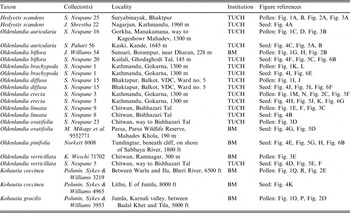
This study was based mainly on material from personal collections, herbarium material from Tribhuvan University Central Herbarium (TUCH) and some Nepalese specimens deposited at the Natural History Museum, London (BM). The pollen of 17 specimens belonging to 11 species and the seeds of 16 specimens belonging to 11 species were investigated (Table 1). Pollen and seed material was studied using both light microscopy (LM, including the use of a stereomicroscope) and scanning electron microscopy (SEM). The LM and stereomicroscope study was conducted at TUCH. Scanning electron micrographs of nine species of Hedyotis, Oldenlandia and Kohautia were produced at the Laboratory of Plant Systematics, Belgium. The acetolysis method (Erdtman, Reference Erdtman1966, Reference Erdtman1969) was used for the study of pollen under LM, with the acetolysed pollen mounted in glycerin jelly sealed with paraffin. For the SEM study, pollen was acetolysed following Reitsma's ‘wetting agent method’ (Reitsma, Reference Reitsma1969). Acetolysed pollen was rinsed in 70% or 96% ethanol, pipetted onto a stub, and left to dry. The stubs were coated with gold using an SPI-MODULETM sputter coater. Observations and digital images were made under a Jeol JSM 5800 LV microscope. Seeds were directly mounted on stubs, coated with gold and observed under SEM. Illustrations of seeds were made using a stereomicroscope. Pollen terminology is based on Punt et al. (Reference Punt, Hoen, Blackmore, Nilsson and Le Thomas2007) and partly on Dessein et al. (Reference Dessein, Ochoterena, De Block, Lens, Robbrecht and Schols2005) for the description of the tectum. For seed morphology, the terminology is partly based on Stearn (Reference Stearn1966: 506–507) and Dessein (Reference Dessein2003).
Specimens of Hedyotis, Oldenlandia and Kohautia examined for the pollen and seed study, with figure references

Results
Pollen morphology
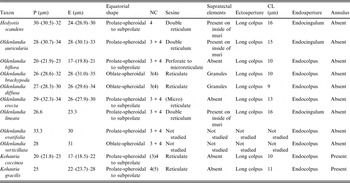
The results of the pollen morphology study are shown in Table 2.
Pollen morphology of Hedyotis, Oldenlandia and Kohautia

P, polar diameter; E, equatorial diameter (values in parentheses represent average lengths). NC, no. of apertures (values in parentheses were not found in all specimens). CL, colpus length.
Polarity, symmetry and size
Pollen grains of Hedyotis, Oldenlandia and Kohautia in Nepalese specimens were all isopolar and radially symmetrical. The average equatorial diameter ranged from 18.5 μm (in Kohautia coccinea Royle) to 31 μm (Oldenlandia brachypoda DC.; Table 2). Size variation, often exceeding 20%, was also observed and documented within a specimen or between specimens of a single population.
Shape
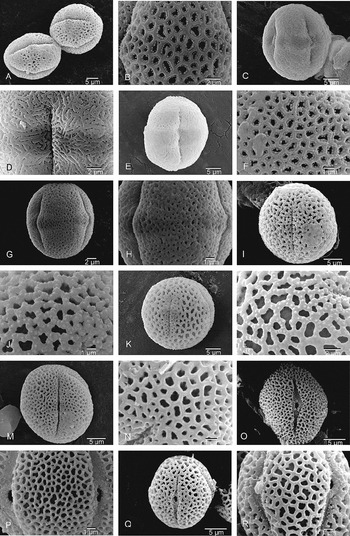
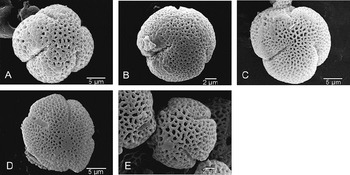
The pollen shape in the equatorial view is described by calculating the ratio of the polar axis (P) and the equatorial diameter (E). The P/E ratio in the complex varies between 0.88 and 1.25. They were oblate-spheroidal (P/E between 0.88 and 1; Fig. 1I, K), or prolate-spheroidal to subprolate (P/E between 1–1.14 and 1.14–1.33; Fig. 1A, C, E, G, M, O, Q). In the polar view the pollen grains are circular in outline, sometimes slightly lobed due to the sunken colpi (Fig. 2A–E).
Equatorial view of pollen grains in SEM. A, B: Hedyotis scandens. C, D: Oldenlandia auricularia; E, F: O. lineata; G, H: O. biflora; I, J: O. diffusa; K, L: O. brachypoda; M, N: O. erecta. O, P: Kohautia gracilis; Q, R: K. coccinea. B & F: Note the presence of supratectal elements on inside of muri. D: Detail of mesocolpium with striate-reticulate sexine. H: Perforate to microreticulate tectum. J & L: Note the presence of granules on the surface of muri. N: Detail of apocolpium indicating the absence of supratectal elements. O & Q: External colpus; also note the annulus around the mesoporus. P & R: Detail of mesocolpium with reticulate sexine.

Polar view of pollen grains in SEM. A: Hedyotis scandens. B: Oldenlandia biflora; C: O. erecta. D: Kohautia gracilis; E: K. coccinea.

Apertures
Position and number. In all species apertures were positioned along the equator (zonoaperturate). The number of colpi was 3 or 4 in Oldenlandia auricularia (L.) K.Schum., O. biflora, O. erecta (Manilal & Sivar.) R.R.Mill, O. lineata (Roxb.) Kuntze, O. ovatifolia (Cav.) DC., O. verticillata L.; 3 to occasionally 4 in O. brachypoda DC. and O. diffusa (Willd.) Roxb.; 4 to occasionally 3 in Kohautia coccinea; 4 in Hedyotis scandens Roxb.; and 4 to occasionally 5 in Kohautia gracilis (Wall.) DC.
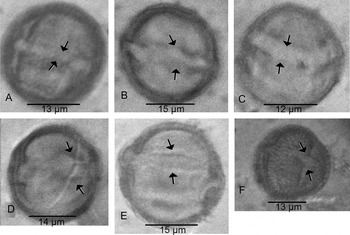
Type of aperture. In Nepal, pollen apertures in all members of the complex were found to be compound, comprising an ectocolpus, a mesoporus and an endoaperture. The mesoporus of the Kohautia species showed an annulus (Fig. 1O, Q), a feature not observed in Nepalese members of Hedyotis and Oldenlandia. Endoapertures may be an endocingulum as in Oldenlandia auricularia, O. lineata and Hedyotis scandens, or a lalongate endocolpus as in Oldenlandia biflora, O. brachypoda, O. diffusa, O. erecta, O. ovatifolia and O. verticillata (categorised as Os type A by Lewis, Reference Lewis1965a, Reference Lewis1965b). In the Kohautia species there was an endocolpus combined with a marked thickening around the inside of the mesoaperture (Os type B in Lewis, Reference Lewis1965a, Reference Lewis1965b). The thickening around the mesoaperture on the inside coincided with the thickening around the mesoaperture on the outside and hence formed one single structure. We prefer to name this structure an annulus.
Three pollen types were distinguished on the basis of the endoaperture:
Type 1: endocingulum in Hedyotis scandens, Oldenlandia auricularia and O. lineata (Fig. 3A–C);
Equatorial view of pollen grains showing endoaperture types in LM. A: Hedyotis scandens. B: Oldenlandia auricularia; C: O. lineata; D: O. ovatifolia; E: O. verticillata; F: O. erecta. A–C: Note the brighter zone between arrows indicating position of endocingulum. D–F: Area within arrows indicates the presence of lalongate endocolpus.

Type 2: lalongate endocolpus in Oldenlandia biflora, O. brachypoda, O. diffusa, O. erecta, O. ovatifolia and O. verticillata (Fig. 3D–F);
Type 3: endocolpus combined with an annulus around the mesoporus in Kohautia coccinea and K. gracilis (Fig. 1O, Q).
Pollen wall stratification
The exine layer was composed of a nexine and a sexine layer with a row of columellae and a tectum with or without supratectal elements. The nexine was often thickened along the ectocolpi.
Tectum. The tectum was reticulate (lumina > 1 μm and larger than muri) in Oldenlandia brachypoda, O. diffusa, Kohautia coccinea and K. gracilis (Fig. 1J, L, P, R). Hedyotis scandens, Oldenlandia auricularia and O. lineata were characterised by having a double reticulum, i.e. with an infra- and a suprareticulum (Fig. 1B, D, F). The reticulation often tended to be of the striate-reticulate type in Oldenlandia auricularia (Fig. 1D). Oldenlandia biflora (Fig. 1H) showed a transition between perforate (perforations < 1 μm and smaller than the muri) and microreticulate (perforations < 1 μm and larger than the muri), and O. erecta exhibited a transition between microreticulate and reticulate (Fig. 1N).
Supratectal elements. Supratectal elements were absent in Oldenlandia erecta, O. biflora and Kohautia species whereas in Hedyotis scandens, Oldenlandia auricularia and O. lineata supratectal elements were present on the inside of the muri (Fig. 1B, D, F). Pollen of Oldenlandia diffusa and O. brachypoda were beset with granules (Fig. 1J, L).
Fruit dehiscence and seed morphology
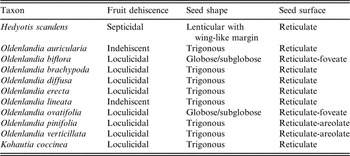
The results of the fruit dehiscence and seed morphology studies are shown in Table 3.
Fruit dehiscence and seed shape and surface in Hedyotis, Oldenlandia and Kohautia

Fruit dehiscence
The only species with septicidally dehiscent capsules (the defining characteristic of the genus Hedyotis) was found to be Hedyotis scandens, which had a beak protruding beyond the calyx lobes. This is loculicidally dehiscent from the top but then divides septicidally into two valves. The capsules were indehiscent in Oldenlandia auricularia and O. lineata, whereas in Oldenlandia biflora, O. brachypoda, O. corymbosa, O. diffusa, O. erecta, O. ovatifolia, O. pinifolia (Wall. ex G.Don) Kuntze, O. verticillata, Kohautia coccinea and K. gracilis capsules were loculicidally dehiscent from the top.
Seed morphology
Seeds in the Nepalese species were all found to be non-crateriform, i.e. they lack a ventral cavity or depression as found in North American Houstonia. Seeds were small in size (0.2–0.8 mm in length) and numerous, sometimes more than 100 per capsule (e.g. Oldenlandia diffusa).
Shape. Based on their shape three basic types of seed could be identified within the complex:
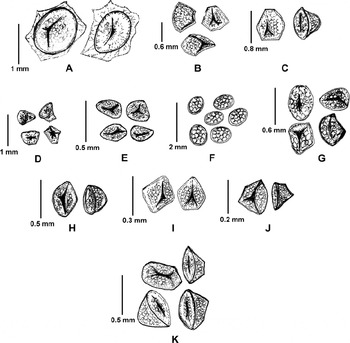
Type 1: dorsiventrally flattened, lenticular seeds with an irregularly narrow wing-like margin. This is the seed type observed in Hedyotis fruticosa and among Nepalese species is found only in H. scandens (Fig. 4A);
Variation in seeds (as seen under stereomicroscope ×20) among the members of Hedyotis, Oldenlandia and Kohautia. A: Hedyotis scandens. B: Oldenlandia lineata; C: O. auricularia; D: O. verticillata; E: O. pinifolia; F: O. biflora; G: O. ovatifolia; H: O. erecta; I: O. brachypoda; J: O. diffusa. K: Kohautia coccinea.

Type 2: subglobose or bluntly angular seeds turning globose in Oldenlandia biflora and O. ovatifolia (Fig. 4F, G, Fig. 5C, D);
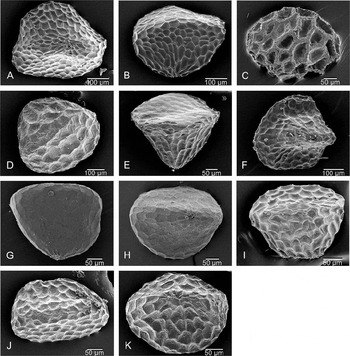
Seed morphology in SEM. A, B: Oldenlandia auricularia; C: O. biflora; D: O. ovatifolia; E, F: O. verticillata; G, H: O. pinifolia; I: O. diffusa; J, K: O. erecta. C & D: Note subglobose shape in O. biflora and O. ovatifolia.

Type 3: trigonous or obconical seeds found in Oldenlandia auricularia, O. brachypoda, O. diffusa, O. erecta, O. lineata, O. pinifolia, O. verticillata and Kohautia coccinea (Fig. 4B–E, H–K, Fig. 5A, B, E–K). Seeds are also trigonous in Kohautia gracilis (Dutta & Deb, Reference Dutta and Deb2004).
The trigonous seeds also exhibited a range of morphological variation in size, colour and shape. The lateral sides of the seeds were more concave in Oldenlandia auricularia, O. lineata, O. pinifolia, O. verticillata and Kohautia species (Fig. 5A, F, H) compared with the Oldenlandia corymbosa–diffusa complex (including Oldenlandia brachypoda, O. corymbosa, O. diffusa and O. erecta; Fig. 5I–K). The latter group was also characterised by very small seeds (< 0.5 mm) compared with the other species in this study.
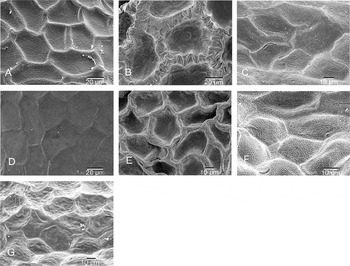
Seed surface. The seed surface was of three types: reticulate (reticulate pattern with distinctly elevated ribs that were readily visible to the naked eye; Fig. 6A, C–G), reticulate-foveate (reticulate pattern with broader walls and appearing pitted) and reticulate-areolate (reticulate pattern of an obscure type that is generally only visible under 40× magnification). The reticulate pattern was found in Oldenlandia auricularia, O. brachypoda, O. diffusa, O. erecta, O. lineata, Kohautia coccinea and K. gracilis. Oldenlandia biflora and O. ovatifolia were characterised by a reticulate-foveate seed coat surface with hexagonal pits (Fig. 6B). Oldenlandia pinifolia and O. verticillata had the obscure type of reticulation termed reticulate-areolate (Fig. 6C, D). Seed coat cells were punctated in all members of the Hedyotis–Oldenlandia–Kohautia complex. Punctation was comparatively dense and more distinct in Oldenlandia brachypoda and O. diffusa (Fig. 6E, F) than in O. erecta (Fig. 6G).
Detail of seed coat surface in SEM. A: Oldenlandia auricularia; B: O. biflora; C: O. verticillata; D: O. pinifolia; E: O. brachypoda; F: O. diffusa; G: O. erecta. A, E–G: Seed coat surface reticulate. B: Seed coat surface reticulate-foveate. C & D: Seed coat surface reticulate-areolate. E & F: Note the well-marked punctations in seed coat cells of O. brachypoda and O. diffusa.

Discussion
Hedyotis: sensu stricto or sensu lato?
The selection of Hedyotis fruticosa L. as a conserved type for Hedyotis necessitates the redefinition of the generic limits of Hedyotis and consequently several other (possibly new) genera around the world. Hedyotis species can be segregated from Oldenlandia by the septicidally dehiscent capsule, which splits into two distinct valves, and by the dorsiventrally flattened seeds with thin or winged margins. In Nepal this new delimitation of Hedyotis requires the transfer of many taxa from Hedyotis L. to Oldenlandia L., all of which already have combinations in Oldenlandia. These are Oldenlandia auricularia (L.) K.Schum. (syn.: Hedyotis auricularia L.), O. biflora L. (syn.: H. biflora (L.) Lam.), O. brachypoda DC. (syn.: H. brachypoda (DC.) Sivar. & Biju), O. corymbosa L. (syn.: H. corymbosa (L.) Lam.), O. diffusa (Willd.) Roxb. (syn.: H. diffusa Willd.), O. erecta (Manilal & Sivar.) R.R.Mill (syn.: H. erecta Manilal & Sivar.), O. lineata (Roxb.) Kuntze (syn.: H. lineata Roxb.), O. ovatifolia (Cav.) DC. (syn.: H. ovatifolia Cav.), O. pinifolia (Wall. ex G.Don) K.Schum. (syn.: H. pinifolia Wall. ex G.Don) and O. verticillata L. (syn.: H. verticillata (L.) Lam.). The key characters for Hedyotis mentioned earlier (septicidally dehiscent capsules and dorsiventrally flattened seeds) fit well for the Asian and Pacific species of Hedyotis but cannot be applied with certainty to the taxa in the rest of the world, especially with respect to the ‘Hedyotis’ species of the Hawaiian Islands and of North and South America which Terrell & Robinson (Reference Terrell and Robinson2003) suggested might require generic separation.
In Nepal, the Hedyotis–Oldenlandia–Kohautia complex can be characterised by a herbaceous or subshrub habit; bilocular ovary with numerous ovules in each locule; pollen grains 3–4(–5)-colporate; and seeds small (0.2–0.8 mm) and numerous per fruit. The seeds are generally angular and trigonous, dorsiventrally flattened, although are lenticular with an irregular wing-like margin or subglobose in some species.
The variation in fruit type and dehiscence together with seed and pollen morphology are important taxonomic characters in the Hedyotis–Oldenlandia–Kohautia complex. On the basis of these characters five homogeneous groups have been identified within the complex from Nepal. These groups largely coincide with sections identified by Wight & Arnott (Reference Wight and Arnott1834). The five groups are as follows:
Group 1 (Hedyotis fruticosa group): This group is represented by a single species, Hedyotis scandens, in Nepal. It has diplophragmous capsules (which are characterised by partly loculicidal dehiscence from the top and then septicidal dehiscence along the septum into two distinct valves) and H. fruticosa-type seeds (dorsiventrally flattened, lenticular with irregularly narrow wing-like margin; Fig. 4A, Table 3). Terrell & Robinson (Reference Terrell and Robinson2003), in their comparative morphological survey of Asian and Pacific species of Hedyotis, found that most of the Sri Lankan and Micronesian taxa have diplophragmous capsules and fruticosa-type seeds. For these species, they recognised a new group as Hedyotis subgen. Hedyotis. These characters are absent in Hawaiian and North and South American taxa but could be important for defining Hedyotis in its narrower sense. Flowers in Hedyotis scandens are heterostylous, a regular feature in the Rubiaceae (Anderson, Reference Anderson1973). The pollen is colporate with an endocingulum as endoaperture (Fig. 3A, Table 2). The tectum is of the double reticulate type and supratectal elements are present on the inside of the muri (Fig. 1B). The representatives of the Hedyotis fruticosa group are distributed throughout Sri Lanka, India, China, Southeast Asia, Indonesia and Micronesia.
Group 2 (Oldenlandia auricularia and O. lineata group): This group includes members of the former genus Exallage, a genus segregated from Hedyotis by Bremekamp (Reference Bremekamp1952). The members are characterised by the seeds possessing ‘oldenlandioid’ characters (trigonous seeds with concave lateral sides; Fig. 4B, C, Fig. 5A, B) and indehiscent capsules (see Table 3). Terrell & Robinson (Reference Terrell and Robinson2003) proposed the inclusion of Exallage under Oldenlandia as Oldenlandia subgen. Exallage (Bremek.) Terrell & H.Rob. This group was also included under Hedyotis sect. Euhedyotis by Wight & Arnott (Reference Wight and Arnott1834) and Hooker (Reference Hooker1880). The pollen is colporate with an endocingulum as endoaperture (Fig. 3B, C, Table 2). The tectum is of a double reticulate type and supratectal elements are present on the inside of the muri (Fig. 1D, F). Members of this group are strong aluminium accumulators, which is thought to be a relatively primitive feature (Jansen et al., Reference Jansen, Dessein, Piesschaert, Robbrecht and Smets2000).
Group 3 (Oldenlandia corymbosa–diffusa complex and O. pinifolia, O. verticillata group): This group is characterised by loculicidal dehiscent capsules and oldenlandioid seeds. The pollen is colporate and endoapertures are lalongate endocolpi (Fig. 3E, F, Table 2). Based on gross morphology this group can be further divided into two subgroups:
Subgroup 3a (Oldenlandia corymbosa–diffusa complex): This subgroup comprises Oldenlandia brachypoda, O. corymbosa, O. diffusa and O. erecta which are all annual herbs and are characterised by loculicidal capsules with very small-sized oldenlandioid seeds (< 0.5 mm) compared with the other species (Table 3). The concavity of the lateral sides of the seeds is less pronounced in the trigonous seeds of this group (Fig. 4H–J, Fig. 5I–K). Some members of this group (e.g. Oldenlandia diffusa, O. brachypoda; Fig. 6E, F) have distinct punctations on the surface of the seed coat, whereas punctations are less obvious in O. erecta.
Subgroup 3b (Oldenlandia pinifolia and O. verticillata): These species are characterised by sessile and capitate cymes, crustaceous and loculicidally dehiscent capsules, erect calyx teeth, and seeds of the oldenlandioid (trigonous) type (Table 3) with strongly concave lateral sides (Fig. 4D, E, Fig. 5F, H). The seed coat is reticulate-areolate (Fig. 5E, G). Wight & Arnott (Reference Wight and Arnott1834) suggested placing these taxa under Hedyotis sect. Scleromitrion Wight & Arn. Govaerts et al. (Reference Govaerts, Ruhsam, Andersson, Robbrecht, Bridson and Davis2006) included Oldenlandia verticillata and O. pinifolia in Hedyotis.
Group 4 (Oldenlandia biflora and O. ovatifolia group): The members of this group have 4-angular capsules and globose or subglobose seeds with the seed coat surface of the reticulate-foveate type forming hexagonal pits (Fig. 5C, D, Table 3). This distinguishes the group from the rest of Hedyotis and Oldenlandia. The pollen is colporate and endoapertures are lalongate endocolpi (Fig. 3D, Table 2). Santapau & Wagh (Reference Santapau and Wagh1964) accepted the group as a distinct genus, Gonotheca Blume ex A.DC. However, Gonotheca Blume ex A.DC. is a later homonym of Gonotheca Raf. Therefore Babu (Reference Babu1971) renamed the genus Thecagonum Babu. Ridsdale (Reference Ridsdale and Dassanayake1998) treated them as Oldenlandia but Mill (Reference Mill, Grierson and Long1999) placed these species under Hedyotis. Groeninckx et al. (Reference Groeninckx, Dessein, Ochoterena, Persson, Motley and Kårehed2009) found Oldenlandia biflora to be sister to the Kadua clade (Polynesian taxa often considered under Hedyotis s.l.). The study did not include Oldenlandia ovatifolia so further sampling is needed to see whether O. biflora and O. ovatifolia should be transferred to Kadua Cham. & Schltdl.
Group 5 (Kohautia group): This group includes Kohautia gracilis and K. coccinea which are distinct from Hedyotis and Oldenlandia by their thyrse-like inflorescence and rather large funnel-shaped corolla tubes with stamens and style included. Capsule and seed characters resemble true Oldenlandia (i.e. loculicidal capsules and trigonous seeds; Fig. 4K, Table 3). Endoapertures are endocolpi with a distinct annulus around the mesoaperture (visible both outside and inside). Groeninckx et al. (Reference Groeninckx, Dessein, Ochoterena, Persson, Motley and Kårehed2009) and Kårehed et al. (Reference Kårehed, Groeninckx, Dessein, Motley and Bremer2008) found Kohautia biphyletic, forming two well-supported clades corresponding to the two subgenera of Kohautia, namely Kohautia and Pachystigma. Palynologically these two subgenera are distinct because subgenus Kohautia has an annulus whereas Pachystigma has not (Lewis, Reference Lewis1965a, Reference Lewis1965b).
Concluding Remarks
These results clearly indicate that the Nepalese members of the Hedyotis–Oldenlandia–Kohautia complex represent diverse lineages of species. However, some members of the complex (Oldenlandia auricularia, O. biflora, O. lineata and O. ovatifolia) exhibit morphological characters intermediate between Hedyotis and Oldenlandia. We have provided a useful method for identifying the presently known species for inventories and ecological and floristic studies in Nepal. Further study is required, preferably using molecular phylogenetic techniques, to clearly establish the natural units within this wide-ranging complex. With our current knowledge, it is proposed here to accept the generic status of Hedyotis, Oldenlandia and Kohautia. This is somewhat in agreement with the treatment of Mill (Reference Mill, Grierson and Long1999) in the Flora of Bhutan but with the removal of some species of Hedyotis to Oldenlandia as explained above.
Acknowledgements
We thank the administration of the Central Department of Botany, Tribhuvan University, Kathmandu, Nepal for providing access to laboratory facilities. We also thank Roy Vickery, Curator of the Natural History Museum, London (BM), for providing herbarium material and Dr Peter Hoen and Dr Wim Punt, Laboratory of Palaeobotany and Palynology, The Netherlands, for help with description of the apertures in Kohautia. In addition, the first author thanks his former adviser, Dr Krishna Kumar Shrestha, Tribhuvan University, Kathmandu, for comments and support during the course of this study.