INTRODUCTION
Climate affects several ecological processes, from the performance of individual organisms, to the dynamics of populations and the distribution of species. This has been clearly illustrated by a series of recent studies that have linked changes in ecosystem properties with large-scale climate fluctuations (Ottersen et al. 2001; Stenseth et al. 2002, 2003; Walther et al. 2002). The extent and intensity of parasitism can also be modulated by climatic conditions (Mouritsen and Poulin, 2002a). Recent reports have highlighted the causal relationship between climate change and emerging parasitic diseases, i.e. diseases suddenly increasing in either local prevalence or geographical distribution (e.g., Marcogliese, 2001; Harvell et al. 2002). With many climatic models predicting small increases in average temperatures over the next several years for many parts of the world, it is crucial to understand how parasites may respond to the change, for the sake of human health and the preservation of natural communities and ecosystems. However, because of the many direct and indirect effects of temperature and other climatic variables on parasite transmission, it is proving difficult to predict how climate change may impact on any given parasites or their hosts.
In trematodes (flukes), temperature has a very clear, and pronounced, direct effect on a crucially important step of the transmission cycles. All trematodes use molluscs (generally snails) as first intermediate hosts. Within this host, they multiply asexually and produce relatively large numbers of infective stages known as cercariae. Typically, these free-swimming cercariae leave the snail host to penetrate their next host; the latter may be the vertebrate definitive host in which the worms mature, as in blood flukes (e.g., family Schistosomatidae), or a second intermediate host in which the cercariae encyst and await ingestion by the definitive host. The production of cercariae in snails is a fundamental component of the parasite's overall transmission success. This process is also directly influenced by temperature: within the range of temperatures in which host and parasite can live, an increase in temperature is almost invariably coupled with an increase in cercarial output (e.g., Shostak and Esch, 1990; Lo and Lee, 1996; Umadevi and Madhavi, 1997; Mouritsen, 2002). This phenomenon results from 2 independent processes: higher temperatures not only trigger the emergence of cercariae from snails, but they also accelerate the production of cercariae within snails (e.g. Ataev, 1991). The net outcome of increasing temperature will thus be a greater number of cercarial infective stages in aquatic habitats. This consequence of climate warming is not trivial: trematode parasitism is not only a major veterinary and health problem worldwide, but trematodes also play major roles in the structuring of animal communities, especially in intertidal ecosystems (Sousa, 1991; Mouritsen and Poulin, 2002b). Any temperature-mediated increase in the extent of trematode infections may have measurable repercussions.
Enhanced cercarial production at higher temperatures may be a simple consequence of increased metabolic activity of the host and the greater energy this may render available to the parasite. In ectothermic animals, the rate of physiological processes increases markedly with increasing temperatures. Typically, for enzyme-catalysed processes, as well as physiological processes such as metabolic rate that rely on underlying enzymatic reactions, Q10 values ranging between 2 and 3 are the norm, implying a doubling or tripling of physiological rates per 10 °C increase in temperature (Schmidt-Nielsen, 1997; Willmer, Stone and Johnston, 2000). This typical range of Q10 values also provides a rough null hypothesis for investigations of temperature-dependent cercarial production by trematodes in snail hosts. If a 10 °C increase is generally associated with 2- to 3-fold increases in cercarial output, then cercarial production follows the basic pattern observed for other physiological processes. On the other hand, if a 10 °C increase in temperature induces more pronounced increases in cercarial output, then the direct effects of temperature are probably compounded by indirect effects. The net result would be a greater-than-expected proliferation of trematode infective stages, with possible consequences for host populations and whole ecosystems.
The influence of temperature on cercarial output is likely to vary both within and among trematode species for a range of reasons. Firstly, all else being equal, if cercarial output is already very high, it may be difficult for the parasite to increase its output even if the temperature increases. There exist constraints on maximal cercarial output that vary among trematode species and families (Galaktionov and Dobrovolskij, 2003), and these undoubtedly determine to a great extent how cercarial output responds to temperature. Nevertheless, in similar snail hosts, we might expect that a trematode producing 100 cercariae per day at a given temperature would have more host resources available to expand its production than one that already produces 5000 cercariae of similar size daily at the same temperature. Thus, the magnitude of cercarial production may interact with temperature changes to determine how production rates will respond. Secondly, the size of the snail host may also matter, for similar reasons. Consider 2 related trematodes both producing 1000 cercariae per day at a given temperature; if one trematode uses a snail species that is twice as large as that used by the other trematode, then we might expect the former to have access to more host resources to increase its production of cercariae than the latter. Thirdly, the thermal regime experienced by both the trematodes and snail hosts in nature may also constrain any physiological responses to increasing temperatures. As a general rule, temperatures are higher, on average, and less variable temporally, both daily and seasonally, at low latitudes than at high latitudes. At high latitudes, temperatures would often be too low to allow cercarial production (i.e. during all of winter) and, overall, would only exceed 20 °C during summer. We might thus expect that trematodes from high latitude areas would respond differently to a slight rise in temperature, when the ambient temperature is already around 20 °C, than trematodes from the tropics.
Here, I tackle 2 important questions regarding the impact of temperature on cercarial proliferation in trematodes. First, is the increase in cercarial output associated with increases in temperature greater than expected based solely on physiological processes? In other words, are the Q10 values associated with cercarial production greater than those associated with physiological processes in general? Second, is the effect of temperature on rates of cercarial production influenced, or even constrained, by other factors? Specifically, I will investigate the influence of the magnitude of cercarial production, snail shell size and latitude on the response of trematodes to increasing temperatures. Answering these two questions will provide essential information for the construction of more accurate models of parasite epidemiology as a function of changing climate.
METHODS
Data were obtained from experimental studies of cercarial output at different temperatures. These studies were found using a keyword search on the Web of Science (years 1955–2004), as well as by searching the reference lists at the end of relevant papers. Many studies found in this way had to be discarded because they did not provide adequate quantitative information. The typical study consisted of maintaining small groups of snails at 2 or more constant temperatures for a few to several days, and counting the number of cercariae shed per snail per unit time in the different groups. Other abiotic conditions were the same among groups of snails within a study, but varied among studies. Cercarial production was estimated over observation periods ranging from 1 to 24 h; for comparative purposes, here all have been converted to daily output rates, i.e. number of cercariae produced per snail per 24 h. Although in many species the rate of cercarial emergence from snails is not constant and often shows daily peaks at particular times (e.g., Combes et al. 1994), this had no effect on the estimate of Q10 values. For any given trematode species, the same procedures were used for cercarial counts at different temperatures, which allowed a relative measure such as the Q10 to be estimated without bias (see below).
All studies spanned a range of temperatures that encompassed 20 °C, except for a couple of studies that came within 1 or 2 ° of that temperature. Because 20 °C is a temperature that is well within the natural temperature range regularly experienced by all the host and parasite species considered here, it was chosen as the focal temperature to allow comparisons among different host-parasite systems. Using the most appropriate experimental temperatures used in each original study, I computed the Q10 for cercarial production rates in the vicinity of 20 °C for each study, using the standard formula (Schmidt-Nielsen, 1997):

where C2 and C1 are cercarial output rates at temperatures t2 and t1, respectively. A Q10 value of 1 indicates no change in cercarial output rate, a value lower than 1 indicates a reduction in output rate, a value of 2 indicates a 2-fold increase, etc. Because Q10 values are typically not constant for different parts of the temperature range, I also computed Q10 for cercarial production in the 25–30 °C range, for the subset of trematode species for which sufficient data were available. This second value will be used to determine whether the rate of increase in cercarial production decreases with increasing temperature, as seen for most physiological processes (Willmer et al. 2000).
Data were also obtained for 3 variables that may influence cercarial production. First, cercarial output at 20 °C was recorded as the number of cercariae released by a snail per 24 h at 20 °C. This value was taken directly from the experimental results of each study, or extrapolated from the results obtained at lower and higher temperatures if there was no 20 °C treatment in the experiment. Second, mean snail shell length was used as a measure of snail size. Usually given in the original studies, this information had to be obtained from molluscan databases in a few cases. Third, the latitude at which the snails and parasites were obtained for study was also recorded. Although altitude can also be an important determinant of natural thermal regime, the vast majority of studies for which altitude could be obtained or inferred used snails from sea-level or low-altitude areas. In the few studies where laboratory-bred snail lines were used, no latitude was recorded.
Cercarial output at 20 °C, snail shell length and latitude were used as independent variables, and Q10 as the dependent variable. When data on a given trematode species in a given snail species were available from more than one study, they were averaged (geometric mean for cercarial output and Q10) to obtain species values. In contrast, when data on a given trematode species were obtained from 2 different snail species, each trematode-snail species combination was treated as a different species, as though they were trematode sister-species. All variables were log10-transformed to meet the assumptions of parametric tests. Initially, the different trematode species were treated as statistically independent observations and the associations between variables were investigated using both Pearson correlation coefficients and multiple regressions. However, similarities among trematode species due to common ancestry make them non-independent in a statistical sense, and the analyses were thus repeated while controlling for potential phylogenetic influences. The phylogenetically independent contrasts method (see Felsenstein, 1985; Harvey and Pagel, 1991) was used. Relationships among higher trematode taxa were derived from the phylogeny of trematode families, based on molecular data, proposed by Olson et al. (2003). Within families, relationships were straightforward, as there were no more than 2 genera per family, and no more than 2 species per genus among the species in the present dataset, with 2 exceptions. The first exception was the family Heterophyidae, in which there were 3 genera represented in the dataset. Based on much greater morphological affinities, Euhaplorchis and Haplorchis are considered more closely related to each other than to Centrocestus (J. Pearson, personal communication). The second exception was the genus Schistosoma, with 3 species; recent molecular studies, however, agree that S. mansoni and S. haematobium are more closely related to each other than to S. japonicum (Lockyer et al. 2003; Morgan et al. 2003). Independent contrasts were computed between sister taxa derived from the fully resolved trematode phylogeny, using the program CAIC, version 2.0 (Purvis and Rambaut, 1994). Relationships between contrasts in the different variables were assessed using correlations forced through the origin (see Garland, Harvey and Ives, 1992).
RESULTS
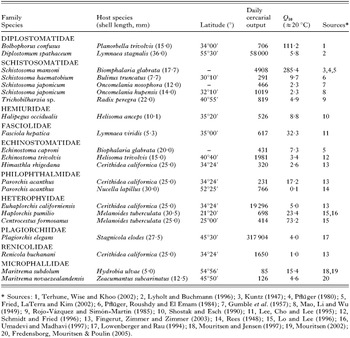
Data were obtained for 19 trematode species, representing 10 different families, and using a total of 16 different snail species (Table 1). Two trematode species, Schistosoma japonicum and Parorchis acanthus, were each studied in 2 different snail species; each trematode-snail combination was treated as a distinct species, so that in the analyses there are actually 21 trematode ‘species’ (and a maximum of 20 sets of independent contrasts in the analyses controlling for phylogeny).

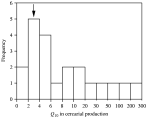
Q10 values (at around 20 °C) varied widely among trematode species, indicating changes in daily cercarial output ranging from small reductions to 200-fold increases in response to a 10 °C rise in temperature (Table 1, Fig. 1). The geometric mean of all recorded values suggests that on average cercarial output increases almost 8-fold when temperature rises by 10 °C. There was also much variation within trematode families (Table 1), suggesting that the Q10 in cercarial production is not tightly constrained by phylogeny. Overall, the distribution of values of Q10 in cercarial production indicates that the observed temperature-mediated increases in cercarial output are much more substantial than those expected from physiological processes, for which Q10 values are typically between 2 and 3 (Fig. 1). Although the mode of the distribution is around values of 2 or 3, the long tail of the skewed distribution means that more than half the recorded values are greater than the mode (Fig. 1).

Fig. 1. Frequency distribution of Q10 values for cercarial production in 21 species of trematodes. The scale on the x-axis is contracted toward the right-hand side of the figure. The arrow indicates the typical Q10 values generally recorded for physiological and metabolic processes.
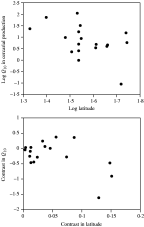
Using species values as independent observations, there was no significant correlation between latitude and either cercarial output at 20 °C or snail shell length (both P>0·33). There was, however, a significant positive correlation between snail shell length and cercarial output (r=0·492, N=21, P=0·0233): trematodes in larger snails achieve a higher daily cercarial output. Although cercarial output varied across 5 orders of magnitude and snail shell length varied 7-fold among trematode species, neither of these variables had any influence on Q10 in cercarial production, in either simple linear or multiple regressions (all P>0·12). In contrast, latitude was negatively related with Q10 in cercarial production based on both a simple correlation (r=−0·461, N=18, P=0·0544) and a multiple regression including the other 2 predictor variables (partial regression coefficient: −0·540, P=0·0323). Thus, trematodes at higher latitudes tend to have lower values of Q10 in cercarial production than those at lower latitudes (Fig. 2).

Fig. 2. Q10 in cercarial production as a function of latitude, across 21 species of trematodes (top) and 17 phylogenetically independent contrasts (bottom).
For the 10 trematode species in which Q10 in cercarial production at both (approximately) 20 °C and 25 °C could be estimated, Q10 values were generally lower at the higher temperature (two-tailed paired t-test, t=2·789, D.F.=9, P=0·0211). None of the 3 predictor variables (latitude, host shell length, and cercarial output at 20 °C) correlated significantly with the Q10 at about 25 °C (all P>0·13), although the limited number of trematode species in these analyses makes any weak trend difficult to detect.
In the analyses using phylogenetically independent contrasts, the same relationships were observed. Again, there was a significant positive correlation between snail shell length and cercarial output at 20 °C (correlation through the origin: r=0·527, N=20 sets of contrasts, P=0·0169). The negative relationship between latitude and Q10 at around 20 °C was also seen with independent contrasts (r=−0·613, N=17 sets of contrasts, P=0·0089), again suggesting that trematodes at higher latitudes show lower values of Q10 in cercarial production than those at lower latitudes (Fig. 2).
DISCUSSION
Recent reports linking climate change and emerging parasitic diseases have highlighted some of the challenges that the near future will bring us (Marcogliese, 2001; Harvell et al. 2002; Mouritsen and Poulin, 2002a). The effects of climate change on diseases caused by trematodes have received only limited attention. Forecast models have recently attempted to anticipate the spread of some parasitic trematodes, notably schistosomes and liver flukes responsible for human and veterinary diseases (Yilma and Malone, 1998; Bossaert et al. 1999; Moodley et al. 2003). These models have focused on the geographical expansion of the diseases expected from global temperature changes, rather than the local changes in the prevalence or intensity of infections. Here, I provide a synthesis of the available empirical information that can be used to develop predictive frameworks regarding local infection levels. Overall, I found that the temperature-mediated increases in cercarial production reported in the literature are much greater than what would be expected based solely on physiological processes.
Typically, in ectothermic animals, for most physiological processes such as metabolic rate, that rely on underlying enzymatic reactions, Q10 values range between 2 and 3 (Schmidt-Nielsen, 1997; Willmer et al. 2000). This is true for physiological processes in snails, too (e.g., Van Aardt and De Kock, 1991). In general, however, Q10 values for most physiological processes are not constant for different parts of the temperature range. In the vicinity of 20 °C, the focal temperature in this study, Q10 values are normally closer to 2 than 3 for physiological processes in aquatic invertebrates (Willmer et al. 2000). The present results also indicate that Q10 values for cercarial production decrease from 20 °C to 25–30 °C. Still, the Q10 values reported for temperatures around 20 °C are markedly higher than those for physiological processes at that temperature. This suggests that cercarial output is not simply directly related to host metabolism, and that other factors act in synergy with it to determine how many cercariae are produced per unit time.
The biological characteristics of cercarial production vary among trematode taxa. In particular, constraints on cercarial output are not the same across all species (Galaktionov and Dobrovolskij, 2003). In some trematodes, a single miracidium infecting a snail can only give rise to a finite number of cercariae: the total output is predetermined genetically by its number of totipotent cells. In other species, asexual divisions can continue almost indefinitely, producing a virtually infinite succession of cercariae fuelled by energy availability. Information on this crucial aspect of cercarial production is unavailable for most taxa in the present analysis, and differences in modes of cercarial production could not be taken into account here. Although constraints on the total number of cercariae that a single miracidium can generate may have little impact on the short-term Q10 values computed here, they might affect how long increased cercarial output rates can be maintained. In species with finite total output, elevated cercarial emergence at high temperature will last only until all totipotent cells are exhausted, whereas in trematodes with no predetermined limit to cercarial numbers, the increased rate of cercarial emergence can be sustained as long as the snail provides sufficient resources. The ecological significance of sustained high rates of cercarial output is discussed below.
Some of the more extreme Q10 values obtained here may be, to some extent, by-products of the methodology used in the original studies. In some species, although cercarial production is inhibited below a certain temperature, the production of rediae or sporocysts continues and these generative stages accumulate inside the snail (Galaktionov and Dobrovolskij, 2003). Infected snails may be stored at such low temperatures prior to their use in cercarial release experiments. When they are exposed to temperatures of 20 °C or higher, their parasites switch from redial to cercarial production and the large accumulated redial population causes a disproportionate emergence of cercariae, not as a direct effect of temperature on rate of production but as a clearance of the large population of cercarial progenitors. This could, at least in part, account for the very high Q10 values in some species. Also, experimental procedures varied across studies: acclimation temperature, whether the snails were exposed to new temperatures abruptly or gradually, and whether they were exposed to higher or lower temperatures than that at which they were acclimatized. This could account for the strange result reported by Rees (1948), who found slight decreases in cercarial output at higher temperatures. These differences across studies no doubt cause some variation in quality among the data, but they are unlikely to bias the results in any particular direction. Indeed, when excluding Rees' (1948) unusual result, as well as the two Q10 values greater than 100, the geometric mean of all remaining values shows that on average cercarial output increases almost 7-fold when temperature rises by 10 °C, still much greater than expected from physiological processes.
Across trematode species, cercarial output increased with increasing host shell length, a phenomenon already documented in species within the family Schistosomatidae (Loker, 1983). This finding suggests that resource limitation may constrain cercarial output, and that trematodes exploiting larger hosts have access to more resources. Of course, the quantity of cercariae produced is only one component of cercarial output; the other one is cercarial size. There is no obvious trade-off between numbers and size of cercariae, and cercarial size also increases with increasing host shell length, at least in schistosomes (Loker, 1983). Cercarial size was not included in the present study because of insufficient data. However, it has no impact on the estimation of Q10 in cercarial output since Q10 values are computed within species only.
Despite wide variation in both host size and the magnitude of cercarial output at 20 °C, neither of these variables covaried with Q10 in cercarial production among trematode species. The snail host has little impact on the potential of a trematode to increase its cercarial production, since different trematode species using the same snail species can have widely different Q10 values. The only variable that appeared to influence Q10 values was the latitude from which parasites and snails originated. This correlation persisted after correcting for trematode phylogeny, and thus indicates the importance of the natural thermal regime in shaping the responses of parasites to increasing temperatures. The lowest latitude included in the dataset was 21 °N, and the low latitudes in the dataset therefore correspond to subtropical or mild temperate areas. The present results suggest that a small increase in environmental temperatures at those latitudes would have the greatest repercussions on trematode transmission.
Two important issues need to be considered in the context of temperature-mediated increases in cercarial production. First, although a rise in temperature will trigger an increase in cercarial output, this may be short-lived. It is quite likely, for instance, that at higher temperatures, and with cercarial production greatly enhanced, the snail host would not live as long as it would normally. A short-lived peak in cercarial emergence, however, may be sufficient to cause extensive mortality in the next host of the trematode. For instance, several consecutive days of unseasonably hot weather resulted in increased cercarial production by microphallid trematodes on intertidal mudflats in Denmark; the consequence was the mass mortality and local extinction of the parasites' second intermediate hosts (Jensen and Mouritsen, 1992). Laboratory studies have shown that the exposure of second intermediate hosts to many cercariae simultaneously induces higher mortalities than the gradual exposure to low numbers typical of field conditions (e.g., Fredensborg, Mouritsen and Poulin, 2004). Thus, there is no need for the increased cercarial output to be maintained over many weeks or months, for the temperature-mediated effects of parasites to have a substantial ecological impact.
The second issue that must be addressed regards the quality of the cercariae; an increase in the quantity being produced may not lead to increased per capita transmission success if the cercariae are of lower quality. Cercarial quality can be measured as their survivorship and/or their infectivity or transmission success to the next host. Generally, cercarial survival decreases steadily with increasing temperature (e.g., Evans, 1985; McCarthy, 1999; Mouritsen, 2002; Fried and Ponder, 2003), although this phenomenon is not universal (e.g., Lo and Lee, 1996). This appears to be a direct result of the increased activity shown by cercariae at higher temperatures, which accelerates the depletion of their finite energy reserves (Pechenik and Fried, 1995; McCarthy, 1999). In contrast, cercarial infectivity, measured as the likelihood that a cercaria will successfully infect its target host under standard conditions, generally increases with temperature before dropping off at high temperatures (e.g., Evans, 1985; McCarthy, 1999). By combining cercarial survival and cercarial infectivity into a single measure of transmission efficiency, previous workers have shown that cercarial transmission efficiency is not negatively affected by increasing temperatures (Evans, 1985; McCarthy, 1999). Low cercarial infectivity at lower temperatures is offset by low mortality, whereas improved infectivity at higher temperatures is counter-balanced by high mortality. The net result is that, in the species of Echinostomatidae investigated to date, transmission efficiency remains roughly constant between approximately 15 and 30 °C (Evans, 1985; McCarthy, 1999). Under these conditions, a temperature-mediated increase in cercarial output would lead to greater infection levels in the next hosts of trematodes, even if cercarial survival is lower at higher temperatures.
The results of the present study suggest a common scenario for most trematode-host associations: an increase of a few degrees in environmental temperatures should lead to marked increases in cercarial emergence from snail first intermediate hosts, with little if any reduction in their transmission efficiency. The increase in cercarial output may take the form of brief pulses rather than a continuous release, but the effects of the former are known to be severe, at least for the small invertebrates commonly acting as second intermediate hosts for trematodes. Climate change involves alterations in a complex system of interlinked abiotic factors, that will send changes propagating through ecosystems; it is extremely difficult to predict the net effect on any given animal population or ecosystem. Global warming has been predicted to cause altered geographical distributions in many trematode species (e.g., Yilma and Malone, 1998; Bossaert et al. 1999; Moodley et al. 2003); the results of the present study suggest that, unless its effects are cancelled out by other changes, global warming may also enhance the local impact of trematodes.
I thank John Pearson for unpublished information about trematode phylogeny, and Brian Fredensborg for useful comments on an earlier version of the manuscript.