Introduction
The majority of clinical trials testing the efficacy of family intervention programmes for the improvement of relapse rates and hospitalizations in schizophrenia are generally consistent, but evidence of their effect on positive and negative symptoms (Falloon et al. Reference Falloon, Boyd, McGill, Williamson, Razani, Moss, Gilderman and Simpson1985; Xiong et al. Reference Xiong, Phillips, Hu, Wang, Dai, Kleinman and Kleinman1994; Barrowclough et al. Reference Barrowclough, Tarrier, Lewis, Sellwood, Mainwaring, Quinn and Hamlin1999, Reference Barrowclough, Haddock, Tarrier, Lewis, Moring, O'Brien, Schofield and McGovern2001; Dyck et al. Reference Dyck, Short, Hendryx, Norell, Myers, Patterson, McDonell, Voss and McFarlane2000; Bradley et al. Reference Bradley, Couchman, Perlesz, Nguyen, Singh and Riess2006; Chien et al. Reference Chien, Chan and Thompson2006; Garety et al. Reference Garety, Fowler, Freeman, Bebbington, Dunn and Kuipers2008) and family burden (Barrowclough et al. Reference Barrowclough, Tarrier, Lewis, Sellwood, Mainwaring, Quinn and Hamlin1999; McDonell et al. Reference McDonell, Short, Berry and Dyck2003; Hazel et al. Reference Hazel, McDonell and Short2004; Bradley et al. Reference Bradley, Couchman, Perlesz, Nguyen, Singh and Riess2006; Chien et al. Reference Chien, Chan and Thompson2006; Magliano et al. Reference Magliano, Fiorillo, Malangone, De Rosa and Maj2006; Chien & Wong, Reference Chien and Wong2007) is contradictory and the effect on employment has not been established specifically. In addition, whether others factors related to outcome, such as adherence, time of useful work, duration of disease or pre-morbid adjustment (Girón et al. Reference Girón and Gómez-Beneyto1998, Reference Girón and Gómez-Beneyto2004), play an intervening or an independent role in the therapeutic process has not yet been investigated.
The association of relapse with negative attitudes in the immediate family circle has been found in the majority of studies (Bebbington & Kuipers, Reference Bebbington and Kuipers1994; Butzlaff & Hooley, Reference Butzlaff and Hooley1998) but in Spain this association has not been clearly established (Gutierrez et al. Reference Haddock, Barrowclough, Tarrier, Moring, O'Brien, Schofield, Quinn, Palmer, Davies, Lowens, McGovern and Lewis1988; Arevalo & Vizcarro, Reference Arevalo and Vizcarro1989; Montero et al. Reference Montero, Gómez-Beneyto, Ruiz, Puche and Adam1992; Canive et al. Reference Canive, Sanz-Fuentenebro, Vazquez, Qualls, Fuentenebro and Tuason1995; Girón & Gómez-Beneyto, Reference Girón and Gómez-Beneyto1998). In this culture there is a general lack of controlled and randomized clinical studies on the efficacy of family intervention programmes in schizophrenia.
Another important issue not yet clarified concerns the effectiveness of family intervention programmes in ordinary treatment settings, and their population impact. There are only two studies addressing the effectiveness of family intervention with respect to the total population of patients drawn from a defined geographical area, with inconclusive results (Barrowclough et al. Reference Barrowclough, Tarrier, Lewis, Sellwood, Mainwaring, Quinn and Hamlin1999; Garety et al. Reference Garety, Fowler, Freeman, Bebbington, Dunn and Kuipers2008).
The present study aimed to address some of these unresolved questions by testing the effects of a family intervention programme on relapse, symptoms, functioning and family burden in a sample of patients in a defined catchment area living with relatives with risk attitudes over a period of 2 years. Patients with positive symptoms were selected for this study considering their association with poor clinical and social outcome (Siegel et al. Reference Siegel, Irani, Brensinger, Kohler, Bilker, Ragland, Kanes, Gur and Gur2006). A further objective was to assess the independence of the effects of family intervention with regard to other factors that might contribute to the outcome, such as adherence to other treatments and prognostic factors.
Method
Subjects
The subjects were patients with schizophrenia registered at mental health centres in a district with 121024 inhabitants in the city of Alicante, Spain. The patients fulfilled the following selection criteria: (i) schizophrenia or schizophreniform disorder according to DSM-IV criteria (APA, 1994); (ii) to select patients with severe and persistent disorder but with sufficient stability to allow for establishing a reliable baseline, the following operative criteria were applied: persisting positive psychotic symptoms for more than 1 year or a clinical relapse in the previous 2 years, with at least 2 months of clinical stability, defined as no variations in two Psychiatric Assessment Scale (PAS) ratings taken at an interval of 1 month. Patients with such severe persistent symptoms that it was not possible to identify a clinical relapse on the PAS were excluded; (iii) aged 17–55 years; (iv) having lived at home for more than 1 month with a key relative (identified as the relative with the greatest number of hours of face-to-face contact with the patient) with a critical attitude, measured by means of the Semantic Differential (at least one item with a positive score under the dimension of negative evaluation or passivity), or a deficit in empathic capacity (index of empathic capacity ⩾0.5) measured using the Empathy Questionnaire (Girón & Gómez-Beneyto, Reference Girón and Gómez-Beneyto1995, Reference Girón and Gómez-Beneyto2004); (v) absence of mental retardation, serious cognitive disorder, abuse or dependence on toxic substances according to the DSM-IV criteria in the patient and their relative, including serious mental illness in the latter; and (vi) family group or key relative had not received psycho-educational family intervention lasting for more than 3 months.
Design
The study was designed as a clinical trial in which, given that lack of employment is a key risk factor for both clinical relapse and poor social functioning (Girón & Gómez-Beneyto, Reference Girón and Gómez-Beneyto1998, Reference Girón and Gómez-Beneyto2004) and to avoid its unequal distribution between the experimental and the control group, patients were randomized depending on their Quantity of Useful Work during the previous year (Strauss & Carpenter, Reference Strauss and Carpenter1974). Two patients with level 0–1 or level 2–4 on the Quantity of Useful Work scale were randomized to two groups: family intervention+individual counselling+standard treatment, or individual counselling+standard treatment. The allocation to each group was carried out blind to the identity of the patient. Two interventions were made, one family intervention and the other individual counselling applied to patients in both groups so as to balance the expectations of the control group. Patients were asked to participate voluntarily and gave their written informed consent. The study protocol was approved by the review board of Miguel Hernández University.
Measures
Patients already diagnosed with schizophrenia or schizophreniform disorder by their psychiatrists were included in the study only if an independent clinical evaluation carried out by an experienced psychiatrist confirmed the diagnosis. The primary outcome was clinical relapse. Three measurements were taken, one before the trial started, one at 9 months and one at the end of the 24-month intervention period. However, in this report only the first and the last measurements are considered. Monthly evaluations were made to determine the possibility of clinical relapse and major incidents, and also to evaluate adherence to pharmacological treatment. Evaluation was carried out by a psychiatrist who was not involved in the processes of treatment, randomization or allocation. Active measures were taken to guarantee the evaluator's blindness to the patient study group. Clinical records were examined to evaluate the use of services. The positive symptoms were evaluated by using the Spanish version of the PAS (Krawiecka et al. Reference Krawiecka, Goldberg and Vaughan1977; Perez-Fuster et al. Reference Perez-Fuster, Ballester-Gracia, Giron-Gimenez and Gómez-Beneyto1989). The evaluator was trained specifically in the use of this scale, attaining an inter-rater intra-class correlation coefficient (ICC)>0.96. To establish clinical relapse, the method of Vaughn et al. (Reference Vaughn, Snyder, Jones, Freeman and Falloon1984) was followed. Persisting positive symptoms were defined according to criteria described previously (Girón & Gómez-Beneyto, Reference Girón and Gómez-Beneyto1995, Reference Girón and Gómez-Beneyto2004). Negative symptoms were measured using section 1 of the Spanish version of the World Health Organization Psychiatric Disability Assessment Schedule (WHO-DAS; WHO, 1988; Mañá et al. Reference Mañá, Ivorra and Girón1998), and the performance of social roles using section 2 of the same document. An overall score for each of the sections corresponds to the mean of the items evaluated. Social relations were measured by means of the first eight items of the Quality of Life Scale (QOLS; Heinrichs et al. Reference Heinrichs, Hanlon and Carpenter1984). The ratings ranged from 0 (absent) to 6 (adequate), and the sum of the scores was used. The quantity of work was measured by means of the Quantity of Useful Work item of the Strauss & Carpenter Prognostic Scale (Strauss & Carpenter, Reference Strauss and Carpenter1974). The first measurement corresponds to the year before the intervention and the second to the last 12 months of the trial. To evaluate these items, we conducted interviews with the patient and with at least one relative. The overall functioning of the patient was measured by means of the Global Assessment of Functioning (GAF) Scale-DSM-IV (Hilsenroth et al. Reference Hilsenroth, Ackerman, Blagys, Baumann, Baity, Smith, Price, Smith, Heindselman, Mount and Holdwick2000) and an improvement of 10 points at 2 years' follow-up was used as outcome.
To measure pre-morbid social adjustment, the Premorbid Adjustment Scale (Phillips, Reference Phillips1953) was used. Other patient variables such as sex, age, marital status, schooling and length of illness from onset to last admission were also recorded.
Family burden was evaluated by means of the Spanish version of the Social Behaviour Assessment Schedule (SBAS; Platt et al. Reference Platt, Weyman, Hirsch and Hewett1980; Gómez-Beneyto et al. Reference Gutierrez, Escudero, Valero, Vázquez, Castro, Álvarez, Baltar, Blanco, González and Gómez1986). The sum of the key relative's rating of the level of objective difficulties in eight areas of his/her life when considered in relation to the presence of the patient at home was used (the higher the score, the more burden perceived). An objective burden score not related to the presence of the patient at home; the sum of the key relative's rating of the level of objective difficulties in eight areas of his/her life when these are not considered in relation to the presence of the patient at home was also used. Any major risk to life or health such as suicide, serious accident or serious binge opioid/cocaine abuse was recorded as a major incident.
Therapeutic interventions
The family intervention technique of Kuipers et al. (Reference Kuipers, Leff and Lam2002) was used. The key elements of the programme were: providing information, active listening and clarification of emotions, problems and needs, establishing a therapeutic alliance, improving communication, problem-solving techniques, diminishing critical attitudes and overinvolvement, and training in empathy. The intervention team was composed of highly experienced psychiatrists, psychologists, social workers and nurses. They were trained specifically in family intervention by a member of Julian Leff's team. The sessions were held every fortnight during the first 9 months and then monthly for the remaining 15 months. As the deficit in empathic capacity is a risk factor for clinical relapse and poor social functioning (Girón & Gómez-Beneyto, Reference Girón and Gómez-Beneyto1998, Reference Girón and Gómez-Beneyto2004), after the ninth month of intervention a module of six sessions was added to train the empathic capacity of both the patient and their relative. Therapy sessions were taped systematically and they were reviewed and discussed by the intervention team at regular intervals. Three supervision sessions were given during the trial to guarantee therapists' adherence. Patients in the experimental and the control group received ‘treatment as usual’ in addition to individual counselling. The standard treatment included support, home visits, social work, rehabilitation and medication. Individual counselling consisted of problem-solving and psychological support given by an experienced psychiatrist who had no training in the family intervention technique.
Compliance with antipsychotic treatment and rehabilitation
Compliance with antipsychotic treatment was evaluated using Falloon et al. (Reference Falloon, Boyd, McGill, Williamson, Razani, Moss, Gilderman and Simpson1985) criteria, monthly and prospectively over the 24 months of follow-up. Afterwards, assessments were made to evaluate compliance during the year prior to the intervention. The number of days without taking medication and the dose prescribed and taken in mg/day of chlorpromazine (WHO, 2002) were used. The use made of rehabilitation services was evaluated monthly using the attendance registers of specific rehabilitation or reinsertion programmes.
Statistical analysis
An intention-to-treat analysis was performed. To avoid autocorrelation and control the intra- and intergroup variability when assessing the differences between groups, the percentages of relative change [(baseline score−final score)/baseline score]×100 or absolute change, when baseline scores included 0, were used. To explore the possibility of developing a patient's global outcome score, a factor analysis was carried out including the presence of clinical relapse during the 2 years before the trial, positive and negative symptoms, employment and social relations at baseline. A single factor was obtained explaining 53.9% of the variance.
Consequently, a patient's global outcome score was calculated by adding the standardized scores of the following variables: clinical relapse, change in positive symptoms, change in negative symptoms, change (in %) in social relations, and change in employment. Univariate analysis and multiple regression analysis were conducted. Kaplan–Meijer's method was used to assess the difference between survival curves. A relationship was considered statistically significant when p<0.05. To determine the independent relationship between family intervention and prognostic factors with the outcome variables, several regression models in two blocks were constructed. The first block included family intervention and the second block the prognostic factors that showed a correlation with a level of significance p<0.10 with the outcome variables. If block 2 contributed significantly to improving R 2, a stepwise linear regression model was carried out (forward stepwise selection with α to enter=0.05 and α to remove=0.10).
Results
Description of patients and relatives
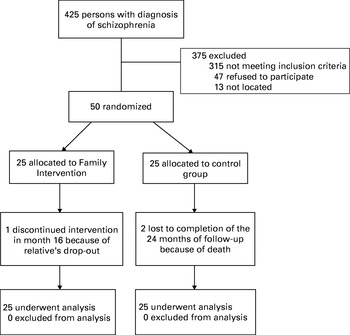
Four hundred and twenty-five patients were filed in their mental health centre as having schizophrenia. Out of these, 188 did not comply with strict diagnostic criteria of schizophrenia, were >55 years old, were not living with a relative or the relative's mental state was not adequate for answering the interview. Out of the remainder, 56 had no clinical stability for the past 2 months or did not present positive symptoms or previous relapses, 22 had already received family psycho-educational treatment for >3 months, 45 did not comply with the follow-up requirements because they were likely to change their residence during the study period. Once these were excluded, four key relatives were not included because they did not present a critical attitude or lack of empathy. Ninety-seven met the selection criteria, and 50 of these agreed to take part in the trial. The patient flow diagram is shown in Fig. 1.
Patient flow diagram.

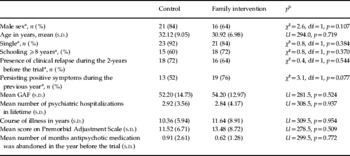
There were no statistically significant differences between the participants and the 47 patients who did not agree to take part in the study in terms of age, sex, schooling, persisting positive symptoms, GAF score, quantity of useful work, number of days of psychiatric hospitalization in the previous 2 years, or total number of hospitalizations. Before the trial onset, the key relatives in the intervention and control groups did not differ in age, sex, marital status, schooling, employment outside the home, type of kinship, or in the number of hours of face-to-face contact with the patient. Tables 1 and 3 shows that there were no differences in demographic variables or in social and clinical functioning between the participants in the family intervention group and those in the control group. Ninety per cent of patients were living with their family of origin, and the rest with a stable partner.
Demographic and clinical characteristics for the family intervention and control groups at baseline

GAF, Global Assessment of Functioning Scale; s.d., standard deviation.
a Dichotomous variable (0=no, 1=yes). b Mann–Whitney U test, χ2 test.
Patient outcomes
All but one of the patients complied fully with the treatment sessions. During the 24 months of the trial, there were no statistically significant differences between the family intervention (FI) and control groups (C) in the number of consultations made in out-patient mental health centres (values in parentheses are standard deviations) [psychiatrist FI: 9.7 (4.2), C: 12.6 (7.6), p=0.5; mental health nurse, FI: 1.9 (2.0), C: 2.7 (3.0), p=0.6; social worker, FI: 1.4 (2.2), C: 2.1 (2.8), p=0.6; counsellor, FI: 8.0 (5.4), C: 9.3 (5.4), p=0.6; auxiliary nurses, FI: 0.6 (0.9); C: 1.2 (1.7), p=0.4].
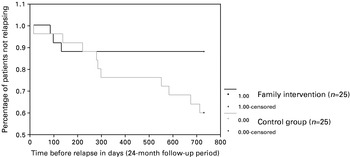
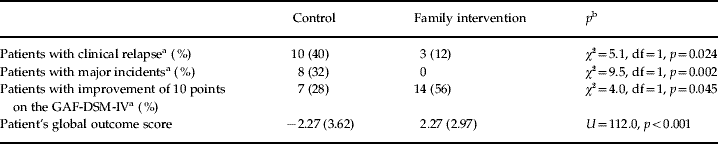
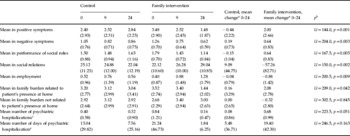
Tables 2 and 3 show that there was a lower rate of clinical relapse and major incidents, in addition to an improvement in positive and negative symptoms, in employment, social relations, global functioning, and family burden in the family intervention group. A highly significant association was found between family intervention and patient's global outcome score. The difference between groups in the change in number of psychiatric hospitalizations tended towards statistical significance, and the decrease in the number of days and number of hospitalizations was only statistically significant in the family intervention group (Wilcoxon p=0.002 in both cases). Figure 2 shows the survival curves in clinical relapse for the family intervention and control groups (log rank=4.31, df=1, p=0.038).
Cumulative proportion of survival in family intervention and control groups.

Patients' outcomes at 24 months of intervention
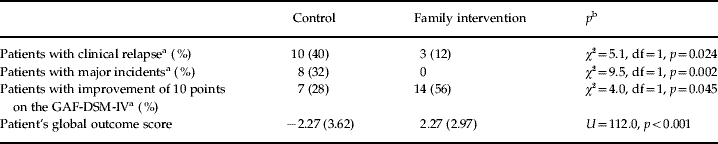
GAF, Global Assessment of Functioning Scale.
a Dichotomous variable (0=no, 1=yes). b Mann–Whitney U test, χ2 test.
Patients' outcomes at baseline, 9 and 24 months in control and family intervention groups

Standard deviation (s.d.) given in parentheses.
a Change in social relations in %.
b Mann–Whitney U test.
c In the basal period, the mean number of psychiatric hospitalizations and the mean number of days of psychiatric hospitalization during the previous 2 years (s.d.).
In 45 of the 47 patients who did not agree to take part in the trial, the number of psychiatric hospitalizations and length of stay in days during the 2 years the trial lasted were recorded. The decrease in the number and days of hospitalization in the family intervention group, as compared with the 2 previous years, was significantly greater than in patients who did not agree to participate [mean absolute change in number of hospitalizations: 0.68 (0.99) v. 0.18 (1.0), Mann–Whitney U test (MWU)=396.0, p=0.019; mean absolute change in days of hospitalization: 19.4 (42.3) v. 9.8 (33.1), MWU=398.5, p=0.027]. The control group did not differ significantly from the patients who did not agree to participate.
Unlike the result obtained for the objective family burden related to the patient's presence at home, no statistically significant differences were found between the groups in the objective burden score not related to the patient's presence at home.
Regarding major incidents, two suicide attempts, two accidental deaths related to psychotic symptoms, a serious fight where the patients sustained serious injuries and three patients initiating substance abuse were recorded in the control group. In the family intervention group minor incidents were detected such as starting sexual relationships with the risk of HIV infection, vagrancy, bouts of alcohol consumption, and aggressivity.
Adherence to pharmacological and rehabilitation treatments
During the trial, patients were treated with a mean dose of 425.8 (253.1) mg/day of chlorpromazine equivalent. There were no statistically significant differences between the family intervention and control groups in compliance with treatments. There were no differences in the percentage of days without medication during the follow-up period between the experimental and control groups [FI: 2.0 (5.8), C: 3.0 (8.1), MWU=297.0, p=0.7]. Neither was there any difference between the groups in terms of the doses prescribed or taken [FI: 449.2 (245.4), C: 402.4 (263.5), p=0.2] of typical or atypical antipsychotic drugs or of clozapine. There was no significant difference between the groups regarding the number of months engaged in rehabilitation activities [FI: 5.7 (10.6), C: 6.6 (13.3), p=1.0].
Multivariate analysis
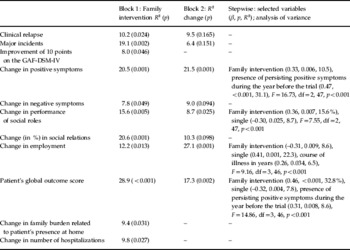
To assess whether the family intervention programme contributed to positive gains above other plausible factors, we first carried out a series of correlations between family intervention, other prognostic factors (course of illness in years, pre-morbid adjustment scale, daily dose of neuroleptic drug taken during the trial or when predicting clinical relapse, in the period up to relapse, number of hours per month spent on rehabilitation activities, male sex, single, presence of persisting positive symptoms during the year before the trial, presence of clinical relapse during the 2 years before the trial) and outcomes. Second, to assess the independence of the relationship between family intervention and the patient's clinical and social outcomes, multivariate regression models were designed that included the family intervention (0=no, 1=yes) and among the prognostic factors those that presented a bivariate Pearson's correlation coefficient with a level of p<0.1.
Table 4 shows the contribution of family intervention (block 1) and prognostic factors (block 2) to the prediction of the outcome variables. The last column shows the results of the stepwise selection procedure in those cases where R 2 was significantly improved. The result of the regression by blocks procedure in predicting clinical relapse, major incidents, improvement of 10 points on the GAF scale, change in social relations and change in negative symptoms only selected family intervention as a predicting variable with statistically significant coefficients. However, when predicting the change in positive symptoms, the stepwise procedure selected family intervention and also persisting positive symptoms during the year before the trial onset. In the prediction of change in performance of social roles, the stepwise procedure selected family intervention and being single. In the prediction of change in quantity of useful work, the stepwise procedure selected family intervention, being single, and duration of the illness. In the prediction of the patient's global outcome score, the stepwise procedure selected family intervention, being single, and persisting positive symptoms during the year before the trial onset. Regarding the prediction of the change in objective family burden related to the patient's presence at home, no significant relationship was found with any of the patient's prognostic factors or with the key relative's variables [age, female sex (0=no, 1=yes), being married (0=no, 1=yes), hours of face-to-face contact with the patient per week in the baseline period, and employment outside the home (0=no, 1=yes)]. Only family intervention predicted the change in objective family burden related to the patient's presence at home, accounting for 9.4% of the variance. Regarding the prediction of the change in the number of psychiatric hospitalizations, no significant relationship was found with any of the patient's prognostic factors. Only family intervention predicted the change in the number of psychiatric hospitalizations, accounting for 9.8% of the variance.
Results of the estimation of linear regression models predicting outcomes

GAF, Global Assessment of Functioning Scale; β, standardized coefficient.
R 2 given as percentage.
The effect of family intervention on an outcome variable may be direct (for example, by intervening in a crisis, solving problems or achieving a positive change in attitude) or indirect, resulting from the effect on another outcome variable. To further analyse the relationship between family intervention and outcomes controlling these indirect effects, the same analytical procedure as that shown in Table 3 was performed. The results of the analysis show that family intervention is the only variable selected with a statistically significant effect on clinical relapse, major incidents, change in number of hospitalizations, positive symptoms, social relations, and employment. Regarding the change in negative symptoms, the stepwise procedure selected the change in performance of social roles (β=0.570, p=0.000, R 2=49.4%) and change in social relations (β=−0.243, p=0.046, R 2=4.2%), with F=27.1 (df=2, 47, p=0.000). With regard to the change in performance of social roles, the stepwise procedure selected the change in negative symptoms (β=0.483, p=0.000, R 2=49.4%), change in employment (β=−0.294, p=0.002, R 2=7.2%), and change in family burden related to the patient's presence at home (β=0.338, p=0.000, R 2=13.3%), with F=35.8, (df=3, 46, p=0.000). Finally, as regards the change in objective family burden related to the patient's presence at home, the stepwise procedure selected the change in performance of social roles (β=0.575, p=0.000, R 2=33.0%; F=23.6, df=1, 48; p=0.000).
Discussion
Family intervention significantly reduced the number of clinical relapses, major incidents, positive and negative symptoms and admissions to hospital, improved social functioning and relieved family burden, as compared with standard treatment. This effect was maintained after controlling the quantity of useful work, prognostic factors, antipsychotic dose taken and time devoted to rehabilitation.
The prevention of clinical relapse is similar to that found in previous randomized controlled studies in which the individual family intervention lasted for 2 years (Falloon et al. Reference Falloon, Boyd, McGill, Williamson, Razani, Moss, Gilderman and Simpson1985; Hogarty et al. Reference Hogarty, Anderson, Reiss, Kornblith, Greenwald, Ulrich and Carter1991). The question remains as to whether the long-term effects of this prolonged treatment are also more durable (Tarrier et al. Reference Tarrier, Barrowclough, Porceddu and Fitzpatrick1994; Bertelsen et al. Reference Bertelsen, Jeppesen, Petersen, Thorup, Øhlenschlaeger, le Quach, Christensen, Krarup, Jørgensen and Nordentoft2008).
The evidence regarding the efficacy of family intervention in randomized controlled trials on relieving positive symptoms is contradictory (Falloon et al. Reference Falloon, Boyd, McGill, Williamson, Razani, Moss, Gilderman and Simpson1985; Xiong et al. Reference Xiong, Phillips, Hu, Wang, Dai, Kleinman and Kleinman1994; Barrowclough et al. Reference Barrowclough, Tarrier, Lewis, Sellwood, Mainwaring, Quinn and Hamlin1999, Reference Barrowclough, Haddock, Tarrier, Lewis, Moring, O'Brien, Schofield and McGovern2001; Chien et al. Reference Chien, Chan and Thompson2006; Garety et al. Reference Garety, Fowler, Freeman, Bebbington, Dunn and Kuipers2008). The duration of the intervention and sampling and methodological parameters may account for the differences found between studies.
Regarding major incidents, Garety et al. (Reference Garety, Fowler, Freeman, Bebbington, Dunn and Kuipers2008) found no clear differences between the experimental and the control group. In our case, all the adverse major incidents occurred in the control group. Some risk situations occurring in the family intervention group were identified and treated early on in crisis intervention sessions with the active participation of the family to prevent major incidents (active measures for risk prevention were taken, and at no time was family support or contact lost despite any initial rejection that such behaviour might generate).
The findings about hospital admissions are consistent with those of other authors (Pharoah et al. Reference Pharoah, Mari, Rathbone and Wong2006). The almost significant effect of the family intervention on the prevention of hospitalizations in this trial is reinforced by the finding that the intervention group experienced a significant relative decrease of hospitalizations compared with the group of patients who refused to participate whereas this was not the case in the control group. The lack of clear statistically significant differences in this case may be partly explained by the fact that, in our setting, the possibilities of hospitalization are reduced because of the small number of available beds (six beds/100 000 inhabitants), and also partly by the greater family support given in situations of crisis. These two factors reduce the variability in hospitalization indicators and hence the probability of finding differences between the groups.
The favourable effect of intervention on negative symptoms is consistent with that reported by Dyck et al. (Reference Dyck, Short, Hendryx, Norell, Myers, Patterson, McDonell, Voss and McFarlane2000) but differs from that found in other trials (Xiong et al. Reference Xiong, Phillips, Hu, Wang, Dai, Kleinman and Kleinman1994; Barrowclough et al. Reference Barrowclough, Tarrier, Lewis, Sellwood, Mainwaring, Quinn and Hamlin1999, Reference Barrowclough, Haddock, Tarrier, Lewis, Moring, O'Brien, Schofield and McGovern2001; Bradley et al. Reference Bradley, Couchman, Perlesz, Nguyen, Singh and Riess2006; Garety et al. Reference Garety, Fowler, Freeman, Bebbington, Dunn and Kuipers2008). This may be explained by differences in the sample, techniques, application or duration of treatment.
The effect of family intervention on the improvement in social functioning has been found to be positive on the majority of efficacy studies (Pfammater et al. Reference Pfammater, Martin-Junghan and Dieter-Brenner2006); however, no effect was found in effectiveness studies (Chien & Wong, Reference Chien and Wong2007; Garety et al. Reference Garety, Fowler, Freeman, Bebbington, Dunn and Kuipers2008). The effect on the improvement in time of useful work has not been described previously.
Family intervention is associated with a reduction in family burden attributed to the patient's presence at home, but not with the burden not attributed to other factors, which supports the specificity of the effect. The reduction in the burden is consistent with the findings of other authors (Xiong et al. Reference Xiong, Phillips, Hu, Wang, Dai, Kleinman and Kleinman1994; Hazel et al. Reference Hazel, McDonell and Short2004; Chien et al. Reference Chien, Chan and Thompson2006; Magliano et al. Reference Magliano, Fiorillo, Malangone, De Rosa and Maj2006; Chien & Wong, Reference Chien and Wong2007).
Given that family interventions are known to promote treatment compliance, it can be speculated that it is by this means that family intervention has an effect on clinical symptoms and thus contributes to fewer relapses (Pharoah et al. Reference Pharoah, Mari, Rathbone and Wong2006). However, in this study multivariate analyses showed that the effect of family intervention on the various patient outcomes is independent of compliance with antipsychotic drug treatment and rehabilitation activities. Moreover, the family intervention maintains its effects after controlling for prognostic factors such as being single, persisting positive symptoms in the year before the trial and the duration of illness. These statistically significant independent associations of family intervention with improvement in the patient's clinical and social functioning support the specificity of its effect.
The results of the multivariate analysis show that the effect of family intervention on negative symptoms and performance of social roles may be mediated by its effect on employment and in social relations. Similarly, the effect on burden is found to be mediated by the improvement in patient's performance in social roles, and this is consistent with the findings reported in some cohort studies (Provencher & Mueser, Reference Provencher and Mueser1997; Magliano et al. Reference Magliano, Fiorillo, Fadden, Gair, Economou, Kallert, Schellong, Xavier, Gonçalves Pereira, Torres Gonzales, Palma-Crespo and Maj2005; Roick et al. Reference Roick, Heider, Toumi and Angermeyer2006).
The improvement in social functioning brought about by family intervention is not accompanied by a clinical worsening such as that reported in the context of industrial rehabilitation (Wing et al. Reference Wing, Bennett and Denham1964). In this respect, family intervention could have a double effect, first by creating a more stimulating family environment that encourages opportunities for activity, thereby reducing negative symptoms, and second by providing a ‘holding’ environment, which might reduce the intensity of positive symptoms. Obviously, more research is needed to test this hypothesis.
The trial has several limitations. Given our inclusion criteria, patients who suffered severe schizophrenia with persisting positive symptoms at the maximum score on the PAS, or with co-morbidity due to the use of toxic substances, were excluded from our study. Thus, it could be considered that the external validity of this trial is limited by the restrictive inclusion criteria. However, the intervention programme was designed for patients without such characteristics. Patients with substance abuse co-morbidity or living on their own require another type of therapeutic intervention (Barrowclough et al. Reference Barrowclough, Haddock, Tarrier, Lewis, Moring, O'Brien, Schofield and McGovern2001; Haddock et al. Reference Haddock, Barrowclough, Tarrier, Moring, O'Brien, Schofield, Quinn, Palmer, Davies, Lowens, McGovern and Lewis2003). In addition, judging from the high rate of refusal in this study, it is necessary to consider that the intervention was offered to all patients in the catchment area who met the inclusion criteria independently of their subjective perceived need for treatment. This procedure differs from those usually used in clinical trials of efficacy and shows the effectiveness of the intervention and also its limited population impact. We also tried to minimize the effect that the lack of a psychotherapeutic placebo might have on increasing the effect of family intervention by adding individual counselling with no known effect on the study outcomes. In addition, we attempted to maintain the evaluator's blindness regarding group allocation.
The results of this study could be interpreted in the light of the stress-vulnerability model of schizophrenia (Zubin & Spring, Reference Zubin and Spring1977; Nuechterlein et al. Reference Nuechterlein, Dawson, Gitlin, Ventura, Goldstein, Snyder, Yee and Mintz1992). This model postulates that psychotic episodes result from the interaction between the individual vulnerability of the patient and the level of environmental stress the patient is exposed to. According to this model, the improvement in patients' clinical conditions and social functioning may be related to changes in relatives' attitudes, as a result of the psychosocial intervention. This hypothetical relationship between family intervention and change in family behaviour and attitudes will be the subject of a future study.
Acknowledgements
This study was supported by project grant 97/1159 from Fondo de Investigaciones Sanitarias, and project grant 011010 from Fundació La Marató de TV3. This study was supported by the Associació Valenciana de Docència i Investigació en Salut Mental. We are grateful to Professor J. Leff and C. Gamble for assistance in the team's training in psychosocial family intervention.
Declaration of Interest
None.