

Introduction
In a digitally-networked society, many of our interactions are carried out through the services of telecommunications companies known as intermediaries, which carry and mediate our communications. This article examines how Canadian internet service providers (ISPs), as a particular class of intermediaries, act as “privacy custodians” when they govern the privacy of their subscribers and users. Internet service providers play numerous roles in our society besides simply providing internet access, with each role denoting a position in a social relationship and an associated set of expectations.Footnote 1 In this article, I show how the role of privacy custodian has developed in Canadian telecom since the early 2000s, in tension and contradiction with the roles of copyright enforcer, surveillance partner, advertiser, and information merchant. Other scholars (Balkin Reference Balkin2016; Kerr Reference Kerr2002) have argued we could address some of these tensions by seeing intermediaries as fiduciaries and regulating them appropriately. The fiduciary concept has much in common with the role of the privacy custodian, in that it refers to a relationship of dependence between users and ISPs, where an information asymmetry leaves users with little choice but to trust (or hope) that their privacy is being protected by these organizations. However, the argument for defining intermediaries as information fiduciaries (Balkin Reference Balkin2016) is a prescriptive one that seeks to align these organizations with a legal category and its obligations, a proposal to address the possibility of harm that these organizations can cause. The concept of privacy custodian refers more broadly to an organization that governs the privacy of its users, whether or not we think this role triggers fiduciary obligations. My interest here is to describe how this role has developed into the present, to identify its tensions and contradictions, and to understand the strategies that ISPs use to navigate these pressures. One of these strategies has been for intermediaries to take a more positive or proactive stance as privacy custodians, voluntarily going beyond statutory obligations. However, privacy custodians exercise discretion both when meeting statutory obligations and when extending their roles further. Intermediaries that take positive steps to strengthen privacy protections and share information about their practices do so selectively, publicizing privacy-enhancing measures while minimizing conduct that users might disapprove of.
Where ISPs have access to vast amounts of sensitive personal information about their users—including their browsing histories, interests, habits, and secrets—they act as privacy custodians by “guarding the link between the information and the identity of the person to whom it relates” (R v Spencer [2014], para 46). Where ISPs are conduits of information, they act as privacy custodians by guarding the privacy of these communications. Internet service providers also act as privacy custodians by limiting the amount of information they collect, even though such collection might be easy or profitable. Privacy custodianship is not just limited to the obligations specified by privacy law but refers more broadly to how personal information is governed by these organizations. Finally, the role of a privacy custodian extends beyond its relationship with users and their personal information and is played out through a broader relationship with the public. This includes efforts by some intermediaries to educate the public about privacy, as well as the accountability regimes through which intermediaries report how they gather, handle, and disclose personal information.
As privacy custodians, intermediaries must navigate role “conflicts”Footnote 2 when they assist government agencies and other organizations investigating their customers and users (see Kerr and Gilbert Reference Kerr, Gilbert, Mendina and Britz2004). On a recurring basis, expectations that intermediaries should act as guardians and caretakers of personal information have competed or conflicted with other pressures and public policies, including copyright, policing and cyber security. In order for ISPs to operate as agents of surveillance, identification, and targeted marketing, they must reconcile these roles with their conduct as privacy custodians.
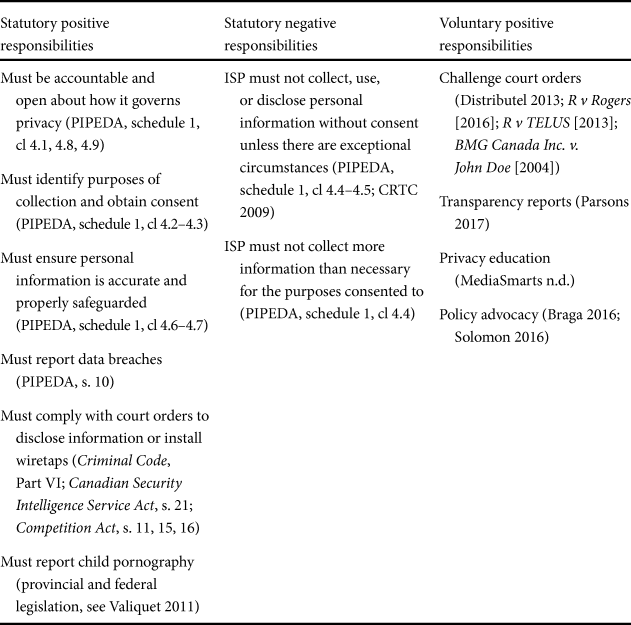
Privacy custodians have both positive and negative statutory obligations, and can choose to adopt additional positive responsibilities to protect individual privacy. Canadian ISPs are subject to the Personal Information Protection and Electronic Documents Act (PIPEDA), which imposes positive responsibilities around accountability, identifying the purposes of collection and obtaining consent, ensuring accuracy of information, and using appropriate safeguards. However, the privacy responsibilities that have been at the center of internet policy debates are expressed primarily in negative terms. These are obligations not to collect, use, or disclose personal information, or to place specific limits on these activities (schedule 1, cl 4.4–4.5). These negative obligations are recurrently tested by pressures to collect, use and disclose more information, where this serves the needs of government agencies, copyright owners, or corporate profitability. The following table lists the positive and negative statutory responsibilities of ISPs discussed in this article, and the positive responsibilities that some ISPs have been voluntarily adopting.
Canadian ISP Responsibilities as Privacy Custodians

PIPEDA: Personal Information Protection and Electronic Documents Act; ISP: internet service provider; CRTC: Canadian Radio and Telecommunications Corporation
It is important to note that the above distinction between negative and positive responsibilities is not always straightforward. Many negative responsibilities have a corresponding and equivalent positive responsibility, and vice versa (M. G. Singer Reference Singer1965). For example, the positive duty to obtain consent before disclosure can be considered a prohibition against disclosure without consent. An obligation to openness, accuracy, and accountability has a corresponding obligation not to be secretive and misleading. But other responsibilities can be difficult to frame in terms of a positive/negative equivalence, and one of the most important for this analysis is the limitation on disclosure, which is essentially negative, and requires some additional reasoning to translate to a positive duty. However, this is precisely what some intermediaries have done (Distributel 2013; R v Rogers [2016]; R v TELUS [2013]; BMG Canada Inc. v John Doe [2004]), by interpreting the limitation of disclosure as obliging them to take certain actions in order to protect their users. Effectively, this means that some intermediaries have been adopting a more positive orientation towards their privacy responsibilities and playing a more active role in determining what it means to be a privacy custodian. Rather than a legal standard which they must meet, some organizations have treated privacy as a value to fight for, even if this means challenging state actors or opposing court orders. This trend reflects the growing recognition of the important role played by privacy custodians and the efforts of some organizations to differentiate themselves by publicly demonstrating (rather than merely stating) their commitments to the privacy of their users. However, this trend has been neither consistent nor strong, since intermediaries’ roles as privacy custodians are continually in conflict with contradictory pressures.
Intermediaries, whether these are massive corporate ISPs or not-for-profit community networks, can be understood as collective actors, in that they exercise a degree of autonomy when making decisions, such as whether or not to cooperate with law enforcement, or what it means to safeguard their users’ privacy. We can see this through the different approaches that ISPs acting as privacy custodians have adopted regarding issues such as privacy policies, the amount of time they choose to retain personal information, how they respond to copyright notices, and how they share information for reasons of security and law enforcement (Clement and Obar Reference Clement and Obar2016; Kerr Reference Kerr2002; Parsons Reference Parsons2017). For each of these questions, intermediaries must find ways of resolving the tensions around their responsibilities as privacy custodians when these conflict with other roles and are subject to contradictory pressures.
Internet service providers occupy a strategic position by operating infrastructures that link directly to individual users, providing valuable opportunities for surveillance and identification. Copyright owners, police and security agencies have long recognized this, attempting to enroll ISPs as active partners in their investigatory and enforcement actions (Nesbitt Reference Nesbitt2003; Nevis Consulting Group 2003). As privacy custodians, ISPs must safeguard communications and personal information and be accountable to their users regarding these practices. In their surveillance roles, ISPs collect and disclose information and are sometimes prohibited from notifying their users or the public of such activities. While those advocating for surveillance practices often claim that intermediaries can collect or disclose personal information while respecting privacy (Public Safety Canada 2012, 371; Toews Reference Toews2012), the contradiction between the two has been made clear through a number of legal contests covered in this article.
Surveillance by ISPs also occurs where it is profitable or aids in network management, and these practices must be reconciled with privacy commitments. Data generated about network users by ISPs has become increasingly lucrative, whether to target advertising, tailor services, authorize access, or to be transformed into new kinds of information commodities (Fung Reference Fung2016). As ISPs expand their roles beyond merely carrying data, to collecting—and monetizing—it as well, conflicts with privacy responsibilities can quickly arise (see Office of the Privacy Commissioner 2015b).
Internet service providers operate in the midst of rival pressures to collect and share more data on the one hand, and the concerns of users and privacy advocates on the other, where accommodating some desires or expectations creates tension with others. In steering a course through these currents, organizations must consider how their actions will be perceived, and so privacy governance is selectively publicized as a matter of corporate social responsibility (CSR) (see Parsons Reference Parsons2017; Pollach Reference Pollach2011). Intermediaries seek to establish trust and confidence in their users, who understand that this relationship has the potential to be abused (Balkin Reference Balkin2016), and who are often concerned and distrustful about how their personal information is handled (Office of the Privacy Commissioner 2017). When intermediaries monetize personal information, they can try to win support from users by explaining the consumer benefits (Henderson Reference Henderson2014), or they can limit publicity and carry on “under the radar” (Behar Reference Behar2018). Either way, obtaining valid consent from users is key in Canadian privacy law, and skirting this requirement can lead to the undesirable publicity of public complaints and being called out by the Office of the Privacy Commissioner (2015b).
When ISPs share personal information without users’ consent, as a result of pressure from state agencies or court orders, a common public justification is that these actions are limited to, or constrained by, what is legally required (Gaudrault Reference Gaudrault2012; Karadeglija Reference Karadeglija2014; Ling Reference Ling2014; Mediacaster 2011). Whatever the public thinks of these practices, intermediaries insist they have no choice but to comply with the law. And yet, companies operating in the same legal jurisdiction have taken rather different approaches in interpreting just what their legal obligations consist of. Indeed, citing what is “required by law” can obscure the amount of latitude that intermediaries have in their actions, including the choice to test or challenge the law (see R v Rogers [2016]; R v TELUS [2013]). Internet service providers thereby minimize their agency, even as they exercise it. Footnote 3
The final way for intermediaries to resolve their privacy role conflicts is to publicly position themselves as privacy champions, visibly going above and beyond a minimum commitment to PIPEDA. This is an approach that does not exclude the possibilities described above, as the same company can quietly monetize personal information, defend disclosures to government as a legal necessity, while also championing its efforts to fight for users’ privacy interests. Positive actions by intermediaries are the focus of this article, but the roles of intermediaries as privacy custodians developed before PIPEDA and the internet, and this history requires some brief elaboration.
Pre-Internet Intermediaries as Privacy Custodians
While the expectations applied to intermediaries in Canada varied over the course of the nineteenth and twentieth century, the idea that these organizations had a duty to protect the privacy of the communications is almost as old as the idea that they had a duty to help law enforcement. By 1918, companies were subject to provincial legislation in Ontario and Quebec that regulated eavesdropping and wiretapping (Martin Reference Martin1991, 144–145), followed in the 1950s by legislation in Alberta and Manitoba (Canadian Committee on Corrections 1969, 82; Cornfield Reference Cornfield1967, 112). More general privacy laws developed gradually in Canada over the latter half of the twentieth century and into the twenty-first (Cohen Reference Cohen1982, 665–67; Cornfield Reference Cornfield1967; Power Reference Power2013). However, the eavesdropping and surveillance restrictions that did exist often did not apply to police investigations, so formal requirements for intermediaries to assist police in intercepting communications were rarely stated explicitly (Cornfield Reference Cornfield1967, 112). Rules prohibiting intermediaries divulging private communications could be overcome through some form of “lawful authority.”Footnote 4 Intermediaries (specifically, telephone and telegraph companies) did apparently assist police investigations and enable wiretaps, but the extent and nature of this surveillance is unclear.Footnote 5
In 1969, the Ouimet Report (Canadian Committee on Corrections 1969) recommended greater control over electronic surveillance and accountability for its use, eventually leading to the Protection of Privacy Act in 1974 (Hubbard, Brauti, and Fenton Reference Hubbard, Brauti and Fenton2015, sec. 1.1.1; Rabideau Reference Rabideau1991, 172–73). The Privacy Act amended the Criminal Code to criminalize the “invasion of privacy” as well as formalizing the exemptions to such an offence. These exemptions specified when forms of electronic surveillance were not considered a crime, such as when carried out under judicial authorization (Hubbard, Brauti, and Fenton Reference Hubbard, Brauti and Fenton2015). The 1974 amendments thereby formalized the authority under which police (or intermediaries working on their behalf) could carry out surveillance, and established a hierarchical relationship between the roles and responsibilities of intermediaries. “Invading” the privacy of subscribers was now a criminal act, thereby constraining intermediaries as carriers of communications, and obliging them to respect the privacy of subscribers. However, the exemptions listed in what would become Part VI of the Criminal Code effectively trumped this negative responsibility, specifying instances in which privacy invasions could be justified or legally authorized. Intermediaries now clearly had a vital role to play in safeguarding privacy, but their privacy obligations were secondary to their judicially-authorized surveillance responsibilities. By the 1990s, the legal authorities under which police could demand or request access to subscriber communications or records held by telephone companies were fairly clear, but the attempt to extend such rules to cover ISPs would set off lengthy and contentious debates.
Invisible Handshakes and Internet Surveillance
In the early public internet of the 1990s, police forces in general devoted little attention to online investigative and surveillance techniques. According to Birnhack and Elkin-Koren (Reference Birnhack and Elkin-Koren2003), governing online activity was initially left to the “invisible hand” of the market and the new private intermediaries. In the 2000s, state agencies sought to make an “invisible handshake” (Birnhack and Elkin-Koren Reference Birnhack and Elkin-Koren2003) with these intermediaries, recruiting and co-opting them towards state goals. Data packets may frequently cross international borders without inspection, but they are carried over a physical transport infrastructure that is, by necessity, a local asset and therefore subject to state control (Goldsmith and Wu Reference Goldsmith and Wu2006, 73). Governments recognized that the cooperation of ISPs would be key to policing and surveillance in the online era, and some of these ISPs (the former telecom monopolies that emerged as ISPs in the mid-1990s) were already familiar partners for state agencies.
While some authors writing in the 2000s warned that ISPs would become close surveillance partners of state agencies (Birnhack and Elkin-Koren Reference Birnhack and Elkin-Koren2003) and copyright owners (de Beer and Clemmer Reference de Beer and Clemmer2009, 405–6), these authors did not fully appreciate the ways that the interests of these groups were fundamentally misaligned. Such conflicts came dramatically to the fore in battles over copyright reform, where the business models of intermediaries and copyright owners were at odds (see Edwards Reference Edwards2011; Haggart Reference Haggart2014). When it came to state surveillance efforts, ISPs were more willing to act as deputies or partners, but even this cooperation had its limits, and the tension became more pronounced following the Snowden disclosures of 2013. In both cases—copyright enforcement and state surveillance—ISPs’ roles as privacy custodians would come into conflict with expectations that these organizations would act as internet police or surveillance deputies. However, it was in a legal dispute concerning copyright that Canadian ISPs would first assert the privacy interests of their subscribers, interpreting a negative responsibility not to disclose information as a positive duty to oppose such disclosure.
Privacy and Piracy
In 2004, a group of incumbent ISPs took an active stand to protect the privacy of their subscribers against a group of copyright owners. In what would become a landmark legal decision (BMG Canada Inc. v John Doe [2004]), the ISPs acted to safeguard the interests of their customers: the “John” and “Jane Does” whom copyright owners sought to identify. The copyright owners presented a list of IP addresses collected by the copyright surveillance company MediaSentry, which had identified these addresses as sharing copyrighted music. In order to link these same IP addresses to internet subscribers who could be sued for copyright infringement, the copyright owners needed the help of ISPs. However, ISPs had a statutory responsibility to limit the disclosure of personal information as a consequence of PIPEDA, which had recently come into effect. The Federal Court was in a position to decide between these competing demands, and had the power to order the ISPs to cooperate.
The relevant aspects of the case described above (known as BMG Canada Inc. v Doe), besides the threshold it established for subsequent information disclosures (Geist Reference Geist2005), were the different positions taken by the five ISPs involved. All were acting as privacy custodians for their respective “Does.” The companies were “trusted holders” of these subscribers’ identities (Kerr and Cameron Reference Kerr, Cameron, Strandburg and Raicu2006, 272), but how they acted on this responsibility varied. Importantly, some ISPs rationalized their role as privacy custodians in a way that included a positive responsibility to assert the privacy rights of their subscribers. Others adopted a more negative orientation—treating privacy responsibilities as a set of conditional obligations not to disclose personal information. The case would be an important early episode in a process that would see some intermediaries developing more positive conceptions of privacy stewardship.
The lowest degree of involvement in BMG Canada Inc. v Doe came from Vidéotron, which chose not to participate in the court proceedings. The company’s guardianship of its subscribers’ identities amounted to waiting for the court order to be issued before these identities were disclosed—a position that could be attributed to the company’s various media interests and its general opposition to “piracy” (Kerr and Cameron Reference Kerr, Cameron, Strandburg and Raicu2006, 290; Pacienza Reference Pacienza2004; Thompson Reference Thompson2004). This was a negative orientation to the company’s privacy responsibilities, which were interpreted as a prohibition against disclosing customer information to a private party in the absence of a court order.
On the other hand, Shaw provided the greatest resistance to the motion, pushing back to protect the privacy of the company’s customers (Pacienza Reference Pacienza2004; Shaw Communications Inc. 2004; G. Shaw Reference Shaw2004; Thompson Reference Thompson2004). The positive duty of a privacy custodian expressed by Shaw Communications amounted to asserting the privacy rights of the company’s anonymous subscribers by making arguments on their behalf to oppose the court order sought by the copyright owner. Meanwhile, Bell (2004) and Rogers (2004) both submitted privacy-related arguments, and TELUS (2004, 2) complained about being conscripted to carry out investigations for the copyright owners, which might result in the company being sued by its own customers (Kerr and Cameron Reference Kerr, Cameron, Strandburg and Raicu2006, 278–79).
In the end, Justice von Finckenstein refused to grant a court order to compel the ISPs to identify their customers on several grounds,Footnote 6 with Shaw and TELUS publicly claiming credit for protecting the privacy of their subscribers (G. Shaw Reference Shaw2004). The decision (and its subsequent appeal) solidified both the duty of ISPs to protect the identities of their subscribers and the conditions under which such protection could be overcome in a lawsuit (Geist Reference Geist2005; Kerr and Cameron Reference Kerr, Cameron, Strandburg and Raicu2006).
While this particular episode is a good starting point for considering how ISPs developed into the privacy custodians upon which we are all now so dependent, it is certainly not the beginning of a straight trajectory through which intermediaries became increasingly-vigorous defenders of subscriber privacy. BMG Canada Inc. v Doe was a notable instance of ISPs asserting their positive responsibilities as privacy custodians in a way that established legal standards for future cases but one that was followed by inconsistency, ambivalence, and contradictory attitudes by intermediaries towards the privacy of their users.
In subsequent years, ISPs involved in copyright cases interpreted their responsibilities as privacy custodians in a variety of ways. When file-sharing lawsuits reappeared in Canada in 2011, the three ISPs involved (Bell, Cogeco, and Vidéotron) did not oppose the copyright owner’s attempt to obtain a court order to identify their subscribers (McKenna Reference McKenna2011; Mediacaster 2011). In a subsequent case involving the same copyright owner (Voltage Pictures), the ISP TekSavvy also did not oppose the court order but fought for the right to notify the subscribers it was being asked to identify (Dobby Reference Dobby2012; Gaudrault Reference Gaudrault2012) and argued for ways to minimize the privacy impacts of any information disclosure (TekSavvy 2015, 722–31). In another file-sharing lawsuit, the ISP Distributel originally agreed to identify some subscribers but then changed its position and opposed the copyright owner in court, claiming the motion to identify its subscribers would be a threat to their privacy rights (Distributel 2013, 52–54; O’Brien Reference O’Brien2013). Most recently, in a case before the Supreme Court of Canada, Rogers contested a motion from Voltage Pictures to identify its customers, but it did so on the issue of costs rather than privacy grounds (Rose Reference Rose2017).
These preceding examples demonstrate how Canadian ISPs operate as privacy custodians in the context of file-sharing lawsuits by copyright owners. In these cases, the statutory negative responsibilities of privacy custodians have been fairly clear and uncontroversial under PIPEDA, as requiring a court order prior to any disclosure of personal information. Positive responsibilities have depended more on the discretion of the intermediary, with some choosing to be more assertive than others in defence of users’ privacy interests. In contrast, when intermediaries act as privacy custodians responding to police agencies, PIPEDA’s negative responsibilities have been more easily neutralized by exceptions written into the statute. Until the Supreme Court of Canada’s decision in R v Spencer [2014],Footnote 7 intermediaries had wide latitude to decide when to insist on a court order in law enforcement matters. Exceptions to privacy obligations, whether discretionary or mandatory, have been key points of contention in the story of lawful access in Canada.
PIPEDA, Lawful Access, and Exceptions to Privacy Protection
What is known as “lawful access” includes a number of positive duties, or requirements for intermediaries to assist state actors in obtaining information or carrying out surveillance. These duties involve complying with court orders, such as those mandating wiretaps (Government of Canada 2002). A related positive responsibility is the mandatory disclosure of information relating to child pornography (Valiquet Reference Valiquet2011). However, the debate over lawful access has frequently focused on the negative responsibilities of privacy custodians, and the scope of the exceptions to these responsibilities. In other words, an intermediary’s responsibilities not to disclose personal information can serve as a barrier to lawful access, but one that can often be overcome by state actors through exceptions to privacy law.
The principles underlying PIPEDA include consent to the collection and disclosure of personal data, and limiting the collection and the disclosure of data to a specified purpose. The exception to obtaining consent for any disclosure of personal data occurs where such disclosure takes place “by the authority of law” (OECD 1980). Therefore, while a prohibition against the disclosure of personal information without consent is a key part of private-sector privacy law in Canada, PIPEDA (and related privacy legislation) includes a substantial list of exceptional circumstances in which the non-consensual disclosure of personal information is legally permitted (Lawson and O’Donoghue 2009, 34–35; Power Reference Power2013, 79–81).
The disclosure of personal information without consent is covered by PIPEDA’s section 7(3), which specifies the circumstances in which such disclosures are permissible. These include various kinds of investigations, compliance with court orders, matters of national security, emergency situations, and contacting next-of-kin in instances of injury or death. In these circumstances, information that has been collected by an intermediary for other reasons (such as managing a subscriber’s account) can be shared without the knowledge or consent of the subscriber. The subsection considered the most important in debates over intermediaries’ lawful access responsibilities has been section 7(3)(c.1), which permits disclosure to a “government institution” that has “identified its lawful authority.” This section was reportedly introduced into PIPEDA “by Industry Canada as a result of representations made by law enforcement and national security agencies. The intent as explained to Parliament was to maintain the status quo for these agencies to allow them to engage in pre-warrant intelligence gathering” (Morin Reference Morin2011, 4).
Subsequent to enactment, the limits of the “status quo” protected by PIPEDA’s “lawful authority” section turned out to be particularly ambiguous (see BCCLA 2012, 60–61). Eventually, court decisions would provide greater guidance as to how the law should be interpreted, but police agencies and ISPs needed some shared understanding without having to wait for these precedents to be established, particularly regarding the important issue of online child pornography (known as internet child exploitation). To this end, the Canadian Coalition Against Internet Child Exploitation (CCAICE) was formed in 2005 as a partnership between incumbent ISPs, industry associations, and government agencies (CCAICE 2005). The CCAICE went about designing and implementing a protocol that would meet the “intent behind section 7(3)(c.1)” and be “privacy compliant” (Morin Reference Morin2011, 8). The protocol provided a way for child exploitation investigators who had obtained an IP address to request an internet subscriber’s name and address information at the “pre-warrant stage” of investigations (Morin Reference Morin2011, 1). As per PIPEDA’s section 7(3)(c.1), requests for disclosure were based on the police officer’s “lawful authority” and the cooperation of ISPs was voluntary.
Since the phrase “lawful authority” was never clearly defined, it ended up being interpreted in different ways by government agencies and private organizations (House of Commons Standing Committee on Access to Information, Privacy and Ethics 2007; Lawson Reference Lawson2011; Morin Reference Morin2011; L. Singer Reference Singer2012). Disclosures were made in cases not involving child exploitation, and police sometimes requested more than just name and address information (Ling Reference Ling2014; Office of the Privacy Commissioner 2015a, 7). While, in some cases, a simple phone call from a police officer requesting information was enough for an intermediary to share its records, other organizations set the bar higher, and a small number refused any compromise of user privacy unless mandated by law. An intermediary’s resistance could be grounded in a commitment to its users (Public Safety Canada 2012, 271) or concerns over corporate liability for privacy violations (House of Commons Standing Committee on Access to Information, Privacy and Ethics 2007; Public Safety Canada 2012, 184, 193). The difficulty of obtaining the cooperation of recalcitrant intermediaries created investigative obstacles and delays, and according to proponents of lawful access legislation, this created a need for revisions to PIPEDA that would mandate and standardize compliance (House of Commons Standing Committee on Access to Information, Privacy and Ethics 2007; Public Safety Canada 2012).
After successive governments failed to pass lawful access legislation, ISPs’ discretion was curtailed by the Supreme Court’s Spencer decision (R v Spencer [2014]), which strengthened privacy custodians’ negative responsibilities and effectively barred most voluntary disclosures under PIPEDA’s section 7(3)(c.1)(ii). However, the role conflict faced by intermediaries serving the needs of government agencies and acting as privacy custodians for their users remains an underlying tension.
Lawful Access and Role Conflict
The role conflict at the heart of lawful access has been the topic of repeated consultations and public debates in Canada, where surveillance and privacy have often been presented as trade-offs. Lawful access proponents have rarely made an explicit argument that privacy should be sacrificed in the interests of security, tending to present lawful access as respecting, protecting, or safeguarding privacy rights (Public Safety Canada 2012, 371; Toews Reference Toews2012). However, such claims were frequently accompanied by the metaphor of “balance”—between privacy on the one hand and what was variously described as security, the needs of law enforcement, public safety, or the public interest on the other. Supporters of lawful access legislation claimed that it struck an appropriate balance (CBC News 2009; House of Commons Standing Committee on Access to Information, Privacy and Ethics 2007; Public Safety Canada 2012, 183, 187; Toews Reference Toews2012), while critics argued that it tipped the scales against privacy (Stoddart et al. Reference Stoddart, Work, Denham, Hamilton, Bertrand, Ring and Bengts2011) or pointed to the incompatibility of privacy rights and the proposed surveillance measures (Cavoukian Reference Cavoukian2011; Public Safety Canada 2012; 2013, 271). The metaphor of balance is often used to frame debates about surveillance and security in a liberal political context, and there are ample reasons to doubt whether security and privacy are somehow exchangeable (Neocleous Reference Neocleous2008, 12–13). However, in Canada’s lawful access debate, “balance” became a way of talking about intermediaries’ role conflict, wherein companies were expected to act as both privacy custodians and surveillance partners, with the choice to extend either privacy protection or government cooperation to the legal limit. The limits of what an intermediary could do in one of these roles would end up defining the other.
In general, intermediaries avoided taking a public position on either side of the lawful access debate. Industry representatives accepted government needs as legitimate but made their support conditional on having specific concerns addressed (Public Safety Canada 2012, 165, 257). Telecom companies were primarily interested in clearly determining their obligations under privacy law and lawful access legislation, wanting to know how legal changes would impact their operations. The industry’s main concerns were over the costs and obligations of lawful access (CBC News 2009; Nevis Consulting Group 2003; Parsons Reference Parsons and Geist2015, 263; Public Safety Canada 2011) and not over whether lawful access would make them less effective as privacy custodians. It seems that the freedom of individual intermediaries to resolve this role conflict on their own terms would readily be exchanged for legal clarity and financial compensation, and it is only recently that some intermediaries have been publicly asserting themselves as privacy custodians in this debate (see below).
In 2012, the most significant attempt to pass lawful access legislation (as Bill C-30) was widely opposed and proved politically untenable (Ibbitson Reference Ibbitson2012), thereby failing to limit intermediaries’ discretion. Limitations on intermediary conduct were imposed by the Spencer decision (R v Spencer [2014]), which effectively declared most warrantless disclosures to be unconstitutional. This fixed the “balance” of competing roles further in favor of privacy responsibilities than lawful access proponents had hoped. However, even with the restrictive implications of this decision, intermediaries have found novel ways to define themselves as privacy custodians. Additionally, lawful access proponents (unhappy with the implications of Spencer) have renewed their push for surveillance capabilities and police powers, giving intermediaries another opportunity to take a public stance on these issues (Braga Reference Braga2016).
Redefining Privacy Custodians through Positive Responsibilities: Resisting in Court, Educating the Public, and Transparency Reporting
I have previously described how intermediaries developed as privacy custodians, and some of the different ways that organizations have defined themselves in this role in recent years. The lawful access debate highlighted the inconsistencies among privacy custodians dealing with a longstanding role conflict, and the overwhelming public opposition to Bill C-30 likely convinced some intermediaries of the importance that users attached to privacy. However, it is only since the latest lawful access consultation in 2016 that some intermediaries have championed privacy interests in public policy (Braga Reference Braga2016; Solomon Reference Solomon2016). Before this, there are a number of ways in which some intermediaries have asserted the privacy of users and redefined themselves as privacy custodians by adopting certain positive responsibilities. I have previously discussed this trend in relation to copyright cases, but recent years provide a number of other noteworthy examples.
As described above, Canadian intermediaries have generally avoided pushing for stronger privacy laws, or (until recently) against weaker privacy obligations. However, some have fought legal battles to assert the rights of their users under the laws which do exist. TELUS and Rogers have both gone to court to argue against police overreach in lawful access (R v TELUS [2013]; R v Rogers [2016]). As in the case of BMG Canada Inc. v Doe, these companies have rationalized their negative responsibility not to disclose (in the absence of a court order) as a positive responsibility to oppose an improper court order. In both cases, a judge ruled the court order to be inappropriate or excessive, but it is important to keep in mind that these instances are not representative of the thousands of court orders that either company annually complies with (R v Rogers [2016], paras 9–10). While rare, these examples of active opposition provide privacy custodians a means of publicly affirming their privacy commitments (Blackburn Reference Blackburn2013; Dobby Reference Dobby2016) and differentiating themselves from other companies that have presumably complied with similar orders (see Fraser Reference Fraser2016).
In recent years, some intermediaries have also found ways to redefine themselves as privacy custodians without positioning themselves in court. Such efforts include privacy education programs for customers and the broader public, the most notable of which has been the TELUS WISE program, which includes free seminars, school presentations, and online resources (TELUS 2016). While TELUS WISE was extended to the public in 2013 (previously available only to business customers), it operates in partnership with MediaSmarts (MediaSmarts n.d.), a long-standing digital literacy organization that also promotes privacy awareness and that has been supported by many Canadian ISPs.
The 2013 Snowden disclosures prompted a great deal of privacy-related concerns among internet users, giving Canadian intermediaries an opportunity to promote themselves on the basis of privacy and security (Miller Reference Miller2014; Woods Reference Woods2014). At a Canadian industry conference I attended in 2014, an executive from an incumbent ISP presented the argument that service providers had an opportunity to gain a competitive advantage by offering better security, showing a photo of Edward Snowden as an answer to the question of why we care about privacy and security. In the wake of high-profile data breaches and revelations of sophisticated surveillance programs, many customers have wondered about the extent to which intermediaries are protecting their information. As a result, some privacy custodians have taken proactive steps to improve such safeguards and to engender trust with consumers by more openly communicating corporate privacy practices.
One significant development towards a more positive role for intermediaries as privacy custodians has come in the form of “transparency reports,” and greater disclosure of these companies’ role in facilitating state surveillance. Since 2010, numerous (primarily US-based) companies have been issuing such transparency reports, documenting how they handle requests from both governments and private actors to remove content or disclose information (Clement and Obar Reference Clement and Obar2016, 300). Canadian intermediaries began doing likewise after the lawful access controversy had raised considerable questions about the telecom industry’s disclosures of personal information, after Edward Snowden had heightened concerns over state surveillance, and after inquiries were made by Christopher Parsons and the Citizen Lab (Bronskill Reference Bronskill2014; Freeze, Dobby, and Wingrove Reference Freeze, Dobby and Wingrove2014). Even so, the release of the first of such reports in 2014 came in the absence of an immediately precipitating crisis, scandal, or “sudden focusing event” in Canada’s telecom industry (Parsons Reference Parsons2017, 11). TekSavvy and Rogers were the first to publish reports, despite the role conflict created through contradictory lawful access responsibilities that appeared to restrict such disclosures, with Rogers effectively declaring a new approach to privacy and surveillance in which “the needs of [Rogers] customers came first” (Bronskill Reference Bronskill2014).Footnote 8
Industry Canada responded to this private sector initiative by producing guidelines for transparency reports (Industry Canada 2015), thereby contributing to their legitimization, and the majority of Canada’s large telecom companies (with the notable exception of Bell) now account for disclosures of personal information in some form. However, standardization of reporting across the industry has not taken place, and companies can be selective in how they report on privacy governance. Rather than leveling the information asymmetry between users and ISPs and enabling comparisons across the industry, transparency reports can be used to enhance an organization’s reputation or public image (Parsons Reference Parsons2017). This is significant in and of itself, however, as it demonstrates how privacy accountability is reputation-enhancing enough to pursue—in this case normalizing a practice that goes beyond statutory obligations.
The Future of Privacy Custodians
While some intermediaries have freely adopted a more positive orientation as privacy custodians, significant changes have also been mandated by recent court decisions that favor stronger privacy protection. The Spencer decision now joins a developing body of jurisprudence which recognizes that many kinds of “metadata” are personal information and therefore require privacy protection (Office of the Privacy Commissioner 2014). More recently, a justice of the Ontario Superior Court ruled that Rogers and TELUS not only had standing to assert the privacy rights of their subscribers in opposition to a court order, but that they are “contractually obligated to do so” (R v Rogers [2016], para 38). For Geist, this represents a “sea change” by affirming that companies have “a positive obligation to defend the privacy interests of their subscribers” (2016).
These higher expectations for privacy custodians can be contradicted by legislation to grant police greater powers or to limit liability for disclosure (see Handa, Birbilas, and Di Fazio Reference Handa, Birbilas and Di Fazio2015), but a more immediate contradiction has arisen from intermediaries’ business opportunities to collect and exploit personal information (Fung Reference Fung2016). Bell stepped into a new advertising role and expanded its collection of personal information in 2013 to include its subscribers’ internet browsing habits (Henderson Reference Henderson2014). Following an unprecedented number of complaints, the Office of the Privacy Commissioner (2015b) found that Bell had not obtained adequate consent from its customers, leading the company to withdraw the program and delete the collected information (Dobby Reference Dobby2015). More recently, a privacy scandal in the United States led to publicity for EnStream, which is jointly owned by Bell, Rogers, and TELUS, to serve clients interested in verifying subscriber identities or determining the locations of users (Behar Reference Behar2018). In these cases, intermediaries play a double role by providing subscribers with connectivity and privacy, while providing another set of customers a service that depends on user data. These roles can largely be reconciled with statutory obligations by satisfying the requirement for expressed consent from subscribers, but an intermediary that profits from what it knows about individuals has a qualitatively different relationship with subscribers than an intermediary that limits any non-essential collection and disclosure.
The future outlook for intermediaries as privacy custodians is therefore quite mixed. The Spencer decision has restricted voluntary disclosures of personal information to government agencies, and, with the exception of obligations for companies experiencing a data breach (Lithwick Reference Lithwick2014), new positive responsibilities have not been imposed through law. Nevertheless, a number of intermediaries have adopted a more positive orientation to privacy of their own accord, by asserting the privacy rights of customers in court cases, by advocating for privacy interests in a public consultation, by issuing transparency reports, and by educating the public about the importance of privacy protection. However, such efforts have been wildly inconsistent across the industry, with organizations choosing to exceed minimum privacy obligations only in particular ways. Therefore, we should expect to see privacy custodians continuing to differentiate themselves on the basis of their positive conduct, but doing so in a selective manner. Future scandals may add to the current public unease around privacy governance by corporations (Angus Reid Institute 2018; Office of the Privacy Commissioner 2017) and generate more comprehensive approaches by privacy custodians to meet consumer expectations.Footnote 9 In the immediate future, we should be alert to how intermediaries respond to continuing pressures to monetize private information. Finally, the old tensions around lawful access remain, and battle lines around the issue may be drawn again if advocates are able to successfully move it back onto the government’s policy agenda (Parsons Reference Parsons and Geist2015).
Conclusion
Intermediaries now occupy a pivotal role as privacy custodians, but this is by no means a culmination of the hundred-year history outlined earlier in this paper. Public policies to safeguard privacy took time to develop and did so in close relation to contradictory pressures. Relevant legal regimes have sometimes imposed clear obligations and prohibitions, but intermediaries typically exercised a great deal of discretion in determining the nature of their conduct as privacy custodians. This meant making choices about the extent to which information could be collected, used, and disclosed to other parties. Intermediaries are more than rule-bound organizations complying (or failing to comply) with their obligations as privacy custodians. Rather, intermediaries are collective actors that develop their own rationales for what it means to operate as privacy custodians, defining and redefining this role, while resolving the role conflicts that arise when they are subject to contradictory sets of expectations. Through their interaction with government agencies—in government consultations, through collaborative alliances like the CCAICE, and in court or regulatory battles—ISPs have played an important part in determining what privacy governance means for individual users.
I have argued that the responsibilities of privacy custodians can be differentiated in positive and negative terms. Negative responsibilities, or prohibitions on particular kinds of conduct, typically include exceptions that have been at the center of role conflicts, public debates, and court cases involving ISPs. These exceptions include PIPEDA’s section 7(3)(c.1), which allowed for otherwise-prohibited disclosures of personal information. Court orders in copyright cases are an exception that mandates such disclosures. Consent can also free a company from certain responsibilities if it is properly obtained.
While privacy custodians have often taken advantage of exceptions to their negative responsibilities, some organizations have been developing new positive responsibilities related to privacy. These include asserting the privacy rights of users in public (court proceedings and a government consultation), educating the public, and being more open about how they govern privacy, such as through transparency reports. Intermediaries raising the bar through positive responsibilities have been a welcome development—and an important counterbalance to forces pushing in the opposite direction.
There is no neat distinction between privacy custodians that take a positive orientation and those that meet the bare minimum of their obligations. Privacy responsibilities are diverse and each ISP can choose which statutory obligations to exceed. The same organizations that champion privacy through one set of actions might collect, use and disclose personal information through others, selectively publicizing only those efforts that enhance their reputations as privacy custodians. These different choices can be distinguished and compared to better inform consumers, but any such evaluation is limited by both what ISPs decide to disclose about their practices and customers’ ability to choose in a concentrated market (Clement and Obar Reference Clement and Obar2016).
We know from previous experience that role conflicts occur where the responsibilities of a privacy custodian and state surveillance partner must be “balanced,” and additional conflicts will likely arise as ISPs find new uses for information about their users. While there are now compelling reasons for intermediaries to present themselves as being responsible, trustworthy, and even trailblazing when it comes to governing privacy, we are still largely dependent on what these organizations tell us about their actions and policies. The recent trend towards greater transparency has provided more information about how we are governed by these indispensable institutions but has also highlighted their continued discretion in disclosing information about themselves. An organization that acts positively in some respects will not do so in all others, and practices that users might disapprove of are less likely to be publicized.
In an era of growing concern over personal privacy (Office of the Privacy Commissioner 2017), amidst stories of data breaches, surveillance, and behavioral manipulation, the conduct of privacy custodians is of major public importance. Intermediaries can be expected to express their own positions in the policy debates of the future, but it is less clear whether they will attempt to speak on behalf of users’ privacy interests. As the lawful access battle over Bill C-30 demonstrated, it may be necessary for public voices to articulate their own demands. Researchers and regulators have their own role to play in cutting through information asymmetries and advancing these debates, which will continue to delimit and influence privacy custodians’ decisions.