Typhoon Yolanda, known as Super Typhoon Haiyan in the Philippines, was a category 5 tropical cyclone that ravaged Southeast Asia, particularly the Republic of Philippines, on November 8, 2013. Haiyan is one of the strongest storms recorded. There were many casualties, with at least 6100 casualties in the Philippines alone. To aid in post-disaster recovery, a number of countries sent international humanitarian assistance, including medical support. 1 , Reference Fischetti 2
In cases of natural disaster, many patients experience traumatic injuries caused either by the disaster itself or by the hazard-filled environments that arise because of the disaster.Reference Millie, Senkowski and Stuart 3 - Reference Xu, Huang, Zhou and Zeng 5 The hazardous situation may prevent the wound-healing process, thus increasing the likelihood of the development of infection and chronic wounds.Reference Phalkey, Reinhardt and Marx 6 , Reference Whyte 7 The outcome of disaster-related wounds may be influenced by the disaster-related medical situation, including the presence of uncontrolled chronic disease and malnutrition and the scarcity of resources for suitable and timely medical contact.Reference Robson 8 - Reference Brem, Jacobs and Vileikyte 11 Because wound infection is associated with substantial morbidity and mortality, prolonged hospital stays, rehospitalization, and the consumption of medical resources,Reference Robson 8 , Reference Perencevich, Sands, Cosgrove, Guadagnoli, Meara and Platt 12 - Reference Vegas, Jodra and Garcia 16 wound infection may negatively influence reconstruction and reorganization in disaster areas. It has been suggested that a triage method could improve the treatment of wounds among patients in disaster areas. Specifically, it has been suggested that a specialist decide on the best treatment option, including surgical and antibiotic treatments.Reference Whyte 7 , Reference Ennis 17 - Reference Okumura, Kai and Hayati 20
Because little is known about the prevalence and risk factors of wound infection in post-disaster situations, we investigated the prevalence, characteristics, risk factors, and consequences of wounds and wound infection 1 month after a disaster.
Methods
Study Design and Population
We performed a retrospective review of consecutive patients admitted to a Korean Disaster Relief Team (KDRT) clinic located at St. Paul’s Hospital, Tacloban City, Republic of Philippines, between December 9 and 13, 2013. All traumatic injury patients were included; patients not exhibiting a wound were excluded. The study was approved by the Institutional Review Committee of Wonju College of Medicine, Yonsei University (approval number: YWMR-13-5-075).
The KDRT team consisted of 6 medical doctors (3 emergency medicine specialists, 1 general surgeon, 1 pediatrician, and 1 gynecologist), 4 nurses, 1 pharmacist, and 6 medical administrators. Two emergency medicine specialists and the general surgeon performed wound evaluation and care. If the wound exhibited signs of acute infection including cellulitis extending 2 cm beyond the wound margin, increased local temperature, pain on palpation, or drainage from the site, the medical team performed drainage and debridement of the wound. If the patient required surgical operation and hospitalization for post-operation management or daily intravenous antibiotics, the patient was transferred to a nearby hospital.
Data Collection
Medical records and photographs of the wounds were reviewed to collect information. Recorded demographic variables included sex, age, temperature, and past medical history, including diseases that may affect the wound-healing process such as chronic diabetes, peripheral vascular disease, and chronic kidney disease. Current wound history was collected and included wound onset, causal factors including injury mechanism (penetration or blunt trauma) and injury inducer (organic or inorganic substance), qualitative changes of the wound including size and drainage, and previous medical treatments of the wound including surgical repair history. The location, greatest depth, greatest size (width or length), presence of foreign body contamination as evaluated by physical examination or simple X-ray radiography, presence of cellulitis, and purulent drainage of the wound were diagrammed. Photographs were taken if required for wound description. The measured outcome factors included whether the wound required primary care (simple dressing or primary repair) or subsequent management of incisions and drainage, the repair of wound reopenings, surgical debridement, or hospitalization for intravenous antibiotics.
Definition of Wounds
Wounds were categorized on the basis of a number of factors. Wounds were categorized as either superficial or deep. Injuries of the dermal and subcutaneous layers were defined as superficial wounds, whereas injuries of the muscle or tendon, intra-articular, and bone layers were defined as deep wounds. Wounds were categorized into the uninfected group and the infected group. Wounds that had significantly increasing erythema or cellulitis of the surrounding skin, induration of the surrounding skin, lymphangitis, increasing ulcer size, or large amounts of drainage as well as wounds in patients with fever were included in the infected group. Fever was defined as a body temperature of more than 38.3°C. Wounds were categorized as either acute or chronic. Acute wounds were those in which healing was anticipated to progress through an orderly physiologic sequence of inflammation, proliferation, and maturation. Chronic wounds were those in which healing was impaired owing to inadequate angiogenesis, impaired innervations, or impaired cellular migration. Wounds were divided into direct or indirect disaster-related wounds. Direct disaster-related wounds were those that occurred on November 8, 2013, the day of the typhoon. Indirect disaster-related wounds were those that occurred before or after the typhoon. If the time to medical access was more than 48 hours after injury or the patient did not follow the doctor’s orders with regard to medication or wound follow-up, the wound was considered to be an inadequately cared for wound.
Statistical Analysis
Categorical variables were compared by using chi-square test or Fisher’s exact test. Nonparametric continuous variables were compared by using the Mann-Whitney U test. To determine the variables associated with wound infection, multiple logistic regression was performed. A P value <0.05 was considered statistically significant. Analysis was performed by using IBM SPSS software version 20.0 (SPSS Inc, Chicago, IL, USA).
Results
Patient Characteristics
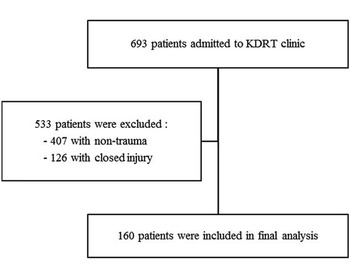
During the study period, 693 patients were admitted to the KDRT clinic; 286 were traumatic injury patients. Of the traumatic injury patients, 126 were excluded because they did not present with an open wound. In total, 160 patients were enrolled in the study for further analysis (Figure 1).
Flow Diagram of the Study. Abbreviation: KDRT, Korean Disaster Relief Team.

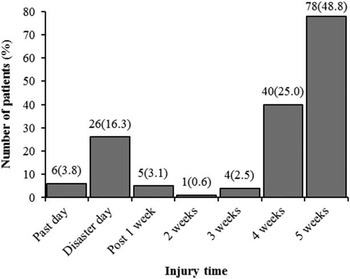
The study period was 5 consecutive days, 1 month after the disaster. The patients were grouped by how long after the disaster the injury occurred (Figure 2). Injuries occurred most frequently at 5 weeks (48.8% of patients) after the disaster, 4 weeks (25% of patients) after the disaster, and on the day of disaster (16.3% of patients).
Histogram of Patients Requiring Wound Care, Divided by Time of Injury in Relation to Disaster Day, Admitted by the Korean Disaster Relief Team Over 5 Consecutive Days 1 Month After the Disaster.

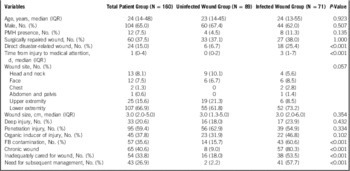
When the patients were divided into the infected and uninfected groups, 71 patients (44.4%) were included in the infected group. The 2 groups did not differ significantly in age, sex, past medical history, wound site, wound depth, injury mechanism, or inducer of injury (Table 1). A direct disaster-related wound, foreign body contamination of wound, an inadequately cared for wound, and a chronic wound were associated with wound infection (P<0.001). In addition, the elapsed time from injury to medical contact was associated with wound infection (P<0.001).
Patient CharacteristicsFootnote a

a Abbreviations: FB, foreign body; IQR, interquartile range; PMH, past medical history.
Predictors of Disaster-Related Wound Infection
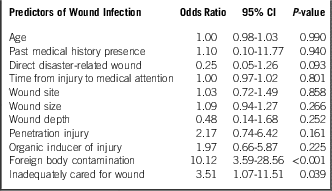
Foreign body contamination and an inadequately cared for wound were associated with wound infection by multivariate analysis (odds ratio [OR]: 10.12, 95% confidence interval [CI]: 3.59-28.56, P<0.001; OR: 3.51, 95% CI: 1.07-11.51, P=0.039, respectively). There was no significant association between wound infection and age, past medical history, direct disaster-related wound, elapsed time from injury to medical contact, wound site, wound size, wound depth, injury mechanism, or injury inducer (Table 2).
Multivariate Analysis of Risk Factors Associated With Wound Infection

Outcome of Wound Infection
In the infected group, 41 patients (57.7%) required subsequent wound management. In contrast, in the uninfected group, only 2 patients (2.2%) required subsequent management: one patient required treatment for an open fracture and the other had a ligament rupture that required surgical exploration and tenorrhaphy. The need for subsequent wound management was significantly associated with wound infection (P<0.001; Table 1).
Discussion
Natural disasters such as typhoons, floods, earthquakes, volcanic eruptions, tsunamis, and other geologic processes can cause dangerous injury to people. Various types of wounds occur as the result of disaster, yet few studies have described disaster-related wound infection and the related risk factors. Our study examined patients 1 month after the disaster; however, the majority of wounds requiring care occurred in the post-disaster recovery period, and most wounds were not directly caused by the typhoon. Many wounds, especially those of the lower extremities, were caused by destroyed buildings, garbage, and other byproducts of the disaster. Secondary infections of the wounds were caused by contamination by soil, broken wood, dirty water, and pieces of metal. In addition, a number of patients were injured while rebuilding their homes. According to a previous study by LimReference Lim 21 about wound infections incurred in the 2004 Indian Ocean tsunami, a large number of deep wounds were caused by debris from dislodged corrugated iron roofing commonly used in the tropics. These wounds became grossly contaminated and frequently infected. We also found many wounds caused by debris of corrugated roofing metal in the disaster areas. Thus, to avoid injury in the post-disaster phase, environmental recovery should be emphasized before reconstruction occurs, and the use of protective equipment should be encouraged during disaster recovery and reconstruction.
Our study revealed that many patients suffered from wound infection. The development of wound infection is related to inadequate care of the wound, arising from poor compliance and the unavailability of medical access. Wounds sustained during the disaster tended to be more susceptible to infection, likely owing to delayed medical attention in the aftermath of the disaster. For the best medical accessibility, medical teams should be deployed to the disaster region soon after a disaster to provide essential medical services to the victims. Many disaster medical teams withdraw before individual patients are cured; thus, wound infection in surgical sites may still occur. To improve follow-up treatment and to sustain wound care between medical teams, brief universal medical record forms should be created to facilitate active cooperation between relief teams. As well, patient education materials, written in the native language, should be developed and handed out at discharge to help to minimize wound infection through behavioral changes.
We observed many undressed wounds that were contaminated with foreign bodies, even though the wounds had been surgically repaired. Infection of these wounds may arise as a result of insufficient irrigation of the wound owing to the lack of time and sterile water. These infections create a vicious cycle, creating additional overcrowding in medical clinics and increasing consumption of medical resources. To avoid the infection of wounds, physicians should consider the use of tissue adhesive as a field-expedient barrier dressing for linear lacerations.Reference Levy and Tang 22 If the physician cannot confirm that a wound is clean and uncontaminated, the use of a delayed closure method could prevent wound infections arising from contamination. When urgent surgical intervention is required and an anesthesiologist is unavailable, the use of regional anesthetics should be considered.Reference Missair, Pretto and Visan 23 Even with limited resources in disaster situations, a general physician can provide effective treatment, referring only specific patients to a subspecialist for treatment.Reference Liu, Yang and Xu 18
Tetanus is an acute, often fatal disease caused by wound contamination with Clostridium tetani. Some studies presented several cases of wound tetanus after natural disasters.Reference Afshar, Raju, Ansell and Bleck 24 - Reference Sutiono, Qiantori, Suwa and Ohta 26 In this study, all of the patients with open wounds received tetanus prophylaxis if their tetanus immunization history was unknown, if they had received less than 3 doses of adsorbed tetanus toxoid, or if it had been more than 5 years since the last dose they received. Patients without a complete primary tetanus immunization series should receive tetanus immunoglobulin (TIG). However, no cases of wound tetanus infection were reported; therefore, none of the patients received treatment for tetanus during the study period. This is assumed to be because the patients included were limited to those who were ambulatory because of the lack of a pre-hospital transfer system and the limited capacity of our medical team to admit patients.
Limitations
There were some limitations to our study. First, there may have been a selection bias, because the data were obtained by a single regional medical team, and collaboration in a disaster situation is difficult. Additionally, the profile of admitted patients should have differed according to the capability of the medical teams. A temporary surgical room was sufficient for all wound care, except in cases requiring hospitalization; thus, the majority of patients were accepted for our team. Second, we were unable to investigate the details of previous wound management or treatment plans, because there were no transfer notes. Third, overlapping patients, arising from consecutive daily admission, may have been included in the study. However, because the study collection period was the final 5 days of our stay, those requiring short-term follow-up or hospitalization were referred to other medical teams, thus minimizing the chances of overlapping patients. Finally, long-term outcomes were not collected, because the study period was the final 5 days of our stay.
Conclusion
In post-disaster situations, many infected wounds require definitive care. Wound infection is related to contamination of the wound and to inadequate medical care. The prevention of wound infection, through careful initial treatment, will prevent additional strains on post-disaster medical teams.