

Introduction
Introduced to Brazil during the colonial period, sugarcane (Saccharum officinarum) has become one of the most important crops in the country’s economic sector. With more than 10 million hectares, Brazil has become the largest producer of ethanol in the world, surpassing the United States (FAO, 2016; Renewable Fuels Association, 2012). With the increase of the demand of production and with the gradual elimination of burning, the process of mechanization of its harvest intensified. Due to the production system, the intense traffic of machinery within the production area causes several impacts on the cane ratoon, besides soil compaction (Molin et al., Reference Molin, Veiga and Cavalcante2014).
According to Mialhe (Reference Mialhe2000), the traffic of vehicles and machinery in sugarcane represents one of the most drastic attacks on its root bed. A method that allows harmonization between wheel set and plant is the controlled traffic system (Masek, Reference Masek, Kroulik, Chyba, Novak and Kumhala2014). The main aspect of this technique is the permanent distinction between the areas for root development and those used for wheel traffic.
The need for accuracy in the traffic of sugarcane machines boosted the adoption of automatic steering systems. Studies by Silva et al. (Reference Silva, Moraes and Molin2011) show that the automatic steering system is the main precision agriculture tool used in the sugarcane production system. It is usual on planting and on harvesters, whereas in tractors with transshipment trailers that go along with the harvesters at the same intensity in the field, the adoption of this resource is minimal, or when done, inferior technologies are used with respect to positioning accuracy.
When it comes to towed vehicles, keeping them on the correct path is not simple, since the only feature under control is the steering angle of the front wheels of the tractor, representing risks of deviations from the ideal traffic, resulting in compaction and damage to the ratoon. Trailers tend to suffer deviations on side slopes and on curved paths, which often occurs in producing areas (Backman et al., Reference Backman, Oksanen and Visala2010). Therefore, the objective of this work was to evaluate those errors on a towed set with and without the use of an automatic steering system during the sugarcane harvest and better understand its magnitudes and how to mitigate it.
Materials and methods
The study was conducted in production areas of a sugarcane mill located in the western part of the state of São Paulo, with a clay soil and yield for the first cut of 109 Mg ha−1. Three plots were used in the experiment where the planting lines were previously designed as rectilinear on sloping fields: area 1 with slope of 5.29% (6.59 ha), area 2 with slope of 7.58% (6.80 ha) and area 3 with slope of 7.94% (10.12 ha). Two transshipment trailers TAC 14000 (Civemasa, Matão, Brazil) with three axles each where equipped with a GNSS receiver with RTK correction for determining instant positioning: FMX® (Trimble, Sunnyvale, USA) and X30® (Topcon, Tokyo, Japan) for first and second trailer, respectively. The tractor, a JD 6180 J (John Deere®), was equipped with an AutoPilot automatic steering system with an AgGPS 262 GPS receiver and a controller AgGPS NavController II (Trimble, Sunnyvale, USA), with a RTK correction system. The antenna inclination corrections were performed by the devices.
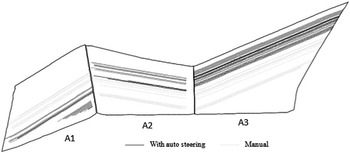
For this, the study was divided into two parts: in the first, the tractor steering system was activated, while in the second it was not activated, so the steering was manual. Figure 1 shows the three areas with the lines where each condition was tested (with and without automatic steering on the tractor). The average forward speed was approximately 1.25 m s−1. Data collection was continuous under acquisition frequency of 0.5 Hz.
The three areas and lines where data was collected with and without the use of automatic steering on the tractor.

Ordination and exportation of data were performed in AutoCAD software (Autodesk, San Rafael, USA) and QGIS (Open Source Geospatial Foundation, Beaverton, USA). Parallelism errors (deviations) were evaluated by the difference of the orthogonal distance between the position of the antennas in the center of the tractor and for each trailer and the reference line, originated upon the furrows project, using an automated algorithm developed by Spekken et al. (Reference Spekken, Salvi and Molin2014). The error of each part of the set was obtained, corresponding to the displacement of the articulated set, allowing it to understand the misalignments as a function of axis position and sloping terrain conditions. Statistical analysis and Tukey test at 5% significance was made using R software (R Development Core Team).
Results and discussion
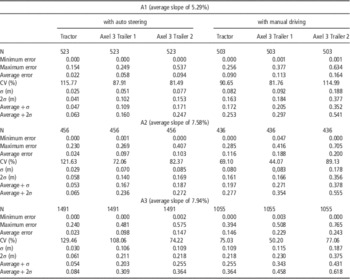
The results presented in Table 1 show the errors between passes for each component of the set (tractor, transshipment trailer 1 and transshipment trailer 2) referring to the three experimental areas for the values found with and without the use of the automatic steering system. Sugarcane producers consider that errors in 2σ, that indicate a 95% probability of occurrence, should be below 0.1 m in order to avoid damage to the sugarcane ratoon. This value comes from the dimensions of the equipment, since the gap between the tires and the ratoon is approximately 0.16 m.
Errors between lines of tractor and each transshipments trailer in its third axis for the three experimental areas collected with and without the use of auto steering system

N: number of collected point; σ: standard deviation; 2σ: twice standard deviation; CV(%): coefficient of variation.
The alignment errors observed on the tractor with the use of the steering system when compared to the projected trajectories are within the acceptable range in the three areas. However, when observing the values for the test without its use, the errors are up to 0.15 m, above acceptable. However, when observed the values obtained for areas 2 and 3 without the use of auto steering, with a slight difference of slope, the errors increased by 0.10 m.
Regarding the errors of the transshipments, it is verified that in all the terrains the values are above the acceptable. In addition, as expected, the values of the third axel in the second trailer are always higher in relation to the values found in the third axel of trailer 1, indicating the effect of lateral misalignment caused by slope.
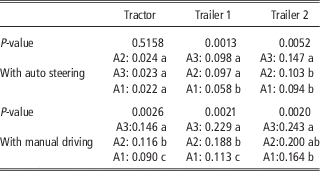
Table 2 shows the values found for the analysis of variance (ANOVA) for each treatment (automatic and manual driving). The effect of the slope factor was analyzed in each of the treatments. In addition, it also presents the means comparisons through Tukey test for each part of the set. When the automatic steering system was used on the tractor, it is observed that the value of P is higher than the value accepted for it to be significant (p>0.05), thus, the inclination factor is not relevant for the tractor when it is under automatic steering. While for both trailers, the errors on slope of A1 differs from A3. For the values found in manual steering, both in the tractor and in the trailer 1, the slope is significant and affects the error. For the trailer 2 when subjected to the same type of steering, the slope of A1 differs from A3.
Tukey’s range test of the average error of each part of the set

Averages followed by the same letter do not differ by the Tukey test at the 5% probability level.
Similar conditions were observed by Braunbeck & Oliveira (Reference Braunbeck and Oliveira2006) that show the influence of slope on the ground in vehicle tires with manual steering and portray a tendency of lateral displacement towards the slope of the terrain, which makes it necessary to continuously correct the trajectory by the steering. Abu-Hamdeh and Al-Jalil (Reference Abu-Hamdeh and Al-Jalil2004) conducted computer simulations for stability and control of a tractor-trailer set in different operating conditions and concluded that the traction force that guides the set when it is in slight slope (0–3 degrees) while on steep slopes it moves in the direction of inclination by the action of its own weight.
In order to minimize errors suffered by the tractor-transshipment set, besides the use of the automatic guidance, techniques that work actively in the transshipment have been studied. Thanpattranon et al. (Reference Thanpattranon, Ahamed and Takigawa2016) proposes the use of a sliding hitch bar to control the position of the towed vehicle; results were satisfactory for the correction of the route on different applications.
Conclusions
Slope is an important factor when observing the errors found, causing them to increase depending on the slope in which the set is submitted. It was observed that when using the steering system, for the tractor there are no significant differences, that is, the slope changes do not interfere with the values obtained. In addition, the use of systems that operate in the direction of the tractor minimizes trajectory errors of the transshipment, but are not enough to keep them in the correct course and active systems are required to achieve the target errors established by users.
Acknowledgements
To CAPES (Higher Education Personnel Improvement Coordination) for the scholarship to the first author and “Shunji Nishimura” Foundation for supplying GNSS equipment.