Introduction
Medical history has been proven to be an important contributor to diagnoses and patient management.Reference Hampton, Harrison, Mitchell, Prichard and Seymour 1 , Reference Peterson, Holbrook, Von Hales, Smith and Staker 2 In response to mass-casualty incidents (MCIs), health care providers often have to care for large numbers of victims in settings of limited resources, poor communication, inaccurate and fragmented information, and potentially damaged infrastructure with personal risks. In a chaotic MCI environment, an efficient, reliable, and affordable method of information collection is essential for patient management and successful response.Reference Teich, Wagner, Mackenzie and Schafer 3 - Reference Thieren 5
Obtaining a medical history takes the pattern of one-medical-provider-to-one-patient. This pattern is a problem when the medical provider is overwhelmed by victims. In some MCIs of a medical nature, symptoms are less obvious, and significant numbers of victims are able to help themselves. A modified method for history taking may facilitate information acquisition to improve the efficiency of data collection and medical management. This study was designed and performed to investigate whether self-reporting of symptoms can decrease the time required to obtain medical histories in response to food poisoning MCIs, without sacrificing the completeness of information.
Methods
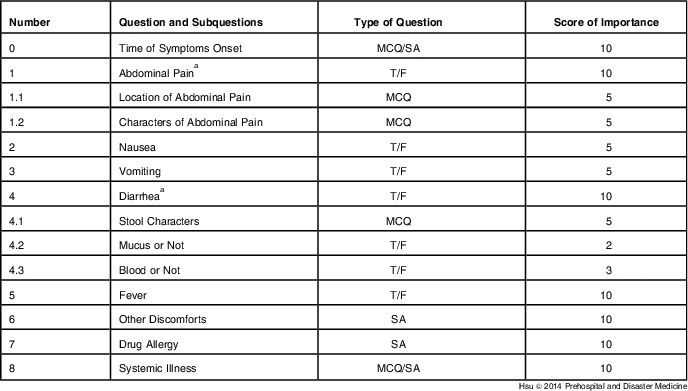
Based on the common symptoms of food poisoning, a questionnaire was created to gather useful information that is usually asked during history taking (Table 1). This questionnaire was validated by experts in emergency medicine and infectious diseases, followed by discussion with nonmedical colleagues and volunteers from the community, to make it easily comprehensible. To measure the completeness of history obtained, each question was scored based on the degree of information required for medical management decisions.
Questions Used in the Questionnaire for Self-reporting of Symptoms, Essential Medical History, and Scores for Each Question

Abbreviations: MCQ, multiple choice question; SA, short answer question; T/F, true or false question.
aIf yes, goes to subquestions.
After approval by the institutional review board of the Chiayi Christian Hospital (Chiayi City, Taiwan), two resident physicians and a number of seventh graders of a nearby middle school who had previous experience of abdominal discomfort with alternating bowel patterns were invited to join the study. The students were instructed to recall the most impressive episode of gastrointestinal trouble and use this experience to respond to the questionnaire. Enrolled students were randomly divided into two groups. Students in the experimental group answered the questionnaire first. Then they were individually interviewed by a resident physician to complete the medical history. Students in the control group were interviewed in the traditional way to collect their medical history. The time required for each interview was measured by a trained research assistant. To reduce the influence from inter-rater variability, resident physicians interviewed both experimental and control groups of students.
The time needed to complete the history taking and completeness of obtained information in the two groups of students were compared. Students’ t tests, or Mann-Whitney U tests, were undertaken for statistical analysis based on data normality, and a P value of less than .05 was determined to be significant (IBM SPSS Statistics, version 21.0, IBM Corporation, Armonk, New York USA). Comprehensibility of each question was scored by enrolled students and reported using descriptive statistics.
Results
There were 41 students enrolled in the study: 22 in the experimental group and 19 in the control group. In the experimental group, Doctor A interviewed 12 students and Doctor B interviewed 10 students. In the control group, Doctor A interviewed 10 students and Doctor B interviewed 9 students. Between the two resident physicians, there was no significant difference in the time needed to complete history taking (185.2 seconds, SD=42.2 vs 173.1 seconds, SD=58.6; P=.449), and the completeness of information obtained (94.1%, SD=5.9 vs 95.0%, SD=5.0; P=.601).
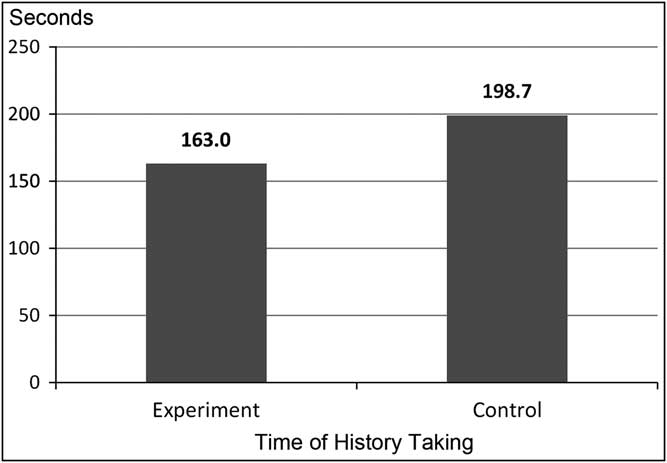
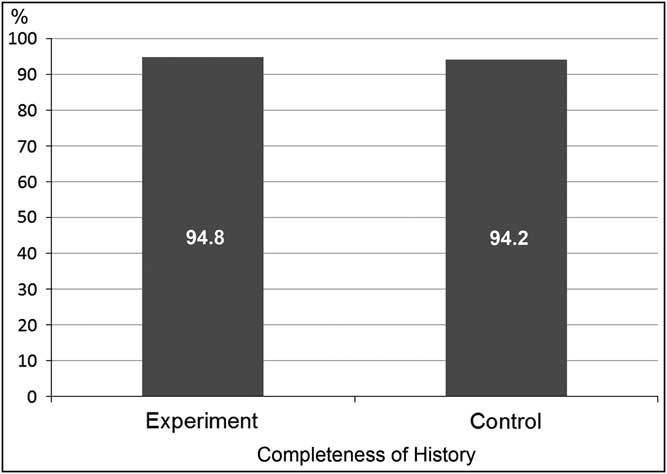
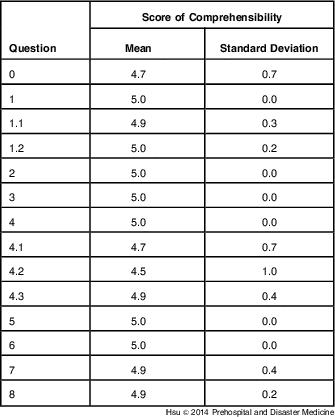
Time to complete history taking was shorter in the experimental group than in the control group (163.0 seconds, SD=52.3 vs 198.7 seconds, SD=40.9; P=.010) (Figure 1). There was no difference in the completeness of history obtained between the experiment group and the control group (94.8%, SD=5.0 vs 94.2%, SD=6.1; P=.747) (Figure 2). Most of the questions were scored “good” in comprehensibility (Table 2).
Time to Complete the History Taking Was Lower in the Experimental Group than in the Control Group (P=.010).

There Was No Significant Difference in Completeness of History Between the Experimental Group and the Control Group (P=.747).

Comprehensibility of Each Question in the Questionnaire (5, Good; 4, OK; 3, No Comment; 2, Some Difficulty; 1, Abstruse)

Discussion
Disaster casualties can have a diversity of presentation in earthquake, tsunami, or complex terrorism attacks. However, for some disasters, such as food poisoning, flu or other infectious pandemics, bio-terrorism, or leakage of a single chemical agent, there can be patients with similar symptoms. In MCIs, a limited number of responders care first for critical patients. The remained noncritical victims are usually left unattended after initial triage. Results of this study showed that noncritical victim self-reporting can shorten the time of history taking by medical personnel without sacrificing the completeness of needed medical information.
Previous experiences in disasters with MCIs shows that fragmented or incomplete medical information and difficult access to medical records were major impediments to care of victims, especially when the victims were evacuated and displaced.Reference Choi 6 - Reference Kimura, Yamamoto and Oku 8 In large-scale health crises, demands for data collection, analysis, coordination, and distribution are tremendous.Reference Teich, Wagner, Mackenzie and Schafer 3 Insufficient, fragmented data or misinformation can compromise not only the safety of patients, but also the effectiveness of the disaster response system.Reference Thieren 5 , Reference Harrison, Harrison and Smith 9 , Reference Weiner and Trangenstein 10 For good coordination and efficient response, it is vital to collect useful information from the very beginning.Reference Weiner and Trangenstein 10 Any efficient method to collect medical history from victims should be helpful to disaster responses.
For an efficient collection of medical information, several forms of medical records are suggested to be developed in advance, based on the result of regional vulnerability analyses. Contents of the forms can be modified after encountering a specific disaster. Copy machines or printers, powered by a portable generator, can easily reproduce the forms for history taking. Furthermore, with light-weight, pocket-sized smart devices with longer battery lives, wireless communication techniques and the Internet can be used to upgrade the paper-based record to electronic health records.Reference Chan, Killeen, Griswold and Lenert 4 , Reference Harrison, Harrison and Smith 9 , Reference Fuse, Okumura and Hagiwara 11 , Reference Prgomet, Georgiou and Westbrook 12 Deployment of a simple, but uniform, electronic medical record to responders at different locations may allow for better and more consistent information collection. It is also helpful to provide real-time patient data to every medical responder to facilitate continuous treatments from the scene to the hospital.Reference El-Masri and Saddik 13 , Reference Caillouet, Paul, Sabatier and Caillouet 14 Better and more accurate information management can improve overall disaster response, emergency medical care, and also public health surveillance.Reference Lurie 7 , Reference El-Masri and Saddik 13 - Reference Shapiro, Mostashari, Hripcsak, Soulakis and Kuperman 16 Furthermore, electronic data are ready for cross-system and cross-organization information sharing.Reference Shapiro, Mostashari, Hripcsak, Soulakis and Kuperman 16 , Reference McIlwain and Lassetter 17 Responders can plan, make decisions, and respond to disasters more efficiently with reduced errors and at lower costs.Reference Whittenburg 18 - Reference Case, Morrison and Vuylsteke 20
Limitations
There were several limitations of this study. First, the number of participants in the experimental and control groups was not large. However, the difference in time to complete the history taking was statistically significant. Second, victims in disasters may have great ranges in age, education levels, and socioeconomic and cultural backgrounds. Although a homogenous group of students was invited for this study, it should be not difficult for citizens to answer the questionnaire because most of them receive 9-year obligational education. Third, memory recalls were used to simulate the food poisoning. In addition, the study situation may not be the same in other disasters. External validation of the study results in other situations, especially in response to a true disaster, is necessary.
Conclusion
This study showed that self-reporting of symptoms and essential medical history using a standardized data collection questionnaire can shorten the time of history taking without sacrificing the completeness of information in MCI food poisoning events.