INTRODUCTION
The study of confabulation has a long history (Korsakoff, 1889/Reference Korsakoff1996; Talland, Reference Talland1965), and most researchers characterize the syndrome as a propensity to confuse untrue memories with true memories (Schnider, Reference Schnider2008). The condition is sometimes referred to as “honest lying” because individuals who confabulate are often unaware of the inaccuracies of the retrieved information (Gilboa & Moscovitch, Reference Gilboa, Moscovitch, Baddeley, Kopelman and Wilson2002). In fact, confabulators frequently insist on the veracity of these distorted memories and sometimes base their actions upon them (Schnider, Gutbrod, Hess, & Schroth, Reference Schnider, Gutbrod, Hess and Schroth1996).
Confabulation has been linked to a variety of etiologies, but the focus of the current study is on confabulation secondary to ruptured anterior communicating artery (ACoA) aneurysms. Although the precise anatomical locus of confabulation is still unclear, recent research points to the ventromedial prefrontal cortex (vmPFC) as a critical region (Fischer, Alexander, D’Esposito, & Otto, Reference Fischer, Alexander, D’Esposito and Otto1995; Gilboa & Moscovitch, Reference Gilboa, Moscovitch, Baddeley, Kopelman and Wilson2002; Turner, Cipolotti, Yousry, & Shallice, Reference Turner, Cipolotti, Yousry and Shallice2008). Given the behavioral and lesion characteristics that underlie confabulation and the association between frontal lobe damage and executive impairments, several prominent models have focused on the contribution of the frontal executive system and its role in memory retrieval (Burgess & Shallice, Reference Burgess and Shallice1996; Dalla Barba, Reference Dalla Barba1993a; Gilboa, Alain, Stuss, Melo, Miller, & Moscovitch, Reference Gilboa, Alain, Stuss, Melo, Miller and Moscovitch2006; Johnson, Hayes, D’Esposito, & Raye, Reference Johnson, Hayes, D’Esposito, Raye, Boller, Grafman and Cermak2000; Metcalf, Langdon, & Coltheart, Reference Metcalf, Langdon and Coltheart2007; Moscovitch & Melo, Reference Moscovitch and Melo1997; Schnider, Gutbrod, et al., Reference Schnider, Gutbrod, Hess and Schroth1996). It is generally agreed that confabulation reflects a combination of memory disorder and executive deficits, as evidenced by the fact that confabulation is not often found in amnesia secondary to damage to the medial temporal lobes (Baddeley & Wilson, Reference Baddeley and Wilson1988; Burgess & Shallice, Reference Burgess and Shallice1996; Johnson et al., Reference Johnson, Hayes, D’Esposito, Raye, Boller, Grafman and Cermak2000).
Confabulation is most commonly observed in retrieval of episodic/autobiographical memories. Thus, most of the existing models of confabulation were formulated to accommodate those findings. Although these models differ in important ways, they all point to impairment in some form of cognitive control or monitoring as the root of confabulation.Footnote 1 Whereas some researchers explain confabulation in terms of post-retrieval monitoring deficits (i.e., determining whether the retrieved information is consistent with task requirements, Dalla Barba, Reference Dalla Barba1993a; Johnson, Reference Johnson1997; Schnider, von Daniken, & Gutbrod, Reference Schnider, von Daniken and Gutbrod1996), others describe confabulation as the emergent property of the disruption of pre-retrieval cue specification (i.e., specifying what needs to be retrieved) and post-retrieval monitoring processes (Burgess & Shallice, Reference Burgess and Shallice1996; Gilboa & Moscovitch, Reference Gilboa, Moscovitch, Baddeley, Kopelman and Wilson2002; Moscovitch & Melo, Reference Moscovitch and Melo1997).
For instance, Dalla Barba’s (1993) and Schnider, von Daniken and Gutbrod’s (Reference Schnider, von Daniken and Gutbrod1996) temporality hypotheses highlight impaired temporal monitoring and an inability to suppress active, yet irrelevant, memory traces as the critical failures in confabulation (Kopelman, Reference Kopelman1987; Schnider & Ptak, Reference Schnider and Ptak1999). In a less constrained model, Johnson and colleagues (Reference Johnson, Hayes, D’Esposito, Raye, Boller, Grafman and Cermak2000) attribute confabulation to a generalized failure in reality/source monitoring. That is, errors are based on confabulators’ inability to accurately identify and monitor the source of the retrieved memory, and such monitoring failure can be manifested as contextual errors (i.e., placing true memory in an inappropriate spatial, temporal, or event context; Ciaramelli, Ghetti, Frattarelli, & Ladavas, Reference Ciaramelli, Ghetti, Frattarelli and Ladavas2006; Conway, Reference Conway2005; Dalla Barba, Cappelletti, Signorini, & Denes, Reference Dalla Barba, Cappelletti, Signorini and Denes1997; Fotopoulou, Solms, & Turnbull, Reference Fotopoulou, Solms and Turnbull2004; Johnson, Reference Johnson, Prigatano and Schacter1991; Schnider & Ptak, Reference Schnider and Ptak1999) or content-based errors (i.e., recalling inappropriate information, Gilboa et al., Reference Gilboa, Alain, Stuss, Melo, Miller and Moscovitch2006; Johnson & Reeder, Reference Johnson, Reeder, Cohen and Schooler1997).
Proponents of another class of models emphasize that while post-retrieval monitoring failure is an important component, confabulation is multi-determined. In their Strategic Retrieval Account, Moscovitch and colleagues (Gilboa & Moscovitch, Reference Gilboa, Moscovitch, Baddeley, Kopelman and Wilson2002; Moscovitch & Melo, Reference Moscovitch and Melo1997) proposed that confabulation is the result of a failure in several controlled aspects of memory retrieval, including guiding and constraining the search process, monitoring, evaluating, and editing retrieved memory, and inhibiting irrelevant memories. In support of this notion, Gilboa and colleagues (Reference Gilboa, Alain, Stuss, Melo, Miller and Moscovitch2006) found that confabulators’ memory errors are most pronounced when retrieval requirements involve strategic retrieval (e.g., retrieving and producing narratives, see also Moscovitch & Melo, Reference Moscovitch and Melo1997). In a similar model, Burgess and colleagues (Burgess & McNeil, Reference Burgess and McNeil1999; Burgess & Shallice, Reference Burgess and Shallice1996) proposed that failure to properly constrain retrieval specifications can lead to retrieval of “generic representations” (i.e., routine responses that are consistent with blended versions of similar past events).
Much of the evidence supporting the idea that confabulators are impaired at controlled aspects of memory retrieval has come from studies of episodic retrieval (for reviews, see Gilboa & Moscovitch, Reference Gilboa, Moscovitch, Baddeley, Kopelman and Wilson2002; Metcalf et al., Reference Metcalf, Langdon and Coltheart2007; Schnider, Reference Schnider2008), and some researchers have argued that confabulation involves primarily episodic and autobiographical retrieval (Dalla Barba, Reference Dalla Barba1993a). However, if the core impairment in confabulation concerns a domain-general cognitive control mechanism that is required for different forms of memory, we should expect to observe confabulation in semantic memory as well.
Consistent with this notion, using a cue word retrieval paradigm, Moscovitch and Melo (Reference Moscovitch and Melo1997) found that confabulators produced a comparable magnitude of confabulatory responses in semantic and episodic recall. They argued that previous observations of increased prevalence of episodic compared to semantic confabulation (Dalla Barba, Reference Dalla Barba1993b; Fotopoulou et al., Reference Fotopoulou, Solms and Turnbull2004) might be the result of differential demands on strategic retrieval (see also Fotopoulou et al., Reference Fotopoulou, Solms and Turnbull2004; Kopelman, Ng, & Van Den Brouke, Reference Kopelman, Ng and Van Den Brouke1997). Specifically, whereas many tests of episodic retrieval require narrative responses, tests of semantic retrieval tend to require single word or phrase responses (Zannino, Barban, Caltagirone, & Carlesimo, Reference Zannino, Barban, Caltagirone and Carlesimo2008). When retrieval demands are matched across memory domains by requiring narrative responses in both cases, the extent of semantic and episodic confabulation is equated (Gilboa & Moscovitch, Reference Gilboa, Moscovitch, Baddeley, Kopelman and Wilson2002). Taken together, these data suggest that high retrieval demands may be critical in eliciting confabulation.
One way to frame the difference between narrative tasks and single word or phrase response tasks is in terms of the demands on pre-retrieval cue specification. Questions necessitating a narrative response are typically open-ended and require the participant to sufficiently constrain the retrieval space to generate a suitable answer. In contrast, questions requiring a single response are inherently more constrained, and thus, rely much less on a participant’s ability to constrain retrieval space. The fact that confabulation in semantic memory occurs more frequently under conditions of open-ended retrieval may point to problems in cue-specification as an important factor in semantic confabulation. However, the contribution of post-retrieval monitoring processes to semantic confabulation remains unclear.
In the present study, we sought to evaluate whether confabulation in semantic memory occurs in a task that poses high demands on post-retrieval monitoring, but not on pre-retrieval cue-specification. Taken together with studies that examined pre-retrieval demands in semantic confabulation (e.g., Gilboa & Moscovitch, Reference Gilboa, Moscovitch, Baddeley, Kopelman and Wilson2002; Moscovitch & Melo, Reference Moscovitch and Melo1997), evidence of post-retrieval failure would suggest that semantic confabulation, like episodic confabulation, is multi-determined, and may reflect problems with either pre-retrieval or post-retrieval strategic memory processes. Such evidence would allow for a better understanding of the conditions under which confabulations are likely to emerge.
We evaluated the contribution of post-retrieval monitoring to semantic confabulation using the semantic illusion paradigm (Erickson & Mattson, Reference Erickson and Mattson1981). When asked, “How many animals of each kind did Moses take on the Ark?”, most people erroneously respond “two.” Errors of this type are thought to reflect faulty monitoring of retrieved information, as when asked, participants are well aware that the correct answer is Noah and not Moses.
Such semantic illusion, termed the “Moses illusion,” has been demonstrated under various conditions in healthy adults and is found to be rather robust (for a review, see Park & Reder, Reference Park, Reder and Pohl2004). For example, subjects succumb to this illusion even when they are forewarned that some questions are anomalous and contain incorrect information. Even when given the option to skip anomalous questions, subjects still make errors on these trials (Reder & Kusbit, Reference Reder and Kusbit1991; Van Oostendorp & De Mul, Reference Van Oostendorp and De Mul1990). Thus, this paradigm lends itself well to an examination of monitoring failures in semantic memory retrieval because it challenges the monitoring system, even in healthy controls. At the same time, although challenging, the task is not so difficult that it precludes observations of the effects of monitoring failures associated with a damaged monitoring system. By posing a high demand on the presumed faulty process we should observe an exaggerated semantic illusion effect in confabulators.
In this study, we examined the role of post-retrieval monitoring with a sentence verification task, rather than a free recall task. We reasoned that sentence verification minimizes pre-retrieval cue specification demands because all of the information necessary to evaluate the veracity of the statement is readily available to the subjects (e.g., “Two animals of each kind were brought onto the Ark by Moses before the great flood.”).
A critical finding in the semantic illusion literature is that as semantic relatedness between a target (e.g., Noah) and foil (e.g., Moses) increases, the likelihood of accepting the foil as true also increases (van Jaarsveld, Dijkstra, & Hermans, Reference van Jaarsveld, Dijkstra and Hermans1997; Van Oostendorp & De Mul, Reference Van Oostendorp and De Mul1990). The effect of semantic relatedness is thought to reflect increased difficulty in rejecting memory traces that have high semantic overlap: the greater the semantic overlap between a target and a foil (e.g., Noah/Moses vs. Noah/Adam), the higher the monitoring demands. If confabulators have particular difficulty with post-retrieval monitoring, they should show a greater semantic illusion effect than controls, especially for semantically related foils, because those items pose high demands on monitoring. On the other hand, if confabulators have a specific impairment in pre-retrieval cue-specification, they should perform similarly to controls under conditions of minimized pre-retrieval specification demands. Furthermore, given the nature of the materials and the task, demands for temporal monitoring and source monitoring are low. Thus, if the locus of the impairment in confabulation is limited to monitoring of temporal (e.g., Dalla Barba, Reference Dalla Barba1993a; Schnider, Gutbrod, et al., Reference Schnider, Gutbrod, Hess and Schroth1996) or source information (e.g., Johnson, Reference Johnson1997), we should observe equivalent performance in confabulators and in controls.
METHOD
Participants
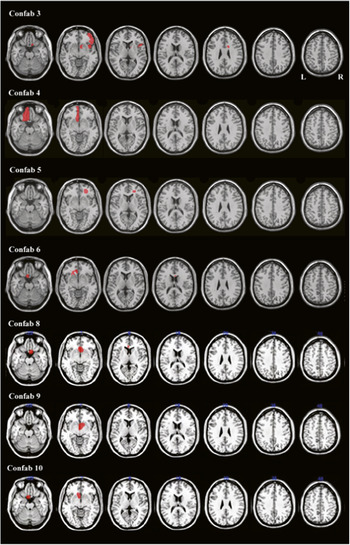
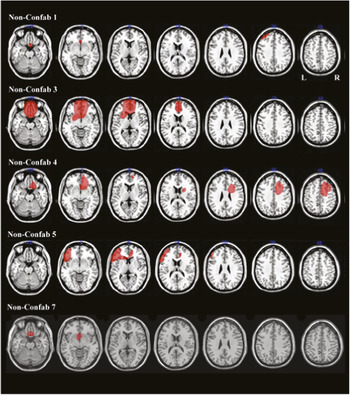
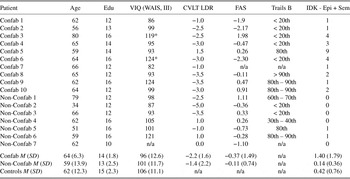
Seventeen patients with ruptured ACoA aneurysm followed at the Boston University Memory Disorders Research Center (MDRC) and recruited from the Patient Database at the Department of Neurology at the Hospital at the University of Pennsylvania (HUP) participated in the study. MRI or CT data were available for 12 patients, and lesion reconstruction overlays are presented in Figures 1 and 2. Twenty healthy controls, matched to patients in age, verbal IQ, and education, were recruited from the MDRC. Table 1 summarizes the demographic data for the patients and controls and the clinical neuropsychological data for the patients.
Reconstruction of lesions for 7 of the 10 confabulators, based on computed tomography and magnetic resonance imaging scans.

Reconstruction of lesions for five of the seven non-confabulators, based on computed tomography and magnetic resonance imaging scans.

Demographic and neuropsychological characteristics for confabulating ACoA patients, non-confabulating ACoA patients, and healthy controls

Note
ACoA = anterior communicating artery; Age = Age in years; Edu = education in years; VIQ = verbal IQ; WAIS, III = Wechsler Adult Intelligence Scale, III; CVLT = California Verbal Learning Test Long Delayed Recall (Z-score); FAS = Phonemic Fluency (Z-score); Trails B (percentile); IDK - Epi + Sem = difference in number of confabulatory response to “I Don’t Know Episodic” and “I Don’t Know Semantic” questions in Dalla Barba’s Confabulation Battery (Reference Dalla Barba1993b).
* = VIQ was estimated using the ANART.
Patients were divided into two subgroups: confabulators (n = 10) and non-confabulators (n = 7), based on report of prior (or current) confabulation in daily life and responses to the Confabulation Battery (Dalla Barba, Reference Dalla Barba1993b). In several studies, aside from overt confabulatory behaviors, confabulation has also been operationalized as providing answers to a minimum of one “Don’t Know” question on the Confabulation Battery (e.g., Ciaramelli & Ghetti, Reference Ciaramelli and Ghetti2007; Ciaramelli et al., Reference Ciaramelli, Ghetti, Frattarelli and Ladavas2006; Fotopoulou et al., Reference Fotopoulou, Solms and Turnbull2004). All confabulators in the present study gave at least one answer to “don’t know” questions, but it should be noted that so did two patients without history of confabulation and several controls, as has also been observed in other studies (e.g., Ciaramelli et al., Reference Ciaramelli, Ghetti, Frattarelli and Ladavas2006; Kopelman et al., Reference Kopelman, Ng and Van Den Brouke1997). As such, patient classification was based on both observations in daily life and responses on the Confabulation Battery.
Materials and Design
The stimuli consisted of 60 sentences, each presenting a semantic fact. For each sentence, four versions were created that differed in a single noun phrase: one version was veridical and included the target noun phrase, and three were false, each including a foil (see Appendix A). The foils varied in the degree of semantic overlap to the target in the context of the statement, with “semantic overlap” defined as shared semantic features. For example, the three foils for the target “Noah” were “Moses” (high semantic overlap), “Adam” (low semantic overlap), and “Malcolm X” (semantically unrelated). In generating the foils, the following guidelines were followed: (a) Extent of semantic overlap with the target items must be greater for high overlap than for low overlap items, and (b) unrelated items must be semantically unrelated to the target. Some of the target items and high overlap foils were similar to those used in previous studies (Erickson & Mattson, Reference Erickson and Mattson1981; Park & Reder, Reference Park, Reder and Pohl2004; Reder & Kusbit, Reference Reder and Kusbit1991).
The 60 experimental stimuli were selected from 72 items generated by the experimenters, based on two pilot studies. The first pilot study was conducted to ensure that the semantic facts used were not too obscure for our population. A group of 15 healthy controls (M age = 57.8 years old; M education = 14.9 years; M VIQ = 102.7) were given a set of forced-choice (FC) knowledge questions. On each trial, subjects were presented with a question (e.g., “Who brought two animals of each kind onto the Ark during the great flood?”) and were asked to select the correct response from among four possible choices (one target and three foils, as described above). An accuracy score was calculated for each item, and we selected 60 items with accuracy > 80% for further piloting.
The second pilot study formally assessed semantic relatedness between each target and its corresponding foils. A group of 20 naïve controls performed a ranking task on the selected 60 items (M age = 61.6 years old; M education = 14.8 years; M VIQ = 106.2). On each trial, subjects read a sentence with the target item underlined and ranked the foil items on a 3-point scale in terms of similarity to the underlined target given the sentence context: with “3” indicating most similar, “2” being intermediate, and “1” being least similar. A similarity score was calculated for each foil. Across all items, high overlap foils were ranked as more similar to targets (M = 2.68; SD = 0.26) than easy foils (M = 2.09; SD = 0.30) and unrelated foils (M = 1.22; SD = 0.22), with all pairwise comparisons with p < .001.
Procedure
For the self-paced experimental task, subjects performed true/false verification on a series of statements, each of which included either a target or a foil. The four trial types (target, high overlap, low overlap, unrelated) were intermixed, with 15 trials of each type. Trial condition was counterbalanced across subjects, such that each item appeared in each condition equally often. Subjects were instructed to read each statement aloud and to respond with “true” if the entire statement was accurate and with “false” if any part of the statement was incorrect.
In a follow-up session, conducted at least 1 week later, subjects’ knowledge of the facts was assessed in a FC knowledge task that was identical to that described in the second pilot study. This was to ensure that when subjects did succumb to a semantic illusion, they did so because of a monitoring error and not because of lack of knowledge.
In accordance with the procedures of the Institutional Review Boards at the VA Boston Healthcare System, Boston University, and HUP, all subjects provided informed consent before testing.
RESULTS
For each subject, only those items which yielded correct FC knowledge were included in the verification task analysis. Although controls outperformed patients in the knowledge task (Controls: M = 92.9%, SD = 4.8%; Patients: M = 83.5%, SD = 12.8%), the two patient groups performed similarly (Confabulators: M = 83.2%, SD = 11.0%; Non-confabulators: M = 83.1%, SD = 16.1%).
Proportion of hits (i.e., responding “true” to targets), false alarms (i.e., responding “true” to foils), and d’ (i.e., an index of an individual’s ability to distinguish targets from foils) on the verification task were calculated for each subject. d’ was calculated with the following formula: z(hits) - z(false alarms), where z is the inverse of the standard normative distribution (MacMillan & Creelman, Reference MacMillan and Creelman2005). Although the hit rate for confabulators was numerically higher than the hit rate for non-confabulators and controls, a one-way analysis of variance (ANOVA) revealed no difference across the three groups (F[2,36] = 1.87; p = .17).
The false alarm rates are of particular interest because they reveal the extent of semantic illusion (see Table 2). Consistent with previous studies of semantic illusion, false alarm rate increased as semantic relatedness increased, as revealed by a Condition main effect (F[2,68] = 59.58; p < .001). Furthermore, a significant difference in overall false alarm rate was found across groups (F[2,34] = 9.62; p < .001). Compared to controls (M = 0.10; SD = 0.08), both confabulators (M = 0.33; SD = 0.21; t[28] = 4.32; p < .001) and non-confabulators (M = 0.24; SD = 0.15; t[25] = 3.15; p < .001) made significantly more false alarms, but performance between the two patient groups did not differ (t[15] < 1). Critically, a significant Group (Confabulators, Non-confabulators, Controls) × Condition (High Overlap, Low Overlap, Unrelated) interaction was found (F[4,68] = 2.61; p < .05). Compared to controls, confabulators had significantly higher false alarm rates in all foil conditions (all p’s < .01). Non-confabulators, on the other hand, committed significantly more false alarms than controls in the high overlap (t[25] = 2.70; p < .05) and low overlap conditions (t[25] = 3.10; p < .01) but performed similarly to controls in the unrelated condition (t[25] = 1.79; p > .05).
Proportion of trials endorsed as true in the different conditions (and standard deviations) on verification trials and proportion of correct responses on follow-up forced-choice knowledge task across four subject groups

Note
A subset of controls (n = 6) was selected to match patient groups in terms of knowledge accuracy.
Analyses of d’ data revealed essentially the same pattern. A significant main effect of Condition (F[2,68] = 62.10; p < .001) was found, revealing that as semantic relatedness increased, discriminability decreased (M high overlap = 1.64; SD = 0.77; M low overlap = 2.19; SD = 0.76; M unrelated = 2.54; SD = 0.56). A significant difference in d’ was found across groups (F[2,34] = 3.92; p < .05). Compared to controls (M = 2.37; SD = .52), both confabulators (M = 1.85; SD = .80; t[28] = 2.14; p < .05) and non-confabulators (M = 1.81; SD = 0.48; t[25] = 2.49; p < .05) had significantly lower discriminability scores, but discriminability between the two patient groups did not differ (t[15] < 1). Lastly, although the Condition × Group interaction failed to reach significance (F[4,68] = 1.95; p = .11), the overall pattern was similar to that in the false alarm data.
Although only trials on which subjects showed accurate FC knowledge were included in the verification analysis, it could still be argued that interpretation of the verification data is complicated by the fact that knowledge task performance was not matched between patients and controls. Given the finding in healthy individuals that increased knowledge enhances performance on the semantic illusion task (Reder & Kusbit, Reference Reder and Kusbit1991), the differential verification performance between controls and patients might be due to the difference in FC knowledge. To address this issue, we selected a subset of controls whose FC knowledge was matched to that of the two patient groups (F[2,22] < 1, see Table 2). Analysis of verification performance based on this subset of subjects revealed largely the same pattern.
DISCUSSION
The primary goal of this study was to examine whether confabulators would show increased errors in a semantic memory retrieval task that poses high demands on post-retrieval monitoring but low demands on pre-retrieval cue specification. Using the semantic illusion paradigm, we found that, compared to controls, all ACoA patients had difficulty rejecting erroneous semantic facts. Consistent with previous findings in the normal literature, control subjects were more susceptible to semantic illusions as the degree of semantic overlap between target and foils increased. However, the effect of semantic similarity on verification was different among confabulators and non-confabulators. Confabulators were more susceptible to illusions than controls, but contrary to our prediction, this was true regardless of the semantic relatedness of target and foils. Non-confabulators were also more susceptible to semantic illusions than controls, but only when foils were semantically related to their corresponding target. Thus, all ACoA patients had difficulty monitoring the veracity of semantically related foils, but confabulators’ monitoring impairment was uniquely characterized by the fact that it extended to unrelated foils as well.
The differential pattern of performance between the two patient groups cannot be attributed to differences in their knowledge of the materials, as the two groups performed equivalently on the FC knowledge task (see Table 2). The finding of verification impairments in the two patient groups when their performance was compared to that of controls with matched FC knowledge further argues against the notion that impaired verification was simply a result of poor knowledge. Different levels of knowledge in patients and controls therefore cannot fully account for the data observed.
The semantic illusion paradigm readily elicits memory monitoring errors in healthy controls, indicating that it challenges even intact monitoring systems. Thus, it is ideal for the examination of monitoring failures in confabulation. The fact that such errors were more frequent in both ACoA groups, and extended to the easiest condition only in confabulators, could be taken as evidence for a general susceptibility to monitoring failure in ACoA patients (Milner & Petrides, Reference Milner and Petrides1984; Moscovitch & Winocur, Reference Moscovitch, Winocur, Stuss and Knight2002), which is exacerbated in confabulators. Yet, the fact that the monitoring impairment in non-confabulators was evident only for semantically related foils, whereas it was evident for both semantically related and unrelated foils in confabulators, suggests that there may be qualitative differences across groups as well. We interpret these findings in the context of a two-process model of monitoring (Gilboa & Moscovitch, Reference Gilboa, Moscovitch, Baddeley, Kopelman and Wilson2002; Moscovitch & Melo, Reference Moscovitch and Melo1997) that distinguishes between a fast, associative component and a slow, systematic component of monitoring (for similar proposals, see Burgess & Shallice, Reference Burgess and Shallice1996; Johnson, O’Connor, & Cantor, Reference Johnson, O’Connor and Cantor1997).
Fast, Associative Component
It has been proposed that memory retrieval is largely stimulus-driven, such that when a stimulus is encountered, associated memories and context information are retrieved (Moscovitch, Reference Moscovitch, Roediger and Craik1989). One mechanism that is engaged to evaluate the accuracy of the retrieved memories is an intuitive “feel rightness” heuristic process (Gilboa et al., Reference Gilboa, Alain, Stuss, Melo, Miller and Moscovitch2006). The feeling of rightness is based on factors such as detail richness of contextual information, retrieval ease (Johnson, Hashtroudi, & Lindsay, Reference Johnson, Hashtroudi and Lindsay1993; Mitchell & Johnson, Reference Mitchell and Johnson2009), and compatibility of retrieved memories with existing schemata or generic memories (Gilboa et al., Reference Gilboa, Alain, Stuss, Melo, Miller and Moscovitch2006). It has been proposed that memories based on true events tend to have richer perceptual and contextual details and higher retrieval ease than memories based on untrue events (Johnson et al., Reference Johnson, Hashtroudi and Lindsay1993; Mitchell & Johnson, Reference Mitchell and Johnson2009); thus, detail richness and retrieval ease can be useful monitoring decision heuristics.
In the semantic illusion paradigm, the feeling of rightness varies as a function of semantic relatedness between target and foils. Because unrelated foils have a very low feeling of rightness, use of this heuristic leads to accurate rejection of unrelated items (i.e., say “false” when feel rightness signal is low). On the other hand, semantically related foils have high feeling of rightness, and reliance on a feel-rightness heuristic may lead to the incorrect endorsement of those foils. As we describe below, to correctly reject semantic foils that have high feel rightness signals, a supplemental verification process must be engaged, such that additional information can be gathered to counter the strong feeling of rightness.
We reason that confabulators’ impairment in rejecting unrelated foils may reflect a disruption of the heuristic process, such that even unrelated foils yield a strong feel rightness signal. It has been proposed that confabulators may over-process task irrelevant information, and such excessive processing could lead to diffuse activation of associated information, which contributes to the feeling of rightness. Consider the unrelated statement, “Two animals of each kind were brought onto the Ark by Malcolm X before the great flood.” An overly diffuse associative retrieval process may lead to activation of task-irrelevant information (e.g., I remember seeing pictures of animals on an ark in a storybook, with two giraffes, etc.), which contributes to the feeling of rightness, thereby resulting in over endorsements of incorrect statements.
A similar explanation was proposed by Ciaramelli, Ghetti, and Borsotti (Reference Ciaramelli, Ghetti and Borsotti2009). Using a converging associate paradigm, the researchers hypothesized that if excessive processing of irrelevant information at test contributes to confabulators’ elevated false memories, inhibiting such processing should improve confabulators’ performance. Consistent with this notion, they found that when required to engage in a divided attention task during memory retrieval, confabulators’ false memories decreased. This pattern is contrary to that observed in controls, whose false memories increased when attention was divided. Previous findings that confabulators are particularly impaired at suppressing currently active, yet irrelevant, memory traces (Gilboa et al., Reference Gilboa, Alain, Stuss, Melo, Miller and Moscovitch2006; Kopelman, Reference Kopelman1987; Schnider & Ptak, Reference Schnider and Ptak1999) are also compatible with this proposal.
Previous reports of elevated endorsement of improbable memories as true (e.g., being a spaceship pirate; Damasio, Graff-Radford, Eslinger, Damasio, & Kassell, Reference Damasio, Graff-Radford, Eslinger, Damasio and Kassell1985; Kopelman, Reference Kopelman1999) in confabulators may also be understood as an impairment in heuristic monitoring. Furthermore, our data and interpretation are also congruent with experimental findings that only confabulators produce idiosyncratic errors (i.e., errors that have no content relation to the to-be-retrieved memories; Ciaramelli et al., Reference Ciaramelli, Ghetti, Frattarelli and Ladavas2006; Delbecq-Derouesne, Beauvois, & Shallice, Reference Delbecq-Derouesne, Beauvois and Shallice1990; Gilboa et al., Reference Gilboa, Alain, Stuss, Melo, Miller and Moscovitch2006; Melo, Winocur, & Moscovitch, Reference Melo, Winocur and Moscovitch1999).
Slow, Systematic Component
The systematic component can be viewed as a secondary monitoring process that verifies the heuristic signal. Additional monitoring includes a host of related processes, such as comparison of retrieved information with task demands, further specification of the retrieval cue, and retrieval of additional information that forms the basis of new comparisons (Burgess & Shallice, Reference Burgess and Shallice1996; Gilboa et al., Reference Gilboa, Alain, Stuss, Melo, Miller and Moscovitch2006; Johnson, Reference Johnson1997).
A failure in systematic verification may also contribute to errors on the semantic illusion task. To reject foils with high feel rightness signals (i.e., high and low overlap trials), additional information must be retrieved and verified (e.g., retrieving that Moses was associated with the Ten Commandments and the Red Sea, not the Ark and the flood). In other words, to overcome the feeling of rightness in the semantically related foil conditions, the systematic process must be engaged, such that additional counter evidence can be gathered. The greater the semantic overlap between a foil and the target, the more systematic monitoring is required. Our finding of enhanced acceptance of high and low overlap foils in both confabulators and non-confabulators suggests that all ACoA patients, regardless of whether they confabulate, have difficulty with such systematic monitoring (Gilboa, Alain, He, Stuss, & Moscovitch, Reference Gilboa, Alain, He, Stuss and Moscovitch2009; Johnson et al., Reference Johnson, Hayes, D’Esposito, Raye, Boller, Grafman and Cermak2000).
If systematic monitoring is reliant on retrieval and verification of additional information, two consequences are to be expected. First, prior knowledge should influence the effectiveness of monitoring in individuals with intact monitoring abilities, such that higher knowledge should lead to better outcome. When inconsistencies arise during statement verification, additional corroborative information or counter evidence must be gathered, and increased knowledge is likely to enhance this process by having more relevant information available. To better understand the impact of knowledge on semantic illusion, we administered an additional recall knowledge task, at least 45 days after the FC knowledge task. We reasoned that a recall task would provide a more precise reflection of an individual’s ability to retrieve further substantiating information. Based on recall task performance, we divided the control subjects into two groups according to a median split: a high recall group (n = 9; M recall accuracy = 91.6%; SD = 4.4%) and a low recall group (n = 10, M recall accuracy = 70.9%; SD = 6.4%). A 2 (high recall vs. low recall controls) × 2 (related vs. unrelated foils) ANOVA on false alarms revealed a significant interaction (F[1,17] = 14.67; p < .01). Whereas high recall subjects (M = 0.06, SD = 0.06) outperformed low recall subjects (M = 0.20; SD = 0.10) in the semantically related conditions (t[17] = 3.53; p < .01), the two groups performed similarly in the unrelated condition (high recall: M = 0.02, SD = 0.03; low recall: M = 0.04, SD = 0.06: t[17] = 1.12; p = .28). This pattern suggests that knowledge has a significant impact on verification of semantically related foils, but not of unrelated items.
Failure of the systematic monitoring process in confabulators, however, was not due simply to worse knowledge. We also administered the recall knowledge task to the patients (one non-confabulator and two confabulators were unavailable for additional testing) and found that confabulators (M recall = 67.4%; SD = 16.5%) committed marginally more false alarms in the semantically related conditions (M false alarm = 0.34; SD = 0.17) than low recall controls (t[16] = 2.07; p = .06), even though recall knowledge was matched between the two groups. This pattern highlights confabulators’ monitoring impairment and suggests that confabulators’ failure to reject the foils is not the result of an inability to retrieve relevant counter evidence; rather it reflects an impairment in the use and evaluation of such information. Non-confabulators (M recall = 70.0%; SD = 15.5%) also numerically endorsed more semantically related foils (M false alarm = 0.29; SD = 0.19) than low recall controls, but this difference was not significant (t[14] = 1.23; p = .23).
Second, decisions that require systematic monitoring ought to be slower than heuristic decisions. Evidence for this comes from a recent event-related potential study of ACoA patients and controls (Gilboa et al., Reference Gilboa, Alain, He, Stuss and Moscovitch2009). Using a remote memory task, the researchers found that successful monitoring in controls was mediated by an early fast monitoring component, followed by a later elaborate monitoring component. This time course distinction was further supported by reaction time data. Both processes, however, were disrupted in confabulators.
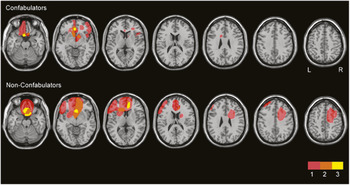
Heuristic and systematic monitoring processes have been linked to different regions within the prefrontal cortex. Based on neuropsychological and neuroimaging evidence, Moscovitch and colleagues (Gilboa et al., Reference Gilboa, Alain, Stuss, Melo, Miller and Moscovitch2006; Moscovitch & Winocur, Reference Moscovitch, Winocur, Stuss and Knight2002) proposed that the feeling of rightness is associated with vmPFC and systematic monitoring is linked to dorsolateral prefrontal cortex (dlPFC). It is unclear how lesion data in this study can be incorporated within such a view. As seen in Figure 3, both confabulators and non-confabulators had damage to vmPFC, as is typically observed in ACoA patients. However, there was no evidence for a region of damage selectively associated with confabulation that might be the neural substrate for heuristic monitoring. Instead our findings suggest that heuristic monitoring may also involve regions outside vmPFC that remain to be specified. Furthermore, although lesions extended into regions of dlPFC in select ACoA patients, this was true for only a minority of cases. Thus, the neural basis of patients’ impairment in systematic monitoring is also unclear. One possibility is that vmPFC is critically involved in incorporating information from heuristic and systematic monitoring processes. Although speculative, such a possibility is consistent with the broader notion that vmPFC is critical for integrating intuitive and analytic aspects of decision making (Damasio, Reference Damasio1996; Volz & von Cramon, Reference Volz, von Cramon, Rabb, Johnson and Heekeren2009).
Top row illustrates lesion overlap for confabulators (n = 7), and bottom row portrays lesion overlap for non-confabulators (n = 5). Number of patients having lesion in the specific regions is color coded (1 = red, 2 = orange, 3 = yellow).

In summary, we provide evidence for the contribution of post-retrieval monitoring errors to semantic confabulation. Taken together with previous findings emphasizing a role of pre-retrieval cue specification (Gilboa et al., Reference Gilboa, Alain, Stuss, Melo, Miller and Moscovitch2006; Kopelman et al., Reference Kopelman, Ng and Van Den Brouke1997; Moscovitch & Melo, Reference Moscovitch and Melo1997), our data suggest that semantic confabulation, like episodic confabulation, is multi-faceted. Furthermore, our data suggest that there may exist a qualitative difference in monitoring impairments between confabulators and non-confabulators, and that monitoring of related, irrelevant memory traces may be supported by a different mechanism than monitoring of unrelated, irrelevant memory traces. We propose that both confabulators and non-confabulators are impaired in the use of systematic monitoring, and that confabulators are additionally impaired in the use of heuristic monitoring. Thus, confabulation can be understood as a combination of deficits in the fast, associative component and the slow, systematic monitoring process. Future research that manipulates the demands placed on these two monitoring processes will be needed to provide direct evidence for the relative contribution of these processes to confabulation.
ACKNOWLEDGMENTS
This research was supported by the Office of Research and Development, Medical Research Service, Department of Veterans Affairs (awarded to M.V.). We thank Olufunsho Faseyitan and Dr. David Schnyer for assistance with lesion reconstructions. Thanks are also due to Dr. Marianna Stark for assistance with patient recruitment, Lisa Peterson for assistance with data collection, and two anonymous reviewers for their insightful comments on an earlier draft of this manuscript. We are especially indebted to all the patients and controls who participated in this research.
APPENDIX A
Experimental statements used in the current study. Target items are italicized and foil items are presented within parentheses (high semantic overlap, low semantic overlap, and semantically unrelated).
Two animals of each kind were brought onto the Ark by Noah before the great flood. (Moses, Adam, Malcolm X)
In the fairy tale “Snow White,” the evil queen was responsible for the plot to kill the princess with a poisoned apple. (pear, nectarine, tomato)
Declared “a date which will live in infamy,” December 7th, 1941, is the day on which the Japanese attacked Pearl Harbor. (Germans, British, Canadians)
Having sampled three bowls of porridge and sat in three chairs, Goldilocks then chose which of the bears’ beds to sleep in. (three little pigs’, three blind mice’s, wolves’)
To have enough food to last them through the winter, squirrels hide acorns from oak trees in their homes and underground. (elm trees, pine trees, palm trees)
Much of our scientific understanding of human evolution was based on Charles Darwin’s theory of natural selection. (Gregor Mendel’s, Louis Pasteur’s, Michael Crichton’s)
One of the reasons why the liberty bell in Philadelphia is famous is because it has a crack. (Washington DC, Boston, Las Vegas)
Following his career as an actor, Ronald Reagan served as a California governor and was then elected president of the United States. (senator, attorney general, county clerk)
On her way to visit her sick grandmother, Little Red Riding Hood met the Big Bad Wolf in the forest and made the mistake of befriending him. (mountains, desert, airport)
Guacamole, a Mexican dip made mainly of avocadoes, is often served with tortilla chips. (artichokes, asparagus, brussel sprouts)
From his hide out in Sherwood Forest, Robin Hood led a band of outlaws who stole from the rich and gave to the poor. (Black Forest, the Everglades, Yosemite)
Even though he was often pressed to do so, Joe DiMaggio refused to talk publicly about his marriage to Marilyn Monroe. (Mickey Mantle, John McEnroe, Martin Luther King)
The discovery of electricity was a direct result of the kite and key experiment conducted by Ben Franklin in a thunderstorm. (Thomas Edison, Samuel Morse, Howard Hughes)
The Colosseum, in Italy’s capital Rome, was used for contests among gladiators. (Florence, Venice, Kansas City)
With the words, “one small step for man, one giant leap for mankind,” Neil Armstrong became the first person to walk on the moon. (Louis Armstrong, Lisa Nowak, Magic Johnson)
The legend of a stork delivering babies on parents’ doorsteps appears in many children’s books. (pelican, eagle, pigeon)
In the movie “Sudden Impact,” the main character Dirty Harry, portrayed by Clint Eastwood, uttered the famous line “Go ahead, make my day.” (John Wayne, Harrison Ford, Desi Arnaz)
In the comic strip “Peanuts,” Linus’ security blanket has a personality of its own. (Charlie Brown’s, Dennis the Menace’s, Cathy’s)
Among his many accomplishments, invention of the telephone is perhaps Alexander Graham Bell’s most significant contribution. (Thomas Edison’s, Ben Franklin’s, Nolan Ryan’s)
After Betsy Ross sewed the first American flag, it acquired the nickname “The stars and stripes.” (Susan B. Anthony, Harriet Tubman, Barbara Streisand)
After they were separated at midnight at the royal ball, the glass slipper was the key to the prince’s reunion with Cinderella. (Snow White, Pocahontas, Carol Burnett)
Francis Scott Key composed Star Spangled Banner while he was witnessing a battle take place. (America the Beautiful, God Save the Queen, Yellow Submarine)
Despite the critical role Julius Caesar played in establishing the Roman Empire, many Roman senators, including Brutus, despised him. (Judas, Benedict Arnold, Sonny Bono)
The legendary sea voyage to the Americas that made Columbus a household name was financed by Spain. (Magellan, Lewis & Clark, Rembrandt)
In Wizard of Oz, the main female character has ruby red slippers that possess magical powers. (Alice in Wonderland, The Lion, the Witch, and the Wardrobe, Hansel and Gretel)
The story about the fictional von Trapp family came to life on the big screen in the blockbuster movie, “The Sound of Music,” starring Julie Andrews. (Audrey Hepburn, Meryl Streep, Hillary Clinton)
As tennis’ first African American champion, Arthur Ashe continued to have a long and prosperous career as a professional sports icon. (Tiger Woods, O.J. Simpson, James Earl Jones)
Comic book superhero Superman is known for his ability to fly, but his real-life identity as Clark Kent is a mild-mannered reporter at the Daily Planet. (Peter Parker, Sherlock Holmes, Billy Crystal)
Children often send letters to the North Pole, to let Santa Claus know what presents they would like. (the South Pole, Alaska, the Bermuda Triangle)
The coming of age story about Tom Sawyer and Huckleberry Finn is often regarded as Mark Twain’s masterpiece. (Charles Dickens’, T.S. Eliot’s, Walter Cronkite’s)
One of the most beloved musical films of all time, the “Wizard of Oz” is a story about the fantastical journey of a young girl, portrayed by Judy Garland, and her dog, Toto. (Shirley Temple, Petula Clark, Lucille Ball)
The Summer Olympic Games are held every 4 years to commemorate the original games held in Ancient Greece. (2 years, 10 years, 6 months)
Before his life took a tragic turn when he was diagnosed with Parkinson’s disease, Muhammad Ali was celebrated as the world champion in heavyweight boxing. (Alzheimer’s disease, macular degeneration, strep throat)
In the novel “Moby Dick,” Captain Ahab spent years hunting down a great white whale. (Captain Nemo, Captain Hook, Captain Crunch)
The Cold War was a period of intense conflict between the United States and the Soviet Union, and the tension was heightened by the anti-communism movement, spearheaded by Joseph McCarthy. (Eugene McCarthy, Joe Lieberman, George Harrison)
By the time they reach the finish line at Copley Square, Boston marathoners have run 26.2 miles from the start at Hopkinton. (Faneuil Hall, Harvard Square, Providence)
The defeat of the giant Goliath was a shock to many because his competitor, David, was of a much smaller stature. (Samson, Abraham, Cher)
Arnold Schwarzenegger was the first foreign-born governor to occupy the California state house in Sacramento. (San Francisco, Beverly Hills, Wilmington)
School teacher Christa McAuliffe was killed when the space shuttle Challenger exploded soon after its launch, killing everybody on board. (Explorer, Sputnik, Mars Rover)
The Statue of Liberty, with a flaming torch in her right hand, is a welcome sight for the numerous immigrants who arrived at Ellis Island. (Long Island, Block Island, Cape Cod)
The pilgrims arrived at Plymouth Rock, tired and weary after a long journey across the Atlantic Ocean. (Pacific Ocean, Indian Ocean, Arctic Ocean)
A whale’s belly was home for Jonah for three days, until the whale spit him out on the shore. (Joshua, David, Mickey Mouse)
School children around the world learn about gravity when they hear the story of an apple falling on Newton’s head. (Einstein’s, Fahrenheit’s, Ringo Starr’s)
The most famous moment in the movie “Casablanca” was Humphrey Bogart’s line “Play it again Sam.” (Cary Grant’s, George Lucas’, George Bush’s)
As a gesture of friendship, the Statue of Liberty was presented to the United States by France in the late 1800s. (Germany, Spain, Mexico)
The musical film “Singing in the Rain” brought Gene Kelly to fame as one of Hollywood’s greatest dancers. (Fred Astaire, Alfred Hitchcock, Paul Bunyan)
After years of persecution by the Chinese government, Dalai Lama fled from Tibet to India and established an exiled government. (Gandhi, Mother Teresa, Bill Clinton)
Plums can be eaten fresh, made into jam, fermented into wine, and dried into prunes. (raisins, dates, almonds)
Although the nursery rhyme “Hey Diddle Diddle” contains many lines that seem to be nonsense, such as the cow jumping over the moon, it remains a favorite among youngsters. (sun, equator, puddle)
“The Gold Rush” was one of the highest grossing silent films, and it starred Charlie Chaplin, one of the most influential British comedic actors. (American, Swiss, Chinese)
Before serving 8 years as president of the United States, President Clinton served as governor of Arkansas for over 10 years. (Alabama, Louisiana, Massachusetts)
The Cuban Missile Crisis could have led to nuclear disaster without the leadership of John F. Kennedy. (Dwight Eisenhower, Gerald Ford, Garth Brooks)
The traditional Thanksgiving feast includes turkey, mashed potatoes, cranberry sauce, and pumpkin pie. (raspberry sauce, blueberry sauce, spinach sauce)
After hosting the “Tonight Show” for 30 years, Johnny Carson retired from show business. (Bob Hope, Rush Limbaugh, Charles Manson)
Public awareness to the dangers of forest fires is raised by Smokey Bear’s “Only You Can Prevent Forest Fires” campaign. (Tony the Tiger’s, Jolly Green Giant’s, Michelin Man’s)
When asked whether he chopped down his father’s cherry tree, George Washington responded, “I cannot tell a lie.” (Abraham Lincoln, Thomas Jefferson, Jerry Seinfeld)
“To be or not to be” is perhaps one of the most famous lines in the Shakespeare play Hamlet. (Macbeth, Henry VIII, Oklahoma)
The Skydeck of the Sears Tower is one of the many attractions that draws countless tourists to Chicago. (Seattle, Detroit, Minneapolis)
The novel 1984, filled with descriptions of “Big Brother” and an oppressive government, has been translated into 62 languages and is considered one of George Orwell’s most famous works. (Orson Welles’, F. Scott Fitzgerald’s, Walt Disney’s)
On foggy nights, Rudolph’s red nose is able to guide Santa’s sleigh. (Dasher’s, Bambi’s, Bugs Bunny’s)