Introduction
Members of the family Siganidae have 29 species worldwide (Froese & Pauly, Reference Froese, Pauly, Roskov, Ower, Orrell, Nicolson, Bailly, Kirk, Bourgoin, DeWalt, Decock, Nieukerken, Zarucchi and Penev2019) and they are known as rabbit fishes. Genus Siganus has been represented by two species along the Turkish coast; dusky spinefoot, Siganus luridus (Rüppell, 1829) and marbled spinefoot, Siganus rivulatus (Forsskål 1775). Siganus rivulatus is mostly found in the western Indian Ocean, several localities in East Africa and from the Red Sea to the eastern Mediterranean. It inhabits shallow waters, usually in schools of 50 to several hundred individuals, as a grazer by feeding on algae and generally prefers protected areas (Froese & Pauly, Reference Froese, Pauly, Roskov, Ower, Orrell, Nicolson, Bailly, Kirk, Bourgoin, DeWalt, Decock, Nieukerken, Zarucchi and Penev2019). It is one of the Lessepsian migrants (Ben-Tuvia, Reference Ben-Tuvia, Moraitou-Apostolopoulou and Kiortsis1985) which invaded the Mediterranean and became one of the commercial alien fish for capture fishery (Saoud & Ghanawi, Reference Saoud and Ghanawi2010). Additionally, there have been limited studies in terms of the culture potential of this species in the Mediterranean Sea (Stephanou & Georgiou, Reference Stephanou and Georgiou2000).
Due to commercial importance of the marbled spinefoot as a food fish, many fishing methods either commercially or recreationally such as spears, gill nets, beach seines, small-mesh nets, cast nets, seine nets, baited hooks and lines (Pacific Community, 2019) have been applied to the species. Global Siganidae capture production from the eastern and western Indian Ocean, Mediterranean Sea and Western Central Pacific was reported to be 157,679 tons in 2017. Furthermore, total capture production of the Siganids in the Mediterranean countries – Cyprus, Egypt, Israel, Lebanon, Libya, Palestine and Syrian Arab Republic – was 1368 tons in 2017 (Fisheries & Aquaculture software, 2019). Siganus rivulatus is one of the target species for small-scale fishery and captured by gill nets and baited hooks in the Turkish Coast of the southern Aegean Sea, especially in Gökova Bay. However, there is no official landing data of S. rivulatus for Turkey.
There have been some scientific studies on the biology and fisheries of marbled spinefoot in the Red Sea and the eastern Mediterranean. Growth, mortality and yield per recruit of marbled spinefoot were reported by El-Gammal (Reference El-Gammal1988), El-Ganainy (Reference El-Ganainy2003), Mehanna & Abdallah (Reference Mehanna and Abdallah2002) and Gabr et al. (Reference Gabr, Bakaili and Mal2018) in the Red Sea. Moreover, Ben-Tuvia (Reference Ben-Tuvia, Whitehead, Bauchot, Hureau, Nielsen and Tortonese1986) and Hussein (Reference Hussein1986) focused on the reproduction of the species, Lundberg & Lipkin (Reference Lundberg and Lipkin1993) and Bariche (Reference Bariche2006) studied the feeding habits of S. rivulatus in the eastern Mediterranean. Besides, different biological aspects including age, growth, mortality and yield per recruit of this species in the eastern Mediterranean were studied by Mohammed (Reference Mohammed1991), El-Okda (Reference El-Okda1998), Bariche (Reference Bariche2005) and El-Far (Reference El-Far2008). Only three scientific studies were conducted on the eastern Mediterranean coast of Turkey by Yeldan & Avşar (Reference Yeldan and Avşar2000), Bilecenoglu & Kaya (Reference Bilecenoğlu and Kaya2002) and Ergenler (Reference Ergenler2016) and they reported the growth and reproduction of the species. Therefore, information regarding the growth, length at reproduction and age are scarce for the southern Aegean Sea.
The purpose of the current study was to present new and original data on the growth and reproduction of marbled spinefoot from the Turkish coast of the southern Aegean Sea. These data are lacking in the scientific literature for the Aegean coast of Turkey and this study is the first to address this deficiency.
Materials and methods
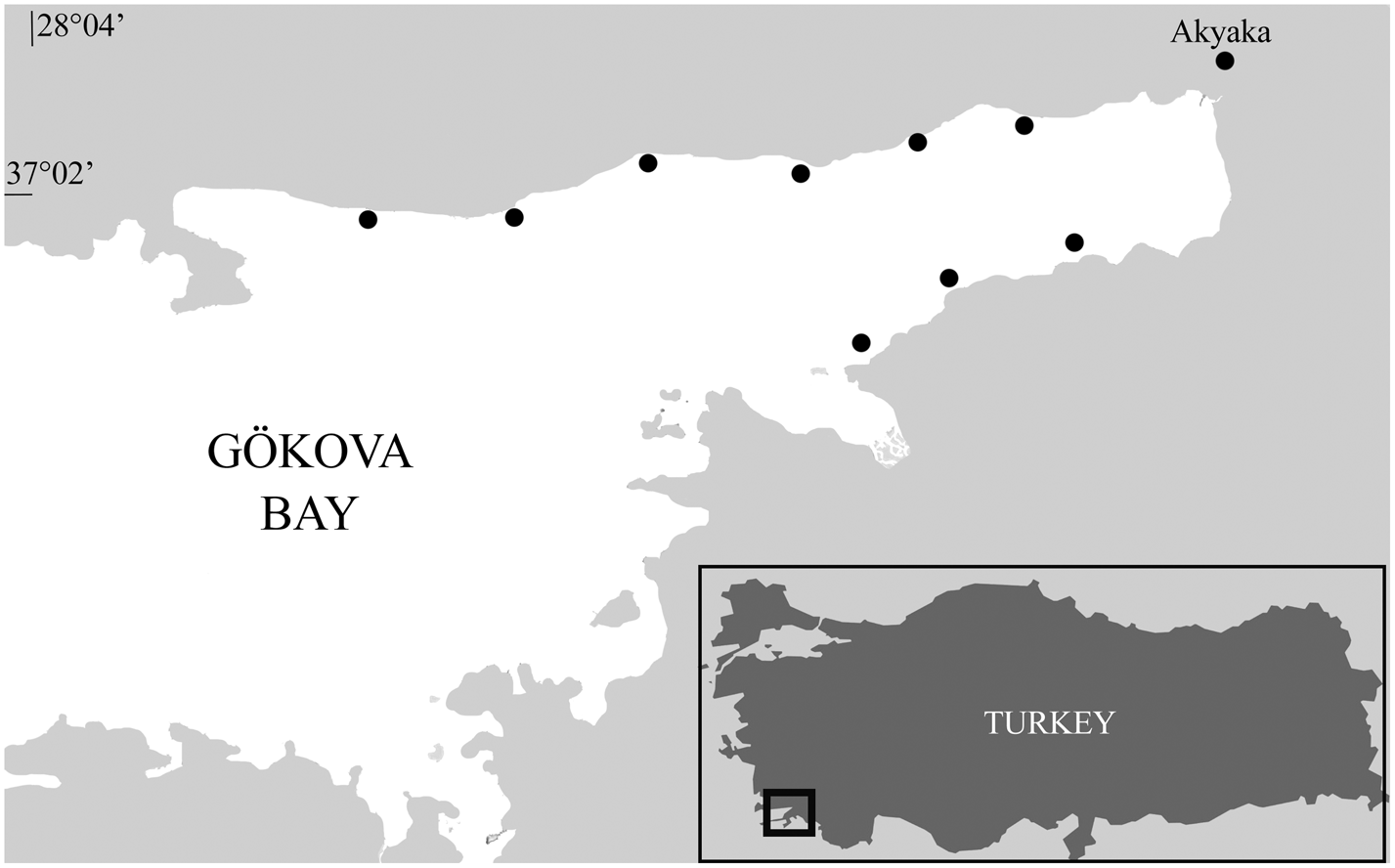
Fish samples (n = 721) were collected between July 2016 and June 2018 from small-scale (trammel nets) and recreational fisheries (by traps and angling) in Gökova Bay, southern Aegean Sea (Figure 1).
Sampling locations of Siganus rivulatus from Gökova Bay, southern Aegean Sea (black points indicate the sampling stations).

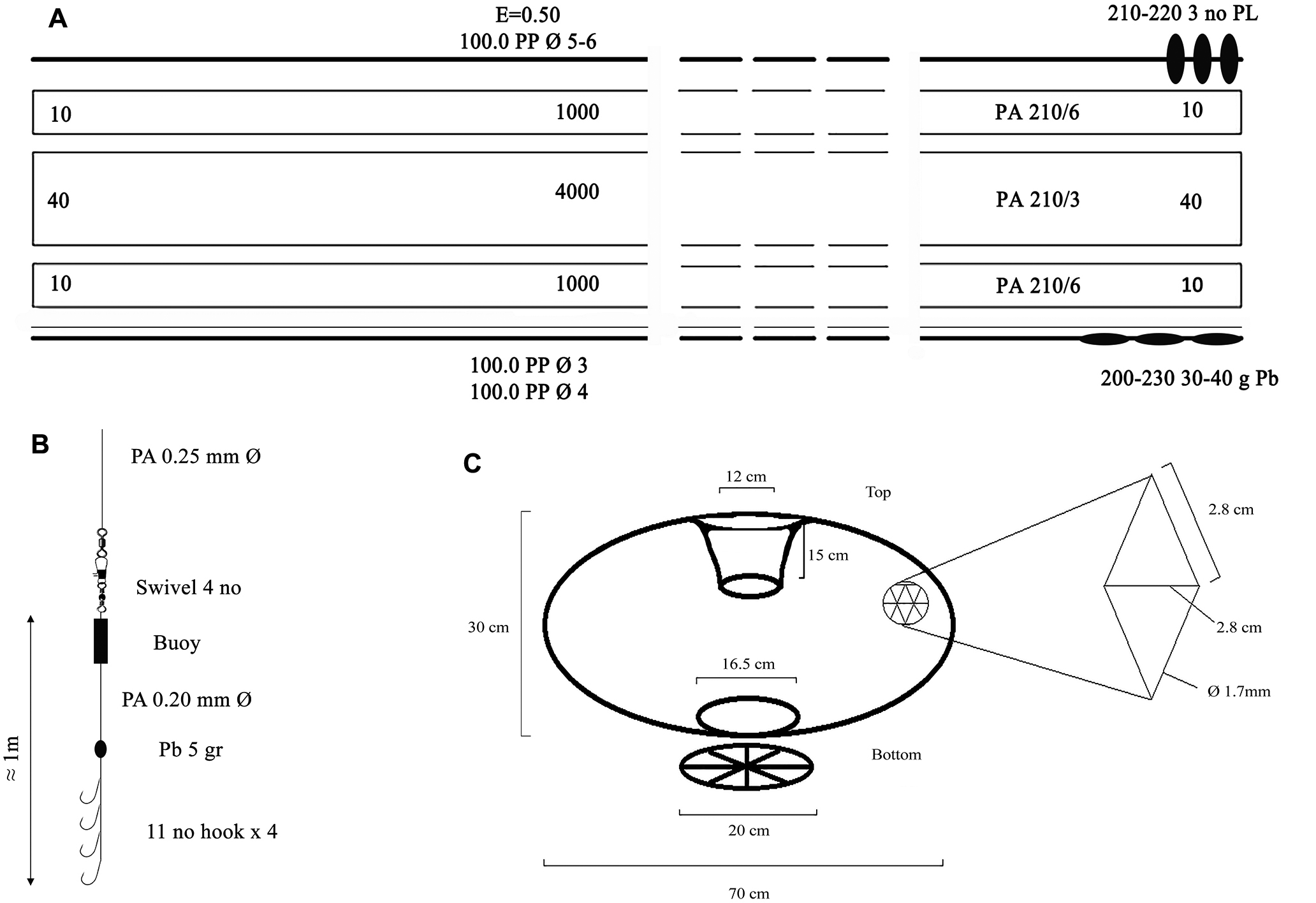
Trammel nets were made of polyamide material with 50 mm stretched mesh size and total length of 500–600 m. They were used on the rocky and seagrass substrates between the time of sunset and sunrise (nets stayed underwater for one night). Fishing tackle had a simple design and angling was performed on the rocky shores of Gökova Bay with crumb as the main bait. Fishing trap (locally named as kirtil) was used on the seagrass and rocky substrates and crumb, purslane and lettuce were the baits. Depth of the fishing operations ranged from 1–20 m. Technical characteristics of fishing gears used in the study were given in Figure 2.
Fishing gears for Siganus rivulatus capture used in the southern Aegean Sea (Out of scale, A; Trammel net, B; Handline, C; Trap).

Total length (TL) was measured in the natural body position to the nearest millimetre. Total weight (W) and gonad weight (GW) were measured to the nearest 0.01 g, and sex was recorded after dissection of the specimen. Pooled data were used to draw annual length frequency diagrams. Studies regarding sex and maturity were carried out by macroscopic analysis of the gonads. Maturity stages were assigned in a 5-stage classification scheme: stage I immature, stage II resting, stage III developing, stage IV ripe and stage V spent (Gunderson, Reference Gunderson1993). The female to male (F:M) ratio was calculated using only mature individuals, and a chi-square (χ2) test was applied for determining the significance of the female to male ratio.
The length–weight relationship was calculated with the formula W = a × L b, where W refers to total body weight (g), L is total length (cm) where a and b are coefficients (Ricker, Reference Ricker1973). The parameters (a and b) of the length–weight relationship were estimated according to linear regression analysis of log-transformed data. Significant difference of b values from 3, which represent isometric growth, was examined with the t-test (Pauly, Reference Pauly1993). The degree of association between variables was calculated by the correlation coefficient (R 2). Fulton's Condition Factor (CF) values were calculated for males and females separately with the following formulae:
 $${\rm CF}\,= \,\left({\displaystyle{{{\rm Body\ Weight}-{\rm Gonad\ Weight}} \over {{\rm Total\ Lengt}{\rm h}^3}}} \right)\times 100$$
Age estimations (n = 360) were made by two experienced independent readers who did not have prior access to information on size, sex or date of capture while they were counting growth increments. The dataset agreed by the independent readers was considered for the estimations. If the readings did not coincide, the vertebra was rejected. Therefore, vertebrae of 307 individuals, covering all size classes, were used for determining the age. Otolith examination process of S. rivulatus, especially the removal, requires too much time and effort due to small-sized otoliths. Therefore, age determination was conducted on vertebrae (Campana, Reference Campana2001; Yalcin et al., Reference Yalcin, Solak and Akyurt2002). All vertebrae from 13th to 16th were taken out, kept in boiling water for 10 min, cleaned from soft tissues and air dried for age estimations and they were examined in xylol by stereoscopic zoom microscope under reflected light against a black background (Yalcin et al., Reference Yalcin, Solak and Akyurt2002). The above-mentioned sections of vertebra were bigger than the others which made age reading easier under the binocular and more practical during the cleaning process. Opaque and transparent rings were counted; one opaque zone together with one translucent zone was considered to be the annual growth indicator.
For growth estimation, standard non-linear optimization methods (Sparre & Venema, Reference Sparre and Venema1998) were used and von Bertalanffy growth function was fitted to size-at-age data. The function L t = L ∞[1−e−K(t−t0)] was fitted to the data, where L t is the fish length (cm) at time t (year), L ∞ is the asymptotic length (cm), K is the growth coefficient (year−1), and t 0 (year) is the hypothetical time at when the length is equal to zero. In addition, accuracy of the growth parameters was examined using Munro's growth performance index (φ = log(K) + 2log(L ∞)) and the t-test (Pauly & Munro, Reference Pauly and Munro1984).
The spawning period was established based on monthly variation in the gonadosomatic index (GSI, %) using the equation GSI = [GW/(W−GW)] × 100, where GW is the gonad weight (g) and W is the total weight (g) of the fish (Ricker, Reference Ricker1975). Length at first maturity (L m) was defined as the length at which 50% of the population investigated was near spawning (King, Reference King1996). The length at 50% maturity was determined with the formula L m = 1/(1 + exp(−(r × (TL−TL50)))) where r is the slope of the curve, TL is the mean length of length classes, TL50 is model constant and L m is the mean length at sexual maturity or the length which corresponds to a proportion of 0.5 (or 50%) in reproductive condition.
Results
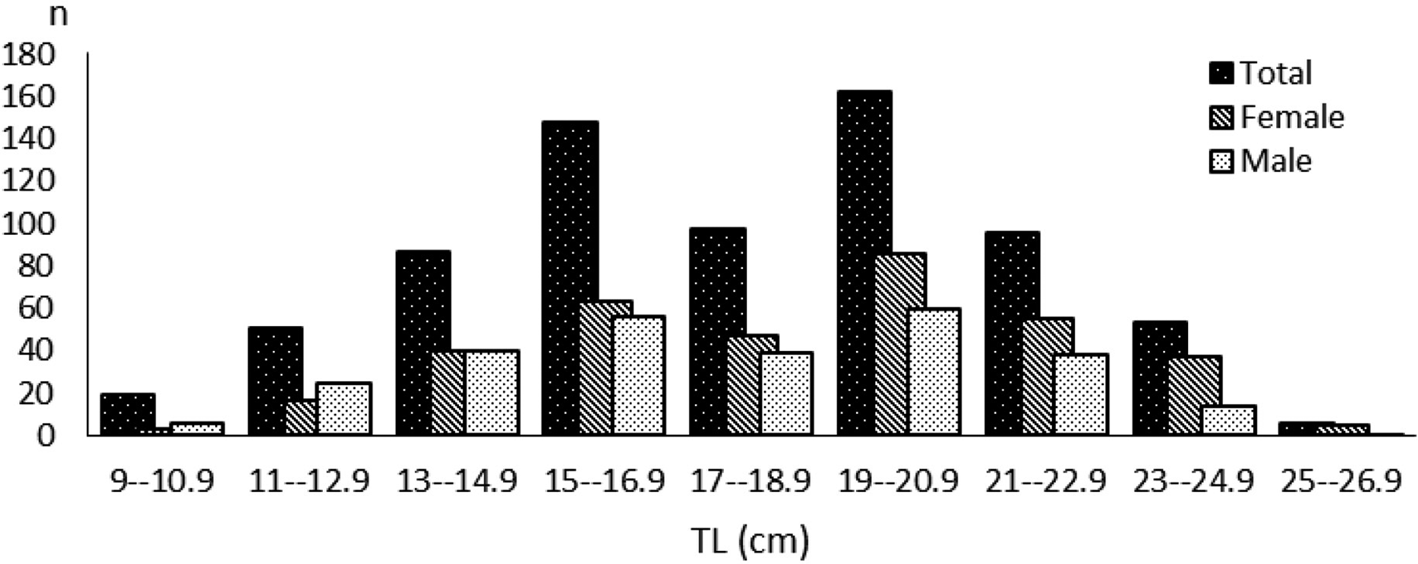
A total of 721 marbled spinefoot individuals were sampled during the study, including 355 females, 279 males and 87 immature individuals that were excluded from the sex ratio determination. Female:male ratio was calculated to be 1:1.27. Chi-square analysis indicated a significant difference between number of males and females (χ2, P < 0.05). The lengths of fish ranged from 9.0 cm (April) to 26.1 cm (August) TL. Males ranged from 9.4–25.2 cm and females varied from 10.8–26.1 cm (Figure 3). The mean length of the whole sample was calculated to be 17.9 ± 0.1 cm, while 17.5 ± 0.2 and 18.7 ± 0.2 cm were determined for males and females, respectively.
Length–frequency graph of Siganus rivulatus from the south-eastern Aegean Sea.

The weights of the samples varied from 8.81–291.26 g. Males were in the range of 11.57–196.08 g and females 14.98–293.42 g. The mean weight of all samples was determined as 79.0 ± 1.87 g, while 71.0 ± 2.54 g was obtained for males and 91.1 ± 2.93 for females. The length–weight relationship was W = 0.00941L3.0828 (R 2 = 0.958) for all individuals. While isometric growth was observed for males and all individuals, positive allometric growth was detected for females (t-test, P < 0.05; Table 1).
Length–weight relationship of marbled spinefoot from southern Aegean Sea

N, number of individuals; a and b, intercept and slope of the relationship; R 2, coefficient of determination; SEb, standard error of slope; CL, 95% confidence limits; GT, growth type (A+: positive allometry, 0: Isometry).
Our results on condition factor (CF) revealed that the values fluctuated between 0.783–1.674 with an average of 1.154 for males and it was between 0.131–2.101 with an average of 1.204 for females.
Age of the stock ranged from 1 to 9 years. Length of the individuals included in the age estimations varied between 9.0 and 26.1 cm TL with a mean length of 18.2 ± 0.2 cm. Regarding the growth, length at infinity was calculated as L ∞ = 27.7 cm. In addition, growth coefficient was found to be K = 0.162 y−1 and t 0 = −1.87 y (a = 4.14, b = −0.15, R 2 = 0.985) is the value calculated for the age before birth. The last result on the growth of the species was the growth performance index which was determined to be φ = 2.09.
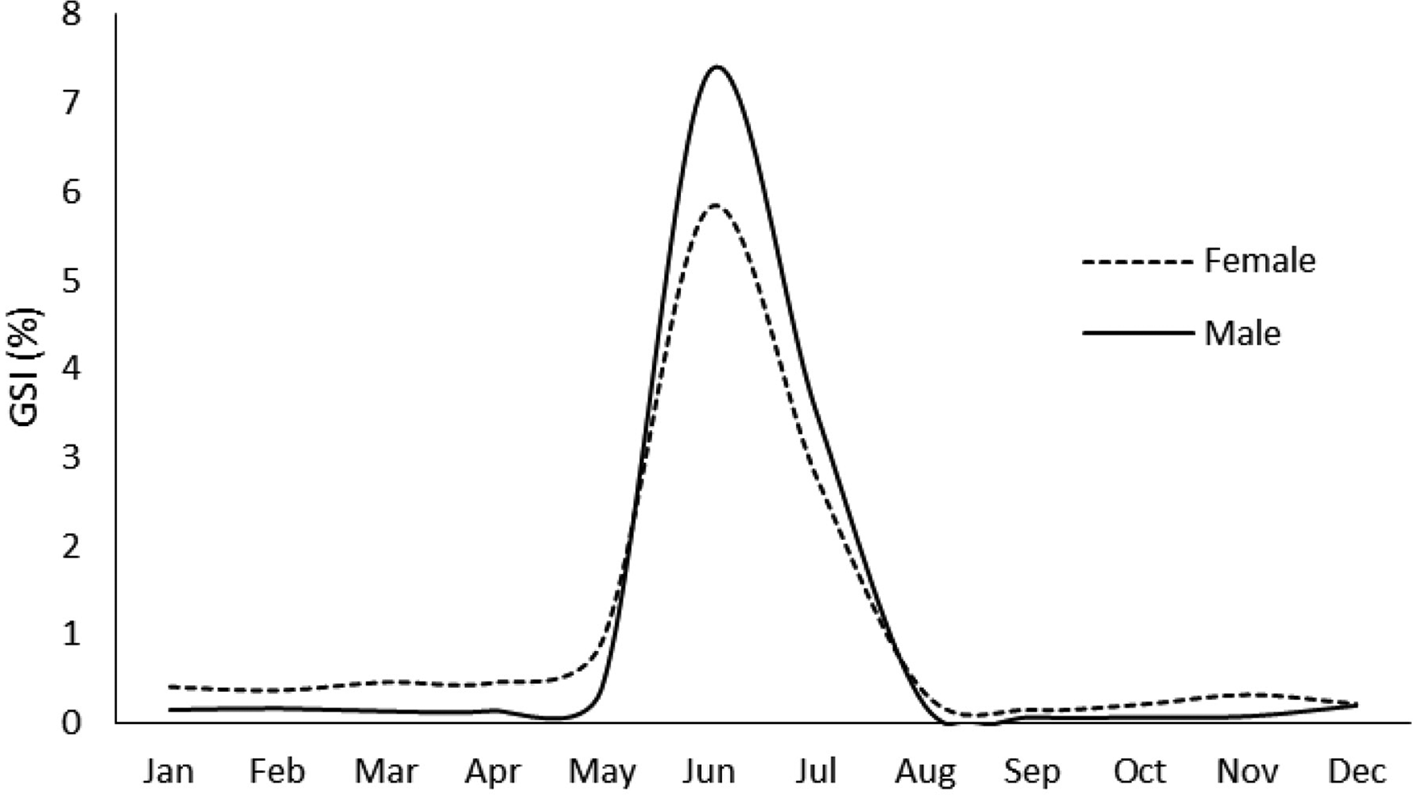
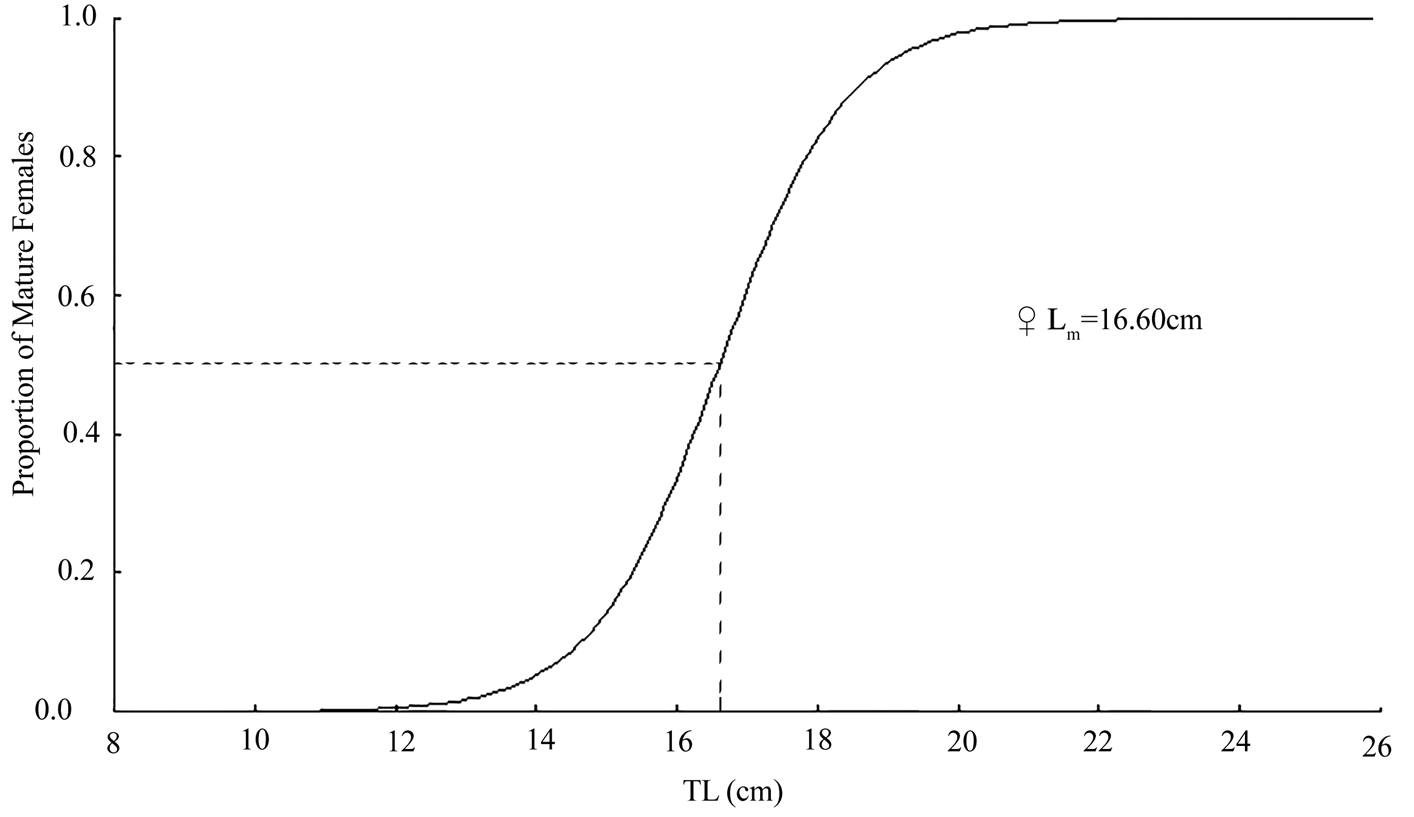
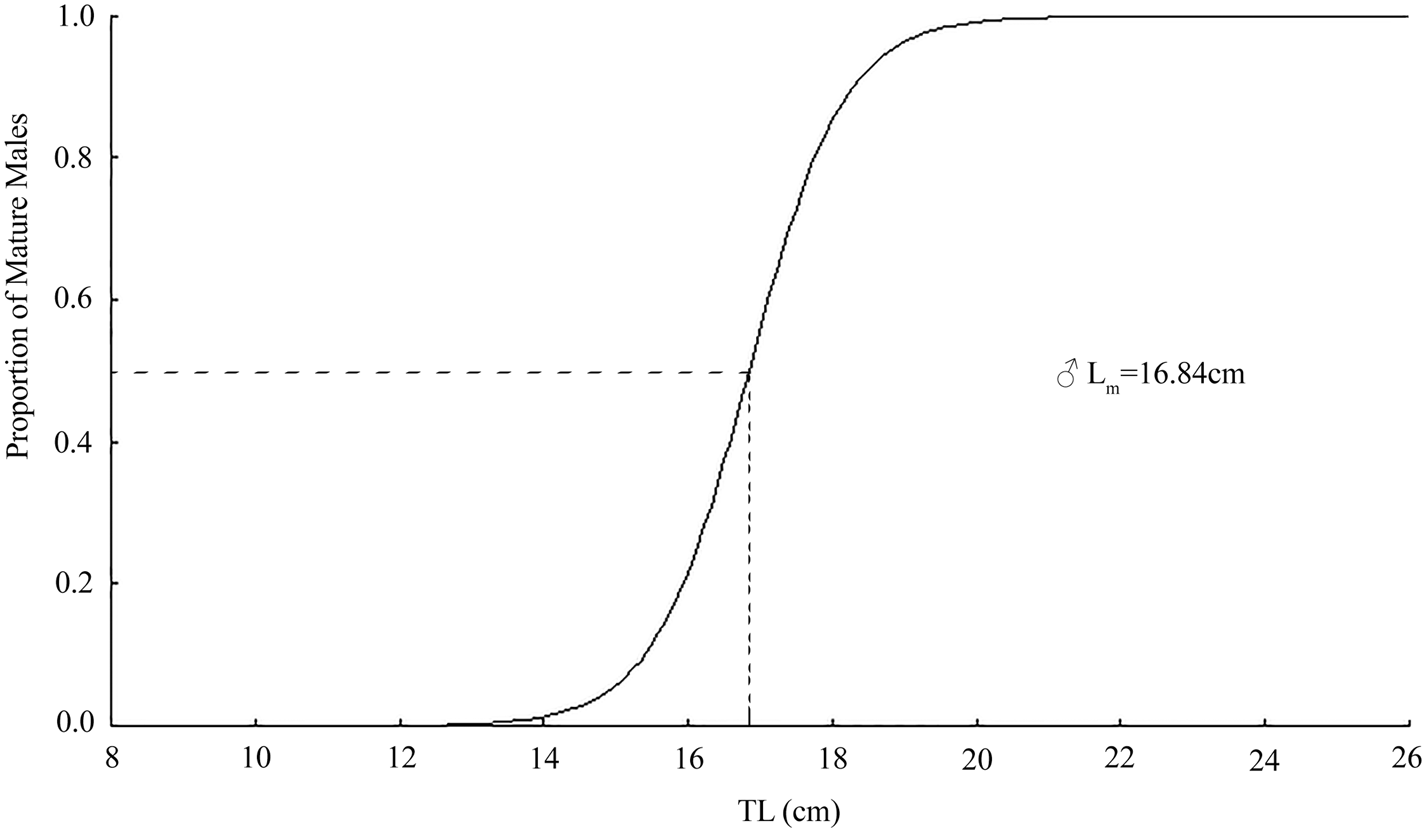
High GSI values were detected in June and July, but were at the minimum level in September for each sex, whilst individuals ready for spawning were observed mostly between May and August, peaking in June (Figure 4). While gonad formation occurred at 10.5 cm in males and 12.2 cm for females, mature gonads were detected at 15.9 and 16.0 cm for males and females respectively. Moreover, length and age at first reproduction were: L m = 16.6 ± 0.44 cm and 1 year (a = 216.517, b = 0.769, R 2 = 0.907) for females, L m = 16.8 ± 0.48 cm and 2 years (a = 216.543, b = 0.645, R 2 = 0.833) for males (Figure 5 & 6).
Monthly gonadosomatic index (GSI) for females and males of Siganus rivulatus in the southern Aegean Sea between 2016–2018.

First reproduction length of female Siganus rivulatus. TL, total length.

First reproduction length of male Siganus rivulatus. TL, total length.

Discussion
This study addressed first data on age, growth, reproduction, spawning season and some other related biological parameters of S. rivulatus for the Turkish coast of the Aegean Sea. Updated information on population parameters is of crucial importance for alien species such as marbled spinefoot due to their potential ecological impacts. This study is considered to provide useful information for further fisheries management of marbled spinefoot by filling the gap on length at maturity, lifespan and spawning season which are lacking in the Turkish fishery regulations.
Siganus rivulatus is considered to be a difficult fish to collect due to its habitat preference. Sampling gears of most studies (Yeldan & Avşar, Reference Yeldan and Avşar2000; Bilecenoğlu & Kaya, Reference Bilecenoğlu and Kaya2002; Gökçe et al., Reference Gökce, Mustafa and Filiz2010) are gill nets, pots and fishing line which limits the total number of samples in comparison to other fishing techniques such as trawl and purse seine nets. The number of samples (n = 721, L min−L max = 9.0–26.1 cm) collected in this study is slightly higher than that of Bilecenoğlu & Kaya (Reference Bilecenoğlu and Kaya2002) (n = 521, L min−L max = 7.0–21.5 cm), Yeldan & Avşar (Reference Yeldan and Avşar2000) (n = 473) and Ergenler (Reference Ergenler2016) (n = 531, L min−L max = 8.5–29.5 cm). Therefore, the present study includes the highest number of representatives in each length group conducted so far around the surrounding waters of Turkey.
Our data indicated that females dominated the stock in terms of number. While El-Drawany (Reference El-Drawany2015) and Yeldan & Avşar (Reference Yeldan and Avşar2000) reported similar results on sex ratio, Ergenler (Reference Ergenler2016) revealed the dominancy of males in İskenderun Bay, eastern Mediterranean coast of Turkey. The range of minimum and maximum lengths (TLmin = 9.0 cm, TLmax = 26.1 cm) of this study is in between the range of the previous study results (minimum 7.0 cm by Bilecenoğlu & Kaya, Reference Bilecenoğlu and Kaya2002; maximum 30.2 by Gabr et al., Reference Gabr, Bakaili and Mal2018). Furthermore, the biggest individual on the Turkish Mediterranean coast was reported from İskenderun Bay with a total length of 29.5 cm by Ergenler (Reference Ergenler2016). Similarity within the length ranges of the reported studies is attributable to sampling gears as most of the studies were performed by artisanal fishery which includes small-scale fishing gears such as trammel nets, pots, traps and handlines.
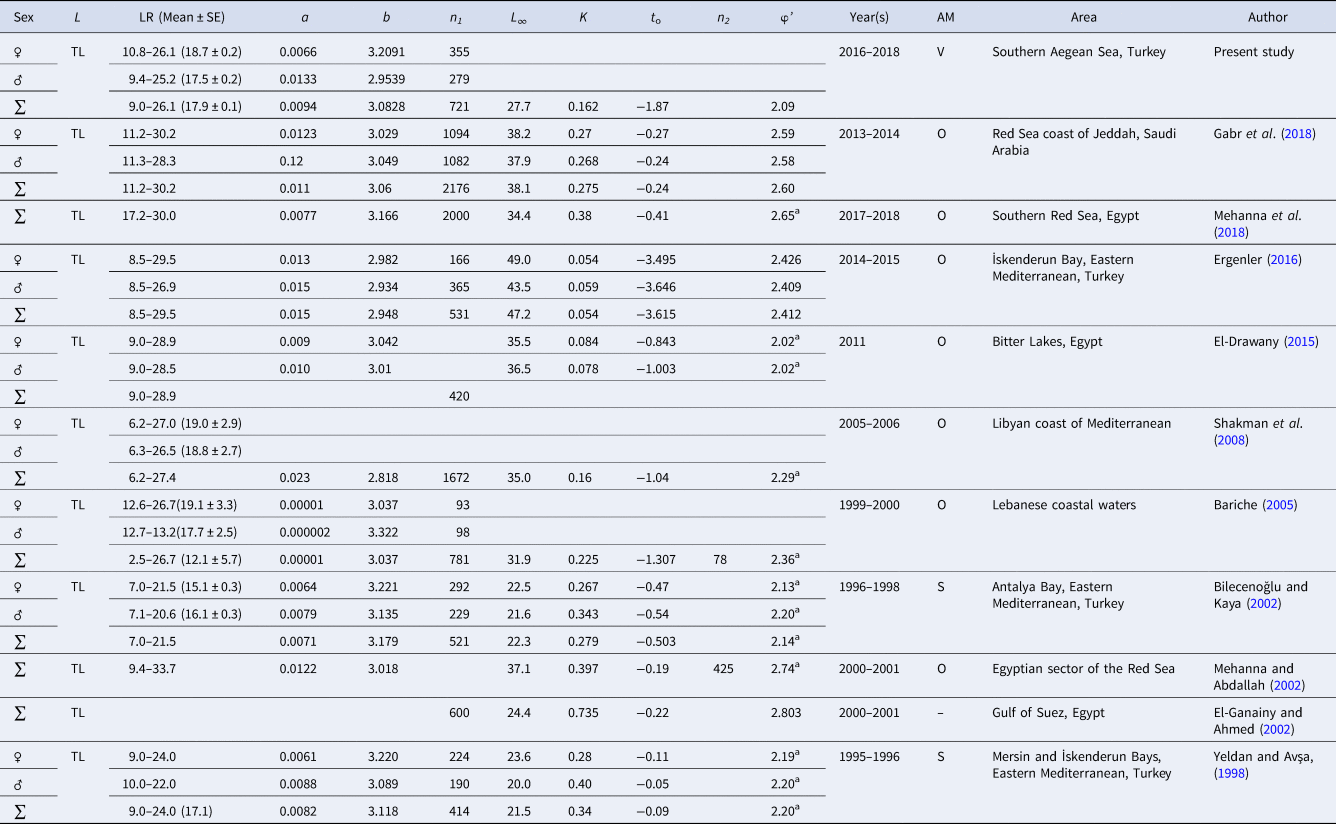
Length–weight relationship (LWR) is not only an important tool in fisheries management, but also an important growth indicator. LWR parameters vary for same species according to regional and sampling differences and accuracy of the measurements (Gülşahin & Soykan, Reference Gülşahin and Soykan2017). The LWR in fish is affected by a number of factors including gonad maturity, sex, diet, stomach fullness, differences in the observed length ranges of the caught specimen and health as well as season and habitat (Froese, Reference Froese2006). The growth of marbled spinefoot in the southern Aegean Sea was isometric (b = 3.0828) and it was found that females grew in weight more rapidly than males (Table 2) similar to those inhabiting the Jeddah coast (Saudi Arabia) (Gabr et al., Reference Gabr, Bakaili and Mal2018), the İskenderun Bay (Turkey) (Ergenler, Reference Ergenler2016) and Bitter Lakes in Egypt (El-Drawany, Reference El-Drawany2015). On the other hand, Bilecenoğlu & Kaya (Reference Bilecenoğlu and Kaya2002) stated allometric growth for marbled spinefoot from Antalya Bay (eastern Mediterranean). ‘b’ values of previous studies ranged from 2.59 (El-Far, Reference El-Far2008) to 3.32 (Bariche, Reference Bariche2005). Variations on b values are attributable to availability or lack of food supply and spatio-temporal differences between regions.
Length–weight relationship and the growth parameters of previous studies for S. rivulatus in the Red Sea and Eastern Mediterranean

–, not given; ♂, ♀ and å, male, female and total; L, length type (TL: total length); LR, length range (cm); SE, standard error of mean length (cm); a, b and n1, intercept and slope of the length-weight relationship, and sample size; L ∞, k, t o, n2 and φ’, asymptotic length (cm), growth coefficient (y−1), hypothetical time at which the length is equal to zero (y), sample size and Munro's phi prime index value; Year(s), sampling year/years; AM, Ageing methods; V, vertebrae; S, scales; O, otoliths.
a Phi-primes of the studies were calculated by the authors.
Age is a required parameter to assess population dynamics and to determine the state of exploited resources (Allain & Lorance, Reference Allain and Lorance2000). For age determination, bony structures such as otoliths and vertebra are considered to be more suitable and satisfactory than scales due to formation timing in the lifespan (Gabr et al., Reference Gabr, Bakaili and Mal2018). Clay (Reference Clay1982) also offered that reading age from vertebrae is better than the other methods. Therefore, age estimation of S. rivulatus in the present study was based on the counting and interpretation of growth zones formed on the vertebrae. Marbled spinefoot was reported as a long life species (Bilecenoğlu & Kaya, Reference Bilecenoğlu and Kaya2002) and our result on maximum age (9 years) confirmed this. Yeldan & Avşar (Reference Yeldan and Avşar1998) stated the highest age to be 7 years for all samples from İskenderun Bay. The maximum observed lifespan around Turkish seas was reported as 10 years by Ergenler (Reference Ergenler2016) from İskenderun Bay. Although aged individuals were announced from the Turkish coast of the Mediterranean, this situation differs in the Red Sea. El Gammal (Reference El-Gammal1988), Mehanna & Abdallah (Reference Mehanna and Abdallah2002) and Gabr et al. (Reference Gabr, Bakaili and Mal2018) revealed 5 years as the maximum age in the Egyptian coast of the Red Sea. The difference in maximum age between the eastern Mediterranean and Red Sea may be attributed to the sampling and ageing methods used (Bariche, Reference Bariche2005), fishing pressure, different growth coefficients, various biotic and abiotic factors such as temperature, predation and food availability. The presented maximum theoretical length of S. rivulatus is slightly higher than the results from comparable studies (Yeldan & Avşar, Reference Yeldan and Avşar1998; Bilecenoğlu & Kaya, Reference Bilecenoğlu and Kaya2002) in the Mediterranean Sea. However, Ergenler (Reference Ergenler2016) reported the L ∞ to be more than twice the results of the abovementioned studies. On the other hand, the maximum theoretical length values reported from the Red Sea are clearly higher than our finding (Table 2). The differences between the growth parameters from different locations (Mediterranean and Red Sea) given in Table 2 are considered due to different factors such as sampling, methodology of ageing or even geographic differences of habitats and condition of the fish samples. Phi-prime index values of the published studies were calculated using reported parameters and they ranged between 2.02 and 2.80. These values were compared with our study's phi-prime index value of 2.09 and a statistically significant difference was observed between the growth performance index values of our study and the published papers.
Gonad formation in females and males was determined to occur at 10.5 and 12.2 cm total length, respectively. Furthermore, 16.6 cm (females) and 16.8 cm (males) total length values were calculated to be the length at first reproduction. El-Drawany's (Reference El-Drawany2015) examination of male and female maturity stages indicated that males and females of S. rivulatus matured at about 15.5 cm total length in the Bitter Lakes of Egypt. Bariche et al. (Reference Bariche, Harmelin-Vivien and Quignard2003) estimated the length at maturity to be 13.2 cm for males and 13.6 cm for females on the Lebanese coast. Ergenler (Reference Ergenler2016) reported the sexual maturity length to be 13.91 and 14.1 cm for females and males respectively in İskenderun Bay (eastern Mediterranean coast of Turkey). Yeldan & Avşar (Reference Yeldan and Avşar2000) revealed the existence of sexually mature individuals bigger than 15.5 cm in the north-eastern Mediterranean coast of Turkey. Conversely, 20.0 cm TL was declared to be the length of first sexual maturation from the southern Red Sea, Egypt by Mehanna et al. (Reference Mehanna, Mohammad, El-Mahdyand and Osman2018). Differences between the previous studies about the length at maturity are relatively small and discrepancies may be attributed to sampling techniques, geographic disparity and the sampling year of the studies. The biggest effect of geographic disparity is undoubtedly on the water temperature. While average seawater surface temperature was 17.2°C in the Mediterranean (southern Aegean Sea – sampling area of the present study), it was reported to be 22.7°C in the Red Sea (World Sea Temperatures, 2020). Therefore, differences in length at maturity values in different locations may be attributable to the water temperature. Although spawning period of the species was reported to be seven months (from March to September) in the Red Sea (Amin, Reference Amin1985), El-Drawany (Reference El-Drawany2015) stated that the spawning season of the species was between April and August in the Egyptian Bitter Lakes. Bariche et al. (Reference Bariche, Harmelin-Vivien and Quignard2003) revealed the spawning season as June on the Lebanese coast and they announced that high temperature in the summer period was the limiting factor in gonadal development. Yeldan & Avşar (Reference Yeldan and Avşar2000) indicated the reproduction period to be July and August in the Turkish coast of the north-eastern Mediterranean. Our results are in accordance with Yeldan & Avşar (Reference Yeldan and Avşar2000) as we detected an increase in GSI values starting from May, a peak in June and a decrease in July and August showing that spawning occurred in between June and August in the southern Aegean Sea. It is clear that S. rivulatus is a summer spawner species.
One of the major concerns about invasive marbled spinefoot is the lack of information on its stock assessment in the Turkish Seas. Many studies (Stergiou, Reference Stergiou1988; Bariche et al., Reference Bariche, Letourneur and Harmelin-Vivien2004; Moleana et al., Reference Moleana, Patrona, Meziane and Letourneur2016) reported that Siganids are strong competitors in terms of feeding and adaptation and S. rivulatus was reported as an herbivorous species (Stergiou & Karpouzi, Reference Stergiou and Karpouzi2002; Bariche, Reference Bariche2006; Pickholtz et al., Reference Pickholtz, Kiflawi and Friedlander2018). Therefore, identifying the probable competition scenarios of the species against other local herbivores such as Sarpa salpa and juvenile fish is of crucial importance in terms of fisheries management and preserving the biodiversity. Despite its commercial importance, no regulative tool such as minimum landing size or fishing period limitation is applied on the fishery of the species in Turkey. This discussion raises two complex questions, i.e. ‘Should we somehow limit the fishery of the species?’ or ‘Should we promote the catch pressure on the species?’ Whatever the answer is, the above-mentioned cases indicate that stock assessment studies and long-term monitoring of the Siganid stocks in the Turkish seas should be the first attempt for ecosystem-based fishery management.
The aims of the present study were to investigate the length distribution, length–weight relationship, age, growth, spawning period and length at maturity of invasive marbled spinefoot in the Turkish coast of the southern Aegean Sea and to compare these results with those of previous studies. Although small-scale fishing fleets have been targeting this valuable species for many years especially in the Mediterranean, more scientific information is needed for providing the sustainability of the fisheries. Therefore, additional comprehensive studies are required in order to expand our knowledge of the biology, ecology and fisheries on this species.
Acknowledgements
This study is supported by Ege University Scientific Research Projects Coordination Unit. Project Number: 2016/SÜF/014.