





Introduction
Increased global food production is a key challenge for achieving food security and feeding the world’s growing population in the decades ahead. Access to quality food is required for a projected population of 9 billion people by 2050 (Karlsson et al. Reference Karlsson, Röös, Sjunnestrand, Pira, Larsson and Andersen2017). Several reviews have concluded that increasing food production with particular emphasis on wheat (Poaceae), an economically important crop, is a potential solution (Muchhadiya et al. Reference Muchhadiya, Gohil, Yadahalli, Hm, Siddiqua and Khayum2024). Numerous studies have documented the persisting issue of declining wheat productivity in Iraq, which continues to fall short of regional and global requirements (Eklund et al. Reference Eklund, Abdi and Islar2017; Alani and Alhiyali Reference Alani and Alhiyali2021).
Various factors can impact wheat production, with infection by pathogens and infestation by insect pests being the primary causes of inconsistent and inadequate wheat yields during pre- and post-harvest production. The wheat thrips, Haplothrips tritici (Kurdjumov) (Thysanoptera: Phlaeothripidae), is the dominant grain crop thrips that damages wheat during the most critical periods of heading and flowering. Thrips feeding during heading and flowering impacts grain milling-quality traits, such as protein content, and quantity, which leads to decreases in yield by up to 0.25 t/ha (Ahmed et al. Reference Ahmed, Radi and Sánchez2019; Zhichkina et al. Reference Zhichkina, Nosov and Zhichkin2023).
Insecticides, with various chemical formulations, are commonly used to manage wheat thrips; however, their application may damage wheat during the early grain-filling stage and also creates environmental and ecological concerns (Ionescu and Penescu Reference Ionescu and Penescu2015; Ghani and Maalik Reference Ghani and Maalik2020). Furthermore, wheat thrips have developed resistance to some conventional insecticides (e.g., deltamethrin and diazinon; Gao et al. Reference Gao, Lei and Reitz2012; Shokouhi-Nia et al. Reference Shokouhi-Nia, Mirshekar and Khani2022).
Alternative and sustainable solutions, such as biological control agents, have been recommended in recent years to address the above-mentioned difficulties (Khidr Reference Khidr2018; Thilagam et al. Reference Thilagam, Sharanappa, Roy, Deb, Padhan and Srividhya2023). Two bacterial microorganisms have shown some ability to control agricultural pests and diseases: Bacillus subtilis Cohn, 1872 (Bacillaceae) and Pseudomonas fluorescens Migula, 1895 (Pseudomonadaceae). These two microorganisms have been extensively studied as either directly affecting the insect pests or improving soil conditions and nutrient availability to encourage plant growth and systemic resistance in the plants (known as plant growth–promoting rhizobacteria; Rashid and Chung Reference Rashid and Chung2017; David et al. Reference David, Chandrasehar and Selvam2018). In some cases, plants infected with these rhizobacteria species were observed to have increased induction of their defence mechanisms, leading to improved crop quantity and quality (Mehmood et al. Reference Mehmood, Saeed, Zafarullah, Hyder, Rizvi and Gondal2023; Vasques et al. Reference Vasques, Nogueira and Hungria2024). Plant growth–promoting rhizobacteria could form biofilms that improve root colonisation, enhance nutrient availability, and promote overall soil health, thereby supporting crop growth and productivity. Beneficial microorganisms modulate primary and secondary metabolism, thereby inducing plant defence responses and enhancing tolerance to biotic and abiotic stresses, including the production of insecticidal metabolites (Beck et al. Reference Beck, Alborn, Block, Christensen, Hunter and Rering2018; Bamisile et al. Reference Bamisile, Afolabi, Siddiqui and Xu2023).
Fungal microorganisms, such as arbuscular mycorrhiza Glomus mosseae Tulasne and C. Tulasne (1885) (Glomeraceae) and the nonmycorrhizal fungus, Trichoderma harzianum Rifai, 1969 (Hypocreaceae), have the ability to promote plant growth (plant growth–promoting fungi) and act as biopesticides against a variety of insect pests (Poveda Reference Poveda2021; Khidr and Khalil Reference Khidr and Khalil2025a). The impact of mycorrhizal fungi and insects is complex because the fungi differentially affect nutrient acquisition in the host plant, which in turn impacts insect herbivory (Gehring and Bennett Reference Gehring and Bennett2009). In contrast, T. harzianum directly reduces insect pest populations like aphids and thrips by inducing elevated enzymatic activity, such as chitinase and protease, within the host plant (Muvea et al. Reference Muvea, Subramanian, Maniania, Poehling, Ekesi and Meyhöfer2018; Mukherjee and Ghosh Reference Mukherjee and Ghosh2023). Numerous studies have demonstrated the influence of soil microbial amendments on plant pathogens (Ali et al. Reference Ali, Khan, Ali, Ullah, Dai and Khan2022; Meddad-Hamza et al. Reference Meddad-Hamza, Benzina, Meddad, Hamza, Reghmit, Ziane and Ksentini2023). Nevertheless, relatively few field investigations have examined the extent to which soil microorganisms impact insect pests.
The present study investigated the practical application of beneficial microorganisms to manage wheat thrips and thereby reduce the need for chemical fertilisers and insecticides. The integrated impacts of biocontrol and the plant growth–promotion activities of microbial biofertilisers were assessed in relation to H. tritici management. Specifically, the biocontrol activities of the bacterial (B. subtilis and P. fluorescens) and fungal (G. mosseae and T. harzianum) biofertilisers, as well as their combinations, were applied as seed treatments to examine their effectiveness on the wheat biological parameters of plant height, number of spikes, number of grains, weight of 1000 grains, chlorophyll content, and the response to pest occurrence, as well as severity of crop infestation.
Materials and methods
Laboratory experiment
Thrips species morphological identification
Wheat thrips, H. tritici, were collected by aspirator from wheat spikes at the Grdarash Station, a facility of the College of Agricultural Engineering Sciences, Salahaddin University, in Erbil, Iraq (geo-coordinates: 44.107610, 36.155308). The collected insects were identified based on morphological characteristics under a binocular dissecting microscope using taxonomic keys (Benmessaoud-Boukhalfa et al. Reference Benmessaoud-Boukhalfa, Mouhouche and Belmazouzi2010; Minaei and Mound Reference Minaei and Mound2010; Wahlberg and Gertsson Reference Wahlberg and Gertsson2022) and further confirmed by expert taxonomists in the Plant Protection Department, College of Agricultural Engineering Sciences, Salahaddin University, Erbil, Iraq.
Preparation of seeds
The wheat seeds of the Hawler 4 wheat variety were obtained from the Erbil Agriculture Research Centre (Erbil, Iraq; geo-coordinates: 43.992481, 36.242382). To eliminate possible surface contamination, all seeds were surface sterilised using a 1% (v/v) sodium hypochlorite solution, soaked for 3 minutes, and then rinsed twice with sterile distilled water before use.
Preparation of microbial formulation
Bacillus subtilis, P. fluorescens, and T. harzianum cultures were received from the Department of Plant Protection, College of Agricultural Engineering Sciences. Arbuscular mycorrhizal fungi Glomus mosseae were obtained as a commercial powder product (Vitax Ltd., Leicester, United Kingdom) and were applied according to label rates (i.e., 50 kg ha–1). Nutrient agar (Difco™, Beirut, Lebanon) was prepared by dissolving 28 g of powder in 1 L distilled water. The mixture was heated to boiling, autoclaved at 121 °C for 15–20 minutes, cooled to 45–50 °C, and then poured into plates under sterile conditions with a pH of about 7.4 (± 0.2). Bacillus subtilis and P. fluorescens were subsequently cultured on the prepared nutrient agar plates and incubated at 25 °C for 48 hours to obtain sufficient biomass. A concentration of 106 colony-forming units/mL was achieved by resuspending bacterial cultures in sterile distilled water after they had been harvested and centrifuged using a spectrophotometer, and bacterial numbers were quantified by measuring optical density at a wavelength of 600 nm.
The cultivation of fungal cultures involved preparing a T. harzianum spore suspension by growing the fungus on potato dextrose agar (Difco™) plates. The potato dextrose agar was prepared by dissolving 39 g of powder in 1 L distilled water, heated to a boil while stirring, sterilised by autoclaving at 121 °C for 15 minutes, cooled to 45–50 °C, and poured into sterile Petri dishes with a pH of about 5.6 (± 0.2). The culture was incubated at 25–28 °C for 5–7 days to facilitate good sporulation. Sterile distilled water with 0.1% Tween 80 was added to the plates to flush out spores. The fungal growth was gently scraped with a sterile loop to dislodge the conidia into the medium. The resulting suspension was passed through sterile muslin cloth to remove mycelial debris. Spore concentration was made as necessary using a hemocytometer to approximately 1 × 10⁶ conidia/mL. Standardised suspensions were immediately used for the subsequent experiments.
Seed germination assay
The bacterial and fungal treatments were evaluated for their germination by soaking 50 seeds in 10 mL of each suspension for 15 minutes. The suspensions then were drained, and the treated seeds were dried on filter paper. Control wheat seeds were treated with sterile distilled water. Ten seeds with five replications were placed in a Petri dish (9 cm) with two layers of Whatman No. 1 filter paper and 1 mL of distilled water to moisten them. The experiment was carried out twice to ensure adequate reliability and validity. Percent germination was calculated after 15 days using the following formula:
 $${\rm germination\ percentage\ }\left({\rm G\%}\right)={{\rm number\ of\ wheat\ germinated} \over {\rm total\ number\ of\ seeds}}\times 100$$
The seed vigour index (SVI) was determined by precisely measuring the root and shoot lengths of the germinated seedlings with a digital calliper (Mitutoyo, Kawasaki, Japan), following methods by (Rashid et al. Reference Rashid, Kazm Mahmud, Kakakhan Awla and Anwar Qadir2024):
 $${\rm seed\ vigour\ index\ }\left({\rm SVI}\right)={\rm germination\ percentage }\times {\rm mean\ seedling\ length}$$
Field experiment
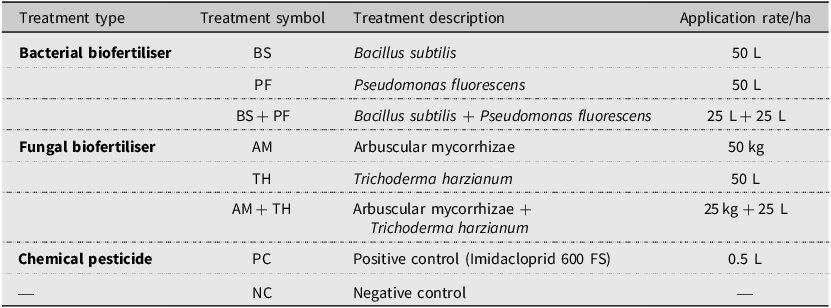
A field study was conducted at the College of Agricultural Engineering Sciences’ Grdarash Station, located in the southwest region of Erbil Province (geo-coordinates: 44.107610, 36.155308), in January 2025. The experimental field soil was silty clay loam with a neutral to slightly alkaline pH (∼7.4). The average rainfall was 73.3 mm, relative humidity was about 65.0%, based on data obtained from the Meteorological Directorate of Erbil Province during the growing season, and no pesticide applications were applied during the study period. Wheat seed (variety Hawler 4) was sourced from the Erbil Agriculture Research Centre and treated as described for the laboratory studies. Wheat seeds were sown by hand into the field during the second week of January at a rate of 150 kg/ha. Overall, there were 24 plots, each measuring 2 × 1.5 m (45 g seeds/plot), in eight rows, with 20 cm between rows. The experiment was set up in three blocks (replications), within which all treatments were randomly assigned using a randomised complete block design, with 2 m of unplanted soil between treatments to reduce movement of insects between plots. Seeds were treated with bacterial fertilisers (B. subtilis and P. fluorescens) or fungal fertilisers (arbuscular mycorrhizae and T. harzianum), either alone or in combination (Table 1). In addition, a negative control group was set up, in which the seeds were treated neither with chemicals nor microbial fertilisers, and a positive control was set up, in which the seeds treated with a chemical pesticide (Imidacloprid 600 FS; Bayer CropScience, Leverkusen, Germany; Table 1).
Microbial seed treatments used in the field experiment.
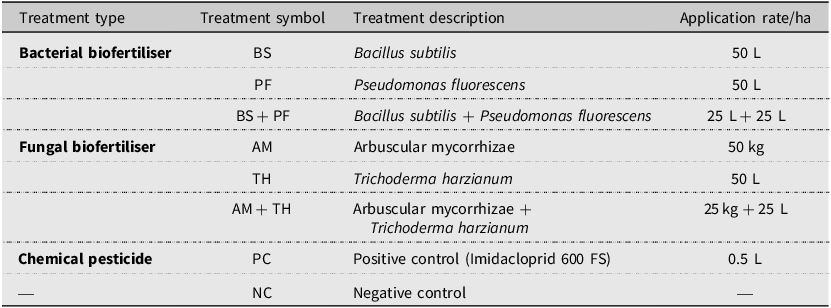
Table 1. Long description
A table comparing different types of seed treatments and their application rates. The table has four rows and four columns. The columns are labeled Treatment type, Treatment symbol, Treatment description, and Application rate/ha. The rows are grouped into three categories: Bacterial biofertiliser, Fungal biofertiliser, and Chemical pesticide. Under Bacterial biofertiliser, the treatments are Bacillus subtilis (BS) with an application rate of 50 L/ha, Pseudomonas fluorescens (PF) with an application rate of 50 L/ha, and a combination of Bacillus subtilis and Pseudomonas fluorescens (BS + PF) with an application rate of 25 L + 25 L/ha. Under Fungal biofertiliser, the treatments are Arbuscular mycorrhizae (AM) with an application rate of 50 kg/ha, Trichoderma harzianum (TH) with an application rate of 50 L/ha, and a combination of Arbuscular mycorrhizae and Trichoderma harzianum (AM + TH) with an application rate of 25 kg + 25 L/ha. Under Chemical pesticide, the treatments are Positive control (Imidacloprid 600 FS) with an application rate of 0.5 L/ha and Negative control with no application rate specified.
Effect of microbial fertilisers on the occurrence of wheat thrips
The population density of H. tritici in naturally infested wheat crops was recorded from all spikes by randomly selecting 10 plants in each treatment and counting thrips, irrespective of their size and stage. Overall, 240 plants were examined each week, starting the third week of March, when the population first appeared inside the spikes, until the first week of May, when the population started to decline and thereafter disappeared from the field close to the time of harvest. This period corresponded to the crop’s heading, flowering, and grain-filling phases.
Individual thrips collected from wheat spikes were placed on a white tray and then transferred into a container labelled according to the specific microbial treatment applied. The specimens in the container were collected with the help of a mouth aspirator. A stereoscopic dissection microscope, connected to a digital camera of the UCMOS (ultra-fine CMOS) series (ToupTek Photonics Co., Ltd., Hangzhou, Zhejiang Province, China), was used to inspect and identify the specimens.
The severity of spike infestation (visual damage scale by thrips) in wheat plants was calculated by randomly selecting 10 plants from each treatment, for a total sample size of 240 plants, regardless of the number of spikes that were examined weekly. The calculations for the severity of spike infestation index were performed according to McKinney’s (Reference McKinney1923) formula, whereby a, b, c, d, and e are the number of wheat spikes with levels of infestation of 0, 1, 2, 3, 4, and 5, respectively (5 being the highest score of spike infestation):
 $$ \left(\% \right)=\rm \left(a * 1\right) + \left(b * 2\right) + \left(c * 3\right) + \left(d * 4\right) + \left(e * 5\right) / \left(a + b + c + d + e\right) * 5 $$
In this way, 0 = no spike infestation; 1 = very slight infestation (≤ 10% of spikes affected); 2 = slight infestation (11–25% of spikes affected); 3 = moderate infestation (26–50% of spikes affected); 4 = severe infestation (51–75% of spikes affected); and 5 = very severe infestation (> 75% of spikes affected).
Effect of microbial fertilisers on biological parameters of wheat
The effect of microbial treatments on specific biological features of wheat was assessed. Ten plants were selected at random before harvesting from each treatment to measure plant height. After harvesting, the grains were separated, and the total number of grains and the weight of 1000 grains from each treatment were quantified via an electronic balance to an accuracy of 0.001 mg (Techfit, Shanghai, China), according to Khidr’s (Reference Khidr2018) equation:
 $${\rm seed\ number\ }\!\!/{\rm spike}={{\rm number\ of\ grains\ within\ each\ microbial\ treatment\ } \over {\rm total\ number\ of\ spikes}}$$
The total number of spikes was calculated for each plot, and the average number of spikes per plant was recorded for each microbial treatment, according to the following equation:
 $${\rm spike\ number}/{\rm plant}={{\rm number\ of\ spikes\ within\ each\ microbial\ treatment\ } \over {\rm total\ number\ of\ plants}}$$
In addition, each microbial fertiliser’s percentage efficiency, based on the number of spikes, was evaluated using the methods of Khidr and Khalil (Reference Khidr and Khalil2017):
 $${\rm efficiency\ }\left({\rm \%}\right)={{\rm microbial\ treatment} - {\rm negative\ control} \over {\rm negative\ control}}\times 100$$
The mean spike length per plant was determined by averaging the measurements from the sampled spikes, and the total spike length was recorded from the base of the spike in each microbial treatment.
The roots from 10 plants in each plot were washed carefully under running tap water to eliminate adhering soil particles and then were dried with paper towels. Cleaned roots were oven-dried at 70 °C until constant weight.
The chlorophyll content was measured in the field using a random sample of five leaves per plant and five plants per plot, for a total of 600 leaves from 120 plants. A SPAD-502 chlorophyll meter (Konica Minolta, Inc., Tokyo, Japan) was used to measure total leaf chlorophyll content based on light absorbance at wavelengths in the red (∼650 nm) and near-infrared (∼940 nm) regions as light passes through leaf tissue (Khidr and Khalil Reference Khidr and Khalil2025b).
Statistical analysis
In the analysis, the population density of thrips and the severity of wheat infestation, along with plant height, number of spikes, number of grains, weight of root, and weight of 1000 grains, were assessed as response variables, microbial treatments were assesssed as factors, and blocks (replications) were considered random factors. The general linear models – specifically, factorial analysis of variance in SPSS Statistics software, version 23 (IBM, Armonk, New York, United States of America), followed by Fisher’s least significant difference test – were used to identify statistical differences between means at P ≤ 0.05. A Pearson correlation analysis was conducted using SPSS, version 23, to assess the relationship between in vitro effects of microorganisms on seed growth and germination parameters. Pearson’s correlation coefficient (r) was used to determine the strength and direction of the linear association between the two variables, and the statistical significance threshold was set at P ≤ 0.05.
Results
In vitro effects of microorganisms on the correlation between seed germination parameters
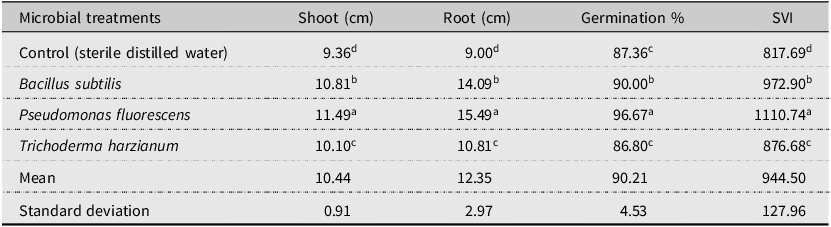
The bacterial biofertiliser treatment – in particular, the P. fluorescens treatment – yielded the longest root (15.49 cm), the most significant increase in shoot length (to 11.49 cm long), the highest percentage of seed germination (96.67%), and the highest SVI (1110.74; Table 2).
Effect of beneficial microorganisms on the correlation between wheat growth and germination metrics under laboratory conditions. Note: The data present the means of shoot and root length, percentage of seed germination and seed vigour index (SVI). Means were separated using Fisher’s least significant difference test, and values followed by the same letter are not significantly different at P ≤ 0.05.
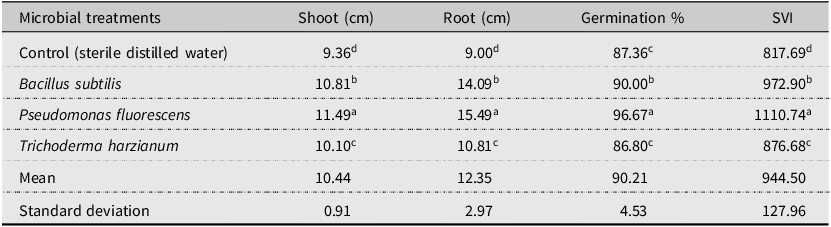
Table 2. Long description
A table comparing the effects of different microbial treatments on wheat growth and germination metrics. The table has 7 rows and 5 columns. The columns are labeled Microbial treatments, Shoot (cm), Root (cm), Germination %, and SVI. The rows list different microbial treatments and their corresponding values for shoot length, root length, germination percentage, and seed vigor index. Row 1: Control (sterile distilled water), 9.36, 9.00, 87.36, 817.69. Row 2: Bacillus subtilis, 10.81, 14.09, 90.00, 972.90. Row 3: Pseudomonas fluorescens, 11.49, 15.49, 96.67, 1110.74. Row 4: Trichoderma harzianum, 10.10, 10.81, 86.80, 876.68. Row 5: Mean, 10.44, 12.35, 90.21, 944.50. Row 6: Standard deviation, 0.91, 2.97, 4.53, 127.96.
Furthermore, Pearson’s correlation revealed that shoot length was highly correlated with the root length (r = 0.989, P = 0.011), germination percentage (r = 0.879, P = 0.121), and SVI (r = 0.981, P = 0.019). Also, root length was correlated with both germination percentage (r = 0.860, P = 0.140) and SVI (r = 0.955, P = 0.035). Germination percentage was strongly positively correlated with the SVI (r = 0.995, P = 0.045; Table 2).
In vivo effect of microorganism on the occurrence of wheat thrips
The population density of wheat thrips, H. tritici, was significantly reduced by the application of each of the plant growth–promoting rhizobacteria, each of the plant growth–promoting fungi, and the combination of the bacterial treatments (F 7,167 = 403.88, P < 0.001; Fig. 1A). The minimum population of H. tritici (6.20/spike, standard error = 0.4) was recorded in wheat plants inoculated with a combined mixture of B. subtilis and P. fluorescens strains, and the next lowest value, resulting from the arbuscular mycorrhizae fungi treatment, did not differ significantly from that of the P. fluorescens–only treatment. The maximum mean thrips population (20.58/spike, standard error = 1.5) was recorded in the untreated negative control (Fig. 1A).
Population density of Haplothrips tritici according to the following experimental factors: A, microbial treatment, B, sample timing, and C, interaction between microbial treatment type and sample timing. Note: Data for the first week correspond to the third week of March, and sampling continued weekly until the first week of May, covering the heading, flowering, and grain-filling stages of the plant. Values presented are means ± standard errors (SE).
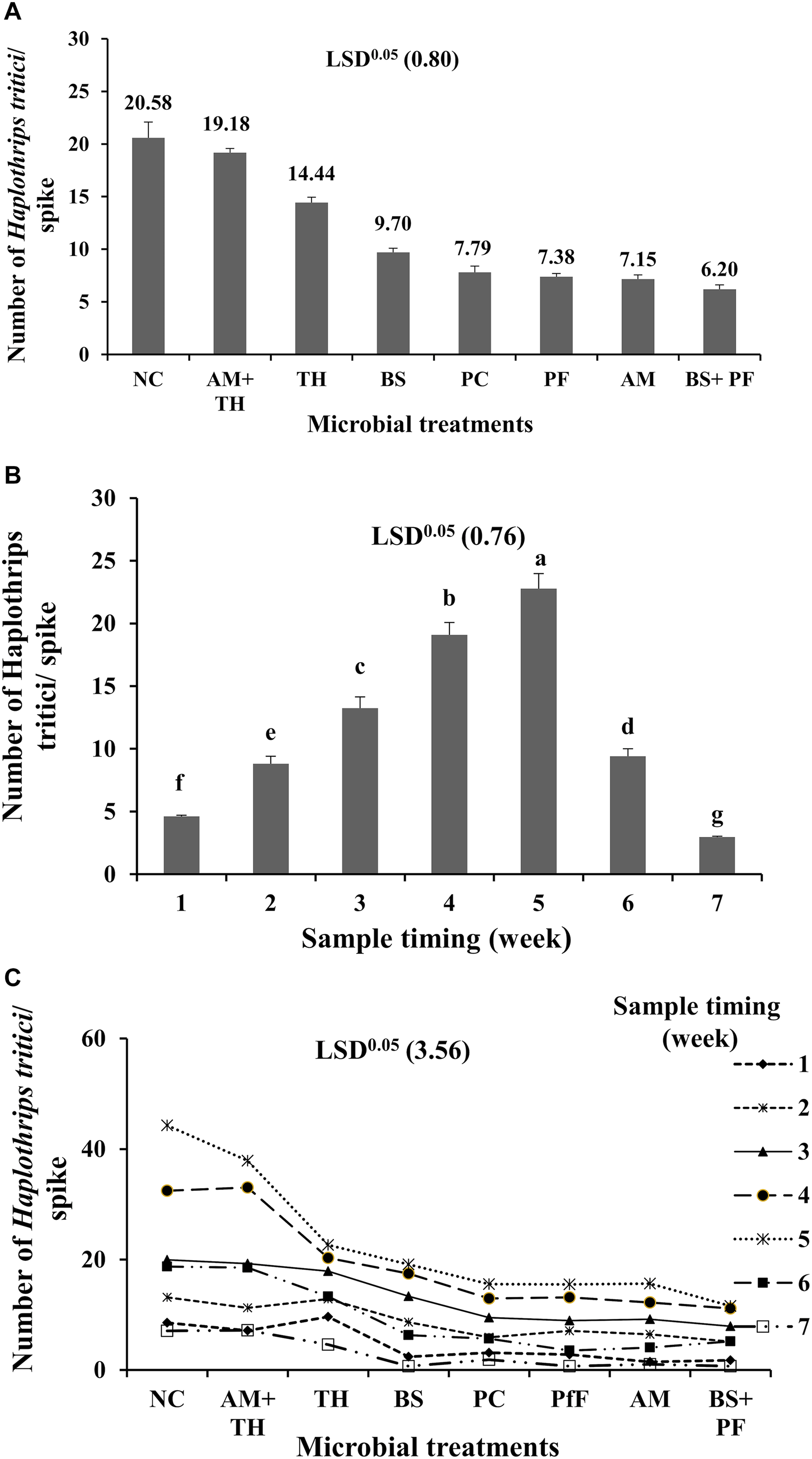
Figure 1. Long description
Panel A: A vertical bar graph shows the number of Haplothrips tritici per spike for different microbial treatments. The x-axis represents the microbial treatments, and the y-axis represents the number of Haplothrips tritici per spike. The treatments include NC, AM+TH, TH, BS, PC, PF, AM, and BS+PF. The values range from approximately 6 to 21. Panel B: A vertical bar graph displays the number of Haplothrips tritici per spike over different sample timings in weeks. The x-axis represents the sample timing in weeks, and the y-axis represents the number of Haplothrips tritici per spike. The weeks range from 1 to 7, and the values range from approximately 3 to 25. Panel C: A line graph illustrates the interaction between microbial treatment type and sample timing. The x-axis represents the microbial treatments, and the y-axis represents the number of Haplothrips tritici per spike. Different lines represent different sample timings in weeks, ranging from 1 to 7. The values range from approximately 0 to 40.
The population density of wheat thrips was significant and fluctuated over time after treatment (F 6,167 = 744.64, P < 0.001), with a substantial decrease to 2.96 individuals/spike (standard error = 0.05) in the seventh week, and the highest population recorded as being 22.7 thrips/spike (standard error = 1.2) during the fifth week of sampling (Fig. 1B). The interaction between population density of wheat thrips and sample timing was significant (F 42,167 = 42.89, P < 0.001; Fig. 1C).
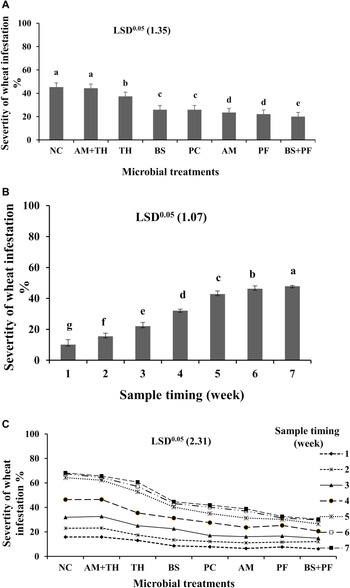
The choice of microbial fertiliser significantly influenced the severity of spike damage by wheat thrips (F 7,167 = 1896.93, P < 0.001). Notably, plants treated with a combination of B. subtilis and P. fluorescens inocula exhibited greater resistance to infestation, with an infestation rate of 20.0%, closely followed by the P. fluorescens–only inoculum, with a severity rate of 22.1%. Conversely, the control consistently displayed the lowest resistance to thrips damage, with a severity rate of 45.2% (Fig. 2A). In addition, the severity of wheat infestation was influenced by the sample timing after treatment with the combined bacteria and with the combined fungi. The highest damage severity in almost all treatments, irrespective of treatment type, was observed in the last week, reaching 47.83% (Fig. 2B).
Severity percentage of wheat crop by Haplothrips tritici in response to the following experimental factors: A, microbial treatment, B, sample timing, and C, interaction between microbial treatment type and sample timing. Note: Data for the first week correspond to the third week of March, and sampling continued weekly until the first week of May, covering heading, flowering, and grain-filling stages of the plant. Values presented are means ± standard errors (SE).
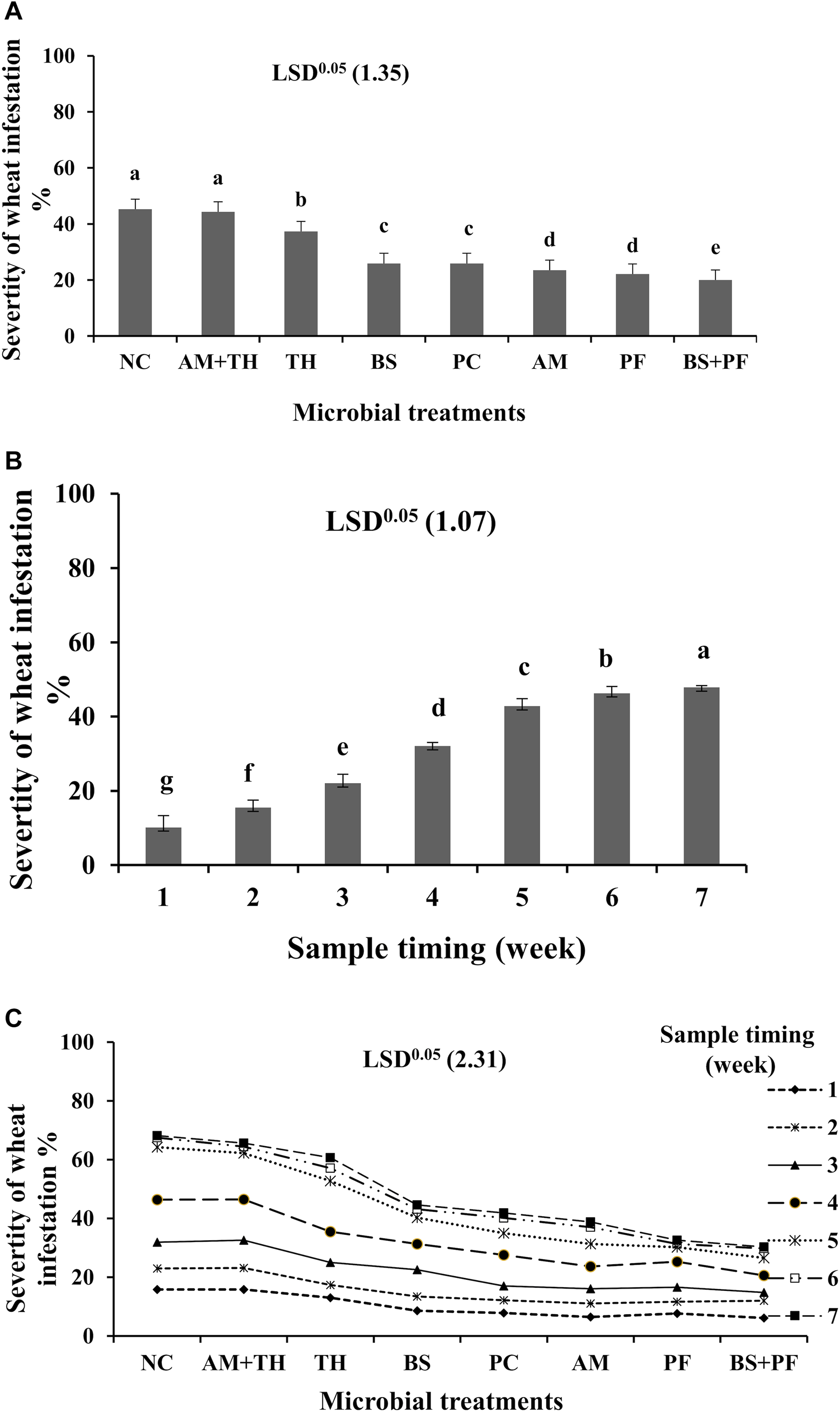
Examination of thrips infestation revealed substantial variations in spike infestation severity that were contingent upon the interaction between microbial treatments and the number of weeks post-treatment (F 42,167 = 67.50, P < 0.001). Spikes from the control and the combined fungal treatment did not differ significantly and exhibited the highest mean values (45.2 ± 4.2% and 44.3 ± 3.9%, respectively) across all weeks. In contrast, spikes from the combined bacterial treatment and the P. fluorescens-only treatment exhibited the lowest severity levels (30.3 ± 2.6% and 32.5 ± 2.4%, respectively) compared to those of the other treatments in the seventh week of infestation, with no significant difference between them (Fig. 2C).
In vivo effect of microorganism on biological parameters of wheat
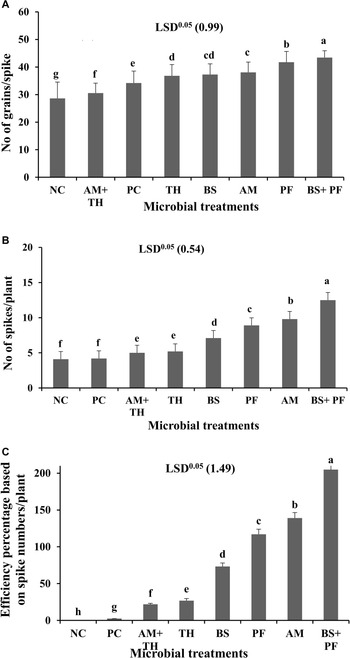
The field experiment used several microbial treatments either alone or in combination and resulted in a significant effect on the number of grains on a wheat spike (F 7,119 = 4.53, P < 0.001; Fig. 3A). Significant differences in mean grain quantity were observed between treatment types when seeds were inoculated with both P. fluorescens and B. subtilis. This combination enhanced the number of grains per spike to an average of 43.4 ± 2.5, higher than the P. fluorescens–only treatment (41.7 ± 3.9 grains/spike) and the B. subtilis–only treatment (37.2 ± 3.8 grains/spike; Fig. 3A).
Influence of seed treatments with bacterial and fungal biofertilisers on the following plant productivity variables: A, number of grains per wheat spike, B, number of spikes per wheat plant, and C, efficiency percentage. Note: Efficiency was based on the number of spikes per plant for each treatment and calculated according to equation 6. Values presented are means ± standard errors (SE).
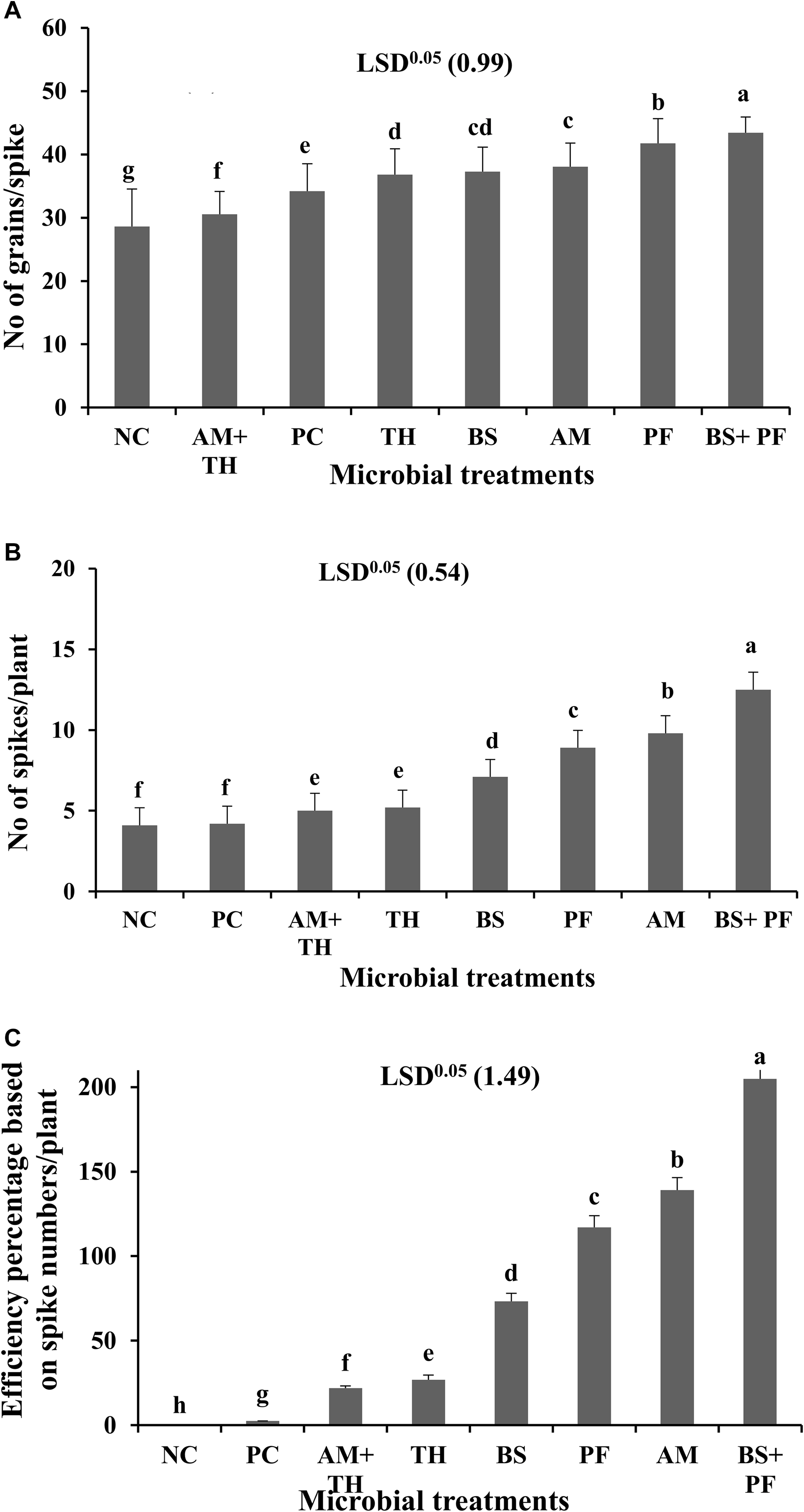
In addition, the type of microbial treatment had a significant impact on the number of spikes produced by the wheat plant (F 7,239 = 3.94, P < 0.001). The combined bacterial fertilisers (BS + PF) resulted in the highest number of spikes per plant (12.5 ± 1.7 spikes/plant). The lowest number of spikes per plant was observed in the control (4.1 ± 1.5 spikes per plant), which did not differ significantly from the pesticide (Imidacloprid) treatment, which had 4.2 ± 1.6 spikes/plant (Fig. 3B).
The most efficient microbial treatment was the combined bacterial treatment, followed by the arbuscular mycorrhizae fungi treatment. However, the lowest efficiency was recorded in the control seed, followed by the chemical insecticide seed treatment (Fig. 3C).
Neither the weight of 1000 grains nor the length of the spike was significantly affected by treatment (F 7,239 = 1.83, P = 0.09 and F 7,239 = 0.86, P = 0.57, respectively).
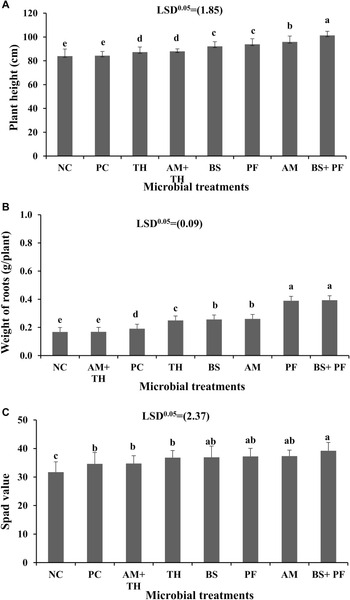
Significant disparities were recorded in the height of the wheat crop vis-à-vis the type of microbial fertiliser employed (F 7,239 = 18.54, P < 0.001). Notably, the combined bacterial treatment demonstrated the most substantial influence in the growth of the plants, yielding a mean height of 101.3 ± 3.5 cm. In contrast, the control, which had no fertiliser applied, yielded the least height (83.9 ± 5.9 cm), but the control treatment results did not differ significantly from the chemical insecticide (84.2 ± 3.6 cm; Fig. 4A).
Influence of seed treatments with bacterial and fungal biofertilisers on the following plant biometrics: A, plant height, B, weight of roots, and C, chlorophyll content in plants. Values presented are means ± standard errors (SE).
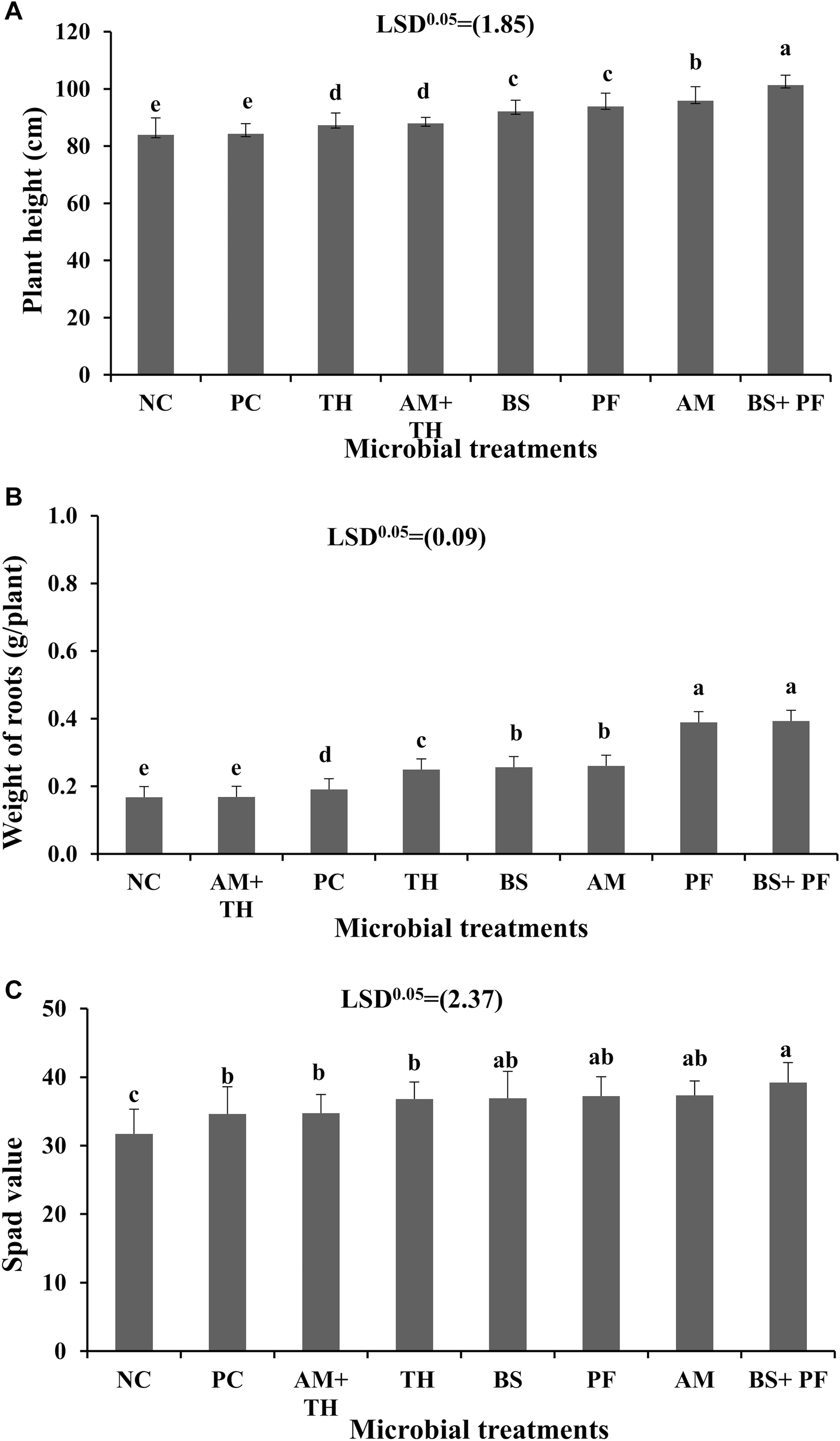
Figure 4. Long description
Panel A: A vertical bar graph shows the plant height in centimeters for various microbial treatments. The x-axis represents different microbial treatments, and the y-axis represents plant height in centimeters. The treatments are labeled as NC, PC, TH, AM+TH, BS, PF, AM, and BS+PF. The graph indicates that the BS+PF treatment results in the highest plant height, followed by PF and AM treatments. Panel B: A vertical bar graph displays the weight of roots in grams per plant for different microbial treatments. The x-axis represents the microbial treatments, and the y-axis represents the weight of roots in grams per plant. The treatments are labeled as NC, AM+TH, PC, TH, BS, AM, PF, and BS+PF. The graph shows that the BS+PF and PF treatments result in the highest root weight. Panel C: A vertical bar graph illustrates the SPAD value, which indicates chlorophyll content, for various microbial treatments. The x-axis represents the microbial treatments, and the y-axis represents the SPAD value. The treatments are labeled as NC, PC, AM+TH, TH, BS, PF, AM, and BS+PF. The graph indicates that the BS+PF treatment results in the highest SPAD value, followed by PF and AM treatments.
The weight of the root plant was significantly influenced by the fungal and bacterial biofertilisers (F 7,239 = 7.39, P < 0.001). The greatest root weight (0.39 g) was recorded from combined bacterial treatment and from P. fluorescens alone (Fig. 4B). Mean chlorophyll level was significantly affected by the type of microbial treatment (F 7,119 = 2.89, P < 0.001), with the highest mean chlorophyll content (39.2 ± 2.9) found in the combined bacterial treatment and the lowest chlorophyll level (31.7 ± 3.6) found in the control (Fig. 4C).
Discussion
The present study showed that plant growth–promoting rhizobacteria P. fluorescens and B. subtilis substantially improve the germination and growth of wheat seeds in an in vitro experiment. As demonstrated by numerous comparable studies, two P. fluorescens strains have been shown to improve key growth attributes in wheat, such as shoot and root length, biomass accumulation, and seedling vigour (Safari et al. Reference Safari, Jamali, Nooryazdan and Bayat2018; Lastochkina et al. Reference Lastochkina, Garshina, Ivanov, Yuldashev, Khafizova and Allagulova2020; Li and Hu Reference Li and Hu2020). These results underline the potential of these bacterial biofertilisers as effective plant growth–promoting rhizobacteria that support better yield of wheat (Smyth et al. Reference Smyth, McCarthy, Nevin, Khan, Dow, O’Gara and Doohan2011; Zahra et al. Reference Zahra, Tariq, Abdullah, Azeem and Ashraf2023). Likewise, the plant growth–promoting fungi have been shown to enhance the germination and growth of wheat seeds, thereby boosting the quality and quantity of harvest (Hajieghrari and Mohammadi Reference Hajieghrari and Mohammadi2016; Ali et al. Reference Ali, Khan, Ali, Ullah, Dai and Khan2022).
The present study’s field data indicated substantial diversity in the treatments employed for wheat crops to mitigate and prevent thrips damage, as reflected directly within the insect population density and indirectly by the severity of infestation on the spikes of the wheat crop. The most efficient microbial treatment with the lowest population of wheat thrips was observed in both the seed treatment that combined both P. fluorescens and B. subtilis inocula and the use of the arbuscular mycorrhizal fungal biofertiliser. The study results emphasise the distinct features of the approach while providing novel context on the functioning of these microbial interactions under field conditions in wheat crops, with the endophytic bacterial strains P. fluorescens and B. subtilis positively influencing the resistance of wheat plants to H. tritici, enhancing plant tolerance, and possibly inducing systemic resistance in the plants. Consequently, both bacterial strains exhibited an additive effect on the growth of wheat plants and their resilience against wheat thrips.
These results align with those of previous studies that showed that plant growth–promoting rhizobacteria, including P. fluorescens and B. subtilis, separately or in combination, can protect crops from multiple piercing and sucking insect pests (i.e., thrips) through the presence of diverse constituents (e.g., lipopeptides surfactin and iturin) that likely enhance defence gene expression in the wheat plant (Disi et al. Reference Disi, Simmons and Zebelo2019; Rumyantsev et al. Reference Rumyantsev, Alekseev, Sorokan, Burkhanova, Cherepanova and Garafutdinov2023). Thrips have been shown to exhibit sensitivity to the bioactive components, resulting in reduced survival and feeding activity brought about by the synergistic interaction of the microbial rhizobacteria and indicating the formulation’s broad-spectrum efficacy against various wheat pests (Pineda et al. Reference Pineda, Zheng, van Loon, Pieterse and Dicke2010; Khairullin et al. Reference Khairullin, Irgalina, Urazbakhtina and Maksimov2021).
The additive effect of various Bacillus spp. strains has been shown to improve the resilience of wheat plants against insect pests. For example, Veselova et al. (Reference Veselova, Burkhanova, Rumyantsev, Blagova and Maksimov2019) found that B. subtilis can activate genes associated with the salicylate-dependent signalling pathway, which play a key role in plant defence mechanisms against piercing and sucking insect pests. Similarly, Magnucka and Pietr (Reference Magnucka and Pietr2015) and Naeem et al. (Reference Naeem, Aslam, Khaliq, Ahmed, Nawaz and Hussain2018) showed that Pseudomonas and Bacillus bacterial strains wheat seed inoculum have a synergistic effect, reducing the phloem-feeding insect population and promoting seed germination through seed hormone balance maintenance, thereby increasing the performance of the wheat crop. Moreover, Muhae-Ud-Din et al. (Reference Muhae-Ud-Din, Ali, Naveed, Naveed, Abbas, Anwar and Tanveer2018) and Tanveer et al. (Reference Tanveer, Yasmin, Nosheen, Farah and Altaf2024) found that the integrated effect of Bacillus with other microbial species resulted in increased nutrient absorption by colonising the roots, thereby enhancing physiological and morphological traits of wheat (i.e., chlorophyl content and plant height) to a greater degree than when the endophytic microbes were applied alone. It is possible that this is a reference to the collateral formation of a biofilm in the rhizosphere layer by the bacterial strains, which creates an environment conducive to the growth and development of seedlings (David et al. Reference David, Chandrasehar and Selvam2018; Rani et al. Reference Rani, Basha, Darsha, Christy, Nagaiah, Kasthuri, Pandian, Das and Kungwani2023). On the other hand, the breakdown of chitin, a major structural component in the insect gut lining, by chitinase enzymes produced by various bacteria (i.e., Pseudomonas) offers a highly effective and environmentally friendly approach to managing insect pests (Broadway et al. Reference Broadway, Gongora, Kain, Sanderson, Monroy and Bennett1998; Commare et al. Reference Commare, Nandakumar, Kandan, Suresh, Bharathi, Raguchander and Samiyappan2002; Sarkhandia et al. Reference Sarkhandia, Devi, Sharma, Mahajan, Chadha, Saini and Kaur2023).
The present field study demonstrates that inoculation of wheat seeds with arbuscular mycorrhizal fungi significantly reduced thrips populations while enhancing plant height and grain yield. Arbuscular mycorrhizae significantly influence the performance of phytophagous insects, as demonstrated by studies involving 40 insect species across diverse host plants (e.g., Koricheva et al. Reference Koricheva, Gange and Jones2009). These effects are associated with mycorrhiza-induced changes in plant morphology, physiology, and defence chemistry, which ultimately alter insect feeding, reproduction, survival, and population dynamics (Koricheva et al. Reference Koricheva, Gange and Jones2009). This might refer to several factors; for instance, arbuscular mycorrhizae can increase concentrations of certain secondary metabolites (i.e., flavonoids, tannins, and myrcene), which are absent in nonmycorrhizal plants. The monoterpene myrcene functions as a semiochemical with distinguished biological activity that is primarily employed by insects for communication and can assist in deterring western flower thrips from attacking deciduous fruit trees (Broughton and Harrison Reference Broughton and Harrison2012).
Furthermore, prior studies have indicated that mycorrhizae have a comparable impact on belowground and aboveground herbivores, suggesting that their effects on plant defences are systemic rather than localised to root tissues (Bi et al. Reference Bi, Song and Zeng2007; Pozo and Azcón-Aguilar Reference Pozo and Azcón-Aguilar2007). Mycorrhizal associations are known to modify levels of defensive metabolites in plant tissues, thereby affecting the performance of specialised herbivores such as thrips, which feed by piercing plant epidermal and mesophyll cells to extract cellular contents where these compounds are localised. In this context, the interaction between the plants and arbuscular mycorrhizal fungi has been reported by Muvea et al. (Reference Muvea, Subramanian, Maniania, Poehling, Ekesi and Meyhöfer2018) to reduce both thrips populations and their feeding activity. As a result, decreased thrips damage may limit the efficiency of virus transmission and replication in attacked plants (Muvea et al. Reference Muvea, Subramanian, Maniania, Poehling, Ekesi and Meyhöfer2018).
The endophytic fungus, T. harzianum, exhibited minimal efficacy in the present study’s in vitro and in vivo experiments, as evidenced by poor wheat agronomic performance and a large thrips population relative to those resulting from the other microbial treatments. Consistent with our work, Muvea et al. (Reference Muvea, Meyhöfer, Subramanian, Poehling, Ekesi and Maniania2014) found that T. harzianum exhibited limited efficacy in reducing thrips populations and, consequently, failed to significantly reduce feeding punctures compared to other endophytic fungi species tested as seed treatments. In addition, in Khidr and Khalil’s (Reference Khidr and Khalil2025a) field experiment involving wheat crops treated with various plant extracts and entomopathogenic fungi, T. harzianum did not provide adequate protection, resulting in the lowest efficiency, biological yield, and number of grains per spike. Several studies using Trichoderma as a biopesticide have been performed in controlled greenhouse or laboratory settings, with additional field investigations required to corroborate the findings; the scarcity of such field studies likely is due to field trials typically producing nonsignificant results (Poveda Reference Poveda2021).
Soil pH might influence the relative success of microbial colonisation and may explain the variation in treatment efficacy observed among the tested microorganisms. The soil pH reported in the present study is generally favourable for rhizobacteria P. fluorescens and B. subtilis. In contrast, T. harzianum can adapt to acidic environments more efficiently, which might influence microbial colonisation, and arbuscular mycorrhizal fungi are known to remain active under neutral to slightly alkaline conditions (Hyder et al. Reference Hyder, Inam-ul-Haq, Bibi, Humayun, Ghuffar and Iqbal2017; Farghaly et al. Reference Farghaly, Nafady and Abdel-Wahab2022).
Based on this, common factors that might limit the use of bacteria and fungi as biofertilisers include environmental factors (such as temperature and soil humidity) and biological factors (such as competition with other microorganisms occupying plant root surroundings). It can be concluded that biofertiliser performance is highly context-dependent and that small differences in soil, climate, microbial strains, or management practices can result in variations in results relative to findings reported in other studies.
Conclusion
The findings of the present study highlight the remarkable potential of combining rhizobacterial inocula (P. fluorescens and B. subtilis) or the arbuscular mycorrhizae fungal (G. mosseae) alone as effective treatments for boosting wheat growth and yield. The synergistic impact of combined plant growth–promoting rhizobacteria yielded not only the highest physiological and agronomic parameters of wheat plants but also the lowest population of wheat thrips. Incorporating bacterial and fungal biofertilisers as a basis for the further development of a biopreparation for integrated pest management in wheat crops could reduce reliance on chemical fertilisers and insecticides for the control of agricultural insect pests, enhance soil fertility, and improve yields, thereby underscoring their potential as a key component of sustainable farming strategies.
Acknowledgements
Laboratory experiments were conducted in the Higher Education and Biotechnology Laboratory of the Department of Plant Protection, College of Agricultural Engineering Sciences of Salahaddin University, Erbil, and the field experiment was carried out at the college’s Grdarash Station. The authors appreciate the facilities provided by officials who manage the college’s graduate laboratory and field facilities.
Funding statement
No funding applied.
Competing interests
The author declares that he has no competing interests.


 Open access

