Funerary rituals are rites of passage aimed at separating the dead from the community of the living, thereby ensuring the continuity of social order (Van Gennep Reference Van Gennep1960). These activities go beyond inhumation and involve actions conducted before, during, and after the burial event (Parker Pearson Reference Parker Pearson2023); therefore, understanding rituals as structured sequences of funerary actions rather than isolated events offers deeper insight into ancient conceptions of death (Parker Pearson Reference Parker Pearson2016; Pereira Reference Pereira2013). Mayanists have increasingly applied this conceptualization of funerary contexts (Goudiaby et al. Reference Goudiaby, Barrientos, Sion, Tiesler, Suzuki and Pereira2022; Tiesler et al. Reference Tiesler, Andrea Cucina, Price, Ardren and James2010). Classic Maya burials are the result of sequences of funerary actions that included predeposition body treatment, inhumation, deposition of grave goods, and postdepositional reentry, underscoring the importance of enduring relationships between the living and the dead (Eberl Reference Eberl2005; Fitzsimmons Reference Fitzsimmons2009; McAnany Reference McAnany1995; Weiss-Krejci Reference Weiss-Krejci2006, Reference Weiss-Krejci, Fitzsimmons and Shimada2011a, Reference Weiss-Krejci2020).
In this article, I applied an archaeothanatological approach to the study of 35 burials with 62 individuals from Group IV, a nonroyal elite domestic compound at Palenque, Mexico. I drew on previous works on Mayanist mortuary archaeology (Ruz Lhuillier Reference Ruz Lhuillier1989; Scherer Reference Scherer2015; Welsh Reference Welsh1988; Wright Reference Wright1994) and adjusted the methodology to the specificities of this case study: the characteristics of the individuals interred, the grave type, the ritual attributes of the skeletons (articulation, position, and orientation), the types and spatial arrangement of grave goods, and the evidence of reopening. The data I collected revealed complex funerary treatments, including body preparation, primary and secondary burials, and postburial modifications. Despite these treatments’ variability, I argue that these activities were materializations of beliefs shared by the population at Palenque that involved the prolonged use of both burials and broader funerary areas. These actions underscore the centrality of ritual interaction with the dead in Classic Maya mortuary traditions.
Burial and Funerary Sequence in Archaeology
To unravel the complexities of bone preservation, mortuary archaeology requires theoretical frameworks (Tiesler Reference Tiesler, Malvido, Tiesler and Pereira1997). The French school of archaeothanatology made a significant contribution to the study of archaeological burials by laying the conceptual foundation of taphonomic analysis of postdepositional thanatological processes (Duday Reference Duday2009; Duday and Guillon Reference Duday, Guillon, Schmitt, Cunha and Pinheiro2006; Duday et al. Reference Duday, Le Mort and Tillier2014). This approach enables the reconstruction of past funerary practices by integrating knowledge of the decomposition processes of the articulations in the human body with detailed contextual analysis. Articulations in the body are classified into labile joints, which decompose rapidly, and persistent joints, which resist decomposition over extended periods (Duday Reference Duday2009). By analyzing the diachronic sequence of joint disarticulations, archaeologists can differentiate between natural and cultural modifications to burials and thereby discern intentional ritual activities (Mickelburgh et al. Reference Mickelburgh, Wescott, Gluschitz and Klinkenberg2022).
After death, a body can undergo various processes before reaching its final burial. Weiss-Krejci (Reference Weiss-Krejci, Fitzsimmons and Shimada2011b) conceptualizes these stages within a “funerary cycle” that begins with death and progresses through body treatments, temporary interment, reentry, and final deposition. Although some individuals are interred without additional posthumous rites, others undergo complex intermediate stages of exposure or manipulation (Weiss-Krejci Reference Weiss-Krejci, Sabrina and Bonnie2011b:75). Other scholars consider burials as the primary unit of analysis. A burial in archaeology is the material residue of intentional ritual gestures encompassing inhumation and subsequent transformative actions (Duday Reference Duday2009:24–25). These practices may include predepositional, depositional, and postdepositional activities (Duday Reference Duday, Malvido, Tiesler and Pereira1997; Tiesler Reference Tiesler2006:80–84).
These approaches demonstrated that focusing on the dynamic formation processes of mortuary contexts provides valuable insight into ancient funerary practices. Nevertheless, further refinement is necessary for the application of these concepts to specific case studies. For instance, focusing only on funerary cycles or on burials’ formation processes limits the examination of multiple tombs with individuals buried at different times (Pereira and Goudiaby Reference Pereira, Goudiaby and Tiesler2022). When a burial is reopened to make room for additional corpses, depositional and postdepositional activities converge, intertwining the funerary cycles of multiple individuals. Consequently, a comprehensive understanding of burial formation requires merging both approaches by tracking the funerary cycles of individual skeletons while reconstructing the sequence of actions performed within and around the burial (Aspöck et al. Reference Aspöck, Klevnäs and Müller-Scheeßel2020).
Funerary activities have also been scrutinized through the lens of thanatological processes. Hertz’s (Reference Hertz, Needham and Needham1960) ethnographic study of secondary burials in Borneo linked interment phases to mourning rituals and the soul’s journey to the afterlife, wherein the final burial symbolized the deceased’s transition and the social reorganization of the living. Recent frameworks in archaeothanatology expanded on these concepts, categorizing funerary actions into a structured sequence of gestures, including the gesture of the corpse, the gesture of transformation, and the gesture of skeletonization (Pereira Reference Pereira2013). A funerary sequence consists of all ritual actions related to the deceased and the burial within a shared ideological system (Goudiaby et al. Reference Goudiaby, Barrientos, Sion, Tiesler, Suzuki and Pereira2022:128).
Merging the funerary cycle of the dead and the formation processes of burials into the examination of funerary sequences enables a more dynamic approach to mortuary studies. Moreover, by recognizing burial formation as a continuous process, rather than a discrete event, this perspective furnishes a valuable framework for scrutinizing postdepositional and reentry activities. Such practices have been documented in various contexts, including prehistoric Turkey (Haddow et al. Reference Haddow, Sadvari, Knüsel, Hadad and Osterholtz2016) and medieval and postmedieval Europe (Klevnäs et al. Reference Klevnäs, Aspöck, Noterman, van Haperen and Zintl2021); they were also typically conducted by the Classic Maya (Weiss-Krejci Reference Weiss-Krejci, Fitzsimmons and Shimada2011a, Reference Weiss-Krejci2020). By foregrounding funerary actions as the primary unit of analysis, this approach fosters a nuanced understanding of the interactions between the living and the dead and provides a framework for interpreting the material evidence of ritual and social practices in past societies.
Classic Maya Burials
Maya funerary practices have been extensively reviewed (Fitzsimmons Reference Fitzsimmons2009; Ricketson Reference Ricketson1925; Ruz Lhuillier Reference Ruz Lhuillier1989; Scherer Reference Scherer2015; Welsh Reference Welsh1988). Despite considerable regional and chronological diversity, archaeologists have identified recurring patterns throughout the Maya region, which have often been interpreted as part of a shared religious substratum (De la Garza Reference De la Garza, Malvido, Tiesler and Pereira1997; Ruz Lhuillier Reference Ruz Lhuillier1989). Subsequent research has demonstrated that Maya conceptions of death and the afterlife were not exclusive to elite groups but were shared across social strata (Scherer Reference Scherer2015). Although royal burials were typically more elaborate, distinctions between royal and nonroyal interments appear to be primarily a matter of scale, rather than deriving from fundamentally different ideological frameworks.
In Mayanist mortuary archaeology, burials are interments of human skeletal remains, either with or without associated objects (Welsh Reference Welsh1988:15). Graves, defined as any designated space or receptacle for the dead (Welsh Reference Welsh1988:15–16), ranged from simple pits and inhumations within construction fills to simple or elaborate masonry crypts and vaulted tombs (Scherer Reference Scherer2015:5–6). Moreover, there is evidence of burials in caves and chultunes (Ruz Lhuillier Reference Ruz Lhuillier1989). Becker (Reference Becker, Daniel and Robert1992) notes that burials and caches shared cognitively related features and can be conceptually interchangeable, complicating the straightforward application of Western categories to their study.
Among Maya burials, inhumation was the predominant deposition form, although cremation was also documented (Scherer and Houston Reference Scherer, Houston, Tiesler and Scherer2018; Tiesler Reference Tesler, Tiesler and Scherer2018). The position and orientation of bodies varied widely, including extended, flexed, and even seated positions. Burials appear to be aligned with architectural structures or according to cardinal directions (Scherer Reference Scherer, Hutson and Ardren2020); this feature may reflect social identities, including provenance or community affiliation (Scherer Reference Scherer2015:189).
Classic Maya burials frequently underwent postdepositional interventions, including tomb reentry, fire drilling, bone manipulation, and the retrieval of grave goods. These practices are well documented among Classic Maya royalty (Eberl Reference Eberl2005; Fitzsimmons Reference Fitzsimmons2009; Stuart Reference Stuart and Houston1998) and encompassed ancestral veneration and political acts, such as tomb desecration, reuse, and exhumation for political reconciliation (Weiss-Krejci Reference Weiss-Krejci, Fitzsimmons and Shimada2011a, Reference Weiss-Krejci2020). Funerary sequences included the postdepositional alteration of decomposed skeletons and the deposition of additional individuals. Other documented practices include painting bones (Eberl Reference Eberl2005) and sealing burial contexts (Duncan Reference Duncan2014). Intentional skeletal manipulations have also been identified in domestic compounds (Goudiaby et al. Reference Goudiaby, Barrientos, Sion, Tiesler, Suzuki and Pereira2022; Núñez Reference Núñez2011).
Practices of burial reentry can lead to the formation of multiple burials, which can result from the simultaneous interment of several individuals or later reentry activities involving the addition of bodies or disarticulated bones (Pereira and Goudiaby Reference Pereira, Goudiaby and Tiesler2022). These can range from fully articulated skeletons to fragmented or isolated bones of distinct individuals (Chase and Chase Reference Chase and Chase1996). A detailed analysis of funerary sequences is crucial for understanding these complex funerary and extra-funerary contexts, as demonstrated by studies conducted throughout the Maya region (Goudiaby et al. Reference Goudiaby, Barrientos, Sion, Tiesler, Suzuki and Pereira2022; Tiesler Reference Tiesler, Malvido, Tiesler and Pereira1997; Tiesler et al. Reference Tiesler, Andrea Cucina, Price, Ardren and James2010, Reference Tiesler, Suzuki and Pereira2022).
Site Background: Palenque
Palenque-Lakamhá occupies a strategic position on a 2 km2 plateau bordered by the Sierra Madre de Chiapas, Mexico (Figure 1). Overlooking the Tabasco Plains, the site has been inhabited from the sixth century AD until the ninth century AD (San Román Martín Reference San Román Martín2005). Beginning in the eighth century AD, Palenque’s rulers expanded their influence, establishing the city as a dominant polity in the northwestern Maya Lowlands (Liendo Stuardo Reference Liendo Stuardo2005, Reference Liendo Stuardo and Liendo Stuardo2011). This power is reflected in its civic-ceremonial center, which housed a royal palace, multiple temples, a ballcourt, and an extensive corpus of inscriptions (e.g., Marken Reference Marken2007; Ruz Lhuillier Reference Ruz Lhuillier2013; Stuart and Stuart Reference Stuart and Stuart2008). Several of these monumental structures served as focal points for elaborate funerary rituals.
Palenque in the northwestern Maya Lowlands. (Color online).

Royal and Nonroyal Elite Funerary Practices
Burials in the civic-ceremonial center share consistent traits, including a north–south orientation and an extended supine position (González Cruz and Balcells González Reference González Cruz and Joshua Abenamar Balcells2015; Ruz Lhuillier Reference Ruz Lhuillier1959). Notable royal tombs include the sarcophagi of Kinich Janaab Pakal and the “Red Queen”—possibly the burial of Tzak-bu Ajaw, Pakal’s wife (González Cruz Reference González Cruz2011; Ruz Lhuillier Reference Ruz Lhuillier2013). Pakal’s remains were placed in a monolithic sarcophagus within the Temple of the Inscriptions and covered by an engraved slab. His body was painted with cinnabar and hematite pigment (Tiesler Reference Tiesler, Tiesler and Cucina2004) and was interred with numerous grave goods. A snake-shaped “psychoduct” extended from the tomb to the temple’s summit (Ruz Lhuillier Reference Ruz Lhuillier2013). This feature, standard in royal burials at Palenque, facilitated the long-standing ritual communication with the deceased (Scherer Reference Scherer2015:207–208).
Despite their similarities, Tzak bu Ajaw’s tomb differs from Pakal’s in several aspects, including the grave goods, the presence of an orifice on the covering slab, and the placement of two sacrificed individuals beside the sarcophagus (Cucina et al. Reference Cucina, Tiesler, Pacheco, Tiesler and Cucina2004; González Cruz Reference González Cruz2011). The tomb was revisited multiple times before its final sealing, as indicated by the postdepositional reduction of the skeletons of the sacrificed individuals and the presence of a burned censer and a spindle whorl near the orifice on the sarcophagus (González Cruz Reference González Cruz2011). Unlike other Maya royal burials in which corpses were posthumously altered (Fitzsimmons Reference Fitzsimmons2009), Palenque’s royal bodies remained undisturbed.
Recent investigations at Palenque have deepened our understanding of the social, economic, and political roles of the nonroyal elite (López Bravo et al. Reference López Bravo, López Mejia and Venegas2004; Marken and González Cruz Reference Marken and González Cruz2007). The discovery of several burials in domestic compounds suggested that they engaged in funerary traditions, including burial position and orientation, similar to those of the ruling dynasty (Núñez and Ciudad Ruiz Reference Núñez and Ciudad Ruiz2024). Some elite domestic burials featured sarcophagi and stone chambers (López Bravo Reference López Bravo2000). Welsh (Reference Welsh1988:111) noted that Palenque’s nonroyal burials contained relatively few grave goods compared to other Maya sites. However, this assumption is challenged by subsequent findings, such as the richly adorned funerary chambers in Group B (De la Garza et al. Reference la Garza, Mercedes and García2012).
Group IV: An Elite Residential and Funerary Complex
Group IV was a domestic compound, located northwest of the civic-ceremonial center, that housed a prominent nonroyal elite lineage. Its earliest structures date to the late sixth century (Johnson Reference Johnson, Johnson and Joyce2022; Marken and González Cruz Reference Marken and González Cruz2007). This chronology is further supported by epigraphic evidence: Group IV is one of the few Classic Maya domestic compounds in which written texts were found (Stuart and Stuart Reference Stuart and Stuart2008). Architectonically, Group IV consists of several structures with different functions arranged around a central open space (Barnhart Reference Barnhart2001). Residential and administrative structures J1, J2, and J3 occupy the western and southern sides of the plaza, whereas the northeastern section of the complex was designated for funerary and ritual purposes around Structures J6, J7, and J4 (Figure 2). The topographic layout of Group IV corresponds to Becker’s (Reference Becker and Sabloff2003) Type 2 Plazas, characterized by ceremonial buildings on the eastern side of the open space and an entrance oriented toward the west.
Group IV showing concentrations of burials.

The PREP Mortuary Sample
Previous excavations in Group IV uncovered multiple burials. Rands and Rands (Reference Rands and Rands1961) found 13 burials distributed across three stratigraphic levels near Structure J6, and the Proyecto Arqueológico Palenque (PAP) discovered four additional interments in front of J6 and J7 (Núñez and Ciudad Ruiz Reference Núñez and Ciudad Ruiz2024). Between 2016 and 2018, the Proyecto Regional Palenque (PREP), directed by Rodrigo Liendo, further investigated Group IV to better understand the social organization of a nonroyal elite household and its relationships with the royal dynasty. PREP also aimed to understand domestic funerary traditions and their role in shaping intrahousehold social relationships at Palenque (Liendo Stuardo Reference Liendo Stuardo2017:3).
PREP found 43 burials, which were in the patio in front of Structures J6 and J7, the hallway between J4 and J6, the narrow space between J6 and J7, the area south of J7, and the midden behind J3 (Ciudad Ruiz Reference Ciudad Ruiz2022; Ciudad Ruiz and Varela Scherrer Reference Ciudad Ruiz and Varela Scherrer2021; Liendo Stuardo Reference Liendo Stuardo2017, Reference Liendo Stuardo2019; see Figure 2). Johnson (Reference Johnson, Johnson and Joyce2022) conducted a thorough excavation of J7, determining that it was constructed in the seventh century AD in a single phase atop an altar. This altar, in turn, covered a burial directly excavated into a sterile layer of hard-packed yellow earth. The burial consists of an elaborate cruciform crypt with two mirrored niches, which radiocarbon dating places between the late sixth and early seventh centuries AD (Johnson Reference Johnson, Johnson and Joyce2022). Evidence of burning in the structure’s fill and on and around the altar suggests that rituals were performed both before and during the building’s construction (Johnson Reference Johnson, Johnson and Joyce2022).
Currently, PREP is preparing samples for radiocarbon dating and planning a detailed analysis of the ceramics associated with the burials to refine the relative and absolute chronology of those found in the patio. Given these efforts, I defer any interpretation of diachronic changes in funerary practices to future studies and focus on the formation processes of each burial. Nonetheless, I do describe the stratigraphic relative distribution of the burial in the patio based on excavation and published data (Liendo Stuardo Reference Liendo Stuardo2017, Reference Liendo Stuardo2019; Núñez and Ciudad Ruiz Reference Núñez and Ciudad Ruiz2024). Rands and Rands (Reference Rands and Rands1961) and, more recently, Núñez and Ciudad (Reference Núñez and Ciudad Ruiz2024:128–129) were able to identify several stratigraphic levels of burials, each associated with architectural modifications in the patio.The first level corresponded to the earliest phases of the patio beneath and around J7. The second level included burials excavated into the hard-packed yellow earth of the patio in front of J7 and J6, which was associated with the construction of J7 during the seventh century AD. The third and fourth levels encompassed the most recent burials in Group IV, which contained vessels associated with the Late Classic Murciélago–Balunté period, roughly AD 700–850 (Esteban Mirón, personal communication 2025).
Methods
The typologies used by PREP align closely with those conventionally employed in Mayanist mortuary archaeology (Scherer Reference Scherer2015; Welsh Reference Welsh1988; Wright Reference Wright1994) but were adapted to address the characteristics of burials at Palenque (Núñez Reference Núñez2012). I considered the characteristics of the individuals (sex and age at death), grave goods (raw material, function, symbolism), the funerary context (characteristics of the grave and skeleton, spatial arrangement of grave goods), and evidence of reopening.
Excavations used the Harris Matrix method (Harris Reference Harris1979), emphasizing stratigraphic relationships within archaeological deposits. Skeletal elements were numbered and bagged separately, and their taphonomic movements were documented (Liendo Stuardo Reference Liendo Stuardo2019:169). Each burial was recorded with 3D photogrammetry, and I conducted a postexcavation taphonomic analysis of the 3D models, cross-referencing the findings with field data (De Tomassi and Lercari Reference De Tomassi and Lercari2025). I present here the results of the taphonomy of 35 of the 43 burials documented by PREP, the ones in which sufficient evidence was preserved for analysis.
Osteological analyses, including minimum number of individuals (MNI), sex, and age at death, were conducted by Adriana Zamora and Luis Núñez (Liendo Stuardo Reference Liendo Stuardo2019). Age estimation was based on macroscopic morphological characteristics, including the auricular surface of the ilium, the sternal end of the fourth rib, and the pubic symphysis (Buikstra and Ubelaker Reference Buikstra and Ubelaker1994). For subadults, the team used the chronology of dental eruption (Ubelaker Reference Ubelaker1989) and epiphyseal union (Buikstra and Ubelaker Reference Buikstra and Ubelaker1994). Sex estimation was based on morphological features of the skull and pelvis (Buikstra and Ubelaker Reference Buikstra and Ubelaker1994; Walker Reference Walker2005).
Grave goods were classified by raw material and function (Coe Reference Coe, Benson and Griffin1988; Welsh Reference Welsh1988) and included ceramic vessels, body items, greenstone beads, obsidian prismatic blades, spindle whorls, bone needles, unmodified fragments of quartz crystals, a chicozapote seed, and stingray spines.
Burials and Graves
Grave Typology. I classified grave types based on whether the burial receptacle allowed for decomposition in an empty environment (indirect) or involved direct inhumation in the soil (direct), following the criteria established by Núñez and Ciudad (Reference Núñez and Ciudad Ruiz2024:121–123). To reconstruct the decay environment (Pereira Reference Pereira, Tiesler, Suzuki and Pereira2022), this classification considers both the physical characteristics of the grave and the articulation of the skeletons. For consistency, I adopted a condensed version of this terminology (Figure 3):
1. Indirect
a. Simple crypts: Burials with stone walls and floors, sealed with a lid, typically made of flat or thick slabs. The walls consist of stacked masonry blocks or stones, and the shape is usually irregular or rectangular.
b. Elaborate crypts: More carefully constructed and larger crypts, usually rectangular or oval. The walls may be made of slabs and capped by several carefully made flat or monolithic slabs.
2. Direct: The bodies are interred directly in the ground. This grave type includes various forms: on the floor, in fill, atop other burials, within middens, and in pits. Pits may be surrounded by stones, resembling cists as defined in Anglophone terminology (Scherer Reference Scherer2015:6).
3. Stone boxes (caja or cajón): Small stone crypts made from slabs of stone or masonry blocks, typically containing secondary individuals.
Grave types in Group IV: (a) B4-B5-B7, simple crypts; (b) B11, elaborate crypt; (c) B10, stone box; (d) B23, elaborate crypt.

Ritual Characteristics of the Skeletons
Articulation. I used three classifications of the degree of anatomical articulation of a skeleton: primary, secondary, and reduced primary individuals. Primary individuals are anatomically articulated skeletons that decomposed in situ (Duday Reference Duday2009:25). Secondary individuals are intentionally disarticulated skeletons that decomposed in a place different from the final burial (Hertz Reference Hertz, Needham and Needham1960). A reduced primary individual implies a reopening event, followed by partial or complete alteration of the anatomical articulation (Duday Reference Duday, Malvido, Tiesler and Pereira1997:119–120).
Position and Orientation. The predominant burial position at Palenque is extended supine, with the head oriented roughly north–northeast. This position is standard across the northwestern Maya Lowlands (Scherer Reference Scherer2015, Reference Scherer, Hutson and Ardren2020) and is frequently observed in Classic Maya royal tombs (Fitzsimmons Reference Fitzsimmons2009).
Grave Goods Spatial Arrangement
To explore the relationships between grave goods and ritual practices, I documented the spatial association of artifacts, distinguishing between their connection to specific individuals and their placement within the burial. I specified associations between objects and specific body parts (e.g., head, pelvis, legs) or to structural elements of the grave. Grave goods were sometimes found in contexts indicative of postdepositional activities (e.g., above covering slabs). I could not determine the spatial arrangement for some goods and so removed them from the analysis (Supplementary Material 1).
Reopening
Reopening events must be interpreted cautiously because reentry may not have left material traces. Reopened burials in Group IV were previously identified by Welsh (Reference Welsh1988:35–36), although he did not specify the criteria he used. Núñez (Reference Núñez2012) later proposed that, at Palenque and nearby sites, indicators of reopening include broken or missing slabs, bone manipulation, and the displacement of grave goods. Similar criteria have been applied at other Maya sites (Goudiaby et al. Reference Goudiaby, Barrientos, Sion, Tiesler, Suzuki and Pereira2022) and were also used in this study. I identified reopening events in Group IV based on the following:
• Broken or missing slabs: In Group IV, several burials lack slabs in the southernmost section of the grave (Figure 4). However, other indicators, such as additional depositions or reductions, must also be present to confirm reopening.
• Reduced primary individuals: Although the presence of a secondary individual does not necessarily indicate reopening (because the individual may have been deposited after decomposing somewhere else), a reduced primary individual suggests a reentry event (Duday Reference Duday, Malvido, Tiesler and Pereira1997).
Evidence of reopening in Group IV: note the missing slabs in the southern part of Burial 4. (Color online).

Results
Demography
Osteological analyses determined the biological sex for 28 adult individuals, finding a predominance of male over female individuals (19 males, including one probably male, and 9 females). Adults (>20 years old; n = 41) greatly outnumbered subadults (<20 years old; n = 11). When the sample is divided into age ranges, it includes three perinatal individuals, five infants, three children, no adolescents, seven young adults, 13 middle adults, and four old adults, with an additional 16 individuals classified as just adults (Liendo Stuardo Reference Liendo Stuardo2019; Supplementary Material 2).
Grave Goods
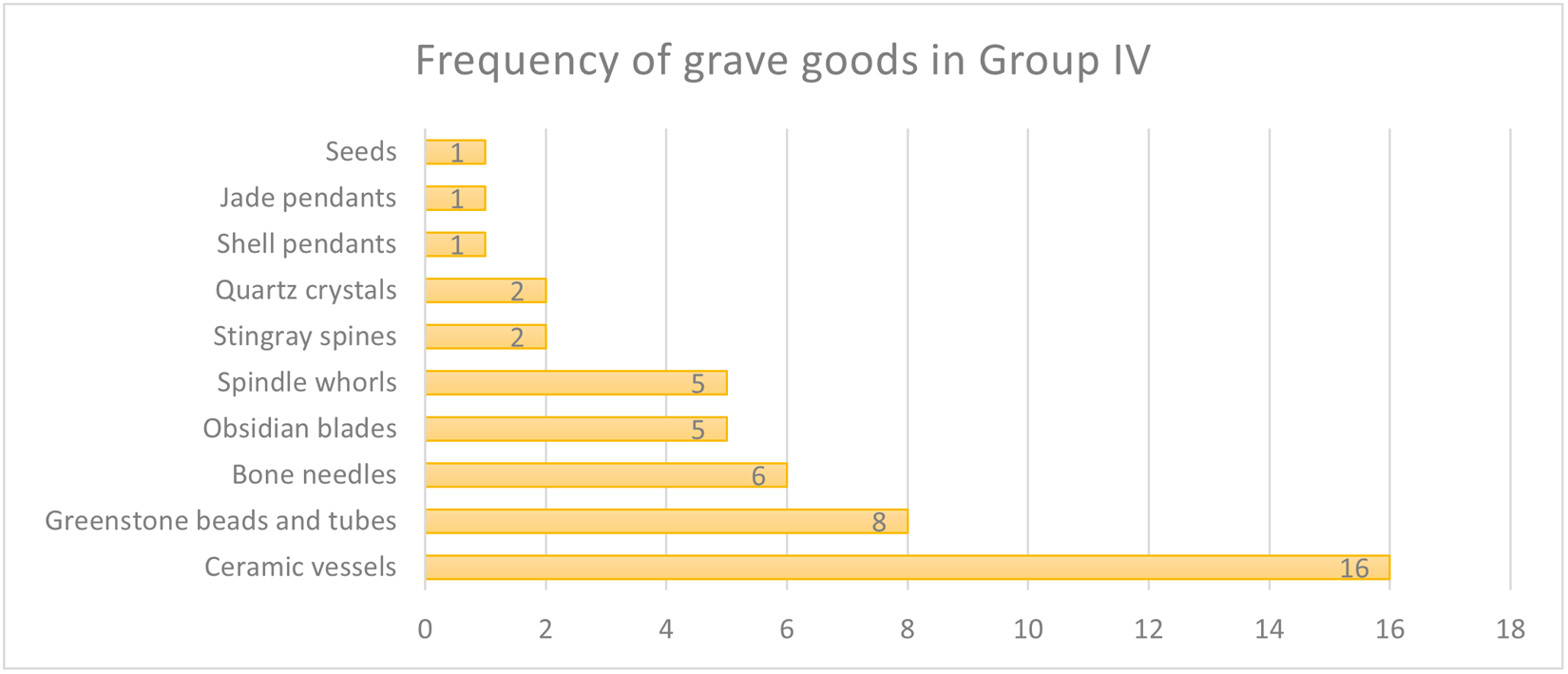
Grave goods were found in 26 of 35 burials and were consistent with the typical funerary objects in the Maya region (Figure 5; Ruz Lhuillier Reference Ruz Lhuillier1989; Welsh Reference Welsh1988). The most common goods were ceramic vessels, greenstone beads, and bone needles. Other artifacts, such as an anthropomorphic greenstone pendant, a chicozapote seed, and perforated shell pendants, were rare.
Number of burials in which each grave good was found.

Burial Groups and Funerary Activities
These groups of burials are based on the conflation of the analytical typologies outlined above, especially grave type and skeletal content (Table 1). Although the size of the sample did not allow statistical analyses, I ran multivariate cluster analyses to confirm the validity of the groups I generated (Supplementary Material 3).
Burial Groups.

Individual Simple Crypts. Five burials (B1A, B21, B22, B28, B33) contain primary individuals. There is generally no evidence for reopening, except for B21A and B28A, which have scarce remains that may suggest either reduction or natural degradation. Grave goods include ceramic vessels or items like greenstone beads.
Elaborate Crypts. Six elaborate burials (B3, B11, B23, B25, B32, B37) primarily contained adult individuals and only two subadults. These crypts were predominantly individual burials, although some exhibited unique traits.
Among them, B23 stands out because of its elaborate container and grave goods. The burial consisted of a rectangular crypt with a monolithic slab, except for an open southern section. It housed a primary elderly female deposited with greenstone beads in her mouth and hand, an obsidian blade on her chest, a spindle whorl beneath the open side of the covering slab, and a needle by her neck.
B11 also warrants attention. This crypt contained the disarticulated remains of an infant covered with dirt. A fragmented polychromatic vessel was positioned between the fill and the stone slabs of the lid. The lid was in place, suggesting dirt did not infiltrate naturally but was instead intentionally deposited to cover the skeleton (Figure 6). Although this does not necessarily indicate reopening, the disarticulated remains imply that the individual had already decomposed when the crypt was filled and sealed. Moreover, the shape of the crypt suggests it was designed to contain an infant in an extended supine position (Figure 6a). The funerary sequence likely involved a reopening event followed by the alteration of the skeleton, which was later covered by dirt; a vessel was placed on the skeleton before closing the crypt. B11 is the only burial in Group IV showing evidence of intentional fill before sealing and a completely disarticulated primary reduced individual.
Funerary sequence in Burial 11: (a) elaborate crypt covered by flat slabs; (b) a polychrome vessel atop the intentional fill. (Color online).

Mausoleum. B14 contained the remains of a single adult male, buried in an extended dorsal decubitus position. This individual was associated with significant grave goods, including greenstone beads and the only shell and greenstone earplugs in Group IV.
Mixed Simple Crypts with Multiple Individuals. These contexts typically included one or more primary individuals in extended supine positions alongside secondary disarticulated remains. Reopening was common and occurred primarily in later patio phases (Table 1).
Burials B1B-C, B12, and B26, which were not reopened, contained one primary and one or more secondary individuals, often represented by fragmented bones or isolated teeth. They featured fewer grave goods than reopened burials. Although they lack evidence for reopening, the disarticulated remains may be a result of reduction or a secondary deposition alongside the primary individual.
B1D-E, B4, B5, and B7 contained multiple primary and secondary individuals. Evidence for reopening includes broken or missing slabs (B1D-E, B4, B5), reduced individuals (B1D-E, B7), and additional depositions (B1D-E, B4, B5, B7). Grave goods included ceramic vessels, a spindle whorl, quartz crystals, bone needles, and stingray spines. B5 had an unmodified quartz crystal between the broken slabs, suggesting the quartz was used during a reopening event.
An illustrative example is B7, which contained a primary male adult (B7A) deposited on the articulated upper body of another male (B7B). B7B’s legs were disarticulated and placed atop B7A’s lower limbs. Ceramic vessels were positioned beneath B7A’s feet and beside B7B’s disarticulated legs (Figure 7). The sequence of events seems to be as follows:
1. B7B, a male individual, was buried, possibly with a vessel at his feet (Figure 7b).
2. After enough time for B7B’s body to decompose, the crypt was reopened.
3. B7B’s leg and foot bones were removed, and B7A, another male adult, was deposited atop B7B’s upper body, with a vessel beneath his feet (Figure 7a).
4. The bones of B7B’s legs were rearranged around B7A’s feet, along with a ceramic vessel.
Funerary sequence in Burial 7. Vessels associated with B7A (a) and B7B (b).

One of the vessels could have been deposited initially alongside B7B, but this is impossible to determine.
Direct. Eleven direct interments contained scarce artifacts with each burial. B13 was the only direct interment with evidence of reopening and contained two vessels. Direct burials could be primary (e.g., B2, B6) or secondary (e.g., B15, B16).
Secondary Indirect. Four stone boxes (B8, B10+9, B29, B30) contained secondary individuals. Two were multiple contexts: one showed evidence of reopening (B10+9), and one was undisturbed (B8). These burials contained numerous and diverse goods, including spindle whorls, greenstone beads, vessels, perforated Oliva shells, stingray spines, and a chicozapote seed. Individual secondary burials contained fewer grave goods. Stone boxes, especially individual ones, generally belonged to earlier patio phases.
Summary of Burials and Funerary Activities
Funerary practices in Group IV involved several key steps, which can be summarized as follows.
1. Predepositional body preparation: There is evidence for dressing the corpse in the form of the body items found with individual B14A within the mausoleum. Moreover, the bone needles by the neck of certain skeletons may also be evidence for a dress or a shroud (De Tomassi Reference De Tomassi2021), although they could have possessed other meanings.
2. Primary deposition: Most primary individuals, both subadults and adults of both sexes, were buried in a supine extended position (n = 24) or flexed (n = 3), with heads oriented north–northeast (5°–35° E). In primary depositions, items were consistently associated with specific body parts, such as greenstone beads in hands or mouths (B23A, B1A, B2A), obsidian blades on the chest or near the head (B1D, B12A, B41A), and ceramic vessels near the feet or legs (B12A, B22A, B25A, B26A).
3. Secondary depositions and reopening: There are 27 disarticulated individuals in the sample, although it is difficult to determine whether these were secondary deposition or reduced individuals. Some disarticulated individuals were deposited in ad hoc burials (e.g., B10+9 and B34), whereas others were deposited in mixed contexts. Notably, multiple secondary burials contained more grave goods than individual ones. In mixed contexts (B4, B5, B7, B13), activities such as reduction, primary and secondary deposition, and grave goods deposition converged. Multiple secondary and mixed reopened burials had similar grave goods, such as stingray spines, quartz crystals, bone needles, spindle whorls, and ceramic vessels.
Chronological Patterns
Burial patterns in Group IV exhibit chronological variation, particularly in burial types, reopening practices, and the distribution of individual versus collective burials. The earliest burials beneath and around Structure J7 are predominantly undisturbed individual crypts (B14, B32, B33, B37). These burials primarily contain adult males.
The burials in the second phase are predominantly individual (either primary or secondary) interments, mostly direct or within stone boxes. The only exceptions are one multiple secondary burial (B8) and one reopened mixed burial (B13).
The later patio phases are characterized by a marked diversity in burial type (Núñez and Ciudad Ruiz Reference Núñez and Ciudad Ruiz2024). Although individual burials are present (e.g., B1B-C, B6, B21), there is an increase in multiple burials (B3, B10+9, B12) and multiple reopened burials (B4, B5, B7).
Discussion
Archaeothanatology has proven essential to identifying long-term ritual engagement within single mortuary spaces, revealing that these burials were not static contexts but active elements in Group IV’s ancient ritual landscapes. I recognized complex funerary sequences, including primary depositions, secondary individuals in ad hoc or mixed contexts, and reduced individuals. These sequences often overlapped, resulting in assemblages of pre-, peri-, and postdepositional activities and including the placement of goods, such as vessels and quartz crystals. Group IV burials share ritual traits with broader Palenque mortuary traditions, including body orientation and position, grave goods and their spatial arrangement, and the protracted use of funerary spaces. The following discussion highlights key patterns.
Demography and Differential Treatment
Sex and age-at-death are conventionally proposed to explain differential mortuary treatments. In Group IV, distinctions based on sex are unclear. The absence of females in earlier crypts near J7 may suggest that early funerary rituals favored males, but it could also reflect excavation biases. Significant female burials were documented in both the civic-ceremonial center and residential areas of Palenque (De la Garza et al. Reference la Garza, Mercedes and García2012:218; González Cruz Reference González Cruz2011), and overall patterns do not suggest strong gender-based distinctions (Núñez Reference Núñez2011).
Subadults, in contrast, exhibit distinctive treatments, and their underrepresentation mirrors broader regional trends (Núñez Reference Núñez2012). Most were buried in simpler interments with scant grave goods. The only elaborate grave with extensive manipulation, B11, contained an infant, reinforcing the notion that subadults underwent different mortuary treatments. Ceramic vessels were overwhelmingly associated with adults (n = 13), with exceptions in one mixed-age multiple secondary context (B10+9), one collective primary context (B3), and B11 (see Table 1). In B11, the vessel was associated with the reopening event, rather than with the infant, whereas in B3, it was associated with the adult individual buried alongside the infant. Among mixed reopened burials, only B1D-E, the burial of a primary child and a reduced adult male, lacked vessels. Although the death of subadults held ritual significance, their burials reflect unique practices tied to their developmental and social status (Scherer Reference Scherer2015).
Posthumous Reverence, Grave Type, and Grave Goods
Grave elaboration in Group IV relates to higher numbers of grave goods, supporting interpretations that burial wealth reflects the status of the deceased (Krejci and Culbert Reference Krejci, Culbert and Grube1995) or that of their family (Schwake Reference Schwake, Morris, Jones, Awe, Thompson and Badillo2010). Individual B14A was buried with greenstone adornments and with the only shell and stone earplugs found in the sample (Johnson Reference Johnson, Johnson and Joyce2022). Taube (Reference Taube2005:42) suggests that earplugs were conceptually associated with the death expression “och bi” (he enters the road), which refers to rebirth as an ancestor. Ancestorhood was a selective status, conferred on particularly significant individuals—typically adult males—who were revered after death (Goudiaby Reference Goudiaby2018; McAnany Reference McAnany1995). The construction of a shrine atop B14, its grave goods, and the prolonged ritual use of J7 reflect the ancestral status of Individual B14A and the significance of his memory for his successors (Johnson Reference Johnson, Johnson and Joyce2022).
Elaborate crypts show evidence of peculiar ritual practices. For instance, B3 was the only primary collective burial in the group, whereas B23 exhibits evidence of recurrent ritual activity connected to its open slab and the deposition of the spindle whorl beneath it. Furthermore, Individual B23A was buried with grave goods similar to the ones deposited with Pakal and Tzak bu Ajaw, such as greenstone beads near the skull and in the hand (González Cruz Reference González Cruz2011; Ruz Lhuillier Reference Ruz Lhuillier2013).
Elaborate crypts also resemble royal tombs in their limited postdepositional skeletal manipulation. The only royal burial at Palenque with evidence of possible skeletal manipulation is the Early Classic burial in Temple XX (González Cruz and Balcells González Reference González Cruz and Joshua Abenamar Balcells2015). Some important burials in both temples and domestic compounds were possibly reopened, although early archaeological reports are often unclear when distinguishing between ritual reopening and looting (Blom and La Farge Reference Blom and Farge1926). According to Scherer (Reference Scherer2012), the use of sarcophagi in the funerary tradition at Palenque facilitated interactions with deceased rulers while delaying putrefactive processes. Mostly untouched elaborate crypts in Group IV may have been conceptually similar.
However, not all unopened burials indicate high status, because many simpler graves were also left undisturbed. Bodies buried directly in dirt decay faster, integrating into the sediment. Despite their simplicity, some direct burials contained high-status goods like greenstones and obsidian blades, suggesting the individuals had held significance beyond social rank. Stone containers—crypts and boxes—also symbolically integrate with the built environment, although they maintain a physical separation between the corpse and the sediment. Crypts likely facilitated later bone retrieval (Núñez Reference Núñez2011, Reference Núñez2012), but several were not reopened. These simple crypts may have had functions and meanings similar to royal tombs and elaborate crypts. The prevalence of crypts as a grave type at Palenque (Núñez and Ciudad Ruiz Reference Núñez and Ciudad Ruiz2024) may reflect a shared concern for the longer preservation of corpses and bones.
Several burials in Group IV underwent reopening, and the skeletons were commonly rearranged after decomposition, forming multiple burials with specific grave goods. As mentioned, in B7 each individual was associated with a ceramic vessel. B4 and B5 have two and three vessels, respectively. B13, another mixed reopened burial, was the only direct context with more than one vessel. This evidence suggests that ceramic vessels were deposited during reopening events. If reopening a burial involved the deposition of goods, this would explain the generally higher amount of goods in reopened contexts.
Some objects—stingray spines, quartz crystals, and chicozapote seeds—were found with secondary or reduced individuals. Notably, they bear ritual connotations tied to postdepositional activities. Classic Maya iconography suggests that stingray spines were associated with bloodletting rituals conducted by royal individuals to communicate with supernatural beings and ancestors (Haines et al. Reference Haines, Willink and Maxwell2008). Likewise, chicozapote seeds or fruits hold symbolic links to the vegetative cycle of plants, connecting them to rebirth as ancestors (Scherer Reference Scherer2015). Notably, the iconography on Pakal’s sarcophagus represents the ruler’s ancestors flourishing from fruit trees, including a chicozapote tree (Ruz Lhuillier Reference Ruz Lhuillier2013).
In Group IV, spindle whorls are consistently linked to secondary manipulation or reopening events, as seen in burials B10, B20, and B23. A spindle whorl was placed near the orifice on the grave lid of the sarcophagus of Tzak bu Ajaw (González Cruz Reference González Cruz2011), and the association of spindle whorls with multiple burials is observed across Palenque (López Bravo et al. Reference López Bravo, López Mejia and Venegas2004). Based on this evidence and on the association of spinning with the filiform shapes of the supernatural portals through which supernatural beings manifest in our world, I previously suggested that spindle whorls were symbolically connected to the communication with ancestors (De Tomassi Reference De Tomassi2024).
Quartz crystals were often linked to divinatory rituals (Brady and Prufer Reference Brady and Prufer1999). Astor-Aguilera (Reference Astor-Aguilera2010:101) notes that among contemporary Maya in Quintana Roo, the j’meeno’ob (ritual officers) use quartz to perceive nonhuman entities and to communicate with them. Although the reference is to contemporaneous Maya, in Group IV quartz crystals were found within two reopened burials, which suggests their usage in rituals of communication with the dead.
Ceramic vessels in Group IV are also found within secondary burials and in reopened contexts. Notably, the Quadripartite Badge, a Classic Maya iconographic motif associated with sacrifice and ancestor rebirth, features a sacrificial vessel adorned with a quadripartite glyph, surmounted by a stingray spine, a shell, and a flowery element (Robertson Reference Robertson and Robertson1974). The Quadripartite Badge appears at Palenque in scenes related to communication with the dead and ancestor rebirth, such as the tablets of the temples in the Group of the Cross and on Pakal’s sarcophagus (Astor-Aguilera Reference Astor-Aguilera2010; Scherer Reference Scherer2015). In this frame, Scherer (Reference Scherer2015) suggests that ceramic dishes may be used to summon supernatural beings from the Otherworld.
Although these artifacts indicate rituals of communication with the dead, their precise funerary meaning remains ambiguous. Their presence in multiple contexts suggests they were not personal belongings of the deceased. These objects may have symbolized communication with the ancestors. Alternatively, they may have been used during postdepositional activities around those burials and later discarded, although it is challenging to prove this hypothesis without knowing the life-history of these objects (Duday Reference Duday, Malvido, Tiesler and Pereira1997). However, the evidence suggests that stingray spines, quartz crystals, and vessels were ritual tools. Moreover, parallels with kratophanous or termination rituals observed at other Maya sites (Kunen et al. Reference Kunen, Galindo and Chase2002) further support their ritual significance. Future research should explore these aspects further to refine our understanding of postdepositional funerary practices in Group IV.
Summary of Results
The integration of archaeothanatology, grave typology, and grave goods revealed the following funerary cycles:
1. Direct interments: Bodies decompose and merge with the environment
2. Stone-separated interments
a. Non-reopened simple crypts
b. Reopened simple crypts, involving
i. Reduction
ii. Addition of secondary, primary individuals, or both
c. Elaborate crypts with untouched bodies
3. Secondary depositions: Exhumated or curated bones that were later buried
These practices produced both individual and multiple burials containing secondary and primary individuals and specific grave goods. Group IV’s funerary landscape reflects long-term use. Diverse activities, such as the cult of selectively chosen significant individuals, the integration of “lower-status” burials, and the postdepositional manipulation of skeletons and grave goods were conducted in Group IV. These patterns mirror broader ritual traditions at Palenque involving the prolonged usage of ritual spaces and concerns about corpses’ decay.
Conclusions
I applied an archaeothanatological approach to examine corpse decay and funerary sequences in Group IV, an elite residential compound at Palenque. Analysis of burial formation, grave goods, and taphonomic data revealed complex funerary sequences involving body preparation, inhumation, exhumation, reburial, and the manipulation of grave goods and the architecture of the grave. This approach enabled the reconstruction of protracted funerary practices, both within individual burials and across the mortuary landscape of Group IV. Maya burials were likely not intended as final resting places but as the start of the soul’s journey (Hull Reference Hull2006). Nevertheless, burials and bones remained focal points of activity for centuries (Eberl Reference Eberl2005; Scherer Reference Scherer2015). At Palenque, highly significant contexts were permanently sealed with plaster or dirt (Ruz Lhuillier Reference Ruz Lhuillier2013), indicating that even though the deceased were ritually invoked, their tombs were not reopened. In contrast, other burials were frequently reopened. However, despite the existence of differential treatments predominantly based on ancestral status, most of the dead participated in the prolonged use of funerary spaces, such as Group IV’s patio. Distinctions reflected different material expressions of the same shared beliefs about death and the afterlife.
Despite the limitations of the sample, this research advances our understanding of funerary traditions in the northwestern Maya Lowlands by emphasizing the dynamic relationship between the deceased, their burial context, and grave goods. Crucially, it demonstrates that archaeothanatology allows us to trace the protracted use of funerary spaces and shed light on the significance of mortuary practices for the ancient Maya social fabric.
Acknowledgments
The data were collected with the permission of the Instituto Nacional de Antropología e Historia (INAH), under the auspices of PREP. I would like to express my gratitude to Dr. Rodrigo Liendo Stuardo, the PREP team, Luis Núñez, and Clara Arranz. The editing was revised by Naivy Rodal, Alejandra Chávez, and Gina Palefski. The comments of three anonymous reviewers greatly improved the quality of the article.
Funding Statement
This work received support from the Gerda Henkel Stiftung (PhD fellowship no. AZ 24_P_22).
Data Availability Statement
The drawings, photographs, and 3D models of funerary contexts and elements are stored in the archives of the Proyecto Regional Palenque. They can be accessed by emailing the author.
Competing Interests
The author declares none.
Supplementary Material
The supplementary material for this article can be found at https://doi.org/10.1017/laq.2025.10122.
Supplementary Material 1. Spatial Arrangement of Grave Goods (table).
Supplementary Material 2. Characteristics of the Individuals (table).
Supplementary Material 3. Multivariate Cluster Analysis (text).