Introduction
The aim of enhanced recovery programmes is to deliver evidence-based care with the goal of improving patient experience, clinical outcomes and duration of hospital stay. This has been shown to be possible across many different surgical disciplines.Reference Paton, Chambers, Wilson, Eastwood, Craig and Fox1–Reference McDonald, Siegmeth, Deakin, Kinninmonth and Scott3 They can also promote a more positive and productive working environment.Reference Hubner, Addor, Slieker, Griesser, Lecureux and Blanc4 However, enhanced recovery programmes have not been widely adopted within head and neck surgery departments.
Patients undergoing laryngectomy have multiple complex needs, necessitating a multidisciplinary team (MDT) approach. There are many factors to consider when facilitating their recovery, and several key milestones that each patient needs to meet in order to be discharged. We felt that in our unit there was some variability in how efficiently each patient was managed and guided through the multiple parallel steps required for discharge, leading to prolonged hospital stays in some cases. We therefore thought laryngectomy patients represented an ideal patient group in which to design and implement an enhanced recovery programme. We wanted a patient pathway that was built with MDT involvement and stipulated a step by step timeline to achieve independence with airway, nutritional and physical care as well as screening and provision of prophylaxis against complications. We hypothesised this would enable laryngectomy patients to have a better post-operative experience, with fewer complications and a shorter hospital stay.
According to National Health Service improvement, there are four main areas to consider in developing a comprehensive enhanced recovery after surgery programme: pre-operative assessment, planning and preparation; reducing the physical stress of surgery; a structured approach to immediate post-operative care; and early mobilisation,5 or as put more succinctly by Kehlet (the founder of enhanced recovery): ‘having a global approach to peri-operative care’.Reference Kehlet6
Materials and methods
In 2014, a working group consisting of trainee and consultant surgeons, clinical nurse specialists, ward nurses, dieticians and speech and language therapists was formed to review evidence from the literature, develop a care pathway and introduce it to our unit, Queen's Medical Centre, Nottingham, UK.
Although we acknowledge that enhanced recovery after surgery involves both pre-, intra- and post-operative components, after contemplating the resources available to us we decided to focus our attention on the immediate post-operative patient journey, from arrival on the post-operative ward to discharge from hospital. We undertook a literature review to identify what the current body of evidence was for the post-operative care of the laryngectomy patient. We then held a series of meetings with the MDT to discuss the available evidence. Using the mini-Delphi technique, we reached agreement on our ideal care strategy, thus creating standards and targets for the enhanced recovery programme.
We conducted a classic three cycle audit against our new standards. A retrospective baseline audit of our previous 2 years of laryngectomy patients (2012 to 2014) was undertaken; this included 13 patients and compared their care to our new formalised evidence-based care pathway. With Trust approval, we then introduced the enhanced recovery pathway and recruited 11 consecutive patients undergoing laryngectomy between August and November 2014 (enhanced recovery after surgery 1). This involved having a coloured paper chart at the end of the patient's bed, which was to be reviewed and completed by nurses, doctors and allied health professionals reviewing the patient, and filed in the hospital notes at discharge. Figure 1 shows the proforma document used at the patient bedside to prompt the MDT in the expected care of the patient.
Proforma document used at the patient bedside to prompt the MDT in the expected care of the patient.
T = tumour; N = node; M = metastasis; Y = yes; N = no; L = left; R = right; ALT = anterolateral thigh flap; MDT = multidisciplinary team; H&N = head and neck; CNS = clinical nurse specialist; SALT = speech and language therapist; CT = computed tomography; TED = thromboembolism deterrent; OD = once daily; TDS = ter die sumendum (three times daily); PPI = proton pump inhibitor; TEP = tracheoesophageal puncture; NG = nasogastric; O2 = oxygen; HME = heat and moisture exchanger; Dr = doctor; Hb = haemoglobin; adj = adjusted; F/u = follow up; LRTI = lower respiratory tract infection; PE = pulmonary embolism; DVT = deep vein thrombosis

We prospectively audited our results for this cohort of patients and presented the results to ward staff and the wider MDT, giving everyone an opportunity to comment on the project and raise any concerns they had regarding the implementation of the enhanced recovery pathway. Following a further mini-Delphi exercise of the working group, staff education sessions and some minor changes to the proforma, the results were re-audited using the next 10 consecutive patients following the completion of the review process (December 2014 to May 2015, enhanced recovery after surgery 2). The patients were then followed up for five years to compare survival and complications before and after implementation of the enhanced recovery project. A total of 21 patients participated in the enhanced recovery programme; 20 survived to hospital discharge.
Development of the standards
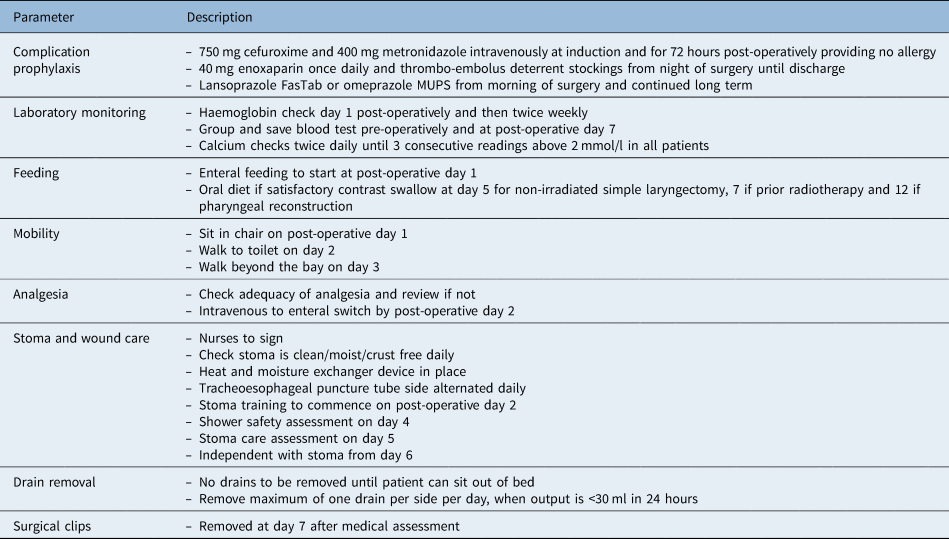
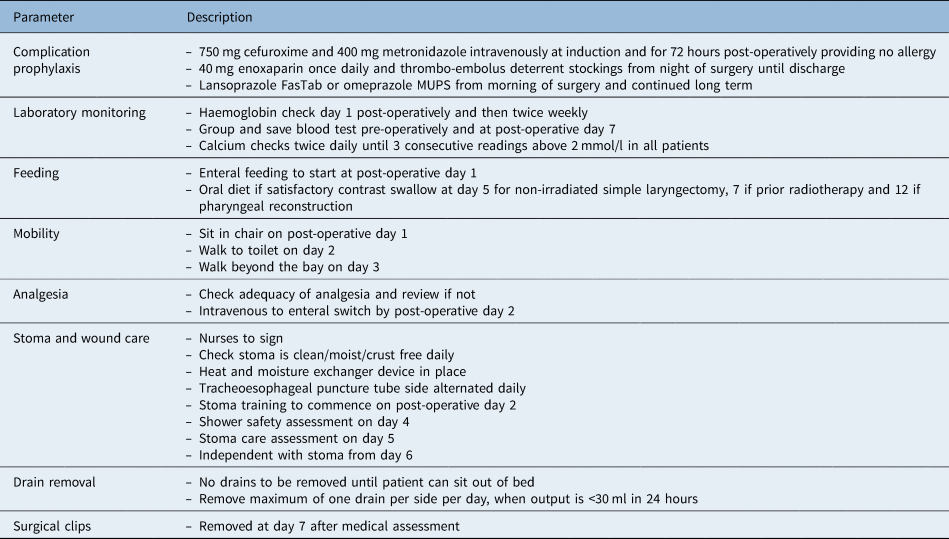
Post-operative laryngectomy care was divided into six main categories: (1) complication prophylaxis (antimicrobial, antiembolic, anti-reflux); (2) laboratory monitoring; (3) feeding; (4) mobility; (5) analgesia; and (6) stoma and wound care (including surgical drains). The summary of our agreed post-operative enhanced recovery programme is illustrated in Table 1.
Agreed targets for enhanced recovery programme
Complication prophylaxis
Antimicrobial
At the time of developing our protocol there was not much guidance on the use of antibiotic prophylaxis in total laryngectomy. The Scottish Intercollegiate Guidelines Network classified the procedure as ‘clean-contaminated’ and therefore antibiotic prophylaxis was recommended.7 Rodrigo et al. Reference Rodrigo, Alvarez, Gomez, Suarez, Fernandez and Martinez8 determined that cefazolin, clindamycin with gentamicin and amoxicillin-clavulanate were equally effective in preventing post-operative wound infection.Reference Rodrigo, Alvarez, Gomez, Suarez, Fernandez and Martinez8 This was reiterated in a study by Skitarelic et al.Reference Skitarelic, Morovic and Manestar9 a decade later comparing cefazolin and amoxicillin-clavulanate. A short course of antibiotics was found to be as good as a long course in a literature review.Reference Simo and French10 A survey of UK head and neck surgeons has subsequently shown that during the project's time period there was no consensus in UK prescribing choices.Reference Harris, Ofo, Cope, Nixon, Oakley and Jeannon11 This finding repeated the results of an American study.Reference Langerman, Ham, Pisano, Hohmann and Meltzer12
We selected 750 mg cefuroxime and 400 mg metronidazole given intravenously for 72 hours as our choice of antibiotic prophylaxis in non-allergic patients.
Antiembolic
The Department of Health risk assessment tool, in conjunction with NICE guidance for reducing venous thromboembolism risk in hospital (CG92, replaced by NG89), dictates that as our patients have an active malignancy and the procedural time is greater than 90 minutes, pharmacological thromboprophylaxis is indicated unless the individual has a specific bleeding risk.13 Mechanical thromboprophylaxis is also recommended while reduced mobility is ongoing in the absence of contraindications. We therefore advocated that all patients receive thrombo-embolus deterrent stockings and once daily enoxaparin 40 mg from the night of surgery until discharge from hospital, unless there were specific reasons not to.
Antireflux
Small prospective trials have shown a reduced rate of pharyngocutaneous fistula formation with peri-operative anti-reflux treatment.Reference Stephenson and Fagan14,Reference Seikaly and Park15 Gastro-oesophageal and gastropharyngeal reflux is known to be common in laryngectomees,Reference Smit, Tan, Mathus-Vliegen, Devriese, Brandsen and Grolman16 and studies suggest a higher rate of tracheoesophageal fistula complications in patients with refluxReference Lorenz, Grieser, Ehrhart and Maier17,Reference Cocuzza, Bonfiglio, Chiaramonte, Aprile, Mistretta and Grosso18 as well as improved resolution with anti-reflux treatment.Reference Cocuzza, Bonfiglio, Chiaramonte, Aprile, Mistretta and Grosso18,Reference Pattani, Morgan and Nathan19 Our care pathway therefore advocated the use of lansoprazole FasTab® or omeprazole MUPS® (multiple unit pellet system) from the morning of surgery and continuing long term.
Laboratory monitoring
Low pre- and peri-operative haemoglobin is associated with an increased risk of pharyngocutaneous fistula.Reference Morton, Mehanna, Hall and McIvor20,Reference Erdag, Arslanoglu, Onal, Songu and Tuylu21 It is also associated with increased peri-operative morbidity and mortality. As a modifiable risk factor, it is important not to be overlooked. In the first stage of implementing the enhanced recovery programme, we created a prompt for haemoglobin monitoring on the proforma document pre-operatively, day one post-operatively and twice weekly thereafter. Our consensus opinion was that this represented a sensible frequency for anaemia monitoring, although we accept that providing a space for the haemoglobin result on a chart does not necessarily lead to better maintenance of the parameter. In combination with this, prompts for group and save blood samples were created pre-operatively and at day seven post-operatively.
Acute hypocalcaemia can be life threatening. It is well documented that there is a rate of hypoparathyroidism following laryngectomy, regardless of extent of thyroidectomy or exposure to previous radiotherapy.Reference Thorp, Levitt, Mortimore and Isaacs22,Reference Basheeth, O'Cathain, O'Leary and Sheahan23 We decided to monitor calcium levels twice daily in the initial post-operative period until three consecutive readings were above 2.0 mmol/l. Initially this was just for patients who underwent a total thyroidectomy or had prior radiotherapy, but on review this was extended to all patients. The post-thyroidectomy hypocalcaemia Trust guidelines were placed in the doctor's office and instructions given on the proforma were to follow these guidelines in the event of a low result.
Feeding
It is standard practice that all patients undergoing laryngectomy have an enteral feeding route established prior to or during surgery. This was a nasogastric tube, gastrostomy (radiologically inserted gastrostomy or percutaneous endoscopic gastrostomy) or nasogastric tube inserted through the tracheoesophageal puncture site. Provided bowel sounds were present, feeding through the designated route was commenced day 1 post-operatively and continued until oral feeding was established (or long term). Oral diet was reintroduced following a satisfactory ‘milk test’ performed at the bedside during the second post-operative week or a gastrograffin swallow demonstrating the absence of leak. It has been shown that even patients who have early enteral feeding still suffer a decline in nutritional status,Reference Wiel, Costecalde, Séguy, Merrot, Erb and Chevalier24 and poor nutritional status is well documented to adversely affect outcomes.Reference Talwar, Donnelly, Skelly and Donaldson25 Other benefits of establishing earlier oral diet are the potential to reduce hospital stay and improve patient satisfaction.
There has been a trend towards earlier oral feeding post-laryngectomy. It was recognised that pharyngocutaneous fistula tended to occur prior to the introduction of feeding (day 5–6 vs day 7–10),Reference Saydam, Kalcioglu and Kizilay26,Reference Prasad, Sreedharan, Dannana, Prasad and Chandra27 and it was postulated that the dilution of saliva with water and milk might actually have a protective effect.Reference Medina and Khafif28 Multiple studies have shown no adverse effects when introducing oral diet as early as post-operative day 2,Reference Medina and Khafif28–Reference Eustaquio, Medina, Krempl and Hales30 and two systematic reviews failed to find a difference in pharyngocutaneous fistula rate between early feeding (within one week) or delayed feeding (after one week).Reference Martin, Jordan and Carney31,Reference Aires, Dedivitis, Petrarolha, Bernardo, Cernea and Brandao32 However, many of these studies excluded patients with prior radiotherapy or flap reconstruction of the pharynx, which are felt to take longer to heal. The Iowa head and neck protocols advocate feeding at day 7 in a non-irradiated patient and up to 14 days for a fully irradiated laryngectomee.33 We also decided that we would not discharge patients until their first contrast swallow or milk test.
On reviewing the evidence available to us, we decided to commence oral diet at post-operative day 5 in the non-irradiated total laryngectomee, day 7 in those with previous radiation therapy and day 12 in those who underwent a pharyngeal reconstruction.
Mobility
It is understood that early mobilisation following critical illness can improve outcomes, and established enhanced recovery programmes in other specialties particularly place an emphasis on early mobilisation.Reference Jones, Kelliher, Dickinson, Riga, Worthington and Scott34,Reference Vlug, Bartels, Wind, Ubbink, Hollmann and Bemelman35
We were unable to find any specific guidance in relation to expected or desired mobility following major head and neck surgery. By consensus, our group agreed to set a target of getting the patient into a chair on the first post-operative day, walking to the toilet on the second post-operative day and walking to the shower on the third post-operative day. On implementation, the ward nurses identified that the process of showering on post-operative day 3 proved quite challenging, and so this was modified to walking beyond the bay in enhanced recovery after surgery 2.
Analgesia
Poor post-operative analgesia is deleterious to the patient in terms of patient experience, but both inadequate and excess analgesia can contribute to avoidable morbidity. Patient questionnaires have shown post-operative pain to be unnecessarily high,Reference Inhestern, Schuerer, Illge, Thanos, Meissner and Volk36 and retrospective patient record analyses have shown administration of analgesia to be insufficient on both a regular and an as needed basis.Reference Mom, Bazin, Commun, Dubray, Eschalier and Derbal37,Reference Orgill, Krempl and Medina38 Post-operative analgesia pathways have been designed in other centres, although this has not resulted in clinically significant improved analgesia.Reference Orgill, Krempl and Medina38 Our team believed that post-operative analgesia requirements varied substantially between patients and should therefore be tailored and titrated individually rather than following a fixed schedule. We thus implemented only a basic check of adequacy of analgesia to prompt a review if found to be insufficient and also a reminder to consider switching from intravenous to enteral analgesia at post-operative day 2 if not done beforehand.
Stoma and wound care
Stoma care
This topic was divided into two sections: stoma care carried out by the ward nurses, and stoma training given to the patient to facilitate independence and discharge. The enhanced recovery proforma had a section for nurses to sign to confirm the stoma was clean, moist and crust free and that a humidification and a moisture exchange device was in place once there was no oxygen requirement. There was also a prompt to alternate the side of the nasogastric tube if a primary tracheoesophageal puncture had been made with a tube placed in the fistula.
By consensus, we agreed to commence patient stoma training on post-operative day 2, with a shower safety assessment on day 4 and an assessment of stoma care on day 5, with a view to the patient being independent with stoma care from day 6. The process of stoma training was a gradual introduction of processes required to keep the stoma site healthy. This involved inspecting the stoma with a mirror, using tweezers to remove crust, safe use of suction and nebuliser machines, and checking speaking valve placement (if applicable). Tuition was also provided in the use of whichever heat and moisture exchanger system the patient chose. If self-care was not felt to be achievable, supportive discharge planning was commenced.
Drain removal
In this protocol, because we were not proposing to discharge patients until after their contrast swallow, we acknowledged that an aggressive drain removal regime would not affect length of stay but may increase the risk of haematoma or seroma formation. However, drains do restrict the mobility of the patient, cause discomfort and can themselves act as a conduit for infection so keeping them in longer than necessary is also undesirable. There is not much evidence regarding optimal duration of drains in the ENT literature. Standard practice is to remove drains when the output is lower than 25–30 ml in a 24-hour period and in the absence of chyle or fresh bleeding,Reference Kasbekar, Davies, Upile, Ho and Roland39–Reference Amir, Morar and Belloso41 although there is not a scientific basis for this.Reference Flam and Smith42 This is mirrored in other specialties such as plastic surgery.Reference Hassan, Chatterjee and Alshameeri43 Work has been completed on increasing the frequency of drain measurements to facilitate earlier discharge,Reference Kasbekar, Davies, Upile, Ho and Roland39,Reference Amir, Morar and Belloso41 but in the context of the laryngectomy patient we felt this was not relevant to our patient group. A study that increased the acceptable drainage amount to 50 ml in a 24-hour period did not lead to significantly more adverse outcomes.Reference Harris, Doolarkhan and Fagan40
We decided no surgical drain would be removed until the patient had sat out of bed. Then drains could be removed when the output was less than 30 ml in a 24-hour period, providing a maximum of one drain per side per day was removed. Sutures or surgical clips were prompted to be removed at day 7 but only after a medical assessment to confirm suitability for removal.
Statistical analysis was provided by a third party professional statistician. A confidence level of 95 per cent was set. The Student's t-test and chi-squared tests were used to test for differences between the retrospective data and enhanced recovery after surgery 1, and the retrospective data and enhanced recovery after surgery 2 as well as the pooled prospective enhanced recovery data. The Kruskal–Wallis rank sum test was used to assess a difference in median length of stay. After confirming no statistically significant differences in the patient demographic data between the three cohorts, for ease of reading most of the results are reported as retrospective prior to the introduction of the enhanced recovery pathway and as prospective pooled results for both cycles after the introduction of the pathway.
Results
Demographic data and operative details
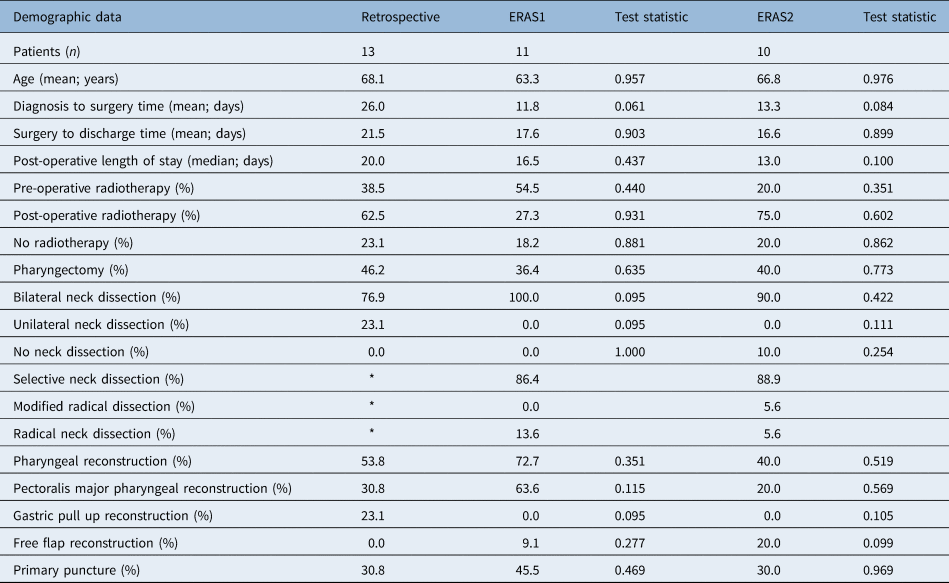
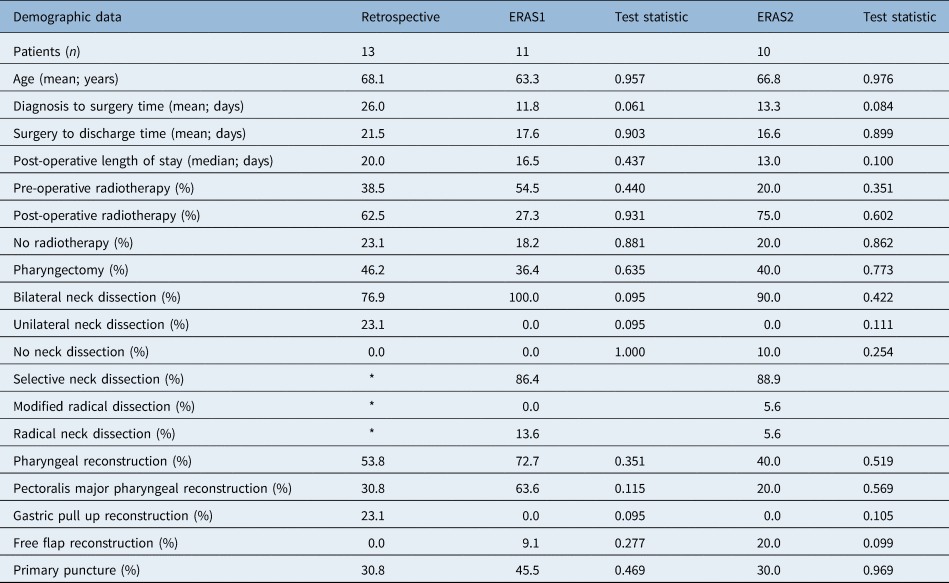
The average age at surgery was 66.2 years (range, 26–91 years), with no significant difference between the 3 cohorts (p = 0.96, t-test) (Table 2).
Demographic data and operative details
*No data available. ERAS = enhanced recovery after surgery
In the retrospective group, 38.5 per cent of patients had radiotherapy prior to laryngectomy, and 38.1 per cent of patients in the prospective group had pre-operative radiotherapy. Although no statistical significance was found between enhanced recovery after surgery 1 and enhanced recovery after surgery 2, it is noted that there was a higher proportion of patients in enhanced recovery after surgery 1 who underwent pre-operative irradiation.
All 34 patients underwent a total laryngectomy. Using the chi-square test for significance, no statistically significant differences between the operations performed were identified across the 3 groups in terms of whether there was concurrent neck dissection (and subtype), pharyngectomy, pharyngeal reconstruction or primary tracheoesophageal puncture. Overall, 88.2 per cent of patients had a bilateral neck dissection, and 87.5 per cent of the neck dissections were selective neck dissections. Again, although it was not found to be statistically significant, more people in the enhanced recovery after surgery 1 group had pharyngeal reconstruction compared with either the retrospective cohort or enhanced recovery after surgery 2 group, and the type of reconstruction changed across the cycles, with a trend away from gastric pullups and towards free tissue transfer.
The time from diagnosis to surgery reduced from 26 days before the implementation of the enhanced recovery programme to 12.5 days after the enhanced programme (non-significant; p = 0.07).
Post-operative care and pathway adherence
Complication prophylaxis
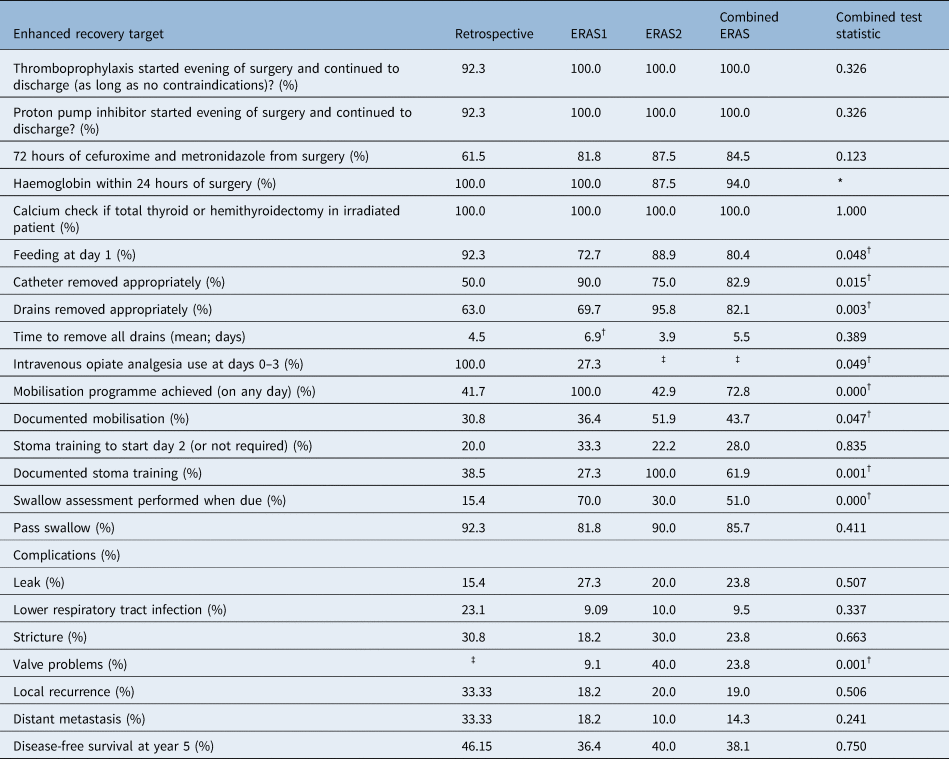
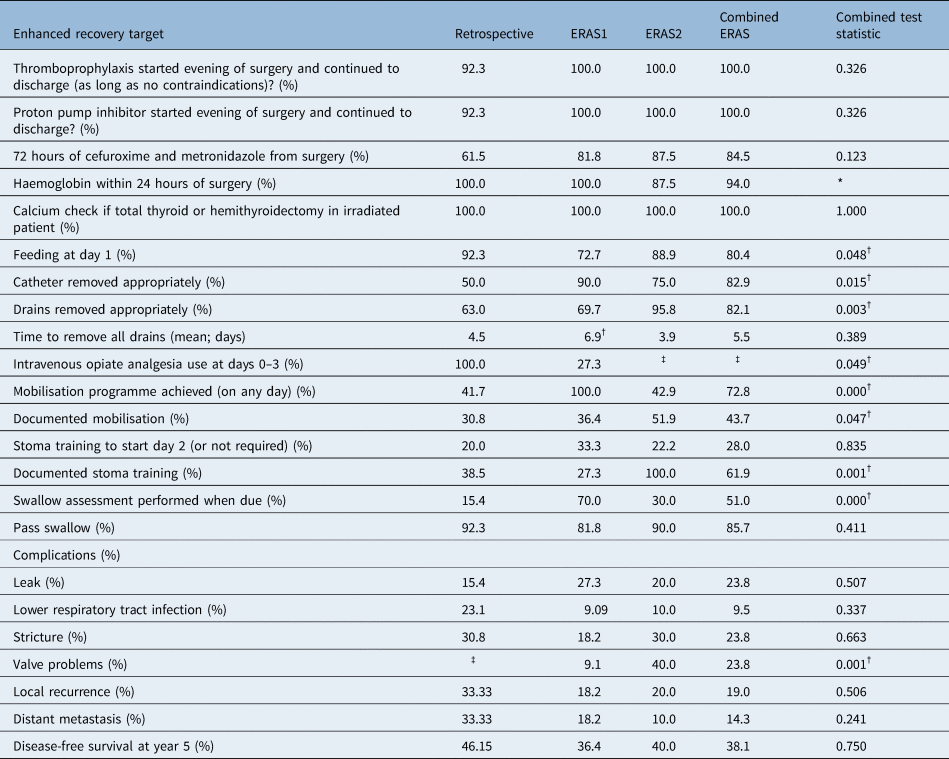
Before the introduction of the laryngectomy enhanced recovery programme, 61.5 per cent of patients received 72 hours of 750 mg cefuroxime and 400 mg metronidazole. After the introduction of the enhanced recovery programme, 84.5 per cent of patients received our chosen antibiotic regimen. This was a non-significant difference (p = 0.12, chi-square). A total of 92.3 per cent of patients in the retrospective audit had a proton pump inhibitor and enoxaparin started on the evening of surgery, which increased to 100 per cent following the introduction of the proforma (non-significant, p = 0.33, chi-square test) (Table 3).
Post-operative care and adherence to the pathway
*Unable to return test statistic; †met statistical significance at the 0.05 significance level; ‡not measured in cycle. ERAS = enhanced recovery after surgery
Laboratory monitoring
In the retrospective cohort, prior to the introduction of the laryngectomy enhanced recovery programme, 100 per cent of patients had a haemoglobin check within 24 hours of surgery and calcium monitoring if a total thyroidectomy or hemithyroidectomy was performed in an irradiated patient. After the implementation of the enhanced recovery pathway, 94.0 per cent had a haemoglobin level taken within 24 hours of surgery, and 100 per cent had appropriate calcium monitoring (haemoglobin non-significant, p = 0.20, chi-square test).
Feeding
Prior to the introduction of the enhanced recovery programme for laryngectomy, 92.3 per cent of patients had enteral feeding started on day 1. In the prospective cycles, 80.4 per cent of patients were fed on post-operative day 1 (significant, p = 0.05, chi-square test). The method of enteral nutrition changed. The proportion having nasogastric feeding increased from 23.1 per cent in the retrospective study to 36.4 per cent in the enhanced recovery after surgery 1 group (non-significant; p = 0.49, chi-square test) and 70.0 per cent in the enhanced recovery after surgery 2 group (significant; p = 0.01, chi-square test).
We compared the historic data prior to implementation of the laryngectomy enhanced recovery programme with our newly defined protocol of introducing oral intake following a successful water soluble contrast swallow assessment. Unsurprisingly, given no prior standardisation, we had a low compliance rate of 15.4 per cent. We performed the swallow assessment on average one day later than target. Following the programme's introduction, we were able to perform a swallow assessment at the desired time (day 5 for laryngectomy with primary closure and no radiotherapy, day 7 when there was prior radiotherapy and day 12 if there was pharyngeal reconstruction) in 51.0 per cent of cases (significant; p < 0.001; mean, 0.7 days; range, −4 to 6 days; chi-square test). In one patient, the swallow, which was performed six days late, was intentionally delayed as prior to the first swallow a pharyngocutaneous fistula was evident. This was the only patient for whom a reason for not following the protocol was apparent, and when they were excluded the swallow was performed an average of 0.5 days late.
Contrast swallow assessment was satisfactory in 92.3 per cent of cases before the implementation of the enhanced recovery pathway. This dropped to 85.7 per cent following implementation of the programme (non-significant). Of those who failed the swallow assessment following the introduction of the pathway, one was performed as per protocol at day 5 (subsequently passed at day 13; no radiotherapy or pharyngeal reconstruction), 1 was performed 1 day late at day 13 (failed at day 25, passed at day 72; prior radiotherapy and pectoralis major pharyngeal reconstruction), 1 was performed 2 days early at day 10 (also failed at day 18, passed at day 31; prior radiotherapy with pharyngeal reconstruction). The patient who had a delayed swallow due to evident pharyngocutaneous fistula had an equivocal swallow at day 18, but subsequently experienced further wound breakdown and fistulation. He did not engage in any follow-up care following hospital discharge and died two months later.
Mobility
The retrospective audit exercise highlighted to us that mobility was documented very poorly in the medical notes, with only 30.1 per cent of key targets (getting into chair, going to the toilet, showering or walking around bay) being documented by doctors, physiotherapists or nursing staff. It was therefore difficult to get a true indication of a patient's mobility status during their recovery. We tried to improve this by incorporating a section on the enhanced recovery proforma for tracking our mobility targets (into a chair on day 1, to the toilet on day 2, showering or walking around bay on day 3); this produced a modest improvement to 43.7 per cent (significant, p = 0.05). In those patients where the documentation was adequate, our baseline audit suggested 41.7 per cent of patients were reaching at least one of our mobility targets. We improved this to 72.8 per cent (significant, p < 0.001).
Analgesia
In the retrospective audit, 50 per cent of patients were prescribed an intravenous opiate for the day of surgery. This reduced to 41.7 per cent for post-operative day 1, 16.7 per cent for post-operative day 2 and 0 per cent on post-operative day 3. After the introduction of the pathway, 28.6 per cent of patients were prescribed an intravenous opiate for the day of surgery, reducing to 15.2 per cent on post-operative day 1 and 0 per cent thereafter (significant, p = 0.05, chi-square). We are unable to comment on the adequacy of analgesia as this section of the proforma was largely ignored.
Stoma care
Prior to the introduction of the enhanced recovery protocol, the process of stoma training was poorly documented, with mention of it occurring in the notes in 38.5 per cent of cases, and stoma training starting on post-operative day 2 in only 20 per cent of these cases. The bedside proforma was designed with a stoma training prompt. Following its introduction, there was documentation of stoma training in 61.9 per cent of cases (significant, p = 0.001, chi-square), commencing on day 2 in 28.0 per cent (non-significant, p = 0.84, chi-square).
Catheter removal was scheduled for post-operative day 1 or 2 when the patient was able to sit and there were no haemodynamic concerns. They were removed according to these parameters: 50 per cent of the time in the retrospective audit cycle, and 82.1 per cent following introduction of the pathway (significant, p = 0.003, chi-square test).
Drains
Drains were removed appropriately 63 per cent of the time in the retrospective study (17 of 27 drains) and 82.1 per cent of the time after the introduction of the enhanced recovery pathway cycle (statistically significant, p = 0.03). The mean time to remove all drains was 4.5 days in the retrospective cycle, 6.9 days in enhanced recovery after surgery 1 group and 3.9 days in enhanced recovery after surgery 2 group (significantly longer time for removal in enhanced recovery after surgery 1, p = 0.05, t-test).
Stay, complications and outcomes
The median length of stay was 20 days before the introduction of the laryngectomy enhanced recovery programme. This reduced to 16.5 days in enhanced recovery after surgery 1 and 13 days in enhanced recovery after surgery 2 groups (non-significant; p = 0.44, 0.10, Kruskal–Wallis rank sum test).
The pharyngocutaneous fistula rate was 20.6 per cent overall, with the rate being 15.4 per cent in the retrospective arm of the study and 23.8 per cent in the prospective arm (non-significant, p = 0.51, chi-square test). Dividing it into those with prior radiotherapy and those without, 4 of 13 patients (30.8 per cent) with pre-operative radiotherapy experienced a pharyngocutaneous fistula whereas 3 of 21 patients (14.3 per cent) with no prior radiotherapy suffered from this complication (non-significant, p = 0.09, chi-square).
It is worth noting that passing a swallow test does not necessarily confirm the absence of leak. A total of 13.3 per cent of patients who passed their initial contrast swallow went on to develop a pharyngocutaneous fistula, split equally between those with and without prior radiation. A total of 75.0 per cent of patients who failed their contrast swallow assessment went on to develop a clinically evident pharyngocutaneous fistula.
Other early complications included hospital acquired pneumonia, 1 incidence of Clostridium difficile infection, a bleeding stoma and a haematoma. Prior to the introduction of the enhanced recovery pathway, 23.1 per cent of patients developed hospital acquired pneumonia; following the introduction of the pathway this dropped to 9.5 per cent (non-significant, p = 0.34, chi-square test).
Most of the complications that occurred after discharge were either neopharyngeal stricture formation (total incidence, 27.3 per cent (30.3 per cent retrospective, 23.8 per cent prospective, non-significant; p = 0.66, chi-square test) or difficulties with the speaking valve (23.8 per cent in the prospective sample). There were also two cases of lymphoedema, and one patient additionally had stomal stenosis.
The 5-year (all cause) mortality rate was 53.9 per cent in the retrospective arm and 61.9 per cent after the introduction of the enhanced recovery pathway (non-significant, p = 0.75, chi-square test). Cancer-specific deaths at 5 years were 53.9 per cent and 52.4 per cent in the retrospective and prospective arms, respectively. All deaths because of recurrent or metastatic disease occurred within the first three years. Rates of local recurrence were 33.3 per cent prior to the enhanced recovery pathway, 19.0 per cent after (non-significant, p = 0.51, chi-square test). Distant metastatic disease was identified in 33.3 per cent of patients in the retrospective cohort and in 14.3 per cent in the prospective cycle (non-significant, p = 0.24, chi-square). Some patients had both locally recurrent and metastatic disease.
Discussion
Developing a comprehensive enhanced recovery pathway is hard, and this project looked only at one small area of pathway development. A lack of good quality evidence on which to base our targets was apparent, and two consensus reviews published after the development of our guideline highlighted the paucity of evidence relating to specialty specific post-operative care in major head and neck surgery, particularly in areas such as timing of drain removal, oral feeding and speech valve placement.Reference Bannister and Ah-See44,Reference Dort, Farwell, Findlay, Huber and Harris45
Dort et al.Reference Dort, Farwell, Findlay, Huber and Harris45 identified 17 key topics to consider when developing an enhanced recovery programme but stopped short of applying specific recommendations for each domain. Previous work has been performed on creating enhanced recovery programmes for laryngectomy patients, and units that have published their data have consistently shown a reduced length of stay varying from 1.5 to 6.7 days,Reference Levin, Ferraro, Kodosky and Fedok46–Reference Cohen, Stock, Andersen and Everts49 although details of the protocol used in each case were not provided and numbers involved in each unit were small (15–30 patients per group). It was also acknowledged that some of the gains in accelerating discharge were by changing acceptable discharge parameters, for example, allowing patients home on enteral feeding before any trial of oral diet or with drains in place which were subsequently managed on an out-patient basis.Reference Bannister and Ah-See44,Reference Hanna, Schultz, Doctor, Vural, Stern and Suen47 A systematic review of 9 studies found the average reduction in length of stay was 3.7 days.Reference Gordon and Reiter50 One study looking at the effect of standardised order sets for post-operative medicationReference Ansari, Fung, MacNeil, Nichols, Yoo and Sowerby51 showed that although they improved adherence to the medication aspect of a clinical pathway, they did not affect the complication rate or overall length of stay, suggesting that an enhanced recovery programme needs to be multimodal to be successful.
Having reviewed the literature, we determined that there was not a published enhanced recovery protocol that we could use ‘off the shelf’ in our laryngectomy population. Using the available evidence and consensus opinion, we created our own and thus acknowledge that it has not been vigorously critiqued or tested outside of our centre. Our rate of complications and long-term follow-up data would not suggest that the changes made to patient management had a detrimental effect, and we have provided full transparency of our protocol to open it to scrutiny.
The introduction of the enhanced recovery programme did allow us to significantly standardise and improve our post-operative care of laryngectomy patients in a number of areas: removing the catheter, removing the surgical drains, reducing opiate use, promoting and documenting mobility and documenting stoma training. Gains made in one of the enhanced recovery after surgery audit cycles were not necessarily transferred to the other but the trend was one of improvement, and as education and familiarity with the programme improved, we would have expected compliance to further increase. Surprisingly, simply getting better at documenting achievements in stoma training did not necessarily transfer into better attainment of targets, suggesting that increasing awareness of the target was not the only barrier to achieving it, in contrast to mobility aims.
There was only one domain in which the performance fell following the introduction of the enhanced recovery programme: the proportion of patients receiving enteral feeding on day 1. After discussion, we were unsure of the reason for this, but it may be secondary to a trend of having more laryngectomy patients spend their first night on the surgical high dependency unit ward rather than the ENT ward, where nurses are less familiar with managing those with laryngectomy procedures and less willing to start feeding, particularly through the tracheoesophageal puncture site.
Although it did not reach statistical significance, the rate of hospital-acquired pneumonia was halved following the introduction of the pathway, and we hypothesise that this might be secondary to the emphasis given to the importance of early mobility, or reduced length of stay thereby reducing exposure to nosocomial infection. The overall length of stay was not statistically significantly shortened; however, we would argue that a median reduction of 5.2 days is clinically significant, and with increased patient numbers we hope to reach statistical significance.
Our speech and language therapy colleagues performed some qualitative research on a subsection of the patients going through the programme (‘Discharge from hospital on the laryngectomy enhanced recovery pathway: a patient experience study’; A White, unpublished data). It identified that patients were keen to return home at the earliest opportunity, although there were recurring themes of lack of control over their care, poor ward-based training prior to discharge and lack of access to high quality locally delivered support post-discharge. Although all 6 patients were enrolled on the enhanced recovery programme, there were 2 clusters of duration of hospital stay: 6, 8 and 9 days and 13, 19 and 27 days. Those with a prolonged length of stay did not report increased satisfaction with ward-based training or ability to self-care than those discharged earlier, suggesting it was the quality rather than the quantity of training which needed to be addressed.
• The field of head and neck cancer surgery has been slow to adopt enhanced recovery after surgery programmes
• The literature did not provide an ‘oven ready’ enhanced recovery after surgery programme for head and neck cancer surgery
• By evaluating outcomes from the literature and using expert consensus opinion, this study developed a novel enhanced recovery pathway
• Provisional results showed a reduced incidence of pneumonia and shortened length of hospital stay
• Possible reasons for this improvement were earlier catheter removal, reduced opiate use and an increased emphasis on early mobilisation
There are limitations to this study. The number of patients involved in this study was fairly small and spread over a three-year period. This makes statistical analysis and drawing conclusions difficult; this is a consequence of the relatively rare nature of laryngectomy surgery. There was variation in the incidence of pre-operative radiotherapy and pharyngeal reconstruction. Over the time period, we performed more free flap reconstructions and fewer gastric pull ups. We also changed the way we provided early feeding for our patients with a greater emphasis on nasogastric feeding rather than via a gastrostomy or tracheoesophageal fistula. The effect of these temporal trends, and likely other unidentified variances over the study duration, cannot be mitigated. This problem has been commented on in other studies.Reference Gordon and Reiter50 There are also many variations of laryngectomy surgery (whether radiotherapy has been performed, extent of neck dissection, concurrent pharyngectomy and method of reconstruction), and this all makes direct comparison with statistically meaningful numbers difficult.
Following completion of the enhanced recovery after surgery 1 and 2 pathways and the qualitative patient experience exercise, we were able to successfully secure funding for a dedicated adult airway clinical nurse specialist to oversee the care of patients with a tracheostoma or tracheostomy both in hospital and in the community. In this way, patients had a defined point of contact, and the same person was responsible for nurturing patient empowerment and independence from before surgery and continuing indefinitely. A patient competencies booklet, which is a patient held learning resource and self-assessment tool, was also developed. We hope these measures helped to address the concerns raised by our patient cohort and could have a further effect on length of stay.
After the consultant spearheading the project left to work at a different centre in late 2016, the enhanced recovery pathway at our institution was discontinued as a formal process. The clinical nurse specialist and the patient-held booklet are ongoing as is the ethos of timely well integrated care. We feel that our project could provide others with a useful insight into how to develop a standardised evidence-based care pathway for some of our most complicated head and neck patients.
Acknowledgements
Many members of the head and neck multidisciplinary team were involved in the creation and review of our enhanced recovery pathway, but especially Sue Mazengarb, Rebecca McNaught, Muriel Donaldson, Anna White, Suzanne Slade, Bridie McEntegart and Katherine Behenna at Queen's Medical Centre, Nottingham.
Competing interests
None declared