Di più dolce, o lieta sorte
Quando mai potrò goder?
When shall I ever be able to enjoy
A sweeter, or happier, fate?Footnote 1
When I stumbled upon this verse from the libretto by Carlo Sigismondo Capeci (1652–1728) to his 1713 Ifigenia in Tauri, I thought how appropriate these words may turn out to be if, indeed, the two arias before me eventually prove to be material that has survived from the opera he wrote with Domenico Scarlatti (1685–1757). I had been researching material at the Lewis Walpole Library, Yale University (US-FAy), under a travel grant to inform the composition of my Op. 127, The Lewis Walpole Tableaux, when I encountered music amassed by Thomas Gray (1716–1771), author of the celebrated Elegy Written in a Country Church-Yard (1751). His ten bound volumes, now catalogued as ‘Quarto 532 MS Manuscript music collected by Thomas Gray, ca. 1740’, contain over three thousand pages of handwritten music, primarily opera-seria arias, that were copied before 1740 and gathered while Gray toured Italy with his friend, the critic and collector Horace Walpole (1717–1797).Footnote 2
The collection consists of the music of Johann Adolf Hasse (1699–1783), Leonardo Vinci (1690–1730), Giovanni Battista Pergolesi (1710–1736), Leonardo Leo (1694–1744), Michele Fini (1708–1752) and others.Footnote 3 On the inside of each volume's cover, Gray has drawn up a table of contents; unfortunately, the second (Quarto 532 MS 2) and tenth (Quarto 532 MS 10) volumes appear to have lost this information. Even without an index, the former is identified as containing the music of Johann Adolf Hasse, with ‘Hasse’ being written upon its spine and the volume's copyist having inscribed ‘Hasse’ at the beginning of each aria. This is not the case for the tenth volume, in which most of the previously unattributed works have been found.
In deciphering the tenth volume's contents, it became clear that Gray had brought together early artists of the Accademia dell'Arcadia and their pupils or associates (see Table 1).Footnote 4 To the best of my knowledge, I appear to have uncovered five excerpts from La caduta del regno dell’ Amazzoni (1690) on a libretto by Giuseppe Domenico de Totis (known in Arcadia as Filedo Nonacrio) and one from Il Colombo overo l'India scoperta (1691) written by Cardinal Pietro Ottoboni (Crateo Ericinio), both of which have music attributed to Bernardo Pasquini (Protico Azetiano).Footnote 5 Immediately following these, and also lacking an indication as to their composer, are two arias from Ifigenia in Tauri (1713) that match the libretto by Carlo Sigismondo Capeci (Metisto Olbiano), which was derived from the spoken tragedy Ifigenia in Tauris (1709) by Pier Jacopo Martello (Mirtilo Dianidio). Further, I have established that the volume holds the Salmo Decimoquinto from the Estro poetico-armonico by Benedetto Marcello, Arcadia's Driante Sacreo, both music and text (in its original Italian) having been written out by Gray.Footnote 6 Other associations with Arcadia surface throughout the tenth volume,Footnote 7 but outstanding among all these names is that of Nicola Porpora (1686–1768). Although Porpora had also set texts by the great Arcadian librettist Metastasio (Artino Corasio), and even produced his part of the score to Berenice, Regina d'Egitto (1718), with Domenico Scarlatti supplying the rest, he was not a member of Arcadia and had rivalries with Hasse, Vinci and George Frideric Handel.Footnote 8 In his assemblage, Gray places Porpora's Or che d'orrido verno immediately after Hasse's cantata Perche Leggiadra Irene. Since both works involve the recurring pastoral character named Clori, one wonders if Gray flanked the pupil and his one-time teacher side by side for comparison.Footnote 9 It should be said that the still-unattributed vocal work in Gray's hand near the start of the tenth volume (third item in Table 1), with the resounding ‘Clori infedele!’ of its first recitative, also sees Clori as one of its protagonists and appears to date from the early 1700s, a time when Handel had written his own Clori, Tirsi e Fileno (1707), a cantata for three voices.
Contents of Quarto 532 MS 10 (with new findings in bold). ‘Quarto 532 MS Manuscript music collected by Thomas Gray, ca. 1740’. Courtesy of the Lewis Walpole Library, Yale University

In the column ‘Location’ the items not given in bold were identified and catalogued (as they appear) by the Lewis Walpole Library. The numbers represent the library's cataloguing information; for example, 10:4 refers to the fourth identifiable work/aria in volume 10. I have added letters in small case to identify separate works within a larger grouping.
With regard to Handel, Gray's tenth volume contains two of his arias, both set to words by John Milton, one of the poets Gray respected most. The first is ‘Life is short, no Moment loose [sic]’ for Handel's 1741 Samson on a libretto by Newburgh Hamilton based on John Milton's Samson Agonistes, and the second is ‘Hide me from Day's garish Eye’ from Handel's L'Allegro, il Penseroso ed il Moderato (1740), where Milton's L'Allegro and Il Penseroso are reclaimed. It should be said that two hundred years before Handel, a similar dialectical opposition, where an Epicurean and a Stoic argue over the supremacy of pleasure over virtue, was rendered by Moderata Fonte (1555–1592) in what Virginia Cox terms a ‘brief philosophical-encomiastic rappresentazione’ entitled Le feste (having both narrative and song), which was presented in 1581 before Doge Niccolò Da Ponte; Cox claims this was ‘the first surviving secular dramatic work by a female Italian writer’.Footnote 10
All in all, Gray's tenth volume contains rare material brought back by the poet from his Grand Tour of 1739–1741 or gathered later by him as he continued to build his music collection. After thorough research, I have paired every entry except one with a possible or probable author. Table 1 provides a full set of contents for this volume (Quarto 532 MS 10), showing what was known of it alongside (in bold font) probable composers and titles of the anonymous works. In addition to these excerpts, the anonymous ‘Regole per l'Accompagnamento’ written out in Gray's hand, which appear at the front of the volume, provide significant information on the accompaniment style of the period.Footnote 11
The ‘Regole per l'Accompagnamento’
The ‘Regole per l'Accompagnamento’, or rules for basso-continuo accompaniment, are connected directly to those found in volume 6, where they precede and continue within what Gray called ‘Toccata per il Cembalo’, in an assemblage otherwise reserved for the music of Michele Fini. Paper size, handwriting, watermark, countermark, stave measurements and subject matter (see Figures 1 and 2) all support the argument that the separated portions of the ‘Regole’ belong together.Footnote 12 This proves of importance, since it was previously assumed that the material collected in the tenth volume did not correspond to a time when Gray was on his travels in Italy, on account of the volume's size and different binding.Footnote 13
Watermark found throughout US-FAy Quarto 532 volume 6 and at the start of volume 10: (a) Quarto 532 MS 6, fol. 1, bottom, centre; (b) Quarto 532 MS 6, fol. 5, top, centre; (c) Quarto 532 MS 10, fol. 2, top, centre. ‘Quarto 532 MS Manuscript music collected by Thomas Gray, ca. 1740’. Courtesy of the Lewis Walpole Library, Yale University

Countermark found throughout Quarto 532 volume 6 and at the start of volume 10: (a) Quarto 532 MS 6, fol. 6, top, centre; (b) Quarto 532 MS 10, fol. 1, top, centre

Gray's manuscript instructions for playing basso continuo contain rules for and examples of harmonization and rhythmic placement, and even mention the acciaccatura.Footnote 14 These ‘Regole per l'Accompagnamento’ are of particular interest given that past biographers have argued whether or not Thomas Gray had received lessons directly from Domenico Scarlatti. The debate seems to have arisen from a passage in William Mason's 1775 biography of Gray where he describes the poet's taste in music as being ‘founded on the best models, those [of the] great masters in Italy, who flourished about the same time with his favourite Pergolesi’.Footnote 15 Mason adds that ‘in Music [Gray] gained supreme skill in the more refined powers of expression; especially when we consider that art as an adjunct to poetry: for vocal music, and that only, (excepting perhaps the lessons of the younger Scarlatti) was what he chiefly regarded’.Footnote 16
Since Mason was Gray's friend, first owner of the music collection after him and a proficient keyboard player, one can assume that his knowledge of Gray's regard for Scarlatti was accurate. If this is the case, then Gray must have had access to the ‘lessons of the younger Scarlatti’. Although Domenico Scarlatti was not in Italy at the same time as the Englishman, Giuseppe Scarlatti – the younger composer of the extended Scarlatti family – worked in Rome from 1739 to 1741,Footnote 17 and his opera La Merope was shown at the Teatro Capranica during Rome's 1740 Carnevale season.Footnote 18 Gray was in Rome from March to July of that year, and it is conceivable that both men might have been in the papal city at the same time. Significantly, the term ‘lessons’ used by Mason can be understood to mean direct teaching but can also refer to a set of studies or sonatas, as known in England.Footnote 19 Of such sonatas, Domenico Scarlatti's Essercizi per Gravicembalo (exercises for keyboard), first printed in London by B. Fortier in 1738 in a luxurious (and very large) edition, quickly gained popularity with amateurs and professionals alike, especially after Thomas Roseingrave produced a more accessible version in 1739 that contained the initial thirty sonatas and twelve additional ones.Footnote 20 Although the catalogue of his personal libraryFootnote 21 does not mention the Essercizi, Gray might still have owned a copy, and perhaps these ‘lessons’ are what Mason was referring to; but an intriguing passage in Edmund Gosse's biography of Gray, admittedly published in 1882, claims that ‘the poet used to sit [at the harpsichord] in the twilight and play toccatas of Scarlatti and Pergolesi’.Footnote 22
Evaluating the style of notation found in the ‘Toccata per il Cembalo’, the stave braces (see Figure 3) more closely resemble those found in Alessandro Scarlatti's ‘Regole per ben sonare il Cembalo’Footnote 23 than those in the remainder of volume 6 allocated to Fini's works. Of note are the fiery ascents with hand-crossings in the bottom bars of the excerpt that summon up Domenico Scarlatti's signature keyboard passages. Domenico's sonatas consisted mostly of binary-form movements which were meant as stand-alone works, even though they were often grouped according to key by copyists and editors as suites or essercizi;Footnote 24 and as early as on its first leaf, the anonymous toccata shows such a binary-form piece.
‘Toccata per il Cembalo’. Quarto 532 MS 6:6, unnumbered

As a thorough review of known accompaniment treatises and studies against which the ‘Regole per l'Accompagnamento’ and ‘Toccata per il Cembalo’ can be compared goes well beyond the scope of the present article, I now turn to the La caduta del regno dell’ Amazzoni and Il Colombo overo l'India scoperta arias in Quarto 532 MS 10.
Excerpts from La Caduta del regno dell’ Amazzoni and Il Colombo overo l'India scoperta
All five excerpts from La caduta del regno dell’ Amazzoni in the tenth volume agree exactlyFootnote 25 with the libretto by Giuseppe Domenico de TotisFootnote 26 for the opera presented at Palazzo Colonna in January 1690. Two of these arias resurface as reductions for soprano voice (in the role of Mandane) and continuo in a manuscript held at the library of the Conservatorio di Musica Luigi Cherubini in Florence, and are purported to be by Bernardo Pasquini, but, unfortunately, they display no definite ascription.Footnote 27 The first, ‘Se un'astro scintilla, Amor l'infiammò’, takes place in Act 1 Scene 13 (see Figure 4), while the second, ‘L'honor, che più aggrada’, is sung in Act 2 Scene 14. It appears that the Bibliothèque nationale de France holds an identical reduction of ‘Se un'astro scintilla’, bearing the inscription ‘Del Sr Bo Pasquini’.Footnote 28 In light of this and the strong concordance with the libretto, the authorship of Bernardo Pasquini seems likely. The same level of agreement between aria text and libretto can be witnessed for ‘Se vuoi ch'io t'ami’ from Il Colombo overo l'India scoperta (see Figure 5), which is thought to have been set to music by Pasquini on the libretto by Cardinal Pietro Ottoboni for a December 1690 performance at the Teatro Tor di Nona. According to the Aggiunta (the addendum to the libretto) this duet between Tendilla and Fernando in the opera's second act is to be sung at the end of Scene 16.Footnote 29 It should be mentioned that a similar ‘Se vuoi ch'io t'ami’ resurfaces as an aria for Dorifile sola in Act 3 Scene 3 of Capeci's 1713 Ifigenia in Tauri (see Table 2 in the next section).
‘Se un’ astro scintilla’. Quarto 532 MS 10:14, fol. 53r

‘Se vuoi ch'io t'ami’. Quarto 532 MS 10:14, fol. 50r

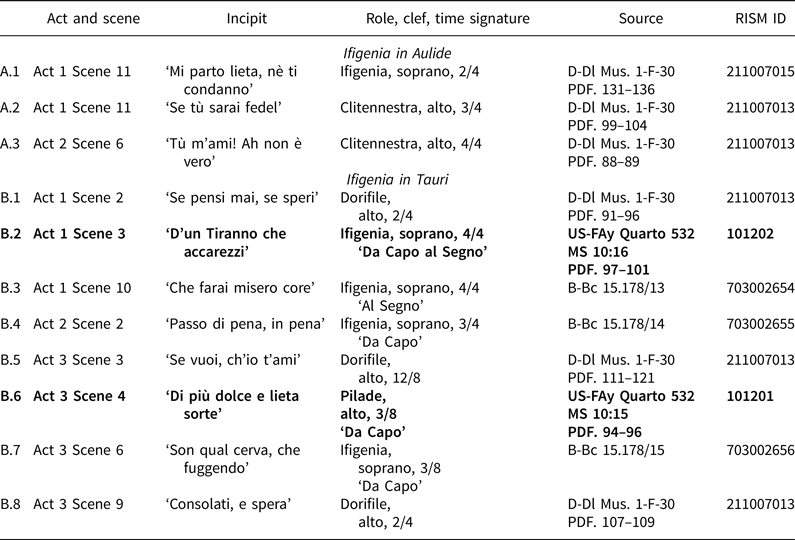
Extant arias from Ifigenia in Aulide and Ifigenia in Tauri on the 1713 librettos by Carlo Sigismondo Capeci (with new findings in bold)

In the first column above ‘A’ = arias from Ifigenia in Aulide and ‘B’ = arias from Ifigenia in Tauri
With all six passages contained within the same grouping, there is good reason to believe that they represent Pasquini's music. Since paper circulated widely, it is not always a reliable indication of provenance, but the size of the folios and their watermarks are characteristic of paper found in Rome at the time.Footnote 30 The watermarks described as ‘giglio inscritto in un doppio cerchio’ (lily inscribed in a double circle) and ‘giglio entro doppio ovale’ (lily within a double oval) recur regularly in Alexandra Nigito's massive compilation of Bernardo Pasquini cantatas, and the drawings she labelled as filigrana Tipo A1, A2 and B1 in her Table 34 resemble watermarks seen in Gray's Pasquini arias.Footnote 31 Pasquini specialists are invited to scrutinize the arias conceivably composed by the former maestro di cappella to Queen Kristina Wasa of Sweden,Footnote 32 founding patron of the Accademia dell'Arcadia, as their analysis does not appear herein.
Why these particular excerpts and the two following Ifigenia in Tauri arias written for Queen Kristina's successor in Rome – French-born Maria Kazimiera Sobieska, Queen dowager of Poland – were collected by Thomas Gray remains a mystery. However, within the same volume, he has put back to back arias from operas strongly associated with the War of the Spanish Succession (1701–1714): La caduta del regno dell'Amazzoni,Footnote 33 written in 1690 to celebrate the marriage of Charles II to Maria Anna of Neuburg, and Ifigenia in Tauri, written in 1713, during the last bitter years of the war that began in earnest with the death of Charles II in 1700 and the subsequent appointment of Philippe duc d'Anjou as his successor. Under the heading ‘Anglia’, the first volume of Gray's commonplace book highlights that the poet had educated himself on national and foreign affairs for the years spanning 1689 to 1701 and leading up to the major conflict. Below the caption ‘1689’ Gray writes bluntly, ‘War declared with France’, then, at ‘1697’, he documents the death of Poland's King Jan Sobiesky – Queen Maria Kazimiera Sobieska's husband – and, for ‘1700’, follows this with ‘Spain – Carlos 2d dies, & by his will declares the D: of Anjou his Successor’.Footnote 34
Facing increasing political unrest in her country after the death of her husband, Maria Kazimiera Sobieska sought exile in Rome, where she arrived on 1 April 1699.Footnote 35 Once settled, Sobieska, according to her nineteenth-century biographer Kazimierz Waliszewski, ‘took great pride in following the footsteps of her illustrious forerunner, the foundress of the Accademia degli Arcadi [Queen Kristina of Sweden]’, and she was inducted into the Accademia on 5 October 1699 under the name Amirisca Telea.Footnote 36 In 1704 Maria Casimira – as she was known in Rome – called upon the services of Carlo Sigismondo Capeci (also spelled Capece), a poet of the Arcadians under the name of Metisto Olbiano, to create librettos for the performances at Palazzo Zuccari.Footnote 37 At first, these were set to music by Alessandro Scarlatti, who was then her maestro di cappella, and, when he left this position to return to Naples, Alessandro passed the title down to his son, Domenico,Footnote 38 who remained in that post from 1709 until Maria Casimira relocated to Blois, France in June of 1714.Footnote 39
Regarding the political climate under which the pair of 1713 operas Ifigenia in Aulide and Ifigenia in Tauri were developed, Aneta Markuszewska observes that chance alone cannot account for the fact that Euripides wrote his Iphigenia plays during the Second Peloponnesian War and Capeci penned his while the War of the Spanish Succession was tearing territories and families apart.Footnote 40 With Poland having attempted to silence her political voice, Maria Casimira seems to have turned to the arts as a means to show her opposition to the hostilities. As stated in the 1713 opera's argomento, the patroness's poet, Capeci, departed from Pier Jacopo Martello's ItalianFootnote 41 version of Euripides’ taleFootnote 42 in order to adapt it to current taste, or ‘al gusto de’ moderni Drammi’. Perhaps Capeci's libretto, subsidized by Maria Casimira just prior to the negotiations of the Treaty of Utrecht, voices her plea for a peaceful end to the war that had been raging for more than a decade.
Other than his political interest in these operas, Thomas Gray might very well have been gathering material to inspire the work he began in 1741 shortly after returning from his Grand Tour: his Agrippina. Gray admired the works of Jean Racine (1639–1699), author of the plays Britannicus (1669), in which Agrippina features prominently, and Iphigénie (1675); and William Powell Jones's descriptive register of Gray's early catalogue of his library shows that it held the Oeuvres de Racine and Euripides's Tragoedia XX praeter ultinam,Footnote 43 where, in the latter, it is said that Gray's annotations are found throughout.Footnote 44 In support of this hypothesis, it might be mentioned that Giuseppe Domenico de Totis, author of the aforementioned La caduta del regno dell'Amazzoni collected by Gray, had written his own version of Agrippina in 1691.Footnote 45 It should also be noted that although Handel and Porpora had both composed versions of Agrippina, these works do not feature in Gray's handwritten scores.
In early April 1742 Gray sent a first draft of the opening scene of his Agrippina to Richard West,Footnote 46 and in the ensuing weeks the pair exchanged thoughts and opinions on the style of language best suited for the English stage. Then, on 8 May 1742, Gray tells West that he has just finished reading Thucydides: ‘I have finished the Peloponnesian war much to my honour, and a tight conflict it was, I promise you’Footnote 47 – a reading that would be relevant for someone interested in the climate under which Euripides had written his Iphigenia in Aulis and Iphigenia in Tauris. In the same month, Gray, corresponding with John Chute, who was residing in Florence at the time, thanks him for music sent his way: ‘My Dab of Musick & Prints you are very good to think of sending with your own’.Footnote 48 Within the context of this chronology, it seems plausible that the Ifigenia in Tauri arias in Gray's tenth volume might have been included in the ‘Dab of Musick’ sent from Chute to Gray in May of 1742. This being said, a stronger determination of provenance remains to be established. Moreover, although the texts of both Ifigenia in Tauri arias in Gray's collection strongly correlate with Capeci's 1713 libretto for the opera that was initially set to music by Domenico Scarlatti, the excerpts bear no ascription as to their composer, hence the immediate need to examine them further.
Two Arias from Ifigenia in Tauri (1713) on the Libretto by Carlo Sigismondo Capeci
The collaboration between Carlo Sigismondo Capeci and Domenico Scarlatti yielded at least seven operas for their patroness, including the 1713 Ifigenia in Aulide and Ifigenia in Tauri, but very little of this joint operatic output has survived.Footnote 49 According to RISM, only nine arias from the pair of Ifigenia operas still exist; therefore my recent rediscovery of what appear to be two additional arias composed on the libretto to Ifigenia in Tauri, presented in Rome in 1713 and bearing the mention ‘E posto in Musica dal Sig. Domenico Scarlatti’, warrants scholarly attention. The extant arias from the Capeci–Scarlatti Ifigenia operas attributed to Domenico Scarlatti are as follows:
1 three arias from Ifigenia in Tauri, all for the role of Dorifile and written in alto clef, held at the Sächsische Landesbibliothek – Staats-und Universitätsbibliothek, Dresden (D-Dl), manuscript Mus. 1-F-30;
2 three arias from Ifigenia in Tauri, all for the role of Ifigenia and written in soprano clef, contained within the library of the Conservatoire royal de Bruxelles – Koninklijk Conservatorium Brussel (B-Bc), 15178 under the numbers 13, 14 and 15;
3 three arias from Ifigenia in Aulide also in D-Dl, Mus. 1-F-30. As Markuszewska points out, ‘Se tù sarai fedel’ is not from Ifigenia in Tauri but from Act 1 Scene 11 of Ifigenia in Aulide, and Clitennestra's aria ‘Tù m'ami! Ah non è vero’ is from its Act 2 Scene 6.Footnote 50
To these, we add the excerpts possibly composed by Domenico Scarlatti and recently located in Thomas Gray's music manuscripts in the Lewis Walpole Library, Quarto 532 MS 10:
4 two arias from Ifigenia in Tauri: ‘Di più dolce e lieta sorte’, in alto clef and to be sung by Pilade in Act 3 Scene 4, Quarto 532 MS 10:15; and ‘D'un Tiranno che accarezzi’ (Act 1 Scene 3), for the role of Ifigenia and written in soprano clef, Quarto 532 MS 10:16 (see Figures 6 and 7).
‘Di più dolce e lieta sorte’. Quarto 532 MS 10:15, fol. 60r

‘D'un Tiranno che accarezzi’. Quarto 532 MS 10:16, fol. 61v

Domenico Scarlatti is the only composer known to have set Capeci's Ifigenia, but others may also have attempted to do so. Grouping the surviving arias according to respective acts and scenes yields a better sense of their possible interrelations (see Table 2). In effecting this reordering, a comparative evaluation of subsequent (or closely related) scenes can help determine coherence and consistency, and hence aid in determining the likelihood that they were written by the same composer – in this case, Domenico Scarlatti. It should be borne in mind that such comparative remarks aim to contribute useful material to the greater pursuit of determining the composer of the newly found Ifigenia in Tauri arias and should not be misconstrued as an attempt to prove authorship beyond all doubt.
Features of the Newly Discovered Scores
As mentioned previously, nine arias from the pair of Ifigenia operas composed by Domenico Scarlatti survive. Comparing the copyist's penmanship to the Scarlatti Ifigenia in Tauri arias in the Dresden manuscript, the arias in the Brussels copy and the products of known copyists active in Rome at the time, a firm match cannot be established. The shapes of letters, notes and clefs show promise when scrutinizing the Brussels copy against Gray's if one accounts for variances between a carefully transcribed copy and what seem to be the hurriedly notated Ifigenia arias in Quarto 532 MS 10. The S-shaped ‘8’ in the time signature of ‘Di più dolce’ (see Figure 8) is strikingly peculiar, and, of countless materials consulted, only B-Bc 15178/15 contains a comparable eight, which can be seen in ‘Son qual cerva’ from the third act's Scene 6 (see Figure 9). On the other hand, a distinctive segno drawn as two vertical and two horizontal lines with four dots, one in each corner, can be observed in ‘D'un Tiranno che accarezzi’ (see Figure 10) in this clearly spelled-out da capo al segno form, but the segno marker in B-Bc 15178 differs. Notably, the same segno drawn in ‘D'un Tiranno che accarezzi’ can be found in many places within the manuscript of Alessandro Scarlatti's 1723 Erminia. A treble clef with a similarly elongated stem, a slanted ‘3’ in the time signature and the added presence of a distinctive wavy ‘w’ custos (see Figure 11) placed at the end of staves – used to specify the pitch to follow at the start of the next system – can be seen in Giovanni Pertica's copiesFootnote 51 as well as in the overture to Tolomeo et Alessandro previously in the possession of musicologist Sebastiano Arturo Luciani and reproduced in Ralph Kirkpatrick's biography of Domenico Scarlatti.Footnote 52
Characteristic ‘8’ in time signature of ‘Di più dolce’. Quarto 532 MS 10:15, fol. 60r

Characteristic ‘8’ seen in the first page of ‘Son qual cerva’. Library of the Conservatoire royal de Bruxelles – Koninklijk Conservatorium Brussel (B-Bc), 15178/15. Used by permission

Characteristic segno in ‘D'un Tiranno’. Quarto 532 MS 10:16, fol. 61v

End-of-stave custos in ‘Di più dolce’. Quarto 532 MS 10:15, fol. 60r

As for overall appearance, the singer's stave in ‘Di più dolce’ gives the impression that it was added after notation of the other instruments or, at the very least, altered. The aria begins with Pilade's first note scribbled over a pre-existing full rest, still perceptible underneath the stem of the inscribed g1 (in the alto clef). The next three bars in the singer's part contain stave lines that have been retraced, and throughout the entire first page new notes and smudged ink coexist in a texture highly indicative of corrective jottings where erasures have not succeeded in completely removing the initial notes (see Figure 12). The second and third pages of the aria do not exhibit similar modifications, but the second Ifigenia aria in the collection, ‘D'un Tiranno che accarezzi’, contains an entire section of five bars that has been pasted directly over the original contents (see Figure 13).
Corrections in first bars of singer's part in ‘Di più dolce’. Quarto 532 MS 10:15, fol. 60r

Corrected section pasted directly onto ‘D'un Tiranno’. Quarto 532 MS 10:16, fol. 62v

The portion of the watermark found (46 mm wide x 54 mm high) in the Ifigenia arias of Quarto 532 MS 10 shows a shield with curved scrolls having a double bar sinister (two diagonal bars) running from the bottom left to the top right (see Figure 14). A countermark approximately 40 mm wide formed of the roman letters ‘I V’ is also present (see Figure 15, where it can be seen upside down).Footnote 53 Both the watermark and countermark are located at the top of the page and centrally along the longitudinal plane. Again, attempting to substantiate provenance from watermarks alone often proves perilous; for example, in the case of the two arias under consideration, the paper could have been brought to Rome by Maria Casimira, or perhaps the arias were transcribed from another source.
Portion of watermark, Quarto 532 MS 10, fol. 60v, top, centre

Countermark, Quarto 532 MS 10, fol. 61v, top, centre

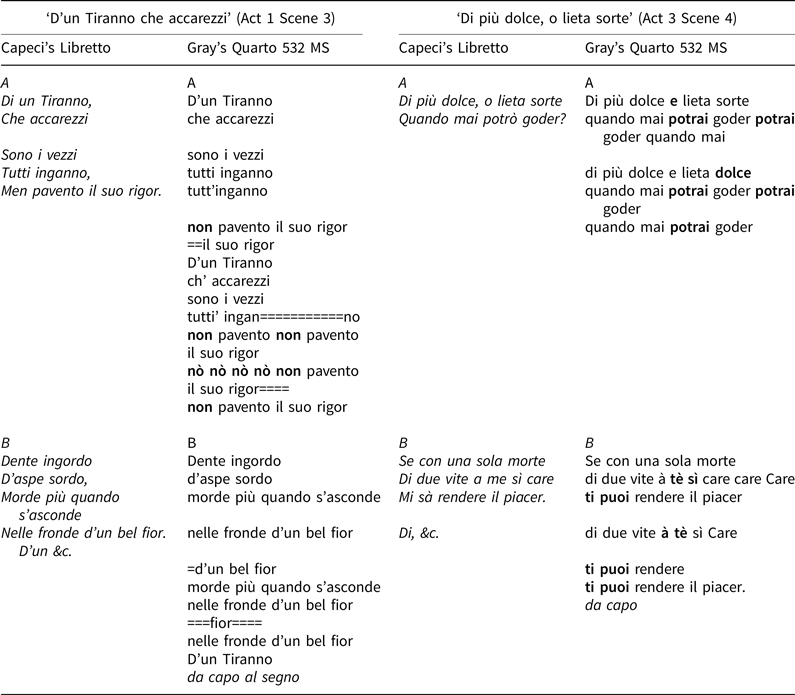
Concordance with Capeci's Libretto
The texts from the arias in Thomas Gray's collection yield a near-to-exact match to Capeci's 1713 libretto for Ifigenia in Tauri (see Table 3, where deviations are shown in bold). A Capeci–Scarlatti Ifigenia in Tauri was presented anew for the Turin carnival season of 1719,Footnote 54 and although ‘Di un Tiranno’ was maintained, ‘Di più dolce’ does not appear in this revised libretto.Footnote 55 This suggests that Pilade's ‘Di più dolce e lieta sorte’ in Gray's collection may belong to the original 1713 production. Because ‘Di un Tiranno’ begins on the verso side of the last page of ‘Di più dolce’ and materializes in the same hand and style, could it be surmised that both arias correspond to the original libretto of Ifigenia in Tauri written for Maria Casimira in 1713, and perhaps even embody its original music?
Comparison of Capeci's Ifigenia in Tauri (1713) libretto with arias in Gray's Quarto 532 MS 10 (deviations shown in bold)

The reasons for the slight variances in text will not be investigated here except to say that such modifications occur frequently in Domenico's treatment of Capeci's Ifigenia. For example, similar word changes and inversions can be observed in both the Brussels and the Dresden scores, where attribution to Domenico Scarlatti is recognized. In Ifigenia's ‘Che farai misero core’ from Act 1 Scene 10 (B-Bc 15178/13), ‘il’ is dropped completely from ‘senza il rigore’. Likewise, in the second section of ‘Passo di pena, in pena’ from Act 2 Scene 2 (B-Bc 15178/14), the libretto reads ‘Porto non vede, o sponda’ while the score shows Ifigenia singing the rearranged ‘non vede porto ò sponda’. In Ifigenia's ‘Son qual cerva, che fuggendo’ from Act 3 Scene 6 (B-Bc 15178/15), words are recombined when repeating the first verse, and ‘e mira al Varco, Teso l'arco feritor’ becomes ‘e mira teso l'arco’, while ‘che fuggendo’ becomes ‘và fuggendo’, and this first section ends with the reordered ‘e mira l'arco feritor’. Further, in the Dresden aria for Dorifile, ‘Se pensi mai, se speri’ from Act 1 Scene 2 (D-Dl, Mus. 1-F-30), Scarlatti inverted the libretto's text to ‘se speri se pensi’ in the third repetition of the opening verse, conceivably to inject variety; significantly, this also occurs in Gray's volume, when Pilade sings ‘potrai goder quando mai’ to end his first enunciation of the first verse instead of finishing it with ‘quando mai potrai goder’, and also when he sings ‘e lieta dolce’ instead of the libretto's ‘o lieta sorte’ in echoing the same verse.
It is relevant to note that, in ‘Mi parto lieta, nè ti condanno’ from Ifigenia in Aulide's Act 1 Scene 11 (D-Dl, Mus. 1-F-30), Ifigenia, instead of singing ‘A chi ne gode Pena non è’, ends the aria with ‘à chi ne gode pena non è nò nò non è’ – an emphasis on ‘nò’ that returns at the end of the A section of Ifigenia in Tauri's ‘D'un Tiranno’, when Ifigenia sings ‘nò nò nò nò non pavento’. Equally, in the Dresden score for ‘Consolati, e spera’ from Scene 9 of Ifigenia in Tauri's third act, in repeating the B section, the first line is omitted completely, as is the case for section B of Pilade's ‘Di più dolce’. Although it was common for composers to reorder a libretto's text, in all extant Ifigenia in Tauri arias from the ‘Dominicus Capece’Footnote 56 pair as well as in the two recently discovered ones, the beginnings of each stanza from Capeci's libretto emerge intact in the music, as the composer only repeats words or groups of text in the middle or end of sections or in their repetition. Further to these observations, there are resemblances in the setting of the two newfound arias that cannot be disregarded when reviewed in conjunction with those ascribed to Domenico.
Observations and Comparisons
Of the extant arias from the 1713 Capeci–Scarlatti Ifigenia in Aulide and Ifigenia in Tauri, instrumentation is specified in ‘Che farai misero core’ from Act 1 Scene 10 (B-Bc 15178/13), where, on the first stave, the violins playing in unison are marked ‘vv’ while the second stave bears the indication ‘viola’. Likewise, in D-Dl Mus.1-F-30, ‘Unis’ is shown for the first stave in ‘Se pensi mai, se speri’ from Act 1 Scene 2; as ‘Unissi’ for ‘Consolati, e spera’ for Act 3 Scene 9; and for this same act's ‘Se vuoi, ch'io t'ami’ from Scene 3, the rich instrumentation is scored ‘Flauto’ for the first two staves, ‘viol & Unis’ for the third stave and ‘viola’ for the fourth. Consequently, the lack of any distinct markings at the beginning of instrument staves in Gray's Ifigenia copies leads one to assume that both arias are to be played by two violin parts, one viola and continuo.
Although the 1719 production of Ifigenia in Tauri at the Teatro Carignano, dedicated to the Savoyard ‘All'Altezza Reale di Carlo Emanuel Principe di Piemonte’, saw Diana Vico as Ifigenia and Antonio Pasi (also known as Tonino) as Pilade, the Ifigenia cast of 1713 remains unknown.Footnote 57 Nevertheless, if the arias of Quarto 532 MS 10 were intended for the original performance at Palazzo Zuccari, it is likely that the vocal demands would have matched those of the other passages planned for the same singer. Pilade's sole surviving aria sees no equivalent, but the four excerpts for Ifigenia allow for a verification of their featured range, and Ifigenia's ‘D'un Tiranno che accarezzi’ does not deviate from the others (see Table 4).
Vocal range for Ifigenia's arias, Ifigenia in Tauri

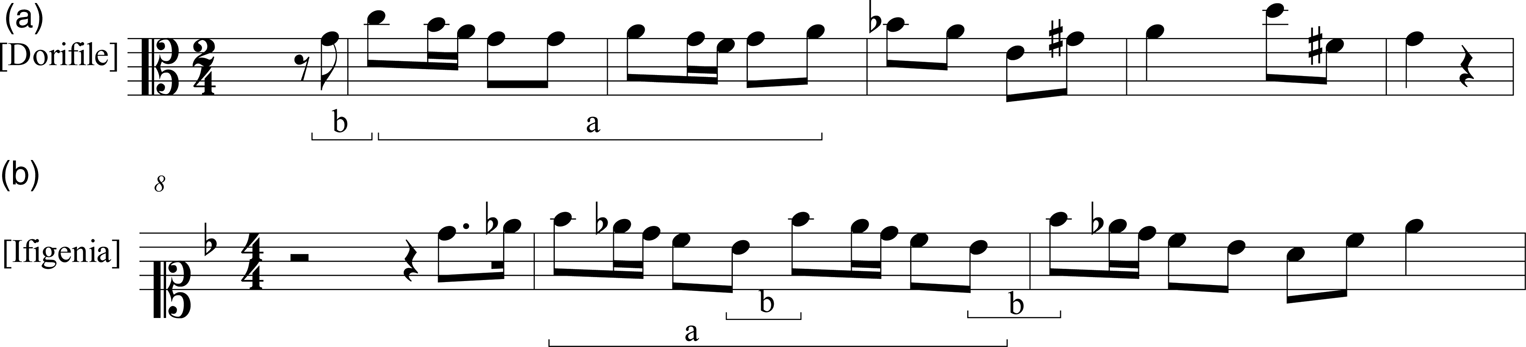
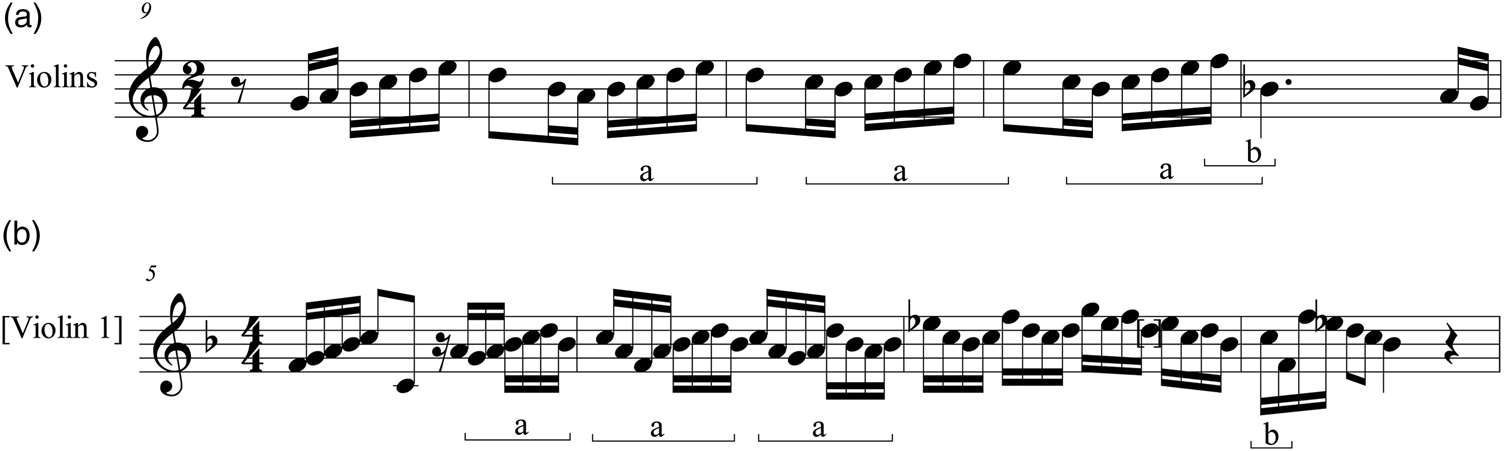
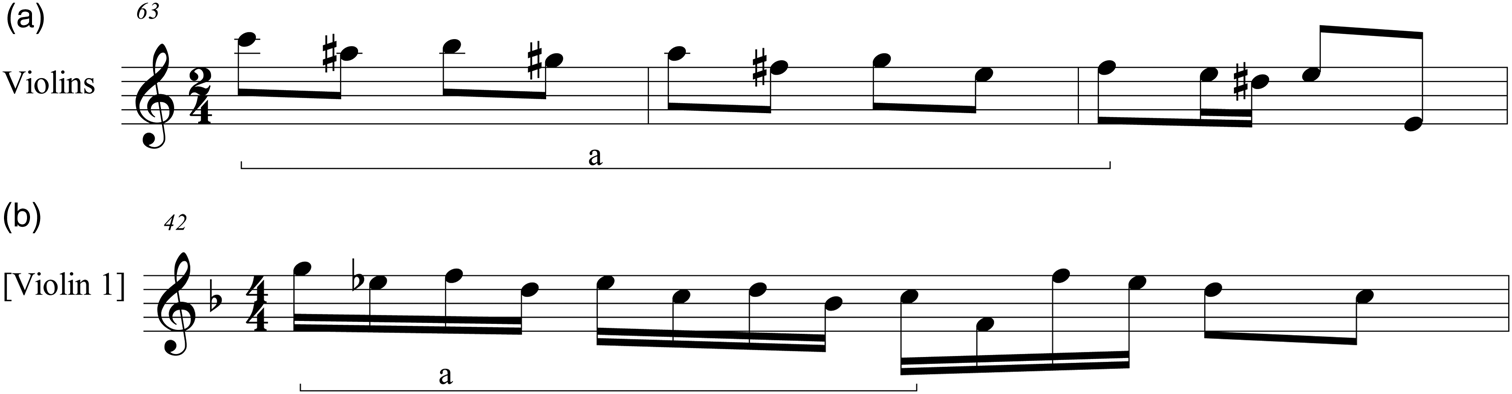
A comparison of ‘Se pensi mai, se speri’, which immediately precedes ‘D'un Tiranno che accarezzi’, exposes fascinating resemblances between these two opening-act arias. Even upon the most modest of appraisals, one can find the inaugural rhythmic pattern of Dorifile's ‘Se pensi mai, se speri’ (Act 1 Scene 2) recurring in Ifigenia's ‘D'un Tiranno che accarezzi’ (Act 1 Scene 3) in her first verse's ‘sono i vezzi’ (bar 1) and again upon reiteration of the A section at ‘accarezzi sono i vezzi’ (bars 9–10), which, significantly, contains a comparablê1–̂5 jump (instead of the previous number'ŝ5–̂1) at the repetition of the contour (see Example 1). Across these two scenes, parallels manifest themselves in similar gestures, such as in the respective first ritornellos, where in both cases the violins create a propulsive wind-up with a quick turn from below followed by an ascending stepwise fourth, followed by reiteration of the figure, and both lines end by dropping a perfect fifth (in one case, the drop is repeated and filled in by step) (see Example 2).
(a) ‘Se pensi mai, se speri’, bars 1–5 (Act 1 Scene 2, Dorifile); (b) ‘D'un Tiranno che accarezzi’, bars 8–10 (Act 1 Scene 3, Ifigenia)

(a) ‘Se pensi mai, se speri’, bars 9–13 (Act 1 Scene 2, Dorifile); (b) ‘D'un Tiranno che accarezzi’, bars 5–8 (Act 1 Scene 3, Ifigenia)

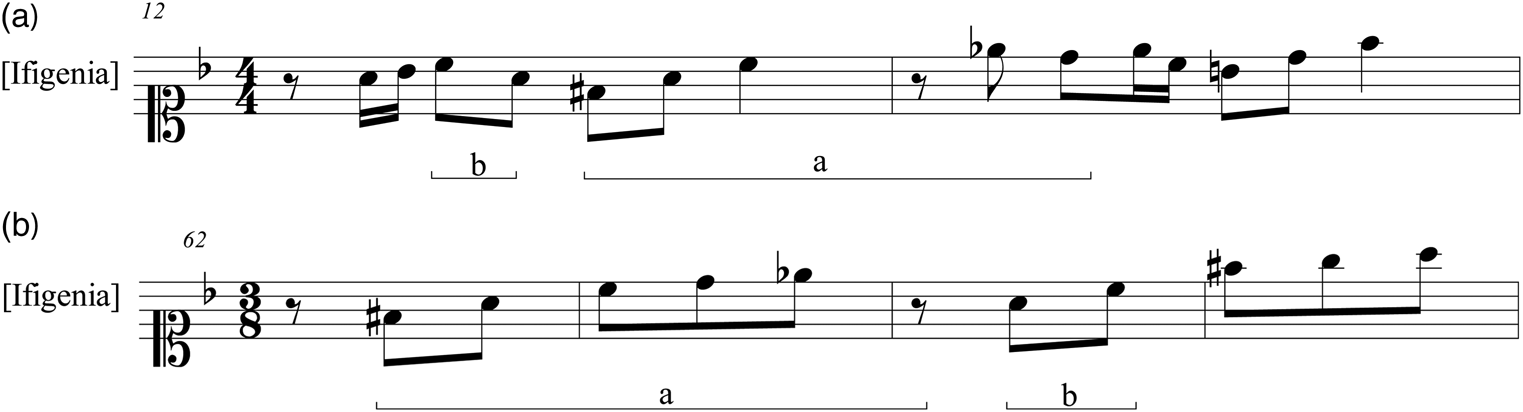
More obvious still, and amplified by the high register, the first violin brings the aria to its end by sequencing down in thirds from the sixth degree to the local tonal area, E minor (note the Neapolitan inflection of F(♮) at the start of bar 65). This motion doubles Dorifile in bars 63 to 65 and appears in the penultimate measure in ‘D'un Tiranno’ (see Example 3). Additional validation of consistent composition comes when spotting that Ifigenia's f♯1–a1–c2–e♭2–d2 diminished-seventh pattern in her coloratura passage on ‘tutt'inganno’ (bars 12–13) anticipates her later f♯1–a1–c2–d2–e♭2 at ‘và fuggendo’ in ‘Son qual cerva, che fuggendo’ (bars 61–62) from the third act's Scene 6, where the gesture is bookended by a mirrored a–c pair (Example 4).
(a) ‘Se pensi mai, se speri’, bars 63–65 (Act 1 Scene 2, Dorifile); (b) ‘D'un Tiranno che accarezzi’, bars 42–43 (Act 1 Scene 3, Ifigenia)

(a) ‘D'un Tiranno che accarezzi’, bars 12–13 (Act 1 Scene 3, Ifigenia); (b) ‘Son qual cerva’, bars 62–64 (Act 3 Scene 6, Ifigenia)

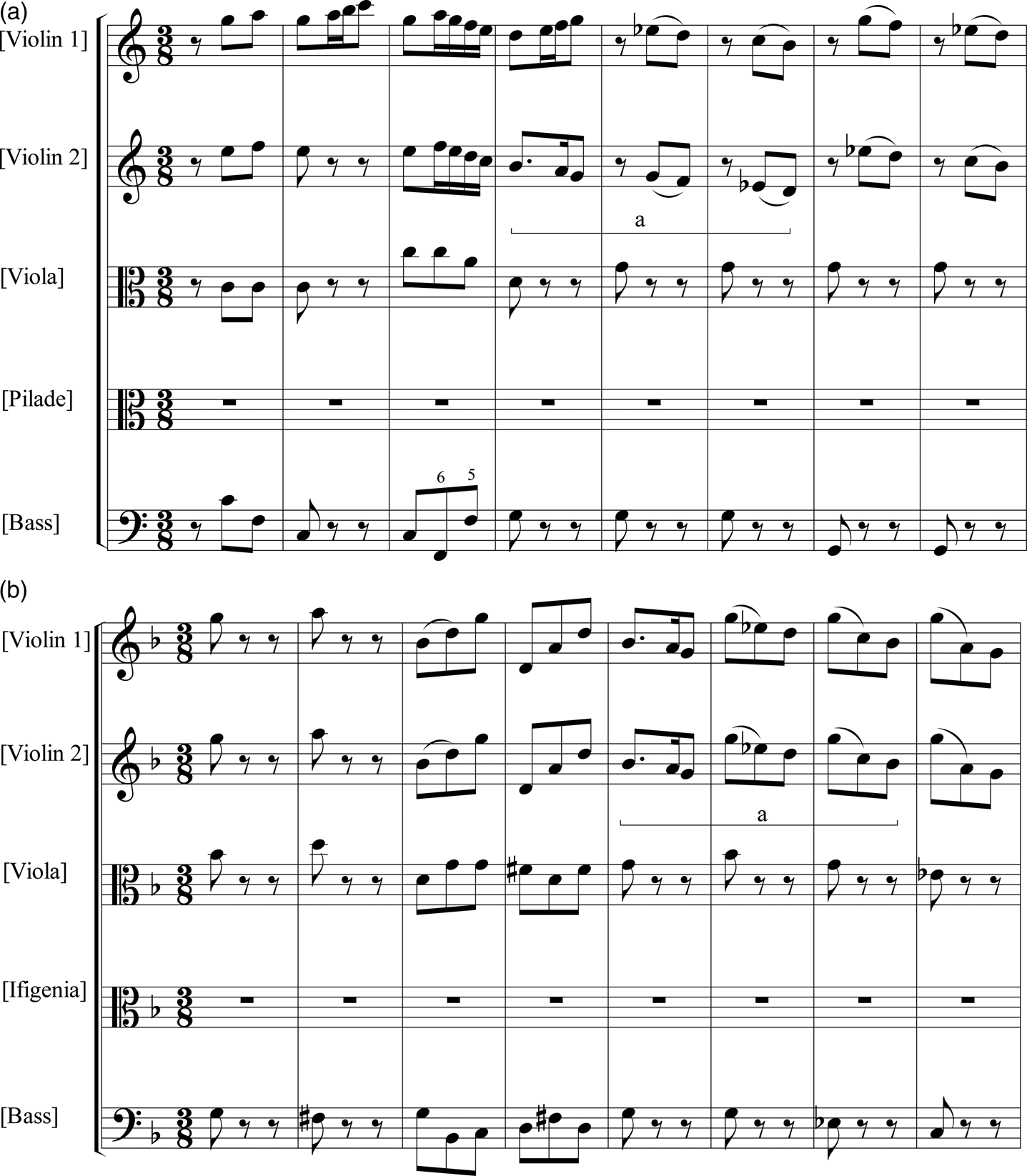
As for the second aria in Thomas Gray's collection, ‘Di più dolce e lieta sorte’, written for Pilade in Act 3 Scene 4, the composer chose to harmonize the melodic line sparsely, with the instruments appearing almost exclusively on the first beat of the bar or following the end of Pilade's sentences and, accordingly, never interfering with the singer's part. Comparing ‘Di più dolce e lieta sorte’ to Scarlatti's setting of ‘Son qual cerva, che fuggendo’ allows for an appraisal of the likelihood that Gray's Ifigenia in Tauri aria from Act 3 Scene 4 logically precedes Scarlatti's Scene 6 from the same act. From the outset, the two da capo arias, both in 3/8, display similarities that cannot be dismissed. The melodies both begin with g2–a2 in the violins and feature a few bars later a dotted quaver–semiquaver–quaver figure on b(♭)1–a1–g1, with only its modality differing. More striking is the resemblance of the passages beginning at the respective bars 5 and 6: the succession g2–e♭2–d2 and g2–c2–b♭1 in the doubled violins in ‘Son qual cerva’ is close to what we hear in the same location (second phrase of the piece) of ‘Di più dolce’ (see Example 5). The gesture arises once more when Ifigenia sings anew ‘Son qual cerva che fuggendo che fuggendo’ (bars 42–47) before moving to the B section of this sixth scene.
(a) ‘Di più dolce e lieta sorte’, bars 1–8 (Act 3 Scene 4, Pilade); (b) ‘Son qual cerva’, bars 1–8 (Act 3 Scene 6, Ifigenia)

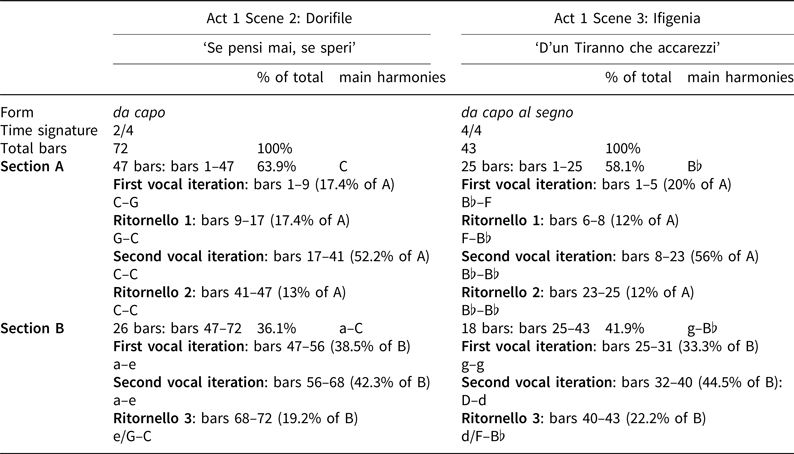
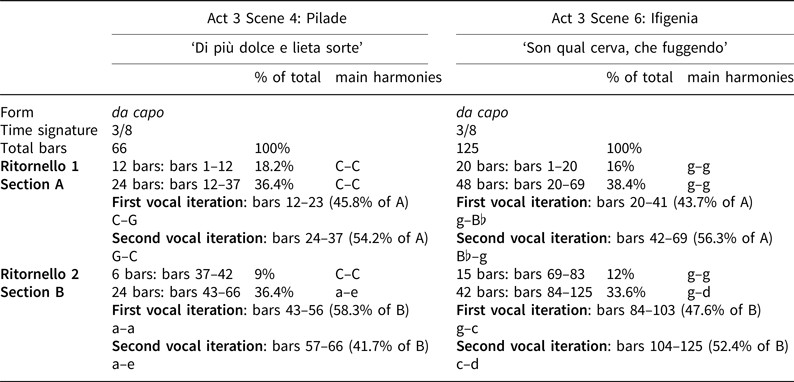
Additionally, the structural proportions in the respective arias exhibit a level of concordance that supports the hypothesis that the excerpts form a coherent whole (see Tables 5 and 6). For example, the equivalence in their relative section lengths teamed with their respective harmonic emphases imply that corresponding tonal areas are given the same harmonic weight in relation to the total duration of the aria.
Structural proportions and main harmonies, Ifigenia in Tauri, Act 1 Scenes 2 and 3

Structural proportions and main harmonies, Ifigenia in Tauri, Act 3 Scenes 4 and 6

Conclusion
Given the rarity of some of the works contained within Thomas Gray's manuscripts, such as those examined from La caduta del regno dell'Amazzoni, Il Colombo overo l'India scoperta and Ifigenia in Tauri, his music collection Quarto 532 MS 10 proves a valuable resource for musicology, music history, analysis and composition – in addition to offering ten volumes of exquisite music awaiting performance.
As for the two arias that match Carlo Sigismondo Capeci's libretto for the Ifigenia in Tauri opera he wrote with Domenico Scarlatti in 1713, the comparable treatment of text, the consistent musical gestures and the similarities between coupled scenes yield reasonable arguments to support the hypothesis that Domenico was their composer. At this point, however, definite attribution cannot be made. Further study of Thomas Gray's annotations, personal notes and letters to friends and other correspondents may open promising avenues in clarifying the matter.
Regarding the concert merits of the findings, I premiered excerpts from Gray's music collection alongside my composition for solo piano The Lewis Walpole Tableaux, Op. 127, at the Lewis Walpole Library on 26 January 2020. The concert ended with thematic motives from Gray's Il Colombo overo l'India scoperta, La caduta del regno dell'Amazzoni and his Ifigenia in Tauri cited directly as a homage in its concluding ‘Tableau 10: Ode to Collectors’. More recently, I presented both Ifigenia in Tauri arias in their complete forms during a concert I had filmed as a study aid and which was aired during a virtual concert for the conference Thomas Gray among the Disciplines in Cambridge, UK, on 31 July 2021 to mark the two hundred and fiftieth anniversary of the poet's death.Footnote 58 I played ‘Di più dolce e lieta sorte’ as a piano reduction and created a computer rendition of ‘D'un Tiranno che accarezzi’. However, without a singer, neither format renders justice to the artful combination of the music with Capeci's words. It is hoped, therefore, that interpreters of this repertory will be keen to perform these Ifigenia in Tauri arias.
To conclude, it might be worth stating that when, in 1704, two of Maria Casimira's sons were held captive by their political rival, Augustus II, she implored their release and, in a letter to her son Alexander, exclaimed,
If it is necessary, for the satisfaction of the tyrant's merciless hatred of us all, that to ensure him against us, some member of the family should remain in his hands, I am willing to enter his prison – if only my dear children may be free, and their lives saved.Footnote 59
With time's prison having long claimed Maria Kazimiera Sobieska, Carlo Sigismondo Capeci, Thomas Gray and our presumed composer, Domenico Scarlatti, performance awaits so that their Ifigenia, captive for well over three hundred years in the hands of this indiscriminate tyrant, can now also be freed. Free Ifigenia!