Anglophone clergy across the Atlantic, from pulpit and press, responded to the Revolution which began in 1688 and lasted until 1689 in England and Wales, until 1690 in Scotland, until 1691 in Ireland, and until 1692 in the American colonies. As one would expect, the clergy drew upon the Bible to help explain or to provide solace in the wake of recent dramatic events. It is also unsurprising that clergy reached for providential explanations of God's power or mercy at this revolutionary moment. What some may find surprising is that many clergy sought to understand the Revolution by delving into the narrative of civil history. It is even more perplexing that, for a brief time, a number of clergy from across the Anglophone Atlantic archipelago sought to situate this modern revolution in the context of a mythic, ancient history. Three initial examples reveal revolutionary era clergy speaking and writing about Scots, Irish, and Cambro-Briton mythic origins and constitutional roots. In March 1689, Edmund Murphy, Catholic titular bishop of Ossory, penned the Kilkenny address welcoming King James VII and II onto Irish soil as: “the undoubted heir of [King] Fergus [of Scotland and Ireland] by the lineal descent of one hundred and ten crowned heads, with that boast of antiquity, to which no other monarch . . . can aspire . . . . [W]e behold no conqueror, but our own blood restored to us.”Footnote 1 In a Massachusetts election sermon on May 23, 1689, Independent preacher Cotton Mather used the tale of the transatlantic voyage of Prince Madoc of Wales to lay a Briton or English claim to the Americas: “both Britains and Saxons, did inhabit here, at least Three or Four hundred years before Columbus was born.”Footnote 2 And, when Richard Tenison, Church of Ireland bishop of Killala, preached on the anniversary of the 1641 Irish rising and massacre, on October 23, 1690, while exiled in London, he claimed England's “Ancient Right to Ireland . . . , derived from Gurmund (Son of Belin, King of Brittain) Lord of Bayon in Spain.”Footnote 3 These clergy during the Glorious Revolution, then, deployed mythic stories—two of legendary rulers Fergus and Gurmund, and one of Prince Madoc's equally fictitious claim to the New World. This article suggests that the implied conquest by the Dutch stadholder in 1688 made discussion of ancient sovereignty particularly relevant. It also suggests that competing claims exposed the dangers of this line of reasoning.
In 1689, John Locke prefaced his Two Treatises of Government with a complaint about the “Drum Ecclesiastick” of clergy attempting to sway constitutional debate during the Glorious Revolution. He borrowed the phrase from Samuel Butler's Restoration attack on Puritan extemporaneous preaching (“And pulpit, drum ecclesiastick, / Was beat with fist instead of a stick”) in order to disparage the pulpit politics of the 1680s.Footnote 4 Other commentators of that decade also chided “our Long-Rob'd Divines, puft up with a Conceit of their own Parts, would but keep closer to their Texts” and asked preachers to “leave State-Affairs to the State or civil Magistrate.”Footnote 5 Preachers themselves criticized the “scurrilous or scolding Language . . . in publick Sermons,” as did one in Edinburgh in 1686, and another Edinburgh preacher in 1687 promised to forbear to “entertain you with a politick Lecture on Government,” as being “not my province.” But preachers were unwilling to leave the field to lay commentators: “What have we to do with modelling State Affairs . . . , which yet is the common Entertainment of every petty Club . . . , except it be in Church[?],” asked a Cork preacher in 1686. Instead, their state sermons, preached before judges, lords lieutenant, parliaments, and elections, often called for prescribing or proscribing this or that political solution or reading of revolutionary events. John Vesey reminded Irish Protestants gathered in London on October 23, 1689 for their annual remembrance, of “the Latitude these Occasions allow” to provide extended constitutional commentary.Footnote 6 This was especially true during the Revolution era, which brought questions of allegiance and competing constitutions to the fore. The nature of clerical political comment especially through their use of history can be found in state or occasional sermons on days of thanksgivings, fasts, anniversaries, or elections, from the late 1680s and early 1690s.Footnote 7
State sermons attempted to persuade listeners and readers, directing them toward a specific thought or action relevant to the topical occasion. Like all sermons, they followed the traditional organization of doctrine, reasons, and uses (application). Such occasional sermons often concluded with reference to the contemporary situation, but developed the basis for this application throughout the sermon. Preachers grounded exegesis of a particular biblical text in a variety of ways, which can be grouped under three headings: God's Law (biblical injunctions or corollaries as well as providence), Natural Law (reason), and Civil Law (history or “Ancient Government”).
Early modern sermonizing has been subject to intense scrutiny recently, and several important studies of providential or natural law reasoning by late-Stuart preachers have been published. Indeed providentialism has been claimed as the dominant mode of English revolutionary-era sermons.Footnote 8 But preachers also used civil history to understand the Revolutions of 1688–1692. Even those offering a providential or rational reading sometimes developed a historical narrative as well, drawing from biblical, classical, or modern history. Most remarkable were the Scottish, Irish, colonial, and occasionally English clergy who preached about their own respective ancient, even mythic national origins and resulting original constitutions. The histories deployed might be bounded by national and confessional fences. But Church of England, Church of Ireland, Scottish Episcopalian, Presbyterian, and Independent clergy knew which origin myths clashed with their own, and dueling histories featured in pulpit political commentary during the revolutions.
Previous studies of antiquarianism help but do not adequately explain why clergy resorted to such stories, in part because, although we will show how many revolutionary-era preachers focused on civil history, modern historians have heretofore linked clerical antiquarianism almost exclusively with church history. Historians note that English divines were part of a historical revolution, whether that of the Renaissance humanists, or especially that of the late-Stuart age. Historians claim that Stuart clerical antiquarians, who studied both material antiquities and philology, produced primarily chorographical works of local history or ecclesiastical history, whereas historians focused on chronological national and ethnic narratives.Footnote 9 John Pocock, for example, distinguished the national narratives written by early modern chroniclers and historians from “the histories of the English law or church, which were written by lawyers and churchmen and conceived in quite different terms.”Footnote 10 Stuart clergy from across the denominational and multiple-kingdom spectrum engaged in ecclesiastical or evangelical antiquarianism to assert the antiquity and, thus, the purity of their Church.Footnote 11 Clergy debated, for example, whether the ancient Culdees among the Scots had had some sort of pre-Reformation Presbyterian system before Catholic episcopacy was established there. But the 1689–1690 references to Fergus, Madoc, and Gurmund suggest that clergy engaged in both chorography and chronology. Their antiquarian skills became especially valued as appeals for political allegiance hinged on competing conquest narratives. The accepted definition of clerical antiquarianism has obscured their chronological research and how this contributed to debate on civil constitution origins. One study focusing on the English allegiance controversy after 1688 reveals that about half of the relevant publications were either written by clergy or direct responses to clergy-penned pamphlets.Footnote 12 And several clergy among this sample historicized the process.
If clerical antiquarianism doesn't fully explain interest in legendary origins, neither does the historiography of Stuart ancient constitutionalism alone. Pocock and others have shown how ancient constitutionalism dominated English political discourse from the late-Elizabethan era to the 1680s. Ancient constitution language, they argue, was propounded by early Stuart and by whig Exclusion Crisis writers. When Robert Brady and other tory historians of the early 1680s asserted the importance of the Normans and feudalism, they broke the daisy chain of immemorialism—the supposed English constitutional continuities from Saxon or even Cambro-Briton roots. Ancient constitutionalists might reject 1066 as an absolute conquest or redefine it, and the Argumentum Anti-Normannicum (1680) might continue to be made through the Glorious Revolution. But such an argument became the shibboleth of one rump party only, even as “defenders of the Glorious Revolution and its settlement rushed into print with works . . . aiming to prove that . . . since Saxon times kings had shared authority with the Lords and Commons.”Footnote 13 The number of post-1689 “radical ancient constitutionalists” shrank. And immemorialism as a widely shared political discourse, historians assert, “became steadily less powerful.”Footnote 14 Pocock's The Ancient Constitution and the Feudal Law (1957) argues that while a minimal “conservative and legalist version” of the ancient constitution survived 1689, it “lost much of its original character.” Pocock's 1987 retrospect underlines the shift by noting the eighteenth century was hardly “an age of unrelieved ancient-constitutionalism.”Footnote 15 Christopher Hill bluntly summarized the declining concern after the Glorious Revolution to deny that Normans had interrupted the immemorial constitution: “Conquest theory had ceased to be a threat and became a joke.”Footnote 16 The sermons of the Glorious Revolution, however, suggest that it remained relevant, and the narrative arc of ancient constitutionalism should be extended at least through the early 1690s.
The historiography of ancient constitutionalism also is misdirected to the extent that it examines the English common-law mind and primarily focuses on Saxon custom and institutions, to the exclusion of the multiple kingdom or imperial dimension in the late-Stuart period. Recently, a few historians apply the concept beyond England's borders, noting how, for example, the Scots and the Irish claimed the mantle of Ancient Britons, the French fashioned a Frankish ancient constitution, or even, as we shall see, the American colonial peoples claimed their own ancient constitution. And Colin Kidd's synthetic work shows how similar claims interacted across the multiple kingdoms over several centuries. Scots and Irish historians asserted their own ancient royal lineage and civil and church constitutions against English nationalist claims, whether the latter were the Galfridian (that is, following Geoffrey of Monmouth) origin myth of Brutus and his descendants, the more lasting myth of Arthurian and other imperial conquests, or, by the Stewart/Stuart era, “the growing ascendancy of [Saxon] Gothicism in English discourse.” Stuart political commentators, then, presented competing antiquities not in a vacuum but in “a theatre of multipolar ideological conflict”; they always had to balance claims to freedoms against demands of imperium.Footnote 17
Antiquity not only served competing national histories, but also supported both absolute and limited monarchy. When in 1689 Murphy articulated an ancient, royal Scots/Stewart lineage stretching back from James II to Fergus MacFerqhard, the original Scots king who supposedly had journeyed from Ireland to establish Scotland circa 330 BCE, Murphy was glossing a mythic, supposedly unbroken, descent which had been fleshed out by sixteenth-century historians Hector Boece and George Buchanan, and reaffirmed by Stuart royalist Sir George Mackenzie as recently as 1685 and 1686. The right literally had been inscribed in the set of some 110 royal portraits–beginning with King Fergus and including at least forty rulers, supposedly ruling some 700 years, who were fictitious or wholly unrelated to Scotland—which Charles II commissioned for Holyrood Palace in 1684, and which painter James de Witt had only completed in 1686 with that of James II.Footnote 18 These were not just window dressings. Just before William landed in England and James fled to France and then to Ireland where Murphy addressed him, Arthur Ross, archbishop of St. Andrews, and other Scottish clerics expanded Mackenzie's argument. They not only claimed the antiquity of the Scottish monarchy, but also added “that all the Primitive Governours were Paternal and Monarchical.”Footnote 19 Others contested the meaning, but not the myth. One anonymous pamphlet of 1689 argued: “when Fergus the first was chosen King, the Estates gave the Crown to Him, His Heirs and Successors, and confirmed it by an Oath. Fergus being deceased, leaving two Sons . . . ; and the Estates being conveened, chused a King.”Footnote 20 Choosing and oath-taking echoed Buchanan's claim in Rerum Scoticarum Historia that Scottish kingship had originally been elective. As Buchanan explained, in this 1582 work, first published and translated into English in 1690, “Fergusius . . . was sent for . . . out of Ireland . . . . He, by the publick consent of the [Scots] People, was chosen King . . . . Fergus dying, left Two sons behind him . . . ; neither of them yet able to manage the Government; so that the chiefs of the Clans meeting together to declare the succeeding King, there was great Contention amongst them.”Footnote 21 Revolutionary era contemporaries took seriously such appeal to ancient kingship, and used it to support opposing positions: both divine right of kings and conciliar government.
Clergy from various parties, denominations, and nations delved into or retold at length this type of ancient history or legend to explain the current situation. Rather than a monolithic British dialog, the English, Scots, Irish, and New England sermons of the era 1688–1694 reveal a Britannic interest in shared, but often contested, origin and conquest myths.Footnote 22 Preaching, at least outside the English court, briefly led such historicizing. Clergy used the variety of ancient constitutions to interpret what is commonly termed the Glorious Revolution, the new regime, and resulting allegiance questions. And yet, their efforts from such a wide variety of denominational and, especially, national perspectives ultimately might have doomed any unity based on privileging the ancient past. After examining clerical ancient constitutionalism, this article returns to consider why preachers, especially Episcopalian preachers, might be concerned with this “boast of antiquity” during the revolutionary era. It suggests that this clerical historical culture, which explored competing civil constitutions and secular histories of the three kingdoms and their antecedents, owed its existence in part to the liturgical calendar.
I. National and Denominational Identities and Argumentation in the State Sermons
While scholarly examination of historical culture—both formal historical writing and more gestural invocations of the past—has expanded from narrative to history in plays, poems, and even gardening books, history in sermons has not received much notice.Footnote 23 There are four distinct reasons to examine how English-speaking preachers responded to the Revolution. First, preachers across the Atlantic archipelago faced a “crisis of conscience” after 1688 as they grappled with switching allegiance, and this crisis led them to rethink the past. Between 1686 and 1688, Anglican clergy had resisted the repeal of the penal laws, the reading of the Declaration of Indulgence, and, finally, the government itself. After this Anglican Revolution it became difficult to claim that no Church of England-man had plotted against James II or supported revolution. Both whig and tory clergy tried to square that fact with the canon of obedience and non-resistance preached in the previous century.Footnote 24 Second, preachers also wrote many antiquarian treatises. Both Williamite and Jacobite clergy rushed into print histories which contextualized the contemporary revolutions and successive allegiance debates. Sermons might be ephemeral speech acts, but printed sermons often served as précis of longer arguments.Footnote 25 For example, then dean of St. Patrick, William King, delivered his Europe's Deliverance from France and Slavery: A Sermon Preached at St. Patrick's Church, Dublin, On the 16th of November, 1690 (Dublin, reprinted London, 1691) before publishing the related and more famous State of the Protestants of Ireland Under the late King James's Government (1691). Third, inexpensive, occasionally printed “publick Sermons” were common, widely read, and influential commentaries on contemporary affairs. Such sermons often developed an extended, historical narrative.Footnote 26 Marginal references to a wide array of non-biblical sources made a few sermons appear more like monographs.Footnote 27 Finally, congregations shaped occasional red-letter day sermons—January 30 remembrance of the martyrdom of Charles I, October 23 thanksgiving for deliverance from the Irish Rebellion of 1641, November 5 thanksgiving for discovery of the Gunpowder Treason.Footnote 28 Auditories, stewards, or corporate bodies often urged publication, and so such sermons reflect more than the solitary clerical conscience.Footnote 29
Clergy had their particular local or national auditory and confessional group in mind as their prime audiences. But, while revolutionary context differed dramatically from nation to nation or colony, “the confessional fates of Ireland, Scotland, and England were inextricably intertwined.”Footnote 30 Moreover, many print-worthy preachers were amphibious; nearly one-third of those publishing occasional sermons delivered before non-English auditories were born or educated in multiple kingdoms or colonies. Of some thirty clergy from Scotland, Ireland, or the colonies who published works between 1685 and 1695, seventeen are featured in The Oxford Dictionary of National Biography and five of those were born, educated, or raised in more than one or more of the following: England and Wales, Scotland, Massachusetts, and Ireland. And some continued peripatetic careers, often reacting to changing circumstances, such as the Church of Ireland ministers who fled that country between 1688 and 1691. Congregational minister Increase Mather, born in Massachusetts and educated at Harvard, relocated to and preached in Interregnum Ireland (receiving his master of arts from Trinity College) and then England, before returning to Boston to minister, interrupted by his mission to London between 1688 and 1692.Footnote 31 Scotland-born Presbyterian Daniel Williams eluded the Uniformity Act by leaving England to serve as a chaplain in Ireland, where he also preached before Presbyterian-Independent congregations at Drogheda and Dublin, before escaping the Catholic regime there by returning to London where he preached before Nonconformists.Footnote 32
Like their denominational careers, clerical writings also were distinct but interrelated across the Atlantic archipelago. It is difficult to distinguish English from Irish or Scottish publications. Gilbert Burnet's January 31, 1689 sermon before the Commons was licensed as part of the well-orchestrated English, Williamite campaign.Footnote 33 But the Edinburgh-born court preacher's sermon was reprinted at Boston and again in French, suggesting a wider audience. George Walker, who was born in Yorkshire but probably educated in Scotland, preached a sermon behind the walls of besieged Londonderry which was printed at London and reprinted at Edinburgh. A handful of “Irish” sermons remembering the discovery of the 1641 Irish plot and massacre were preached in London, albeit by and before Protestants from Ireland, and, as such, preachers distinguished themselves and their audience from, on the one hand, the English “from whom we have learned both our Language, and our Catechism,” and, on the other, the unrepentant native Irish.Footnote 34
Thus, while English post-1688 occasional or state sermons can be distinguished from Scottish, Irish, or colonial ones, what separates them is less their preachers' prosopographical attributes and more their differing arguments and historical cultures. For heuristic purposes, I organize this discussion based on whether a preacher based his argument on God's Law, Natural Law, or Civil Law. Of course, a preacher rarely freighted his argument on one bottom alone. God's law might be shown to be based on rational natural law and its truth shown in repeated iterations in civil history.Footnote 35 The ad hoc nature of set-piece sermons meant that reflection on the meaning of a particular red-letter day might impel a preacher to shift from providence or reason to history and antiquity. Preachers broached political commentary not only in the concluding application relating the sermon to the congregation's current situation, but also in the typologies established in the first parts of the sermon: the text, doctrine, and reasons.
Preachers chose their text to compliment the occasion. Many chose from a few common texts for thanksgiving, fast, and remembrance sermons in the second half of the seventeenth century and the first half of the eighteenth century.Footnote 36 Of eighty-three sermons preached and printed between 1689 and 1694—virtually all from Dublin, Edinburgh, or Boston, and a sample of those from London—twenty-one, or more than a quarter, chose a passage from Psalms. English and Irish state preachers were most likely to select a Psalm; Massachusetts preachers never did. Thus, unsurprisingly, a rhetoric of gratitude for deliverance from enemies dominated these sermons. Examining solely the scripture passages chosen as texts for these sermons, one would envision these were perilous years, filled with plots and adversaries, and dependent on God's deliverance and subjugation of opponents.Footnote 37 By explaining political deliverance in providential terms, state sermons became thanksgiving sermons.Footnote 38
Historians have well described preachers' providential explanations of the Revolutions of 1688–1692, their appeals to “the divine right of providence.”Footnote 39 English Court preachers repeatedly invoked God's direct intervention using virtually identical phraseology to explain revolutionary changes. Their sermons formed part of a propaganda “campaign,” organized, according to historian Tony Claydon, by “William's head of publicity,” Gilbert Burnet. The revolutions, as Burnet repeatedly described the events of 1688–1689, must spring from “the hidden designs of Providence,” he preached at Westminster Abbey, November 5, 1689. The popular London preacher Simon Patrick echoed Burnet at Covent Garden, January 31, 1689: “unlookt for Revolutions . . . dispose us to confess the Providence of God.” The appropriate, and for Williamites the politically safest, response to God's grace and mercies was gratitude. Across the North Sea, Dutch Orangist clergy preached a similar public relations “providential discourse” to legitimate 1688–1689.Footnote 40
Even so, preachers built such providential arguments upon profane civil history, if only to confirm teleology. The historian “finds a Deity,” noted St. George Ashe at Trinity College in 1694, “in the wonderful turns of Providence, and manifest Discoveries of the Divine Managements in the Revolutions of the World.” When future archbishop of Canterbury John Tillotson explicated a verse on God's “Great Deliverance” of the Jews by noting its contemporary relevance at Lincolns Inn, January 31, 1689, he turned to a historical relation of God's “great Judgments upon us.” Tillotson expanded on the reflation between conquest and the English ancient constitution: “Four times we have been Conquer'd; by the Romans, Saxons, Danes, and Normans, And our intestine Divisions have likewise been great and of long continuance. Witness the Barons Wars, and that long and cruel Contest between the two Houses of York and Lancaster.”Footnote 41 It is less that providence (“great Judgments”) helps one understand history (“our ancient Government”), than the study of history (“intestine Divisions . . . of long continuance”) helps one understand providence. Outside England, preachers often mentioned “the Remarkable Revolutions of Providence,” as did Cotton Mather in Boston, in 1689. If the causal factor in the contemporary Revolution “Twas Gods Hand, and His alone,” as claimed by Bishop Edward Wetenhall of Cork and Ross, in Dublin, on October 23, 1691, then there was little need to rethink issues of allegiance and passive obedience.Footnote 42 Thus, Irish and other clergy sometimes embodied God's will as William himself. “God has rais'd us up a Glorious Deliverer . . . , [who] succeeds his Illustrious Ancestors,” Richard Tenison informed Irish Protestants gathered in London, on October 23, 1690.Footnote 43
Preachers might also base their arguments on natural law, although “proofs . . . from Scripture and Reason must necessarily be intermixt and interwoven.”Footnote 44 Historians find few clergy outside England who developed Lockean, natural law, or universalist justifications for recent revolutionary events. Bishop Wetenhall's Case of the Irish Protestants (1691) is interpreted as applying “contract theory.” Scottish preacher James Canaries in his 30 January 1689 sermon is shown to defend “Lockean rights of individual resistance.” And State of the Protestants of Ireland by King, now bishop of Derry, also is argued to be Lockean.Footnote 45 Preachers certainly sought a philosophic basis for the preservation of society. “Man not being Animal monasticum, sed politicum, a Monkish but sociable Creature; so it is necessary to Agree upon Laws for the preservation of [‘Society’],” preached Richard Claridge at Pershore, Worcestershire, in April 1691.Footnote 46 But even these rational theories they often rooted in history. As royal chaplain, William Sherlock, explained, “how Monarchies first began, and what was the Original of particular Monarchies, is very obscure for want of History, which is the only way to know it.”Footnote 47
At least two Irish clerics invoked history to support a complex natural law argument following Grotius's thoughts on ius gentium and its application to conquest.Footnote 48 Grotius's On the Law of War and Peace (published in Latin 1625, in English 1654, 1655, 1682) could be used to argue a subtle “just war” defense of conquest based on the law of nations. If two independent nations battled, Grotius argued, then the law of nations applied, and a sovereign could claim to be fighting a just war, and making a just conquest, if that sovereign's rights were traduced. This separated 1688–1689 from the mid-century Interregnum, differentiated legitimate William from usurper Oliver Cromwell, and “left non-resistance intact.” Bishop King advanced “Grotius's Opinion in his Book De jure Belli & Pacis, lib. I. Cap. 4. § 11,” in the opening sentence of his State of the Protestants of Ireland:
It is granted by some of the highest assertors of Passive Obedience, that if a King design to root out a people, or destroy one main part of his Subjects in favour of another whom he loves better, that they may prevent it even by opposing him with force; and that he is to be judged in such a case to have Abdicated the Government.Footnote 49
But Bishop King ignored the safer argument of allegiance based on competing rights of two sovereigns, in favor of a claim that echoed Edmund Bohun's statement, that “His late Majesty forfeited his Right to Govern by his Misgovernment,” which had made Bohun's History of the Desertion (1690) so controversial. Thus, King brought back into play the very argument—that the nation could judge their own monarch—most Williamites wanted to keep buried.Footnote 50 In 1690, Richard Tenison also drew support from On the Law of War and Peace (lib. 3, c. 6): “not only he that wages War in a Just Cause, but every Man in a Solemn War, is Lord and owner of what he takes from the Enemy. And Aristotle says . . . That the Conqueror should enjoy what he Conquers.”Footnote 51 Tenison remained on safer ground than King, however, because Tenison did not assert the claim based on the recent Williamite conquest, but on one much earlier. Ireland, Tennison insisted, “was Conquer'd some hundreds of Years since,” and, thus, the Irish could not claim just war against the English, neither in 1641 nor in 1689–1691. Again, the natural law assertion devolved back upon a historical narrative. And Irish Protestant historical sensibility differed from that expected by examining the English allegiance debate alone.
Preachers also directly championed the verdict of the past, whether retailing biblical, classical Greek and Roman, modern (post-Reformation), contemporary, or ancient Scot, Briton, or Saxo-Gothic history. Of course, they often used scripture, “the History of the Primitive times,” as a series of analogies for recent events.Footnote 52 As noted, Psalms offering thanks for God's deliverance and asking destruction of one's enemies proved a tempting passage for preachers during the Glorious Revolution. And stories of rebuilding from Haggai or Nehemiah might also suggest themselves to a Scot or Massachusetts preacher during the 1690s. But most preachers then and now underpin exegesis with biblical history, and neither national historical cultures nor pre- and post-revolutionary era sermons can be easily distinguished on this account alone.Footnote 53
University-educated clergy might also justify a particular application of a biblical text by using examples from ancient Greece or Rome. English state sermons commonly referenced classical history, a learned flourish deployed by court preachers such as Burnet or Simon Patrick.Footnote 54 Even discounting the Galfridian story of Brutus of Troy, classical ancient history could intersect that of Gothic antiquity. Preachers might mention Goths and Vandals, for example, and thus link ancient Rome with the roots of the Gothic constitution. Tillotson, as we have seen, noted that England's litany of the many “times we have been Conquer'd” began with the Romans.Footnote 55 Outside England, a few made similar nods to classical antiquity, such as referring to what Livy wrote in opposition to the wicked maxim that “Reasons of State” have precedence over “things of God,” as John Spalding did before the Scottish Parliament in May 1690. But Scots and Irish preachers referred much less often to Greek and Roman history than their English counterparts. And there was no Machiavellian moment referencing ancient virtue/corruption in sermons from Ireland, Scotland, or New England.Footnote 56
Much more likely than classical allusions was “present Observation” of current history for which occasional sermons served as oral lieux de mémoire.Footnote 57 Preachers might appeal to their own audience as “eare Witnesses” of recent events, as David Williamson appealed to the Scottish Parliament in June 1690. Private memory validated public oratory. And, by the end of the 1690s, preachers historicized revolutionary events by directing listeners or readers to recently published narratives.Footnote 58
Preachers also mined sixteenth- and seventeenth-century modern history repeatedly between 1688 and 1694 for examples of the “Grand Design”: a supposed long-standing and wide-ranging “black Conspiracy” against not just the Protestant Church, but also against civil constitutions from the reigns of Mary and Elizabeth or earlier.Footnote 59 When William Lloyd, bishop of St. Asaph, preached before the king and queen on Gunpowder Treason day in 1689, he recalled Jesuit activity in various plots from Paris 1572 to London 1678: “there have past [sic] very few years, in which they have not had some Design or other on foot.” Gilbert Burnet, in his Gunpowder Treason sermon of 1689, was reminded of “a mighty League was formed above an Age ago,” before the 1588 Armada, and elsewhere he provided evidence of an overarching Jesuit design, especially plots to divide Protestants from the 1560s onward. Surprisingly, Burnet's many state sermons relied mainly on providence not history to explain the events of 1688–1689, even though he was renowned as author of the History of the Reformation of the Church of England (1679, 1681).Footnote 60 But, as we shall see, other preachers not only fleshed out the history of the grand papal design, they related it to attacks on the ancient constitution.
II. The Use of History in English, Scottish, Irish, and Colonial Sermons
English, Scottish, Irish, and colonial clergy used the ancient or Gothic past during the 1688–1694 period especially to help answer two questions: what role did conquest play in creating each kingdom or colony?; and, relatedly, when did Briton, Scots, Saxon, and Irish ancient constitutions arise and how were these early civil governments composed? The theory behind both lines of inquiry was that government ought to be as it originally was. We can compare their responses, by examining sermons from each national group in turn.
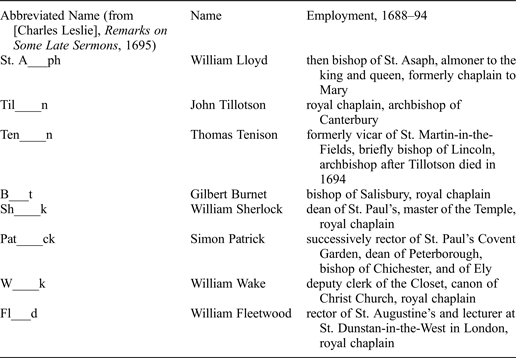
The number of English printed state sermons swamps any archipelagic counterpart. Many more occasional sermons were preached and printed in London during this period than the thirty-four or so such sermons printed in Edinburgh, Dublin, and Boston, and therefore a sample of forty-two English occasional sermons solely from the period 1689 to 1692 is used for comparison. Irish nonjuror Charles Leslie criticized the English pulpit “Champions of the Usurpation” who preached such state sermons: “your St. A___phs, your Til____ns, Ten____ns, B___ts; your Sh____ks, Pat____cks, W____ks, Fl___ds.” Leslie's glittering nemeses may be labeled Williamite court preachers (See Table 1: English Court Clergy ).Footnote 61
English Court Clergy

This group preached and then published the bulk of the sample of English state sermons considered below. Most based their preaching on the abstract theories of “Abdication, or King de Facto, or Conquest, or Providence.”Footnote 62 About half this group of English printed sermons never referred to the history of the British Isles, or any history between biblical times and the reign of James II, beyond gesturing vaguely to “Ages just past.”Footnote 63 They relied instead upon providence or generalized natural law, “the common Law of all the World.”Footnote 64
A few court preachers, however, did root their sermons in history. Bishop Lloyd of St. Asaph, in his November 5, 1689 sermon, briefly noted that William's Descent “ended in a Conquest without Blood.” Five months later, again at Whitehall before William and Mary, Lloyd extended his historical exegesis. Taking cue from his own Historical Account of Church-Government As it was in Great-Britain and Ireland (1684), he explained that England had experienced multiple conquests. “So the Britains . . . had been over-run once or twice, and recovered, before they were driven out of their Country. So the Saxons being invaded by the Danes, had driven them out once or twice . . . , before they came to be a Conquered People.”Footnote 65 Tillotson's 1689 thanksgiving sermon not only listed the times the English had been conquered, it also appended to this narrative of how the ancient constitution had been threatened from 55 BCE to 1485 CE a more recent history of the Papal Design against the English Church and civil government. From the early sixteenth to the late seventeenth centuries, “our ancient Government” remained under an ongoing, repeated threat. And he warned about this again in a May 29, 1693 sermon.Footnote 66 Sherlock gestured to this ongoing struggle in less specific terms on January 30, 1692, by assuring his House of Commons auditory that William would keep the constitution “upon its ancient Bottom.”Footnote 67
Scottish preachers, particularly Scottish Episcopalians, more willingly referenced their long, mythic antiquity than did English court preachers. Late-Stuart Scottish clergy followed a Mackenzian patriarchal model of history before mid-1689, when Episcopalians dominated Scottish print culture, and a Buchananite conciliar one afterwards, when Presbyterians did. In 1685 on the anniversary of the Restoration, Canaries had preached at Selkirk rejoicing in “the happy Return of the Royal Family, to the Possession of their Ancient Rights,” while at the same time bemoaning the long history before then when the Scottish's Church “best and most Primitive Government was abolished” in favor of “the basest Anarchical Model of . . . Presbytery.”Footnote 68 In October 1687, Episcopalian minister John Mackqueene, while preaching on James VII and II's birthday in Edinburgh Cathedral, claimed bragging rights for the antiquity of the Scottish crown. No other kingdom, he noted, “can boast such a Series of Princes, such a Lineal Succession of Kings, in a regular and orderly Descent,” for some two thousand years since Fergus.Footnote 69 During the Revolution itself, the Scottish Episcopalians clung to Mackenzian ideas while deriding similar Buchananite ones. Archbishop Ross of St. Andrews led virtually the entire Scottish bench to sign a letter to James II hoping for the failure of “all who Invade your Majesties Just and Undoubted Rights,” on November 3, 1688, an unfortunately timed signal of support for James II just before William successfully landed his troops in the South.Footnote 70 Ross and the university administrators of St. Andrews also condemned Buchananite history for wrongly placing kings from Fergus onward under the “consent of the People,” and asserted that Buchanan's “Characters of a King, and of a Tyrant, are so Chimerical and imaginarie.” Ancient authors proved Fergus was real, the St. Andrews clergy insisted, but an elected Fergus was chimerical.Footnote 71
Scottish Episcopalians continued to deride both presbytery and consent of the people but their days were numbered. Canaries's January 30, 1689 sermon in Edinburgh dismantled ahistorical early Williamite contributions to the allegiance controversy. Canaries mocked arguments based on pretended “Original liberties from the Law of Nature,” any supposed government slight to which might justify rebellion. And he rejected any conquest right based on “voluntary condescention,” that is, on the supposed voluntary consent of all.Footnote 72 After the winter of 1688–1689, however, Scottish Episcopalian sermons virtually disappeared.Footnote 73 In April, when Scottish Presbyterian parliamentarians agreed to support the Williamite Revolution, their Claim of Right also labeled “prelacy . . . a great and insupportable grievance.” After the Covenanter rabblings during the Winter of 1688–1689, those violent, ritualized attacks on Episcopalian ministers, the Scottish Convention not only refused to offer compensation to Episcopalians persecuted, but it also ordered Presbyterian ministers previously “thrust out” to be restored. Presbyterian intransigence, along with Episcopalian refusal to shift allegiance, ensured that William would agree to abolish Scottish episcopacy, which would be done by the Summer of 1690.Footnote 74 Episcopalians kept the debate alive through 1689, and even longer, from refuge in London where, in private, they bemoaned “our . . . antient government pulld to peeces.”Footnote 75 But, in Scotland, Presbyterians controlled press and pulpit from the Spring of 1689.
Scottish Presbyterians, when they argued from history, specifically deployed a Buchananite model of antiquity. But they did so only obliquely. In any case, only eight existent Presbyterian sermons were published between 1690 and 1696. One reason for this paucity is that at least one Presbyterian tradition emphasized extemporare preaching, which made it less likely there would be a draft for the printers. James Clark, later a prominent Glasgow minister, when preaching before local magistrates in 1690, invoked their “Ancient Pri[v]iledges.” John Spalding's two sermons published in 1690 and 1696 deployed numerous historical anecdotes but otherwise referred vaguely to the antiquity of Scottish “Priviledges, Liberties and Properties.” In 1690, David Williamson took the Buchananite text Psalms 2:10—“Be wise therefore, O ye Kings: be Instructed, ye Judges of the Earth”—to argue that dominion came from the collective will of the nation. Gilbert Rule, preaching before Parliament in May 1690, referred to the antiquity of Scottish Presbyterianism.Footnote 76
After 1689, Presbyterian lay writers “reached back . . . towards old . . . , antiquarian . . . formulations,” but Scottish Presbyterian clergy seemed more interested in preaching up their martyrologies and denigrating Episcopalian ones, or vice versa.Footnote 77 Williamson compared the recent “flea-bit sufferings” of the Episcopalian clergy, who were victims of the rabblings of 1688–1689, with the more extensive miseries of Presbyterian ministers circa 1666, for which he drew from Sir James Stewart's anonymous martyrology, Naphtali, or, The wrestlings of the Church of Scotland for the kingdom of Christ (Edinburgh, 1667, 1680).Footnote 78 By referencing the banned Naphtali, Williamson nailed his colors to the mast. In 1689, a vicar in Newcastle-upon-Tyne had looked northward with horror to condemn “Buchanan . . . , Nephthali, and other Scotch Fanaticks, who maintained Rebellion under the disguise of such self defence.”Footnote 79 Overall, as the 1690s progressed, Scottish Presbyterian clergy relied less on consideration of the Fergusian constitution, descent, and liberties, and more on partisan prosopography of recent outrages.Footnote 80
When in April 1689 Robert Fleming, Presbyterian minister of the Rotterdam Scots Church, wrote a panegyric on the Williamite Revolution, he contrasted the settled ecclesiastic and civil constitution of “Ancient Scotland,” with that of “Poor mad-brain'd Ireland,” which foolishly “dreams it can withstand, / Alone, that conqu'ring hand.” Protestant clergy preaching before Irish assemblies also tended to emphasize either repeated subjugations by the “conqu'ring hand” or Ireland's addled relation to the papal Grand Design or both.Footnote 81 Irish preachers more often invoked history and antiquity than any other clerical group in the Atlantic archipelago. Sixteen Irish sermons were preached and printed between 1689 and 1694, if we define “Irish” to mean that the preachers were of the Church of Ireland or Presbyterians preaching in that nation; three were preached before Irish Protestants in London on the October 23, 1641 anniversaries. Eleven of these Irish sermons detailed the history of this supposed all-encompassing design against their Protestant religion and civil constitution. This, in itself, is hardly surprising, as nine were preached in 1689 and 1690, when Catholic armies still controlled part of the Irish isle. Moreover, those preached on the October 23 anniversary included the three in London and another three in Dublin; and another three were preached on the Gunpowder Treason anniversary of November 5, 1605. These preachers drew upon Sir John Temple's The Irish Rebellion (1646, 1679) to paint a repeating cycle of outrages. Bishop Wetenhall, for example, quoted “‘[one] hundred fifty four thousand Souls [died] in four months time,’ as the Account was given in by the Actors themselves . . . in Sir John Temple's Book.” Richard Tenison drew his list of horrors—“they tried whether a Man's Guts or a Dogs were longest; and made candles of a Man's grease”—from various printed works and manuscript sources. According to his marginal notes these sources included: Temple; A new remonstrance from Ireland, containing an exact declaration of the cruelties, insolencies, outrages, and murders exercised (1643); Henry Jones, A remonstrance of the beginnings and proceedings of the rebellion in the county of Cavan (1642); and Edmund Borlase, The history of the execrable Irish rebellion (1680).Footnote 82
Irish preachers tied recent outrages, then, to a long train of abuses, ranging across the continent and over centuries, and affecting both church and state. This wider campaign supposedly involved, depending on the preacher, Pope Urban VIII, English Catholics, Queen Mary, the Paris massacre of 1572, the duke of Alba's “Council of Troubles” in the Netherlands, and even the fifteenth-century Council of Constance burning John Hus and Jerome of Prague.Footnote 83 Dean William King, later bishop of Derry and archbishop of Dublin, developed a clear narrative of the extent “of the Contrivance and Design against us,” in his sermon given on November 16, 1690. “Some . . . date it from the very beginning of the Reformation; some from the Restauration . . . , and some from the Pyrenean Peaces; but . . . we can trace it by many Foot-steps from the Year 1670.” The Secret Treaty of Dover of that year was only one step in this enterprise. Even the warming-pan conspiracy regarding the birth of James III simply copied “an attempt of the same kind in the days of Queen Mary”!Footnote 84 Recent threats to reformed religion, then, achieved metonymical correspondence with events of the previous century, and followed a Foxeian teleology.
The preachers envisioned a design that would have sought to alter not only religion, but European civil constitutions as well.Footnote 85 And it stretched back well before the Reformation. The historical roots of King's Design paled compared to the breadth of John Finglas's November 5, 1690 tale of repeated papal assertion over emperors and secular rulers: Boniface VIII appearing in emperor's robes with a sword carried before him in 1300; Adrian IV “caus[ing] the Emperor Fredrick to hold his Stirup” in 1155; twelfth-century Popes Alexander III and Celestine III “trod[ding] upon [emperors'] neck[s]”; and Innocent III excommunicating King John before the Magna Carta.Footnote 86 In 1698, John Travers would even lay the foundation during the seventh-century reign of the Emperor Phocas!Footnote 87This Grand Design had a long genealogy.
Although most Church of Ireland preachers viewed the papal design against Europe's liberty, and specifically against England's ancient constitution, as longstanding, few credited Ireland with an ancient constitution worth defending. An important exception to this trend, however, was Anthony Dopping's Modus tenendi Parliamenta in Hibernia, which the Church of Ireland bishop of Meath published in 1692. This Modus was a supposed twelfth-century record of English liberties which extended to Ireland. Other preachers, however, demurred, and claimed instead that English conquest and right to rule Ireland extended back to Norman, Saxon, or even Briton invasions. Bishop King thought of Ireland as “a Conquered Country,” while Bishop Wetenhall looked forward to “the Second William the Conqueror,” adding “I do averr us in Ireland conquered.”Footnote 88
Richard Tenison likewise laid out the history of England's Irish conquests in his October 23, 1690 sermon. The violent 1641 rebellion derived from “Church-men . . . abroad . . . , and most falsely telling the [Irish] People, they were a Free Nation . . . , when they cannot but own that it was Conquer'd.” And conquered repeatedly.
For, not to insist upon King Arthur's Claim . . . ; Or upon King Edgar's Conquest . . . ; We all know that King Henry the Second reduc'd them to Obedience . . . ; and Charters of Submission to him were voluntarily signed and delivered by the seven Kings of the Country . . . ; to which both Clergy and Laity did . . . sware Homage and Fealty to him in a Publick convention at Lismore, where the Laws of England were also thankfully received.Footnote 89
Yet in listing these conquests, Tenison returned, perhaps unwittingly, to the language of ancient constitutionalism. For swearing homage voluntarily and receiving laws with thanks, suggest compact not conquest. And it was unclear if there was a historical conquest, or a state of always being in relation to Britannic kings. Henry II's “Ancient Right” simply acknowledged reputed claims even more ancient by Edgar, Arthur, or even the fabled Gurmund son of Belin. Tenison concluded that the Irish “ought therefore to be subject unto England, as the Inhabitants of the English Plantations in America now are.”Footnote 90 Given that Tenison was quite willing to use rightful conquest and the law of nations to defend England's rights in Ireland, would not 1170, 1541, or even 1689 have worked just as well as this quasi-mythical assertion of Briton or Saxon conquest as a basis for dominion theory? The answer is that the authority of antiquity trumped all. As Keith Thomas notes, such “historical fictions” functioned as “a ‘charter’ for contemporary claims.”Footnote 91 In the search for origins, age was more important than veracity.
“The English Plantations in America” also laid claim to antiquity. Recent historians argue that a British American “historical identity, with its roots in an imagined antiquity,” and even that an American colonial ancient constitutionalism developed out of the “forensic history” of the common law mind.Footnote 92 Colonial ancient constitutionalism had its counterpart in colonial sermons, at least those of the Mathers in Boston. Of nine public, occasional sermons preached and printed the colonies between 1690 and 1694, all are from Boston, and six are by Cotton Mather; two are by Samuel Willard, pastor of the Third Church, Boston, from 1678 until his death in 1707; and one is by Cotton Mather's father, Increase.Footnote 93 Cotton Mather, Increase's eldest son, became head of the influential North Church when his father sailed to London. Increase Mather went overtly to congratulate James II on the Declarations of Indulgence, and secretly to complain about Sir Edmund Andros, governor of New England from 1686 to 1689, and to secure a restored charter for Massachusetts. In 1688, Increase Mather reported from the negotiations that he thought James II would soon grant “a certain Magna Charta for a speedy Redress of many Things,” as James had already addressed the English Presbyterians with his hope for “a Magna Charta for the Liberty of Conscience.”Footnote 94 In 1692, Increase Mather did return to Boston with a grand charter for Massachusetts—not that of James II, but one signed by William and Mary restoring charter government.
Many American colonials believed, as did their counterparts in England, Scotland, and Ireland, in a long-standing popish design against their religion and government. Cotton Mather's sermons laid out how it threatened international Protestantism from France in the old world and the new: “in Germany,” he preached in December 1689, “the French King has there made even the Popish Provinces themselves a Stage of Blood”; while in March 1690 he noted “an Invasion by bloody Indians and French-Men, begun upon Us.”Footnote 95 The establishment of the royal Dominion of New England and the rule of Andros, he suggested, had been a further step towards fulfilling the supposed papal conspiracy. Cotton Mather, also probably penned The Declaration, Of the Gentlemen, Merchants, and Inhabitants of Boston, and the Countrey Adjacent (April 18, 1689), which complained that, under Andros, “we have been treated with multiplied contractions to Magna Charta.”Footnote 96 The Mathers' rhetoric of several Magna Cartas, a periodic re-confirmation of Gothic liberties, alerts us to the sway of ancient constitutionalism over New England clergy. “The late Revolutions” led to the return of “our Government, into the Hands of our Ancient Magistrates,” as well as “the Ancient Constitution of New-England.”Footnote 97 In May 1693, Increase Mather preached on Isaiah 1:26: “I will Restore thy Counsellours as at the Beginning.” This election-day sermon contrasted the Revolution which ensured “all English Liberties Restored,” with “their Late Bondage.”Footnote 98
The Mathers' obsession with transatlantic ancient constitutions may well have influenced others. Boston merchant Joshua Scottow wrote a tract that some scholars suggest Perry Miller had in mind when he developed the declension thesis that argues colonial Puritan writings coupled “idealization of the founders” with a fear that colonial piety had declined since then. Alongside a religious context, however, one must add the relevance of colonial constitutional appeals to antiquity during the Revolution of 1689–1692. Scottow entitled his 1691 tract Old Mens Tears For their own Declensions, Mixed with Fears Of their and Posterities further falling off from New-England's Primitive Constitution. Scottow's idealization of New England's “foundations of Civil and Sacred Politie” is as much secular as religious.Footnote 99
In addition to adumbrating a New England Gothic constitution, Cotton Mather laid England's claim to America by ancient conquest. In his election sermon of May 23, 1689, while Massachusetts considered creating a provisional government, Cotton Mather rooted the debate in mythic antiquity. Mather asserted that “Britains and Saxons,” as we have seen, “afforded the first Discoverers of America in these latter Ages.” Mather's claim is much more astounding to our ears than it would have been to those of contemporaries, although he qualified this assertion by adding, “whatever truth may be in that assertion of one who writes,” when he repeated the claim again in 1702.Footnote 100 For the term “Britains” signals that he was referring to the Welsh “Ancient Britons” in general, and to the Welsh Prince Madoc who supposedly sailed to the New World in 1170 in particular. Madoc's voyages had been the subject of extensive speculation by George Peckham (1583), David Powel (his Historie of Cambria, 1584, revised as History of Wales, 1697), Richard Hakluyt (1589–1600), and Sir Thomas Herbert (1634, reprinted 1677).Footnote 101 These “Annals” repeatedly legitimated the conquest of the Americas as a prior claim to title.Footnote 102
The argument for America mirrored that for Ireland—conquest was of such antiquity that its origins were lost in the mists of myth, and, thus, it broached no counter-claim. Again, the very antiquity of English dominion suggested a long-established ancient constitution, which, paradoxically, threatened English hegemony. If, as Cotton Mather elsewhere noted, “there is an England in America, as well as One in Europe,” then American English liberties limited the imperial crown.Footnote 103 Increase and Cotton Mather's ancient constitutionalism took a Buchananite line, emphasizing conciliar not patriarchal rule—“not at all Despotical, but wholly Ministerial.”Footnote 104 One English ancient constitutionalist, William Atwood, knew very well the implications of such reasoning, and he rejected applying Gothic liberties to the colonies. Although Atwood, who would be appointed chief justice of the New York colony in 1700, had defended English ancient constitutionalism in his Fundamental Constitution of the English Government (1690), he would attempt to quash any such claim in the rest of empire. Atwood's History, and Reasons, of the Dependency of Ireland upon the Imperial Crown of the Kingdom of England attacked such a claim by which longstanding English conquest buttressed the, in this case, Irish ancient constitution when it resurfaced in the work of William Molyneux, Bishop Dopping's brother-in-law, in 1698.Footnote 105 Atwood's claim to English dominion over Ireland and the Americas sat uneasily with the Mathers' Buchananite claim to elective kingship and liberties. But both were applications of ancient constitutionalism to the empire.
III. Conclusion: The Britannic Constitutions and the Common Prayer Mind?
Writers across the Atlantic archipelago turned to origin myths and deep national histories to explain the Revolutions of 1688–1692; indeed, they did so more the further away from Whitehall's Chapel Royal they preached. Historians, conditioned to seek the English ancient constitution in the early Stuart common law mind, have overlooked clerical contributions to debates over Britannic constitutions just after 1688. The drums ecclesiastic, to pluralize Butler's and Locke's phrase, of Anglophone Irish, Scots, and Massachusetts clergy led this historical turn. English court preachers promoted a providential explanation of the Revolution(s) not a historical one, probably because Gothic ancient origins might not justify rule by the Dutch William, and because historical debates had recently fed bitter whig–tory divisions. But away from court, and especially among the Irish, New England, and Scottish clergy, history and late-Stuart ancient constitutionalism loomed large in interpretations of the revolutionary era. Clergy divided over competing national antiquities and over the meaning of the second Williamite conquest, or absence thereof. But they agreed as to the value and significance of this historical agenda.
In order to explain fully why Anglophone clergy across the Atlantic archipelago were especially prone to ancient constitutionalist arguments and rooted their occasional sermons in antiquity, we might point to what could be labeled the Common Prayer mind as much as to ecclesiastical antiquarianism. Episcopalian preachers in Ireland, Scotland, and England especially developed a strong Gothic-to-modern narrative at least in part because the Anglican ritual calendar focused on “the symbolic anniversaries of their own recent history.” Whether January 30, May 29, or October 23, such sermons occasioned annual reconsideration of each such “Memorable Anniversary in our Kalendar.” Preaching polemic against the pope's “unjust Usurpation over Kings,” had long been established as a canonical part of the liturgical calendar in the Church of Ireland. When parliament established “A Form of Divine Service to be used October 23” in 1666 (the Act was reprinted in 1689, and the practice revived for the Irish Protestants in London), the Church of Ireland included a collect which recalled the Irish Rebellion of 1641, “when thou didst suffer those men of Blood to make their Swords fat with the Slaughter of so many thousand Innocents.” Such prayers of historical specificity led preachers annually to ponder the relation between the past and present, continuity and change, and, particularly, the meaning of secular history. Presbyterians and Independents, who were “strongly opposed to fixed dates for their days of celebration and fasting,” were somewhat less likely than those following the Prayer Book to memorialize the secular chronology on these days “of White in our Kalendar,” as Church of Ireland preacher Ranulph Walley termed them before his Dublin assembly on November 5, 1705.Footnote 106
By the first decades of the eighteenth century, clergy across the Atlantic archipelago referred less often to the secular, civil narrative, and rarely insisted on mythic origins as they had during the Revolution era. Even providential references such as Walley's to “special Acts of God's Providence” in 1705 seem more perfunctory than earlier ones. Instead increasingly state preachers relied on natural law. References to natural law abound in fourteen sermons preached and published in Dublin, Edinburgh, and Boston between 1700 and 1711. Bishop William King asserted the truth of his exegesis based on “Humane Nature,” in Dublin, September 1704; Walley appealed to “Natural Reason” in his Dublin sermon in 1705; and John Arbuthnot likewise appealed to “sober and unprejudiced Reason” or even “Political Arithmatick,” when he preached in Edinburgh in 1706.Footnote 107 Whether this was a long-term shift or whether future moments of revolutionary upheaval again brought forth providential sermonizing is worth further study.Footnote 108
In any case we find a transformation in how after 1700 a state preacher might use civil law and narrative to support his exegesis or exhortation. Eighteenth-century preachers occasionally referred to competing conquest narratives and ancient origins, as did Church of Ireland Bishop Edward Smith in Dublin, on October 23, 1703: “the Irish . . . supposing [“English men”] Conquerors and Invaders.” But their historical referents became vague. William Stoughton referred obliquely to “so generous a Constitution” of “our Forefathers,” in his Dublin sermon, January 31, 1709, a date usually associated with extensive historical memory. And, while Francis Higgins praised “the Ecclesiastical and Civil Constitution we are so happy in,” his Dublin sermon in August 1705 did not recount any political history. Antiquity even became discounted as a sound basis for argument. “One could hardly believe upon the credit of antient History” alone, noted Bishop Charles Hickman in Dublin, on November 5, 1705. Arbuthnot even mocked arguments based on the supposed “Glory and Antiquity of the ancient British Race,” in his 1706 Edinburgh sermon. Contemporary experience became more highly valued than history. Bishop Hickman's exegesis in Dublin, on November 5, 1703, witnessed solely “the same things practis'd in our own times”; Jacques d'Aubigny told the Dublin Huguenot Church in April 1707 that they “need not look any further than the History of our Time.” Preachers appear to have shifted from considering specific origin myths to abstract ones. That is, they replaced focus on the mythical rule of the English over the Irish, or the Scottish ancient constitution, with focus on the abstract efforts of “any Nation to preserve it's Ancient Constitution,” or “Restoring the Ancient Laws and Government of any Country,” as did Pratt in Dublin on May 29, 1709. Preachers asserted immemorialism less often, and instead envisioned a historicized and mutable past. Thus Ebenezer Pemberton admitted “Nor has the Form of Government in our nation, been just the same from the beginning,” in a Boston sermon on May 31, 1710.Footnote 109 If change was a given, then to deny or assert past conquests had become much less politically relevant.
Twenty years earlier, an unchanging constitution was more valued, and origin myths more vital for setting out the proper form of government for this or that national or people. Preachers were most likely to discuss the Fergusian descent, Arthurian conquests, or the twelfth-century roots of the Design between 1688 and 1694. The revolutionary era impelled clergy not only to base their contributions to political thought on historical principles, but also to root their identity in relation to competing claims to Briton, Scots, Irish, and Saxo-Gothic antiquity. During revolutionary eras, histories, like mythologies, are good to think and to preach.