Introduction
The family Syngamidae belongs to the parasitic superfamily Strongyloidea. In the literature gapeworms (Syngamidae) are often confused within their genus level (Carpenter & Derrickson, Reference Carpenter, Derrickson, Archibald and Pasquier1987; Spalding et al., Reference Spalding, Kinsella, Nesbitt, Folk and Foster1996) and identification. Classification of syngamids has changed several times (Lengy, Reference Lengy1969; Ali, Reference Ali1970). In the most recent classification the Syngamidae comprises the Stephanurinae, Syngaminae and Archeostrongylinae (Lichtenfels, Reference Lichtenfels, Anderson, Chabaud and Willmott1980; Hartwich, Reference Hartwich1994). The Syngaminae consist of Syngamus, Cyathostoma and Hovorkonema which occur only in birds (Baruš & Tenora, Reference Baruš and Tenora1972; Hartwich, Reference Hartwich1994).
Species of the genus Hovorkonema are found worldwide and have a broad host range among birds (Baruš & Tenora, Reference Baruš and Tenora1972). Hovorkonema variegatum has been reported in Europe, Asia and North America (Rysavý & Ryshikov, Reference Rysavý and Ryshikov1978; Okulewicz, Reference Okulewicz1984). Definitive hosts are Casuariiformes (Casuarius sp., Dromaius sp.) Galliformes (Gallus gallus, Pavo cristatus) and Gruiformes. The life cycle is probably indirect via ingestion of earthworms infected with third stage larvae (Hartwich, Reference Hartwich1994).
The gapeworm Syngamus trachea has a cosmopolitan distribution and is a parasite of Galliformes and Passeriformes, but also recorded from species of Anseriformes, Ardeiformes, Pelecaniformes, Otidiformes, Piciformes and Cypseliformes (Yamaguti, Reference Yamaguti1961). Syngamus spp. are found mainly in the trachea of land birds. Syngamus trachea can infect its hosts directly, when the definitive host ingests eggs or third stage larvae, or indirectly via transport hosts such as earthworms or insects (Hartwich, Reference Hartwich1994; Anderson, Reference Anderson2000).
Cyathostoma spp. have been reported from the nasal or infraorbital cavities or the trachea of at least 10 bird families but mainly from waterbirds (Ali, Reference Ali1970). Simpson & Harris (Reference Simpson and Harris1992) recorded Cyathostoma lari from the orbital cavity and the lower eyelid of birds of prey. Cyathostoma trifurcatum infects the trachea of black storks Ciconia nigra in Poland (Okulewicz, Reference Okulewicz1984), and in Latvia and Slovakia (Hartwich, Reference Hartwich1994).
In addition to morphological features, molecular markers are most useful either for species identification (Gasser, Reference Gasser, Kennedy and Harnett2001), in the search for cryptic species (Chilton et al., Reference Chilton, Gasser and Beveridge1995; Blouin, Reference Blouin2002) or for phylogenetic analysis (Blaxter, Reference Blaxter, Kennedy and Harnett2001). DNA technology provides an alternative approach to morphology for the identification of closely related parasites (Hung et al., Reference Hung, Chilton, Beveridge, McDonnell, Lichtenfels and Gasser1997). Ribosomal DNA has been most extensively studied because of its presence in multiple tandemly arrayed copies and thus provides a large molar excess of target in polymerase chain reactions (PCR) (Blaxter, Reference Blaxter, Kennedy and Harnett2001). Within ribosomal DNA there are coding regions (small subunit (SSU) or 18S, 5.8S gene and large subunit (LSU) or 28S) which evolve relatively slow and non-coding regions like the internal transcribed spacer 1 and 2 (ITS-1, ITS-2) which change more rapidly in evolution (Blaxter, Reference Blaxter, Kennedy and Harnett2001). The rapidly evolving internal transcript spacer regions ITS-1 and ITS-2 have in particular been used to distinguish between species of the order Strongylida (Chilton et al., Reference Chilton, Gasser and Beveridge1995; Stevenson et al., Reference Stevenson, Chilton and Gasser1995; Hung et al., Reference Hung, Chilton, Beveridge, McDonnell, Lichtenfels and Gasser1997; Blouin, Reference Blouin2002; Samson-Himmelstjerna et al., Reference Samson-Himmelstjerna, von Harder and Schnieder2002). In the present study, we compared DNA sequences of the SSU gene within the order Strongylida of the species S. trachea and H. variegatum and the ITS-2 region of H. variegatum and C. verrucosum to distinguish between these closely related species.
The aims are to examine the epidemiology of syngamids in wild birds in Germany, to investigate the pathological alterations and to demonstrate methods for species identification based on morphological differences and the sequence of 18.S and ITS-2 rDNA.
Materials and methods
Sampling techniques
A total of 549 birds of four orders (503 Falconiformes, 22 Gruiformes, 1 Ciconiformes, 23 Strigiformes) were examined for nematodes in their respiratory system. Dead birds were obtained from rehabilitation stations from June 1995 to June 2000. Birds originated mainly from three different locations in Germany: Baden-Württemberg (47°50′ to 49°25′ N, 8°50′ to 9°75′ E), Lower Saxony (52°00′ to 53°00′ N, 9°50′ to 11°00′ E) and Berlin-Brandenburg (52°00′ to 53°25′ N, 11°50′ to 14°50′ E). All carcasses were sent to the Leibniz-Institute for Zoo and Wildlife Research, Berlin, for routine post-mortem examination for parasites (Ritchie et al., Reference Ritchie, Harrison and Harrison1994; Doster & Goater, Reference Doster, Goater, Clayton and Moore1997; Krone & Cooper, Reference Krone, Cooper and Cooper2002). The organs of the respiratory tract were opened and tissues as well as contents were examined. Nematodes were removed, cleaned in isotonic NaCl solution and stored in a solution of 70% ethanol and 5% glycerol. Specimens were cleared in lactophenol and examined, measured, and photographed using a microscope (Zeiss Axioskop™). Nematodes were identified using the keys of Lichtenfels (Reference Lichtenfels, Anderson, Chabaud and Willmott1980) and Hartwich (Reference Hartwich1994). A t-test was used to compare measurements of the eggs (Sokal & Rohlf, Reference Sokal and Rohlf1997).
DNA extraction
Genomic DNA was prepared from single worms by proteinase K treatment. Each nematode was incubated overnight at 55°C in 100 μl proteinase K buffer(100 mm Tris (pH 8), 100 mm NaCl, 50 mm DTT, 10 mm EDTA), 1 μl proteinase K (50 mg ml− 1) and 10 μl sodium dodecyl sulphate (SDS) 10%. DNA was purified using QIAGEN DNeasy Tissue Kit (Qiagen GmbH, Hilden, Germany) and eluated in 100 μl elution buffer.
PCR amplification
The SSU region of the rDNA was amplified by forward primer UNI5′(GCTTGTCTCAAGATTAAGCC), situated at the 5′ end, and the reverse primer UNI3′(TGATCC(AT)(GT)C(CT)GCAGGTTCAC), situated at the 3′ end of the SSU region. The ITS-2 region was amplified with forward primer 2a1 (ACGTCTGGTTCAGGGTTG) situated at the 3′ end of the 5.8S gene, and the reverse primer 2r (TTAGTTTCTTTCCTCCGCT) situated at the 5′ end of the 28S gene. Primers were designed following Blaxter lab nematode genomics (http://www.nematodes.org) and were partially modified.
PCR was performed in a total volume of 50 μl using 1 × buffer, 2 mm MgCl2, 40 mm of each dNTP, 10 pmol of each primer, 1 U of GenTherm DNA polymerase (Rapidozym, Berlin, Germany) and 1–10 μl of the extracted genomic DNA under the following conditions: 95°C, 30 s (denaturation); 45°C, 1 min (annealing) for ITS-2 or 53°C, 1 min for SSU, respectively; 72°C, 1 min (extension) for 35 cycles. PCR products were detected on 1.5% agarose gel containing 0.004% ethidium bromide.
Cloning and sequencing
The PCR products were purified with NucleoSpin® Extract Kit (Macherey-Nagel, Düren, Germany), ligated into the plasmid vector pGEM®-T Easy (Promega, Mannheim, Germany) and transformed into TOP 10 competent cells. Transformants (white colonies) were selected from LB plates, containing x-gal (40 μg ml− 1), IPTG (0.4 mm) and ampicillin (100 mg ml− 1), grown overnight in 5 ml LB medium containing ampicillin (100 μg ml− 1). Plasmids were isolated from 3 ml overnight culture with NucleoSpin® Plasmid (Macherey-Nagel, Düren, Germany) and were confirmed to contain the insert by EcoR I restriction enzyme analyses. Inserts were sequenced by GATC Biotech AG (Konstanz, Germany).
Sequences were aligned using ClustalW (Thompson, J.D.; Higgins, D.G. & Gibson, T.J.; version 1.4) and then corrected visually using BioEdit (Hall, T.; version 6.0.6). P-Distances were calculated using MEGA 3.0 (Kumar et al., Reference Kumar, Tamera and Nei2004).
Results
Recovery of syngamid nematodes
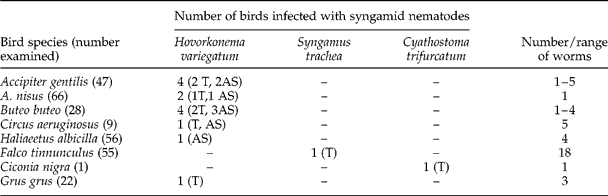
Syngamid nematodes infected the order Falconiformes (2.4%), the Gruiformes (4.5%) and one of the Ciconiformes (table 1). This is the first record for C. trifurcatum in Germany. Hovorkonema variegatum was the parasite most often diagnosed. This nematode was found in the air sacs and trachea in nearly equal numbers (table 1). This study reveals the marsh harrier Circus aeruginosus and the white-tailed sea eagle Haliaeetus albicilla as new host records for H. variegatum. All specimens of S. trachea were found in the trachea of a common kestrel. No syngamid was observed in birds of the order Strigiformes: Asio flammeus (n = 1), A. otus (n = 8), Athene noctua (n = 1), Bubo bubo (n = 2), Glaucidium passerinum (n = 1), Strix aluco (n = 4), Tyto alba (n = 5); nor in the following birds of the order Falconiformes: Buteo lagopus (n = 4), Falco columbarius (n = 1), F. peregrinus (n = 47), F. subbuteo (n = 6), Milvus migrans (n = 4), M. milvus (n = 25), Pandion haliaetus (n = 31), Pernis apivorus (n = 14); nor in Otis tarda (n = 1) of the order Gruiformes.
The occurrence of three species of syngamid nematodes in the trachea, bronchi or air sacs of eight bird species.

AS, air sacs; T, trachea or bronchi.
Morphological features
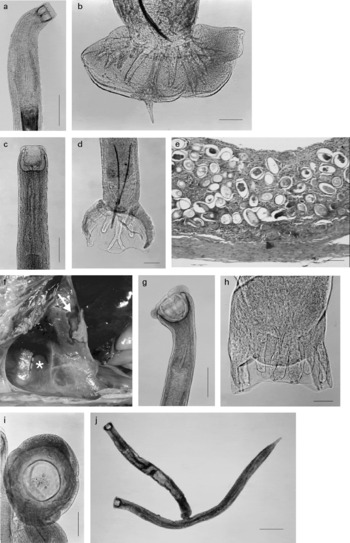
Characteristics which differentiate syngamids include the dorsal rays of the bursa copulatrix, spicula length (fig. 1b,d,h) and the mouth capsule (fig. 1a,c,f,g). Male and female worms were found in copulation and showed a y-shaped appearance.
a–b. Cyathostoma trifurcatum. a. Mouth capsule and oesophagus. b. Bursa copulatrix with rays. c–e. Hovorkonema variegatum. c. Mouth capsule and oesophagus. d. Spicules and bursa copulatrix with rays. e. Air sacculitis of a goshawk (Accipiter gentilis) with eggs of H. variegatum. f. H. variegatum in situ in the thoracal-caudal air sac of an Eurasian buzzard Buteo buteo with thickening of the air sac wall (arrow) and worm on the surface of the cranial kidney pole (asterix). g–j. Syngamus trachea. g. Mouth capsule and oesophagus of a male. h. Spicules and bursa copulatrix with rays. i. Collar surrounding anterior end of mouth capsule in adult female. j. Y-shaped appearance of a pair of S. trachea in permanent copulation. Scale bars: a, c, g, i, 250 μm; b, 50 μm; h, j, 500 μm; d, f, 100 μm.

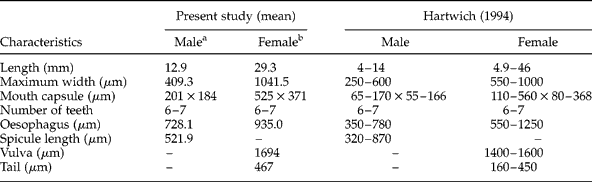
Measurements of the morpohological characteristics of H. variegatum, e.g. length, width, mouth capsule, number of teeth, oesophagus, spicule, vulva and tail are similar to those described by Hartwich (Reference Hartwich1994) (table 2).
Measurements of Hovorkonema variegatum specimens recovered from eight bird species (see table 1).
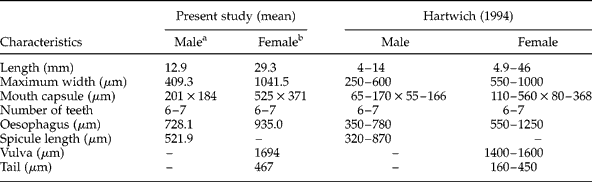
an = 8; bn = 13.
Both the egg length and width of H. variegatum and S. trachea were different (P < 0.0001, t-test, n = 10). Eggs of H. variegatum measured 82.4 ( ± 3.8) × 43.2 ( ± 0.9, n = 10) and eggs of S. trachea 91.9 ( ± 4.4) × 48.5 ( ± 1.4, n = 10).
Pathological findings associated with worms were found in 7 of 12 cases infected with H. variegatum. Alterations consisted of thickened air sac walls (fig. 1e), lesions or granulomata at the site of worm attachment, sometimes involving underlying tissues. Lymphoplasmocytic air sacculitis were the most prominent histological lesions found. Only a small irritation of the mucosal layer in the trachea of the infected common kestrel from Berlin could be attributed to infection with S. trachea.
Molecular analysis
The length of the SSU sequence of H. variegatum (AY702705) was 1687 nucleotides with a G+C content of 47.18%. Syngamus trachea (AF036606) has a similar SSU length of 1717 nucleotides and a G+G content of 47.82%. Pairwise comparisons revealed a sequence difference of 2.9% and occurred in 51 alignment positions.
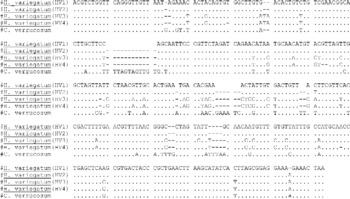
The ITS-2 PCR products of H. variegatum were 223–227 bp in size with a G+C content of 41.15–41.59%. Pairwise comparisons revealed two groups (fig. 2). Isolates of HV1 (DQ679967) and HV2 (AY702698) (group 1) differ in 1% (2 nucleotide positions). HV3 (AY702699) and HV4 (DQ679968) (group 2) also show similarity with 2% nucleotide differences. The comparison between these two groups showed differences from 14.0% to 14.5%, which are 41 and 42 nucleotide positions, respectively. In addition, the ITS-2 gene sequence of the closely related C. verrucosum (AY702700) was compared pairwise to group 1 and group 2 of H. variegatum revealing a difference of 22% and 21%, respectively. The length of the ITS-2 sequence of C. verrucosum was 254 nucleotides with a G+C content of 36.62%.
Alignment of the ITS-2 sequences of Hovorkonema variegatum isolates.

Discussion
Bernard & Biesemans (Reference Bernard and Biesemans1978) reported a high prevalence of 21% of S. trachea in the carrion crow Corvus corone (n = 62) and a low prevalence of 2.4% in the common kestrel Falco tinnunculus (n = 42) among specimens from five bird families from Belgium. In one of 30 common kestrels from Austria S. trachea was recorded (Kutzer et al., Reference Kutzer, Frey and Kotremba1980). A similar prevalence of 2% in the common kestrel was also shown in the present study. In contrast to Forrester et al. (Reference Forrester, Bush, Williams and Weiner1974), who reported S. trachea as the third most prevalent nematode occurring in small numbers (mean: 3, range: 1–4) in 7 of 74 sandhill cranes Grus canadensis tabida from Florida, Syngamus trachea was not present in cranes in this study. Schuster et al. (Reference Schuster, Schaffer and Shimalov2002) diagnosed a prevalence of 1.8% (n = 120) for S. palustris in white storks from Germany.
According to our data, the prevalence of H. variegatum in raptors is 3% with the highest prevalence of 9% in goshawks. Cranes showed a prevalence of 5%. A similar prevalence of 4% in raptors was recorded by Furmaga (Reference Furmaga1957), who identified Cyathostoma sp. in three rough-legged buzzards (n = 83) and two barn owls (n = 18). Hovorkonema variegatum (Cyathostoma variegatum) has caused mortalities of captive whooping cranes Grus americana and sandhill cranes (Carpenter & Derrickson, Reference Carpenter, Derrickson, Archibald and Pasquier1987). Spalding et al. (Reference Spalding, Kinsella, Nesbitt, Folk and Foster1996) reported H. variegatum in the oral cavity of one whooping crane (n = 27) introduced to Florida.
Cyathostoma trifurcatum was found in the black stork, and this is a new record for Germany, but no specimen was found in raptors or cranes. Fatal infections in four of 12 raptors caused by Cyathostoma spp. were reported by Lavoie et al. (Reference Lavoie, Mikaelian, Sterner, Villeneuve, Fitzgerald, McLaughlin, Lair and Martineau1999) who conducted a survey in Canada on 394 specimens of Falconiformes and Strigiformes from 1993 to 1996.
Unlike the study of Frank (Reference Frank1977), who found pathological alterations of the mucosal layer and haemorrhages in the trachea of white storks infected with S. trachea we diagnosed only slight lesions of the mucosa in the common kestrel. Lierz et al. (Reference Lierz, Schuster, Ehrlein and Göbel1998) described H. variegatum from a juvenile goshawk Accipiter gentilis with an aerosacculitis and a nephritis of the cranial lobe of the kidney caused by the parasite. Clinical signs were identical with those described for S. trachea infections. We also diagnosed lymphoplasmocytic air sacculitis caused by H. variegatum. No pathological findings were associated with C. trifurcatum, but Lavoie et al. (Reference Lavoie, Mikaelian, Sterner, Villeneuve, Fitzgerald, McLaughlin, Lair and Martineau1999) recorded a diffuse pyogranulomatous air sacculitis, pneumonia, and bronchitis due to Cyathostoma spp. Fatal parasitic pneumonia caused by Cyathostoma in three injured wild North American owls and four juvenile burrowing owls Athene cunicularia bred in captivity were described by Hunter et al. (Reference Hunter, McKeever, Bartlett, Redig, Cooper, Remple and Hunter1993). Lesions were most severe in air sacs, rather than in lung tissues. Host reactions were more intensive against parasite eggs than adult or larval worms.
For species differentiation, primary characteristics such as the bursa copulatrix, mouth capsule, spicules and egg measurements can be used. In addition, sequence differences were used for rapid species identification, independent of development stage or sex. The high intraspecific difference of the ITS-2 sequence between the two groups of H. variegatum might indicate either a subspecies or a cryptic species, which are morphologically indistinguishable. Currently there are no models which define the level of nucleotide differences required to distinguish between closely related parasite species (Stevenson et al., Reference Stevenson, Chilton and Gasser1995). Blouin (Reference Blouin2002) found intraspecific variations of at least 1% between different species of the order Strongylida. This corresponds with variations in group 1, which includes isolates HV1 and HV2 with an intraspecific nucleotide difference of 1% and group 2 (isolates HV2 and HV3) with a 2% nucleotide difference, respectively. Variations between these two groups fall within the range of closely related species belonging to the same genus observed by Chilton et al. (Reference Chilton, Gasser and Beveridge1995) and Chilton & Gasser (Reference Chilton and Gasser1999) (0.9% to 28.3%). Stevenson et al. (Reference Stevenson, Chilton and Gasser1995) found differences in the ITS-2 sequence between two morphologically well defined Haemonchus species (order Strongylida, family Trichostrongylidae) of 1.3%. The sequence difference of 21% and 22% respectively of the morphologically well defined species C. verrucosum and H. variegatum indicates that the ITS-2 sequence provides a powerful diagnostic marker for species identification.
Intraspecific variation in the highly conserved coding SSU region is very low. Therefore a difference of 2.9% between H. variegatum and S. trachea indicates that these are clearly separate species as confirmed by morphological characters. The highest variation is observed between the nucleotide positions 30 to 210 and 540 to 700. These regions provide a diagnostic marker to distinguish S. trachea from H. variegatum as the eggs, larval stages or adult females are difficult to distinguish. Furthermore on the base of these regions the implementation of a restriction enzyme analyse (RFLP) can provide a fast tool for species diagnostics Gasser, (Reference Gasser, Kennedy and Harnett2001).
The present study has shown that sequences are useful diagnostic markers for species identification independent of developmental stages. The new determined sequences can be used either directly as diagnostic markers or as basis for further approaches like RFLP or the development of species-specific primers.
Acknowledgements
The authors are grateful to J. Schurath for technical assistance and to R. Altenkamp, D. Haas, O. Lessow, K. Mueller, D. Schmidt, P. Sömmer and L. Wölfel for submitting the birds. R. Tscherner provided the specimens of C. verrucosum.