


Introduction
Cognitive Behavioural Therapy for psychosis (CBTp) is effective, and reduces rehospitalization and distress associated with positive symptoms compared to routine care (National Institute for Health and Clinical Excellence (NICE), 2009; Wykes, Steel, Everitt and Tarrier, Reference Wykes, Steel, Everitt and Tarrier2008; Sarin, Wallin and Widerlöv, Reference Sarin, Wallin and Widerlöv2011). The current NICE guidance on the treatment of schizophrenia recommends that all patients are offered CBT (NICE, 2009). However, this recommendation is not being met and people with schizophrenia and other psychoses continue to suffer poor access to psychological therapy (Kuipers, Reference Kuipers2011; Schizophrenia Commission, 2012).
The lack of suitably trained therapists is a key factor limiting access (Clark et al., Reference Clark, Layard, Smithies, Richards, Suckling and Wright2009; Shafran et al., Reference Shafran, Clark, Fairburn, Arntz, Barlow and Ehlers2009). In the UK the Improving Access to Psychological Therapies (IAPT) initiative for people with Common Mental Illnesses (CMI) has been addressed by using a “stepped care” approach to treatment. A new workforce has been trained and employed to offer clients suffering from either anxiety disorders and/or depression, providing either “low intensity” or “high intensity” evidence-based therapy (see Clark, Reference Clark2011). Within the IAPT framework “low intensity” therapy is delivered by staff with less experience and training in therapy, and comprises structured, manualized approaches, such as guided self-help and computerized treatment packages. The therapy is therefore more readily available, at a lower cost and, for many service users, results in sufficient improvement for them to return to their usual routine. High intensity therapies are reserved for people with more complex and severe difficulties, which do not respond to low intensity intervention. However, IAPT-CMI services rarely work with people with psychosis, and particularly not those with current, distressing positive symptoms of psychosis, who often require secondary mental health care.
We have piloted a programme of training in a brief, structured, low intensity (LI) intervention, designed specifically for frontline mental health staff working with people with psychosis. If effective, the programme has the potential to improve access to psychological interventions through workforce transformation. Previous attempts to disseminate skills in “psychosocial interventions” for people with psychosis have met with limited success. For example, evaluation of the Thorn training, which includes CBT and Family Intervention strategies (Mairs and Arkle, Reference Mairs and Arkle2008), suggests that these skills are not translated into ongoing clinical practice once a course is completed. There is also little evidence of evaluated positive impact of the training on patient outcomes (Brooker and Brabban, Reference Brooker and Brabban2004). In contrast to this approach we attempted instead to select interventions (Graded Exposure and Behavioural Activation) that were of proven efficacy in treating anxiety and depression in the absence of psychosis (Wolitzky-Taylor, Horowitz, Powers and Telch, Reference Wolitzky-Taylor, Horowitz, Powers and Telch2008; Mattick, Andrews, Hadzi-Pavlovic and Christensen, Reference Mattick, Andrews, Hadzi-Pavlovic and Christensen1990; Mazzuchelli, Kane and Rees, Reference Mazzucchelli, Kane and Rees2009, Reference Mazzucchelli, Kane and Rees2010), and, importantly, have been demonstrated to be readily disseminable to frontline staff, who then offer the treatments to service users (Lejuez, Hopko, Acierno, Daughters and Pagoto, Reference Lejuez, Hopko, Acierno, Daughters and Pagoto2011; Ekers, Richards, McMillan, Bland and Gilbody, Reference Ekers, Richards, McMillan, Bland and Gilbody2011). Learning from the experiences of the Thorn Initiative, we also built ongoing supervision and support into our training.
Our own intervention aimed to support service users with a diagnosis of psychosis to work towards a personal recovery-based goal (such as taking a daily walk or being able to use the bus, through to starting a college course), helping them to overcome difficulties relating to either anxious avoidance or depression-related inactivity. Both anxiety and depression are common in psychosis and have a detrimental impact on functioning, psychotic symptoms and relapse rates (Birchwood, Iqbal and Upthegrove, Reference Birchwood, Iqbal and Upthegrove2005; Achim et al., Reference Achim, Maziade, Raymond, Olivier, Mérette and Roy2005). They are therefore important targets for therapy, and reducing these symptoms whilst working towards a positive personal goal, should promote recovery. Therapy is delivered over eight weekly sessions with a booster session at one month. Key aspects of the manualized intervention include: provision of education about either anxiety or depression and the links with avoidance and activity levels respectively; setting a personal, recovery goal for the sessions and breaking the goal down into smaller, more manageable steps; planning in-session and homework tasks, supporting the client to reach their goal; troubleshooting areas of difficulty, including strategies for maintaining adherence to the manual when psychotic symptoms are impeding progress.
As described in the pilot evaluation (Waller et al., Reference Waller, Garety, Jolley, Fornells-Ambrojo, Onwumere and Woodall2013), the pilot training and LI intervention package was well-received by staff and service users. Seven frontline staff, who put themselves forward to take part with agreement from their team manager, received training over four half-days (plus weekly group supervision) and completed the intervention with a total of 17 service users, 12 of whom had completed all of our measures. Participants were selected on the basis of having a diagnosis of psychosis, comorbid difficulties with either anxiety and/or depression, and wanting to “do more” (i.e. increase their levels of activity). In contrast to the LI therapy in IAPT, clients were not selected on the basis of the severity of their symptoms. Post-intervention assessments showed improvements in affective and psychotic symptoms and in functioning outcomes, and almost everyone (88%) achieved their goals. In addition to quantitative measures of the effectiveness of the intervention, we collected qualitative feedback from the trained staff and service users participating in the project, in order to better understand their views on the new package and to explore the potential barriers and facilitators of future implementation. The focus of this study was the qualitative analysis of this feedback.
Method
Trained staff interviews
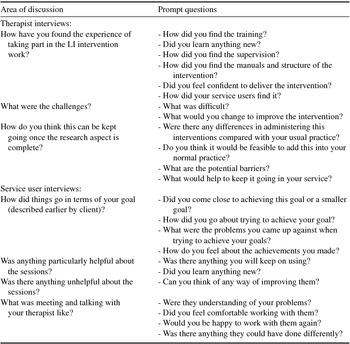
A semi-structured interview schedule was developed, following consultation with the wider research team, to elicit feedback on perceived positive and negative aspects of the intervention, with a particular focus on the feasibility of longer-term implementation in their team (see Table 1). All seven staff members who were trained to deliver the pilot intervention agreed to be interviewed by an independent research worker. Interviews lasted approximately 30 minutes. Professionally, the staff comprised three occupational therapists, one graduate mental health worker, two care co-ordinators (nursing and social work backgrounds) and one psychology graduate research assistant. Staff were recruited from two different teams: an early intervention team (EIT) and a recovery focused team (RFT), working with people with longer term difficulties. Both were part of the South London and Maudsley NHS Foundation Trust. They comprised six females and one male. All had at least one year experience of working with people with psychosis (mean = 7.1 years (SD = 6.09 years)); however, they had little or no previous experience of delivering structured, individual CBT sessions.
Semi-structured interview schedules for therapist and service user interviews

Service user interviews
All 17 service users who completed an intervention provided feedback on their experience. All had a diagnosis of psychosis and were in adult mental health services. Interviews were conducted by a research worker and typically lasted around 10 minutes. This was a shorter time than the staff interviews in order to reduce the burden for service users, as they also completed a number of quantitative outcome measures during the same meeting. Interview questions concerned views on the therapy itself, particularly relating to the achievement of personal goals, helpful and unhelpful aspects of the therapy, and views on the trained staff (see Table 1). Comments were written down verbatim by the research worker. A more detailed description of the demographics of both staff and service users is available (in Waller et al., Reference Waller, Garety, Jolley, Fornells-Ambrojo, Onwumere and Woodall2013).
Qualitative analysis
Staff interviews were audiorecorded with participants’ consent and were subsequently transcribed. They were then examined systematically using thematic analysis, as described by Braun and Clarke (Reference Braun and Clarke2006). An initial coding framework was developed by two raters (AW and HW) based on simultaneous coding of two interviews. The analysis proceeded through a process of reading, re-reading and annotating the transcripts to identify initial codes. Overarching themes were pre-empted to some extent by the questions asked by the researcher, but subthemes emerged from the data. The appropriateness of the coding framework was checked through progressive iterations and reapplied to earlier transcripts as it developed. NVivo 8 (2008) was used for indexing material. In total 15% of the coding was cross-checked to ensure reliability and 83% agreement was attained between the two raters. Service user comments were analyzed systematically using the same process described above.
Results
The findings of the themes and subthemes from the qualitative analysis are summarized below, together with exemplary quotations to illustrate key points. Staff and service user results are reported separately. To preserve anonymity, therapist comments are labelled with a number and team (gender is not included given that only one male took part), whilst service user comments are labelled with their gender and team.
Trained staff interviews
Positive aspects of the intervention
All staff spoke positively about the intervention, stating that they were pleased to be involved in the training and delivery of the therapy. When discussing the positive outcomes for their client, following the delivery of therapy, one person described their involvement as being:
A very positive thing; I’ve certainly enjoyed it. . . I’m glad I’ve done it. (T1, RFT)
Use of the manual and handouts
All seven people described the manual and handouts as useful and written in simple, “user friendly” language. One person stated:
Given that I haven't had any experience [of delivering structured therapy] before, it was quite nice to have something laid out for you in that structured way and it made me feel more confident going into session one and beyond. . . (T2, RFT)
Another person described initial reservations about using the manual, but finding it useful when starting the therapy:
I was really shocked about how much it was broken down. . .initially I did think, “this is a bit joining the dots”, and then it actually became quite useful. (T3, EIT)
In-vivo work
Four members of staff referred to in-vivo, “hands-on” work as particularly useful and powerful for service users, tending to result in the achievement of goals. One person described this work as “empowering”:
. . .when he (service user) actually went on the bus on his own it was probably the most powerful moment for him. . .he was really positive and happy when he got off the bus, he was like, “this does work”! (T4, EIT)
Talking about difficulties
Three people mentioned the value of service users having someone to talk to about their difficulties, especially when they were very socially isolated. For example, one person stated:
. . .he said it's just been nice to talk about things that are in my head to somebody else. . .he hasn't had the chance in a long time to talk about things with another person. . . (T1, RFT)
Brief, structured nature
The brief nature of the intervention, combined with weekly sessions, was described as a key component by three people. One person commented:
To keep the momentum going I think it has to be weekly. . .the whole beauty of this is that it's a short term intervention of eight weeks. (T4, EIT)
Six people referred to the structured and focused nature of the intervention as a positive aspect. One person said:
A nice thing about the low intensity CBT stuff is that was all you were focusing on so I think it was quite useful for the client and enabled them to spend some time on one aspect of their lives and concentrate on that. (T6, RFT)
whilst another discussed the use of consistent therapeutic techniques, which they felt could improve the efficiency of the team's interventions:
There is a temptation to introduce lots of different ideas. . .such as motivational interviewing, ACT, and then lots of occupational therapy tools. . .and I think having. . .a smaller toolkit that you use sometimes. . .that could give us more control and might actually help with the efficiency of our interventions. (T7, RFT)
Training and supervision
Staff training was viewed positively by all, and role plays were highlighted as particularly useful. One person discussed the anxiety-provoking, but useful nature of role plays:
I loathe role plays. . .being made to deal with your own anxiety. . .actually doing it made me think about my clients and their anxiety and understanding that it's really quite challenging having to do something you’re really anxious about. (T3, EIT)
Six out of the seven members of staff reported that they had learnt new skills from the training and supervision of individual cases, and felt able to provide the intervention even with little previous experience of CBT. The four regular attendees of group supervision described this as valuable. One person described their experience of group supervision as comprising discussion of any difficulties encountered, but also in being able to celebrate successes:
If you had any issues in session with the client. . .you could go back and discuss it. . .and everyone would come up with suggestions. . .you felt like you had your toolbox. Also celebrating your successes as well. . .it's great to have so much input, you know, surrounded by psychologists, giving input. . .’cause you don't often. . .get that kind of specialist knowledge. (T3, EIT)
Challenging aspects of the intervention
Anxiety
Four people spoke of their initial anxiety before beginning the intervention with service users, but all described feeling more confident with time and practice. One person said:
It was quite a new thing so I was a bit nervous wanting to make sure you’re doing it right but once you kind of got into the swing of things. . .and you’ve done it a few times it becomes second nature. (T4, EIT)
Complex difficulties
Four staff members discussed the challenging nature of working with service users with complex, multiple and long-standing difficulties. One person described working with a service user with long-standing difficulties:
. . .he's been living like that for many years. . .and it's his norm really; he doesn't really question it. I would say so much so that when you suggest going out it's quite an odd idea to him. (T7, RFT)
These complexities appeared to impact on the staff members’ confidence and the service user's engagement with the intervention. For example, staff described difficulties in keeping service users with complex presentations focused on achieving their personal goals.
Managing endings
Four people discussed difficult feelings encountered by both service users and themselves when coming to the end of the brief therapy, especially when working with people who had limited additional support. For example, one person said:
He's very concerned about the ending. . .this is the third time he's said, “what's going to happen at the end?” (T1, RFT)
Attending group supervision
Supervision was often hard to organize due to other time commitments and three people found it difficult to attend regularly as a result. These people reflected that it might have been useful to attend regularly in order to discuss any difficulties, and it became clear that not all people fully understood the purpose of case supervision, since they had little previous experience of this:
. . .[in] one-to-one social inclusion work you’re not used to group supervision really so I can see the value of it. . .it's just finding the time really. . .it was difficult. (T7, RFT)
Brief, structured nature
Two people at the RF service, both of whom tend to see service users therapeutically for longer periods of time, felt that the brief time frame and structured nature of the intervention could feel constraining, which could put them off future implementation. One person commented on their own therapeutic preference to use a variety of therapeutic techniques:
For me personally I found it a bit too structured. . .it's nice to have that to work through. . .but I think my style as a therapist is that I’ll want to bring in other techniques or tools. . .and that almost felt slightly compromised in this. (T5, RFT)
Another person commented that this could put them off future implementation of the work:
. . .if it's as over bound as that to have to do it with someone every time that would probably put me off. . . (T6, RFT)
Future implementation into services
Keenness to continue
The two members of staff at the EI service described this as a different way of working in comparison to their usual care co-ordination work. Both valued the structured, focused nature of the intervention and the protected time to work on only one goal:
It is quite different to my usual role as a care co-ordinator, which can be a bit all over the place sometimes; it was nice to use a more consistent approach. . .very goal focused. (T3, EIT)
Both were keen to continue the intervention, citing the positive results and the feedback from service users as reasons for this enthusiasm:
I’d be very keen to continue with it because even I was quite surprised at the positive results. . .I think from the feedback and the stuff from all the clients that have been involved it has been really good and I think it really has made a difference so I definitely think it's worthwhile: I believe in it; I want to continue it. (T4, EIT)
Trained staff at the RF service were also keen to continue the intervention, stating that they could see the value in offering brief, structured intervention as part of their package of care: For example, one person stated:
I think the structured approach could work with some of our clients coming in. . .because it is very clear and it could almost be a first stepping stone for some people . . .it is quite efficient timewise. (T1, RFT)
Managing busy workloads
The main difficulties anticipated by those in care co-ordination roles were around time constraints and work loads. One person described:
If we are going to continue with this I think it does have to be reflected in our case loads. . .because it is seeing somebody once a week for 8 weeks and it's probably about 3 hours with the supervision group, the client, the preparation and the writing it up so you’re probably talking about one afternoon a week so I think that could be just quite tricky to implement on a long term basis if you’ve got very high case loads as well; that's going to be the main challenge. (T4, EIT)
Referral process
Those not in care co-ordination roles described some uncertainty in how referrals could be managed and how this might fit into the current assessment process. This included discussion of how suitable service users would be identified, and differentiated from those who might be better suited to other interventions, including a full course of CBT for psychosis. There were some contrasting views regarding who might be most suitable for brief, structured work. For example, one person felt that those people with more severe symptoms would be inappropriate:
. . .I think there are some people that are too anxious for us to help at this level. (T1, RFT)
whilst another suggested that service users with very severe symptoms would be most suitable:
. . .the best people for this stuff to work with are my incredibly depressed clients that I’ve worked with in the past and people that are really depressed and not doing stuff and they’ve stopped being who they are and stopped having a life because they have withdrawn. (T6, RFT)
Ideas for aiding the decision making included determining the service user's agreeableness to the nature of this therapy. One person mentioned the importance of having a team psychologist on board for support in the decision making and assessment process:
I think one of the positives is that we’ve got [the team psychologist], who is very on board with this so they do a lot of the kind of promotion of it and the screening of clients and people being appropriate and so that makes it helpful. . . (T4, EIT)
Fidelity to the protocol
The majority of people described trying hard to stick with the protocol, but finding that there were times when they went off track and had to bring themselves and the service user back to focus on their main goal. One staff member worried that the intervention could become diluted over time and highlighted the value of sticking with the protocol in future work:
It would be nice if we followed the manual as you’re supposed to and did it as a discrete or proper intervention on its own rather than just being a bit fluffy and woolly and incorporate it a bit. (T1, RFT)
Another person described having some reservations about always sticking with the protocol, but wondered if this was related to their own reservations:
I didn't really abide by [the manual] to be honest, but I kind of did my own thing. It did feel sometimes. . .it felt very patronising so actually it was almost like look let's just tack this on at the end, a bit of a paper shuffling activity. But then other people did quite like that and did find that okay so maybe that was also my own. . .reservations. . . (T5, RFT)
Service user interviews: positive aspects of the intervention
Learning new skills
Service users also reported finding the process a positive experience, which had resulted in the acquisition of new knowledge and skills, and an increase in activity levels. Particular new skills and knowledge were highlighted as useful in terms of helping people to reach their personal goals. These included learning to break goals down into smaller steps. For example, one person described this as:
Doing things in stages rather than all or nothing and not expecting to do something all at once. (Male, RFT)
The importance of planning homework tasks and sticking to a schedule was highlighted by five people. One person described the impact of this on their mood and ability to cope with voices:
I feel a bit better like I’ve got a purpose. When the voices say something I just try to ignore them now and stick to the plan. (Male, RFT)
Being able to regularly feedback on progress following planned homework tasks was also highlighted as being useful:
. . .knowing that I would talk about it would help me do it. (Male, RFT)
The educational material on depression or anxiety and tips on coping with stress were also highlighted as useful. For example, one person described:
I learnt about my triggers and to look out for them. I need to keep finding methods of distracting myself when early signs of anxiety come up. (Male, EIT)
Feeling proud of achievements
The majority of service users discussed reaching their goals as a positive aspect of the intervention and described feeling proud of their achievements. One person described having
A really good feeling when I’ve done something. (Male, RFT)
Relationship with trained staff member
All service users gave positive reports of their work with the staff member, describing them as knowledgeable, polite and easy to talk to. One person described the positive aspects as being:
Her attitude and approach - using kindness. And her words, the way she described things seem to sink in easily and you remember them and they’re a good influence. (Female, RFT)
Difficulties encountered during therapy
Interference of other difficulties
Clients often described other physical or mental health problems getting in the way of their progress. Difficulties included high levels of anxiety, fear of psychotic relapse, sleep problems, chronic fatigue syndrome and positive symptoms of psychosis. For example, one client described difficulties in going out to complete her goal, relating to fears about being killed:
Often I don't want to go. I have this feeling like I’m going to die. I have to try to push myself. (Female, RFT)
One person described feeling that her own “stubbornness” could get in the way of her completing her goal:
My stubbornness about not wanting to take the next steps [is a problem I’ve come up against]. My mind doesn't allow for any kind of variation. (Female, RFT)
Not crediting achievements
Whilst the majority of service users reported feeling proud of their achievements, some found this more difficult, even dismissing their achievements. One person, when asked about how he felt about completing his longer-term goal, said
I don't think much of it for me. I think it's a team effort but I know you can't always jump to the top. (Male, RFT)
Another compared her achievements unfavourably to how things were in the past, before she became unwell:
In my old life there were things that I did more. (Female, RFT)
Ideas for improvements
The majority of service users could not think of any ideas for improvements to the intervention. However, amongst those who provided ideas, there were some mixed views in terms of possible improvements to the intervention.
Format and use of handouts
Whilst one person described the handouts as “a bit mind-boggling” and “complicated” (Female, RFT), another described them as “quite simplistic and I would have liked more information” (Male, EIT). Two service users mentioned that they did not like aspects of the “paperwork” (handouts and homework sheets). For example, one person commented that they
Would have preferred a different format without that paperwork. (Female, RFT)
Focus of the intervention
Three clients mentioned that the chosen focus of the intervention did not seem to fit with their needs. For example, one lady who was on the waiting list for a full course of CBT for psychosis and wanting to work on distressing beliefs, commented:
I’m a bit negative about this as it wasn't what I wanted to focus on. (Female, RFT)
Timeframe
Four clients commented that they would have liked more sessions, for example “so I get more practice” (Male, RFT) and due to a perceived need to have “more ongoing therapy” (Male, RFT). One client mentioned that having a long break in the middle of therapy, due to staff absences, was “disruptive and I felt that I gave up on my goals in that time” (Female, RFT).
Discussion
The qualitative feedback provided additional useful insights into the effectiveness and nature of the intervention, the training and the therapeutic relationships between service user and staff member. The data have also highlighted a number of potential difficulties and barriers to longer-term implementation of the intervention, which will need to be addressed in future work. The results of the study have implications for the development and future implementation of Low Intensity CBT for service users with psychosis. The current Improving Access to Psychological Therapies programme for common mental disorders does not include provision of LI work for clients with active psychosis. The new demonstration sites piloting an IAPT programme for Severe Mental Illness (IAPT-SMI), including psychosis, are increasing access to high intensity interventions, but the additional provision still falls far short of NICE recommendations. The work described here may be one way of improving access for this group of clients (Lecomte and Leclerc, Reference Lecomte, Leclerc, Hagen, Turkington, Berge and Grawe2010).
Low intensity interventions for people with psychosis will inevitably be somewhat different in their delivery than those for Common Mental Illness. Engagement is key, and the heterogeneity of presentation in psychosis means that trained staff will need to use clinical judgement and their interpersonal skills, even to deliver an intervention that is heavily based on protocol. The term “low intensity” is not fully defined and has been used differently depending on the context. However, some definitions require that skills in the therapeutic use of the self and the relationship are not required. It may be that it is not the correct term for the intervention when delivered to people with psychosis. The current work was somewhat different in that it was a guided course of treatment and did involve use of therapeutic judgement and skill, backed up by regular supervision, in addition to the use of a structured protocol and self-help materials.
Positive aspects of the intervention: potential facilitators to continued implementation
Staff were enthusiastic about the experience of taking part in the training and delivery of the intervention. They reported learning new skills and wanted to continue using the intervention in their teams. Witnessing the success of service users achieving personal goals was described as rewarding and motivated staff to want to continue delivering the intervention in their service. This rewarding element of delivering the intervention bodes well for future implementation: staff who feel satisfied and rewarded by their work are more likely to attempt to overcome organizational barriers to delivery. For staff, particularly useful aspects of the intervention included using the therapy manuals, the time-limited nature of the work, and the requirement to focus on only one goal, using one approach, rather than an eclectic and ad hoc pragmatic mix of approaches, characteristic of day-to-day care coordination. The focus and structure was especially useful for staff working with service users who had in the past found it difficult to achieve goals, even with a full course of CBTp.
All service users reported that they had learnt some useful techniques, including planning ahead, using coping techniques, breaking goals down into smaller steps and the use of psychoeducation. Service users felt that they had built confidence and felt proud of their achievements. Comments about the newly trained staff were also very positive, with service users describing them as warm, knowledgeable and approachable.
Potential barriers to continued implementation
Staff described a number of challenging aspects of the intervention, including their own initial anxieties around delivering the therapy; the structured and manualized nature of the intervention, focusing on only one main goal; the brief nature of the therapy; the time needed to deliver the intervention; and differences in opinion regarding who might be suitable for the intervention. As might be expected, anxieties about delivering the therapy tended to occur in staff who were less experienced in delivering structured CBT-based interventions, despite having several years’ experience in working with this client group, whereas reservations about the brief, structured nature tended to occur in staff who had more experience in delivering longer-term work, using a variety of techniques and focusing on a number of goals. When asked about future implementation in the service, the main barrier for those in care co-ordination roles was the time needed for preparation, meeting with service users and attending supervision, on top of their usual care role.
For service users, there were very few negative comments. One person would have preferred a longer therapy, and disliked the handouts. One of the most common difficulties to arise was the complication of physical and mental health co-morbidity, which could impinge on the achievement of goals. This was also described as a difficulty by staff.
Ideas for improvements and future training needs
The study has identified several areas for improvement and unmet training needs that could also be incorporated into future research, and also into training and development of the manual.
Client selection
More clarification of who might benefit from the low intensity intervention and who might benefit from longer-term work would be helpful. Some clients and staff reported that they needed more time to work on complex difficulties. The advantages and disadvantages of a brief intervention in these cases could be explicitly incorporated into the training, together with information on referral pathways to other, more suitable interventions for other health problems.
Flexible delivery
Advice on how to accommodate clients’ individual preferences in terms of handouts and rating scales.
Staff experience
More guidance is needed on the process of learning and normalization of particular reactions and common difficulties. For example, staff described feeling anxious before starting the intervention, which is a common experience for new therapists (Skovholt and Ronnestad, Reference Skovholt and Ronnestad2003), but everyone reported feeling more confident and relaxed with time and practice. This would be important to discuss in group training, highlighting how common these fears are, even in people with many years of experience in working with people with psychosis, with the aim of putting staff at ease.
Managing endings
Another common experience, which was not sufficiently addressed in the current training, is the difficulty around ending with service users. This is likely to be especially difficult given the brief nature of the intervention, combined with the often complex needs of the client group. Future training should aim to normalize both staff and service user anxiety around ending (Baum, Reference Baum2005, Reference Baum2006; Martin and Schurtman, Reference Martin and Schurtman1985) and provide techniques for managing these difficulties, including the possibility of referring the client on for continued input if appropriate.
Using supervision
Staff were typically new to group supervision and more explanation of the purpose and structure of this is likely to be useful in the initial training, for example, topics that might be useful to bring up in supervision and addressing misconceptions. Highlighting the importance of group supervision and the benefits reported by attendees may also help to improve attendance, which was often difficult to organize due to other time commitments.
It will be important for future training and supervision to allow more time to discuss the concerns of staff. For example, in this study there were some concerns about the brief, structured nature of the intervention and the structured, focused nature, and also of the use of handouts and rating scales. This has the potential to reduce fidelity to the protocol and limit implementation of the intervention in the long-term. The concerns could be helpfully addressed by highlighting feedback from service users that the focused nature of the intervention was a positive aspect of the work that helped them to learn new skills and achieve their goals.
Managing workloads
Time constraints were the main obstacles for future implementation identified by care co-ordinators. This is an ongoing difficulty, which has been identified in previous studies of long-term implementation of low intensity psychological therapy in routine practice (Brooker and Brabban, Reference Brooker and Brabban2004). A written contract to reduce the caseload during training may be required: however, if access to psychological interventions is to be improved by employing front line staff, ultimately the goal would be to deliver this intervention within their role rather than as a separate activity.
Managing competing client needs
Maintaining the focus of sessions on recovery goals was a particular difficulty for staff working with service users who did not have a care co-ordinator. Staff reported wishing to address other needs, which was likely to have diluted the impact of the structured intervention. The training should directly address this in the future. For example, it may be helpful to include more specific training on agenda setting and practising scheduling a short time at the start or end of the session to discuss other needs, but ensuring that the achievement of the valued goal remains the priority.
Limitations and future directions
The study consisted of interviews with a small sample of newly trained staff and service users, soon after they had completed the intervention. A larger-scale evaluation of the intervention is warranted, including further qualitative work. It may be useful to employ a service user researcher as, although the research worker completing the interventions was independent of the therapy, they were part of the research team and this may have impacted upon the responses given. A service user researcher might also have elicited different, perhaps more honest, responses (see Rose, Reference Rose2004). It will be particularly important to assess qualitative outcomes over a longer time frame as there may be different barriers to and facilitators of continued implementation of the intervention. Often staff and service users are enthusiastic about innovation, but making the change part of routine clinical practice may be more challenging.
Conclusions
Trained staff and service users were able to provide detailed feedback on a low intensity CBT intervention. Service user feedback was almost universally positive. Equipping staff to be slightly more flexible in their delivery of the package, and to feel more confident in discussing the advantages and disadvantages of brief therapies should address the small number of concerns raised by service users. Staff concerns highlighted useful future improvements to the training protocol, particularly addressing the process of learning and common anxieties, the use of supervision, and managing endings. The findings are also likely to be applicable to the implementation of other brief, focused interventions delivered by “non-specialist” frontline staff.
The qualitative feedback supports our quantitative pilot findings (Waller et al., Reference Waller, Garety, Jolley, Fornells-Ambrojo, Onwumere and Woodall2013). The intervention could be effectively delivered by frontline mental health staff working with people with a prior diagnosis of psychosis. Both the training and the intervention were relatively brief. Low intensity interventions for this client group might therefore be a way of improving access to psychological therapy in service users with a diagnosis of psychosis.
Acknowledgements
The research was funded by a grant from the South London and Maudsley Charitable Trust (Ref: LG201). The authors would like to thank all staff and participants from the SHARP and STEP teams at the South London and Maudsley NHS Foundation Trust for taking part in the study.



Comments
No Comments have been published for this article.