INTRODUCTION
Mediterranean climates are well suited for fruit production, and even cultivation of fruit crops typical of cooler climates, such as apple, is spreading in those regions. Yet in Mediterranean areas, the highest evapotranspiration rates occur during the dry season (especially summer months), generating relatively severe water deficit conditions. For those reasons, crop irrigation becomes critical during those months. In addition, due to the strong competition for water resources by municipalities and tourism activities, increasing irrigation water productivity (IWP; i.e. increasing yield per unit of irrigation water) is a major goal for fruit cultivation in Mediterranean areas.
Regulated deficit irrigation (RDI) consists of applying less water than crop evapotranspiration (ETc) during less sensitive phases of crop development and has been long recognized as a potent tool for managing fruit trees, specifically for reducing shoot growth, improving fruit quality and saving irrigation water (Chalmers et al. Reference Chalmers, Mitchell and van Heek1981; Mitchell & Chalmers Reference Mitchell and Chalmers1982). Results of RDI experiments have been promising in certain regions and for some fruit crops (Fereres & Soriano Reference Fereres and Soriano2007). Contrasting and less encouraging results have been obtained in those fruit crops where shoot growth and fruit growth are concurrent, such as apples (Malus domestica Borkh) (Lötter et al. Reference Lötter, de, Beukes and Weber1985; Ebel et al. Reference Ebel, Proebsting and Patterson1993, Reference Ebel, Proebsting and Evans1995; Mpelasoka et al. Reference Mpelasoka, Behboudian and Green2001). Even for those species where temporal separation of shoot and fruit growth is well defined and RDI has proven to be feasible experimentally, irrigation management according to RDI strategies is often too complex to be employed at the farm level.
Partial rootzone drying (PRD) is an irrigation technique that was recently developed for grapes (Vitis vinifera L.) in Australia, with the primary aim of saving irrigation water (Dry et al. Reference Dry, Loveys, Botting, Düring, Stockley, Sas, Johnstone and Lee1996; Dry & Loveys Reference Dry and Loveys1998). With PRD, only one half of the rootzone is irrigated, while the other half is not. The physiological basis for PRD is that roots in drying soil produce abscisic acid (ABA); if there is sufficient sap flow through those roots, ABA is translocated to the shoots (Dodd et al. Reference Dodd, Egea and Davies2008a) where it signals a developing soil-water deficit (Dry et al. Reference Dry, Loveys, Botting, Düring, Stockley, Sas, Johnstone and Lee1996). Accounting for the relative contributions of different parts of the root system to sap flow seems, in fact, to match shoot xylem ABA concentrations (Dodd et al. Reference Dodd, Egea and Davies2008b). In the leaves, ABA induces partial stomatal closure, which reduces transpiration and may increase water use efficiency. However, as the other half of the rootzone is kept well watered, the effect on plant water potential is minimal (Gowing et al. Reference Gowing, Davies and Jones1990) and other metabolic and physiological processes associated with water stress are not affected (Dry et al. Reference Dry, Loveys, Botting, Düring, Stockley, Sas, Johnstone and Lee1996, Reference Dry, Loveys and Düring2000). The technique relies on cyclical wetting and drying of parts of the rootzone in order to stimulate and maintain root-derived ABA signals (Dodd et al. Reference Dodd, Theobald, Bacon and Davies2006). Increased xylem ABA and pH (Davies et al. Reference Davies, Wilkinson and Loveys2002), both probably partly responsible for partial stomatal closure, and reductions of cytokinin contents in roots, shoot apexes, leaves and buds (Stoll et al. Reference Stoll, Loveys and Dry2000; Kudoyarova et al. Reference Kudoyarova, Vysotskaya, Cherkozyanova and Dodd2007) have been reported in plants under PRD regimes. The resulting changes in hormonal balance followed by partial stomatal closure may contribute to reducing vegetative growth and be responsible for higher crop yields than conventional DI when the same volumes of water are applied (Dodd Reference Dodd2009).
In apple, with the exception of one study (O'Connell & Goodwin Reference O'Connell and Goodwin2007), PRD trials imposing DI at 0·4–0·5 of ETc (i.e. 0·5–0·6 water savings) have reported negligible effects on yield or fruit quality for several cultivars (Caspari et al. Reference Caspari, Einhorn, Leib, Redulla, Andrews, Lombardini, Auvil and McFerson2004; Einhorn & Caspari Reference Einhorn and Caspari2004; Lombardini et al. Reference Lombardini, Caspari, Elfving, Auvil and McFerson2004; van Hooijdonk et al. Reference van Hooijdonk, Dorji and Behboudian2004; Leib et al. Reference Leib, Caspari, Redulla, Andrews and Jabro2006; Talluto et al. Reference Talluto, Farina and Lo Bianco2007, Reference Talluto, Farina, Volpe and Lo Bianco2008; Zegbe & Behboudian Reference Zegbe and Behboudian2008; Zegbe & Serna-Pérez Reference Zegbe and Serna-Pérez2011). The present study evaluated the effect of PRD irrigation on yield and fruit quality of two apple cultivars, one with fruit maturing in summer, the other in autumn, under typical Mediterranean conditions. If PRD maintains good fruit yield and quality by avoiding tree water stress during fruit development, a greater advantage of PRD over continuous DI is expected in the late- than in the early-ripening cultivar, as DI is applied when fruits are growing faster and are more sensitive to water deficit in the early- than in the late-ripening cultivar.
MATERIALS AND METHODS
Experimental site and plant material
The study was conducted for three consecutive growing seasons from 2007 to 2009 in a commercial orchard located near Caltavuturo (37°49′ N, 13°53′ E and 850 m a.s.l.), in central Sicily. Plant material consisted of apple trees from cvars Gala and Fuji on M.9 rootstock planted in 2000, trained to a central leader, arranged in North–South-oriented single rows and spaced at 4 m between rows and 1·5 m within rows. When first selected in 2007, cvar Fuji trees had a greater trunk circumference (231 mm) than cvar Gala (169 mm) trees. Soil type was a sandy clay loam (53% sand, 18% silt and 29% clay, by volume) with pH 7·3 and 18 g/kg active carbonates. At field capacity, soil-water content was c. 0·26 m3/m3 and soil-water potential (SWP) c. –17 kPa. With the exception of irrigation, provided by a drip system with a single line per tree row, all trees received the same cultural practices: complex solid fertilizers (12:6:18 N:P:K) were applied to the soil once a year in winter, weeds were controlled by regular tilling of inter-rows and rows, and fruit was thinned by hand in late May (c. 40 days after bloom) leaving 1–2 fruits per spur.
Experimental design, irrigation and tree water status
In the field, uniform trees were selected and labelled according to a randomized block design with four replicates (blocks), each of 42 trees (seven per irrigation treatment and cultivar). The middle three trees in each cultivar and irrigation plot were used for all crop measurements. Contiguous irrigation treatments on the same row or between rows were separated by four buffer trees or one buffer row, respectively. In spring of each year, three irrigation treatments were imposed: (1) conventional irrigation (CI), where all drip emitters (one every 1·5 m of line, located in between consecutive trees and delivering 8 litre/h) were left open so that trees received water on both North and South sides of the rootzone; (2) PRD, where drip emitters on one side of each tree were closed so that trees received 0·50 of CI water only on side of the rootzone; the side was alternated; (3) continuous DI, where all drip emitters, with reduced delivery rate (4 litre/h), were left open so that trees received 0·50 of CI water on both sides of the rootzone.
Climate variables were monitored with a weather station positioned within the experimental plot. Reference evapotranspiration (ET0) was determined according to the FAO Penman–Monteith method (Allen et al. Reference Allen, Pereira, Raes and Smith1998). Irrigation volumes to CI trees were calculated to meet ETc, which was determined as:
 $${\rm ET}_{\rm c} = {\rm ET}_0 \times K_{\rm c} \times K_{\rm r}$$
where K c was derived from FAO indications (Allen et al. Reference Allen, Pereira, Raes and Smith1998) and adjusted to 0·35 in March, 0·5 in April, 0·75 in May, 0·85 in June, 1·0 in July and August, 0·8 in September and 0·75 in October due to the specific soil management and climate conditions; and K r was assumed to be 0·7 due to proportion of wetted soil surface. No adjustment was made to take into account differences between cultivars as fruit crop was present throughout the irrigation periods in both cultivars and differences in canopy size between the two cultivars were contained within 10% at the beginning of the irrigation periods. Length of irrigation periods, number of events, amount of water applied, ET0, ETc and rainfall of the three growing seasons are reported in Table 1.
Irrigation, ET0, ETc and rainfall during the 2007, 2008 and 2009 growing seasons (1 March–31 October)

SWP was monitored continuously at a fixed depth of 400 mm with six Watermark sensors (Irrometer Co., Riverside, CA, USA) connected directly to the weather station. Sensors were positioned at c. 0·3 m from emitters and 0·8 m from the tree trunk in opposite sides of the rootzone. The interval between irrigation events and the duration of each event (maximum 4 h) were adjusted to maintain soil moisture of wetted volume above 0·80 of field capacity (−50 kPa) in the rootzone of CI trees but avoid spreading of wet areas into the dry sides of PRD trees. Wet and dry sides of PRD trees were alternated every 2–3 weeks when SWP in the dry side reached values ranging from −100 to −150 kPa.
Tree water status was determined by measuring leaf stomatal conductance (gs) and relative water content (RWC) at 15-d intervals during the irrigation periods of the 3 years. At each date and between 10:00 and 12:00 h, gs was measured with an AP4 Delta-T porometer (Delta-T Devices, Cambridge, UK) on one randomly chosen sun-exposed, mature leaf per tree. A similar leaf was sampled, wrapped in parafilm and aluminium foil, transported to the laboratory inside ice bags, and immediately weighed in a 5-digit precision balance (fresh weight, FW). Leaves were then placed in test tubes and their petioles submerged in distilled water for 24 h in the dark at 10 °C. After rehydrating, leaves were blot-dried, weighed (turgid weight, TW), transferred into paper bags and oven-dried at 60 °C until constant weight (dry weight, DW). RWC was calculated as (FW–DW)/(TW–DW).
Yield and fruit quality
Fruit of cvar Gala was harvested on 29 August 2007, 27 August 2008 and 1 September 2009 while fruit of cvar Fuji was harvested on 17, 20 and 26 October in 2007, 2008 and 2009, respectively. Fruits of each tree were counted and weighed directly in the field. At harvest, trunk circumference was measured c. 0·15 m above the grafting point and used to calculate trunk cross-sectional area (TCSA) and yield efficiency (kg fruit/mm2 TCSA).
A sub-sample of 30 fruits per tree was randomly selected and taken to the laboratory for determination of fruit quality. Each fruit was weighed, measured in height and width, and photographed with a digital camera. Digital images were used to determine proportion and intensity of peel red colour. Specifically, an algorithm developed with MATLAB software (The MathWorks, Inc.) was used that converts images from RGB (red-green-blue) to CIE (Commission Internationale de l’Éclairage) 1976 (L*, a*, b*) colour space system, extracts the fruit from the image (removing the image background), separates the total fruit area into two sub-regions, cover colour (closer to red) and ground colour (closer to green) according to an adjustable green–red threshold, and quantifies colour characteristics of each region as the weighed distance of each pixel in the image from an interactively chosen reference (best red coloured area for each cultivar). The output is an index for the entire fruit area and one for each of the two regions ranging from 0 (maximum distance from reference or no red) to 1 (identical to reference red). Proportion of cover colour was calculated dividing the number of pixels of the red region by the number of pixels of the entire fruit area. Subsequently, flesh firmness was measured with a manual pressure tester mounting an 11-mm tip (TR di Turoni & Co., Forlì, Italy) on opposite sides of each fruit, after removing the peel. Fruits were then cut in half and one half was used to extract the juice with a centrifuge. Total soluble solids (TSS) in the extracted juice were measured with an Atago Palette PR-32 digital refractometer (Atago Co., Ltd., Tokyo, Japan), and pH and titratable acidity (expressed in g malic acid/l) with a Crison S compact titrator (Crison Instruments, SA, Alella, Barcelona, Spain). The other half of the fruit was used to determine starch pattern index by Lugol staining. Stained fruit sections were photographed and digital image analysis (same algorithm as for peel colour but with no separation into sub-regions) was used to quantify staining with an index ranging from 0 (no staining) to 1 (fully stained). One portion of this second half of the fruit with no staining was weighed fresh and oven-dried at 60 °C for determination of DW as a proportion of initial FW.
For each tree in the trial, fruit was graded and separated into three major classes: <55 mm (unmarketable fruit), 56–65 mm (medium size class) and >65 mm (large size class) in cvar Gala; <65 mm (unmarketable fruit), 66–75 mm (medium size class) and >75 mm (large size class) in cvar Fuji. Medium-sized apples were allotted an average unit price (UP) of €0·25/kg, large size apples at an average UP of €0·50/kg; no value was attributed to unmarketable fruit.
Financial evaluation
A model calculation was done for 1 ha of irrigated apples, spaced 4 × 1·5 m in 25 rows of 66 trees. The required water pressure was applied by a 2·2 kW electrical pump (€700) and one filter (€40) was installed at the head station. A main pipe with internal diameter of 63 mm (polyethylene, 150 m at €3·55/m) from the head station supplies laterals with internal diameter of 16 mm(polyethylene, €2·60/m).
At the farm level, fixed costs (FC) would be different between irrigation treatments. In high-density apple plantings, CI and DI water is typically supplied by one line (16 mm lateral) along each tree row (2500 m) and one dripper per tree (1650 at €0·20 each). PRD would require splitting of the main line to serve a second lateral for each tree row, yielding one dripper at each side of the tree. Thus, PRD requires double the amount of pipes (250 m main and 5000 m lateral), connectors (50 at €1·70 each) and drippers (3300). In order to irrigate alternate sides of the tree, two manual ball valves (€15 each) should be installed after the splitting point of the main pipe. Prices for irrigation components were obtained in 2009 from local suppliers in Bagheria, Italy. System installation would require c. 3 days for CI and DI and 5 days for PRD with labour costs of c. €90/day. Total FC were €8145 for CI and DI and €15 402 for PRD.
Costs associated with water delivery from source to field were not included and only the energy to maintain the required pressure in the irrigation system was calculated, at c. €0·03/m3. Average water price for the area was estimated at €0·15/m3. Costs associated with fertilization, pest control and weed control were considered to be the same for both cultivars and all treatments. However, pruning, fruit thinning and harvest costs were adjusted to take into account differences in yield and growth between cultivars and among treatments, which translated into different amount of labour needed for those operations.
Farmer's average annual profit (P) was calculated as:
 $${\rm P} = {\rm (UP}-{\rm VC)} \times {\rm Y}\;{\rm in}\;\euro /{\rm year}$$
where UP is unit price, VC are variable costs as the sum of production costs (all cultural practices including operation of the irrigation system) divided by yield (Y, average of 3 years) in €/kg. The pay-back period (PBP) is the time in years that it takes to pay off the additional investment needed for switching to PRD irrigation by the extra profit and was calculated as: PBP = (FCPRD − FCCI)/(PPRD − PCI).
Carbohydrate content
Samples (8–10 slices) from fruits of each Gala tree harvested in 2008 were stored at −20 °C for subsequent carbohydrate analysis. Thawed fruit tissue was extracted in 0·8 (v:v) methanol solution containing 1·1 g/l of phenyl-β-D-glucopyranose as the internal standard, using a mortar and pestle. The homogenate was transferred into 10-ml tubes and centrifuged at 5000 g for 5 min. The supernatant was collected, transferred into clean tubes and stored at −20 °C for subsequent analysis by gas chromatography (GC).
Samples were prepared for GC analysis according to the method of Rojas-Escudero et al. (Reference Rojas-Escudero, Alarcón-Jiménez, Elizalde-Galván and Rojo-Callejas2004). Briefly, 0·1 ml of extract were transferred into 2-ml GC-vials and evaporated to dryness under nitrogen current. Subsequently, 0·025 ml of oxime reagent (25 mg hydroxylamine-HCl in 1 ml of piridine) were added, vials were capped and heated at 75 °C for 30 min. Derivatization was completed by adding 0·075 ml of N, O-bis(trimethylsilyl)trifluoroacetamide (BSTFA) plus 0·01 trimethylchlorosylane (TMCS). Carbohydrate quantification was carried out on a Shimatzu 2010 (Columbia, MD, USA) GC set to split mode and mounting an Equity 5 (Supelco, Bellefonte, PA, USA) fast column. A 10-min fast run was developed and optimized for the above carbohydrates and tissues. Calibration curves were constructed with sorbitol, sucrose, glucose and fructose standards in the expected range of fruit samples and all reagents were purchased from Sigma Aldrich (St. Louis, MO, USA). Carbohydrate contents were expressed as mg/g DW.
Data analysis
Factorial analysis of variance (ANOVA) was performed to test year, cultivar and irrigation effects on RWC, gs, yield and fruit quality traits. In the ANOVA model, year, cultivar and irrigation treatment were used as main factors and block as a replicate factor; all possible interactions among main factors were tested. ANOVA with cultivar and irrigation as main factors, cultivar × irrigation as the sole interaction, and block as a replicate factor was performed to test for main effects on trunk growth over the 3 years of trial. For yield/ha and IWP, average data of the 3 years were summarized in tables and used for calculations of financial parameters. ANOVA with irrigation treatment as the main factor and block as a replicate factor was performed to test for main effects on carbohydrate contents of Gala fruit in 2008. All tests were conducted using SYSTAT procedures (Systat Software Inc., Richmond, CA, USA).
RESULTS
Soil and tree water status
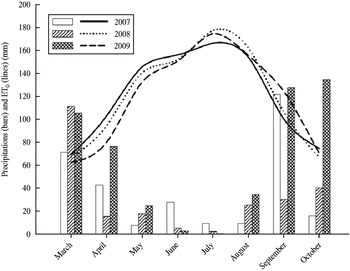
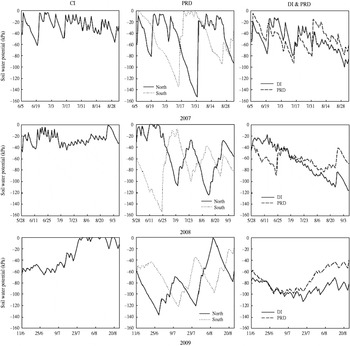
In terms of climate, the three growing seasons were relatively uniform with 2008 somewhat drier and 2009 more humid (Fig. 1); so the number of irrigation events and volumes were adjusted accordingly (Table 1). Average SWP of PRD and DI was 33 and 43 kPa lower than CI, respectively, and reached lower values in 2009 compared with the two previous years (Fig. 2).
Monthly ET0 and precipitations during the growing season of the 3 years of trial near Caltavuturo (37°49′ N, 13°53′ E and 850 m a.s.l.), in Sicily.

SWP in the rootzone of apple trees under CI, PRD and continuous DI during irrigation periods of the 3 years of trial. Right panels report a dashed line for average SWP of wet and dry side of PRD.

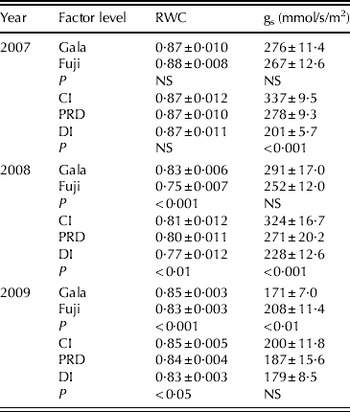
A significant effect of cultivar and irrigation treatment on RWC was detected only in 2008 and 2009 (Table 2). Specifically, DI induced a 5 and 2·4% decrease of RWC over CI in 2008 and 2009, respectively. Also, leaves of cvar Fuji suffered greater dehydration than those of cvar Gala in both 2008 and 2009. However, the irrigation treatment influenced gs only in 2007 and 2008, while cvar Fuji exhibited higher gs than cvar Gala only in 2009 (Table 2). In particular, DI induced decreases of 40 and 30% over CI in 2007 and 2008, respectively; whereas PRD induced decreases of 18 and 16% over CI in 2007 and 2008, respectively. Despite their larger size, tree trunks of cvar Fuji (29·3 mm) grew less than those of cvar Gala (37·5 mm) over the 3 years of the trial (P < 0·01). Compared with CI, PRD and DI irrigation induced an average 12 and 9·5% reduction of trunk growth, respectively, although differences were not statistically significant.
Average leaf RWC and stomatal conductance (gs) during the irrigation period in trees of apple cvars Gala and Fuji under CI, PRD and continuous DI. Means±s.e.m. (n = 36 for cultivar; n = 24 for irrigation)

Yield
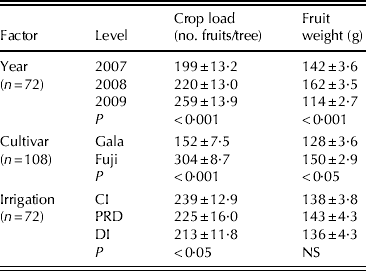
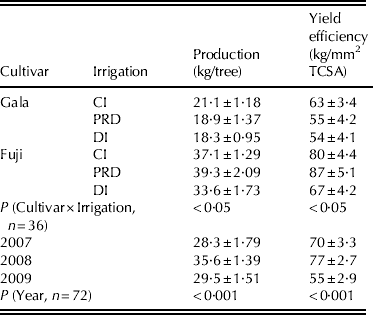
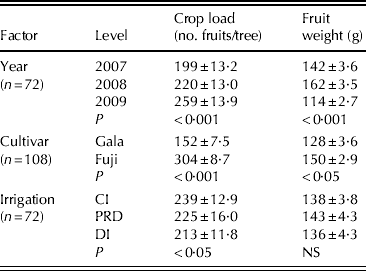
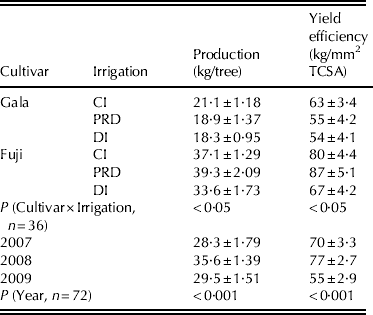
Yield components were significantly affected by the cultivar, as expected, and also by year and irrigation. However, no interactions for crop load or average fruit weight were significant. Both of these components were significantly affected by cropping season and cultivar, with crop load increasing with time and smaller fruits in 2009, and with cvar Fuji producing larger and greater numbers of fruits than cvar Gala (Table 3). Irrigation influenced only crop load, with DI inducing reductions of 11 and 5% over CI and PRD, respectively. Similarly, analysis of production per tree and yield efficiency data revealed no interaction of cultivar or irrigation with year, but a significant cultivar × irrigation interaction. In cvar Fuji, DI irrigation reduced production per tree by 9% and yield efficiency by 16% compared with CI, whereas no significant irrigation effect was observed in cvar Gala (Table 4).
Number per tree and average weight of fruits in trees of apple cvars Gala and Fuji under CI, PRD and continuous DI. Means±s.e.m.
Production and yield efficiency in trees of apple cvars Gala and Fuji under CI, PRD and continuous DI. Means±s.e.m.
Fruit quality
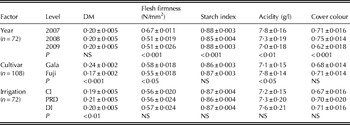
As for fruit quality, data analysis revealed no interaction between year, cultivar and irrigation in any trait, with the exception of TSS and peel colour indices. Flesh firmness was highest in 2007, starch index lowest in 2008 and acidity and proportion of cover colour lowest in 2009 (Table 5). Fruit of cvar Gala exhibited higher proportion of dry matter (DM) and flesh firmness, but lower acidity than cvar Fuji. However, irrigation influenced only DM proportion, with PRD and DI inducing a 5 and 2·5% increase over CI, respectively (Table 5).
Proportion of DM, flesh firmness, starch index, acidity and proportion of cover colour in fruits of apple cvars Gala and Fuji under CI, PRD and continuous DI. Means±s.e.m.

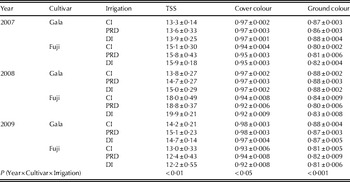
As for TSS and peel colour indices, data analysis showed a significant (P < 0·05) year × cultivar × irrigation interaction. In particular, PRD and DI tended to increase TSS in all years for cvar Gala, but only in 2007 and 2008 for cvar Fuji (Table 6). In cvar Gala, cover colour index was relatively stable across years and irrigation treatments, whereas ground colour index was lowered (greener) by PRD and DI in 2007 and 2009. In Fuji, PRD increased cover colour index (redder) by 1·1% in 2007 and 2009 and DI lowered cover colour index by 1·1% in 2008 and 2009, whereas deficit treatments increased ground colour index in 2007 but decreased it in 2008 (Table 6).
TSS, cover colour index and ground colour index in fruits of apple cvars Gala and Fuji under CI, PRD and continuous DI. Means±s.e.m. (n = 12)

Irrigation influenced both carbohydrate content and their ratios (Table 7). In particular, DI fruit showed 27% more sorbitol and 55% more sucrose than PRD fruit, and 19% more total sugars than CI fruit. As a result, DI produced a 35% lower hexose to transport sugar ratio than PRD.
Carbohydrate content (mg/g of DW) in fruit of apple cvar Gala under CI, PRD and continuous DI in August 2008. Means±s.e.m. (n = 12). Sor/Suc = sorbitol to sucrose ratio; Red/Tran = reducing (glucose and fructose) to transport (sucrose and sorbitol) carbohydrate ratio

Financial evaluation and IWP
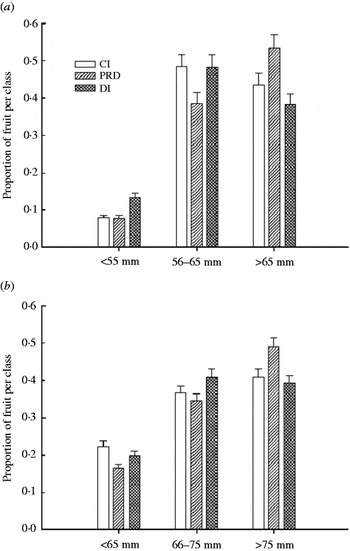
Fruit distribution into size classes was affected by irrigation but in different ways for the two cultivars and consistently in the 3 years (no interaction with year) (Fig. 3). Specifically in cvar Gala, proportion of PRD fruit increased with size class (i.e. most fruit into the largest size class), whereas most of CI and DI fruit fell into the intermediate class (Fig. 3a). In cvar Fuji, PRD and DI fruit followed the same trends observed for cvar Gala, whereas proportion of CI fruit increased with size class, but it was more evenly distributed among the three classes than PRD fruit (Fig. 3b).
Fruit size distribution in trees of apple cvars (a) Gala and (b) Fuji under CI, PRD and continuous DI. Error bars, s.e.m. (n = 36). Averages of the 3 years of trial.

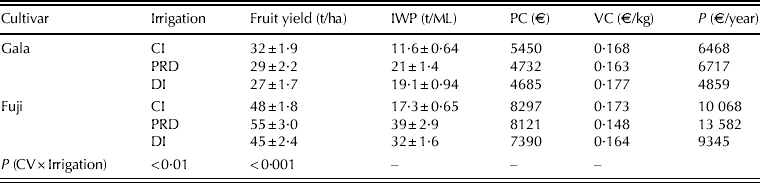
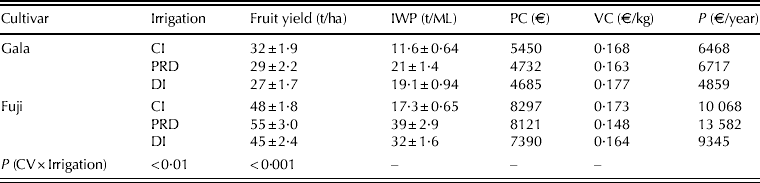
Taking into account fruit distribution into size classes and considering only marketable yield and the UP of each size class resulted in a different response of the two cultivars in terms of IWP and P. In cvar Gala, DI induced a significant 18% reduction of marketable fruit yield compared with CI, and a significant 25 and 28% reduction of P compared with CI and PRD, respectively (Table 8). Both PRD and DI determined significant increases (64 and 58%, respectively) of IWP. In cvar Fuji, PRD induced significant increases of marketable yield (14%), IWP (128%) and P (35%), whereas DI increased only IWP and by 87%. Finally, DI trees showed a 6 and 7% decrease of marketable yield and P over CI, respectively (Table 8). The different P increase obtained in the two cultivars with PRD determined a PBP of 29 years for cvar Gala and 2 years for cvar Fuji.
Marketable fruit yield, irrigation water productivity (IWP), production costs (PC), variable costs (VC) and profit (P) for trees of apple cvars Gala and Fuji under CI, PRD and continuous DI. Unmarketable fruit was not included in the calculations. Average of the 3 years of trial. Means±s.e.m. (n = 36)
DISCUSSION
Soil and tree water status
Despite the similar irrigation volumes applied to both deficit treatments, SWP in the rootzones of PRD trees (average of wet and dry sides) tended to be higher than in the rootzones of DI trees. This has been also reported in previous trials with similar irrigation layouts (Leib et al. Reference Leib, Caspari, Redulla, Andrews and Jabro2006) and it may be attributed to the smaller surface area of wet soil in PRD, which causes less evaporation than in DI. Similarly, better apple yield performances was obtained with one dripper per tree than with two drippers per tree and this has been attributed to less evaporation from soil and higher soil-water content (Girona et al. Reference Girona, Behboudian, Mata, Del Campo and Marsal2010). This was also true in the present experiment, although tree spacing and positioning of the single-line drip system along the row may have somewhat reduced the wet soil surface effect and limited the SWP differences between PRD and DI to an average of about 17%.
In the present study, PRD generally did not affect leaf water status and reduced gs in 2 of the 3 years (Table 2). Previous work with field-grown apple trees has not shown significant effects of PRD on gs (Einhorn & Caspari Reference Einhorn and Caspari2004; Van Hooijdonk et al. Reference van Hooijdonk, Dorji and Behboudian2004; Zegbe & Behboudian Reference Zegbe and Behboudian2008), whereas in a study on cvar Pink Lady, PRD induced significant gs reductions compared with a control (Talluto et al. Reference Talluto, Farina, Volpe and Lo Bianco2008). This discrepancy among experiments or years in the present trial may be at least partly attributable to differences in water deficit levels. The latter may, in fact, determine differences of soil moisture in the wet side of the rootzone, which seems to drive PRD-specific effects such as stomatal closure (Romero et al. Reference Romero, Dodd and Martinez-Cutillas2012). This is at least partly consistent with climate data of the present work, which showed no PRD effect on gs in 2009, which was somewhat more humid than the other two seasons.
The degree of stomatal closure observed in DI (more marked than in PRD) trees, along with minor growth reductions, was not sufficient to maintain leaf dehydration to CI or PRD levels, a response already observed in other studies with apple (Talluto et al. Reference Talluto, Farina, Volpe and Lo Bianco2008; Lo Bianco & Francaviglia Reference Lo Bianco and Francaviglia2012; Lo Bianco et al. Reference Lo Bianco, Talluto and Farina2012). On the contrary, previous studies showed that PRD trees often maintain good water status both in terms of leaf water potential (Einhorn & Caspari Reference Einhorn and Caspari2004; Zegbe & Behboudian Reference Zegbe and Behboudian2008; Zegbe & Serna-Pérez Reference Zegbe and Serna-Pérez2011) or RWC (Talluto et al. Reference Talluto, Farina, Volpe and Lo Bianco2008; Lo Bianco & Francaviglia Reference Lo Bianco and Francaviglia2012; Lo Bianco et al. Reference Lo Bianco, Talluto and Farina2012). This suggests that the way of applying water, rather than just the irrigation volume, determines tree water status and in the present work, differences between DI and PRD may be at least partly due to differences in average SWP between the two treatments.
Yield
As expected, cvar Fuji produced a greater number and bigger fruits than cvar Gala, whereas DI (not PRD) reduced yield and crop load mainly in cvar Fuji (Tables 3 and 4). Despite the increase of crop load over the years, there was no interaction between year and irrigation, suggesting that a better productive performance in PRD compared with DI trees occurred already in the first season of experiment and was stable, i.e. no carry-over effect of irrigation was detected. Similarly, no yield reductions in response to PRD were reported for cvar Gala by Caspari et al. (Reference Caspari, Einhorn, Leib, Redulla, Andrews, Lombardini, Auvil and McFerson2004), Einhorn & Caspari (Reference Einhorn and Caspari2004) or Fallahi et al. (Reference Fallahi, Fallahi and Shafii2008). In cvar Fuji, Caspari et al. (Reference Caspari, Einhorn, Leib, Redulla, Andrews, Lombardini, Auvil and McFerson2004) and Leib et al. (Reference Leib, Caspari, Redulla, Andrews and Jabro2006) reported yield reductions in DI trees, but not in PRD trees, in only one of the years of study and no change in crop load. This may be due to the fact that yield differences in their case were mainly due to differences in average fruit weight, whereas in the present study fruit weight was not affected by irrigation and yield differences were mainly due to differences in crop load.
The different response of the two cultivars should be attributed mainly to differences in crop load and timing of fruit growth. Crop load, e.g., has been reported to enhance the effects of water deficit in apple (Mpelasoka et al. Reference Mpelasoka, Behboudian and Green2001; Naor et al. Reference Naor, Naschitz, Peres and Gal2008). Thus, the higher crop load of cvar Fuji compared with cvar Gala may have determined the differences in RWC and partly explain yield reductions in response to DI in the former cultivar and not in the latter. Furthermore, cvar Fuji fruit mature over a longer period (180–190 days) than cvar Gala fruit (130–135 days), and may have been exposed to water deficit (DI treatment) during their early development (active growth). At this stage, fruits are sensitive to water deficit (Powell Reference Powell1974). Any factor, including water deficit, affecting sugar translocation and glucose starvation in the early growth stages may, in fact, impact fruit drop (Berüter & Droz Reference Berüter and Droz1991) with potential consequences on final yields. In contrast, during late stages of growth, apple fruits accumulate sugars and break down xylem vessels (Lang & Ryan Reference Lang and Ryan1994). This decreases chances of fruit drop by glucose starvation and also decreases fruit osmotic (and also water) potentials (Mills et al. Reference Mills, Behboudian and Clothier1997), maintaining a positive net water balance, which drives cell expansion and final fruit swell.
In addition to crop load and timing of fruit growth, a somewhat greater canopy size and leaf area in cvar Fuji than in cvar Gala may have contributed to generate higher water deficit and reduced DI yield in the former cultivar. Canopy size was not measured in the present study, but differences between the two cultivars are partly offset with winter pruning and should not be proportional to differences in trunk size.
Fruit quality
As for internal fruit quality, irrigation generally increased DM and TSS (Tables 5 and 6). Sporadic increases of TSS in response to PRD or DI have been reported for apple cvars Fuji and Pink Lady grown in dry environments (Leib et al. Reference Leib, Caspari, Redulla, Andrews and Jabro2006; O'Connell & Goodwin Reference O'Connell and Goodwin2007), whereas studies with other apple cultivars report no general response of TSS to PRD or DI (van Hooijdonk et al. Reference van Hooijdonk, Dorji and Behboudian2004; Talluto et al. Reference Talluto, Farina and Lo Bianco2007, Reference Talluto, Farina, Volpe and Lo Bianco2008; Zegbe & Behboudian Reference Zegbe and Behboudian2008; Zegbe & Serna-Pérez Reference Zegbe and Serna-Pérez2011). The presence or absence of response, in this case, may be due to the degree and period of deficit imposed in the various experiments.
As for fruit peel colour, PRD slightly improved cover colour of cvar Fuji fruit, especially in those years (2007 and 2009) of relatively modest yield, whereas there was no consistent irrigation effect on ground colour (Table 6). Regarding peel colour in general, previous irrigation studies have come to contrasting conclusions. Experiments conducted on apple cvars Pacific Rose (Zegbe & Behboudian Reference Zegbe and Behboudian2008) or Pink Lady (Talluto et al. Reference Talluto, Farina, Volpe and Lo Bianco2008), e.g., showed no significant effect of PRD on fruit peel colour, whereas studies with cvar Autumn Rose Fuji revealed the tendency of PRD to increase peel colour over DI (Fallahi et al. Reference Fallahi, Fallahi and Shafii2008) and others on cvar Braeburn showed redder peel colour with reduced compared with full irrigation (Kilili et al. Reference Kilili, Behboudian and Mills1996; Mills et al. Reference Mills, Behboudian and Clothier1997). Several factors such as light interception, temperature and nutrient concentrations may affect peel colour; in the present study a combination of decreased leaf area and canopy shading along with increased availability of nutrients to fruits under PRD may have been responsible for the improved peel colour in the more vigorous cultivar only. Despite the minor reductions of trunk growth observed in the present study, PRD irrigation may indeed reduce shoot growth and leaf area in certain cases (Gowing et al. Reference Gowing, Davies and Jones1990; Talluto et al. Reference Talluto, Farina, Volpe and Lo Bianco2008) resulting in greater light penetration and less competition for nutrients by shoots, especially in more vigorous trees.
In cvar Gala, content and partitioning of specific carbohydrates toward the end of the fruit growth period varied greatly (Table 7). Nearly mature fruit accumulated relevant amounts of sucrose and fructose, both responsible for the sweetness of the ripe apple fruit. Sorbitol, in contrast, was present in relatively small amounts. This may be attributed to oxidation of sorbitol to fructose by sorbitol dehydrogenase (SDH), particularly active during late apple fruit growth (Yamaki & Ishikawa Reference Yamaki and Ishikawa1986; Yamaguchi et al. Reference Yamaguchi, Kanayama, Soejima and Yamaki1996). High SDH activity along with relatively low sorbitol oxidase (Yamaki & Ishikawa Reference Yamaki and Ishikawa1986), converting sorbitol into glucose, may also explain the differences between the two hexose sugars observed in the fruit in the present study. Accumulation of sucrose in the fruit, however, could be due partly to translocation from leaves and low degradative activities (i.e. invertases), but primarily to synthesis ex novo in fruit cells by sucrose-phosphate synthase and/or isoforms of sucrose synthase, as reported for Asian pear (Suzuki et al. Reference Suzuki, Kanayama and Yamaki1996).
Irrigation influenced partitioning into various carbohydrates with DI increasing the transport to hexose sugar ratio as well as total carbohydrates. Accumulation of sugars should contribute to lowering of osmotic potential, while increased sorbitol and sucrose degradation (mainly seen in PRD) should increase the availability of ATP and NADH, needed for active phloem unloading of the polyol by specific transporters (Zhang et al. Reference Zhang, Peng, Pelleschi-Travier, Fan, Lu, Lu, Gao, Shen, Delrot and Zhang2004). Both the biophysical and the biochemical mechanisms would contribute to increase sink strength at the cell expansion stage of PRD and DI fruits of cvar Gala and probably avoid fruit size reductions compared with CI.
Financial evaluation and IWP
Irrigation affected fruit distribution into size classes differently in the two cultivars but consistently in the 3 years, with PRD generally increasing and DI decreasing proportion of large fruits (Fig. 3). Similar responses to DI irrigation were observed in cvar Fuji apple by Leib et al. (Reference Leib, Caspari, Redulla, Andrews and Jabro2006). This effect of PRD on fruit size distribution, already observed in terms of average fruit weight (Table 3), should be primarily attributed to higher fruit sink strength for water and carbon, due to greater TSS and total carbohydrates (Tables 6 and 7) and/or less competition from vegetative organs in PRD compared with CI trees. As a result, it generated increases of marketable yield, IWP and profit, particularly in cvar Fuji (Table 8). On the contrary, DI trees, although retaining fewer fruit, did not show any clear tendency to have greater fruit weight than CI (Table 3), resulting in a decrease of marketable yield and profit over CI.
In both cultivars, PRD seems to offer an advantage over DI primarily in terms of profit. This is mainly associated with greater proportions of fruit in the top value class and should be due to the more severe water deficit conditions experienced by DI than PRD trees (see SWP and RWC). Previous comparisons between PRD and DI indicated the latter as the most convenient irrigation strategy in most cases due to additional costs and management complexity associated with PRD (Sadras Reference Sadras2009). However, the present study indicates that, at least for apple and in Mediterranean environments, the additional costs associated with PRD can be soon offset by higher profits, whereas the reduced yields associated with DI may generate consistent financial losses over time. In addition, the management complexity associated with PRD involves only initial difficulties and can be easily overcome by average irrigation system technology; on the contrary, regulation of DI implies accurate and complex measurements of soil and tree water status, which are often beyond the average farmer's means.
A direct economic advantage of PRD over CI is also evident, but only in cvar Fuji, where the increased profit alone could rapidly offset the additional investment needed to modify the irrigation system and apply the PRD strategy at the farm level. For the area and period examined in the present study, the implementation of a drip system for PRD irrigation of an apple orchard similar to the one described above would, in fact, require an extra expense of about €7258/ha due to doubling of lines and associated installation labour. Without considering the beneficial effect on the environment, the extra investment of converting the irrigation system would be almost entirely paid back after only two full crop seasons of cvar Fuji apples under the conditions imposed in the present study. Improvements of fruit quality in terms of sugar content and peel colour also contribute to the positive evaluation of PRD for cvar Fuji and under the Mediterranean climate of central Sicily. Different considerations must be done for apple cvar Gala, where PBP seems to be very long and an estimate of long-term environmental benefits is needed before deciding on the real advantage of applying PRD to commercial apple orchards of cvar Gala. Regardless of cultivar, water savings of about 1389 m3/ha obtained in the present study generally provide useful indications for application of PRD to apple orchards under limited water availability.
The different responses of the two cultivars to irrigation treatments can be mainly attributed to differences in tree size, crop load and fruit size, but also to the different timing of fruit growth. In particular, undergoing fast fruit growth during the irrigation period must have induced permanent yield reductions (fruit drop) in DI (and not PRD) trees of cvar Fuji, which were unable to recuperate the crop loss suffered during deficit by boosting fruit swell (cell expansion) after rainfall resumption in September. The same response to DI was not observed in trees of cvar Gala (harvested at the end of August), where deficit occurred mostly during final fruit growth and on trees with lower crop loads, both conditions diminishing the sensitivity to water deficit.
From the present observations and previous studies, it can be generally stated that PRD could be proposed to apple farmers in the Mediterranean areas as a convenient option to save up to half of the irrigation water in a simplified manner compared with other complex RDI strategies. Before applying PRD irrigation to Mediterranean apple orchards, it is important to keep in mind that, for similar water savings, late-maturing cultivars with long fruit growth periods, such as cvar Fuji, may perform better and return greater profits than early-ripening cultivars.
This research was financially supported by the Intramural Scientific Research Fundings of the University of Palermo (ex quota 60%) for year 2007. Sincere thanks go to the group of graduate and undergraduate students for their great help in the field and laboratory.