INTRODUCTION
Digenean trematodes utilizing benthic invertebrates and fish as an intermediate host and birds and fish as final hosts are widespread in marine shallow-water ecosystems where dense stocks of possible intermediate and final hosts co-occur (Thomas et al., Reference Thomas, Cezilly, Meeüs, Crivelli and Renaud1997; Mouritsen & Poulin, Reference Mouritsen and Poulin2002; Thieltges & Reise, Reference Thieltges and Reise2007). This has been demonstrated in several studies from temperate to northern subtropical ecosystems along the migratory route of waterbirds. Less information is available from the southern borders of the intermediate hosts where dense flocks of waterbirds are wintering. In the ongoing discussion of the possible spread of diseases and parasites in marine hosts following climate change (Kutz et al., Reference Kutz, Hoberg, Polley and Jenkins2005; Poulin & Mouritsen, Reference Poulin and Mouritsen2006) knowledge of the occurrence and dynamics of pathogens and parasites along their hosts' geographical range could be useful for predicting future scenarios for the role of parasites in marine host populations.
The common cockle Cerastoderma edule and its trematode fauna is a convenient model system for studying the importance of parasites to marine intermediate hosts along a latitudinal gradient (climate gradient) as cockles occur in dense stocks along many waterbirds' east Atlantic flyways from boreal areas (Scandinavia) to southern subtropical ecosystems (north-western Africa). A rich and diversified helminth fauna in cockles has been reported from many sites along the European Atlantic shoreline (Desclaux, Reference Desclaux2003; Russell-Pinto et al., Reference Russell-Pinto, Gonçalves and Bowers2006; Thieltges et al., Reference Thieltges, Krakau, Andresen, Fottner and Reise2006). Preliminary data have indicated dense stocks of cockles in the Merja Zerga coastal lagoon in Morocco, where several migratory birds congregate during winter (Bazaïri et al., Reference Bazaïri, Bayed, Glémarec and Hily2003). To provide knowledge of the parasite community in cockles from their more southern distributional area, we collected cockles from their type habitats in the Merja Zerga lagoon. Cockle individual's load of trematodes was identified and counted, and trematode communities within cockles from the different type sites were compared. Possible factors contributing to the observed diversity and intensity patterns of the trematodes are discussed.
MATERIALS AND METHODS
Study area
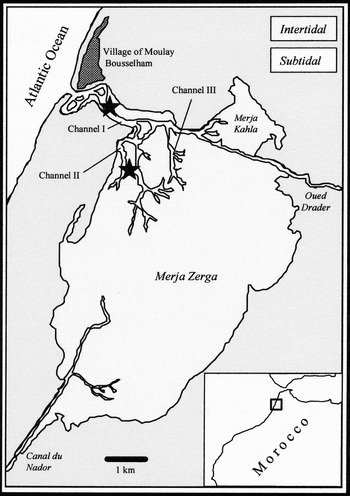
Merja Zerga is a semi-enclosed coastal lagoon located on the northern Moroccan Atlantic coast (34° 47′N–34° 52′N, 6°13′W–6°18′W (Figure 1)). The lagoon is an internationally important biological reserve due to its avifauna. The lagoon is also important to many exploited fish and shellfish stocks (Bayed et al., Reference Bayed, Bazaïri, Benhoussa and Qninba1998). Human activities include summer tourism, fishing, grazing and rush harvesting.
Map of Merja Zerga lagoon located near the small village Moulay Bousselham. The intertidal sampling sites are indicated (★). Subtidal specimens were collected from the nearest channels to these sites.

The surface area of the lagoon is 3730 ha (Carruesco, Reference Carruesco1989). The entrance of the lagoon is a narrow channel. Two permanent freshwater tributaries are connected to the lagoon (accounting for 1–2% of the turnover; Carruesco, Reference Carruesco1989). The salinity ranges between 8 and 36 psu (Labbardi et al., Reference Labbardi, Ettahiri, Lazar, Massik and El Antri2005). The annual sediment temperature within the lagoon varies between 11 and 28°C (authors' recordings, 2 cm below the sediment surface). Tides are semi-diurnal and the mean tide ranges between 0.15 and 1.50 m (Carruesco, Reference Carruesco1989). The intertidal area represents a surface area of 350 ha (2150 of lower marsh and 1400 of upper marsh) whereas the subtidal area accounts for 180 ha (Qninba, Reference Qninba1999). The water depth is generally less than 50 cm but can reach 2 m in some drainage channels at high tide (Ramdani et al., Reference Ramdani, Flower, Elkhiati, Kraïem, Fathi, Birks and Patrick2001).
The host and the associated metazoan species
Cockles were sampled in March 2006 both from intertidal and subtidal sites in the inner and outer part of the Merja Zerga lagoon. At the intertidal sites quantitative samples were taken during low tide by sieving sediment (mesh size: 1 mm) in situ from randomly placed quadrats (0.25 m2) within the experimental plots. Additional cockles, all buried, were hand-picked from a larger area at the inner intertidal site to provide enough cockle specimens to examine for metazoan species. To provide cockles from the subtidal site a dredge (mesh size: 1 mm) was pulled by man-power from the beach several times. Cockles were brought alive to our laboratory.
In the laboratory, the shell length of each cockle was measured to the nearest mm. Based on the size composition two length-groups from the intertidal samples and only one size-group from the subtidal cockles were selected for dissection (examination of metazoan species). For each combination of site, length-group and tidal level thirty cockles were autopsied.
Cockle tissue was removed from the valves and squeezed between two glass slides. All dissections were performed under a stereomicroscope. Different reports on parasites in cockles were used for species identification (Bowers, Reference Bowers1969; Bowers et al., Reference Bowers, Bartoli, Russell-Pinto and James1996; Bartoli et al., Reference Bartoli, Jousson and Russell-Pinto2000; Desclaux et al., Reference Desclaux, Russell-Pinto, de Montaudouin and Bachelet2006; Russell-Pinto et al., Reference Russell-Pinto, Gonçalves and Bowers2006).
Data analysis
The prevalence (% infected cockle individuals) of each metazoan parasite and mean abundance (mean number of metacercariae or metacercariae of each parasite species per host specimen) were determined for each length-group of cockles from the examined sites. To compare the patterns of infections in cockles between sites and length-groups we used box plots (median intensity, 25 and 75% quartiles of the number of metacercariae in infected individuals). For statistical tests see Results section.
A correspondence analysis was used to compare the different parasite infracommunities (i.e. parasite communities within an individual host). However, in order to minimize the strong between-individual variation in infection intensity, cockles were randomly pooled in groups of six individuals. Consequently, instead of thirty cockles per station, the analysis considered six cockles per station as a unit giving 5 replicates per site and length-group. This analysis uses a ‘cockle × parasite species’ matrix where the data are log10 (xi + 1)-transformed (xi = abundance of the species i). It is based on the χ2-distance and is recommended to avoid considering co-absence of species in two sites as a similarity criterion.
RESULTS
Host distribution and density
The density of cockles was higher at the outer intertidal site (550 ± SD = 415 ind m−2) than at the other sites (less than 100 ind m−2). Based on the shell-size composition of the cockle populations we selected two dominant length-groups for examination of parasites from the intertidal sites and only one length-group for each of the subtidal sites (Table 1). At the intertidal site in the outer lagoon, the mean shell lengths (±SD) of the examined cockles were 22 (±2) and 27 (±1) mm, corresponding to age-groups 1+ and 2+, respectively, according to our unpublished growth data from this site. In the inner lagoon, the mean lengths of the two cockle groups from the intertidal site were smaller, 17 (±1) and 24 (±1) mm, respectively. We do not have data on growth patterns from this site, but we assume that the two size-groups again correspond to age-groups 1+ and 2+. At the inner lagoon the growth rate of cockles is expected to be lower than in the outer lagoon because of less favourable environmental conditions (a slightly higher tidal level, more temperature variation and lower flux of food particles in the water). Cockles from the subtidal sites were larger (their mean lengths were 30±2 and 27±1 mm for the inner and outer lagoon, respectively) and we consider them as 2+ cockles.
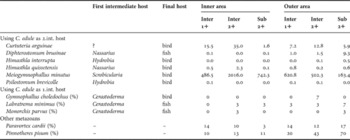
Abundance of trematodes (mean number of metacercariae per host individual) or prevalence (% of infected hosts) in Cerastoderma edule from the examined study sites and size-groups in Merja Zerga (March 2006). The data from each site and size-group are based on examination of 30 cockles.

1. int. host, first intermediate host; 2. int. host, second intermediate host; Inter, intertidal site; Sub, subtidal site; 1+ and 2+, length-groups of cockles.
Metazoan species in cockles
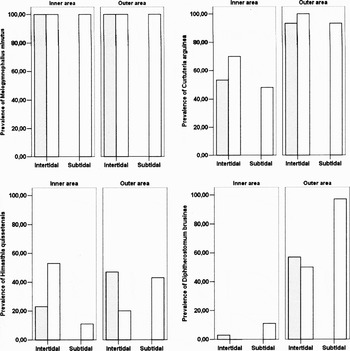
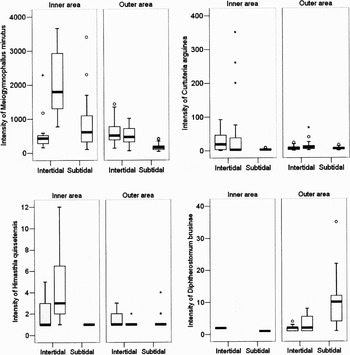
Besides one species of Turbellaria (presumably Paravortex cardii) and the pea crab (Pinnotheres pisum), nine digenean species were found, six using the cockle as a second intermediate host and three using it as a first intermediate host (Table 1). All digenean species were found in both the inner and outer lagoon, except Gymnophallus choledochus which was lacking from the inner site. The most common parasite species utilizing the cockle as a second intermediate host were Meiogymnophallus minutus, Curtuteria arguinae, Himasthla quissetensis and Diphterostomum brusinae (Table 1; Figures 2 & 3).
Prevalence (%) of 4 trematode species in Cerastoderma edule from the different study sites (inner and outer lagoon, inter- and subtidal sites) and age-groups (grey bar, smaller cockles; white bar, larger cockles) in Merja Zerga (March 2006).

Box plots of infection intensities of 4 trematode species in Cerastoderma edule from the different study sites (inner and outer lagoon, inter- and sub-tidal sites) and age-groups (grey bar, smaller cockles; white bar, larger cockles) in Merja Zerga (March 2006). Box plots show the median, interquartile range, outliers and extreme case of metacercaria numbers in C. edule (box length, interquartile range; vertical line, is drawn from the upper quartile to the point that is within a distance of 1.5 box length of the upper quartile; open circle, values between 1.5 and 3 box lengths; star, values more than 3 box lengths).

Prevalence and intensity pattern in Merja Zerga
Gymnophallus choledochus was only found in the large cockles from the intertidal flat in the outer area, where 7% of the cockles were infected by this species. The two other fluke species using cockles as first intermediate host—Monorchis parvus and Labratrema minimus—were recorded both in the inner and outer area in 3 to 7% of the cockles, respectively. In total, flukes using cockles as their first intermediate host infected 10% of the large size cockles in the outer area.
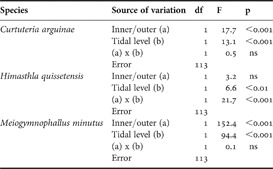
Flukes, that are using a host as their second intermediate host, are generally much more dispersed within the host population than those using the host as their first intermediate host. This is also obvious in our data as all cockles contained a larval stage from at least one fluke species. As an example, all cockles were infected by M. minutus (Figure 2) and more than half of the cockles in the outer lagoon were infected by C. arguinea (>90%) and D. brusinae (>50%). The large cockles (size-group 2+) from the intertidal flat in the inner part of the lagoon harboured the highest numbers of M. minutus and C. arguinea metacercariae (Figure 3). The number of M. minutus metacercariae was particularly high (≈2000 larvae/cockle) in this length-group (Figure 3). Metacercariae of M. minutus were heavily hyperparasitized in the outer lagoon (90%) by what could be the sporozoan Unikaryon legeri (Goater, Reference Goater1993) whereas they were almost healthy in the inner lagoon. When hyperparasitized, the metacercariae which resemble black rings when healthy (transmitted light) become grey bowls and progressively merge into a grey mass when the pathology progresses. In the 2+ size-group, for both M. minutus and C. arguinea the differences in numbers between sites (inner/outer) and tidal levels (intertidal vs subtidal) were significant (Table 2). For H. quissetensis the pattern was less clear. Generally there was a low number of H. quissetensis metacercariae but again with the highest intensity in cockles from the inner intertidal flat. In contrast, the highest number of D. brusinae metacercariae was in subtidal cockles from the outer area, whereas there were few metacercariae in cockles from the other sites. Psilostomum brevicolle and H. interrupta specimens were only found in low numbers in a few cockles.
Two-way analyses of variance comparing the parasite abundance of Cerastoderma edule (size-group 2+ only) as function of site (inner vs outer lagoon) and tidal level (inter- vs subtidal) for the three dominant trematode species. Data were log(x + 1)-transformed prior to analyses.

Flukes with metacercariae in cockles showed a higher intrasite variation in metacercaria numbers in cockles from low-density sites than in cockles from high-density sites (Figure 3).
As cockles occurred in higher densities on the studied intertidal site in the outer area than in the inner area the number of metacercariae m−2 of the prevalent species were generally much higher in the outer part.
The pea crab P. pisum and the flatworm P. cardii were found in a high fraction of the cockles. The prevalence of the flatworm varied between 3 and 17% without any obvious relation to site (Table 1). Conversely, the prevalence of the pea crab (P. pisum) was higher in the outer area (20–70%) than in the inner area (10–13%).
Community of parasites
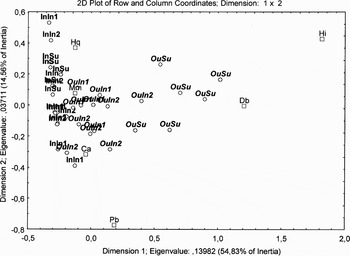
A correspondence analysis based on the community of digeneans with metacercariae in cockles (6 species) shows a distinction between different digenean communities with two major forcing environmental parameters (Figure 4). Axis one (54.8% inertia) separates outer site digenean communities on the positive part from inner site digenean communities. The subtidal outer community is particularly isolated due to the relatively high D. brusinae abundance (9.3 metacercariae per cockle compared to <1.5 in the other situations) (Table 1). To a lesser extent, this community also exhibits the highest H. interrupta abundances (0.5 metacercaria per cockle against almost none elsewhere). These trends can also be observed in the outer intertidal area for both size-groups. Axis two (15% inertia) gives a rough separation between intertidal and subtidal communities. The distinction is less obvious with the intertidal communities. In the negative part they are characterized by higher C. arguinae and to a lesser extent P. brevicolle abundances (both in inner and outer locations) (Table 1). The most opportunistic parasite is M. minutus, at the origin of the axes.
Cerastoderma edule plots (pooled by five individuals) and parasite species plots of the correspondence analysis along axes 1 and 2 (italic type, outer site; roman type, inner site). Circles represent cockles in relation to site (Inxx, inner site; Ouxx, outer site; xxIn, intertidal site; xxSu, subtidal site; 1, smaller size-class; 2, larger size-class) and squares represent trematode species in cockles (Ca, Curtuteria arguinae; Db, Diphtherostomum brusinae; Hi, Himasthla interrupta; Hq, Himasthla quissetensis; Mm, Meiogymnophallus minutus).

DISCUSSION
This is the first report of metazoan parasites in cockles from a locality near their southern distributional border in north-western Africa. Cerastoderma edule is a dominant suspension-feeder in the examined part of Merja Zerga (Bazaïri et al., Reference Bazaïri, Bayed and Hily2005). In the present study a high-density population occurred on the intertidal flat in the near oceanic part of the lagoon, whereas the occurrence of cockles in other parts of the lagoon was more scattered. With about 600 individuals m−2 of adult cockles and a biomass of about 80 g dry weight m−2 the high density population represents an important component of the ecosystem. The high numbers recorded in the outer part are probably not a persistent characteristic of the system as the strong currents at the entrance of the lagoon regularly modify the sandflat morphology (Bazaïri, Reference Bazaïri1999).
The richness of trematodes in cockles in Merja Zerga (9 species) is less than reported from Portugal (13 species) (Russell-Pinto et al., Reference Russell-Pinto, Gonçalves and Bowers2006), France (12 species) (Desclaux, Reference Desclaux2003) and Germany (10 species) (Thieltges et al., Reference Thieltges, Krakau, Andresen, Fottner and Reise2006). However, the relatively low numbers of cockles inspected in the present study could bias the comparison between sites. Nonetheless, the composition of the trematode community in cockles varies along the climate gradient in relation to the distributional patterns of involved intermediate hosts. The same three trematode species using cockles as a first intermediate host have been registered in cockle populations along the gradient from Morocco (Merja Zerga) to Germany (northern Wadden Sea). For the two species using fish as final hosts (L. minimus and M. parvus) this is an indication that their fish hosts Dicentrarchus labrax and Diplodus sargus (Maillard, Reference Maillard1976; Bartoli et al., Reference Bartoli, Jousson and Russell-Pinto2000) are dispersed along the whole climate gradient, unless other fish species also can be hosts to these trematodes. For flukes using cockles as a second intermediate host there are some species with a more limited distribution caused by the absence or presence of their first intermediate host (Thieltges & Reise, Reference Thieltges and Reise2007). Of the six fluke species with metacercariae in cockles in Merja Zerga three species (P. brevicolle, H. interrupta and M. minutus) have been recorded from cockle populations along the whole climate gradient (Merja Zerga to the Wadden Sea). The remaining species (C. arguinae, D. brusinae and H. quissetensis) are not found in the northern part of the climate gradient. In the north, cockles are not found together with N. reticulatus on the intertidal flat and as this snail is a first intermediate host to D. brusinae and H. quissetensis they are missing in cockles at this end of the gradient. So far, there are no reports about macroparasites in subtidal populations of cockles from sites in the northern part of the gradient where N. reticulatus could co-occur with cockles. Curtuteria arguinae is a newly described echinostomatid from Arcachon (Desclaux et al., Reference Desclaux, Russell-Pinto, de Montaudouin and Bachelet2006), whose first intermediate host is unknown. Therefore, we do not have any clues to its absence in the northern part of the gradient.
Missing macroparasites in cockles from Merja Zerga include R. roscovita, H. elongata, G. gibberosus and M. fossarum. Two of these species (R. roscovita and H. elongata) use the common periwinkle L. littorea as a first intermediate host, and G. gibberosus uses Macoma balthica. As these two host species have a southern distributional limit north of Morocco, their parasites are missing in Merja Zerga. For the missing Meiogymnophallus species the situation is less clear, but the distinction between both M. minutus and M. fossarum is not obvious (Russell-Pinto, Reference Russell-Pinto1990; Bowers et al., Reference Bowers, Bartoli, Russell-Pinto and James1996).
There is no overall and clear increase in intensity with size (age) of the examined cockles. Taking M. minutus as an example, higher intensities are recorded in the oldest cockles in the inner area but in the outer area the two groups harbour about the same numbers. This could be due to a lack of infection the previous year(s): both size-groups were therefore infected during a single year and underwent a similar infection. Another possible explanation could be a higher rate of hyperparasitism on M. minutus metacercariae in the outer area. We did observe that roughly 90% of the metacercariae in cockles had an appearance like those infected by the pathogenic sporozoan Unikaryon legeri (Goater, Reference Goater1993). This hyperparasite is supposed to infect and kill M. minutus metacercariae and might control infrapopulations of this trematode (James et al., Reference James, Sannia, Bowers, Nelson-Smith and Bridges1977).
Generally, we found higher intensities in cockles in the inner intertidal area than in the outer intertidal area. With the same input of infective propagules per unit area in the two sections of the lagoon we might expect such a pattern. The high cockle density in the outer area represents a dilution factor towards parasites—the risk of being infected is less when a potential host is surrounded by a high number of conspecifics (Mouritsen et al., Reference Mouritsen, McKechnie, Toynbee and Poulin2003; Thieltges & Reise, Reference Thieltges and Reise2007). However, the supplies of infective propagules are dependent on the numbers of first intermediate hosts and final hosts. Available evidence indicates that the dominance of M. minutus coincides with the dominance of Scrobicularia plana amongst potential 1st intermediate hosts (Bazaïri, Reference Bazaïri1999). The density of this bivalve is higher in the outer part but within a much smaller area than in the inner part of the lagoon.
For D. brusinae the situation is different. It reaches its highest prevalence and intensities in cockles in the outer subtidal area. As D. brusinae is using a cockle-eating fish as a final host and N. reticulatus, a rather subtidal gastropod (Eriksson et al., Reference Eriksson, Evans and Tallmark1975; Bachelet et al., Reference Bachelet2004), as first intermediate host the supply of infective propagules can be expected to be highest in the subtidal region. During a quantitative macrozoobenthos survey N. reticulatus was only registered in the outer lagoon and in particular in the subtidal sites (Bazaïri, Reference Bazaïri1999).
Considering the evidence indicating that cercariae shedding-rate is strongly temperature-dependent (Poulin, Reference Poulin2006) and that the annual period for cercariae production is roughly correlated with temperatures >12°C (Desclaux et al., Reference Desclaux, de Montaudouin and Bachelet2004), high levels of infection intensities were expected in cockles in Merja Zerga. However, the present data do not reveal particularly high infection levels in cockles compared with data from Arcachon (France) (de Montaudouin et al., Reference de Montaudouin, Kisielewski, Bachelet and Desclaux2000), or the Wadden Sea (Germany) (Thieltges & Reise, Reference Thieltges and Reise2006). Other factors may have a negative impact on the production of cercariae. The longevity of cercariae shed by a host declines with temperature (temperature dependent metabolism and a fixed amount of stored energy in a cercaria—do not feed), the life-span of infected intermediate hosts may be shorter because of higher temperatures (Evans & Gordon, Reference Evans and Gordon1983; Evans, Reference Evans1985). Generally, we can expect an increased diversity in benthic invertebrate communities along a latitudinal gradient from north to south (Attrill et al., Reference Attrill2001). As a result lower densities of the individual host organisms are expected, resulting in fewer infected first intermediate hosts per unit area. All together these factors will contribute to lowering the total cercariae production in the southern part of the gradient relative to the northern part. Finally, the energetic cost imposed by some parasites on their host might be higher under subtropical conditions than under temperate conditions. In Merja Zerga the annual surface sediment temperature range in 2005 was from 11 to 28°C (authors' recordings). A high mortality rate of heavily infected cockles during periods with high temperatures might eliminate the more heavily infected cockles from the population (Desclaux et al., Reference Desclaux, de Montaudouin and Bachelet2004).
We did not find new species in the Moroccan lagoon not already seen in Portugal and France. The long distance seasonal migration of waterbirds implies that the pool of bird parasites is potentially present in the whole east Atlantic shore region. The fish parasites may have a more limited distribution as fish being ectothermical animals typically have a more narrow distributional range than birds. So, during the last decade the sea bass Dicentrarchus labrax host to L. minimus has expanded its northern boundary to the North Sea area probably caused by the increased sea temperatures. As a result, L. minimus has recently been observed in cockles from the northern Wadden Sea (Thieltges et al., Reference Thieltges, Krakau, Andresen, Fottner and Reise2006).
Acknowledgements
This study has been financed jointly by CNRS (France) and CNRST (Morocco), and by the ‘Programme National Environnement Côtier’ (Project TAIPAMOR). Thanks to Hamid Rguibi for his valuable assistance in the field.