The myth of creation has been narrated by many cultures with various themes,Footnote 2 one of which speaks of the world originating from a cosmic being who is sacrificed by another primordial being. This theme can be found in the Iranian (Gayōmard and Yima), Indian (Puruṣa and Manu) and Scandinavian (Ymir) creation myths. Through comparative mythology, Lincoln (Reference Lincoln1975)Footnote 3 was able to reconstruct the Indo-European creation myth by elucidating that *Manu, the first priest, sacrifices his twin brother *Yemo, the first king, so that the world and the three social classes could come into existence from his body. Some researchers have posited their opinions regarding the presence of this theme in Iranian mythology. Christensen likens Gayōmard to the Scandinavian Ymir and reasons that he is the Iranian example of a primordial giant (Christensen Reference Christensen, Tafazzoli and Amoozegar2013: 42 ff.). Zaehner recognizes Gayōmard as an invented character substituted for Yima and speculates that his denunciation by Zoroaster in Gāthās caused some of his attributes, particularly his solar lineage, to be allocated to Gayōmard (Zaehner Reference Zaehner1961: 136).Footnote 4
Another theme speaks of the creation through prototypes. As Kreyenbroek (Reference Kreyenbroek1993) reconstructs the I-I creation myth, Varuna fashions motionless prototypes, and Mithra (or Indra in Rigveda) sets them in motion through sacrifice. Boyce (Reference Boyce1975: 1/141) supports this view. Hoffmann (Reference Hoffman, Glauch, Plath and Ziegler1992) looks at several versions of a narrative in the Yajurveda which discusses Āditi's childbearing, in order to introduce the egg-shaped being Mārtāṇḍa. This being, recognized as the Indian equivalent of Gayōmard in terms of its function and the meaning of its name, is described as the progenitor of Vivasvant, Manu, and Yama in Indian mythology.
As a result, two themes of creation from a body exist, distinguished by the victim of the primordial sacrifice: one featuring the primordial cosmic being and another with prototypes like human and bovine. The act of sacrifice necessitates cutting the body of the victim into pieces. This implies that all of these narratives are underpinned by the conceptual metaphor (CM) of “creating is cutting”. According to the conceptual metaphor theory (CMT), metaphors are not merely linguistic and poetic devices used for expressive purposes; rather, they are integral to human cognition, manifesting through language. In this cognitive process, understanding of a conceptual domain is facilitated by another conceptual domain (Lakoff Reference Lakoff and Ortony1993: 203). The first conceptual domain, known as the “target domain” (TD) and typically more abstract, is represented by “creating” in this instance, while the second conceptual domain, the “source domain” (SD), being more concrete and enabling metaphorical conceptualization, is represented by “cutting” in this case.Footnote 5
Cutting encompasses multiple facets, one of which is creative, whereby something is extracted or shaped from an original material. This can be observed, for instance, in the transformation of stone-based objects, which undergo a distinct process before assuming their ultimate form. Starting with a quarry, marble slabs are extracted and shaped through various acts of cutting into sculptures, candle holders, trays, tiles, etc., each with distinct forms corresponding to their intended functions. Wooden objects undergo a similar process, whereby the wood is cut and subsequently shaped or assembled to create items such as chairs, dishes, etc. Based on these examples, the constituent elements forming the structure of the source domain (SD) can be summarized as shown in Figure 1.
The conceptual structure of “cutting” source domain

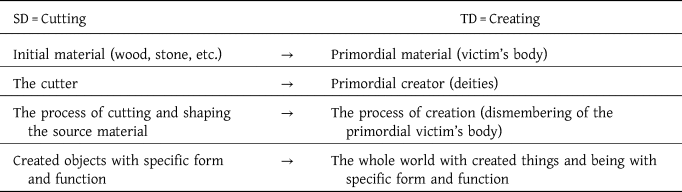
The concept of creation stems from an abstract understanding of this aspect of the SD, namely “cutting something out of something”, where there is a primary material, agents who act upon it, and the resulting phenomena of the process. In the context of the above-mentioned narratives, creation involves a source material for all entities, symbolized as the primordial sacrificial being.Footnote 6 It undergoes dismemberment, akin to being cut into pieces, subsequently shaped by divine forces, resulting in distinct objects or beings with suitable functions. Apparently, the structure of the SD aided ancient societies in comprehending the process of creation. Therefore, considering different types of CMs,Footnote 7 the creation metaphor belongs to the category of structural metaphors, in which the concept of creating is understood through the structural characteristics of the cutting source domain.Footnote 8
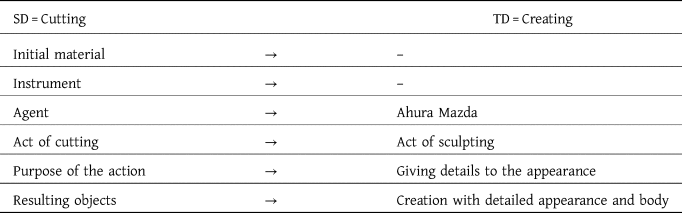
The metaphorical connection between the elements of the SD and the TD is established through a series of “cross-domain mappings”, as described in the CMT.Footnote 9 In the context of creation, these mappings can be illustrated (see Table 1).
Conceptual mappings of the creating is cutting metaphor

It must be noted that Iranian mythology's development of this CM is complex and extensive, necessitating a deeper examination for a cohesive model. Previous theories have focused on the figures symbolizing the primordial victim rather than the CM itself. Linguistic analysis has also primarily concentrated on the name of these figures, while the manifestation of the CM is more evident in verbs denoting action. Put differently, creation is inherently an action, and as such, it is conveyed through specific verbs. Likewise, CMs are cognitive in nature but find their expression in language. From this perspective, linguistic metaphors serve as the tangible representation of the underlying conceptual metaphor (Lakoff and Johnson Reference Lakoff and Johnson1980: 4),Footnote 10 highlighting the significance of analysing linguistic expressions in metaphor analysis.
As for the Zoroastrian texts, Avestan roots ϑβǝrǝs- and taš-, and the Pahlavi term brēhēnīdan, are used for this purpose. It is important to note that the term's literal meaning opens the path to understanding the underlying metaphor. But the significance of this aspect of the Zoroastrian creation myth is often overlooked due to general translations of the mentioned roots: in a general sense, they literally mean “to cut”, but are commonly translated as “create”, “fashion”, or “shape” in the context of creation. This approach presents two issues. First, near-synonyms are translated as identical, obscuring their unique meanings. Second, translations prioritize reader-friendliness by using familiar terms, but this removes cultural richness and specificity, simplifying and diluting the text's original cultural context. To gain valuable insights, a philological, contextual, and thematic examination of creational verbs is necessary. Hence, this article aims to explore a new way of understanding the ancient Iranian worldview on creation reflected in Avestan and Pahlavi sources by focusing on their connections to the conceptual metaphor “creating is cutting”. It begins by conducting an etymological analysis of the aforementioned Avestan roots and their derivatives within three distinct contexts:
1. Non-metaphorical
2. Non-creational metaphorical
3. Creational metaphorical
This investigation sheds light on the structural aspects of the source domain, followed by an examination of how these elements are metaphorically mapped onto the target domain in both non-creational and creational contexts. Subsequently the mappings are analysed along with the focus of the metaphor. Applying the same method, the discussion continues with the analysis of Pahlavi terms brēhēnīdan and kirrēnīdan, emphasizing the former, while referencing previous scholarship on the latter.
1. taš- Footnote 11
The root OIr. taš- “to cut” (Av. taš-, MP tāš) is derived from PIE *tetḱ- meaning “build by cutting” and attested in Skt as takṣ- “to form (by cutting), build” (Cheung Reference Cheung2007: 384–5).
1.1. Non-metaphorical context
A) To chop or hew wood. For example, as narrated in Vd 5.2,Footnote 12 a man cuts down a tree and chops it into firewood to create a fire. Similarly, in Vd 14.7,Footnote 13 a sharp-edged and sharp-pointed axe is mentioned as a necessary tool for making the fire of Ahura Mazda with firewood.Footnote 14
The first two examples highlight two variations of the examined root term: a prefixed verb (auui dim tāšti) denoting the action of chopping and a noun (taša-) indicating the sharp instrument used for the action. Both examples involve splitting wood with an axe into smaller pieces for a specific purpose, such as making ritual firewood. They share common characteristics: the use of an axe as the tool, wood as the material being cut, the requirement of physical force and skill by the agent, and the completion of the action in a single swift movement. The Avestan word for axe derives from this root, reinforcing these implications.
B) To build something. For example, building a sturdy house (Y 57.10).Footnote 15 Also in A3Pa (21–3),Footnote 16 the OP, us-tašanā-, denotes a staircase, made of stone (aϑangainā-).
The prefix ham-, denoting “together”, signifies an action performed by multiple agents when used with intransitive verbs (i.e. hamgam-, “assembly”). In the case of transitive verbs, two meanings can be considered: 1) multiple agents = collective collaboration (i.e. hąm.bǝrǝϑa-, referring to a daēvic gathering in Vd 19.45,Footnote 17 where demons literally carry themselves to the summit of Mount Arzur); and 2) solo agent = modifying how the action is performed on the object(s) (i.e. hąm.bərəϑwā-, denoting “to carry a lot of things together”, thus signifying the earth giving a full harvest of grain (yauua-) to a person who cultivates the land in Vd 3.27).Footnote 18 Another example is handāman- meaning “limb”, formed by ham- + dā- “to put, place”,Footnote 19 essentially referring to assembled components forming an entity (such as limbs forming a body) comparable to MMP hnd'm, denoting a “limb” and referring to a canto that, when combined with other cantos, forms a Hymn Cycle.Footnote 20
In the example at hand (Y 57.10), the verb hąm.tāšti (transitive 3rd person singular) indicates a solo agent (Sraoša), providing the necessary components (i.e. lumber) through hewing the initial material (wood), constructing an entity (sturdy house) by assembling the parts. The successful completion of the task requires skill, dexterity, and expertise, ascribing to Sraoša the possession of these qualifications. The subsequent instance involves stone construction (OP ustašana-),Footnote 21 where the material is chiselled and hewed into an intricate structure, leaving some scraps behind. Unlike the previous context, in which the material was chopped into smaller pieces, here the shift is from an unshapen unity to a detailed entity.
In both A and B, the semantic structure of the term encompasses the initial material, instrument, agent, the act of cutting, the purpose of the act, and the resulting object with its specific functions. The object, at times, constitutes a composite entity, necessitating its assembly, indicated by the application of the prefix “ham-”, signifying the process of bringing together the various parts subsequent to cutting.Footnote 22
1.2. Non-creational metaphorical context
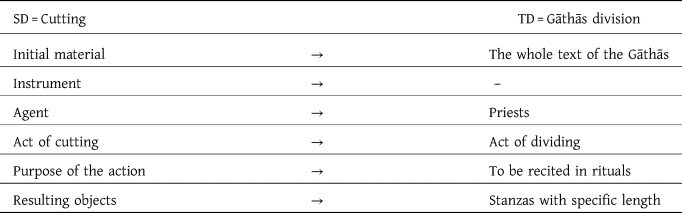
The root is metaphorically employed to denote Gāthās division. The term vačastaštay- meaning “stanza of Gāthās” (Y 57.8)Footnote 23 is used alongside other terms to indicate different divisions of the text.Footnote 24 Thus, the metaphor “dividing a text is cutting” can be identified through the conceptual mappings shown in Table 2.
Conceptual mappings of dividing gāthās is cutting metaphor

As Table 2 depicts, Gāthās is envisioned as a source that is divided into smaller pieces, in this case stanzas.Footnote 25 Similarly, the Latin word caesura, derived from the root caedō/ere meaning “to cut, hew, fell” (de Vaan Reference de Vaan2008: 79), represents breaks within poetry. These instances demonstrate the transition from unity to multiplicity, where the original source is completely divided without remnants.
The TD lacks the instrument, which is not necessary for dividing a text into sections and is not considered part of the TD's structure. Therefore, it is not involved in the mapping process. In accordance with the invariance principle, only elements from the source domain's structure participate in cross-domain mappings that align with the structure of the target domain (Lakoff Reference Lakoff and Ortony1993: 215 ff.).
1.3. Creational metaphorical context
The exclusive agent being Ahura Mazda, it is frequently used for the material creation.Footnote 26 He is also attributed with creating all aspects of goodness (tarṣ̌uuā̊ŋhəm vīspa vohu, Y 70.1),Footnote 27 encompassing beings and concepts,Footnote 28 conceptualized through the same SD.
Analysing ham-taš- in this context reveals two slightly different meanings, arising from the singularity or plurality of the object. In one context, due to the singular object, namely the cow, the term conveys fabrication, suggesting that through the creation metaphor, Ahura Mazda is believed to have hewed the cow's various body parts out of the initial material, followed by their skilful assembly, resulting in the creation of the animal with its distinctive form (Y 47.3).Footnote 29 In another (Yt 5.120), however, the plural object (caϑβārō aršāna) alludes to the act of hewing together.Footnote 30
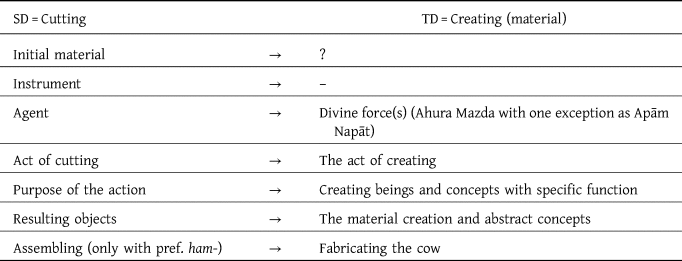
Despite the superficial differences between the examples, all of them rest upon the “creation is cutting” conceptual metaphor, characterized by the mappings shown in Table 3.
Conceptual mappings of taš- in the context of material creation

However, in the mappings (Table 3), two elements are missing from the TD side: the initial material and the instrument.Footnote 31
The examination of the spiritual creation context sheds more light on this matter. The creation of spiritual entities follows a similar process to the creation of material entities, but marked with the distinct adjectives of mainiiutāšta- and hutāšta-.
The former consists of mainiiu- + tāšta- (past passive participle), and has been variously translated based on different interpretations of the first term. Interpreting mainiiu- as a reference to the sky where the action of taš- occursFootnote 32 may not be credible, as the sky itself is described with the same adjective (Yt 13.3).Footnote 33 Notably, the term is not used to refer to divinities, who are typically addressed as yazata-. Therefore, the agency of divinities in the act of creation cannot be inferred from this term as some scholars have suggested.Footnote 34 Kellens suggests that ahuraδāta- and mazdaδāta- are short forms of *ahura.mazda.dāta-, reconstructing the adjective as *spǝnta.maniiu.tāšta- and proposing that it refers to spǝnta.mainiiu as the agent of creation (cited by Mowlaee Reference Mowlaee2013: 198).Footnote 35 While this suggestion seems plausible, several important considerations should be taken into account. First, there is no necessity to interpret the terms as short forms of a larger compound. Second, the compound adjective is exclusively used for spiritual creation, whereas Ahura Mazda is also credited with material creation, which does not employ this adjective. Finally, mainiiu- does not necessarily refer to the Beneficial Spirit without the presence of its accompanying adjective, spǝnta-.Footnote 36 Therefore, it is unlikely that the term references this spirit in this specific context.
Another suggested translation is “spiritually fashioned”, which aligns with the literal meaning of the term.Footnote 37 In this context, mainiiu- (invisible, ethereal, untouchable – the same characteristics possessed by spiritual entities) should be understood as contrasting with gaēϑā- (visible, earthly, tangible).Footnote 38 The root taš- is consistently used when Ahura Mazda is the agent, suggesting that mainiiu- serves as the initial material from which Ahura Mazda hewed these entities. The Avestan term zaraniiō.kǝrǝta- signifies being made out of gold, relating to gold as the initial material for the throne of vohu.manah-.Footnote 39 Similarly, mainiiu- corresponds to zaraniiō and tašta- to kǝrǝta- in terms of their functions. Accordingly, the proposed translation of mainiiutašta- is “hewed out of mainiiu”,Footnote 40 denoting the spiritual nature of the described entitiesFootnote 41 in its ultimate and general sense.Footnote 42
The texts reveal the connection between the form and function of supernatural beings. Although they are part of the invisible forces of the cosmos, these entities were attributed with specific shapes and forms. Their creator's craftsmanship and the material they were hewed from resulted in them being perceived as possessing flawless and perfectly suited imaginary bodies. This belief is captured by the term hutāšta-, meaning “well-hewed”.Footnote 43 This emphasizes that Ahura Mazda was considered a skilled and masterful creator,Footnote 44 supported by further textual evidence where He is referred to as huuāpā̊ Footnote 45 (“good artisan” or “craftsman”)Footnote 46 when discussing the creation of light and darkness, sleep and wakefulness (Y 44.5).Footnote 47
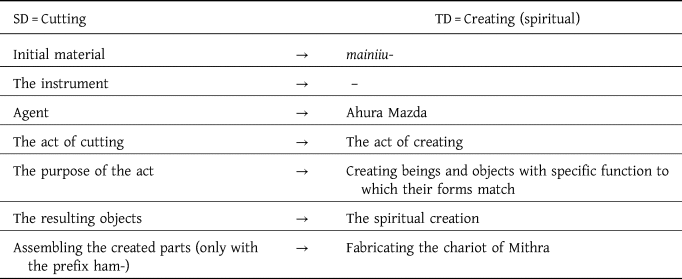
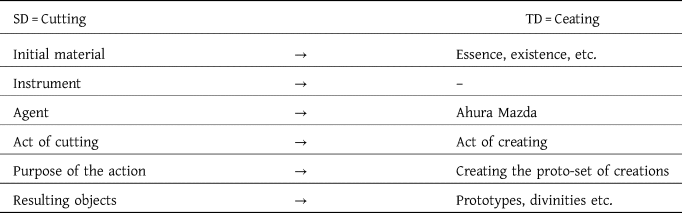
As depicted, the spiritual creation is also based on the creation conceptual metaphor. The mappings are shown in Table 4.Footnote 48
Conceptual mappings of taš- in the context of spiritual creation

According to Table 4, the initial material is mentioned, while the instrument is absent (see n. 31). Concerning the initial material, while it is present in the previous contexts (1.1, 1.2) and spiritual creation, its absence in the context of material creation seems intentional, suggesting that the Zoroastrian perspective may have intentionally excluded or disregarded the initial material in material creation during the evolution of the theme. It seems likely that changing attitudes towards certain aspects of sacrificial practice and the prohibition of attributing the violent act of body dismemberment to Ahura Mazda helped motivate this erasure.Footnote 49
2. ϑβǝrǝs- Footnote 50
The Avestan root ϑβǝrǝs- (OIr. ϑṷars- < PIE *tṷerk̂-) “to cut, to shape” has been attested only in Avestan among the Iranian languages.Footnote 51 In Sanskrit, the name of the creator god, tváṣṭar- is an agent noun derived from this root, literally translating as “cutter (creator)”.Footnote 52
2.1. Non-metaphorical context
It denotes various acts of cutting:
A) To cut something off a source or whole. For example to pare the nails of hands and feet (Vd 17.2);Footnote 53 to cut off the ear of a dog who has committed the sin of killing a sheepFootnote 54 (Vd 13.32);Footnote 55 to cut forth the meat of the sacrificial animal for Haoma (Y 11.7).Footnote 56
Considering the use of prefixes, this root differs from taš-, indicating the direction of movement required for wielding a sharp tool. The first and second instances utilize the prefix upa- (“to, towards”) for movement towards the object. In the third example, the prefix frā- is employed to signify forward movement during the cutting process. This type of cutting is best done with small tools like knives or blades, involving fluid hand movement compared to the striking action of taš-.
B) To cut or dig a hole. For example cutting a hole in the wall of a house where a dead body remains, allowing the owners to leave the place (Vd 8.10)Footnote 57 or let the water flow in a field by piercing [the dam] (Vd. 14.13);Footnote 58 Also digging a two-fingers-deep hole into the cleansing ground as part of the purification process for something that touched a dead body (Vd 9.6).Footnote 59
With respect to the employment of prefixes indicating the movement of the sharp tool in this context, upa- signifies the breach on the surface of the wall or a dam and ni- meaning “down, into” signifies the hole dug in the ground. This connotation is consistent with the previous context to some extent, since it conceptualizes the actions as making cuts and holes on a surface – although deeper and bigger.
C) To carve (for adornment). This is exemplified in the description of the horned gold-adorned hoofs of the four horses pulling Sraoša's chariot (Y 57.27).Footnote 60
The use of the prefix paiti- indicates that the utilized sharp tool, presumably small and pointy, is directed “towards” the surface of the golden or gildedFootnote 61 hooves (safā̊ŋhō zaraniia), implying the act of carving or, more plausibly, engraving patterns on them (potentially performed by Ahura Mazda?).
Unfortunately, related evidence in Iranian sources is scarce. However, the Rigveda provides a broader understanding. The Sanskrit word tvaṣṭar- (lit. “cutter”) derived from the same root, is the name of the god of craftsmanship, who creates through acts of cutting. The text introduces him as the one who provides all forms (1.13.10),Footnote 62 a highly skilled craftsman who has created Indra's mace, the epitome of workmanship (1.61.6),Footnote 63 having a thousand spikes and a hundred edges (6.17.10).Footnote 64 He is also described as “the good craftsman” who turned the well-made golden mace of Indra (1.85.9).Footnote 65 These examples demonstrate that Tvaṣṭar was believed to be a highly skilled deity who cuts objects and beings from initial materials, carving their forms and shapes delicately and masterfully, particularly in the case of Indra's mace. Thus, a proper name had to be derived from a suitable root that conveyed such semantic details, suggesting that the root in question connoted such ideas, as it was employed for this purpose.
This is in line with the Avestan evidence, as both convey mastery and skill and are used for divine objects and adornments. Therefore, ϑβǝrǝs- denotes a deliberate and precise cutting action, wherein the agent employs a sharp instrument to make incisions, serving to create markers, excise specific portions from the source, or form distinct patterns upon the surface. It is achieved through slow, deliberate movements of the tool. The root also includes creating pierces and holes with various tools, within the context of surface cutting. When considering these semantic details, it becomes evident that this particular cutting action bears resemblance to sculpting and carving in which an array of tools such as scalpel, burin, gouge, rasp, adze, etc. are employed.Footnote 66
2.2. Non-creational metaphorical context
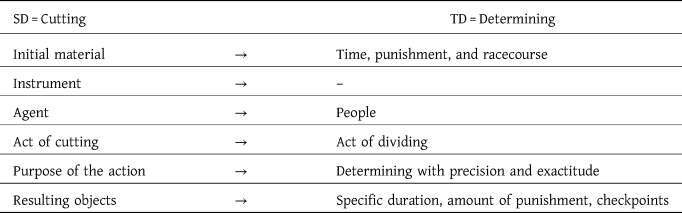
The root is employed to denote measurable time. In the Avestan texts, it is correct to posit the existence of two distinct forms of time: Eternity (+aϑβaršta- zruuan-) and Time (frāϑβaršta- zruuan-). The former represents time without division, while the latter refers to time that is divided and formed. This hypothesis suggests that frāϑβaršta- zruuan- indicates time segmented into discrete slots, in contrast to undivided Eternity. This division is conceptualized as incisions made upon the surface of Time, a process often signified by the prefix paiti-. The shaping and forming of time through these metaphorical “incisions” result in measurable intervals, as can be evidenced in several Avestan examples. For instance, time is metaphorically marked (literally “cut”) to determine the duration of specific events, such as the growth of plants (Yt 13.56)Footnote 67 and the preparation of beaver skins (Yt 5.129).Footnote 68 The fixing of penalties in Vd (7.71)Footnote 69 also follows this pattern, as the severity of punishment is determined by metaphorical incisions according to the gravity of sins. In Yt 19.77, a racecourse with nine cuts is described, where Kavi Haosrawa triumphs over an enemy, suggesting that the race is metaphorically divided into nine checkpoints.
These examples demonstrate that abstract concepts such as time, punishment, and racecourses are metaphorically treated as material-like substances that can be sculpted or divided. Despite variations in the treatment of these concepts, there are discernible similarities. For example, knowledge of plant growth was crucial for ancient Iranians in understanding how to time grazing, while the appearance of the Tištrya star signified rain (Yt 8.4).Footnote 70 Punishment, like other material-like sources, must be “cut” into precise portions that correspond to the offence, ensuring that the guilty party receives an exact and proportional sentence.
In conclusion, the conceptual metaphor “determining is cutting” is discernible and characterized by the mappings set out in Table 5.
Conceptual mappings of determining is cutting metaphor ϑβǝrǝs

2.3. Creational metaphorical context
The root is employed for both spiritual and material creation. Some examples refer to the agency of Ahura Mazda.Footnote 71 However, there is an intriguing piece of evidence considering the agency. In Y 29, the soul of a cow laments:
kahmāi mā ϑβarōždūm kə̄ mā taṣ̌at̰ (Y 29.1)Footnote 72
“For whom did you (divinities) scuplt me? Who hewed me?”
Both Avestan roots are employed within this context: ϑβerəs- is used in the 2nd person plural form (ϑβarōždūm) to denote multiple subjects involved in the creation of the cow, while taš- is used in the 3rd person singular form (taṣ̌at̰) to indicate the involvement of a single subject. Notably, taš- has never been utilized in the plural form when referring to creation. In light of the CM framework, this suggests that during the creation process, hewing was carried out by a solitary agent, while sculpting was a collective endeavor. Furthermore, it implies that the individual responsible for “hewing” the cow in the example is distinct from the multiple agents involved in sculpting, although it remains possible for the hewer to also participate in the sculpting process, proved in the following stanza (29.2), where a character named tašā gǝ̄uš asks Aṣ̌a about the judgement concerning the caretaker and protector of the cow. The duty of answering the question is passed to Ahura Mazda. In the sixth stanza, he answers:
at̰ zī ϑβā fṣ̌uiiaṇtaēcā vāstriiāicā ϑβōrəštā tatašā (Y 29.6)
“For, I, the sculptor, have hewed you for the cattle-breeder and herdsman.”
Kellens (Reference Kellens1995: 349–50) convincingly argues for tatašā as a first-person singular verb, supported by instances in Y 44.6, 37.1, and 39.1 attributing the creation of the cow to Ahura Mazda. He further posits that if another deity were responsible for this creation, they would have addressed the question prior to Ahura Mazda's attempt to do so,Footnote 73 reinforcing the identification of the sculptor with Ahura Mazda.Footnote 74 In light of this identification, Gǝ̄uš Tašan can be understood as a manifestation of His creative quality, portrayed as a character among others, fulfilling a role in the poetic scene functioning to introduce Zoroaster as the caretaker and guardian of the cow on earth (stanzas 8–9).Footnote 75 Another mention of gǝ̄uš tašā in Y 46.9, which likely alludes to Y 29, aligns with this interpretation.Footnote 76
Returning to the previous evidence, an important question regarding the identity of the multiple subjects involved in the sculpting process remains unanswered. It is evident that only deities can partake in this act. The multiple subjects referred to as ϑβarōždūm can be associated with the divinities present at the scene when the cow addresses them.Footnote 77 Humbach and Faiss (Reference Humbach and Faiss2010: 169) propose that the use of plural pronouns xšmaibiiā and xšmat̰ may serve either to address multiple personas or as a form of polite address to Ahura Mazda. In verse 29.8, the speaker, surely a divinity, dialogues with Mazda on the fact that Zoroaster alone listens to “our commandments” (yə̄ nə̄ aēuuō sāsnā̊ gūšatā) and wishes to recite songs of praise “for us” and for Aša to make us renowned (huuō nə̄ mazdā vaštī aṣ̌āicā carəkərəϑrā srāuuaiieŋ́hē). As the speaker addresses Mazda in the vocative case, the term “us” refers to the speaker himself and Ahura Mazda. Hence, it is reasonable to suggest that at least three personas are present at the scene: Mazda, Aša, and the speaker, who might represent Good Thinking if we subscribe to Insler's analysis of the instrumental vohu manaŋhā (1975: 154–5). Nothing prevents us from imagining the presence of additional divinities at the scene. Therefore, the speaker distinguishes Mazda from himself as Mazda is the leader of the divinities. Consequently, the plural references in verse 29.1 most likely address multiple personas. This identifies the subjects of ϑβarōždūm with the intimate circle of divinities surrounding Ahura Mazda, developed under the epithet of the Beneficial Immortals in post-Gāthic texts. Another piece of evidence clearly attributes the act of sculpting the creation to these divinities:
yōi həṇti ā̊ŋhąm dāmanąm yat̰ ahurahe mazdā̊ dātarasca marəxštarasca ϑβarəxštarasca aiβiiāxštarasca nipātarasca nišharətarasca (Yt 19.18).
(The Beneficial Immortals) who are the placers and designers, the sculptors and supervisors, the protectors and guardians of these creations of Ahura Mazda.
It presents a fascinating and intricately described account of the creation process, undertaken by the Beneficial Immortals. They are initially described to position the creatures in the universe. Subsequently, they meticulously plan each creature, mapping out the precise contours and proportions that should be delicately carved and refined. Once the designs are finalized, the sculpting begins, with the Beneficial Immortals closely overseeing every step until the desired outcome is achieved – creatures with their definitive form and intricate features. Furthermore, they ensure the protection of these creations, shielding them from potential hazards, presumably originating from the daēvic forces.
Metaphorically speaking, it is crucial to note, based on the evidence and the semantic nuances of the root, that the Beneficial Immortals do not engage in the act of hewing (taš-) the creatures from the original material. The creatures are already hewed, most likely by Ahura Mazda, as these divine forces are credited with placing them in their specific positions within the universe in order to give the creatures their final appearance through sculpting and carving (ϑβərəs-). Thus, the deliberate absence of taš-, Mazda's exclusive act, in the text is likely intentional. More importantly, there is no mention of other multiple subjects involved in the creation process throughout the Avesta, apart from high-ranked divinities. What can be inferred from this?
In the real world, the process of creating objects with intricate appearances (i.e. sculptures) typically involves two phases. First, the initial material (such as wood or stone) is hewed into an undifferentiated and undetailed form. Second, using appropriate tools, the details are added to the shape through carving and sculpting. These two phases can be compared to the two Avestan roots in the context of creation: taš- meaning “to hew” corresponds to the first phase, while ϑβərəs- meaning “to sculpt” corresponds to the second phase. The paper proposes that, according to the conceptual metaphor “creating is cutting”, it is reasonable to consider that the Iranian creation myth on both the spiritual and material levels, in at least in one of its variants, consists of two phases.Footnote 78
In the first phase of spiritual creation, Ahura Mazda hews solely the general, undetailed and inanimate form of spiritual beings, skilfully and masterfully, from mainiiu-. Vr 7.4 refers to these spiritual forces as “first-put-in-place” (paoiriiō.dāta) and “carved-out-first” (paoiriiō.fraϑβaršta) before the creation of material entities such as the sky, water, earth, plants, and beneficial quadrupeds.Footnote 79 This indicates that after hewing, Ahura Mazda places them in position and further carves and sculpts their envisioned detailed appearance so that they become animate, which includes the second phase.
Now that all the divinities are completely brought to existence, the material creation happens. In the first phase of this type of creation, Ahura Mazda hews the undifferentiated inanimate form of material creatures. In the second phase, with the collaboration of high-ranked divinities, he places them in their designated positions, and carves and sculpts their detailed appearance to match their intended functions. This causes procreation and a multiplicity of creatures, which completes the material creation.
The validity of this hypothesis is confirmed by the Hindu narrative of Mārtāṇda, briefly alluded to in the introduction. Hoffman examines a particular narrative referenced in ŚB III (1,3,3.4), focusing on the genesis of the human race. As per this narrative:
Āditi had eight sons. But those called “the Āditiya gods” were only seven. The eighth she brought forth unshaped. He was only a lump; he was as big transversely as he was vertically; some say “equal to a man”. Then the Āditya gods said: “What has been born after us shall not perish. Come, let us shape this one”. They shaped him the way a man is shaped. From the pieces of flesh they cut off from him and collected, the one has a hand (the elephant) arose … He whom they shaped in this way, that was Vivasvant, the son of Āditi. From him this offspring is descended (Hoffman Reference Hoffman, Glauch, Plath and Ziegler1992: 720; emphasis added by the author).
According to the narrative, the Āditi and her sons are present (similar to Ahura Mazda and the Beneficial Immortals). An unshaped (ávikṛta) inanimate and round entity is brought forth by Āditi (paralleling the undifferentiated inanimate forms hewed by Ahura Mazda). Then they begin to modify (vikṛt-) its appearance (collaborative creation).Footnote 80 Since it mentions pieces of flesh being cut from him, the action is undoubtedly sculpting and carving (denoted by ϑβərəs- in the Iranian narrative). After this process, Vivasvant, the progenitor of human beings, is created (completion leading to animation).Footnote 81
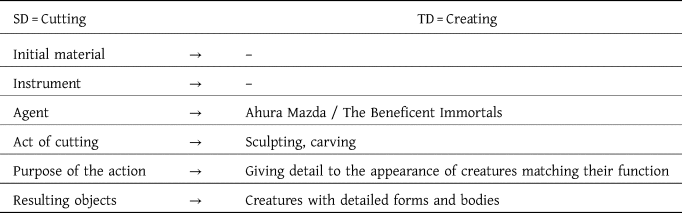
The mapping of this context also contributes to the confirmation of the hypothesis (see Table 6).
Conceptual mappings of ϑβǝrǝs- in the creation context

In line with the preceding metaphorical contexts (1.3, 1.2, 2.2), the omission of the instrument from the mapping can likely be attributed to its inconsistency with the structure of the TD. The instrument is not mentioned in the Hindu narrative either. However, the exclusion of the initial material requires further examination, warranting consideration of two possibilities:
1. As discussed previously, the exclusion of this element in the creational context of the root taš- is probably due to priestly modifications. It is plausible that this case has also been excluded based on the same rationale, encompassing both the spiritual and material creation.
2. The exclusion of the element in both types of creation, along with the semantic details and connotations of the root, suggests that it primarily denotes modifications made to the surface of undetailed forms of creatures previously hewed by Ahura Mazda (taš-). Consequently, the central focus in the underlying structure is not on the initial material, but rather on the agency of the divinitiesFootnote 82 and the nature of the action performed on the objects with the subsequent result. This aligns with the hypothesis proposing two phases of creation, wherein this verb belongs to the second phase, rendering explicit reference to the initial material unnecessary.
In light of all the findings so far, we can summarize the underlying structure and connotations of the two Avestan roots as follows: the root taš-, exclusively employed for Ahura Mazda in creational context, describes the initial phase of creation, entailing the shaping of the creature or object's general form by hewing it from the primary material or fashioning its constituent parts (with -ham-), utilizing skill, strength, and likely a substantial tool such as an axe. Subsequently, the root ϑβǝrǝs- denotes the subsequent phase wherein visual details are imparted to the entity's body and face through sculpting or carving, employing a more delicate blade-like instrument. This process, executed by Ahura Mazda (only in spiritual creation) or both Him and His high-ranked forces (in material creation), exemplifies precision, finesse, and artistic prowess, resulting in the creation of unique spiritual and diverse material beings that harmoniously align their form with their intended function.
3. brēhēnīdan
Nyberg (Reference Nyberg1974: 2/49) has proposed that brēhēnīdan is a denominative form of the noun brīh, denoting “fate” or “destiny”. With regard to this proposal, it is interesting to note the fact that nouns for “fate, destiny” and the like often reflect their derivation from verbs meaning “to divide a whole and distribute the portions to those seen to deserve them”, as in the relation of Greek μοίραι to the verb μείρομαι. Footnote 83 Division cannot be conceived without a preceding act of cutting, confirming the term's derivation from the root OIr. *brī- meaning “to cut” (Skt. bhrī “to harm”) originating from PIE *bhr(e)iH-,Footnote 84 which has been used very few times in Avesta,Footnote 85 despite its absence in Old Persian. However, its cognates in other Iranian languages are found abundantly.Footnote 86
3.1. Non-metaphorical context
It denotes various acts of cutting. For example the severed head of the women from their bodies in dušox (AWN 57.1)Footnote 87 or cutting the stink or decay of dušox off using a blade-like implement (kārd; Bd 27.57).Footnote 88 The seventh book of Dēnkard also states that the Mazda-worshippers joyfully sacrifice an animal from the livestock and cut its meat into pieces and the animal rejoices and happily asks them to do so (Madan Reference Madan1911: 2/670).Footnote 89
Nearly all examples focus on separating a portion from its source. The last example indicates that the correct performance of sacrificial rituals and meticulous and accurate cutting was crucial, as any mistake in cutting and offering the animal's flesh and fat could invalidate the reward. Implying the significance of this task, according to the eighth book of Dēnkard, the lost book of the Avesta, the Pāzag, provided detailed instructions for sacrifices and emphasized the need for expertise to ensure precise adherence to sacred law and dedication of the proper part of the animal to the corresponding deity (Madan Reference Madan1911: 2/682).Footnote 90
The semantic structure of the term encompasses the usual elements, including the initial material, instrument, agent, the act of cutting, the purpose, and the resulting object. However, there is greater emphasis on the completion of the action, the manner in which it is carried out, and the resulting outcome. This context corresponds to the non-metaphorical context of ϑβǝrǝs- (see context 2.1).
3.2. Non-creational metaphorical context
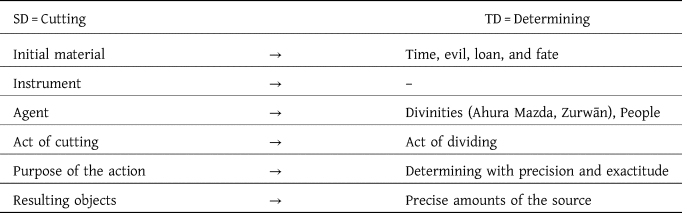
In this context, similar to ϑβərəs-, it denotes the precise time and duration of an event and determining portions, parts, or sections. According to WZ, Ahura Mazda acknowledged that without a specific period of time for his battle with Ahriman, the Evil Spirit can gain favour and incite rebellion against Ahura Mazda (8.1).Footnote 91 In MHD, the discussion generally centres on the repayment of a portion of a loan by the borrower to the lender (3.3–4, cited in Mansouri Reference Mansouri2017: 2/143);Footnote 92 while the seventh book of Dēnkard describes the events that took place at the end of the tenth century of the millennium of Zoroaster (Madan Reference Madan1911: 2/666).Footnote 93 Moreover, in WZ, Zurwān is referred to as brīngar (2.19), which literally translates to “the one who cuts”, yet functions as a synonym for “the one who destines”.Footnote 94
These examples serve as a demonstration of how abstract concepts, such as time, evil, loans, and destiny can be perceived as cohesive entities that can be divided into specific and definite portions or periods, or conceived with an endpoint that is metaphorically represented as a cut, connoting exactitude. There is another significant piece of evidence that merits further explanation:
– agar [ēdōn] āgāh ī hādān brīn [sar] ud frāz-girišnīh [bun] (Pahlavi Nerangestan 22.3).
– If [the child or the woman] is aware of the end and the beginning of the sections of the hymns (Avestan text: yezi vaēϑa hāϑanąm ϑβarǝsǝ̄sca frataurunā̊sca).
The Yasna, an essential liturgical text of Zoroastrianism, is divided into discrete sections known as hād in Pahlavi. This piece of evidence suggests that any youngster or woman intending to be the assistant of the head priest (Zaotar) must possess a precise understanding of the start and end points of each hād.Footnote 95 The direct translation of ϑβarǝsǝ̄s as brīn in this example is significant for further analysis. It suggests that ϑβǝrǝs- may have been used for a similar subject. This translation also confirms the equivalence of the Pahlavi term to the Avestan root.
The “determining is cutting” conceptual metaphor lies under the surface of these metaphorical expressions, characterized by the mappings shown in Table 7.
Conceptual mappings of the determining is cutting metaphor – brēhēnīdan

Since the contexts are similar, the mappings in this case (Table 7) are also similar to those of ϑβərəs- (Table 5). Any differences in the surface of TD are probably due to variations in the content found in the Pahlavi sources. This similarity is also expected to be observed in the creational context.
3.3. Creational metaphorical context
In Pahlavi interpretations of Avestan texts, brēhēnīdan is chosen as the Pahlavi equivalent for ϑβərəs-.Footnote 96 It can be inferred that if the term ϑβərəs- had not been adopted into the Pahlavi language, the conceptual metaphor “creating is cutting” would still have been transmitted in the Pahlavi texts. A closer examination of examples featuring the term supports this assertion:
– dudīgar az gōhr ī āsmān āb brēhēnīd (Bd 1a.8): “Second, he created the water from the essence of the sky”.
– Wahuman az nēk-rawišnīh stī-rōšnīh [nazdist] frāz brēhēnīd (Bd 1.52): “First, he created Good Thought out of the goodness and light existence”.
As evident in these examples,Footnote 97 the underlying theme in the context involves Ahura Mazda acting as an agent who metaphorically cuts off a being or object out of its source or original material, resulting in the creation of a material or spiritual entity. This theme can be expressed as a formula: Ahura Mazda separates “B” out of “A”, where “A” represents the source and “B” represents what has been cut out of “A”. The CM in this context is characterized in Table 8.
Conceptual mappings of brēhēnīdan (1) in the context of creation

Remarkably, according to Table 8, the mappings align with the creational context of taš- (Tables 3 and 4), emphasizing the agent, the resulting creature, and its function. The extracted formula also perfectly matches the presumed first phase of creation, whereby Ahura Mazda hewed (taš-) the undifferentiated inanimate form of the creatures out of an imaginary initial material, transformed into undifferentiated prototypes in Pahlavi sources.Footnote 98 According to the same sources, the procreation of the material creation has not occurred yet. This suggests that, despite the root itself being transmitted to the Pahlavi language as tāšidan (Mackenzie Reference Mackenzie1971: 82), its semantic details in the context of creation have been preserved in the Pahlavi term brēhēnīdan. The only difference lies in the mention of the initial material, which is excluded from the Avestan evidence (Table 3), further confirming its intentional omission. This inclusion can be attributed to the commentary nature of most of the books reflecting the creation narrative (Dk, Bd, WZ, etc.) as they claim to be based on Avesta and Zand. Footnote 99 In other words, their commentary aspect may have influenced the addition of supplementary details and explanations, such as the mention of the initial material (Table 8). Alternatively, it is possible that the influence of other worldviews played a role in introducing this concept.Footnote 100 Considering both reasons at the same time is also probable, since they do not contradict each other.Footnote 101
Ohrmzad's description of the creation of the earth is a revealing example as it displays the development of the simple round entity of the earth into a detailed one, which is a shift from the first to the second phase of creation. According to the narrative (Bd 1a.9): “Third, he created the earth from the water, round, spacious, with no declivity nor acclivity, its length equal to its width and its width to its depth”. It outlines the initial state of the earth prototype, characterized by its undifferentiated nature lacking specific form or details (first phase), which Ahura Mazda establishes (bē winnārd) in the centre of the sky. Subsequently (1a.11): “He placed the essence of the mountains in the earth, that would grow later grow from the earth. To aid the earth he created iron, copper, sulfur, borax, and chalk: all the species of the seed of the hard earth”. Gradually, incremental additions are made to the prototype, resulting in the modification and embellishment of its initially simple, round shape (second phase). Consequently, the narrative concludes by drawing a comparison between the intricate appearance of the earth and another intricately detailed entity (1a.11): “He created the earth hard, like a man whose garment has many layers, enclosing its body tightly”.Footnote 102
The underlying pattern in this exampleFootnote 103 can be formulated as follows: Ahura Mazda created “B” + a detailed description of its appearance sculpted by Him, characterized by mappings shown in Table 9.
Conceptual mappings of brēhēnīdan (2) in the context of creation

The entirety of the mappings (Table 9), particularly the omission of the first two elements, consistently reinforces the similarity between the semantic details of the Pahlavi verb and ϑβərəs- in creational context (Table 6). The extracted formula also matches the assumed second phase of the creation, according to which Ahura Mazda and other high-ranked divinities give details to the undifferentiated form of the creatures followed by procreation.Footnote 104
In Pahlavi sources, however, a development in the narrative is attested. The divinities contribute to defending against Ahriman's assault by mitigating the inflicted harms. For instance, Tištar takes the prototype of water (unity) and, using the power of wind, raises it into the clouds to initiate rainfall (Bd 6b.3).Footnote 105 This endeavour ultimately leads to the creation of various forms of water in the material world, including vast seas, lakes, and rivers (procreation; Bd 6b.17 ff.).Footnote 106 The overall structure of these narratives portrays high-ranked divine entities making modifications to (their respective) prototypes, resulting in material diversity. This concept, depicted in various ways, is comparable to the role of the divinities in the second phase of creation. The primary evolution evident in this narrative revolves around the impact of Ahriman's assault on the procreation process. It appears that the act of sculpting did not favour the priests being attributed to the divinities. As a result, Ahriman is introduced into the narrative as a scapegoat, serving to shoulder the responsibility for this imperfect transition from perfect unity to flawed multiplicity.Footnote 107
Accordingly, the term brēhēnīdan implies a creation that is skilfully hewed and precisely sculpted. This view is further supported by the connotation of the opposite verb, kirrēnīdan, which is derived from the same root and denotes daēvic creation.Footnote 108 As Lincoln (Reference Lincoln1997: 685) has demonstrated, the term carries the meaning “to cut in a clumsy or violent way”,Footnote 109 which is in sharp contrast to brēhēnīdan. In other words, while Ahura Mazda cuts his creation with delicacy and mastery, resulting in beautiful, beneficial, and useful creatures, Ahriman, as an opponent whose characteristics are considered the opposite of Ahura Mazda, also engages in the same action but in a violent and clumsy way, resulting in the creation of ugly, horrifying, and harmful creatures, an exemplar of which is Ažī Dahāka.Footnote 110
Concluding remarks
The creation myth depicted in Avestan and Pahlavi sources reveals the presence of the conceptual metaphor “creating is cutting”. This metaphor conceptualizes the act of creation as a process of cutting or carving something out of a source material. This is evident through the usage of two roots, taš- and ϑβərəs-, in Avesta. Although both roots are generally translated as “to cut”, the non-creational contexts of taš- indicate a more specific act of chopping or hewing skilfully, while ϑβərəs- denotes slicing, cutting off, breaching, or carving/sculpting with exactitude and precision. In non-creational metaphorical contexts, the former root signifies the action of “dividing a whole into pieces”, revealing the presence of the conceptual metaphor “dividing is cutting”. On the other hand, the latter root denotes “determining”, suggesting the presence of the conceptual metaphor “determining is cutting”.
In the context of creation, the first root, exclusively attributed to Ahura Mazda, signifies the act of hewing the formless creations of out an imaginary primary material, while the second root, involving both Ahura Mazda and the high-ranked divine forces as agents, represents the carving and sculpting of the unshaped forms. This highlights the existence of two distinct phases in the creation process, encompassing both spiritual and material forms of creation, which transition from unshaped unified entities to procreation with diverse and detailed forms.
In Pahlavi sources, the same conceptual metaphor is observable through the term brēhēnīdan. While in a non-metaphorical and non-creational metaphorical context this term is synonymous with ϑβərəs-, in the context of creation it inherits the semantic nuances of both Avestan roots. As a result, it represents both phases of creation. Additionally, in Pahlavi sources, the direct agent of both phases is Ahura Mazda, while the high-ranking entities contribute in the second phase by mitigating the harms inflicted by Ahriman and facilitating the procreation of the affected prototypes throughout the world. Ahriman's role is introduced in this phase as well, as the transition from unity to multiplicity gives rise to flawed species, and the blame for these flaws is ascribed to Ahriman's assault.
Abbreviations
- A3Pa
= Artaxerxes III, Persepolis inscription, the first (see Hasan-Doust Reference Hasan-Doust and Mowlaee2020)
- Av
= Avestan
- AWN
= Ardā Wirāz Nāmāg (see Jamaspji Asa Reference Jamaspji Asa1872)
- Bd
= Bundahišn (see Pakzad Reference Pakzad2005)
- BMP
= Book Middle Persian
- Chor
= Choresmian
- CM
= Conceptual Metaphor
- CMT
= Conceptual Metaphor Theory
- Dd
= Dādestān ī Dēnīg
- Dk
= Dēnkard (see Madan Reference Madan1911)
- Gk
= Greek
- HWF
= Handarz ī Wehzād Farrox Pērōz (see Jamasp-Asana Reference Jamasp-Asana1913)
- MHD
= Mādayān ī Hazār Dādestān (see Mansouri Reference Mansouri2017)
- MMP
= Manichaean Middle Persian
- MX
= Mēnōg ī Xrad (see Anklesaria Reference Anklesaria1913)
- OCS
= Old Church Slavonic
- OI
= Old Iranian
- OKh
= Old Khotanese
- OP
= Old Persian
- PIE
= Proto Indo-European
- PRDD
= Pahlavi Rivayad accompanying the Dādestān ī Dēnīg (see Mirfakhrayi Reference Mirfakhrayi2011)
- Prth
= Parthian
- Russ
= Russian
- RV
= Rigveda
- ŚB
= Śatapatha Brāhmaṇam
- SCR
= Serbo-Croatian
- SD
= Source Domain
- Skt
= Sanskrit
- TD
= Target Domain
- Vd
= Vendīdād
- Vr
= Visparad
- WZ
= Wičīdagīhā ī Zādasparm (see Gignoux and Tafazzoli Reference Gignoux and Tafazzoli1993)
- XXF
= Abar Xēm ud Xrad ī Farrox Mard (see Jamasp-Asana Reference Jamasp-Asana1913)
- Y
= Yasn
- Yt
= Yašt