Ruptured abdominal aortic aneurysm (AAA) is the thirteenth leading cause of death in the United States and tenth among older men (Reference Huber, Wang and Derrow20;Reference Lawrence, Gazak and Bhirangi21), accounting for approximately 9,000 deaths annually (Reference Gillum16). Some 30,000–40,000 patients undergo elective repair of the asymptomatic AAA to prevent rupture, with perioperative mortality ranging from 2–8 percent (Reference Hirsch, Haskal and Hertzer19;Reference Lucas, Stukel, Morris, Siewers and Birkmeyer25).
Most AAAs remain asymptomatic for years, although the risk of rupture and death increases with AAA diameter. Management options include no treatment, active surveillance and delayed repair, immediate open surgical repair, and endovascular repair. Management is based on AAA diameter defined for entry criteria into randomized trials as small (AAA<5.5 cm in diameter) and large (AAA≥5.5 cm), as well as patient's life expectancy and operative risk. Recommendations for AAA screening in high-risk populations along with emerging less-invasive treatments have led to increased interest in evaluating the cost and cost-effectiveness of treatment options for unruptured AAA.
Although open surgery has been considered the gold standard for prevention of AAA rupture, an estimated 20–50 percent of AAA could be amenable to endovascular repair based on AAA size, morphology, and patient risk characteristics (Reference Brewster, Geller and Kaufman7;Reference Dorffner, Thurnher, Polterauer, Kretschmer and Lammer11;Reference Treiman, Lawrence and Edwards34). Open surgery has the mortality risk of major vascular surgery with perioperative complications, including myocardial and spinal cord ischemia, respiratory and renal failure, ischemic colitis, and prosthetic graft infection (Reference Meenan, Fleming, Whitlock, Beil and Smith27). Nevertheless, because the risk of rupture may be less than the risk of intervention, early repair may not always be indicated. Equally effective management options in preventing rupture and prolonging survival with lower morbidity and similar or reduced healthcare costs have been sought. As part of a larger evidence report for the Agency for Healthcare Research and Quality, this study assesses the cost and benefits for elective treatment options for unruptured AAA and focuses on the relative costs and cost-effectiveness of open surgery and endovascular repair (Reference Wilt, Lederle and MacDonald36).
MATERIALS AND METHODS
Literature Search
MEDLINE was searched for articles published between 1999 and 2005. Search terms included abdominal aortic aneurysm combined with economics, nursing economics, pharmaceutical economics, cost, pharmacoeconomics, cost analysis, cost allocation, cost-benefit analysis, cost control, cost savings, cost of illness, cost sharing, deductibles and coinsurance, medical savings accounts, healthcare costs, direct service costs, drug costs, employer health costs, hospital costs, health expenditures, capital expenditures, hospital economics, hospital charges, hospital costs, medical economics, and medical fees.
Selection Criteria
Studies were eligible if they reported on the cost and/or cost-effectiveness of endovascular and/or open surgery for elective repair of nonruptured AAA. Case series studies with less than fifty patients per treatment were excluded. Study type, intervention(s), main cost results, and measures of effectiveness data were extracted by a trained abstractor and reviewed with study authors.
Statistical Analysis
Due to heterogeneity in study design, interventions, outcomes and the type of costs (direct and indirect) reported, explicit inclusion of cost categories, and the use of charges versus costs, pooled data synthesis was not performed. Cost estimates from randomized controlled trials and case series are presented followed by the results of the Markov models used to estimate the cost-effectiveness of open surgery versus active surveillance for small AAA and endovascular versus open surgery or endovascular versus no intervention for large AAA.
RESULTS
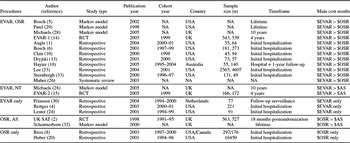
Of the twenty included articles, four were Markov models (Reference Bosch, Kaufman and Beinfeld5;Reference Michaels, Drury and Thomas28;Reference Patel, Haser, Bush and Kent29;Reference Schermerhorn, Birkmeyer, Gould and Cronenwett32), three were randomized controlled trials (2;14;Reference EVAR15), twelve were case series studies (Reference Angle, Dorafshar and Moore1;Reference Bertges, Zwolak and Deaton4;Reference Bosch, Lester and McMahon6;Reference Brox, Filion and Zhang8;Reference Clair, Gray, O'Hara and Ouriel10;Reference Dryjski, O'Brien-Irr and Hassett13;Reference Hayter, Bradshaw, Allen, Guduguntla and Hardman18; Reference Huber, Wang and Derrow20;Reference Lee, Carter, Upchurch, Seeger and Huber23;Reference Lester, Bosch, Kaufman, Halpern and Gazelle24;Reference Prinssen, Wixon and Buskens30;Reference Sternbergh and Money33), and one was a systematic review (Reference Maher, McNamara, MacEneaney, Sheehan and Malone26) (Table 1). Twelve of the articles reported on a comparative analysis of endovascular and open surgical repair (Reference Angle, Dorafshar and Moore1;Reference Bosch, Kaufman and Beinfeld5;Reference Bosch, Lester and McMahon6;Reference Clair, Gray, O'Hara and Ouriel10; Reference Dryjski, O'Brien-Irr and Hassett13;14;Reference Hayter, Bradshaw, Allen, Guduguntla and Hardman18;Reference Lee, Carter, Upchurch, Seeger and Huber23;Reference Maher, McNamara, MacEneaney, Sheehan and Malone26;Reference Michaels, Drury and Thomas28;Reference Patel, Haser, Bush and Kent29;Reference Sternbergh and Money33). Two reported on endovascular repair compared with no intervention (one of which also reported on endovascular and open surgery) (Reference EVAR15;Reference Michaels, Drury and Thomas28), three on endovascular repair only (Reference Bertges, Zwolak and Deaton4;Reference Lester, Bosch, Kaufman, Halpern and Gazelle24;Reference Prinssen, Wixon and Buskens30), two on open surgery versus active surveillance with selective open surgery (2;Reference Schermerhorn, Birkmeyer, Gould and Cronenwett32), and two on open surgery only (Reference Brox, Filion and Zhang8;Reference Huber, Wang and Derrow20).
Overview of Studies

Note. EVAR, endovascular repair; OSR, open surgical repair; NT, no treatment; AS, active surveillance; RCT, randomized controlled trial; NA, not applicable; UK SAT, United Kingdom Small Aneurysm Trial; $EVAR and $OSR, costs associated with EVAR and OSR, respectively.
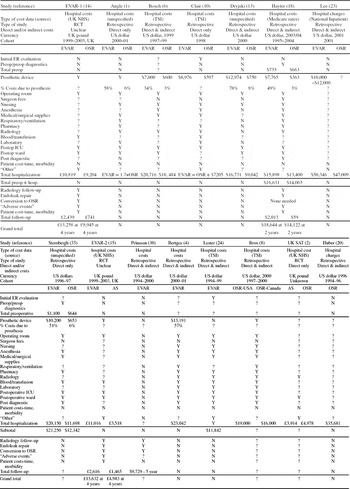
Of the fifteen studies reporting cost data, four reported direct variable costs only; (Reference Angle, Dorafshar and Moore1;2;Reference Clair, Gray, O'Hara and Ouriel10;Reference Sternbergh and Money33) nine included both direct and indirect costs (Reference Bertges, Zwolak and Deaton4;Reference Bosch, Lester and McMahon6;Reference Brox, Filion and Zhang8;Reference Dryjski, O'Brien-Irr and Hassett13;Reference Hayter, Bradshaw, Allen, Guduguntla and Hardman18;Reference Huber, Wang and Derrow20;Reference Lee, Carter, Upchurch, Seeger and Huber23;Reference Lester, Bosch, Kaufman, Halpern and Gazelle24;Reference Prinssen, Wixon and Buskens30) and the remaining two did not explicitly state whether indirect costs were included (14;Reference EVAR15). Four studies used a timeframe of at least 1 year (14;Reference EVAR15;Reference Hayter, Bradshaw, Allen, Guduguntla and Hardman18;Reference Michaels, Drury and Thomas28).
Summarizing costs for these two procedures is complicated, because these studies used different cost reporting strategies (Table 2). AAA repair costs should include preoperative costs, surgical team and hospitalization costs associated with the initial procedure, the costs of the endovascular repair prosthesis and subsequent postoperative surveillance, interventions, hospitalizations, and drug treatment. However, the majority of the studies did not include pre- or postoperative costs (beyond 30 days of the initial hospitalization) and did not include surgeon fees within the cost of the initial hospitalization.
Cost Analyses Findings

Y and N, explicitly included/not included cost; ?, cost not mentioned or inclusion/exclusion uncertain; EVAR, endovascular repair; OSR, open surgical repair; AS; active surveillance; TSI, Transition System, Inc., hospital accounting system; UK NHS, United Kingdom National Health Service; RCT, randomized controlled trial; UK SAT, United Kingdom Small Aneurysm Trial; ICU, intensive care unit.
Small AAAs<5.5 cm
In a randomized controlled trial conducted in the United Kingdom, the mean cost of treatment for patients in the early immediate open surgery group was significantly higher than that for ultrasonographic surveillance with delayed open surgery (£4,978 and £3,924, respectively) (2). No reduction in all-cause mortality was realized (2;Reference Lederle, Johnson and Wilson22). Outcomes did not differ significantly by treatment according to age, gender, or aneurysm diameter, although few women were enrolled.
Despite these published findings, another study used a Markov model based on the UK trial data and concluded that early open surgery was modestly cost-effective for patients with small AAAs ($10,800/quality-adjusted life-year [QALY]), particularly among younger patients (<72 years of age) (Reference Schermerhorn, Birkmeyer, Gould and Cronenwett32). However, because the UK trial found that active surveillance with delayed open surgery resulted in approximately one-third fewer surgical repairs as well as similar survival and quality of life and fewer complications at lower cost compared with early open surgery, it is difficult to conclude that early open surgery may be cost-effective.
Large AAAs≥5.5 cm
Although the studies had no uniform size criteria, most patients included in studies evaluating endovascular and open surgical repair (and all but one of the Markov model reports) involved large AAAs≥5.5 cm in diameter. Hospitalization costs for the initial endovascular procedure ranged from $16,000 to $23,000 (Reference Bertges, Zwolak and Deaton4;Reference Lederle, Johnson and Wilson22), whereas open surgical repair costs ranged from $9,000 to $18,500 (Reference Bertges, Zwolak and Deaton4;Reference Dryjski, O'Brien-Irr and Hassett13). Studies explicitly excluding several care categories from the cost analyses led to relatively low hospitalization cost estimates (e.g., anesthesia, respiratory care, pharmacy, radiology, and laboratory tests (Reference Dryjski, O'Brien-Irr and Hassett13)), whereas those including a very comprehensive list of categories report higher hospitalization costs. The two British endovascular randomized trials report relatively high hospitalization costs of £10,819 (14) and £11,016 (Reference EVAR15) for endovascular repair and £9,204 for open surgical repair. As hospital charges are generally higher than costs, studies relying on hospital charges reported more expensive hospitalizations than those relying on costs (Reference Huber, Wang and Derrow20;Reference Lee, Carter, Upchurch, Seeger and Huber23).
Cost estimates for the endovascular prosthesis range from $7,000 reported for a 1997–99 patient cohort to $13,000 reported for a patient cohort from 2000 (Reference Bosch, Lester and McMahon6;Reference Dryjski, O'Brien-Irr and Hassett13). The prosthesis accounts for 34 percent and 78 percent of the total hospitalization costs reported in these two studies, respectively, with the differences in percentages largely a reflection of how comprehensively the authors itemized costs. Bosch et al. (Reference Bosch, Lester and McMahon6) relied on prosthesis costs near the time of commercialization and estimated a low price for the prosthesis relative to the cost of the hospitalization. Thus, total hospitalization costs for endovascular repair, the difference in the cost of endovascular repair relative to open surgery, and the percentage of total hospitalization costs attributable to the prosthesis were underestimated. In contrast, Dryjski et al. (Reference Dryjski, O'Brien-Irr and Hassett13) excluded several categories of necessary hospital services from the cost estimate and underestimated the cost of the hospitalization relative to the prosthesis.
None of the studies reported on the cost of the training required by surgeons to perform endovascular repair or to acquire new equipment. This training can include attending 1- to 3-month training courses at a cost of $30,000 and purchasing portable fluoroscopy units that cost approximately $250,000 (Reference Bush, Najibi and Lin9).
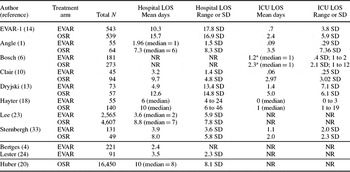
Although the initial hospitalization for endovascular repair results in shorter length of stay (LOS) (14) and less intensive care unit (ICU) use (Reference Clair, Gray, O'Hara and Ouriel10;Reference Dryjski, O'Brien-Irr and Hassett13) than open surgery (Reference Angle, Dorafshar and Moore1;Reference Sternbergh and Money33) (Table 3), all of the studies found that the cost of the initial hospitalization was higher for endovascular repair, primarily due to the high cost of the prosthesis.
Studies Reporting Hospital and ICU Length of Stay

a Includes only subjects staying 1 day or longer.
EVAR, endovascular repair; OSR, open surgical repair; AS, active surveillance; NR, not reported; LOS, length of stay; ICU, intensive care unit; SD, standard deviation.
Two randomized controlled trials provide evidence that there is no difference in overall survival between endovascular repair and open surgery 2 years following the initial hospitalization. Although differences in health-related quality of life favored endovascular repair, they were small and disappeared after 3 months. Nevertheless, postoperative complications, including endovascular prosthesis-related ruptures, infections, endoleaks, thrombosis, or other surgery requiring re-exploration of open surgery, were five times more common with endovascular repair as with open surgery (14). Reinterventions occurred three times as often in the endovascular repair group. As a result, endovascular repair costs were higher than open surgical costs at 4 years (£13,258 versus £9,945) (14). A retrospective review from Australia also reported greater costs at 2 years of follow-up for patients treated with endovascular repair ($18,644) than open surgery ($14,122) (Reference Hayter, Bradshaw, Allen, Guduguntla and Hardman18).
Only one randomized controlled trial evaluated costs and outcomes of endovascular repair versus no intervention for patients with large AAAs who were judged medically unfit for open surgery (Reference EVAR15). Endovascular repair resulted in a 30-day mortality of 9 percent, did not improve all-cause or AAA survival compared with no intervention at 4 years, did not improve health-related quality of life, was associated with a need for continued surveillance and reinterventions, and resulted in higher costs. Endovascular repair substantially increased the cost of the primary hospital admission (£11,016 versus £3,518) and at 4 years (£13,632 versus £4,983). The authors saw no reason to pursue cost-effectiveness modeling.
Markov Methodologies
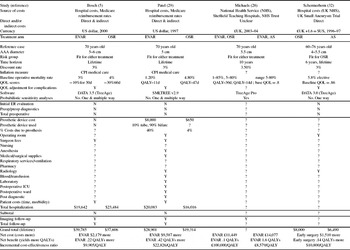
Table 4 summarizes studies that used Markov methodologies to analyze differences in the cost and effectiveness of endovascular repair and open surgery over a patient's lifetime (Reference Bosch, Kaufman and Beinfeld5;Reference Michaels, Drury and Thomas28;Reference Patel, Haser, Bush and Kent29). All three found that endovascular repair was more expensive. As reported for the case series studies, the Markov studies were inconsistent in terms of enumerating what categories of care were considered in evaluating costs.
Markov Model Results

Y and N, explicitly included/not included cost; ?, cost not mentioned or inclusion/exclusion uncertain; EVAR, endovascular repair; OSR, open surgical repair; AS, active surveillance; QOL, quality of life; QALY, quality-adjusted life-year; CPI, Current Price Index; UK NHS, United Kingdom National Health Service; ICU, intensive care unit; AAA, abdominal aortic aneurysm; ER, emergency room.
Two of the Markov studies comparing endovascular repair and open surgery were based on U.S. costs and outcomes and report a higher quality of life with endovascular repair (Reference Bosch, Kaufman and Beinfeld5;Reference Patel, Haser, Bush and Kent29). The incremental cost-effectiveness ratios were $9,905 per QALY and $22,826 per QALY. Using assumptions of effectiveness based on case series data, Patel et al. (Reference Patel, Haser, Bush and Kent29) concluded that the benefits were worth the cost with the qualification that their results were highly dependent on their assumptions regarding mortality and morbidity. They reported that endovascular repair may be more cost-effective than open surgery if endovascular repair operative mortality rates were less than 1.2 percent and the open surgery mortality rates were higher than 1.7 percent. Bosch et al. (Reference Bosch, Kaufman and Beinfeld5) also used case series data as the basis for their model; they reported the sensitivity of their conclusions to endovascular prosthesis performance in terms of long-term failure and rupture rates. Although both authors varied analytical assumptions and conducted sensitivity analyses, they did not vary their assumptions simultaneously by using probabilistic sensitivity analyses to fully test the robustness of their findings (Reference Drummond and Sculpher12;Reference Gold, Siegel, Russell and Weinstein17;Reference Weinstein, Siegel, Gold, Kamlet and Russell35).
In a more recent and rigorous approach to Markov modeling, Michaels et al. (Reference Michaels, Drury and Thomas28) used probabilistic sensitivity analyses and used short-term, but not mid-term, outcome data from the UK trials. With an incremental cost-effectiveness ratio well above accepted norms (£110,000 per QALY), they concluded that endovascular repair was not a cost-effective alternative to open surgery (Reference Gold, Siegel, Russell and Weinstein17;Reference Zierler and Gray37). Regardless of the time frame, the cost-effectiveness of endovascular repair and open surgery was sensitive to assumptions regarding lower early morbidity for endovascular repair, higher open surgery operative mortality rate, increased need for follow-up care for endovascular repair, higher reintervention/complication rates for endovascular repair, and higher healthcare costs.
Michaels et al. (Reference Michaels, Drury and Thomas28) also reported that endovascular repair was cost-effective compared with no intervention in individuals with large AAAs who were judged unfit for open surgery. However, they did not use the previously described 4-year outcomes and cost results from the UK trial that directly compared endovascular repair with no intervention (Reference EVAR15).
DISCUSSION
Conclusions about the cost-effectiveness of AAA repair are time dependent. Studies conducted within a relatively short timeframe fail to adequately address the long-term benefits, harm, or costs associated with endovascular repair. Because open surgery has more frequent and severe early morbidity than endovascular repair, it could result in a longer and more costly hospital stay and subsequent greater duration of impaired functional status and quality of life. Decreased operative mortality rates associated with endovascular repair may be offset by higher complication rates later in life. If follow-up costs associated with complications and reinterventions for endovascular repair are ignored, then endovascular repair's low operative mortality rates favor endovascular repair and may lead to the premature conclusion that endovascular repair is a cost-effective alternative to open surgery. Mid-term results from randomized controlled trials demonstrate that, compared with open surgery, endovascular repair did not improve all-cause mortality or health-related quality of life, costs more, and led to more complications and reinterventions. No studies assessed long-term outcomes for endovascular repair relative to open surgery. Because of the time-dependent nature of these differences in outcomes, the long-term implications of the differences in mortality and morbidity are important for evaluating AAA repair options.
Regardless of the time frame, all studies found that endovascular repair costs more than open surgery. Studies focusing on hospital costs generally found that endovascular repair costs more to perform than open surgery, primarily due to the cost of the prosthesis. Studies accounting for the cost of these prostheses should be aware of the difference between production costs and commercial pricing. Endovascular prostheses first received Food and Drug Administration (FDA) approval in 1999 (Reference Berman, Gentile and Berens3). Once they became commercially available, market prices reflect charges as opposed to production costs. The cost of the prostheses are partially offset by reduced operating room and ICU use, length of stay, blood transfusions, and perioperative complications during the initial hospitalization. Although refinements in endovascular repair technology and operator experience may result in improved outcomes over time, currently, survival associated with AAA repair is generally equivalent over the mid- to long-term. Thus, any potential advantage to endovascular repair versus open surgery lies early in the care process, for example, fewer complications, reduced hospital length of stay, and so on. Hence, from a cost perspective, they have value primarily where early return to work is crucial.
From the perspective of cost, different audiences have different concerns. Traditional economic analyses focus on the cost to the economy of delivering each element of service. However, policy makers may be more interested in the payments they must underwrite than in the economic cost of a procedure. In the United States, where Medicare pays for hospital care using diagnosis-related groups, differences in the costs of the prosthesis or even in lengths of stay may not be relevant to Medicare, because they are all folded into the overall payment. However, those differences are very salient to hospitals that must bear them. Third-party payers, hospitals, and healthcare providers each formulate their own institutional perspective on costs and effectiveness that depends on the extent and duration of their responsibility for the financing and/or provision of care.
Extrapolating the cost experience in one country to another with a different health care and payment system is difficult. No consensus on comparing results of economic analyses across countries exists. Simply factoring in the foreign exchange rate overlooks the variance in utilization and cost estimates across countries due to differences in physician practice patterns, resource valuation, and resource use (Reference Reed, Anstrom and Bakhai31). Although mid-term outcomes from the European randomized controlled trials indicate that endovascular repair is not superior to open surgery and costs more, the cost-effectiveness of endovascular repair relative to other options in the United States awaits the completion of long-term randomized controlled trials.
CONCLUSIONS
For patients with AAA<5.5 cm, immediate open surgery costs more than active surveillance with selective open surgery with no improvement in survival. Among patients with AAAs≥5.5 cm in diameter considered medically fit for open surgery, endovascular repair has greater short- and long-term costs with no improvement in overall survival or quality of life beyond 1 year. Higher costs are attributable to greater long-term complications, need for reintervention, and long-term monitoring than open surgery. Among patients with large AAAs considered medically unfit for open surgery, endovascular repair costs more than no intervention with no improvement in overall or AAA survival.
POLICY IMPLICATIONS
Although conclusions regarding the cost-effectiveness of AAA treatment options vary by institutional perspective and are time dependent, from a societal perspective, current evidence indicates that endovascular repair is not a cost-effective treatment option regardless of medical fitness. However, because the randomized controlled trials evaluating endovascular and open surgical repair were conducted outside of the United States, the endovascular prostheses may not currently have U.S. FDA approval. Future randomized controlled trials conducted in the United States evaluating the long-term effectiveness and cost-effectiveness of endovascular and open surgical repair for medically fit patients and endovascular versus no intervention for patients judged medically unfit for open surgery are needed.
CONTACT INFORMATION
Yvonne C. Jonk, PhD (yvonne.jonk@med.va.gov), Adjunct Assistant Professor, Division of Health Policy and Management, School of Public Health, University of Minnesota, 420 Delaware Street SE, MMC 729, Minneapolis, Minnesota 55455; Health Economist, Minneapolis VA Center for Chronic Disease Outcomes Research, 1 Veterans Drive (111-0), Minneapolis, Minnesota 55417
Robert L. Kane, MD (kanex001@umn.edu), Professor, Division of Health Policy and Management, and Co-Director, Clinical Outcomes Research Center, School of Public Health, University of Minnesota, 420 Delaware Street SE, MMC 197, Minneapolis, Minnesota 55455
Frank A. Lederle, MD (frank.lederle@med.va.gov), Professor of Medicine, Department of Medicine, University of Minnesota, 420 Delaware Street SE, MMC 194, Minneapolis, MN 55455; Staff Physician, Section of General Medicine, Minneapolis VA Center for Chronic Disease Outcomes Research, 1 Veterans Drive (111-0), Minneapolis, Minnesota 55417
Roderick MacDonald, MS (roderick.macdonald@med.va.gov), Staff Researcher, Minneapolis VA Center for Chronic Disease Outcomes Research, 1 Veterans Drive (111-0), Minneapolis, Minnesota 55417
Andrea H. Cutting, MA (andrea.cutting@med.va.gov), Research Coordinator, Minneapolis VA Center for Chronic Disease Outcomes Research, 1 Veterans Drive (111-0), Minneapolis, Minnesota 55417
Timothy J. Wilt, MD, MPH (tim.wilt@med.va.gov), Professor of Medicine, Department of Medicine, University of Minnesota, 420 Delaware Street SE, MMC 194, Minneapolis, Minnesota 55455; Staff Physician, Section of General Medicine, Minneapolis VA Center for Chronic Disease Outcomes Research, 1 Veterans Drive (111-0), Minneapolis, Minnesota 55417