The extensive documentary evidence collected and analysed in the previous studies in this issue suggest a preliminary conclusion that can be summarised as follows: from the collapse of the Han dynasty to the glorious days of the Tang dynasty, the peoples living in the Western Regions along the Silk Road used multiple co-existing forms of money – grain, cloth and coins – with one of these three items becoming predominant according to changes in political and/or economic circumstances. However, this multicurrency system did not outlive the political, economic and fiscal upheavals that shook the Tang empire from the mid-eighth century onwards. As far as the materials from Turfan and Dunhuang are concerned, the latest evidence for this monetary system is provided by a manuscript found at Dunhuang (P 3348 V°), already quoted in Arakawa Masaharu's article,Footnote 1 which permits us to see how such a complex monetary system worked in real life once the silk shipped by the Tang government arrived in the Western Regions. In particular, a subsidiary account (P 3348 V°2 B) inscribed in this accounting report reveals how a local official called Li Jingyu 李景玉, who was vice-commissioner in the army stationed in that region, received his salary for the first semester of the year 745 ce. The process is described in full detail and shows the calculations very clearly:
Given to the vice-commissioner Li Jingyu for spring and summer wages for the 4th year of the Tianbao era (745)
Unhusked millet: 120 piculs
 value (22 coins per bushel): 38,400 coins
value (460 coins per bolt): the indicated quantity of
silk.
[Which is effectively 83 bolts 19 feet and 1 inch of dalian 大練 silk] (P 3348 V°2 B)
As was the case for every official, Li Jingyu's salary was expressed in piculs (shi 碩) of grain. However, he received that salary in bolts of silk at the end of a two-step process of conversion: first, the value of his salary as specified in grain (120 piculs of unhusked millet, su 粟) was converted into coins (38,400 wen 文) at the current rate of exchange, which was written in small characters. This amount of coins was converted in turn into bolts of silk: 83 bolts, 19 feet and 1 inch of dalian-silk. The advantage of this form of payment is obvious: if Li Jingyu had been paid in cash, he would have received at least 160 kg of bronze coins. It is easy to imagine how troublesome it would have been to dispatch such vast amounts of coins as far as Dunhuang to pay the wages of local officials. The same process of dual conversion (first grain to coins, then coins to textiles) was followed for all the other business transactions that were carried out by the Doulu Army, especially for the purchase of provisions. This process throws a clear light on the monetary practices commonly in use during this period: the unit of account was the bronze coin, but the currency that actually circulated was the bolt of cloth.
This accounting report dates to less than 10 years before the great rebellion of An Lushan in 755, which was due in part to government spending far in excess of tax receipts. It represents the latest evidence of the joint use of textiles and coins as means of exchange on the north-western frontier. The documents relating to economic practices in the Dunhuang area after 755 paint a picture that is completely different from that before the An Lushan Rebellion.
The Disappearance of Coins
From the middle of the eighth century onwards, the entire Tang empire was affected by a growing scarcity of coins, particularly in the remote Western Regions. Coins became so rare that during the Jianzhong era (780–783) the Chinese Protectorate of Anxi, at Kucha, decided to cast its own Chinese-style coins. At Dunhuang, the situation was even more dire: all kinds of metallic money completely disappeared for at least two centuries. All the manuscripts of a financial or economic nature from Dunhuang – from the end of the eighth century to the latest dated around 1030 – indicate that payments were made in grain or in textiles for all the transactions that were carried out by lay-people, monks, religious institutions, and by the civil local administration as well. This basic evidence being laid down, a detailed analysis of the means of payment in the documents from Dunhuang reveals a more complex situation. On the one hand, monetary practices were different in the religious and in the secular worlds; on the other hand, some changes were experienced throughout this long period of two centuries, at least in the secular world.
Practices inside the monastic realm
First, let us consider the forms of payment used inside the monasteries. The economic practices of the monasteries are fairly well known from the end of the eighth century onward, thanks to various accounts and especially annual management reports. From the earliest documents that are available – in the early ninth century – it appears that goods and services were mostly paid for in grain, and sometimes in textiles. By itself, the fact that grain had become the prevailing means of payment shows the prevalence of a coinless economy. But it becomes even more evident when we consider that the prices of goods and services were often expressed in piculs (shi 石), or in mai-su 麥粟 (a term combining wheat/barley and millets) in spite of the fact that the values of these two sorts of cereal were quite different (the price of wheat and barley was higher than that of millets by 15 to 44 per cent).Footnote 2 Sometimes, the proportion of each sort of grain was specified, but this was not a consistent rule.Footnote 3 The “picul of mai-su” was the unit of account used by monastery accountants in their annual reports. In this context, how did textiles function as money?
The documents from Dunhuang reveal that three types of textiles were used for payment: usually hemp cloth (bu 布), sometimes a cloth called die (曡, 氎) or xie (緤) that could be cotton or some kind of woollen cloth and, more rarely, woollen cloths (he 褐). One example that reflects common practice in the tenth century records that in the year 930, a few weeks before the annual festival of the Buddha Sakyamuni, which was performed during several days starting on the eighth day of the second month, the Jingtu monastery bought large amounts of raw materials in order to make or to repair the statues of the deities and various religious objects: iron, gold, silver, copper, mercury, timber wood and fuel. Some of these purchases were paid for in hemp cloth, but most were paid for in cereals or in hempseed. Even silk was paid for using these commodities: the monastery paid 51.2 piculs of wheat and millet (more than 3,000 litres) plus 2 bolts of hemp cloth to buy fine silk (ling 綾 and mianchouling 綿紬綾).Footnote 4
All the other monastery accounts provide evidence indicating that silk was not used as money within the monastic framework.Footnote 5 The reason cannot be that the monasteries did not own silk textiles. Various inventories of the holdings of monastery treasuries reveal that at least the most prosperous monasteries owned some silk textiles, but that these were mainly in the form of garments and decorative pieces. Silk was not used for payment because it was considered a consumer good. The account register for the year 930 indicates that after purchase ling and mianchouling silk was immediately put to use to create canopies for the statues which were displayed to the faithful and carried in procession through the streets of Dunhuang during the festival. In other circumstances, silk items were used as gifts or rewards.
The utilisation of silk owned by the Administration of Donations (chensi 儭司) (P 2638) shows a similar trend. This office held large amounts of textiles on behalf of the whole Buddhist community in the Dunhuang oasis. The account register of this office for the year 936 indicates that most of the outlay was for gifts and rewards to high-ranking religious and secular officials, to the empress of Khotan, to several Khotanese monks who visited from Khotan, to the princess of Ganzhou, etc. Other outlays were for ceremonies, but the account register mentions only one allocation of silk for a purchase: to buy a saddle to present to an official.
The annual management reports of the monasteries confirm that silk was very seldom used as a means of payment; quite simply, silk was not recorded in these reports. In the ninth and tenth centuries, the reports recorded only the following products: cereals, soy, oil, butter, flour, bran, hempseeds, oilcakes, sheets of paper and three kinds of cloth – cotton, wool and hemp. We can be sure that silk was not recorded in separate accounts that no longer survive. The annual reports recorded all purchases of edible goods, and show that these were not paid for in silk, nor in any other kind of textile. I have found only one exception: among tens of purchases made during the year 930, only one (2 piculs of wheat or barley) was paid for in silk, not with a bolt of silk but with a garment (P 2049 V°2, col. 46).
Among the three kinds of textile – cotton, wool and hemp – recorded in the annual management reports, the last is the most important. The importance of hemp cloth compared with wool and cotton can be explained if we consider the resources of the monasteries. Religious establishments received income in textiles via two main channels: sales of goods and gifts. Concerning the first channel, monastery accounts clearly show that when laymen who bought goods from the monasteries paid in textiles, they did so more often in hemp than in cotton or woollen cloth. Moreover, among the most important sources of income of the monasteries were the gifts offered by the faithful in exchange for religious services performed by the monks (for example, prayers, sutra recitations, funerals) and most of the time these offerings were given in hemp cloth. Thus, the monasteries held considerable reserves of hemp. We must specify, however, that only a small part of these reserves was used as means of payment by the monasteries. The expenses accounts show that even these non-silk textiles were mostly used by the monasteries themselves – to sew as garments, ornaments for statues and so on.
A commercial practice that took place in Dunhuang throughout the tenth century merits special mention here because it explains how hemp was an important form of income to the Buddhist clergy. This practice was the sale by auction (chang yi 唱衣). In accordance with the prescriptions of the treatises on discipline (Vinaya), any minor possessions left by deceased monks and nuns (clothing, pieces of cloth and other small objects that monks were permitted to own) devolved to the monastic community. These goods, and a sizeable part of the offerings made by the faithful as well, were received by an office called the Administration of Donations, which sold them at regular auctions. In the Chinese Buddhist communities, sales by auction followed fairly precise ceremonial procedures, as described in some treatises on discipline:
Inside the hall (of the monastery), the hall master installs a table on which he places a writing brush and ink stone, a chimestone, scissors, cords and the various objects required . . . The overseer unties the kasaya of the deceased monks, places it on the chimestone and changes the cords. The hall master then takes each item in succession. He presents them, and they are passed from hand to hand. The overseer raises them up and says: “Such-and-such an article, number such-and-such, first bid so-and-so much”. If he evaluates the object at one string of cash, he initiates the bidding at 100 cash. By successive bids, one thus arrives at one string of cash.Footnote 6
At Dunhuang, the clerical authorities followed probably the same standard procedure, except on one point: as we shall see, payment for the goods in the sale was not made in cash. We are fortunate to possess documents from Dunhuang that illustrate the importance of this activity in the economic life of monasteries. Of particular interest to us, they show that all the goods put up for sale were paid for using pieces of hemp.
According to a manuscript in the Pelliot collection (P 2638), in the 6th month of 936, the Administration of Donations held an assembly of accounts (suankuai 算會) at the Jingtu monastery. This meeting seems to have comprised nearly the entire religious population of Dunhuang: 1,086 monks, nuns and novices. Its object was (here I quote the manuscript) “to examine the receipts and expenditures for the past three years [933, 934, 936] concerning all that has been received by official and private donation, bequests made by deceased and sick monks and nuns, as well as gifts made on the occasion of vegetarian feasts”.Footnote 7 These receipts were silk fabrics, gauze, felt, cotton, as well as clothing articles, dishes and platters, items of furniture, etc. In the next part, the document gives “the complete list of names for each and all of the auction sales held by the monks and nuns during this meeting”. I will quote some examples here:
The clothing articles (yiwu 衣物) of the controller of monks (sengtong heshang 僧統和尚) Yin yielded in auction sales (chang de 唱得) 9,032 feet of hemp.
(. . .)
The clothing articles that Madame Yin gave before her death yielded in auction sales 830 feet of hemp cloth.
(. . .)
The silk tunic of Princess Tian yielded in auction 800 feet of hemp cloth.
The articles which were sold in auction during these three years raised a huge sum for the monastery: 58,502 feet of hemp cloth (about 18,000 metres). An objection could be raised: we could surmise that in this document hemp cloth was only the unit of account used by the accountant. But if the buyers had paid with other forms of money, the accountant would have recorded the amount and converted its value into the equivalent in hemp cloth, as his colleague of the Doulu Army did in the case of Li Jingyu discussed above. Moreover, we have indisputable proof that the purchases were paid directly in hemp: the third part of the document indicates that almost all of the proceeds of the sales (95 per cent of the 58,502 feet of hemp cloth) were immediately distributed to the monks, nuns and novices of the Dunhuang community according to a fixed quota.
Another similar document, preserved in the Beijing National Library (Beitu 364: 8444 V°), confirms that it was normal for the proceeds of a sale to be distributed immediately. The document records the sale, item by item, noting the precise distribution of the proceeds from each item. Here I quote the first one:
The master of Dharma and Vinaya (falü) Derong sold a pair of crimson silk shoes at auction for which he obtained 580 feet of hemp cloth. The distribution was as follows: for himself, 150 feet; for Dingzhen (a monk), 150 feet; for Denghui, 150; for Fuying, [of the monastery Ling] tu, 150. Remainder, 20 feet.
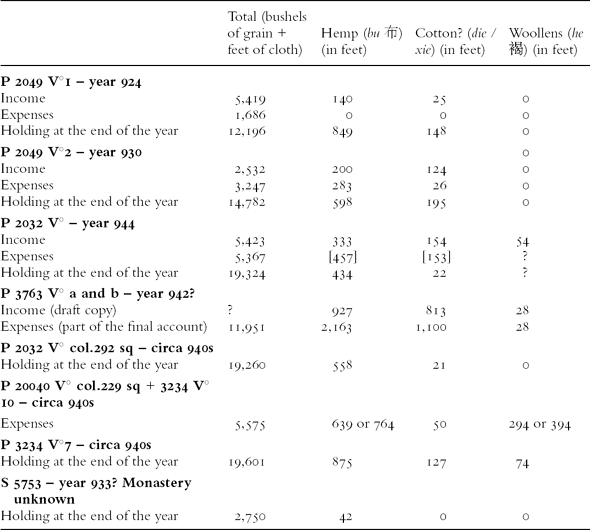
In these auction sales, all payments were made using hemp cloth, not only for the purchase of articles of clothing and pieces of cloth, but for other various objects as well (for example, a fan). As we have seen already, the articles sold in an auction in 936 yielded a huge amount of hemp cloth which was almost entirely distributed to nearly all the religious population of Dunhuang: 1,086 persons, monks, nuns and novices of all the monasteries. As a result, these amounts of hemp cloth, whether they originated in bequests or fees paid for religious services, or were raised from auction sales, entered into the economic network of the Buddhist community and remained in the hands of monks.Footnote 8 However, the monastery accounts also reveal that each monastery maintained only a small reserve of textiles. At the end of the year 923, for example, the Jingtu monastery held only 831 feet of cloth, hemp and cotton (die/xie) in store, and held even less in some other years (see Table 3). These amounts were small in comparison to the quantities managed by the Administration of Donations and the shares distributed to the individual monks by this office. At most, these small reserves of cloth held by each monastery could only have served as subsidiary currency.
The economic practices described above relate to life in the monastic realm. They cannot be seen as reflecting all economic life in the area, particularly when we consider that Dunhuang remained a great centre for trade during the ninth and tenth centuries. Dunhuang had however, been an important Buddhist centre for a long time prior to the ninth century, and during the ninth and tenth centuries had 17 monasteries and convents which housed more than 1,000 clergy, as we saw from manuscript P 2638. If we add to this figure the number of dependents –agricultural labourers, shepherds and servants – then the total number of people who actually lived within the monastic economy constituted a much higher proportion of the population of Dunhuang than was the case in other regions of the Chinese empire.Footnote 9 Moreover, the great monasteries at Dunhuang undoubtedly played a very important economic role in the region. They owned not only fields, gardens, orchards and pastures but also most of the industrial installations in the area. It may be surmised, thanks to the water mills and the oil presses on their estates, that they provided the entire supply of flour and oil to the population of Dunhuang. Hence, it is safe to consider that in their activities of production, the economic practices of Dunhuang monasteries were in concordance with those of the lay population, and even more progressive in some respects.
In conclusion, it should be noted that the situation inside the religious communities, which is fully documented by many accounts, continued without noticeable change until the end of the period documented by the Chinese manuscripts from Dunhuang, i.e. the early eleventh century. For example, the accounts of the Jingtu monastery show that even for the purchase of farmlands it was common practice to pay in grain: “Twenty piculs of wheat/barley and twenty piculs of millet [have been paid] for the price of the land of the Luo family” (P 2032 dated from the mid-tenth century).
Practices among the lay population
The secular documents throw a different light on economic practices outside the monastic realm at Dunhuang. In particular, the contracts of sale reveal how certain changes took place at particular times between the beginning of the ninth century and the end of the tenth century. It is in this purely secular framework that we find some signs of silk being used as a form of payment again. In order to find more accurate information about this trend and to pinpoint some dates, I have tried to analyse these contracts of sale as Helen Wang did for those from Turfan,Footnote 10 then to compare their data with those provided by other kinds of contracts. Besides the contracts of sale, there are among the Dunhuang manuscripts many contracts for borrowing cereals or textiles, for hiring animals and for employing workmen, more than 160 documents in all.Footnote 11 Since these contracts are quite evenly distributed throughout the ninth and tenth centuries, they represent a good source of primary data.
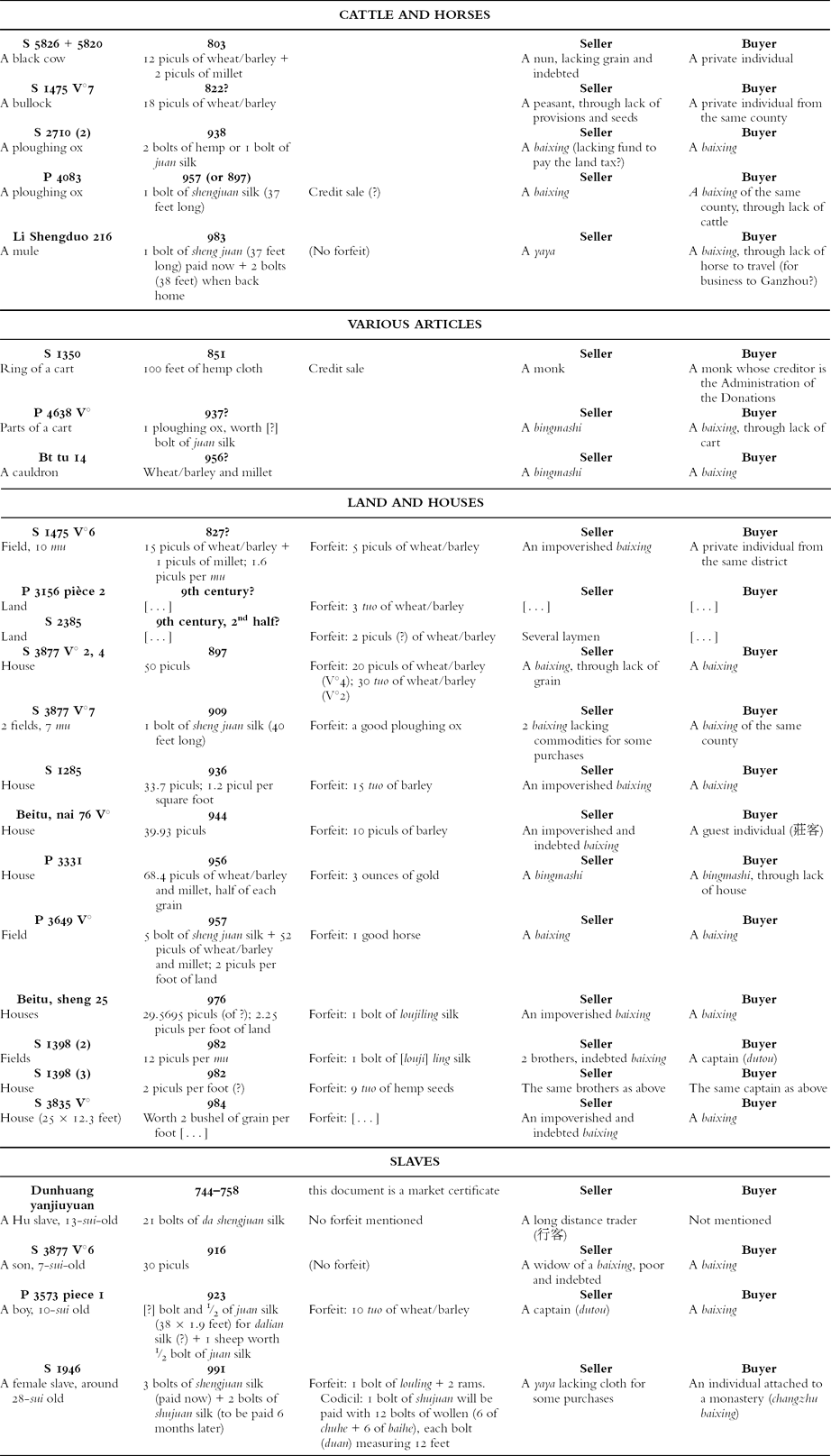
First, let us consider the five sales of cattle (see Table 1): the two sales from the early ninth century are in grain; the three sales from the tenth century are in textiles. Although we are looking at only five documents, they provide us with the first indication of a general trend concerning the use of silk in payments. Before the middle of the eighth century purchases of animals, including cows and bullocks, were paid for in silk.Footnote 12 This custom, which was in accordance with imperial edicts issued during the Kaiyuan era (713–741 ce),Footnote 13 seems to have completely disappeared in the early ninth century, after which it was resumed in the middle of the tenth century. A more precise date for using textiles in payment is revealed in another document, namely a contract for hiring a camel (P 2825 V°). According to this manuscript, dated 896, an inhabitant of Dunhuang intended to go to the capital. Needing an animal with which to travel, he paid five bolts of plain silk to hire an eight-year-old male camel.
Purchase and Sale Contracts, Dunhuang

Baixing = commoners, generally peasants.
Bingmashi, yaya = low ranking officials.
Tuo 馱 = a unit of volume of Tibetan origin.
This contract seems to signal that silk was already being used again for payment as early as the end of the ninth century. But the value of this proof is somewhat weakened by a clause stating that the payment should not be made before departure but only after the traveller's return from the capital. Actually, such a clause was in common use; most contracts for hiring animals for travel, all dating to the tenth century, stipulate that the payment, in silk or hemp cloth, is to be made after return.Footnote 14 We could therefore surmise that using silk as payment was indeed a desire but one that was difficult to fulfil because this commodity was rather rare in the Dunhuang area. Or it may simply indicate that the people of Dunhuang desired silk and that this arrangement was a means by which they could acquire it.
The sale contracts for land and houses show the same general trend: the four contracts from the ninth century are expressed in grain, with the first sale expressed in textiles being dated 909. Payment in grain, however, remains dominant until the end of the tenth century.
The sale contracts for slaves also show the same general trend, the preferred forms of money began to change in the early years of the tenth century, between 916 and 923, in the early years of the Cao family rule.
It was common practice when drawing up a contract to specify a forfeit, i.e. the penalty that was to be paid if either party changed his mind and wished to cancel the contract. The nature of the forfeit provides the most interesting information about the resumption of silk as a form of money. Until 957 the forfeit is expressed in grain, flour or cattle. The first forfeit expressed in textiles appears as late as 976, but from that time on, the forfeit paid in textiles prevails.
Although the documents allow us to trace a general trend, we must be careful not to draw premature conclusions. We must also be aware that the forms of money used in payments will vary not only according to chronology but also according to the buyer's needs. For example, if the widow who sold her son was paid in grain (S 3877 V°6), it was surely because her economic situation was so dire that she was lacking food. Similar circumstances can be surmised for the poor nun (S 5826+582), and the peasant who sold a bullock because he lacked “provisions and seeds” (S 1475 V°7). The situation of the two people who sold a slave is quite different (Dunhuang yanjiuyuan; S 1496) because their needs were not so basic. The goods they intended to buy with the proceeds of their sales were more sophisticated and could be bought with textiles. Another contract confirms that it is less the date than the identity of the buyer that determined the choice of the form of money: the sole payment in hemp cloth (S 1350) was carried out by a monk who could borrow funds from the Administration of Donations, and, as we have seen, supplies of cloth owned by this office were mostly hemp.
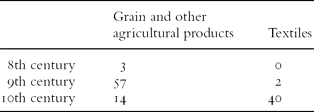
Roughly speaking, the contents of the loan contracts support the findings from the sale contracts. Most of the loans of grain are dated to the ninth century, and from a total of 42 dated contracts concerning loans of cloth, only two predate the tenth century (see Table 2).Footnote 15 As Zhao Feng has previously pointed out, the evidence suggests that in tenth-century Dunhuang, textiles, especially silk, and more precisely, raw silk (shengjuan), had again become an important means of credit.Footnote 16 However, this change is usually seen in special, rather than regular, circumstances: half of these loans of textiles were requested by Dunhuang inhabitants, mostly low-ranking officials and commoners, who were preparing to leave for a journey outside the oasis.Footnote 17 The destination was usually Xizhou (Turfan), Yizhou (Hami), Khotan or even the capital (Chang'an or Luoyang). In such cases of long-distance travel, it was always raw silk that was borrowed.Footnote 18 Clearly, the bolts of silk that travellers borrowed were to be used to cover travel expenses, or sometimes to do some bargaining on their way. Some extant contracts of loans of textiles concern short distance travels to Ganzhou and the Nanshan (Southern Mountains), but in these cases the textiles borrowed were not silk but woollens or cotton. For example, two commoners who intended to go to the Nanshan region to trade (maimai 買賣) borrowed bolts of woollen cloth and the repayments were to be in the same fabrics (S 4445 R 。 1 and R 。 2). The reason was probably that woollens, not silk, were the prevailing means of payment used by people living in this mountainous and rather backward area. Hence we can surmise that, while silk was a common currency on the main trade routes and in the main economic centres, less precious textiles were sometimes preferred in more remote regions.
Number of Dated Loan Contracts from Dunhuang (Trombert 1995, pp. 194–197)

As we can see, using textiles, especially silk textiles, in economic exchanges was common insofar as interregional economic relations were concerned. However, at a more local level, economic practices remained to a large extent unchanged. We have seen that purchases of farmlands and houses were paid mostly in grain until the end of the tenth century. The same evidence is provided by the contracts to hire labour. All the extant contracts stipulate that the salary/wages of the hired person would be paid in grain, the salary being completed with a full set of garments.Footnote 19 This set of garments, called “spring garments” (chun yi 春衣) because contracts were usually concluded at the beginning of the working year, consisted of an undershirt (han shan 汗衫), a gown, trousers and a pair of shoes. This form of payment remained unchanged to the end of the tenth century.Footnote 20 One could surmise that payment in kind was a general rule in medieval China where rural work was concerned. But the contracts found at Turfan show that this general rule did not apply there: most of them, dated from the sixth and seventh centuries, specified that the salary was to be paid partly in silver coins, partly in grain, or sometimes entirely in coins, even when the hired labourer was employed to farm land.Footnote 21 The documents from Dunhuang reveal, through the forms of payments used throughout the tenth century, that there was a return to a non-monetary economy.
To summarise, the documents from Dunhuang show a complete absence of coins, and that silk remained a scarce commodity throughout the ninth century. Silk reappeared as a form of money in the early tenth century but only in the secular sector for those who were travelling over long distances. It did not regain the major role it had played as both an international and local currency during the prosperous years of the Tang dynasty. With respect to the historical events that took place in the area during the eleventh to thirteenth centuries, it can be reasonably assumed that silk never regained its decisive role.
On the Cotton Road
This brief survey on textiles as money at Dunhuang during the ninth and tenth centuries would be incomplete without mentioning the economic role played by a kind of cloth, besides hemp and woollens, which is regularly reported in almost all the monastery account registers (see Table 3) This textile was called either die (曡, 氎), or xie (緤), both names being used very likely to refer to cotton. (The Chinese character used nowadays to refer to cotton, mian 棉, is a late neologism.)
Grain and Textiles in Jingtu Monastery Accounts

Before cotton was introduced into the south-eastern provinces of China during the Song dynasty, cotton cloth was a rare and exotic product. The names used to describe it confirm that it was not well known or understood: the odd expression, mumian 木綿, which means “silk floss from a tree” (similar to the German Baumwolle), and the more commonly used phonetic transliteration from an Iranian word, die 曡 that was often but not always used in the compounds baidie 白曡 (“white cotton”), or die bu 氎布 (“cotton cloth”). From the early seventh century onwards, the character die 曡 was progressively replaced by the homophone die 氎. Over time – the precise date being uncertain – die 氎 was confused with another character, xie 緤, which was probably pronounced die when referring to cotton.Footnote 22 It is important to note that the confusion between the two latter characters, die and xie, has nothing to do with any difference of meaning. Both characters are used to refer to the same thing in the same documents, in particular in the account registers from Dunhuang dating from the tenth century.Footnote 23
According to historical sources, die 曡 or baidie 白曡 was an emblematic product of the Indo-Iranian world; it is mentioned in the contexts of India, Persia, Ferghāna, Uddiyāna, Tokharistan, Kashmir, Sri Lanka and Champa.Footnote 24 It is also reported for just one kingdom, Gaochang (modern day Turfan) in what is now Xinjiang. It is odd that while cotton played an important role in the economy of the Turfan Basin, the dynastic histories make no mention of either the cultivation or weaving of cotton in any other oasis of the Silk Road from the Pamirs to central China.
The manuscripts from Turfan provide evidence that by the mid-fifth century cotton was being cultivated and woven in Turfan on a large scale, and that cotton trade was an important activity on the local markets.Footnote 25 It should be noted, however, that in spite of its importance in local life at Turfan (in particular, it was used for paying various taxes), there is no evidence that cotton was used as a means of payment in commercial transactions.Footnote 26
At Dunhuang, as Professor Liu Jinbao has demonstrated convincingly, cotton was neither cultivated nor woven at any period.Footnote 27 Die and xie, however, are frequently used in the Dunhuang manuscripts to refer to three different kinds of textiles called cu die/xie 粗氎 (緤) (“coarse cotton”), xi die/xie 細氎 (緤) (“fine cotton”) and liji xi die/xie 立機細氎 (緤) (“fine cotton woven on a vertical loom”). In a previous article published in 1996, I demonstrated that this latter kind (fine cotton woven on a vertical loom) was imported from Turfan. It may be helpful to summarise my argument here.Footnote 28
When I was researching the loan contracts, I noticed that fine cotton woven on a vertical loom appears only in a particular context; it was used exclusively to pay the interest on the loans contracted to travel from Dunhuang to TurfanFootnote 29 . The evidence provided by these contracts was that all the inhabitants of Dunhuang who took out loans to fund a journey to Turfan borrowed woven silk on the following conditions:
(1) The interest of the loan was to be paid in fine cotton woven on a vertical loom.
(2) The borrower had to pay the interest on the very day of his return.
(3) To reimburse the principal, however, he was given a term of 15 days or one month from the date of his return.
(4) The principal was payable in the same type of cloth as the loan (i.e. in silk).
(5) In the event that the borrower died on the road or did not come back to Dunhuang for any reason, his guarantor was required to return the principal, but not to pay the interest (that is to say the cotton).
The first clause specifies the desired items. The second clause indicates that the borrower was expected to be in possession of the cotton on his return to Dunhuang. The third and fourth clauses show that the borrower needed time to sell the goods he had acquired in Turfan in order to be able to refund his creditor in silk as specified in the contract. This indicates that he was not expected to be in possession of silk on his return to Dunhuang, and that he did not bring silk back with him. The fifth clause confirms that the cotton really came from Turfan. If the borrower did not return, he could not bring cotton back with him, and his guarantor in Dunhuang could not be expected to have access to cotton. To my original argument, we can add another observation: among all the loan contracts from Dunhuang (about 100 items) there is not a single one that suggests that fine cotton woven on a vertical loom was by travellers setting out from Dunhuang. This fine cotton was a product of Turfan.
After studying the five loan contracts discussed above, together with some other documents that are lists of the loads carried by travellers,Footnote 30 I was able to demonstrate the existence of a steady commercial flow of cotton cloth from west to east, in the opposite direction of the silk flow, which went from east to west. My conclusion, drawn in 1996, has been contested by some researchers. The opinion of Professor Liu Jinbao is that the words die and xie did not refer to cotton in many instances.Footnote 31 His argument is based on two points: (1) that most of the ancient dictionaries, glossaries of Buddhist terms and encyclopaedias give two meanings for the character die: “cotton cloth” but also “woollen cloth” (mao bu 毛布), and some of these works only give the latter definition.Footnote 32 (2) if cotton was neither cultivated nor woven in Dunhuang, then the amounts of die/xie mentioned in the Dunhuang documents, especially those noted in the accounts of the monasteries, are much too large to refer to cotton. According to Professor Liu Jinbao, most of the goods listed in the monastery accounts were related to the productive activities of the monasteries. Thus, the large amounts of die/xie posted in these accounts would not have been cotton but wool, and the large amounts would correspond with the importance of the flocks of sheep owned by the monasteries.
I am not fully convinced by Professor Liu's argument. It is true that the amounts of die/xie mentioned in the documents are large, and that they pose a problem if we compare them with those of hemp, and especially with those of the woollen cloth called he 褐. But I would like to raise some objections. While it is true that the monasteries of Dunhuang owned pastures and kept many flocks of sheep,Footnote 33 it should be pointed out that the accounts provide concrete details relating to receipts. If the receipts of die/xie mentioned in the accounts had come from the flocks of sheep owned by the monasteries, we would expect to find some mention of this source, as in the case for butter in this example from the annual report of the Jingtu monastery:
Income: 0.2 bushel of butter from the shepherds (muyangren ru 牧羊人入)
(P 2049 V°2, col. 129)
But no account mentions any receipt of die/xie in a similar way. For example, the only entry of die recorded during the year 925 is noted as an offering for the recitation of a sutra (P 2049 V° 1, col. 243). Thus, I find no evidence that this kind of cloth was generated by the flocks of sheep belonging to the monasteries.
In fact, unlike the receipts of agricultural products, the income in textiles – including hemp and die/xie – always comes from outside the monasteries. We have seen above that the greatest part of the income in textiles recorded in the accounts – including die/xie – came from gifts, offerings and payment for religious services. Only a very small part came from sales of goods to laymen. On the other hand, a major part of the revenue in agricultural products recorded in the same accounts (grain, flour, bran, oil, oilcakes, etc.) was derived from the arable lands and the equipment owned by the monasteries; for example, mill rent (wei ke 磑課), oil press rent (liang ke 梁課) and rent on gardens (yuan shui 園稅). Since none of the monastery accounts mentions any income in die/xie cloth derived from a similar origin (i.e. pastures and flocks of sheep owned by the monasteries), there is no special reason to think that this kind of cloth was wool.
However, we can agree with Professor Liu that in some monastery accounts the large amounts of die/xie are indeed troublesome. This is particularly true of the following account, a draft of the “income” part of an annual report issued probably by the Jingtu monastery for the year 942 (P. 3763 V° a):
Hemp (bu): 927 feet
Xie: 813 feet
Wool (he): 28 feet
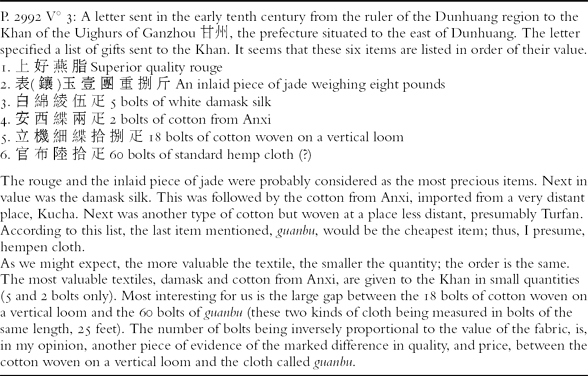
In this case, we are fortunate in having more detail to consider. The heading announces the “income in xie cloth”. The final statement confirms “total length of xie, 813 feet” (ji xie 813 chi 計緤 813 尺). But the detailed account in-between these two quotes shows that the accountant combined the income in fine cotton woven on a vertical loom (here, liji xie 立機緤 or liji 立機) and those of “official cloth” (guanbu 官布). For what reason? In my opinion, he combined them because both textiles were available in bolts of the same length, 25 feet, while hemp (bu) was available in bolts of 40 feet.Footnote 34 These measurements can easily be verified by comparing the different totals, expressed in feet, with each individual entry, expressed in bolts. It is known from other various sources that “official cloth” did not refer to a precise type of textile (hemp, wool, cotton) but to a standard form. In other words, guanbu could be translated as “cloth woven and processed in accordance with government standards”.Footnote 35 Similarly, another manuscript (P 2846) mentions the term guan xie 官緤 (“official cotton cloth”), which allows us to think that guanbu may mean “official hemp cloth”.
Once we consider that the accountants were obliged to express textiles in terms of quantity rather than type, it is easy to understand why he counted the bolts of fine cotton woven on a vertical loom together with those of a textile woven in another material but measuring the same length. In their calculations, the accountants had to express the quantities of cloth in feet, not in bolts, in order to be able to add together bushels (dou 斗) of grain and feet (chi 尺) of cloth, both being, by convention, of the same value.
Now we understand why the annual accountancy reports arranged the textiles they received and distributed in three categories: bu, die/xie and he. This accounting rule would also explain why the amounts of die/xie are so large in some accounting reports – because only part of it was cotton. In the case of the annual report discussed above (P. 3763 V°), the details provided by the “income” part tell us that only one-third of the material under the heading “xie” was cotton (275 feet of liji xie out of a total of 813 feet). Thus, the proportion of cotton compared with that of hemp cloth becomes more plausible if we take into account the context at Dunhuang where cotton was not a local product. Consequently, the second point of the argument developed by Liu Jinbao is less convincing.
In conclusion, I think that Professor Liu is absolutely right to question the exact nature of the cloth called die/xie. It is not impossible that the terms cu xie (coarse xie) and xi xie (fine xie) referred to some woollen cloth, at least at Dunhuang. However, the cloth imported from Turfan that was called “fine xie woven on a vertical loom” was most certainly made of cotton.
From the Silk Road to the Silver Road?
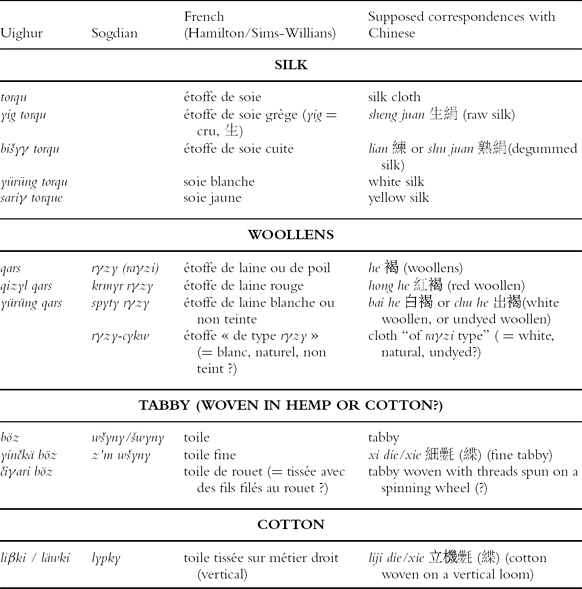
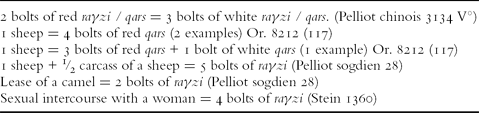
The “Silk Road” was a term coined by the German geographer Baron von Richthofen in the late nineteenth century. It does not appear at all in the Chinese sources, and my short discussion on the Cotton Road above is enough to show that the concept of “the Silk Road” is misleading. The trade between China and the West cannot be summed up in a wide and steady stream of silk fabrics flowing from east to west, in one way only, in order to satisfy the needs of the Westerners who were supposed to be fascinated by this marvellous product. The reality was far more complex. Besides cotton, many other goods were circulating in both directions, and the dominant position of silk in international trade cannot be considered as a steady and continuous phenomenon through the centuries. The ninth- and tenth-century Chinese sources from Cave 17 at Dunhuang point to a decline in the importance of silk as a means of payment. The Uighur and Sogdian manuscripts found in the same cave and consequently dating from the same period, also confirm this trend. The contextual framework of these documents mentioning textiles is quite clear: all are letters or short accounts written by merchants and/or travellers of Uighur, Sogdian or Turco-Sogdian origin. After reading these texts in French or English translation,Footnote 36 we see that they mention the same types of textiles as the Chinese texts dated from the same period (see Tables 4 and 5). Unlike the Chinese documents however, they mention silk less often and in smaller amounts than woollens and other types of textiles. This is obvious in the Uighur texts, and through the Turco-Sogdian texts as well. In other words, it looks as if, on the eve of the second millennium, the era of Sogdian merchants buying and selling silk on the Silk Road was over.
Textile Terminology Mentioned in the Uighur and Turco-Sogdian Documents from Dunhuang Dating from the 9th–10th Centuries

Some Comparative Values and Prices (from Hamilton / Sims-Williams)

More about guanbu and Cotton Woven on a Vertical Loom

Of course, this impression is true only insofar as the surviving documents allow: they are small in number and they cannot present an overall picture of the various activities in which the different social strata were involved. Most of the letters and accounts were probably written by Sogdians who were established at Dunhuang or in nearby areas. Moreover, if they were trading the same types of textiles as the Uighurs, i.e. mostly woollens and cotton, it was because they were in a process of “Turkisation”; they were influenced by the Uighurs not only in the language they spoke and the script they wrote but also in their commercial activities. Collections of Uighur secular documents found in various places further west of Dunhuang, and especially in Turfan, permit us to enlarge the perspective beyond the tenth century.
Through a careful analysis based on script-style and other criteria, Professor Moriyasu has classified these documents into several groups dated from the tenth century to the Mongol period (around the thirteenth and fourteenth centuries). His analysis reveals several changes in the forms of money that were in use during this period.Footnote 37 In the documents dating from the tenth and eleventh centuries it seems that a type of fabric called quanpu was a main form of money. This Uighur term is obviously a loan word from the Chinese guanbu 官布 (“official cloth”). However, in Professor Moriyasu's opinion, although the Chinese guanbu originally meant hemp in both Dunhuang, and in central China, the Uighur quanpu meant a cloth made of cotton. According to Moriyasu and other scholars, böz was another Uighur word which meant “a cotton cloth”. When a piece of böz met a legal standard and was treated as an official cloth, it was probably called quanpu and used as a means of exchange or accounting unit. Although böz was probably also used as a local form of money, the term böz never appears together with quanpu in the group of manuscripts from the tenth and eleventh centuries.
Later, in documents from the Mongol period, the term böz almost entirely replaces the term quanpu. The main change observed in the documents from the Mongol period is the sudden predominance of silver (and the emergence of paper money, čao). The words referring to silver as money do not appear in the documents in which the term quanpu dominates. But they occur so frequently in the documents dated around the thirteenth–fourteenth centuries that it is safe to say that at this time, great amounts of silver circulated as an international currency among Uighur merchants involved in long-distance trade, and that the use of silver infiltrated deeply into the daily life of the Uighur people. Furthermore, we can surmise that as quanpu gradually lost its significance in the Mongol period, cotton cloth (now called böz) was became simply local currency.
The rise of silver as money does not mean that silk completely lost its position as an international currency, and a more thorough analysis of the role of silk in the collections of Uyghur documents would throw more light on this matter. But the increasing use of silver as money observed in Uighur sources is also linked to similar developments in central China. After China was reunified by the Song dynasty, silver was regarded, and used, as an international currency in China and the surrounding countries. From then on, it was not only silk, but silk and silver, that flowed from China to the north and north-west in order to maintain peace. Just as, after the An Lushan Rebellion, the Tang dynasty sent enormous quantities of silk to buy horses from the Uighur merchants;Footnote 38 now the Song dynasty was forced to send great amounts of silver first to the Khitans, then to the Jurchens and the Tanguts. Some of this silver flowed back into China as a result of the trade in luxury goods with neighbouring states.
It would be excessive to conceive of a continuous drain of Chinese silver towards the West on a so-called “Silver Road”. Nevertheless, it is clear that from the eleventh century onwards, silver, following cotton and some other textiles, was beginning to offer strong competition with silk as an international currency. The marvellous qualities of silk ensured that it would not die out completely as a commodity of exchange, but the time “when silk was gold” was over.Footnote 39 The use of silk as a dominant form of money probably did not survive for long after the sealing of Cave 17 in about 1040.