Introduction
Story recall remains a primary measure of episodic memory in Alzheimer disease (AD; see Butters, Granholm, Salmon, Grant, & Wolfe, Reference Butters, Granholm, Salmon, Grant and Wolfe1987). Unlike word-list recall that requires faithful reproduction of target words, story narratives can be communicated as verbatim recall and in a way that retains or conveys the gist of the meaning. The current study investigates how these two types of recall responses, verbatim and gist, are used by patients with AD, and if attentional resources contribute to the process.
Appreciation of a story draws on multiple components of cognition. Kintsch (Reference Kintsch1988, Reference Kintsch1994) outlined discourse analyses into surface lexical and referential details, textbase comprehension, and appreciation of the overarching situation. A surface lexical unit, or “microproposition,” suggests verbatim access and maps the exact label to a semantic referent (e.g., “a cowboy”). Textbase comprehension, or “macroproposition,” draws on sentential and semantic relationships that capture propositional content that may (or may not) be made explicit (e.g., a cowboy could be “a type of occupation”), and represents broader concepts. Lastly, the listener has to integrate the overarching meaning of the text into his or her own world knowledge.
In addition to language, attention and resource capacity are operative during story processing. Following Baddeley’s component model (Baddeley, Reference Baddeley1986; Baddeley & Hitch, Reference Baddeley, Hitch and Bowers1974), information enters the slave systems (phonological loop and visual sketchpad) that have a finite resource capacity and are transient, transfer to working memory, and transition to another resource, the episodic buffer (Baddeley, Reference Baddeley2000) where it can interact with the central executive and semantic information to ultimately integrate to long-term memory (LTM) storage. The exact role of the episodic buffer (for review, see Rudner & Rönnberg, Reference Rudner and Rönnberg2008) and its interaction with discourse analysis is still under debate. On the one hand, Kintsch’s model (1988) posits that story segments are given provisional semantic representations that are accepted or rejected based on plausibility and extant world knowledge. That is, there is a point at which information from the text and other sources is merged. In Baddeley’s model (2000), working memory and/or the episodic buffer can accept input from the slave systems, the executive and semantic stores. At the same time, some independence of the episodic buffer from the phonological loop can be maintained, attested by the fact that patients with a very low digit span (phonological loop) can still integrate and recall elements of a story. Thus, while prose recall recruits multiple cognitive elements, how and when attention interacts with linguistic, executive, and memory functions remains unclear.
AD remains an important disease model to investigate prose processing because of impairment to semantic networks (Chan, Butters, & Salmon, Reference Chan, Butters and Salmon1997) and to attentional processing (Baddeley, Baddeley, Bucks, & Wilcock, Reference Baddeley, Baddeley, Bucks and Wilcock2001; Foldi et al., Reference Foldi, Schaefer, White, Johnson, Berger, Carney and Macina2005). Story recall has been a widely used marker of disease detection, predictor of disease onset, and measure of drug efficacy (e.g., Kluger, Ferris, Golomb, Mittelman, & Reisberg, Reference Kluger, Ferris, Golomb, Mittelman and Reisberg1999). While delayed story recall can be applied as a sensitive measure of episodic memory or of structural correlates of early detection of AD (Rabin et al., Reference Rabin, Pare, Saykin, Brown, Wishart, Flashman and Santulli2009), immediate story recall captures the transition from slave systems to working memory to early storage. Immediate recall was the primary focus of this study.
Studies of written text comprehension and auditory discourse recall have investigated micro- and macroproposition distinctions in memory impaired patients, including AD and/or mild cognitive impairment (MCI; Chapman et al., Reference Chapman, Zientz, Weiner, Rosenberg, Frawley and Burns2002; Hudon et al., Reference Hudon, Belleville, Souchay, Gely-Nargeot, Chertkow and Gauthier2006; Johnson, Storandt, & Balota, Reference Johnson, Storandt and Balota2003; Ripich & Terrell, Reference Ripich and Terrell1988; Ska & Duong, Reference Ska and Duong2005; Welland, Lubinski, & Higginbotham, Reference Welland, Lubinski and Higginbotham2002), amnesia (Baddeley & Wilson, Reference Baddeley and Wilson2002), alcoholism (Maylor, Rabbitt, James, & Kerr, Reference Maylor, Rabbitt, James and Kerr1990), and traumatic brain injury (Nicholas & Brookshire, Reference Nicholas and Brookshire1995). Differential recall of verbatim and gist performance has been found in most but not all studies, and importantly, the role of attentional allocation keeps emerging as a critical unresolved theme. Johnson and colleagues (2003), for instance, measured veridical (i.e., verbatim) and gist responses of the Logical Memory passage of the Wechsler Memory Scale III (Wechsler, Reference Wechsler1997b) in AD, MCI, and healthy age-matched and young controls. Both veridical and gist responses were less frequent in AD than in the controls; veridical responses showed a stronger relationship with increased disease severity, and were more sensitive to differentiate healthy older adults from mild AD. Johnson and colleagues acknowledge the peculiarity that even without factual verbatim recall, patients with dementia were able to comprehend and integrate elements of gist items of the story and proposed two explanations. Their first hypothesis was that if the temporary working memory buffer (Baddeley, Reference Baddeley1986) was a limited capacity store, it would fill up sequentially with a finite number of items. They then reviewed the serial position (Murdock, Reference Murdock1962) of the story events to determine whether story items in the beginning of the story would be present or be displaced by more recently heard items. A serial position effect was not supported, and that hypothesis was rejected. Their second hypothesis was that gist content demanded attentional allocation and integration with executive skills and was buffered in a temporary store (Baddeley, Reference Baddeley1986, Reference Baddeley2001). That is, the ability to reproduce gist may not be as much a linguistic or memory skill, as a skill that places demands on available attentional resources. This second hypothesis has not been tested empirically.
A possible role of attentional resource limits emerges in other studies. Hudon and colleagues (2006) tested the ability to capture details versus gist units in text recall in samples of AD, MCI, and healthy controls. All participants were asked to read and recall a text immediately and after a delay. The authors expected and found a main group effect, but counter to predictions, no one response type was disproportionately impaired in MCI or AD suggesting that both gist and veridical responses were similarly affected by disease. The interpretation was that gist story recall was similar in healthy controls and in the MCI and AD participants, albeit to a lesser degree. They proposed that a processing sequence was operative with more important, larger propositions stored first, followed by smaller, lower-level details. This suggested that the working memory capacity buffer was “saturated” by macropropositions and subsequent details or micropropositions were disadvantaged. Ska and Duong (Reference Ska and Duong2005) also assessed story descriptions in patients with AD and age-matched controls. Although not a recall paradigm, they tested participants’ ability to describe and communicate contents of a picture on multiple organizational levels of Kintsch’s model. At the lowest surface level, participants with AD produced fewer lexical items, simpler syntax, and displayed poorer ability to use pronouns and made references less accurately compared to controls. At the next higher level, both groups had essentially the same ability to communicate perceived elements of the events of the picture. At the highest level of discourse, organization and schema narratives were worse in the patient group. Again, despite impaired ability to produce concrete surface elements and overarching integrated schemas, patients with AD are still able to convey several meaningful ideas. Brookshire and Nicholas (Reference Brookshire and Nicholas1984) have emphasized that resource allocation may be part of this ability to process inferential text. Using measures Brookshire and Nicholas designed, Welland et al. (Reference Welland, Lubinski and Higginbotham2002) showed that AD patients with greater working memory were better able to comprehend discourse and use schemas and mental representation of the narrative. Unfortunately, the measure of working memory used was complex and demanded linguistic processing, which may have confounded their claims.
The purpose of the current study was to explore the role of resource capacity during verbatim and gist responses in AD and age-matched controls. The first aim was to compare recall of verbatim and gist units in both groups, hypothesizing that patients with AD would recall overall fewer items than controls, with verbatim (microproposition) more vulnerable than gist (macroproposition) units. The second aim was to pursue how different types of attention could be involved in mediating recall of story elements. If story recall is dependent on attentional resources, as posited by Johnson et al. (Reference Johnson, Storandt and Balota2003), then there should be a relationship between story recall and attention measures. Three attention measures were selected: (a) Digits Forward (Wechsler, Reference Wechsler1997a) to measure simple capacity, (b) Digits Backward (Wechsler, Reference Wechsler1997a) to capture working memory where information is held and manipulated, (c) performance on the primacy region of the California Verbal Learning Test II (CVLTII) word-list learning task to tap information allocated to episodic buffer. The reasoning for this last task was that serial position recall from the primacy, middle, and recency regions of a word list (Murdock, Reference Murdock1962) taps different aspects of allocation and acquisition. The primacy region is a particularly sensitive marker of AD (Buschke et al., Reference Buschke, Sliwinski, Kuslansky, Katz, Verghese and Lipton2006; Foldi, Brickman, Schaefer, & Knutelska, Reference Foldi, Brickman, Schaefer and Knutelska2003; La Rue et al., Reference La Rue, Hermann, Jones, Johnson, Asthana and Sager2008) as few primacy region items are learned or retained, and the learning curve across multiple trials appears as a “J-shape” rather than the classic “U-shape.” Healthy adults show relatively better recall of items from the primacy and middle regions than AD. Also, on delayed recall healthy adults retain the information from the primacy better than the recency region; this pattern suggests that recency items are transient, do not consolidate, and decay on delay (Foldi, Brickman, Knutelska, & Schaefer, Reference Foldi, Brickman, Knutelska and Schaefer2004). The retained primacy (and middle) items thus represent successful transition from the slave system to the buffer to consolidation.
For the current study, the primacy region learned over five trials was measured, adopting an alternate scoring of serial position (Foldi et al., Reference Foldi, Brickman, Schaefer and Knutelska2003), which varied from the traditional CVLTII. In the classic scoring, performance is derived as a percentage of the subject’s recall over five trials: each region’s score is defined as a function of the subject’s own recall. In the alternate scoring, each region’s score is a percentage of the information presented from that region: encoding from each region is defined independently, regardless of the subject’s overall performance.
Therefore, the second hypothesis of the current study predicted that if attentional resources were operative during story learning, story items should be related to attentional measures of low-level capacity (digits forward), working memory (digits backward), and/or higher-level access of the episodic buffer (primacy region scores). Also, it was predicted that attention measures would be more relevant than memory or traditional language measures for story recall.
Methods
The study was approved by Institutional Review Boards of the medical center and university and written informed consent was provided by all participants.
Participants
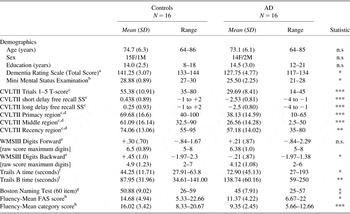
Thirty-two participants took part in the study (see Table 1 for demographics). Sixteen participants with probable AD were recruited from the Neuropsychology Service at Winthrop University Hospital, Stony Brook School of Medicine. All met NINCDS-ADRDA (National Institute of Neurological and Communicative Diseases and Stroke/Alzheimer’s Disease and Related Disorders Association) inclusion criteria for AD (McKhann et al., Reference McKhann, Drachman, Folstein, Katzman, Price and Stadlan1984) based on medical, neurological, and neuropsychological evaluations, a Mini-Mental Status Examination (MMSE; Folstein, Folstein, & McHugh, Reference Folstein, Folstein and McHugh1975) score of <26/30 (Monsch et al., Reference Monsch, Foldi, Ermini-Fünfschilling, Berres, Stähelin and Spiegel1995) and/or a Dementia Rating Scale (DRS; Mattis, Reference Mattis2005) score of ≤133/144 (Salmon et al., Reference Salmon, Thomas, Pay, Booth, Hofstetter, Thal and Katzman2002). Exclusion criteria were prior history of other primary neurological disorders (e.g., Parkinson disease, head trauma), Axis I psychiatric disorders (e.g., schizophrenia, bipolar disorder, substance abuse), or active pharmacologic treatment affecting cognition (e.g., for oncologic or incontinence conditions). Sixteen healthy older adults (controls) were recruited from local senior centers or were relatives of the participants with AD. Inclusion criteria were MMSE scores ≥ 26 and DRS >133. Exclusion criteria were a diagnosis of any dementia, history of other neurologic or psychiatric diseases, or current pharmacologic treatment affecting cognition. Disease severity measures (i.e., DRS and MMSE) differentiated the groups (see Table 1), but demographic characteristics were not significantly different (p > .1). For a secondary analysis, a median split of the patient group on total DRS score (128.5/144) yielded mild (N = 8; DRS mean = 131.4 ± 1.6; range, 129–134) and moderate (N = 8; DRS mean = 124.1 ± 4.0; range, 117–128) subgroups, who did not differ on demographics of age or education (p > .1).
Demographic and neuropsychological performance on controls and participants with Alzheimer Disease (AD)
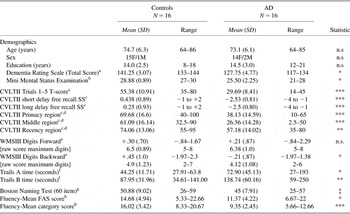
Note. n.s. = not significant; CVLTII = California Verbal Learning Test II; WMS = Wechsler Memory Scale.
*p ≤ .05; **p ≤ .01; ***p < .001; ‡ = trend 0.1 > p > .05.
a(Mattis, Reference Mattis2005); b(Folstein, Folstein, & McHugh, Reference Folstein, Folstein and McHugh1975); c(Delis et al., Reference Delis, Kaplan, Kramer and Ober2000); dlisted as percentage according to alternate scoring (Foldi et al., Reference Foldi, Brickman, Schaefer and Knutelska2003); e(Wechsler, Reference Wechsler1997a); f(Benton, Hamsher, Varney, & Spreen, Reference Benton, Hamsher, Varney and Spreen1983); g(Kaplan, Goodglass, & Weintraub, Reference Kaplan, Goodglass and Weintraub1983); h(Spreen & Strauss, Reference Spreen and Strauss1998).
Materials and Stimuli
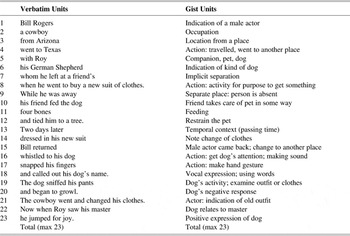
The story was a modified version of the Cowboy Story (Talland & Ekdahl, Reference Talland and Ekdahl1959; see Appendix), divided into 23 verbatim units and 23 corresponding gist units. A verbatim unit was defined as an exact reproduction of the words as they appeared in the story. A gist unit was the conceptual meaning representing each corresponding verbatim unit. For example, “Bill Rogers” is verbatim, and a response of “a man” or “a guy” constitutes a gist response, indicating that the key semantic referent (i.e., male) had been identified. Units were scored as either a verbatim or a gist unit to separate the two different response types and to clearly identify instances where gist responses occurred even in the absence of a verbatim recall. The story text was presented in bold black Times Roman 16 point font on a white page. Participants were asked to read the story and were instructed that they would be asked to tell it back as accurately as possible. They read it twice, once aloud and once to themselves, and were reminded again about the recall before they read it to themselves; there was no time limit constraint for the task. The participant’s verbal recall was audio-recorded, transcribed, and scored by two independent raters (N.S.F. and A.O.). The method of estimation of the reliability of ratings (Ebel, Reference Ebel1951) yielded reliability coefficients of rho=.94 and .95 for the two response types respectively. Disagreements were reviewed and resolved by consensus. The final scores were the total items recalled (maximum 23) for each of the two response types. A 10-item multiple choice recognition task, where each item was associated with a salient part of the story, was presented in written form to the participants following their free recall.
Patients with AD have known semantic deficits (Chan, Butters, Salmon, & McGuire, Reference Chan, Butters, Salmon and McGuire1993), reflected in impaired confrontation naming (Bayles & Tomoeda, Reference Bayles and Tomoeda1983) and verbal fluency (Monsch et al., Reference Monsch, Bondi, Butters, Salmon, Katzman and Thal1992). Language tests were the Boston Naming Test-60 item (Kaplan, Goodglass, & Weintraub, Reference Kaplan, Goodglass and Weintraub1983) and generative fluency measures using letter cues, FAS (Spreen & Strauss, Reference Spreen and Strauss1998) and category cues from the Controlled Oral Word Association (Benton, Hamsher, Varney, & Spreen, Reference Benton, Hamsher, Varney and Spreen1983). Fluency scores are reported as mean items generated in three 1-min trials. Episodic memory decay was measured by short and long delay free recall of CVLTII (Delis, Kaplan, Kramer, & Ober, Reference Delis, Kaplan, Kramer and Ober2000). Tests of attention and capacity were Digits Forward and Digits Backward (Wechsler, Reference Wechsler1997a) calculated using age-adjusted z-scores. The CVLTII serial position scores were derived according to the previously described alternate scoring of Foldi et al. (Reference Foldi, Brickman, Schaefer and Knutelska2003), as the percentage of items recalled from the number of items presented from list’s primacy, middle, or recency regions. Neuropsychological scores are reported in Table 1.Footnote 1
Procedure
Participants read the story, provided the immediate free recall and were presented the immediate recognition task.Footnote 2 The other neuropsychological tests were presented in pseudorandom order during a single session, with all language tasks following the story and word-list learning to avoid contamination.
Data Analyses
Analyses were conducted on SPSS software V18.0 (2009) and Statistica V8.0 (Statsoft, 2009). To determine the relative performance of verbatim and gist recall, data were submitted to a 2 × 2 (Group [Controls, AD] × Response Type [verbatim, gist]) mixed measures analysis of variance (ANOVA) with numbers of responses as the dependent variable. Significance was reported with alpha p < .05 and least significant difference tests for post hoc comparisons. To determine the relative contribution of attention, the relationships between the story recall measures and neuropsychological domains was performed separately for each group conducting Pearson Product Moment linear regression models correlating verbatim and gist responses with language (letter and category verbal fluency and confrontation naming), attention span, capacity, and consolidation (digits forward and digits backward, serial position of CVLTII word list). False Discovery Rate (FDR) adjustment to minimize Type I errors was applied to the multiple comparisons (Benjamini & Yekutieli, Reference Benjamini and Yekutieli2001).
Results
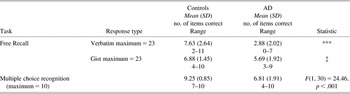
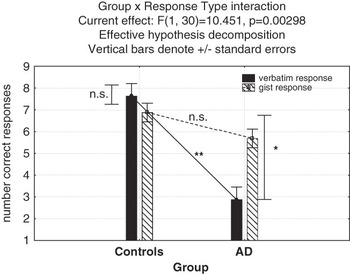
For the first hypothesis, the ANOVA yielded a significant group main effect, F(1, 30) = 40.30, p < .001, partial eta-squared (η2) = 0.57, revealing that the overall group average in AD was worse than the controls (see Table 2). A response type main effect showed a trend, F(1, 30) = 3.50, p = .071, η2 = 0.10, with gist units more easily recalled than verbatim units. A significant Group × Response Type interaction, F(1, 30) = 10.45, p = .003, η2 = 0.26, is depicted in Figure 1. Post hoc analyses indicate that the control group recalled both response types similarly, p > .1, and the AD group recalled more gist than verbatim units, p = .001. The AD group had significantly fewer verbatim units than the control group, p < .001, but gist units were not significantly different between the two groups, p = .36.
Immediate free recall and multiple choice performance of Talland Cowboy Story by controls and Alzheimer Disease (AD) participants

Note. ***p < .001; ‡ = trend, p = .058. Answers were scored either as a verbatim response or a gist response. Scores are listed as means (standard deviation).
Number of correct verbatim and gist responses by controls and Alzheimer disease (AD) groups, *p = .006; **p < .001.

Disease severity played a role in the AD group. The mild and moderate subgroups significantly differed on verbatim responses, t(14) = 2.21, p = .044, with the high functioning subgroup recalling roughly twice the verbatim units (mean 3.88 items ± 2.23 SD) than the low functioning subgroup (1.88 ± 1.25). A trend, p = .091, indicated that gist responses were slightly better in the mild (6.50 ± 1.85) compared to the moderate AD subgroup (4.88 ± 1.72). Moreover, the number of gist items in the controls did not differ significantly from the mild, p = .66, but did from the moderately impaired AD subgroup, p = .02. The controls were significantly better on multiple choice responses, F(1, 30) = 24.46, p < .001, although two AD participants correctly answered all 10 multiple choice responses (see Table 2).
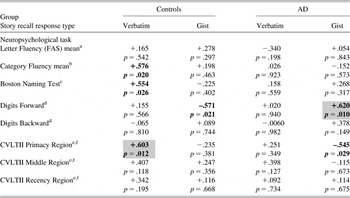
For the second hypothesis, the correlations between the two response types and cognitive tasks are reported in Table 3 for each group.
Pearson product moment correlations between number of verbatim and gist items achieved and measures of language and attention for each group (r, p-value). False Discovery Rate (FDR) adjustment cut point of p = .012 was used; significant correlations are indicated in shaded cells, and trends are indicated in boldface font

Note. a(Spreen & Strauss, Reference Spreen and Strauss1998); b(Benton, Hamsher, Varney, & Spreen, Reference Benton, Hamsher, Varney and Spreen1983); c(Kaplan, Goodglass, & Weintraub, Reference Kaplan, Goodglass and Weintraub1983); dage-adjusted z-score, (Wechsler, Reference Wechsler1997a); eCVLTII = California Verbal Learning Test II (Delis et al., Reference Delis, Kaplan, Kramer and Ober2000); falternate regional scoring (Foldi et al., Reference Foldi, Brickman, Schaefer and Knutelska2003).
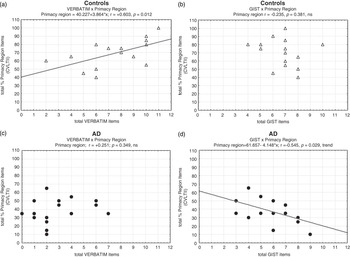
As seen in Figure 2, in the control group, the CVLTII primacy region correlated positively in the control group performance with verbatim responses (Figure 2a), but was non-significant with gist items (Figure 2b). In AD, there was no correlation between the primacy region and verbatim responses (Figure 2c) and a negative correlation between primacy region and gist items, with a trend toward significance (Figure 2d). Thus, the groups showed associations with the primacy region, but differed both in terms of the type of response and the direction of the association.
Relationship between performance on story recall (total verbatim and gist units recalled) and words recalled in the primacy region of the California Verbal Learning Test II (CVLTII) in controls and Alzheimer disease (AD). The significant positive correlation between primacy region (an estimate of successful use of the episodic buffer) and verbatim recall in controls (a) implicated that more verbatim items were associated with high primacy recall or episodic buffer resources. This relationship was not significant in AD (c), where few verbatim items were recalled. In contrast, the gist recall in controls was not significant (b), but in AD (d), the negative correlation indicated that more gist items were associated with low primacy recall, implicating that gist items in AD were not related to episodic buffer resources.

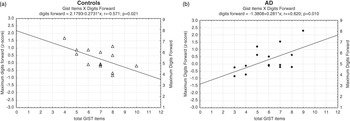
For digits forward (see Figure 3), there was a double dissociation: in controls more digits were correlated with fewer gist items (Figure 3a), but, in AD a longer digit span was associated with more gist items recalled (Figure 3b).
Relationship between gist item recall with digits forward (Wechsler, Reference Wechsler1997a). Calculations used age-adjusted z-scores, shown on left Y-axis; the corresponding maximum digits are provided on right Y-axis. The double dissociation shows that greater numbers of gist items recalled in controls (a) required little demands on low-level capacity resources (low digit span). In Alzheimer disease (AD) (b), more gist items are associated with longer digit spans. An otherwise automatic task in controls may tax low-level capacity in AD and depends on increased attentional resources.

In the control group, the other correlations that showed a trend but did not reach significance were verbatim items with category fluency and with confrontation naming.
Discussion
Two types of story recall were measured in patients with AD and in healthy older adults. Following Kintsch’s construction-integration model of discourse (Kintsch, Reference Kintsch1988; Kintsch & Young, Reference Kintsch and Young1984), responses were coded either as verbatim units (micropropositions) when exact words were reported or as gist units (macropropositions) that represented the essential meaning of the same section of the text. The first hypothesis was to demonstrate that gist recall was more resilient in AD than verbatim recall. As expected, AD participants performed overall worse than controls, and they generated more gist than verbatim responses. The second hypothesis was that available attentional resources influenced story recall, as had been predicted by Johnson et al. (Reference Johnson, Storandt and Balota2003). The findings did show that attentional resource measures were correlated with measures of story recall. But more interesting, was that the associations varied in each group, raising the possibility that participants with AD and controls may be drawing on different levels of attentional resources during story recall.
While controls recalled approximately the same number of gist as verbatim items, AD participants disproportionately favored gist over verbatim recall (see Figure 1) demonstrating a group × response type interaction that has not been consistently detected in earlier studies (e.g., Hudon et al., Reference Hudon, Belleville, Souchay, Gely-Nargeot, Chertkow and Gauthier2006). Controls recalled roughly twice the number of verbatim units as AD participants. Also, verbatim units reflected disease severity with milder AD patients generating approximately twice as many items as more severely impaired participants. This corroborates extant research in AD showing that micropropositional units decline as a function of disease severity (Baddeley & Wilson, Reference Baddeley and Wilson2002; Chapman et al., Reference Chapman, Zientz, Weiner, Rosenberg, Frawley and Burns2002; Hudon et al., Reference Hudon, Belleville, Souchay, Gely-Nargeot, Chertkow and Gauthier2006; Johnson et al., Reference Johnson, Storandt and Balota2003; Welland et al., Reference Welland, Lubinski and Higginbotham2002). The findings also reemphasize previous evidence that verbatim recall is a more sensitive measure of disease detection than gist to differentiate control from patient groups (Hudon et al., Reference Hudon, Belleville, Souchay, Gely-Nargeot, Chertkow and Gauthier2006; Ska & Duong, Reference Ska and Duong2005) even on immediate recall.
The resilience of gist versus verbatim recall in AD can be explained in several ways. First, it may that the poor verbatim recall is secondary to impaired semantic access, a primary characteristic of the disease (Chan et al., Reference Chan, Butters and Salmon1997; Monsch et al., Reference Monsch, Bondi, Butters, Salmon, Katzman and Thal1992). Some support is provided in this study as verbatim units were associated with measures of language in controls (i.e., correlation with naming and fluency), but not in AD. As such, impoverished verbatim recall may relate to an underlying semantic deficit, but does not explain how gist items were recalled in the face of poor verbatim recall. A second possibility derives from Kintsch’s (1988) model that people preferentially encode story knowledge over literal detail. While this may be true in controls, it may have to be qualified in AD as has been suggested by Gallo and colleagues (Reference Gallo, Shahid, Olson, Solomon, Schacter and Budson2006). They used a false memory paradigm to show that “preference” of gist material in AD may be subject to a faulty use of gist information. They report that prior semantic associations (activated by exposure to lists of semantically related words) led participants with AD to falsely believe that related lures presented later had been on the prior list when, in fact, they were not. The researchers concluded that AD participants showed impaired influence of their derived “gist”, with greater reliance on this meaning information than controls. With respect to the current findings, although this experiment did not activate a prior semantic set, gist items may have been more numerous than verbatim items precisely because participants with AD readily rely on associated meanings. Hudon et al. (Reference Hudon, Belleville, Souchay, Gely-Nargeot, Chertkow and Gauthier2006), directly compared the false memory paradigm and prose recall, and hypothesized that underlying working memory and attentional control could account for the common difficulties. A third explanation to the preferential gist recall in AD, is that story units are embedded in sentences or discourse. Waters and Caplan (Reference Waters and Caplan2005) proposed that working memory in healthy older adults influences sentential comprehension more than in younger adults, even after comprehension of content has occurred. This suggests that story units benefit from syntactic context, and when embedded in a story (Kintsch, Reference Kintsch1988), have the additional advantage of the larger discourse’s context to disambiguate meaning. The ability to hold the whole text meaning may be subject to available working memory stores. Nonetheless, it remains possible that, in AD, the presence of a sentence or a story context enabled activation and recall of meaningful gist ideas even without explicit reference to or encoding of exact lexical labels.
The second hypothesis addressed the role of attentional resources and story recall. In controls, better verbatim recall was correlated with greater primacy region recall of the CVLTII (see Figure 2a). Words from the primacy region are those retained after delay in healthy adults and represent information that has likely reached the episodic buffer for later storage. Rudner, Fransson, Ingvar, Nyberg, and Rönnberg (Reference Rudner, Fransson, Ingvar, Nyberg and Rönnberg2007) suggest that when material is transferred to the episodic buffer, it draws on attentional resources, and Baddeley (Reference Baddeley2000) emphasizes that an element of conscious effort occurs at the stage of the episodic buffer. One explanation of the relationship between verbatim and primacy word recall is that they both represent information that has transferred to the episodic buffer. But, whether the two response types avail themselves to those attentional resources in the same way remains unresolved. Another explanation may be that a common factor, such as conscious effort, mediates processing of verbatim units as well as words from the primacy region.
Another association with attention was found with gist items, particularly the correlations with digits forward (see Figures 3a and 3b). A forward digit span task is usually considered a measure of low-level capacity, and like automatic demands of the phonological loop, draws on minimal attentional resources. This may mean that, in controls, a large number of gist items could be associated with minimal demands on capacity resources as was suggested by the correlation with a low digit span. But in AD, a longer digit span was correlated with more gist items and may indicate that more demands were recruited from the capacity of the phonological loop. Perhaps gist recall in AD may no longer be automatic as it is in healthy adults, but demands increased effort even of low-level capacity resources. In addition, AD performance showed a trend toward a negative correlation between gist and the CVLTII primacy region (Figure 2d), in that the more gist items recalled, the worse the primacy region recall. Taken together, more gist items in AD were associated with increased demand of low-level resources (digits), but not with demands of high-level resources of the episodic buffer (primacy region). In contrast, the control group showed an association between verbatim recall and a measure attributed to the episodic buffer. The results of this study provide the initial support of the heretofore untested prediction of Johnson et al. (Reference Johnson, Storandt and Balota2003), that text recall in AD could be associated with attentional resources and capacity allocation. While these and other authors (Hudon et al., Reference Hudon, Belleville, Souchay, Gely-Nargeot, Chertkow and Gauthier2006; Ska & Duong, Reference Ska and Duong2005) had posited involvement of attention resources as a way to explain deficits in AD, the current study extends this idea by differentiating levels of attention that might be involved, namely the phonological loop and the episodic buffer. One difference between the current study and that of Hudon and colleagues is that their patient groups (MCI and AD) generated equivalent numbers of micro- and macropropositions, while the current study showed more gist than verbatim responses in AD. More to the point is not whether AD participants generate quantitatively the same or fewer gist or verbatim items, but whether the group associates or recruits qualitatively different levels of attention with each response type.
The current study also pertains to the conceptualization of subsystems of attention and working memory on storage and memory. Baddeley and Wilson’s (2002) analysis of prose recall in AD suggested that the role of the episodic buffer was to act as the interface between working memory, storage, and the central executive attentional components. Their story units from the Wechsler Memory Scale III Logical Memory Story (which are mostly verbatim) were poorly encoded in AD and were believed to have little input to or from the crystallized knowledge base, as there was no relationship between recall units and the National Adult Reading Test (Nelson, Reference Nelson1982). The current study also found no relationship in AD between story recall and measures of language (i.e., naming or fluency) or memory (i.e., short or long delay recall of the CVLTII). Baddeley suggests that the episodic buffer can be subservient to the executive system, but none of our findings supported a relationship between measures of executive function (e.g., set-switch, perseverations, or intrusions) and recalled items for either group. Also, no study, including this one, has shown a relationship between digits backward and text recall. The digits backwards test involves rote repetition (involving the phonological loop) plus additional holding and manipulation of material, attributed to the function of working memory. This process may be unrelated to those processes needed for prose recall. Future research will need to explore how low-level attentional capacity or high-level episodic buffer resources fall short in AD, and whether failure at this juncture of integration with other subsystems (e.g., linguistic, central executive) ultimately contributes to the poor memory consolidation.
There are several limitations to this study. First, no time limit was imposed when the participants read the story aloud or to themselves. If AD patients read more slowly, they would have more time to process the material. But, Chan, Salmon, and De La Pena (Reference Chan, Salmon and De La Pena2001) have shown that healthy older adults and AD patients have similar reading speeds. Thus, it is unlikely that story exposure time is a primary source of the group difference, although this was not tested empirically. Second, the Talland story is not commonly used and is thus less generalizable. However, its novelty avoided carryover of incidental learning effects of previous exposure to the more widely used Wechsler Memory Scale stories. Third, nine of the 16 participants with AD had significantly poor performance (zero, one, or two items) on verbatim recall; correlations with any measure, whether primacy recall, digits, language or memory scores, may be due to floor effects and interpretations have to be made cautiously. Lastly, the study was carried out with few participants, and replication with more participants is warranted.
Conclusions
The findings of this study address story recall in AD and the possible roles of attentional resources. Controls encoded similar numbers of verbatim and gist units from a novel story, and verbatim units were associated with a measure of consolidation. In contrast, patients with AD had expected overall poorer performance than controls, although relatively better gist than verbatim unit recall. One interpretation is that the extent to which participants with AD were able to capture story gist, they may have had to allocate more low-level attentional resources to do so. It remains unclear whether participants with AD are relegated to this because of a bias in favor of gist processing, poor verbatim encoding, or failure to allocate resources at the level of the episodic buffer.
Acknowledgments
The author gratefully acknowledges Barbara S. Koppel, Adam M. Brickman, Jenny Ly, Kathleen Van Dyk, and Nancy Helm-Estabrooks for their insightful comments and manuscript review; Anna Obrastzova for data acquisition; Nancy Huynh and Ameanté Lacoste for additional data preparation. The research was supported in part by grants from the Alzheimer Association Investigator Initiated RG-05-13534, and Professional Staff Congress-City University of New York awards 63280-00-32 and 64300-00-33.
Appendix
Talland Cowboy Story (adapted from Talland & Ekdahl, Reference Talland and Ekdahl1959):
Bill Rogers, a cowboy from Arizona, went to Texas with Roy, his German shepherd, whom he left at a friend's when he went to buy a new suit of clothes. While he was away, his friend fed the dog four bones and tied him to a tree. Two days later, dressed in his new suit, Bill returned, whistled to his dog, snapped his fingers, and called out his dog's name. The dog sniffed his pants and began to growl. The cowboy went and changed his clothes. Now, when Roy saw his master, he jumped for joy.
Table A1 indicates divisions into 23 units. Each verbatim unit was translated into a gist unit that captured the meaning. Participants were scored either for a verbatim or for a gist response.
Scoring Units

Reprinted with permission from Wolters Kluwer Health: The Journal of Nervous and Mental Disease, “Psychological Studies of Korsakoff’s Psychosis: IV. The Rate and Mode of Forgetting Narrative Material,” by George Talland and Marilyn Ekdahl, Volume 129, pp. 391–404, © 1959.
Sample of Multiple Choice Items
-Who is the story about?
1) CARPENTER
2) SALESMAN
3) FARMER
4) COWBOY
-What was his name?
1) ROY WILLIAMS
2) ROY ROGERS
3) BILL ROGERS
4) ROGER WILLIAMS
-Where was he from?
1) TEXAS
2) NEW MEXICO
3) NEVADA
4) ARIZONA
- How long was the cowboy gone?
1) TWO HOURS
2) TWO DAYS
3) OVERNIGHT
4) FOUR DAYS
-What happened when the cowboy returned?
1) THE DOG SNAPPED AT HIM
2) THE DOG WAS GLAD TO SEE HIM
3) THE DOG WAS GONE
4) THE DOG GROWLED AT HIM
- What did the master finally do to make the dog happy?
1) HE PUT ON HIS OLD CLOTHES
2) HE PATTED HIM
3) HE FED HIM
4) HE UNTIED HIM