Implications
Results from this study using commercial herd data, provide helpful information for farm technical staff, owners and pig companies to aid management decisions. These management decisions contribute to the optimisation of costs and benefits and to help decide which aspects of the farm should be improved in each case.
Introduction
Spanish pig production systems utilises a multiphase production management system as in many countries. During gestation and lactation sows are located in one site, piglets are housed in a different site during the nursery phase, and the grow-finishing (GF) phase is managed in one or several other sites. Under these conditions, the management of the whole pig production cycle focuses on each herd or period. To date there has been limited research done on management factors that affect performance and mortality (Sasaki and Koketsu, Reference Sasaki and Koketsu2008; Rose et al., Reference Rose, Eveno, Grasland, Nignol, Oger, Jestin and Madec2009; Jensen et al., Reference Jensen, Toft, Bonde, Kongsted, Kristensen and Sørensen2012) and economic implications (Rodríguez et al., Reference Rodríguez, Jensen, Plà and Kristensen2011; van der Fels-Klerx et al., Reference van der Fels-Klerx, Puister-Jansen, van Asselt and Burgers2011) in GF pig systems. Furthermore, feed represents 65% to 75% of the total cost of producing pork and ~75% of the total feed is consumed during the GF phase, suggesting that the GF phase is the most expensive phase in pig production (van Heugten, Reference van Heugten2010).
The GF phase is performed by integrated companies with many of these companies having uniform management practices among their associated herds, such as vaccination or antibiotics programmes and feeding regimes. However, these companies may have less uniformity with regards to farm facilities such as feeders, drinkers, floor types, ventilation systems or other production conditions, as companies recruit new herds or build new facilities that utilise the latest technologies. Currently there is little information on the impact of different farm facilities on pig performance traits such as feed intake, feed conversion and mortality.
Therefore, the objective of this study was to determine the effect of pig management and farm facilities on total feed intake (TFI), feed conversion ratio (FCR) and pig mortality (MORT) of Pietrain sired GF pigs using multiple regression analysis. Results from this study could be used to provide applied scientists and pig companies with useful information to improve overall farm productivity.
Material and methods
Sampling and data collection
Animal Care and Use Committee approval was not obtained as this study utilised a database of survey results on existing commercial farm facilities and farm management practices.
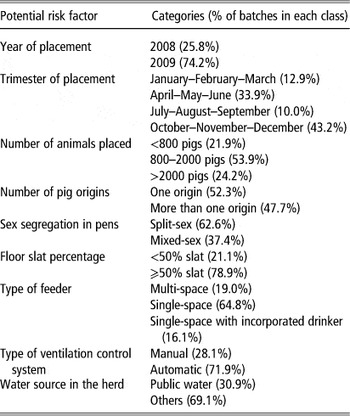
Farm management data from a total of 244 GF herds consisting of 310 batches (range of one to three batches per herd) with a total of 454 855 Pietrain sired pigs in six Spanish integrated pig companies were recorded between July 2008 and December 2009 as outlined in Tables 1 and 2. The average number of batches per company was 51.7 (range of 17 to 168 batches per company) with an average of 75 809 (ranging from 18 852 to 243364) pigs placed per integrated company. The herds were located in four northern Spanish regions; Aragón (44%), Cataluña (36%), Castilla y Leon (17%), and Valencia (3%) where the majority of Spanish pig meat is produced. The temperature and humidity was similar in all regions.
Descriptive values of independent categorical variables studied in 310 batches from 244 herds of GF pigs belonging to six integrated pig companies

GF=grow-finishing.
Descriptive values of independent continuous variables and dependent variables in 310 batches from 244 herds of GF pigs belonging to six integrated pig companies

GF=grow-finishing; s.d.=standard deviation; IBW=initial BW; FBW=final BW; TFI=total feed intake; FCR=feed conversion ration; MORT=mortality rate.
For the purpose of this study, batch was defined as a group of nursery pigs (19.50±1.72 kg) that entered a GF unit and were raised until they reached a suitable weight for slaughter (104.00±3.44 kg). Production conditions were recorded by herd, whereas pig performance records, year and trimester of placement records were recorded by batch. All batches were managed in an all-in all-out basis. All herds and batches had the following factors in common: (i) pigs were sent to the slaughterhouse between 95 and 110 kg of BW, (ii) pigs were either entire male or female, (iii) batches had between 10 to 20 pigs per pen, (iv) nipple drinkers were used in herds, (v) there was no cooling system in herds, (vi) three feed phases were used and (vii) feed were in pellet form.
Performance data studied (MORT, TFI and FCR) were selected based on an extensive literature review (Losinger et al., Reference Losinger, Bush, Smith and Corso1998; Oliveira et al., Reference Oliveira, Yus and Guitián2009). Herd data were collected by survey using a questionnaire model prepared by the research team in consultation with the field veterinarians of the companies that participated in the project. A descriptive summary of the categorical and continuous data used in the study are provided in Table 1 and Table 2, respectively.
Initial weight (IBW) refers to pig live weight when entering the GF unit and final BW (FBW) refers to the weight recorded immediately prior to transportation to the slaughter facility. TFI per pig in kilograms was calculated from the total feed delivered to each batch minus the amount of feed remaining in the silos when each batch was slaughtered, divided by the number of marketed pigs. FCR was obtained by dividing the total feed delivered to each batch by the difference between the total kilograms of pigs sent to slaughter and the total kilograms of pigs that entered at the GF batch. Mortality was calculated as the number of nursery pigs that entered the GF unit minus the number of pigs transported for slaughter divided by the number of pigs that entered the GF unit multiplied by 100.
Data analysis
Batch was considered the experimental unit for all analyses. Descriptive statistics were performed for continuous and categorical variables and their distributions were examined using the UNIVARIATE procedure of SAS (SAS, version 9.2, Cary, NC, USA). A square root transformation of the mortality data was used to fit with the normality assumptions of linear regression and after that the final values were back transformed.
Variables TFI, FCR and MORT were considered as the dependent variables. All other continuous and categorical variables (see Tables 1 and 2) were considered as predictor variables. Dependent variables were analysed using linear mixed effects regression models (SAS, version 9.2) with company included as a random effect. Variance components estimation was done using the restricted maximum likelihood procedure.
Initially, a univariate regression model was used where each predictor variable was included as a single fixed effect, and variables that had P⩽0.25 were selected for use in the multivariate analysis in the MIXED procedure of SAS (SAS, version 9.2). Pearson’s and Spearman’s correlations were performed among independent variables in the multivariate model to avoid multicollinearity between the continuous variables and confounding problems between the categorical variables. A correlation >0.60 between two variables indicated that there was multicollinearity, however in this study we did not have multicollinearity. This variables were selected by comparing P-values in the univariate analysis as well as taken into account its biological relevance with respect to the dependent variable. Subsequently, the model was developed using a manual stepwise model building procedure. All factors with a P<0.05 were retained in the final model. Fixed-effect testing was based on the F-test with denominator degrees of freedom approximated by the Satterthwaite’s procedure. Interactions between significant variables in the multivariate model were tested and included if P<0.05. After fitting the models for each dependent variable, residuals were plotted against predicted values to check homogeneity of variances and the presence of outliers. Company did not affect (P>0.10) any of the dependent variables and therefore was not included in the final models. Correlations among independent variables were not high (r<0.60) and all independent variables were studied to predict each of the response traits.
Results
TFI
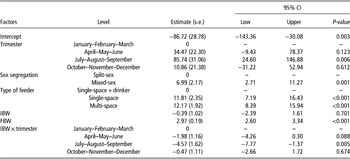
The TFI per pig per batch was 227±16.0 kg (ranging from 190 to 271 kg) (Table 2). Multivariate regression analysis indicated that TFI (Table 3) was influenced by trimester of placement (P=0.01), sex segregations in the pens (P<0.01), type of feeder (P<0.001), IBW (P<0.001) and FBW (P<0.001). The total variance in TFI in the model without any predictors (null model) was 241.1. After of the variables in the multivariable model, the total variance in the model was reduced to 91.9. Thus, the variables selected explained 61.9% of the total variability in TFI.
Estimates of the effects of the factors studied (s.e.) on TFI in kilograms per pig in 310 batches from 244 herds of GF pigs belonging to six integrated pig companies

TFI-total feed intake; GF=grow-finishing; s.e.=pooled standard error; IBW=initial BW; FBW=final BW.
Goodness of fit of the model: AIC=2250.
Categorical variable results with respect to dependent variables are presented based on differences found between the least-square means adjusted in each level (data not show). As expected the estimation of TFI by trimester showed that pigs placed in the first (January to March) and fourth (October to December) trimester had higher TFI (about 2.0%) than second and third trimester (Table 3). When sex segregation was practiced (split-sex pens), there was a reduction in TFI by 3.1%. Batches with pens furnished with multiple and single space feeders had greater TFI than batches arranged with single space feeders with incorporated drinkers (5.2%). However, the difference between multiple and single space feeders was negligible. Finally, the regression analysis indicated that for every 1 kg increase in FBW, TFI increased by 2.97 kg. An interaction between IBW and trimester of placement on TFI was observed (P<0.01) showing that pigs housed in the warm period (July to September) decreased TFI by –4.57±1.62 kg per 1 kg of IBW (P=0.005), whereas no effect of IBW on these traits was observed during the rest of the year.
FCR
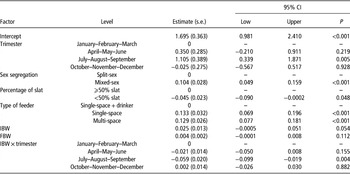
The average FCR was 2.71±0.14 (ranging from 2.44 to 3.20, Table 2). Table 4 shows the multivariate regression results for factors associated with FCR, and indicate that FCR was influenced by trimester of placement (P<0.01), sex segregation (P<0.001), percentage of slatted floor (P=0.05) and type of feeder (P<0.001). The total variance in FCR in the model without any predictors (null model) was 0.0190. After variables were included in the multivariable model, the total variance in the model was reduced to 0.0143 indicating that variables selected explained 24.8% of the total variability in FCR.
Estimates of the effects of the factors studied (s.e.) on FCR in 310 batches from 244 herds of GF pigs belonging to six integrated pig companies

FCR=feed conversion ratio; GF=grow-finishing; s.e.=pooled standard error; IBW=initial BW; FBW=final BW.
Goodness of fit of the model: AIC=−349.6
Average estimation of FCR by trimester also showed that pigs placed in the first (January to March) and fourth (October to December) trimester presented poorer FCR (an increase of 2.4%) than those placed during the rest of the year. When sex segregation was not practiced (mixed-sex pens), FCR was 3.8% poorer. The slatted floor percentage was important in determining FCR, pigs finished in farms with <50% slated floor had 1.7% better FCR. There was no noticeable difference between single and multiple spaced feeders however there was an improvement in FCR when a drinker was incorporated into the single space feeder (4.8%). An interaction between IBW and trimester of placement on FCR was also found (P<0.001) showing that pigs housed in the warm period (July to September) improved FCR (−0.059±0.020 units) per each increment of 1 kg of IBW (P=0.003), whereas no effect of IBW on these traits was observed during the rest of the year.
Mortality
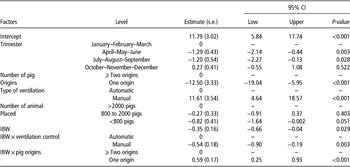
The mean MORT was 4.11±2.53% (ranging from 0.2% to 13.6%) (Table 2). Multivariate regression analysis indicated that MORT (Table 5) was mainly influenced by trimester of placement (P<0.001), number of pig origins (P<0.001), type of ventilation (P=0.001) and IBW (P=0.001). The total variance in MORT in the model without any predictors (null model) was 6.42. However, after variables were included in the multivariable model, the total variance in the model was reduced to 5.12. The variables selected explained 20.4% of the total variability in MORT.
Estimates of the effects of the factors studied (s.e.) on MORT in 310 batches from 244 herds of GF pigs belonging to six integrated pig companies

MORT=mortality rate; GF=grow-finishing; s.e.=pooled standard error; IBW=initial BW.
Goodness of fit of the model: AIC=1388.
Mortality was higher for batches placed between October and March than those placed between April and September (about 29% of difference). It was also observed that batches containing pigs from one origin had a 21.2% lower mortality than batches with pigs from two or more origins. Pigs housed in barns that had an automatic ventilation system had lower mortality (21.4%) than those in barns with manual ventilation systems. Finally, the regression analysis indicated that for every 1 kg increase in IBW, MORT decreased by 0.35%. Interactions between both IBW and ventilation control (P=0.003) and IBW and pig origins (P<0.001) on mortality were also found showing that pigs housed in barns with manual ventilation systems had decreased mortality (–0.54±0.18%) and pigs in a batch from one origin increased mortality (0.59±0.17%) per each increment of 1 kg of IBW.
Discussion
Production and economic data are routinely recorded at pig company and farm levels to provide useful information for farm management decision making. Several authors (Losinger et al., Reference Losinger, Bush, Smith and Corso1998; Larriestra et al., Reference Larriestra, Maes, Deen and Morrison2005; Oliveira et al., Reference Oliveira, Guitián and Yus2007 and Reference Oliveira, Yus and Guitián2009) have published data related to the effect and relevance of production factors on the final output of GF pigs. An important factor considered for selection of herds was the sire line used. In the present study, Pietrain was the most common sire line used by herds for all batches as it is considered the most used line in Spain (Latorre et al., Reference Latorre, Iguácel, Sanjoaquín and Revilla2009) due to its high genetic potential.
The fixed effect of trimester of placement was significantly associated with TFI, FCR and MORT in this study. The fixed effects of sex segregation and type of feeder were associated with TFI and FCR, and the number of pig origins and type of ventilation control were associated with MORT. The low amount of variance explained for FCR (24.8%) and mortality (20.4%) may be explained by a limited variability in the database studied. Maes et al. (Reference Maes, Duchateau, Larriestra, Deen, Morrison and de Kruif2004) and Larriestra et al. (Reference Larriestra, Maes, Deen and Morrison2005) also obtained low values (20% and 13%, respectively) when evaluating factors that influence MORT. In contrast, Oliveira et al. (Reference Oliveira, Yus and Guitián2009) found high values for MORT and TFI (41% and 80%, respectively). In this sense, it is subjective to compare the percentage of variance explained from other studies because of differences in variability or the factors studied. Moreover, despite the low values found in the present study, the effects studied were highly significant and consistent showing that in this case the variance explained from the models had limited importance.
Pigs arriving at farm facilities in cold (October to March) seasons had higher TFI and MORT and poorer FCR. This is in agreement with Oliveira et al. (Reference Oliveira, Yus and Guitián2009) who observed that pigs had higher TFI when placed in cold periods. During cold periods animals require more energy to maintain their body temperature, therefore feed intake increases may impair feed efficiency. Maes et al. (Reference Maes, Duchateau, Larriestra, Deen, Morrison and de Kruif2004) and Oliveira et al. (Reference Oliveira, Yus and Guitián2009) also found higher MORT in pigs placed during the cold season compared with those placed during the warm season, in Belgium and Galicia (Spain), respectively. High MORT in pigs kept during cold periods can be associated with respiratory diseases originating from poorly ventilated buildings (Maes et al., Reference Maes, Duchateau, Larriestra, Deen, Morrison and de Kruif2004).
Automatic ventilation systems in barns, led to a reduction in MORT. According to Saha et al. (Reference Saha, Zhang, Kai and Bjerg2010) the purpose of the ventilation system is to maintain a particular temperature while controlling levels of humidity and removing gaseous contaminants introduced by the animal and their waste. Therefore, the efficient removal of gases and moisture will depend on the type of ventilation control system used. Choi et al. (Reference Choi, Song, Lee and Albright2010) observed higher profitability in nursery pigs housed in barns with automatic ventilation compared with those housed in manual ventilation. However, Oliveira et al. (Reference Oliveira, Yus and Guitián2009) did not find differences between manual and automatic ventilation control on MORT and TFI.
Pigs fed in single-space feeders with incorporated drinkers had better performance than pigs fed in single and multi-space feeder without a drinker. Studies conducted by Gonyou and Lou (Reference Gonyou and Lou2000) and Myers et al. (Reference Myers, Goodband, Tokach, Dritz, Bergstrom, DeRouchey and Nelssen2010) concluded that single-space feeders with incorporated drinker improved performance of GF pigs. In contrast, Patterson (Reference Patterson1991) did not find any benefit in pig performance using feeders with an incorporated drinker. Our study shows a lower TFI in pigs fed with single-space feeder with incorporated drinker, which disagrees with the results found by several studies (Anderson et al., Reference Anderson, VanLunen and Sproule1990; Gonyou and Lou, Reference Gonyou and Lou2000). However, Payne (Reference Payne1991) observed an increase in average daily gain without increasing TFI of pigs fed in feeder with incorporated drinker, as consequence of a lower feed wastage. Thus, in the current study, it may be possible that the lower TFI found in pigs fed in single-space feeder with an incorporated drinker may be due to the lower feed wastage; in other words, the higher feed intake observed in pigs fed in both single and multi-space without drinker may be in part due to the wastage, leading to a poorer FCR.
Batches with mixed-sex pens had higher TFI and poorer FCR than those in split-sex pens. Hill et al. (Reference Hill, Baido, Cromwell, Mahan, Nelssen and Stein2007) suggested that the reason for having split-sex pens was related to the advantages of optimising diet composition among different sexes, mainly between barrow and female pigs. However, in the present study the same diet was fed to male and female pigs in split-sex pens. The lower performance found in mixed-sex pens compared with those in single-sex pens might be a consequence of the differences in the time needed to achieve FBW. Thus, females in mixed-sex pens may be kept longer on the farm so males reach an adequate slaughter. Previous studies also focused on the importance of split-sex on welfare issues due to the potential aggressiveness between males and females, indicating that rearing females separately avoided welfare problems and improved feed efficiency (Giersing and Andersson, Reference Giersing and Andersson1998; Björklund and Boyle Reference Björklund and Boyle2006).
The number of pig origins affected mortality showing that pigs originated from a one origin had lower MORT. This may be due to an increased risk in introducing disease into a herd when pigs are sourced from multiple farms. It may be also due to the fact that larger pig herds have to source their pigs from multiple origins to fulfil their requirements, and pigs in larger herds received less supervision from farm workers. Previous studies also found an increase in MORT with more than one pig origin (Maes et al., Reference Maes, Duchateau, Larriestra, Deen, Morrison and de Kruif2004; Oliveira et al., Reference Oliveira, Yus and Guitián2009). It has been suggested that at each origin herd there are specific pathogen sources. Therefore, in a GF batch with multiples origins, there may be a mixture of pathogens and immunity status, increasing the risk of transmission of pathogens and reducing performance (Harris and Alexander, Reference Harris and Alexander1999; Maes et al., Reference Maes, Deluyker, Verdonck, Castryck, Miry, Vrijens and de Kruif2000).
Pigs placed in pens with <50% slated floor had better FCR compared with pens with more than 50%. In contrast, Oliveira et al. (Reference Oliveira, Yus and Guitián2009) and Losinger et al. (Reference Losinger, Bush, Smith and Corso1998) did not find any influence of slatted floor percentage on TFI or MORT. However, in the current study we did not observe an effect of slatted floor percentage on MORT. In any case, the optimal proportion of slated floor should be related to the density of pigs in the pen, since pigs use specific areas of the pen to feed, rest and defecate, where resting in a dry and solid floor is a priority (Hacker et al., Reference Hacker, Ogilvie, Morrison and Kains1994). In addition, differences observed in FCR but not in MORT could be explained by the greater probability to lose feed through the slats leading to a greater feed wastage in pens with >50% slatted floor.
Conclusion
The results showed that performance of GF pigs improved when batches: (i) were placed in the spring and summer season, (ii) sourced from one origin, (iii) the pens had single-space feeders with incorporated drinker, (iv) the pens had <50% of slated floor, (v) a split-sex pen (males v. females) management system was used and (vi) pigs were housed in barns that had automatic ventilation systems. Furthermore, it is important to take into account the variations in IBW and FBW at batch level, since they played an important role in the performance parameters studied.
Acknowledgements
The authors express gratitude to the six pig companies for allowing to use their data and to FEDNA (Fundación Española para el Desarrollo de la Nutrición Animal) for providing funding for a three month training period for the first author to Ireland. This research was supported by the Spanish Ministerio de Ciencia e Innovación (project AGL2011-29960). We also acknowledge Agencia Española de Cooperación Internacional para el Desarrollo (MAEC-AECID) for providing research fellowships.