The developmental period spanning ages 18–29 years is marked by extremely high rates of alcohol dependence, with the prevalence of alcohol dependence increasing in adolescence, peaking in the early 20s, and declining thereafter (Grant et al., Reference Grant, Dawson, Stinson, Chou, Dufour and Pickering2004; National Institute on Alcohol Abuse and Alcoholism, 2008; Wells, Horwood, & Fergusson, Reference Wells, Horwood and Fergusson2006). One explanation for this age trend is that it represents a mixture of developmentally distinct subtypes of alcohol dependence, with most young people who are diagnosed with alcohol dependence representing a developmentally limited subtype and those diagnosed with alcohol dependence beyond the young adult years representing other subtypes (e.g., a developmentally persistent or late-onset subtype). Heterogeneity in the developmental course of alcohol dependence may have important implications for nosology, etiology, prevention, and treatment. For example, identifying subtype-specific risk factors prior to the onset of alcohol dependence can inform our understanding of the etiology of alcohol dependence as well as the design of more effective prevention programs. Moreover, identifying subtype-specific adult correlates can inspire the development of treatment strategies tailored to target these correlates.
At least two approaches have been applied to define subtypes of alcohol dependence (for a review of the alcohol subtypes literature, see Leggio, Kenna, Fenton, Bonenfant, & Swift, Reference Leggio, Kenna, Fenton, Bonenfant and Swift2009). One approach derives subtypes by combining information about alcohol dependence with other related clinical indicators (e.g., antisocial behavior, family psychiatric history, and lifetime psychiatric disorders). This approach is exemplified in a recent report from the National Epidemiologic Survey on Alcohol and Related Conditions (NESARC; Moss, Chen, & Yi, Reference Moss, Chen and Yi2007). Individuals with a past-year diagnosis of alcohol dependence were selected for subtyping analyses. Subtypes were derived from past-year alcohol dependence and abuse criteria as well as a variety of other retrospectively reported clinical characteristics, including age of onset of drinking and alcohol dependence, family history of alcohol dependence, and lifetime histories of internalizing, externalizing, and substance-use disorders. Five subtypes were identified: a young adult subtype (mean onset age 20), a functional subtype (mean onset age 37), an intermediate familial subtype (mean onset age 32), a young antisocial subtype (mean onset age 18), and a chronic severe subtype (mean onset age 29). Longitudinal follow-up of these subtypes approximately 3 years later revealed that remission from alcohol dependence was relatively common among all subtypes (Moss, Chen, & Yi, Reference Moss, Chen and Yi2010). However, it is notable that the remission rates were highest for the young adult subtype (~70%), consistent with a developmentally limited form of alcohol dependence and lowest for the chronic severe subtype (~35%), consistent with a developmentally persistent form of alcohol dependence.
A potential limitation of this cross-sectional subtyping approach is that retrospective data must be relied on to characterize developmental course (i.e., age of onset of drinking and age of onset of alcohol dependence are retrospectively reported). An alternative subtyping approach is to prospectively map patterns of change in alcohol dependence diagnoses as they develop over time and identify exogenous variables that predict these patterns. This approach was initially advocated by Zucker (Reference Zucker1986), who was the first to propose a developmental typology of alcohol dependence. The merits of this approach include greater emphasis on progression into and out of problematic alcohol use and the potentially useful distinction between predictors of alcohol dependence (e.g., family history of alcoholism and childhood and adolescent psychiatric disorder) and the course of alcohol dependence itself.
Numerous prospective studies have identified different alcohol subtypes either empirically or a priori based entirely or almost entirely on patterns of problematic alcohol use over time (Jackson & Sartor, in press). Most of these studies focused on volume of consumption or frequency of heavy drinking, with just a handful examining more pathological alcohol involvement such as alcohol dependence (Jackson & Sher, Reference Jackson and Sher2005) and alcohol problems/consequences (Bennett, McCrady, Johnson, & Pandina, Reference Bennett, McCrady, Johnson and Pandina1999; Jackson & Sher, Reference Jackson and Sher2005; Warner, White, & Johnson, Reference Warner, White and Johnson2007). Although it is somewhat difficult to compare studies that differ in terms of baseline age of the sample, length of study period, and alcohol measure studied, four prototypical developmental subtypes of alcohol consumption, alcohol problems, and alcohol-use disorders have emerged: (a) a stable low-drinker subtype, characterized by stably low use (or nondependence) over time; (b) a developmentally limited subtype, characterized by decreasing use over time; (c) a late-onset subtype, characterized by increasing use over time; and (d) a persistent subtype, characterized by stably high use over time (Sher, Jackson, & Steinley, Reference Sher, Jackson and Steinley2011).
These developmental subtypes are distinguishable from one another on a variety of behavioral, emotional, and contextual correlates (Jackson & Sartor, in press). Of particular interest, however, is the identification of factors that distinguish among subtypes that have similar starting points but then diverge (i.e., multifinality; Cicchetti & Rogosch, Reference Cicchetti and Rogosch1996), namely, the persistent versus the developmentally limited subtype and the late-onset versus the stable low-drinker subtype. That is, of the individuals who diagnose with alcohol dependence in late adolescence/early adulthood, why is it that some mature out of problematic drinking (developmentally limited subtype) whereas others go on to experience chronic problems (persistent subtype)? Of the individuals who do not diagnose with alcohol dependence during the period of peak prevalence, why do some go on to develop problems later (late-onset subtype) whereas most others do not (stable low-drinker subtype)? We present analyses targeted specifically at these two priority questions. Answers to these questions will be particularly informative for clinicians who will want to distinguish between those who will follow a remitting versus chronic course and, of those currently not alcohol dependent, those who will likely develop dependence in the future.
Few factors have been found that distinguish the persistent from the developmentally limited subtype (Bates & Labouvie, Reference Bates and Labouvie1997; Bennett et al., Reference Bennett, McCrady, Johnson and Pandina1999; Jackson & Sher, Reference Jackson and Sher2005; Schulenberg, O'Malley, Bachman, Wadsworth, & Johnston, Reference Schulenberg, O'Malley, Bachman, Wadsworth and Johnston1996; Schulenberg, Wadsworth, O'Malley, Bachman, & Johnston, Reference Schulenberg, Wadsworth, O'Malley, Bachman and Johnston1996; Wennberg, Andersson, & Bohman, Reference Wennberg, Andersson and Bohman2002). Perhaps the subtypes do not differ in their risk profiles. However, it is also possible that the factors that distinguish these two subtypes have simply not been adequately studied as yet. Although a variety of potential discriminating factors have been examined, including personality, emotional, behavioral, and contextual factors, most studies only assessed these risk factors at or after age 18. Thus, the assessed risk factors often referred to risk occurring at or shortly before age 18, after age 18, or to retrospectively reported lifetime risk, yet considerable theory suggests the importance of childhood antecedents in early-onset and persistent alcohol dependence (Zucker, Reference Zucker1986, Reference Zucker, Zucker, Howard and Boyd1994).
Similarly, few premorbid factors have been found that reliably discriminate the late-onset from the stable low-drinker subtype (Casswell, Pledger, & Pratap, Reference Casswell, Pledger and Pratap2002; Jackson & Sher, Reference Jackson and Sher2005; Muthén & Muthén, Reference Muthén and Muthén2000; Schulenberg, O'Malley, et al., Reference Schulenberg, O'Malley, Bachman, Wadsworth and Johnston1996; Schulenberg, Wadsworth, et al., Reference Schulenberg, O'Malley, Bachman, Wadsworth and Johnston1996; Warner et al., Reference Warner, White and Johnson2007; Wennberg et al., Reference Wennberg, Andersson and Bohman2002), although the search for factors that distinguish these subtypes has not received systematic attention. It is important to test if the late-onset subtype has its roots in childhood or if the onset of alcohol dependence in adulthood is triggered by more proximal events. Few studies have addressed the former question of childhood and adolescent risk, and two (Muthén & Muthén, Reference Muthén and Muthén2000; Schulenberg, O'Malley, et al., Reference Schulenberg, O'Malley, Bachman, Wadsworth and Johnston1996) examined a limited set of adult correlates (e.g., marital status, educational attainment, and unemployment) of the late-onset subtype.
The purpose of the current study was to test the factors that differentiate the persistent from the developmentally limited subtype and the late-onset from the stable low-drinker subtype in a population-based sample of individuals followed prospectively from birth to age 32. We chose to focus our comparisons on the persistent versus developmentally limited subtype and the late-onset versus stable low-drinker subtype because these subtypes were anticipated based on theory and prior research and because results of these comparisons, each involving two groups matched on initial diagnostic status, would have the biggest impact on clinical practice. Alcohol dependence was chosen as the alcohol outcome of interest because of its clinical utility and meaningfulness. Three specific research aims were addressed. The first aim was to describe the childhood and adult correlates that characterize individuals who develop alcohol dependence, as a group. The second aim was to identify factors that differentiate alcohol-dependent adults with a persistent form of alcohol dependence from those with a developmentally limited form. Toward this end, we focused on correlates that have been implicated in theory and research on early-onset and persistent forms of alcohol dependence, including family history of substance dependence, childhood and adolescent measures of behavioral undercontrol and negative affect, and patterns of early substance use (Sher & Gotham, Reference Sher and Gotham1999; Zucker, Fitzgerald, & Moses, Reference Zucker, Fitzgerald, Moses, Cicchetti and Cohen1995). The third aim was to identify factors that differentiate the late-onset from the stable low-drinker subtype. Given theory and research implicating depression and anxiety as antecedents of an adult-onset, negative-affect subtype of alcohol dependence (Zucker, Reference Zucker1986, Reference Zucker, Zucker, Howard and Boyd1994), we selected measures of childhood, adolescent, and adult negative affect as potential discriminators of the late-onset versus stable low-drinker subtypes. In addition, we selected adult correlates indicative of negative or stressful life events that might serve as proximal triggers for the onset of alcohol dependence in adulthood (e.g., stressful job demands, poor relationship quality, and coping with stress by drinking).
The current study builds on prior research in several important ways. First, it is one of only a few studies of alcohol dependence that has followed participants prospectively from birth into the fourth decade of life. Thus, an advantage of the current study is that alcohol-use behavior was tracked further than in most previous studies, which followed participants into their 20s. The longer follow-up can reduce misclassification errors (e.g., late-onset subtype erroneously classified as stable low-drinker subtype) that could alter findings regarding correlates of the different subtypes. An additional advantage of the current study is the prospective measurement of early childhood and adolescent risk factors unbiased by knowledge of the participants' alcohol use patterns. Second, the current study employs an unselected, representative birth cohort, whereas many prior subtyping studies employed college students, children of alcoholics, or treatment samples, samples that may limit the nature and generalizability of the subtypes identified. Third, the exceptional participant retention rate in the current study (96% at age 32) minimizes potential bias introduced by selective attrition; for example, differential dropout of late-onset as compared to stable-low drinkers. Fourth, the current study includes a broad array of correlates collected from laboratory observations, parents, teachers, and other informants, allowing for the best possible chance of discriminating among the subtypes.
Method
Participants
Participants are members of the Dunedin Multidisciplinary Health and Development Study, a longitudinal investigation of the health and behavior of a complete birth cohort. The cohort of 1,037 children (52% boys) was constituted at age 3 years when the investigators enrolled 91% of consecutive births between April 1, 1972, and March 31, 1973, in Dunedin, New Zealand. Cohort families represent the full range of socioeconomic status in the general population of New Zealand's South Island and are primarily of White European ancestry. Follow-up assessments were conducted with informed consent at 5, 7, 9, 11, 13, 15, 18, 21, 26, and 32 years of age, when 96% of the living study members underwent assessment in 2003 to 2005. Cross-national comparisons lend confidence regarding the generalization of findings from the Dunedin Study population to other industrialized nations (Moffitt et al., Reference Moffitt, Caspi, Taylor, Kokaua, Milne and Polanczyk2010).
Measures
Alcohol dependence
Past-year alcohol dependence was assessed at ages 18, 21, 26, and 32 using the Diagnostic Interview Schedule (DIS; Robins, Cottler, Bucholz, & Compton, Reference Robins, Cottler, Bucholz and Compton1995; Robins, Helzer, Croughan, & Ratcliff, Reference Robins, Helzer, Croughan and Ratcliff1981). Complete alcohol dependence diagnostic data were available for 936, 957, 976, and 959 participants at ages 18, 21, 26, and 32. Because the age 18 and 21 assessments preceded, whereas the age 26 and 32 assessments followed publication of the fourth edition of the DSM (DSM-IV (American Psychiatric Association, 1994), slightly different versions of the DIS were used. For this report, we rescored alcohol dependence symptoms from all four assessment waves to be consistent with each other and to conform as closely as possible to DSM-IV criteria. Only one symptom deviated from DSM-IV criteria. At ages 18 and 21, the alcohol dependence withdrawal symptom did not require more than one characteristic sign of withdrawal, or clinically significant distress or impairment caused by withdrawal, and did not include using a “closely related substance” to relieve or avoid withdrawal, because these subcriteria were not a part of the third, revised edition (DSM-III-R; American Psychiatric Association, 1987). Therefore, to ensure consistency across all ages, we did not use these subcriteria in making DSM-IV alcohol dependence diagnoses for ages 26 and 32.
Alcohol dependence groups
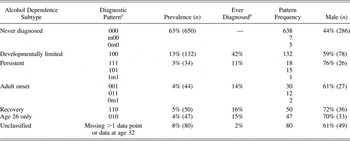
We used our longitudinal data to identify theory-driven developmental trajectories of alcohol dependence. We did not use group-based trajectory modeling because of recent concerns regarding the validity of this approach with nonnormal data, particularly alcohol dependence measures (Bauer & Curran, Reference Bauer and Curran2003; Sher et al., Reference Sher, Jackson and Steinley2011). Instead, we opted to ascertain developmental subtypes of alcohol dependence by examining the time-ordered patterns of alcohol dependence diagnoses across ages 18 to 32 (Table 1). Diagnostic data from the age 18 and 21 interviews were combined into one time point, because they were deemed to jointly reflect the period of emerging adulthood. In order to be classified, individuals had to have data for at least two of the three time points (18/21, 26, and 32), with one of those time points being the last (i.e., age 32); that is, 80 individuals missing more than one time point or data at age 32 were excluded from this report. Among the 957 individuals reported here, only 15 study members were missing one time point. Those 15 individuals were coded as non-alcohol-dependent for that missing age. Excluding these 15 individuals from analyses did not alter the findings. Further, the results of a test for missing completely at random missing data (Little, Reference Little1988) suggested that the missing alcohol dependence data were missing completely at random. Because individuals with missing data at one age tend to return to the study at some later age(s), the attrition in the Dunedin study has not been cumulative, and reasons for missing a few assessments seem to be idiosyncratic rather than systematic.
Developmental pattern, prevalence, and sex composition of alcohol dependence subtypes at ages 18/21, 26, and 32 years

aThe three-digit diagnostic pattern refers to the time-ordered pattern of alcohol dependence endorsement at age 18/21 (the first digit), 26 (the second digit), and 32 (the third digit). A “1” indicates alcohol dependence was endorsed at that measurement occasion, a “0” indicates alcohol dependence was not endorsed at that occasion, and “m” denotes missing data.
bEver diagnosed represents the percentage of those ever diagnosed.
Six groups were identified based on the time-ordered patterns of alcohol dependence: a never-diagnosed group and five alcohol-dependence subtypes (developmentally limited, persistent, adult onset, recovery, and age 26 only; see Table 1). Although we chose to focus our comparisons on the developmentally limited versus the persistent group and the adult-onset versus the never-diagnosed group because these groups were anticipated based on theory, standardized scores on the correlates will be presented for all six groups. We will also present the results of statistical tests of all pairwise comparisons between groups.
The pattern-based approach we used to identify alcohol-dependence groups has the advantage of being clinically translatable, because it mirrors the way clinicians ask about age of onset and longevity of the problem. However, the groups could still be arbitrary. To address this, we compared the alcohol-dependence groups derived from the pattern-based approach to empirically derived subtypes from a latent transition analysis of alcohol-dependence diagnoses for ages 18/21, 26, and 32. Overall correspondence between the two methods was 90%. Four alcohol-dependence groups emerged from the latent transition analysis: a never-diagnosed group (n = 729) and three alcohol-dependence subtypes: a developmentally limited (diagnosed at 18/21 only; n = 132), a persistent (diagnosed at 18/21, 26, and 32, n = 46), and a recovery subtype (diagnosed at ages 18/21 and 26 but not 32, n = 50). All four alcohol-dependence groups identified in the latent transition analysis were identified by the pattern-based approach, and 100% of individuals classified in the never, developmentally limited, persistent, and recovery groups by the pattern-based approach were so classified by the latent transition analysis. The pattern-based approach yielded two additional subtypes not identified by the latent transition analysis: an age-26-only subtype and an adult-onset subtype. All of the individuals making up the pattern-based age-26-only subtype were classified in the latent transition analysis never-diagnosed group, and the individuals making up the pattern-based adult-onset subtype were classified in either the latent transition analysis never-diagnosed (73%, n = 32) or the persistent (n = 12) group. Given the high concordance between the pattern-based approach and the latent transition analysis, as well as the fact that the pattern-based approach yielded the adult-onset subtype predicted by theory, we elected to use the results from the pattern-based approach.
Prospective and adult correlates
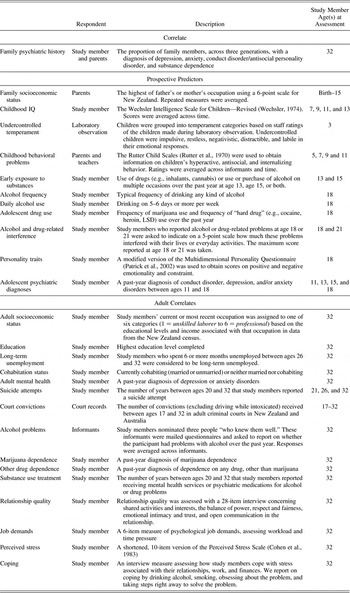
The measures of prospective and adult correlates are briefly described in Table 2. Additional details about the measures are available in supplemental Table S.1 (online only at http://journals.cambridge.org/dpp). All measures for this paper showed reliabilities of >0.70.
Brief description of the prospective predictors and adult correlates of the alcohol dependence subtypes
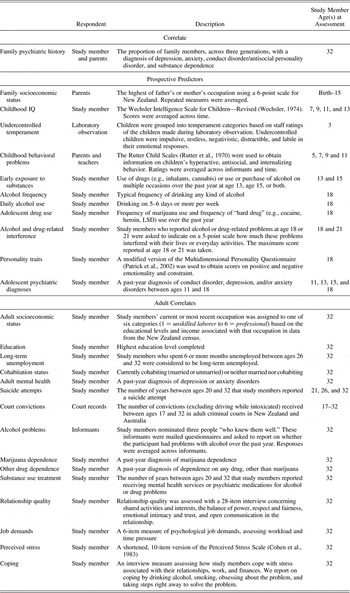
Note: For prospective predictors, we used data from the earliest available measurement point and used all measurement points available, with no selective omission.
Data analysis
Correlates of all six alcohol-dependence groups were examined in addition to testing whether these correlates differentiated the groups of theoretical interest. To examine correlates of the six alcohol-dependence groups, scores were standardized (Z scores: M = 0.00, SD = 1.00) on the full cohort, and the standardized scores for each group were tested for departure from the cohort mean. Standardized scores of 0.20, 0.50, and 0.80 represent small, medium, and large effect sizes, respectively (Cohen, Reference Cohen1992). Separate logistic regressions were used to identify factors that differentiate (a) all alcohol dependent from all healthy individuals, (b) the persistent from the developmentally limited subtype, and (c) the adult-onset subtype from the never-diagnosed group. In these analyses, all prospective and adult correlates were treated as independent predictors, and a dichotomous variable indicating alcohol-dependence group membership was treated as the outcome. All continuous explanatory variables were standardized prior to conducting the logistic regressions. All statistical tests included an adjustment for sex. Between 83% and 99% of the data were available for each variable and pair of variables used in this study.
Results
Prevalence of alcohol dependence and factors that differentiate alcohol-dependent from healthy individuals
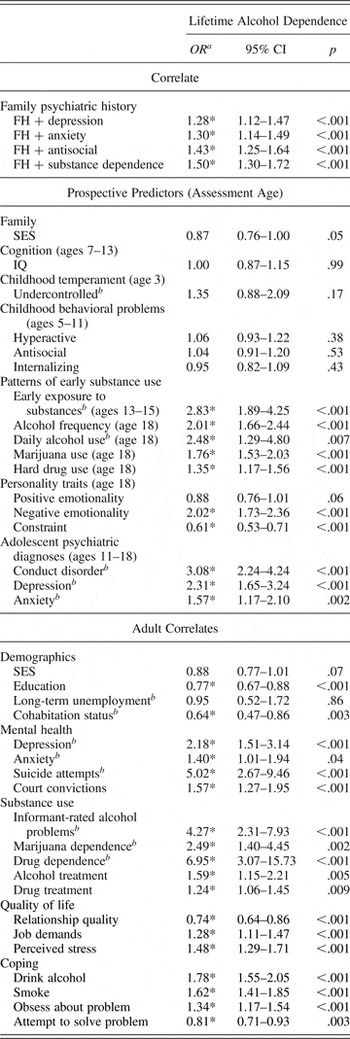
The percentage of participants meeting past-year diagnostic criteria for alcohol dependence at ages 18, 21, 26, and 32 was 11% (8% of females, 14% of males), 18% (12% of females, 25% of males), 14% (7% of females, 20% of males), and 8% (5% of females, 11% of males), respectively, confirming the expected emerging-adulthood peak. The prevalence of lifetime alcohol dependence was 32% (n = 318; 22% of females, 41% of males). Nearly every prospective and adult correlate was significantly associated with a lifetime diagnosis of alcohol dependence (see Table 3).
ORs for the prediction of lifetime alcohol dependence from prospective and adult correlates, adjusted for sex
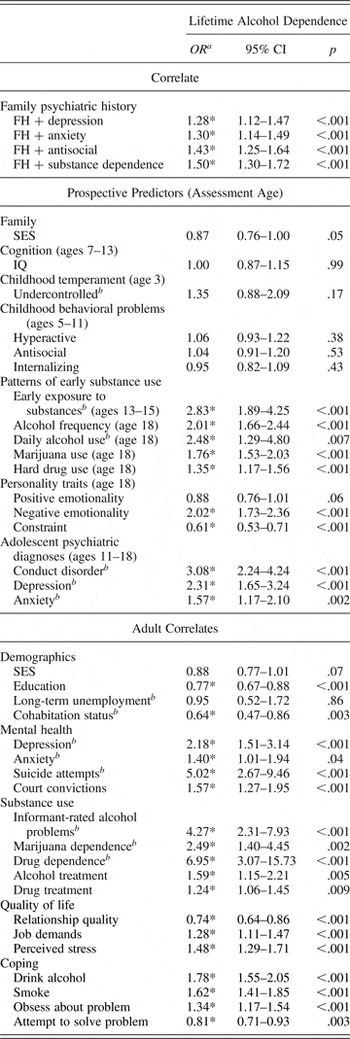
Note: Continuous predictors are standardized. OR, odds ratio; CI, confidence interval; FH, family history; SES, socioeconomic status.
aModel predicts the odds of a lifetime diagnosis relative to never diagnosing.
bUnstandardized dichotomous predictor.
*p < .05.
Factors that differentiate the alcohol dependence subtypes
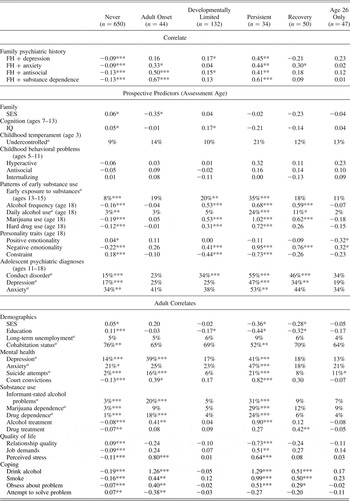
Standardized mean scores on all prospective and adult correlates as a function of alcohol dependence subtype are presented in Table 4. A group with a score that did not significantly differ from the cohort mean could be interpreted as having normative levels of that correlate. For example, the adult-onset subtype did not differ from the normative levels on childhood temperament, childhood behavior problems, patterns of early substance use, personality traits, or adolescent psychiatric diagnoses. In general, the persistent subtype exhibited the highest levels of risk in both childhood and adulthood, followed by the recovery subtype for childhood risk and the adult-onset subtype for adult risk. The never-diagnosed group generally exhibited the lowest levels of risk, compared to the cohort norm.
Standardized mean scores (M = 0.00, SD = 1.00) on prospective and adult correlates as a function of subtype
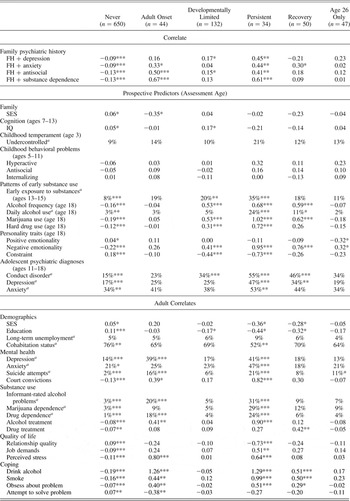
Note: Statistical tests are adjusted for sex, comparing each group to the overall cohort mean. FH, family history; SES, socioeconomic status.
aDichotomous variable. The values indicate the group prevalence.
*p < .05. **p < .01. ***p < .001.
Discriminating the persistent from the developmentally limited subtype
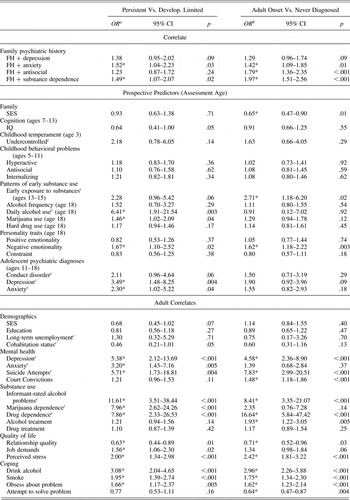
Relative to the developmentally limited subtype (Table 5), the odds of the persistent form of alcohol dependence were increased by a positive family history of anxiety disorders, family history of substance dependence, daily alcohol use and more frequent marijuana use in late adolescence, and several indices of negative affect in adolescence (trait negative emotionality, depression, and anxiety disorders). For example, daily use of alcohol by age 18 increased the odds of developing a persistent rather than developmentally limited course by 6.41 (95% CI = 1.91–21.54). Adult correlates discriminating the persistent from the developmentally limited subtype included depression and anxiety, suicide attempts, informant-rated alcohol problems, marijuana and other drug dependence, quality of life indices, and poor coping strategies. In all cases, the persistent subtype scored in the worse direction.
ORs for the prediction of alcohol dependence subtypes from prospective and adult correlates, adjusted for sex

Note: Continuous predictors are standardized. OR, odds ratio; CI, confidence interval; FH, family history; SES, socioeconomic status.
aModel predicts odds of persistent relative to developmentally limited subtype.
bModel predicts odds of adult-onset subtype relative to never-diagnosed group.
cUnstandardized dichotomous predictor.
*p < .05.
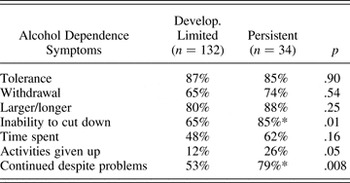
In terms of their alcohol dependence symptom profile at age 18/21, the persistent and developmentally limited subtypes were, for the most part, indistinguishable, with two notable exceptions (Table 6). Individuals with the persistent subtype were more likely to report both an inability to reduce their alcohol consumption and continued use despite problems. Furthermore, individuals with the persistent subtype reported that their alcohol and drug use at age 18/21 interfered more with their everyday activities (persistent: M = 3.00, SD = 1.26; developmentally limited: M = 2.25, SD = 1.11; p < .001).
Comparison of persistent and developmentally limited subtypes on prevalence of DSM-IV alcohol dependence symptoms at age 18/21

Note: Statistical tests are adjusted for sex.
*p < .05.
Discriminating the adult-onset subtype from the never-diagnosed group
Relative to the never-diagnosed group (Table 5), the odds of adult-onset alcohol dependence were increased by a positive family history of anxiety, antisocial, and substance-use disorders; early exposure to substances' and trait negative emotionality in adolescence. Adult correlates discriminating the adult-onset subtype from the never-diagnosed group included depression, suicide attempts, court convictions, informant-rated alcohol problems, drug dependence, alcohol treatment, poor relationship quality, perceived stress, and poor coping strategies. For example, perceived stress was associated with a 2.42 (95% CI = 1.81–3.22) increase in the odds of developing adult-onset alcohol dependence, relative to never being diagnosed, and coping with stress by drinking was associated with a 2.96 (95% CI = 2.26–3.88) increase.
Discussion
Consistent with previous research (Guo, Hawkins, Hill, & Abbott, Reference Guo, Hawkins, Hill and Abbott2001; Hasin, Stinson, Ogburn, & Grant, Reference Hasin, Stinson, Ogburn and Grant2007; Zucker et al., Reference Zucker, Fitzgerald, Moses, Cicchetti and Cohen1995), we report that individuals ever diagnosed with alcohol dependence were different from their nondiagnosed counterparts on a wide array of prospective and adult correlates. We contribute novel information by documenting that different developmental subtypes of alcohol dependence, derived from the prior literature, are characterized by a unique constellation of childhood and adolescent risk factors and adult correlates. Three developmental subtypes were anticipated based on theory and prior research: a developmentally limited, a persistent, and an adult-onset subtype. Our findings add new information about the construct validity and utility of these previously agreed-upon subtypes. Findings regarding each of these three subtypes are summarized below.
Developmentally limited subtype
The developmentally limited subtype was characterized by a diagnosis of alcohol dependence at age 18/21 but not thereafter and was the most prevalent of the alcohol-dependence subtypes (13% of the cohort). The observed risk profile for developmentally limited alcohol dependence involved largely normative childhood development, an abrupt peak in engagement in problem behaviors in adolescence, and low levels of problems in adulthood. The adolescent involvement in problem behaviors of this group included elevated scores (relative to the cohort mean) on adolescent conduct disorder, early exposure to substances, frequency of alcohol, marijuana, and hard drug use in adolescence, and the personality traits of negative emotionality and lack of constraint.
This risk profile is consistent with speculation that individuals with a developmentally limited form of alcohol dependence are responsive to contemporaneous social-developmental demands of adolescence and young adulthood (Moffitt, Reference Moffitt1993; Zucker, Reference Zucker, Zucker, Howard and Boyd1994). As adults, they may be sensitive to the negative consequences of problem behavior and have the ability to limit this behavior. A question for longitudinal follow-ups is whether members of this group will reemerge with problematic alcohol use later in life.
Persistent subtype
The persistent subtype, the least prevalent group (3% up to age 32), was characterized by diagnoses of alcohol dependence from ages 18/21 to 32. Individuals in the persistent group exhibited the highest levels of risk on almost all prospective and adult correlates, with scores frequently between 0.50 and 1.00 SD above or below the sample mean in the more pathological direction, indicating large effect sizes. Existing typologies of early-onset and persistent alcohol dependence highlight the role of a family history of alcohol dependence and the presence of concomitant antisocial behavior (Babor et al., Reference Babor, Hofmann, DelBoca, Hesselbrock, Meyer and Dolinsky1992; Cloninger, Bohman, & Sigvardsson, Reference Cloninger, Bohman and Sigvardsson1981; Zucker, Reference Zucker1986), and research has shown behavioral undercontrol to be a robust predictor of early-onset and persistent alcohol dependence (Jackson & Sher, Reference Jackson and Sher2005; Jacob, Bucholz, Sartor, Howell, & Wood, Reference Jacob, Bucholz, Sartor, Howell and Wood2005; Sher & Gotham, Reference Sher and Gotham1999), suggesting the so-called externalizing syndrome (McGue, Iacono, & Krueger, Reference McGue, Iacono and Krueger2006). Consistent with research, individuals with persistent alcohol dependence were distinguished (relative to the cohort mean) by family histories of substance dependence and antisocial behavior, high rates of childhood conduct disorder, low constraint, and adult court convictions. However, these externalizing risk factors and correlates were not the only distinguishing features of the persistent subtype. Rather, family histories of internalizing disorders (anxiety or depression), adolescent trait negative emotionality, and adolescent depression and anxiety were also elevated for the persistent subtype. This could indicate that individuals with persistent alcohol dependence suffer from global impairment or that there are multiple pathways to chronic alcohol dependence (e.g., internalizing and externalizing pathways; King, Iacono, & McGue, Reference King, Iacono and McGue2004).
Relative to individuals with developmentally limited alcohol dependence, individuals with persistent alcohol dependence fared worse on every prospective and adult correlate. The prospective factors that significantly differentiated persistent from developmentally limited alcohol dependence involved adolescent alcohol and marijuana use, indices of negative affectivity, and family liability. Specifically, individuals with persistent alcohol dependence were more likely to drink daily in late adolescence, more likely to attempt (unsuccessfully) to reduce drinking, and more likely to continue drinking despite acknowledging that their substance use was causing problems in their daily lives. Individuals with persistent alcohol dependence also used marijuana more frequently in adolescence, experienced higher levels of trait negative emotionality in adolescence, had higher rates of adolescent diagnoses of depression and anxiety, and had denser family histories of substance dependence and anxiety disorders than did individuals with developmentally limited alcohol dependence. In the limited prior research on this topic, family history of alcoholism (Bennett et al., Reference Bennett, McCrady, Johnson and Pandina1999; Jackson & Sher, Reference Jackson and Sher2005) and measures of negative affect (Bates & Labouvie, Reference Bates and Labouvie1997; Jackson & Sher, Reference Jackson and Sher2005) have not been found to distinguish the persistent from the developmentally limited subtype, though the direction of the effect, when reported, indicates that individuals with the persistent form of alcohol dependence are worse off on these factors. Our finding that adolescent negative affect differentiates the persistent from the developmentally limited subtype should be interpreted within the context of the persistent subtype generally scoring worse on all childhood risk factors. A question for future follow-ups is how long members of this group will continue to be dependent on alcohol and with what implications for their physical health.
Adult-onset subtype
The adult-onset subtype, with a prevalence of 4% by age 32, was characterized by a first-time diagnosis of alcohol dependence at age 26 or 32. The adult-onset subtype scored worse than the never-diagnosed group on selected prospective predictors (see Table 5, childhood socioeconomic status, early exposure to substances, and adolescent trait negative emotionality) as well as family history variables. However, relative to the average cohort child, adult-onset cases were virtually indistinguishable (Table 4), indicating that it will be difficult to know who or what to target for preventing adult-onset dependence. The one exception was family history; adult-onset cases had dense family histories of substance dependence, suggesting that premorbid clinical screening for family history can identify individuals at risk for adult-onset alcohol dependence. By adulthood, individuals with adult-onset alcohol dependence were exhibiting moderate to severe problems across mental health, substance-use, quality of life, and coping domains, further highlighting the need for prevention and early intervention. A question for future follow-ups is whether members of this group will develop a persistent course or show time-limited, intermittent stress-related episodes.
Extant theories about the adult-onset subtype emphasize the role of negative affectivity as a trigger for the onset of alcohol dependence in adulthood (Cloninger et al., Reference Cloninger, Bohman and Sigvardsson1981; Zucker, Reference Zucker1986). Some evidence even suggests that adult-onset alcohol dependence is linked to genetic factors common to depression and alcohol dependence, and that depressive symptoms may be present as early as childhood (Zucker et al., Reference Zucker, Fitzgerald, Moses, Cicchetti and Cohen1995). There was mixed support for these hypotheses in the current study. On the one hand, although they had relatively dense family histories of substance dependence and anxiety disorders, there was limited evidence that precursors of adult-onset alcohol dependence could be identified in childhood. That is, childhood temperament/personality, behavior problems, and psychiatric disorders were, for the most part, unremarkable for this group of individuals as children. On the other hand, individuals with adult-onset alcohol dependence experienced significant negative affectivity in adulthood as indicated by high rates of depression and suicide attempts and high levels of perceived stress, and they reported greater difficulty with effectively coping with stress (e.g., drinking more to cope and making fewer attempts to solve the problem). It is possible that this negative affect observed in adulthood is a consequence rather than a proximal cause of adult-onset alcohol dependence. However, given dense family histories of substance dependence and anxiety disorders, individuals who develop adult-onset alcohol dependence could be likened to a ticking time bomb. They have the diathesis (e.g., family history of substance dependence) and are simply awaiting the stressor(s) (e.g., negative or stressful life events that promote negative affectivity) that trigger the onset of alcohol dependence.
Recovery and age-26-only groups
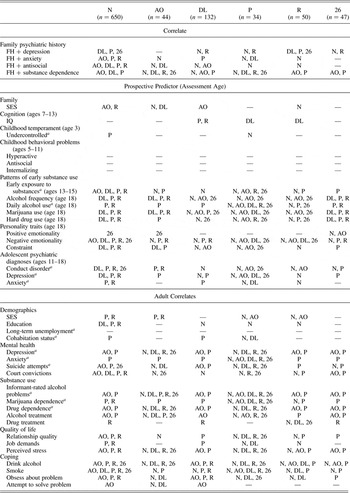
The recovery (5%) group must remain suspect because our data are right-hand censored, and the age-26-only group is similarly suspect because it was not anticipated by theory or prior research. Despite this, the existence of these two groups may have interesting implications. For example, it may be that most cases of alcohol dependence are relatively time limited, which is consistent with findings from NESARC (Vergés et al., Reference Vergés, Jackson, Bucholz, Grant, Trull and Wood2011). Thus, there may be just two forms of alcohol dependence: time limited and persistent. However, among the alcohol dependence groups that we identified, those with a possible time-limited course (i.e., adult onset, developmentally limited, recovery, and age 26 only) differed in important ways on some of the correlates we examined (Table 7). For example, family history of substance dependence set apart the adult-onset group from the developmentally limited, recovery, and age-26-only groups. In contrast, the developmentally limited and age-26-only groups had fairly similar profiles on the childhood and adolescent correlates, with exception of their patterns of early substance use. The developmentally limited group engaged in significant substance use as adolescents, whereas the age-26-only group did not. Thus, the developmentally limited and the age-26-only groups may similarly reflect time-limited alcohol dependence, with substance-use involvement and subsequent dependence simply shifted later in development for the age-26-only group.
Sex-adjusted pairwise comparisons (p < .05) among all subtypes on all correlates
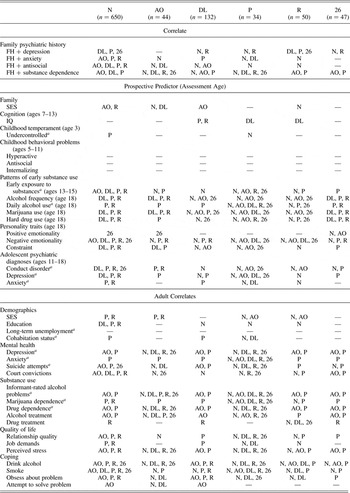
Note: N, never; AO, adult onset; DL, developmentally limited; P, persistent; R, recovery; 26, age 26 only. When these abbreviations appear in a cell, it means that these groups differ significantly (p < .05) from the group under consideration. (—) No group differences. FH, family history; SES, socioeconomic status.
In terms of the recovery group, we cannot speculate about what proportion of this group is truly “recovered” (and is perhaps comparable to the developmentally limited group) and what proportion will relapse (and is perhaps comparable to the persistent group).
Limitations and future directions
This study has several limitations. First, because we did not have data on alcohol dependence prior to age 18 or after age 32 and because of the gaps between assessment phases (e.g., between ages 21 and 26), it is possible that we missed the onset and/or offset of alcohol dependence for some individuals. However, the developmental subtypes identified here correspond well with those identified in other longitudinal studies spanning similar ages with more continuous assessment schedules (Schulenberg, O'Malley, et al., Reference Schulenberg, O'Malley, Bachman, Wadsworth and Johnston1996). Moreover, we previously reported that our “net” of four successive 1-year DIS diagnoses at ages 18, 21, 26, and 32 captured all but eight of the cohort members who reported treatment for mental health or substance-use problems between assessment windows (Moffitt, Caspi, et al., Reference Moffitt, Caspi, Harrington, Milne, Melchior and Goldberg2007; Moffitt, Harrington, et al., Reference Moffitt, Harrington, Caspi, Kim-Cohen, Goldberg and Gregory2007). Nonetheless, for individuals whose onset and/or offset of alcohol dependence was not observed, misclassification errors will have occurred. For example, because we did not assess alcohol dependence past age 32, some individuals currently classified in the never-diagnosed group could still develop alcohol dependence sometime in the future. These types of classification errors could alter findings regarding the subtype correlates. Longer follow-up could resolve some of these issues. It is of interest, however, that of the five NESARC subtypes (Moss et al., Reference Moss, Chen and Yi2007), only one had onset of dependence after age 32, and this “functional” subtype had relatively low alcohol consumption and mild symptoms.
Second, we did not examine how the various correlates were themselves related and whether these correlates had independent or overlapping associations with alcohol dependence group membership. Rather, the goal of this study was to assess the construct validity and potential utility of different developmental subtypes of alcohol dependence. As such, we tested the differential relations between correlates and developmental subtypes of alcohol dependence for which there are theoretical grounds to expect differential associations. To our knowledge, the results of this study provide the most comprehensive picture to date of the clinical and theoretical significance of developmental subtypes of alcohol dependence. Although our selection of correlates was broad, a limitation is that measures of social context, such as peer drinking, were not included. Given the importance of social context for alcohol use, measures of social context may further discriminate among the subtypes. A next step is to delineate the various pathways of risk leading to the development of the different alcohol-dependence subtypes. Intervention studies are particularly well suited to this task. For example, an intervention study could demonstrate that reducing daily drinking among 18-year-olds alters the course of alcohol dependence.
Third, we may not have had enough power to detect some effects and test others. For example, the magnitude of the effects for the childhood temperament and behavioral problems measures were small and nonsignificant but in the expected direction, with the persistent subtype scoring the worst and the never-diagnosed group scoring the best. Perhaps, with a larger sample, the group differences would have reached statistical significance. In addition, given the small number of individuals in each subtype, we did not examine sex differences in the correlates of the subtypes. However, we did control for sex in the analyses. Further, we did not test for genetic differences among the alcohol-dependence subtypes. Differences in genetic background would provide further evidence of the construct validity of each subtype, but larger samples will be needed to test whether genes identified in genome-wide association studies may differentiate the subtypes.
Fourth, the lifetime prevalence of alcohol dependence in our sample was high (32%), compared to lifetime estimates reported in epidemiological surveys. This higher lifetime prevalence is not attributable to higher rates of alcohol dependence among New Zealanders, because rates of past-year alcohol dependence in New Zealand do not differ significantly from rates found in the United States when similar diagnostic interviews are used (see Moffitt et al., Reference Moffitt, Caspi, Taylor, Kokaua, Milne and Polanczyk2010, their table 1). Rather, the high lifetime prevalence in our study is likely a function of our prospective data collection versus the retrospective methods used in most epidemiological surveys. Research has shown that this phenomenon, the doubling of lifetime rates of disorder in prospective versus retrospective studies, is not limited to alcohol dependence but rather applies to a variety of psychiatric problems (Copeland, Shanahan, Costello, & Angold, Reference Copeland, Shanahan, Costello and Angold2011; Moffitt et al., Reference Moffitt, Caspi, Taylor, Kokaua, Milne and Polanczyk2010).
Implications
The current study has implications for the nosology, etiology, prevention, and treatment of alcohol dependence. With respect to nosology, all alcohol-dependent individuals are not alike, suggesting that developmental information about onset and course should be incorporated into the DSM-5 and International Classification of Diseases. With respect to etiology, the persistent form of alcohol dependence, as compared to the developmentally limited form, appears to be characterized by a general vulnerability to alcohol-specific and nonspecific risk factors. Although both of these groups engage in problem behavior during adolescence, the persistent group exhibits more childhood-onset, severe, and pervasive problems and is distinguished by family histories of psychiatric disorder as well as extreme levels of negative affectivity. With respect to prevention, individuals at risk for persistent alcohol dependence may benefit from early and ongoing, broad-based interventions targeting general mental health as well as alcohol and drug use. Our findings suggest that daily drinking in the year before the 18th birthday, before legal access to alcohol, appears to single out these individuals whose dependence will persist into their thirties. These young daily drinkers, whose alcohol dependence subsequently persisted for almost 15 years, reported as 18-year-olds that they had already tried to quit or cut down, suggesting motivation to change that could be harnessed with effective early treatment.
In contrast, our results suggest that identifying individuals at risk for adult-onset alcohol dependence may be difficult because prior to adulthood, they were almost indistinguishable from ordinary cohort members. However, adult-onset cases did have dense family histories of substance dependence. This finding, in conjunction with prior research demonstrating that family history of alcohol dependence predicts alcohol dependence recurrence, impairment, and mental health service usage (Milne et al., Reference Milne, Caspi, Harrington, Poulton, Rutter and Moffitt2009), suggests that preventive screening for and education about family history may be particularly important for this subgroup. Once diagnosed, individuals with adult-onset alcohol dependence may benefit from treatment strategies aimed toward enhancing coping with stress and reducing reliance on alcohol consumption as a coping strategy.
In summary, the subtype-specific etiologies suggest the importance of targeted prevention and intervention efforts based on the characteristics of the subpopulation. Given the demonstrated sound nomological net for these developmental alcohol-dependence subtypes in the first three decades of life, future research can look for subtype differences in relation to treatment choice, treatment response, and lifelong prognosis.
Supplementary Materials
The supplementary materials referred to in this article can be found at http://journals.cambridge.org/dpp.