





No CrossRef data available.
Article contents
- Abstract
- Non-technical Summary
- Introduction
- Locality information
- Mode of occurrence
- Lithology of the Jhura pond section
- Question of reworking of the Oxfordian fossils
- Identification of turritellid species
- Contrasts in naticid assemblages between the Jurassic and Miocene of Kutch
- Ancillary taxa
- Diversity
- Microfaunal assemblage data
- Paleoecology of two assemblages
- Ethics
- Conclusions
- Declaration of competing interests
- References
Comment on: Fürsich et al., 2023, Miocene instead of Jurassic: the importance of sound fieldwork for paleontological data analysis
Published online by Cambridge University Press: 04 April 2024
Article contents
- Abstract
- Non-technical Summary
- Introduction
- Locality information
- Mode of occurrence
- Lithology of the Jhura pond section
- Question of reworking of the Oxfordian fossils
- Identification of turritellid species
- Contrasts in naticid assemblages between the Jurassic and Miocene of Kutch
- Ancillary taxa
- Diversity
- Microfaunal assemblage data
- Paleoecology of two assemblages
- Ethics
- Conclusions
- Declaration of competing interests
- References
Abstract
We published a series of papers regarding the oldest turritellids, naticids, their paleoecological interaction, and gastropod biozonation, which are of Oxfordian in age, from the Jhura pond section, Kutch, western India. Recently, an Oxfordian age was challenged by Fürsich et al. (2023) and they argued for a Cenozoic age. The authors reproduced a local geological map based on regional data where the Jhura pond section sediments were overlying the Bhuj Formation. In the original regional data, there was no Bhuj Formation and the introduction of the Bhuj Formation served to show that Jhura pond section sediments were “allochthonous”. Other lines of argument against our conclusions (e.g., identification of associated bivalve fauna, foraminiferal assemblage, and geological context) were brought forward. There were additional inconsistencies, such as the reworking of Oxfordian fossils, in their comment/opinion pieces. The only hard evidence was the report of a microfaunal assemblage, but the taxa were identified at the generic level and most of the genera appear in the Jurassic or even earlier.
Here we provide detailed and concrete evidence explaining features at the Jhura pond section, such as the subvertical nature of the beds, the ooid-bearing lithologies, the presence of various Oxfordian fossils, the difference in turritellids, naticid assemblages, and differences in the diversity curves between the present beds and the lower Miocene Chhasra Formation of Kutch. Detailed paleoecological analyses (both gastropods and bivalves) speak for two paleocommunities. We, therefore, reiterate that the present Jhura pond section sediments are Oxfordian in age and validate all the interpretations and conclusions that we have made in our previous papers.
Information
- Type
- Comment
- Information
- Copyright
- Copyright © The Author(s), 2024. Published by Cambridge University Press on behalf of Paleontological Society
References
Ager, D.V., 1973, The Nature of the Stratigraphical Record: New York, Macmillan, 118 p.Google Scholar
Alberti, M., Pandey, D.K., and Fürsich, F.T., 2011, Ammonites of the genus Peltoceratoides Spath, 1924 from the Oxfordian of Kachchh, western India: Neues Jahrbuch für Geologie und Paläontologie – Abhandlungen, v. 262, p. 1–18.CrossRefGoogle Scholar
Alberti, M., Nützel, A., Fürsich, F.T., and Pandey, D.K., 2013a, Oxfordian (Late Jurassic) gastropods from the Kachchh Basin, western India: Neues Jahrbuch für Geologie und Paläontologie – Abhandlungen, v. 270, p. 275–300.CrossRefGoogle Scholar
Alberti, M., Fürsich, F.T., and Pandey, D.K., 2013b, Deciphering condensed sequences: a case study from the Oxfordian (Upper Jurassic) Dhosa Oolite Member of the Kachchh Basin, western India: Sedimentology, v. 60, p. 574–598.CrossRefGoogle Scholar
Allmon, W.D., 1994, Patterns and processes of heterochrony in turritelline gastropods, lower Tertiary, U.S. Gulf and Atlantic coastal plains: Journal of Paleontology, v. 68, p. 80–95.CrossRefGoogle Scholar
Allmon, W.D., 1996, Systematics and evolution of Cenozoic American Turritellidae (Mollusca: Gastropoda) I: Paleocene and Eocene coastal plain species related to “Turritella mortoni Conrad” and “Turritella humerosa Conrad”: Palaeontographica Americana, v. 59, 134 p.Google Scholar
Allmon, W.D., 2007, Cretaceous marine nutrients, greenhouse carbonates, and the abundance of turritelline gastropods: The Journal of Geology, v. 115, p. 509–523.CrossRefGoogle Scholar
Allmon, W.D., 2011, Natural history of turritelline gastropods (Cerithiodea: Turritellidae): a status report: Malacologia, v. 54, p. 159–202.CrossRefGoogle Scholar
Alroy, J., Aberhan, M., Bottjer, D.J., Foote, M., Fürsich, F.T., et al., 2008, Phanerozoic trends in the global diversity of marine invertebrates: Science, v. 321, p. 97–100.CrossRefGoogle ScholarPubMed
Bandel, K., 1999, On the origin of the carnivorous gastropod group Naticoidea (Mollusca) in the Cretaceous with description of some convergent but unrelated groups: Greifswalder Geowissenschaftliche Beiträge, v. 6, p. 143–175.Google Scholar
Bardhan, S., Bhattacharya, D., and Mitra, K., 1979, Significance of ammonite genus Reineckeia in the regional stratigraphic set-up of Jurassic of Kutch, Gujarat: Quarterly Journal of the Geological, Mining and Metallurgical Society of India, v. 51, p. 163–165.Google Scholar
Bardhan, S., Chattopadhyay, D., Mondal, S., Das, S.S., Mallick, S., Chanda, P., and Roy, A., 2012, Record of intense predatory drilling from Upper Jurassic fauna of Kutch, India: implications for the history of biotic interaction: Palaeogeography, Palaeoclimatology, Palaeoecology, v. 317–318, p. 153–161.CrossRefGoogle Scholar
Bardhan, S., Mallick, S., and Das, S.S., 2014, Palaeobiogeographic constraints on drilling gastropod predation: a case study from the Miocene Khari Nadi Formation in Kutch, Gujarat: Special Publication of the Palaeontological Society of India, v. 5, p. 205–213.Google Scholar
Bardhan, S., Saha, S., Das, S.S., and Saha, R., 2021, Paleoecology of naticid–molluscan prey interaction during the Late Jurassic (Oxfordian) in Kutch, India: evolutionary implications: Journal of Paleontology, v. 95, p. 974–993.CrossRefGoogle Scholar
Bhalla, S.N., and Abbas, S.M., 1975, Post-Jurassic elements in the Jurassic foraminiferal assemblage from Cutch: Geological Society of India, v. 16, p. 379–381.Google Scholar
Bhalla, S.N., and Abbas, S.M., 1978, Jurassic foraminifera from Kutch, India: Micropaleontology, v. 24, p. 160–209.CrossRefGoogle Scholar
Biswas, S.K., 1992, Tertiary stratigraphy of Kutch: Journal of the Palaeontological Society of India, v. 37, p. 1–29.CrossRefGoogle Scholar
Biswas, S.K., 1993, Geology of Kutch: Dehradun, India, K.D. Malaviya Institute of Petroleum Exploration, 450 p.Google Scholar
Biswas, S.K., 2005, A review of structure and tectonics of Kutch basin, western India, with special reference to earthquakes: Current Science, v. 88, p. 1592–1600.Google Scholar
Biswas, S.K., and Deshpande, S.V., 1970, Geological and tectonic maps of Kachchh: Bulletin of Oil and Natural Gas Commission, v. 7, p. 115–123.Google Scholar
Biswas, S.K., Mahender, K., and Chauhan, G.D., 2022, Field Guide Book of Geology of Kutch (Kachchh) Basin, Gujarat, India: Cham, Springer Nature, XXII, 183 p.CrossRefGoogle Scholar
Blanford, W.T., 1870, Observations on the Geology and Zoology of Abyssinia, Made During the Progress of the British Expedition to that Country in 1867–68: London, Macmillan, 487 p.CrossRefGoogle Scholar
Brünnich, M.T., 1772, M.T. Brünnicii Zoologiae Fundamenta: Hafniae at Lipsiae, Grunde i Dyrelaeren, 266 p.Google Scholar
Catuneanu, O., and Dave, A., 2017, Cenozoic sequence stratigraphy of the Kachchh Basin, India: Marine and Petroleum Geology, v. 86, p. 1106–1132.CrossRefGoogle Scholar
Chao, A, Gotelli, N.J., Hsieh, T.C., Sande, E.L., Ma, K.H., Colwell, R.K., and Ellison, A.M., 2014, Rarefaction and extrapolation with Hill numbers: a framework for sampling and estimation in species diversity studies: Ecological Monographs, v. 84, p. 45–67.CrossRefGoogle Scholar
Chattopadhyay, D., and Dutta, S., 2013, Prey selection by drilling predators: a case study from Miocene of Kutch, India: Palaeogeography, Palaeoclimatology, Palaeoecology, v. 374, p. 187–196.CrossRefGoogle Scholar
Chowksey, V., Maurya, D.M., Joshi, P., Khonde, N., Das, A., and Chamyal, L.S., 2011, Lithostratigraphic development and neotectonic significance of the Quaternary sediments along the Kachchh Mainland Fault (KMF) zone, western India: Journal of Earth System Science, v. 120, p. 979–999.CrossRefGoogle Scholar
Conrad, T.A., 1860, Descriptions of new species of Cretaceous and Eocene fossils of Mississippi and Alabama: Academy of Natural Sciences of Philadelphia, v. 2, p. 275–297.Google Scholar
Costa, O.G., 1856, Paleontologia del Regno di Napoli. Parte II: Atti dell'Accademia Pontaniana, Naples, v. 7, p. 1–378.Google Scholar
Das, S.S., Saha, S., Bardhan, S., Mallick, S., and Allmon, W.D., 2018, The oldest turritelline gastropods: from the Oxfordian (Upper Jurassic) of Kutch, India: Journal of Paleontology, v. 92, p. 373–387.CrossRefGoogle Scholar
Das, S.S., Mondal, S., Saha, S., Bardhan, S., and Saha, R., 2019, Family Naticidae (Gastropoda) from the Upper Jurassic of Kutch, India and a critical reappraisal of taxonomy and time of origination of the family: Journal of Paleontology, v. 93, p. 673–684.CrossRefGoogle Scholar
Datta, K., 1992, Facies, fauna and sequence: an integrated approach in the Jurassic Patcham and Chari Formations, Kutch, India [Ph.D. thesis]: Kolkata, India, Jadavpur University, 167 p.Google Scholar
de Montfort, P.D., 1808, Conchyliologie Systématique et Classification Méthodique des Coquilles 1: Paris, F. de Schoell, 409 p.Google Scholar
de Montfort, P.D, 1810, Conchyliologie Systématique et Classification Méthodique des Coquilles: offrant leur figures, leur arrengement générique, leur description charactéristiques, leur noms; ainsi que leur synonymie en plusieurs langues: Paris, F. Schoell, 676 p.Google Scholar
d'Orbigny, A.D., 1826, Tableau méthodique de la classe des Céphalopodes: Annales des Sciences Naturelles, v. 7, p. 245–314.Google Scholar
Finlay, H.J., and Marwick, J., 1937, The Wangaloan and associated molluscan faunas of Kaitangata–Green Island Subdivision: New Zealand Geological Survey Branch, Palaeontological Bulletin No. 15, Wellington, 53 p.Google Scholar
Fischer, P., 1887, Manual of Conchyliology and Conchyliological Palaeontology or Natural History of Live or Fossil Molluscs, Volume 1: Paris, Savy, 1369 p.Google Scholar
Forbes, E., 1838, A Catalogue of the Mollusca Inhabiting the Isle of Man and the Neighbouring Sea: Edinburgh, John Carfrae and Son, 63 p.Google Scholar
Fürsich, F.T., 1984, Benthic macro invertebrate associations from the boreal Upper Jurassic of Milne Land, central East Greenland: Grønlands Geologiske Undersøgelse, Bulletin, no. 149, p. 1–72.CrossRefGoogle Scholar
Fürsich, F.T., and Aberhan, M., 1990, Significance of time-averaging for palaeocommunity analysis: Lethaia, v. 23, p. 143–152.CrossRefGoogle Scholar
Fürsich, F.T., and Jablonski, D., 1984, Late Triassic naticid drillholes: carnivorous gastropods gain a major adaptation but fail to radiate: Science, v. 224, p. 78–80.CrossRefGoogle Scholar
Fürsich, F.T., Oschmann, W., Singh, I.B., and Jaitly, A.K., 1992, Hardgrounds, reworked concretion levels and condensed horizons in the Jurassic of western India: their significance for basin analysis: Journal of the Geological Society, v. 149, p. 313–331.CrossRefGoogle Scholar
Fürsich, F.T., Heinze, M., and Jaitly, A.K., 2000, Contributions to the Jurassic of Kachchh, western India. VIII. The bivalve fauna; part IV, subclass Heterodonta: Beringeria, v. 27, p. 63–146.Google Scholar
Fürsich, F.T., Alberti, M., and Pandey, D.K., 2013, Stratigraphy and palaeoenvironments of the Jurassic rocks of Kachchh: field guide (published on the occasion of the 9th International Congress on the Jurassic System in Jaipur, India, 06–09.01.2014): Beringeria, Special Issue, no. 7, p. 1–174.Google Scholar
Fürsich, F.T., Pandey, D.K., Alberti, M., Mukherjee, D., and Chauhan, G., 2020, Stratigraphic Architecture and Palaeoenvironments in the Kachchh Rift Basin During the Jurassic: Pre-Congress Field Trip, 24 Feb – 1 March 2020, Field Trip Guide WR010, 36th International Geological Congress (IGC), New Delhi, Geological Survey of India, 143 p.Google Scholar
Fürsich, F.T., Bhosale, S., Alberti, M., and Pandey, D.K., 2023, Miocene instead of Jurassic: the importance of sound fieldwork for paleontological data analysis: Journal of Paleontology, v. 97, p. 341–346.CrossRefGoogle Scholar
Futterer, K., 1894, Beiträge zur Kenntniss des Jura in Ost-Afrika: Zeitschrift der Deutschen Geologischen Gesellschaft, v. 46, p. 1–49.Google Scholar
Gardner, J.A., 1935, The Midway Group of Texas: University of Texas Bulletin, v. 3301, 403 p.Google Scholar
Gaur, K.N., and Talib, A., 2009, Middle–Upper Jurassic Foraminifera from Jumara Hills, Kutch, India: Revue de Micropaléontologie, v. 52, p. 227–248.CrossRefGoogle Scholar
Goswami, P., Das, S.S., Bardhan, S., and Paul, S., 2020, Drilling gastropod predation on the Lower Miocene gastropod assemblages from Kutch, western India: spatiotemporal implications: Historical Biology, v. 33, p. 1504–1521.CrossRefGoogle Scholar
Gotelli, N.J., and Colwell, R.K., 2001, Quantifying biodiversity: procedures and pitfalls in the measurement and comparison of species richness: Ecology Letters, v. 4, p. 379–391.CrossRefGoogle Scholar
Gray, J.E., 1847, A list of the genera of recent Mollusca, their synonyma and types: Proceedings of the Zoological Society of London, v. 15, p. 129–219.Google Scholar
Gümbel, C.W., 1870, VorUiufige Mitteilungen uber Tiefseeschlamm: Neues Jahrbuch für Mineralogie, Geologie und Paläontologie, v. 1870, p. 753–767.Google Scholar
Harper, E.M., Forsythe, G.T.W., and Palmer, T., 1998, Taphonomy and the Mesozoic marine revolution: preservation state masks the importance of boring predators: Palaios, v. 13, p. 352–360.CrossRefGoogle Scholar
Harzhauser, M., Reuter, M., Piller, W.E., Berning, B., Kroh, A., and Mandic, O., 2009, Oligocene and Early Miocene gastropods from Kutch (NW India) document an early biogeographic switch from western Tethys to Indo-Pacific: Paläontologische Zeitschrift, v. 83, p. 333–372.CrossRefGoogle Scholar
Howse, R., 1848, A catalogue of the fossils of the Permian System of the counties of Northumberland and Durham: Tyneside Naturalists’ Field Club, Transactions, v. 1, p. 219–264.Google Scholar
Hsieh, T.C., Ma, K.H., and Chao, A., 2022, iNEXT: Interpolation and Extrapolation for Species Diversity. R package version 3.0.0, https://cran.r-project.org/web/packages/iNEXT/iNEXT.pdf.Google Scholar
Jaccard, A., 1869, Description géologique du Jura Vaudois et Neuchatelois et de quelques districts adjacents: Matériaux pour la Carte Géologique la Suisse, v. 6, p. 1–340.Google Scholar
Jain, S., and Garg, R., 2014, Jurassic benthic foraminiferal biostratigraphy—an age-constrained template for local, regional and global correlation: Journal of the Palaeontological Society of India, v. 59, p. 1–14.CrossRefGoogle Scholar
Karapunar, B., Werner, W., Fürsich, F.T., and Nützel, A., 2021, Predatory drill holes in the oldest thyasirid bivalve, from the Lower Jurassic of south Germany: Lethaia, v. 54, p. 229–244.CrossRefGoogle Scholar
Kauffman, E.G., 1977, Evolutionary rates and biostratigraphy, in Kauffman, E.G., and Hazel, J.E., eds., Concepts and Methods of Biostratigraphy: Stroudsburg, Pennsylvania, Dowden, Hutchinson & Ross, p. 109–142.Google Scholar
Kelley, P.H., and Hansen, T.A., 2006, Comparisons of class- and lower taxon-level patterns in naticid gastropod predation, Cretaceous to Pleistocene of the US Coastal Plain: Palaeogeography, Palaeoclimatology, Palaeoecology, v. 236, p. 302–320.CrossRefGoogle Scholar
Kidwell, S.M., and Bosence, D.W., 1991, Taphonomy and time-averaging of marine shelly faunas, in Allison, P.A., and Briggs, D.E.G., eds., Taphonomy: Releasing the Data Locked in the Fossil Record: New York, Plenum, p. 115–209.CrossRefGoogle Scholar
Kitchell, J.A., Boggs, C.H., Kitchell, J.F., and Rice, J.A., 1981, Prey selection by naticid gastropods: experimental tests and application to the fossil record: Paleobiology, v. 7, p. 533–552.CrossRefGoogle Scholar
Kitchin, F.L., 1900, The Jurassic fauna of Cutch. The Brachiopoda: Memoirs of the Geological Survey of India, Palaeontologia Indica, ser. 9, v. 3, p. 1–87.Google Scholar
Klompmaker, A.A., Kowalewski, M., Huntley, J.W., and Finnegan, S., 2017, Increase in predator–prey size ratios throughout the Phanerozoic history of marine ecosystems: Science, v. 356, p. 1178–1180.CrossRefGoogle ScholarPubMed
Koken, E., 1892, Ueber die Gastropoden der rothen Schlernschichten nebst Bemerkungen über Verbreitung und Herkunft einiger triassischer Gattungen: Neues Jahrbuch für Mineralogie, Geologie und Paläontologie, v. 2, p. 25–36.Google Scholar
Kotaka, T., 1978, World-wide biostratigraphic correlation based on turritellid phylogeny: Veliger, v. 21, p. 89–196.Google Scholar
Kothyari, G.C., Kandregula, R.S., Chauhan, G., Desai, B.G., Taloor, A.K., Pathak, V., Swamy, K.V., Mishra, S., and Thakkar, M.G., 2021, Quaternary landform development in the central segment of tectonically active Kachchh Mainland Fault zone, western India: Quaternary Science Advances, v. 3, no. 100018, https://doi.org/10.1016/j.qsa.2020.100018.CrossRefGoogle Scholar
Kowalke, T., and Bandel, K., 1996, Systematik und Paläoökologie der Küstenschnecken der nordalpinen Brandenberg–Gosau (Oberconiac/Untersanton) miteinem Vergleichzur Gastropoden fauna des Maastrichts des Trempbeckens (Südpyrenäen, Spanien): Mitteilungen der Bayerischen Staatssammlung für Paläontologie und Historische Geologie, Munich, v. 36, p. 15–71.Google Scholar
Kumar, P., Saraswati, P.K., and Banerjee, S., 2009, Early Miocene shell concentration in the mixed carbonate–siliciclastic system of Kutch and their distribution in sequence stratigraphic framework: Journal of the Geological Society of India, v. 74, p. 432–444.CrossRefGoogle Scholar
Lamarck, J.B. de, 1819, Histoire Naturelle des Animaux sans Vertèbres. Vol. 6, 1ère partie: Paris, Deterville, 232 p.Google Scholar
Linnaeus, C., 1758, Systema Naturae per regna tria naturae, secundum classes, ordines, genera, species, cum characteribus, differentiis, synonymis, locis, ed. 10, tomus 1: Stockholm, Sweden, L. Salvii, 823 p.CrossRefGoogle Scholar
MacNeil, F.S., and Dockery, D.T. III, 1984, Lower Oligocene Gastropoda, Scaphopoda, and Cephalopoda of the Vicksburg Group in Mississippi: Mississippi Geological Survey Bulletin, v. 124, 415 p.Google Scholar
Marwick, J., 1957, Generic revision of the Turritellidae: Proceedings of the Malacological Society of London, v. 32, p. 144–166.Google Scholar
Merriam, C.W., 1941, Fossil turritellas from the Pacific Coast region of North America: University of California Publications in Geological Sciences Bulletin, v. 26, p. 1–214.Google Scholar
Mitra, K.C., 1978, Jurassic terebratulidae from Jhura dome, Kutch: Indian Journal of Earth Sciences, v. 5, p. 141–153.Google Scholar
Mitra, K.C., and Ghosh, D.N., 1964, A note on the Chari Series around Jhura Dome, Kutch: Science Culture, v. 30, p. 192–194.Google Scholar
Mitra, K.C., and Ghosh, D.N., 1979, Jurassic turritellas from Kutch, Gujarat: Quarterly Journal of the Geological Mining and Metallurgical Society of India, v. 51, p. 119–122.Google Scholar
Mitra, K.C., Bardhan, S., and Bhattacharya, D., 1979, A study of Mesozoic stratigraphy of Kutch, Gujarat, with special reference to rock-stratigraphy and biostratigraphy of Keera dome: Bulletin of the Indian Geological Association, v. 12, p. 129–143.Google Scholar
Mukherjee, D., Alberti, M., Fuersich, F.T., and Pandey, D.K., 2017, Brachiopods from the Middle to Upper Jurassic strata of Gangta Bet in the Kachchh Basin, western India: Journal of the Palaeontological Society of India, v. 62, p. 137–145.CrossRefGoogle Scholar
Oppel, A., 1863–1865, Palaeontologische Mittheilungen: Vol. II, Ueber Ostindische Fossilreste, p. 267–288 (1863); Ueber Ostindische Fossilreste, p. 289–304 (1865).Google Scholar
R Core Team, 2021, R: a language and environment for statistical computing: R Foundation for Statistical Computing, Vienna, Austria, https://www.R-project.org/.Google Scholar
Ramkumar, Mu., Alberti, M., Fürsich, F.T., and Pandey, D.K., 2013, Depositional and diagenetic environments of the Dhosa Oolite Member (Oxfordian), Kachchh Basin, India: implications for the origin and occurrence of the ooids and their correlation with the global Fe-oolite peak, in Ramkumar, Mu., ed., On a Sustainable Future of the Earth's Natural Resources: Heidelberg, Springer Earth System Sciences, p. 179–230.CrossRefGoogle Scholar
Sacco, F, 1893, Part 14: Strombidae, Terebellidae, Chenopidae, Haliidae e Cypreidae, in Ballardi, L., and Sacco, F., eds., I Molluschi dei Terreni Terziarii del Piemonte e della Liguria. Torino: Bollettino del Musei di Zoologia ed Anatomia Comparata delle Reale Universita di Torino, v. 8, p. 63–64.Google Scholar
Saha, S., Das, S.S., and Mondal, S., 2021, Gastropod biozonation for the Jurassic sediments of Kutch and Jaisalmer basins and its application in interbasinal correlation, in Banerjee, S., and Sarkar, S., eds., Mesozoic Stratigraphy of India. A Multi-proxy Approach: Society of Earth Scientists Series: Cham, Springer Nature, p. 333–372.CrossRefGoogle Scholar
Saul, L.R., 1983, Turritella zonation across the Cretaceous–Tertiary boundary, California: University of California Publications in Geological Sciences, v. 125, p. 1–149.Google Scholar
Sohl, N.F., 1977, Utility of gastropods in biostratigraphy, in Kauffman, E.G., and Hazel, J.E., eds., Concepts and Methods of Biostratigraphy: Stroudsburg, Pennsylvania, Dowden, Hutchinson & Ross, p. 519–540.Google Scholar
Sowerby, J.C., 1840, Explanations of the plates and wood-cuts. Plates XX to XXVI, to illustrate Capt. Grant's Memoir on Cutch: Transactions of the Geological Society of London, v. 5, no. 2, p. 1–289.CrossRefGoogle Scholar
Sowerby, J.D., 1837, Mineral-Conchologie Grossbrittaniens, von James Sowerby; Deutsche Bearbeitung, herausgegeben von Hercules Nicolet, durchgesehen von Dr. Agassiz: Neuchâtel, H. Nicolet, 52 p.Google Scholar
Spath, L.F., 1924, On the Blake collection of ammonites from Kachh, India: Memoirs of the Geological Survey of India, Palaeontologia Indica, n. ser., v. 9, p. 1–29.Google Scholar
Spath, L.F., 1927–1933, Revision of the Jurassic cephalopod fauna of Kachh (Cutch): Memoirs of the Geological Survey of India, Palaeontologia Indica, n. ser., v. 9, Memoir 2, p. 1–945.Google Scholar
Squires, R.L., 1988, Rediscovery of the type locality of Turritella andersoni and its geologic age implications for West Coast Eocene strata, in Filewicz, M.V., and Squires, R.L., eds., Paleogene Stratigraphy, West Coast of North America : Pacific Section, SEPM, West Coast Symposium, v. 58, p. 203–208.Google Scholar
Stenzel, H.B., 1940, New zone in Cook Mountain Formation, the Crassatella texalta Harris–Turritella cortezi Bowles zone: American Association of Petroleum Geologists Bulletin, v. 24, p. 1663–1675.Google Scholar
Stoliczka, F., 1867–1868, Cretaceous fauna of southern India. Vol. 2. Gastropoda: Palaeontologia Indica, Ser. 5, p. 1–498.Google Scholar
Talib, A., Gaur, K.N., and Bhalla, S.N., 2007, Callovian–Oxfordian boundary in Kutch Mainland, India—a foraminiferal approach: Revue de Paléobiologie, Genève, v. 26, p. 625–630.Google Scholar
Taylor, J.D., Cleevely, R.D., and Morris, N.J., 1983, Predatory gastropods and their activities in the Blackdown Greensand (Albian) of England: Palaeontology, v. 26, p. 521–553.Google Scholar
Vermeij, G.J., 1977, The Mesozoic marine revolution: evidence from snails, predators, and grazers: Paleobiology, v. 3, p. 245–258.CrossRefGoogle Scholar
Vermeij, G.J., 1987, Evolution and Escalation: An Ecological History of Life: Princeton, New Jersey, Princeton University Press, 527 p.CrossRefGoogle Scholar
Vredenburg, E., 1925–1928, Description of Mollusca from the post-Eocene Tertiary formations of north-western India 1 and 2: Memoirs of the Geological Survey of India, v. 50, p. 1–463.Google Scholar
Wenz, W., 1938–1944, Gastropoda, 1, in Schindewolf, O.H., ed., Handbuch der Paläozoologie, 6: Berlin, Verlag Gebrüder Bornträger, p. 1–1639.Google Scholar
Wheeler, H.E., 1958, Primary factors in biostratigraphy: American Association of Petroleum Geologists Bulletin, v. 42, p. 640–655.Google Scholar
Woodring, W.P., 1928, Miocene mollusks from Bowden, Jamaica: pelecypods and scaphopods: Publications of the Carnegie Institution, Washington, D.C., v. 366, p. 1–222.Google Scholar
Woodring, W.P., 1930, Upper Eocene orbitoid foraminifera from the western Santa Ynez range, California, and their stratigraphic significance: Transactions of the San Diego Society of Natural History, v. 6, p. 145–170.Google Scholar
Woodring, W.P., 1931, Age of the orbitoid-bearing Eocene limestone and Turritella variata zone of the western Santa Ynez Range, California: Transactions of the San Diego Museum of Natural History, v. 625, p. 371–388.Google Scholar
Zardini, R., 1985, Fossili Cassiani (Trias Medio-Superiore). Primo aggiornamento all'Atlante dei Bivalvi e secondo aggiornamento all'Atlante Gasteropodi della formazione di S. Cassiano raccolti nella regione Dolomitica attorno a Cortina d'Ampezzo: Cortina d'Ampezzo, Edizione Ghedina, 17 p.Google Scholar
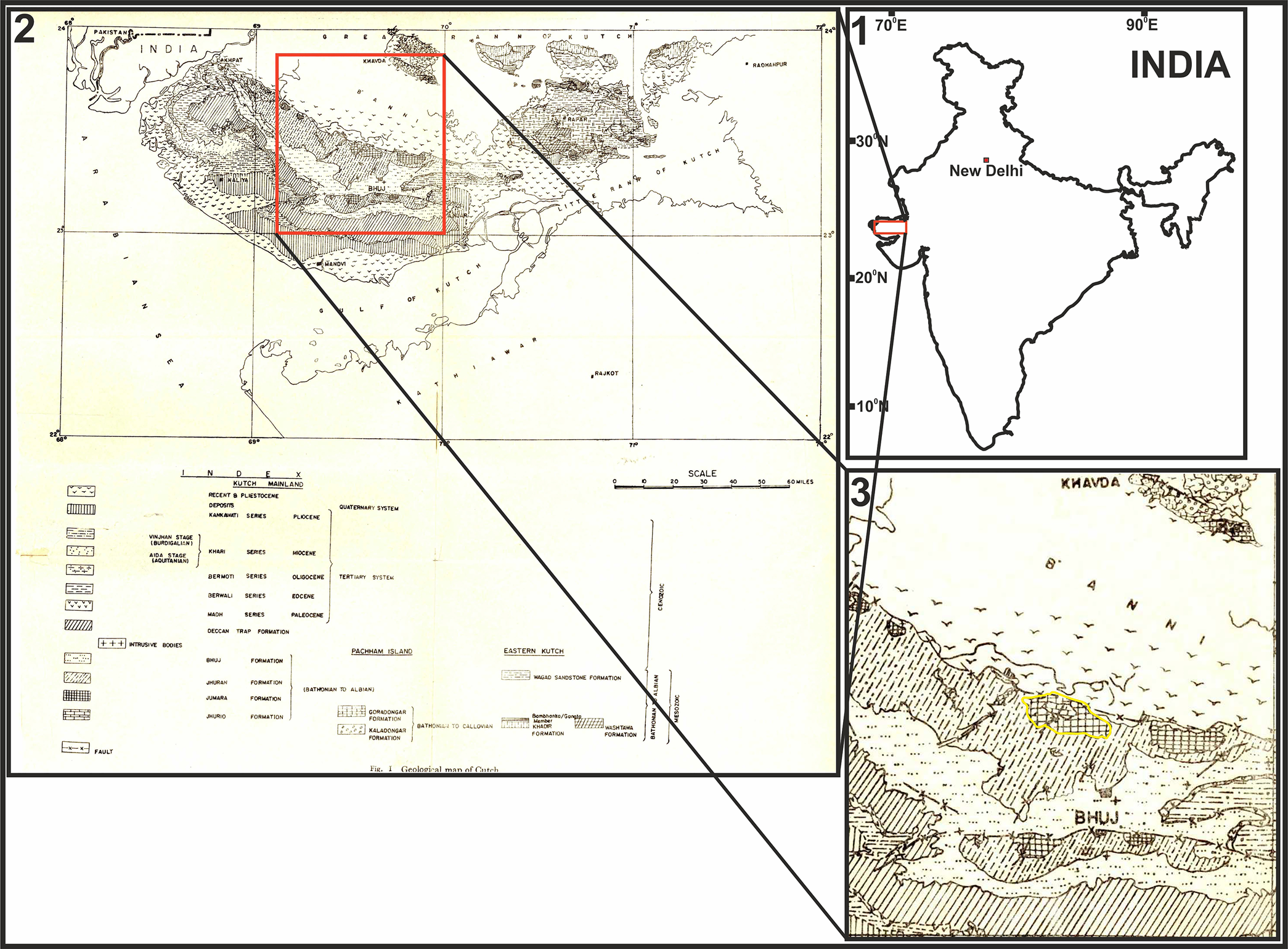
Figure 1. (1) Map of India showing the position of Kutch area marked by red rectangle. (2) Reproduction of original regional geological map of Kutch mainland of Biswas and Deshpande (1970). Position of Jhura Dome is indicated by the red square. (3) Enlargement of the Jhura Dome area in (2), with Jhura Dome marked by yellow outline. Note the sketchy nature of the Jurassic beds of the Jhura Dome. The only three formations are discernible: Jhurio, Jumara, and Jhuran.
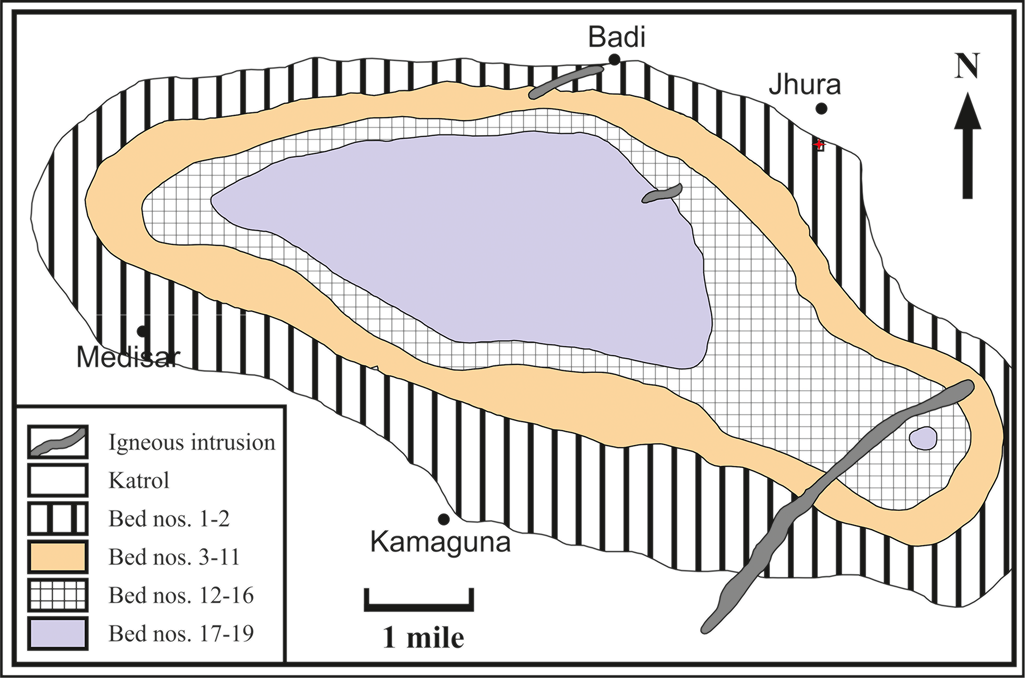
Figure 2. Geological map of Jhura dome. Mitra and Ghosh (1964) first provided the geological map of Jhura dome along with the scale. The enlarged version of that geological map of the Jhura dome was provided by Mitra (1978) but without scale. We have redrawn the geological map of the Jhura dome from Mitra (1978) and added the map scale from Mitra and Ghosh (1964, fig. 1). The red star marks the Jhura pond section collection locality of Mitra and Ghosh (1964). Bed 1: Green-brown, oolitic limestone with sandstone bands. Bed 2: Alternating layers of gypseous shale/sandstone. Bed 3: Calcareous sandstone. Bed 4: Shale. Bed 5: Sandy limestone. Bed 6: Brown shale. Bed 7: Sandy limestone. Bed 8: Hard, compact sandstone. Bed 9: Shale. Bed 10: Red, massive sandstone. Bed 11: Green shale. Bed 12: Ferruginous sandy limestone. Bed 13: Shale. Bed 14: Ferruginous limestone. Bed 15: Brown shale. Bed 16: Brown shale with sandstone. Bed 17: Golden oolite. Bed 18: Clayey, calcareous sandstone. Bed 19: Sandy limestone. Katrol = Katrol Formation.
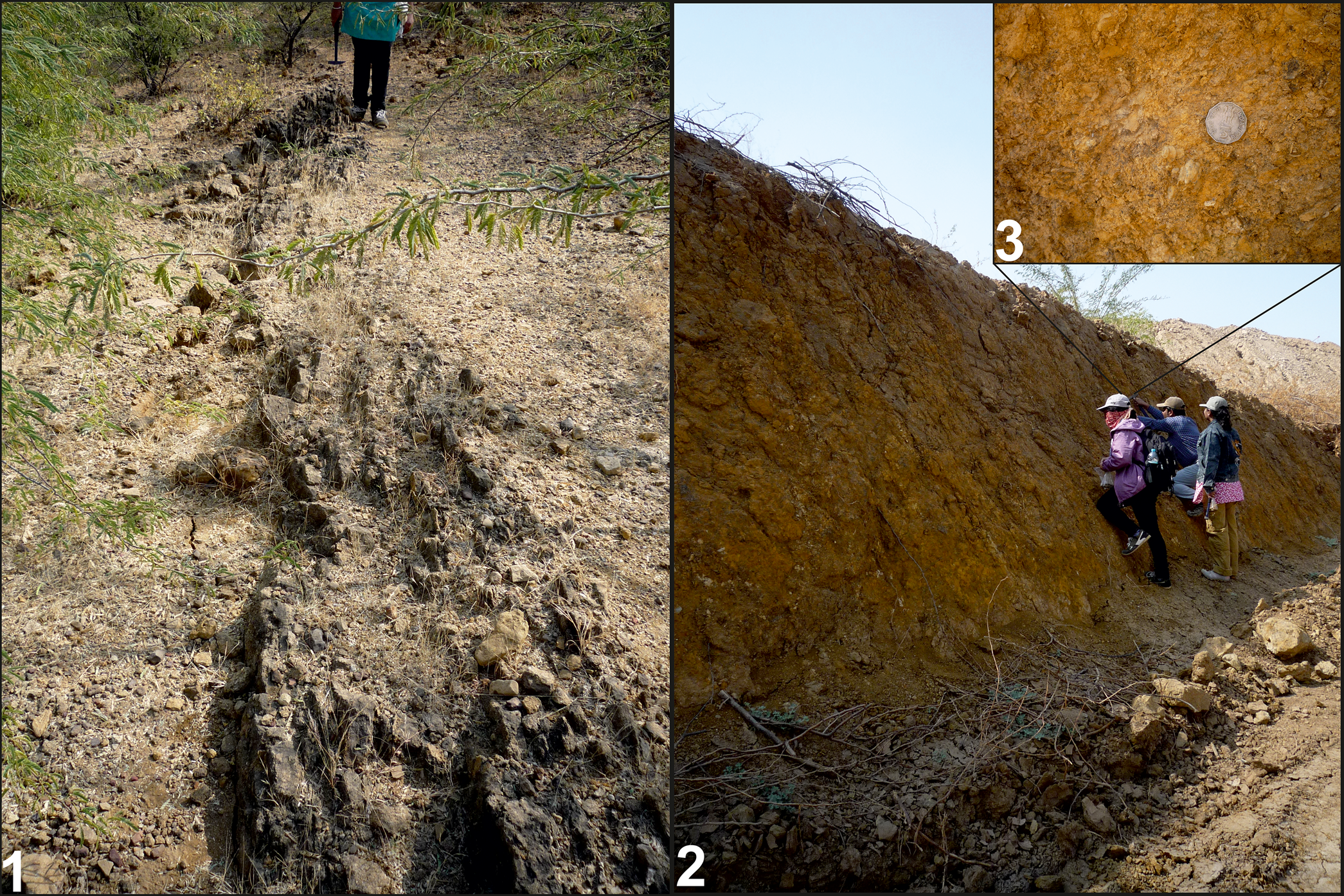
Figure 3. Field photographs of the Jhura pond section, 1 km SE of Jhura village (23°25′35.5″N, 69°36′58.2″E). (1) Subvertical alternation of shale-sandstone with abundant turritellid specimens; photograph taken 3 January 2014; (2) subvertical fine-grained sandstone bed yielding sparse turritellids (see 3); photographs taken 24 January 2015. Prof. K. Halder confirmed on 6 February 2023 that the both beds are still present at the Jhura pond section.
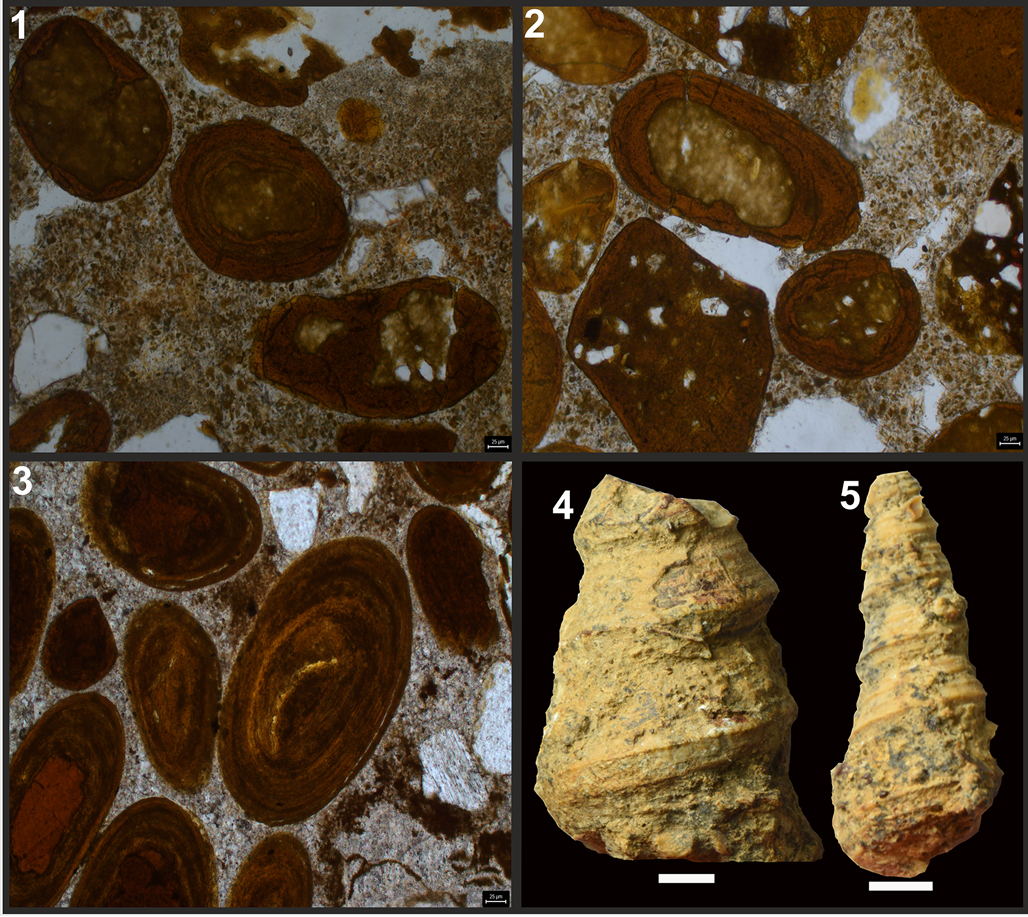
Figure 4. Petrographic characters of Fe-ooid-bearing rocks from the Jhura pond section, strongly resemble those of the Oxfordian Dhosa Oolite from the Bhakri area, 7 km SE of the Jhura pond section. (1, 2) Thin sections from the Jhura pond area. (3) Thin section from the Bhakri area. (4, 5) Presence of ooids on turritellid fossils (specimen nos. ISI/g/Jur/T 11003 and ISI/g/Jur/T 11004) from the Jhura pond section. Scale bars = (1–3) 25 μm; (4, 5) 1 cm.
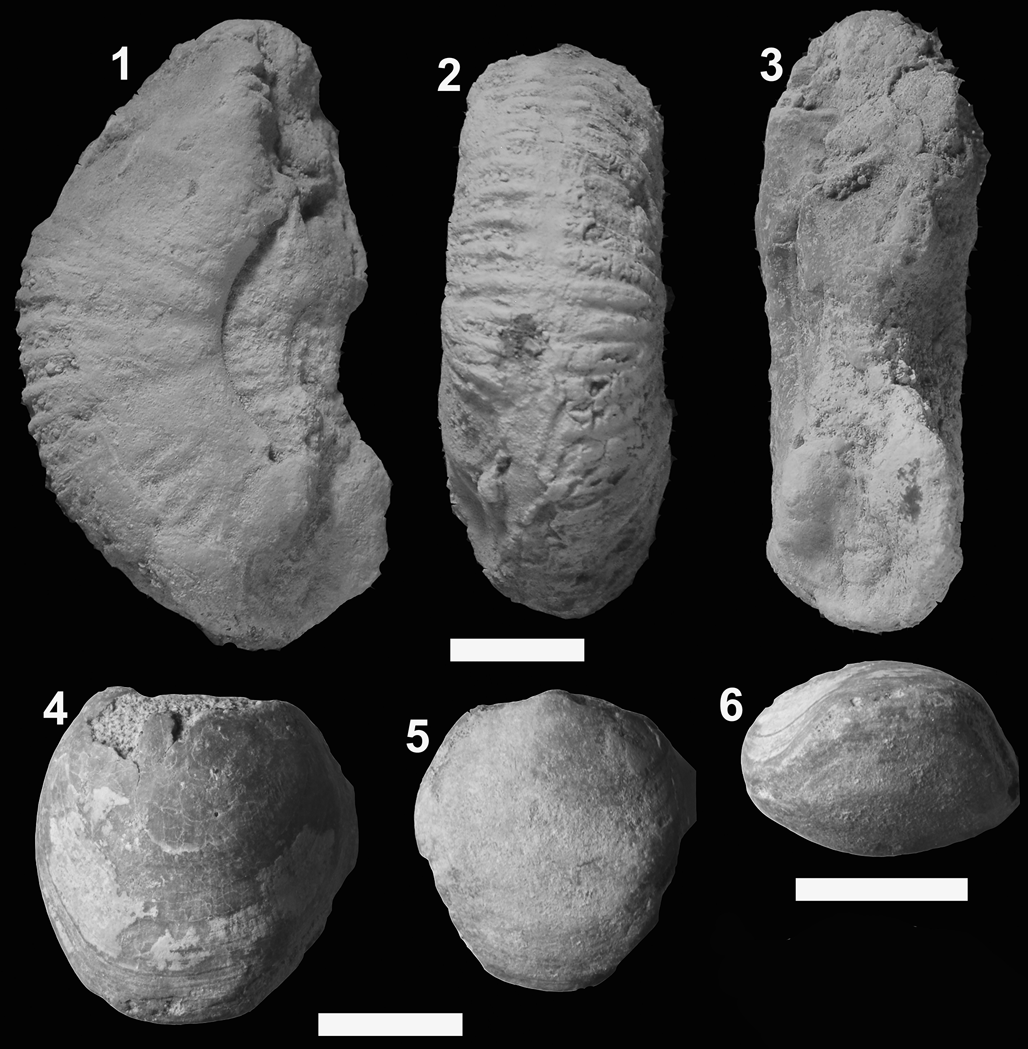
Figure 5. Additional Jurassic fossils from the Jhura pond section. (1–3) Collotia sp., aff. C. fraasi (Oppel, 1865) (specimen no. ISI/Amm/Jur/Col 1), (1) lateral, (2) ventral, and (3) apertural views. (4–6) Kutchithyris aff. K. euryptycha Kitchin, 1900 (specimen no. ISI/Brac/Jur/Kut 1), (4) dorsal, (5) ventral, and (6) anterior views. Scale bars = 1 cm.
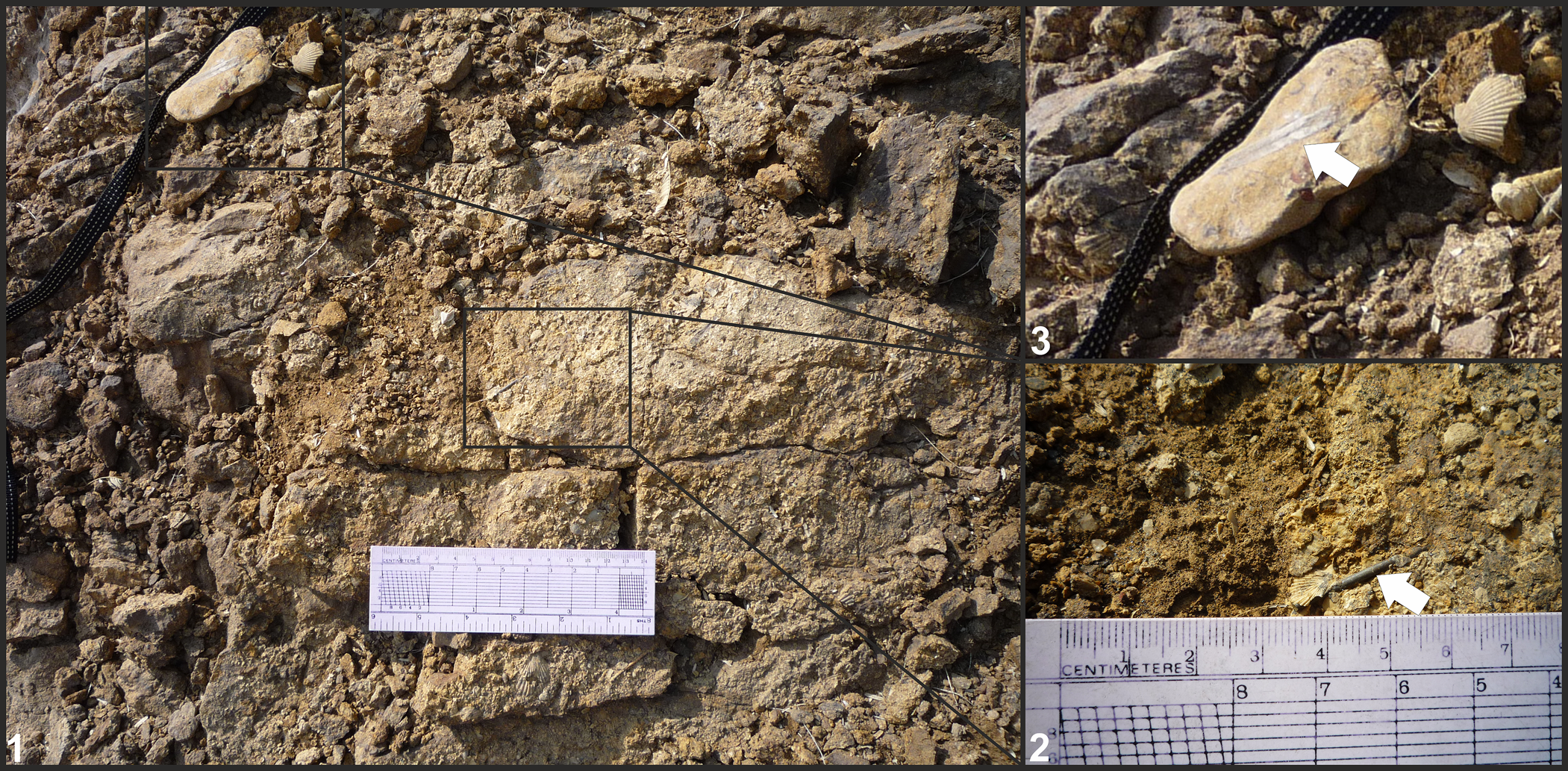
Figure 6. (1) Field photograph of ooid- and turritellid-bearing sandstone showing belemnite specimens (2, 3, see arrows). (2) Belemnite specimen resembling Belemnopsis tanganensis (Futterer, 1894) (specimen no. ISI/Bel/Jur/K 1); (3) longitudinal section of another belemnite specimen (see arrow).
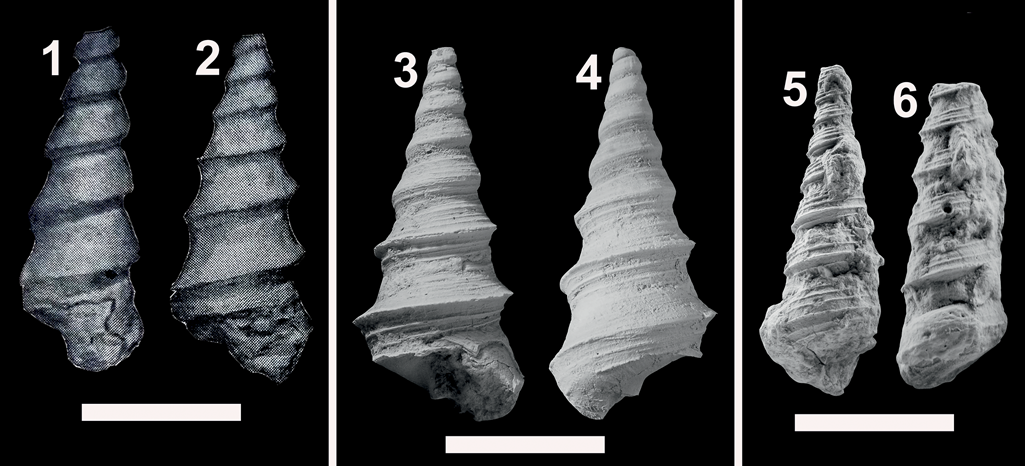
Figure 7. (1, 2) The original syntype specimens of Turritella jadavpuriensis Mitra and Ghosh, 1979 (G.S.I. type nos. 19629 and 19630), now lost; images reproduced from Mitra and Ghosh (1979). (3, 4) The replacement paraneotype specimen of T. jadavpuriensis (specimen no. ISI/g/Jur/T 5) of Das et al. (2018, figs. 7.1, 7.2). (5, 6) Most dominant Miocene species, Zaria angulata (Sowerby, 1840) (specimen nos. ISI/G/T/MIO/K/U 192 and ISI/G/T/MIO/K/U 200). Scale bars = (1, 2) 2 cm; (3–6) 1 cm.
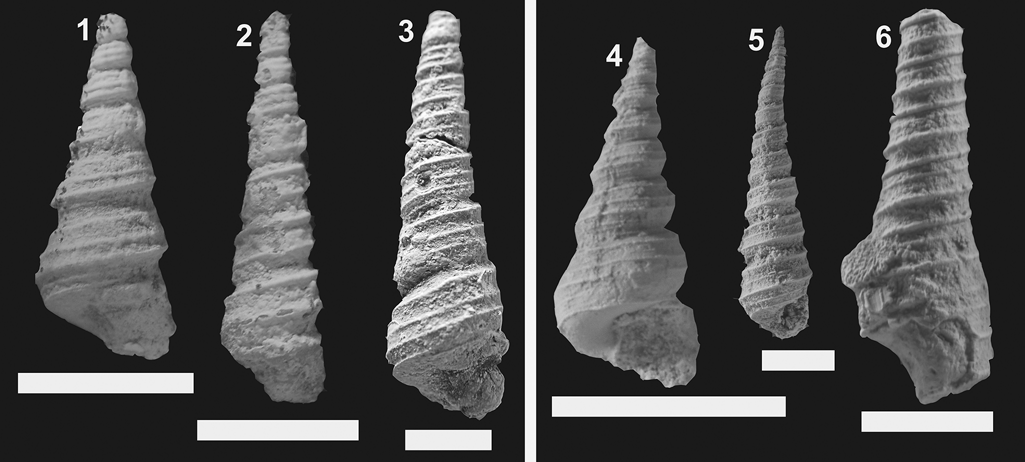
Figure 8. Comparison of three species from the Jhura pond section (1–3) and the Lower Miocene of Kutch (4–6) (see text for detailed comparisons) (1) Turritella jhuraensis Mitra and Ghosh, 1979 (no. ISI/g/Jur/T 32); (2) Turritella amitava Das et al., 2018 (no. ISI/g/Jur/T 45); (3) Turritella dhosaensis Das et al., 2018 (no. ISI/g/Jur/T 52). See also Das et al. (2018, figs. 10.1, 10.4, 14.5); (4) Turritella assimilis Sowerby, 1840 (no. ISI/G/T/MIO/C/U 12635); (5) Turritella kachchensis Vredenburg, 1928 (no. ISI/G/T/MIO/K/U 7555); (6) Haustator tauroperturritus de Montfort, 1810 (no. ISI/G/T/MIO/K/U 65). Scale bars = 1 cm.
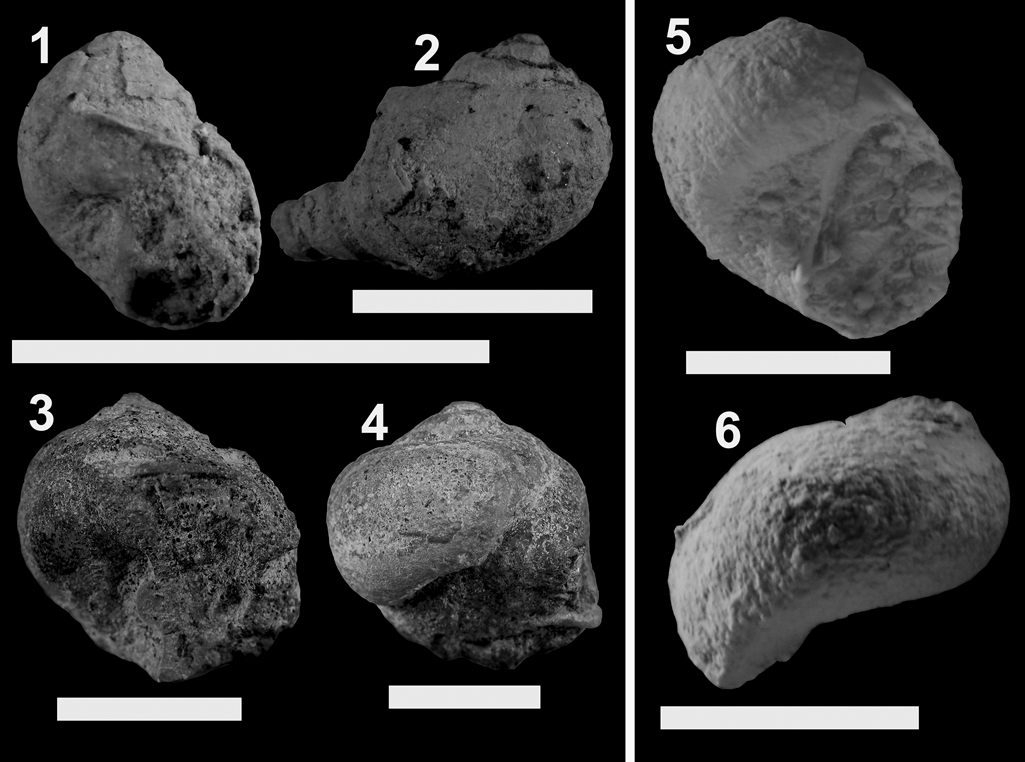
Figure 9. Naticid species showing the subfamily- and the genus-level differences between the Oxfordian (1–4) and the Miocene (5, 6) assemblages of Kutch. (1, 2) Gyrodes mahalanobisi Das et al., 2019 (nos. ISI/g/Jur/N 8 and ISI/g/Jur/N 1); (3) Euspira jhuraensis Das et al., 2019 (no. ISI/g/Jur/N 77); note numerous ooid grains inside the aperture of the shell; (4) Euspira lakhaparensis Das et al., 2019 (no. ISI/g/Jur/N 99). From Das et al., 2019, figs. 1.5, 1.2, 4.1, and 6.1. (5, 6) Natica obscura Sowerby, 1840 (no. ISI/G/N/MIO/K/U 20). Scale bars = 1 cm.
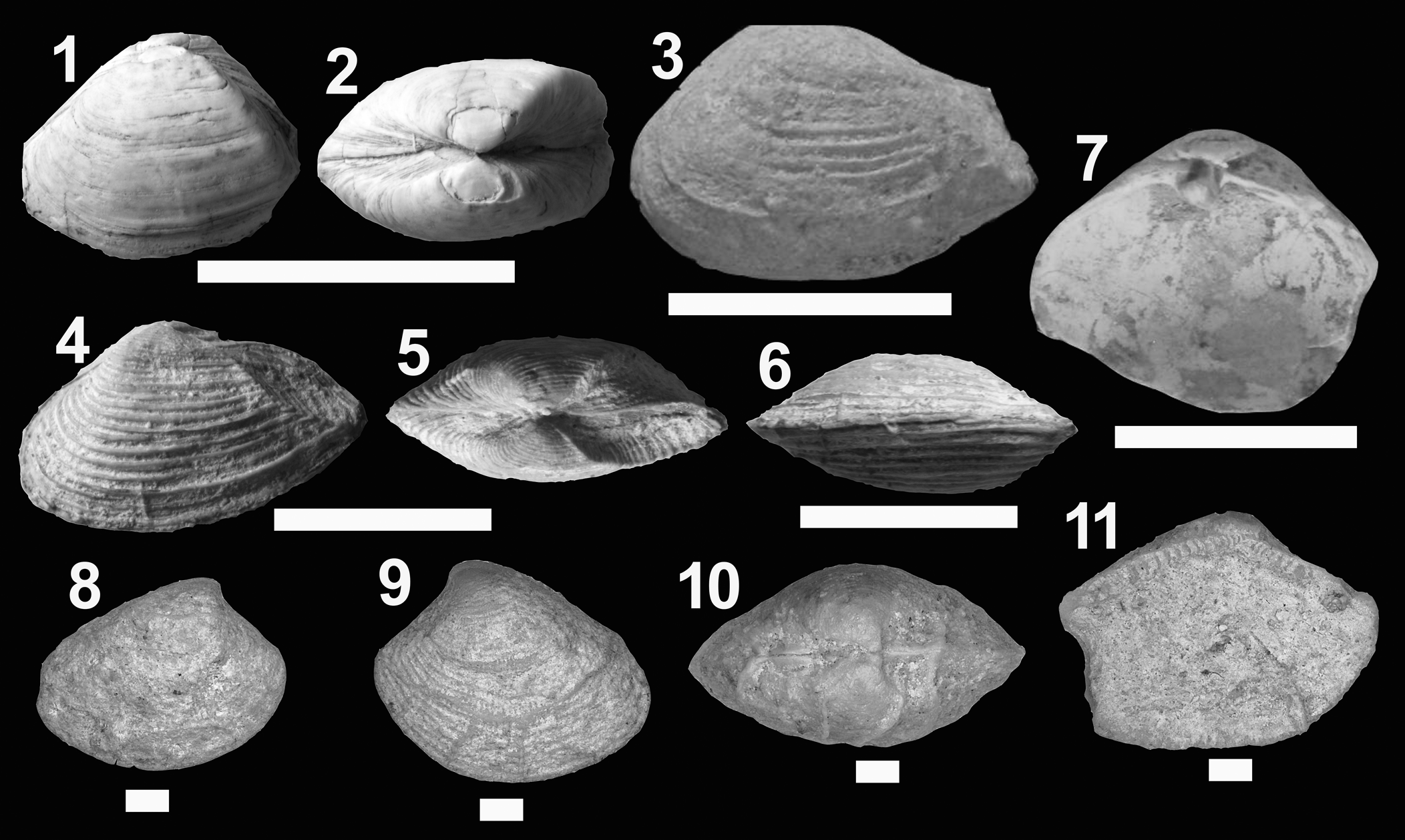
Figure 10. (1–7) Indocorbula sp. showing different diagnostic morphological characters (shape and ornamental variations, keeled escutcheon [5], offset beaks [2], and bipartite chondrophore [7] with large cardinal posterior socket) of the genus. Specimens numbers: (1, 2) ISI/B/Jur/R13/C 60; (3) ISI/B/Jur/C 10; (4–6) ISI/B/Jur/R13/C 2; (7) ISI/B/Jur/C 19. (8–11) Palaeonucula sp. (8) right valve (no. ISI/B/Jur/P 65); (9) left valve (no. ISI/B/Jur/P 68); (10) dorsal view (no. ISI/B/Jur/P 90); (11) internal view (right valve; no. ISI/B/Jur/P 75). Scale bars = (1–7) 1 cm; (8–11) 500 μm.
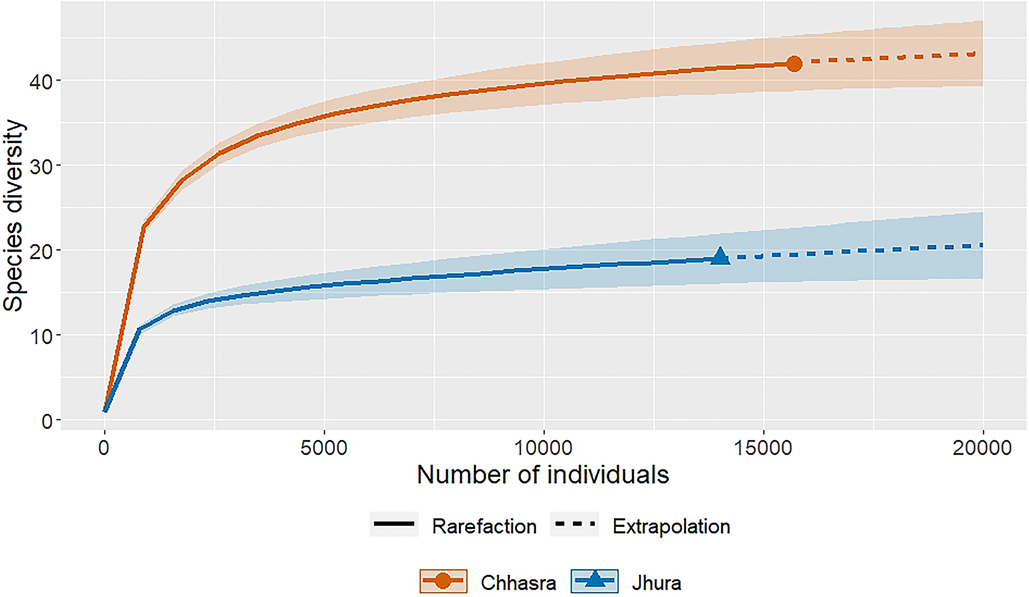
Figure 11. Rarefied (solid line) and extrapolated (broken line) diversity curves for the Lower Miocene Chhasra Formation (in red) and the Oxfordian Dhosa Oolite Member (in blue), with their estimated variance. The extrapolation was performed at N = 20000.
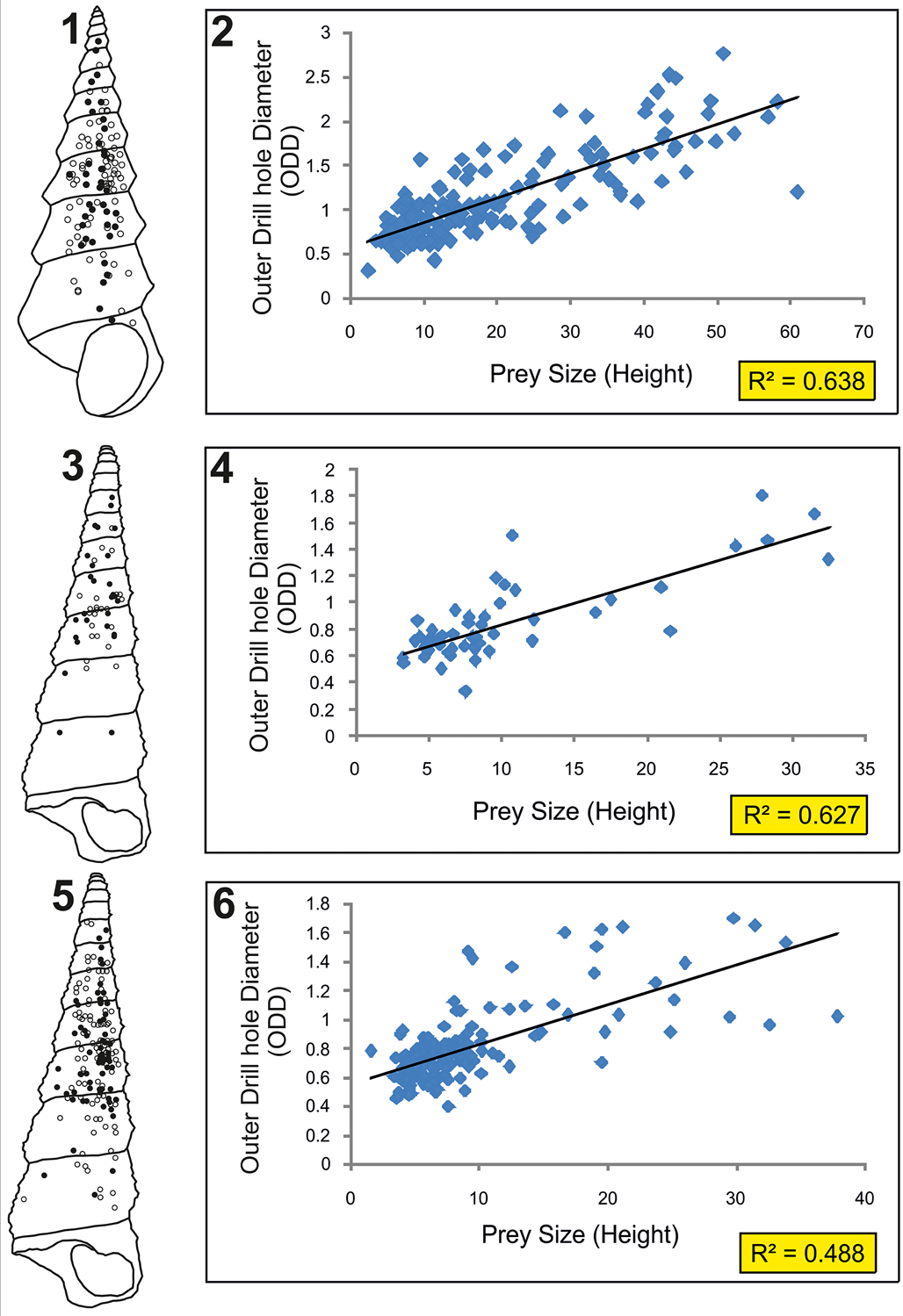
Figure 12. (1, 3) Vertical distribution (not to scale) of naticid-like drill holes on turritellid species. (1) Oxfordian Turritella jadavpuriensis and (3) Miocene Zaria angulata. (5) Vertical distribution (not to scale) of muricid-like drill holes on Z. angulata. (1, 3, 5) Solid circles indicate drill holes at the apertural side; hollow circles indicate abapertural drill holes. (2, 4, 6) Bivariate plots of Outer Drillhole Diameter (ODD), as a proxy of predator size, versus turritellid prey size (height). Relationship between predator size (ODD) and prey size (height) in (2) Oxfordian T. jadavpuriensis and (4) Miocene Z. angulata (for naticid-like drill holes); relationship between predator size (ODD) and prey size (height) in (6) Miocene Z. angulata (for muricid-like drill holes).
 You have
Access
- 5
- Cited by
Non-technical Summary
Turritellid gastropods are prey and naticid gastropods are predators and their oldest interaction was reported by us from the Oxfordian (157 million years ago). Recently, the Oxfordian age was disputed on the basis of mostly comments/opinion pieces. A map was reproduced based on data that are not correct. The only hard evidence provided, was the microfaunal assemblage. Against these claims, we hereby furnish several concrete examples, such as locality information, mode of occurrence, lithology (Fe-ooid-bearing beds), indigenous Oxfordian fossils, and the distinct assemblage of turritellid and naticid gastropods between the present and the Miocene beds of the Chhasra Formation, Kutch. Furthermore, the diversity curves and paleoecological analyses (both gastropods and bivalves) speak for two distinct and separate assemblages. We, therefore, reiterate our early claims about the age and evolution of prey–predator interaction and the development of the conchiolin layer in corbulid bivalves and other inferences that we have described in our previous publications.
Introduction
“One gets very skeptical about other people's records in palaeontology.”
— Ager, Reference Ager1973, p. 15.Recently, we published a series of papers (Das et al., Reference Das, Saha, Bardhan, Mallick and Allmon2018, Reference Das, Mondal, Saha, Bardhan and Saha2019; Bardhan et al., Reference Bardhan, Saha, Das and Saha2021; Saha et al., Reference Saha, Das, Mondal, Banerjee and Sarkar2021) on the Oxfordian turritellid gastropod-dominated marine invertebrate assemblages from Jhura, Kutch, western India. Fürsich et al. (Reference Fürsich, Bhosale, Alberti and Pandey2023) challenged an Oxfordian age of our fossil materials and advocated for a Miocene age. They tried to establish that our locality information and mode of occurrence of the beds are incorrect. Their conclusion, however, is flawed, as we demonstrate in this comment.
Locality information
Fürsich et al. (Reference Fürsich, Bhosale, Alberti and Pandey2023, p. 342, fig. 1) provided a geological map of the Jhura Dome and mentioned that this map had been “modified after Biswas and Deshpande, Reference Biswas and Deshpande1970.” The map of Biswas and Deshpande (Reference Biswas and Deshpande1970, p. 117) is a regional geological map (see also Fig. 1) on which the different domes are drawn in hand sketches and shown in very spotty occurrences. We are not sure how a geological map with all of the local details (Fürsich et al., Reference Fürsich, Bhosale, Alberti and Pandey2023, fig. 1) could be reproduced from such a simplified regional map. Careful observation of the regional map of Biswas and Deshpande (Reference Biswas and Deshpande1970) and field study of the area reveal the presence of only three formations: Jhurio (Bathonian), Jumara (Callovian–Oxfordian), and Jhuran (Kimmeridgian); the Bhuj Formation is not present there. The introduction of the Bhuj Formation in the newly traced map is therefore wrong, and erroneously led Fürsich et al. (Reference Fürsich, Bhosale, Alberti and Pandey2023) to argue that the Jhura pond section is above the Bhuj Formation and therefore, “allochthonous” and not connected to the surrounding Oxfordian strata. Fürsich et al. (Reference Fürsich, Bhosale, Alberti and Pandey2023) further claimed that Biswas (Reference Biswas1993, p. 225) found Miocene strata nearby the pond area, which is incorrect. Rather, Biswas (Reference Biswas1993, p. 225) mentioned the presence of gently dipping Miocene strata to the south of the Jhura Dome. Another inconsistency in Fürsich et al.'s (Reference Fürsich, Bhosale, Alberti and Pandey2023) map is that the Jhura camp area is shown within the Bhuj Formation, yet they previously reported finding the ammonite Peltoceratoides Spath, Reference Spath1924, and some gastropod species there, which are Oxfordian in age (Alberti et al., Reference Alberti, Pandey and Fürsich2011, Reference Alberti, Nützel, Fürsich and Pandey2013a). This was done perhaps to avoid an isolated Bhuj Formation near the Jhura pond section. We here reproduce the map of the Jhura Dome, which Mitra and Ghosh (Reference Mitra and Ghosh1964) and Mitra (Reference Mitra1978) provided (Fig. 2). Clearly the area of the Jhura pond section (1 km SE of Jhura village) falls on the Dhosa Oolite Member, supporting our assignment of an Oxfordian age. However, we regret that the GPS data provided in our original text was incorrect (it should have been 23°25′35.5″N, 69°36′58.2″E), although the actual locality information provided (i.e., 1 km SE of Jhura village) was correct as described.
(1) Map of India showing the position of Kutch area marked by red rectangle. (2) Reproduction of original regional geological map of Kutch mainland of Biswas and Deshpande (Reference Biswas and Deshpande1970). Position of Jhura Dome is indicated by the red square. (3) Enlargement of the Jhura Dome area in (2), with Jhura Dome marked by yellow outline. Note the sketchy nature of the Jurassic beds of the Jhura Dome. The only three formations are discernible: Jhurio, Jumara, and Jhuran.
Geological map of Jhura dome. Mitra and Ghosh (Reference Mitra and Ghosh1964) first provided the geological map of Jhura dome along with the scale. The enlarged version of that geological map of the Jhura dome was provided by Mitra (Reference Mitra1978) but without scale. We have redrawn the geological map of the Jhura dome from Mitra (Reference Mitra1978) and added the map scale from Mitra and Ghosh (Reference Mitra and Ghosh1964, fig. 1). The red star marks the Jhura pond section collection locality of Mitra and Ghosh (Reference Mitra and Ghosh1964). Bed 1: Green-brown, oolitic limestone with sandstone bands. Bed 2: Alternating layers of gypseous shale/sandstone. Bed 3: Calcareous sandstone. Bed 4: Shale. Bed 5: Sandy limestone. Bed 6: Brown shale. Bed 7: Sandy limestone. Bed 8: Hard, compact sandstone. Bed 9: Shale. Bed 10: Red, massive sandstone. Bed 11: Green shale. Bed 12: Ferruginous sandy limestone. Bed 13: Shale. Bed 14: Ferruginous limestone. Bed 15: Brown shale. Bed 16: Brown shale with sandstone. Bed 17: Golden oolite. Bed 18: Clayey, calcareous sandstone. Bed 19: Sandy limestone. Katrol = Katrol Formation.
Fürsich et al. (Reference Fürsich, Bhosale, Alberti and Pandey2023, p. 341) alleged that Mitra and Ghosh (Reference Mitra and Ghosh1979) “failed to provide precise locality information” from where they collected turritellid specimens along with the Oxfordian ammonites. In fact, Mitra and Ghosh (Reference Mitra and Ghosh1964, Reference Mitra and Ghosh1979) did provide the precise locality information of their collecting site within the Dhosa Oolite Member: they reported Turritella jadavpuriensis Mitra and Ghosh, Reference Mitra and Ghosh1979, precisely from the uppermost part of the Dhosa Oolite Member. Mitra and Ghosh (Reference Mitra and Ghosh1964, p. 193) reported the species as “Turritella jadavpuria n. sp.”, which was formally described in 1979. Moreover, Mitra and Ghosh (Reference Mitra and Ghosh1979, p. 120) also provided the locality information of the fossil site, as mentioned in their systematics of T. jadavpuriensis under the heading ‘Locality’ — “About one kilometre, south-east of village Jhura, Kutch.” Despite the wrong co-ordinate, we wonder why one of the authors (SB) of Fürsich et al. (Reference Fürsich, Bhosale, Alberti and Pandey2023) failed to locate our pond section.
Recently, Prof. Kalyan Halder of Presidency University, Kolkata, India, a well-known worker of the Cenozoic fossils of Kutch, was conducting fieldwork there and, upon our request, he visited the Jhura pond section and located it without any difficulty. One of us, Subhendu Bardhan (SB) has been visiting Kutch since 1975 and first published on Jhura materials in 1979 (Bardhan et al., Reference Bardhan, Bhattacharya and Mitra1979). Dr. Bardhan, along with his Ph.D. students during the early 1990s (one of them is Dr. D. Mukherjee, who was a co-author of Fürsich et al., Reference Fürsich, Pandey, Alberti, Mukherjee and Chauhan2020), used to take long traverses several times up to the Jhura core. Dr. Bardhan encountered turritellid-bearing rocks in the adjacent Kaila River beds (he did not pursue this assemblage at that time since the main focus was ammonites and brachiopods [Dr. Subhendu Bardhan, personal communication, 2023]).
Fürsich et al. (Reference Fürsich, Bhosale, Alberti and Pandey2023) also mentioned the recent construction of many small ponds from where the typical Oxfordian turritellid species, such as T. jadavpuriensis (Fürsich et al., Reference Fürsich, Bhosale, Alberti and Pandey2023, figs. 3.1, 3.2), were collected. It is true that the strike extension of the Jhura pond section towards the north was leveled for expansion of agricultural land during 2016. Consequently, it now appears that the turritellid-bearing beds do not have a patchy outcrop but have a larger areal extent.
Mode of occurrence
Our studied section shows steeply dipping beds (Fig. 3), as also mentioned by Fürsich et al. (Reference Fürsich, Bhosale, Alberti and Pandey2023). This may be due to local as well as regional factors. There is a reverse fault through which the Kaila River is flowing. Chowksey et al. (Reference Chowksey, Maurya, Joshi, Khonde, Das and Chamyal2011) and Kothyari et al. (Reference Kothyari, Kandregula, Chauhan, Desai, Taloor, Pathak, Swamy, Mishra and Thakkar2021) also recorded high-angle dipping Mesozoic rock underlying Quaternary sediments near the Kaila River (see Kothyari et al., Reference Kothyari, Kandregula, Chauhan, Desai, Taloor, Pathak, Swamy, Mishra and Thakkar2021, figs. 6–8). The classical Jurassic rocks in the mainland of Kutch are found in a series of E–W trending anticlinal domes, including Jara, Jumara, Keera, Jhura, Habo, etc. (see Biswas and Deshpande, Reference Biswas and Deshpande1970, fig. 1; also Fig. 1 herein). Northern parts of these domes have been affected by the Kutch Mainland fault (KMF) and igneous activity (Biswas, Reference Biswas2005). In many cases, the northern parts of those domes are missing (e.g., Jara dome; Subhendu Bardhan, personal observation, 2023). In Jumara and Keera, the northern parts of the Jurassic strata (partly preserved), including the Dhosa Oolite Member (e.g., in Keera), dip at a high angle (Mitra et al., Reference Mitra, Bardhan and Bhattacharya1979; Datta, Reference Datta1992). The Jhura pond section is also situated at the northern limit of the Jhura Dome, north of which there are no outcrops (only the cultivatable land within the Banni Plain [Grassland]). So, it is not surprising that the beds are subvertical.
Field photographs of the Jhura pond section, 1 km SE of Jhura village (23°25′35.5″N, 69°36′58.2″E). (1) Subvertical alternation of shale-sandstone with abundant turritellid specimens; photograph taken 3 January 2014; (2) subvertical fine-grained sandstone bed yielding sparse turritellids (see 3); photographs taken 24 January 2015. Prof. K. Halder confirmed on 6 February 2023 that the both beds are still present at the Jhura pond section.
Lithology of the Jhura pond section
We mentioned in our paper (Das et al., Reference Das, Saha, Bardhan, Mallick and Allmon2018) that detailed stratigraphic information is available for the Jhura pond section. It includes several shale–sandstone beds with occasional limestone bands that resemble the upper part of the lower Oxfordian Dhosa Oolite Member (see Das et al., Reference Das, Saha, Bardhan, Mallick and Allmon2018). Fe-ooids are found in varying amounts in these beds (Fig. 3.1). These Fe-ooids are also found among Turritella jadavpuriensis shell fragments (Fig. 4.4, 4.5). Similarly, many Fe-ooids have adhered to a naticid species, Euspira jhuraensis Das et al., Reference Das, Mondal, Saha, Bardhan and Saha2019 (Das et al., Reference Das, Mondal, Saha, Bardhan and Saha2019, fig. 4; also see below).
Petrographic characters of Fe-ooid-bearing rocks from the Jhura pond section, strongly resemble those of the Oxfordian Dhosa Oolite from the Bhakri area, 7 km SE of the Jhura pond section. (1, 2) Thin sections from the Jhura pond area. (3) Thin section from the Bhakri area. (4, 5) Presence of ooids on turritellid fossils (specimen nos. ISI/g/Jur/T 11003 and ISI/g/Jur/T 11004) from the Jhura pond section. Scale bars = (1–3) 25 μm; (4, 5) 1 cm.
While describing the details of the characteristic texture of the Dhosa Oolite, Datta (Reference Datta1992, p. 47, fig. 21) mentioned that “the textural composition suggests intermixing of materials from contrasting depositional environments. The ooids are likely to be derived from high energy parts while the lime mud is a typical product of quiet environment.” Later, Fürsich et al. (Reference Fürsich, Oschmann, Singh and Jaitly1992), Alberti et al. (Reference Alberti, Fürsich and Pandey2013b), and Ramkumar et al. (Reference Ramkumar, Alberti, Fürsich, Pandey and Ramkumar2013) shared the same view of the external source of ooids and quartz grains within the micritic sediment. The Fe-ooids are mostly elliptical, have numerous concentric rings, and their nuclei are occupied by bioclasts and quartz grains. We here present microphotographs of several Fe-ooid-bearing units in the Jhura pond section (Fig. 4.1, 4.2). Clearly, these resemble the Dhosa Oolite texture noted by the above-mentioned workers (see Fürsich et al., Reference Fürsich, Pandey, Alberti, Mukherjee and Chauhan2020, fig. 61) as well as the Dhosa Oolite in the Bhakri area (Fig. 4.3) (S. Sarkar, personal communication, 2023). It is pertinent to mention that the entire Lower Miocene succession (Khari Nadi and Chhasra formations) is completely devoid of oolitic sediment (Biswas, Reference Biswas1992; Kumar et al., Reference Kumar, Saraswati and Banerjee2009; Catuneanu and Dave, Reference Catuneanu and Dave2017). This fact strongly corroborates our correlation of the studied stratigraphic segment with the Dhosa Oolite Member.
Question of reworking of the Oxfordian fossils
Fürsich et al.'s (Reference Fürsich, Bhosale, Alberti and Pandey2023) other assumption, on the basis of which they criticized our age determination, is that the presence of many Jurassic fossils in the Jhura pond section is due to reworking. While the potential for time averaging is always to be taken seriously in any fossil assemblage (Fürsich and Aberhan, Reference Fürsich and Aberhan1990), claims of reworking at a biostratigraphic scale (sensu Kidwell and Bosence, Reference Kidwell, Bosence, Allison and Briggs1991) must be evaluated with particular care. In this case, the presumed mechanism of reworking (Miocene transgression) would have been expected to rework fossils from rocks of all ages over which it passed. Why then are only Oxfordian fossils found? Mitra and Ghosh (Reference Mitra and Ghosh1964) reported two Oxfordian ammonites, Peltoceras kumagunense Spath, 1931, and Paryphoceras rugosum Spath, 1928, from the Dhosa Oolite bed from which they collected two turritellid species (Turritella jadavpuriensis and Turritella jhuraensis Mitra and Ghosh, Reference Mitra and Ghosh1979). Mitra and Ghosh (Reference Mitra and Ghosh1979, p. 119) also mentioned that “the horizon bearing T. jadavpuriensis and T. jhuraensis is directly overlain by the Kimmeridgian horizon.” During our careful search, we also discovered one broken ammonite specimen belonging to Collotia sp., aff. C. fraasi (Oppel, Reference Oppel1865) (Fig. 5.1–5.3). We included this occurrence in our initial submission of our paper (Das et al., Reference Das, Saha, Bardhan, Mallick and Allmon2018), but because we were unable at the time to provide full reference of the describing author due to lack of access to literature, we deleted it at the request of the editor. Additionally, we found one belemnite specimen morphologically close to Belemnopsis tanganensis (Futterer, Reference Futterer1894) (see Spath, Reference Spath1927, p. 9, pl. 1, figs. 3a, b, 4) (Fig. 6).
Additional Jurassic fossils from the Jhura pond section. (1–3) Collotia sp., aff. C. fraasi (Oppel, Reference Oppel1865) (specimen no. ISI/Amm/Jur/Col 1), (1) lateral, (2) ventral, and (3) apertural views. (4–6) Kutchithyris aff. K. euryptycha Kitchin, Reference Kitchin1900 (specimen no. ISI/Brac/Jur/Kut 1), (4) dorsal, (5) ventral, and (6) anterior views. Scale bars = 1 cm.
(1) Field photograph of ooid- and turritellid-bearing sandstone showing belemnite specimens (2, 3, see arrows). (2) Belemnite specimen resembling Belemnopsis tanganensis (Futterer, Reference Futterer1894) (specimen no. ISI/Bel/Jur/K 1); (3) longitudinal section of another belemnite specimen (see arrow).
During our recent revisiting of the photographs and outcrops, we found one unidentifiable but unmistakable longitudinal cross-section of a belemnite (see Fig. 6.3) and several broken belemnite fragments. Besides cephalopods, we also found a single specimen of the brachiopod Kutchithyris aff. K. euryptycha Kitchin, Reference Kitchin1900, in our old collections (Fig. 5.4–5.6). This species is most abundant in the Oxfordian Dhosa Oolite Member (Mukherjee et al., Reference Mukherjee, Alberti, Fuersich and Pandey2017). These occurrences clearly argue for an Oxfordian age determination.
Identification of turritellid species
The family Turritellidae occasionally has been reported from pre-Cretaceous strata, but all of these reports (including one by Fürsich, Reference Fürsich1984) have been discounted on further investigation (see Allmon, Reference Allmon2011, p. 163). Claims of Jurassic turritellids should, therefore, be treated with caution, as we acknowledged in our original paper (Das et al., Reference Das, Saha, Bardhan, Mallick and Allmon2018). Fürsich et al. (Reference Fürsich, Bhosale, Alberti and Pandey2023) mentioned that the Lower Miocene sediments of Kutch contain abundant turritellids, which of course does not imply that any horizon in this area bearing abundant turritellids is of Miocene age. Recent compilations of turritelline gastropods record approximately 1,700 fossil and living species and subspecies names, which may translate into perhaps 800 valid fossil species (see Allmon, Reference Allmon2011). We listed both the turritellid-dominated assemblages (TDA of Allmon, Reference Allmon2007) and turritellid-rich assemblages (TRA) from the fossil record since the Early Cretaceous (Bardhan et al., Reference Bardhan, Saha, Das and Saha2021, supplementary table 3). Turritellids are excellent biostratigraphic markers within basins (e.g., Woodring, Reference Woodring1930, Reference Woodring1931; Gardner, Reference Gardner1935; Stenzel, Reference Stenzel1940; Wheeler, Reference Wheeler1958; Kauffman, Reference Kauffman, Kauffman and Hazel1977; Sohl, Reference Sohl, Kauffman and Hazel1977; Saul, Reference Saul1983; Squires, Reference Squires, Filewicz and Squires1988), but also show notorious homoplasy across time and geography (Merriam, Reference Merriam1941; Marwick, Reference Marwick1957; Kotaka, Reference Kotaka1978; MacNeil and Dockery, Reference MacNeil and Dockery1984; Allmon, Reference Allmon1994, Reference Allmon1996).
In our original paper (Das et al., Reference Das, Saha, Bardhan, Mallick and Allmon2018), we were careful to document all diagnostic shell characters, including whorl profile, growth-line shape, protoconch form, and early apical ontogeny. Figure 7.1, 7.2 shows the original syntype of Turritella jadavpuriensis proposed by Mitra and Ghosh (Reference Mitra and Ghosh1979), which was reposited in the Central Palaeontological Laboratory, Geological Survey of India (GSI), and had been declared lost. We designated a replacement neotype (Das et al., Reference Das, Saha, Bardhan, Mallick and Allmon2018, fig. 7). Turritella jadavpuriensis is the most dominant species within the Jhura turritellid community (75% of the total turritellid shells). It has both inflated and slender variants, of which the inflated variant, shown in Figure 7.3 and 7.4, is the most common. Figure 7.5 and 7.6 shows for comparison the most abundant turritellid species in the Miocene of western India, Zaria angulata (Sowerby, Reference Sowerby1840). This comparison shows distinct differences in terms of whorl angulation, number of spirals, the relative strength of primary spirals, and depth of suture. Turritella jadavpuriensis ranges up to 6.5 cm in height, almost double the size of Z. angulata (detail of the apical sculpture formula is available for T. jadavpuriensis, see Das et al., Reference Das, Saha, Bardhan, Mallick and Allmon2018, but such information is not available for Z. angulata). Another important difference is that T. jadavpuriensis has prosocline growth lines while Z. angulata has opisthocline growth lines.
(1, 2) The original syntype specimens of Turritella jadavpuriensis Mitra and Ghosh, Reference Mitra and Ghosh1979 (G.S.I. type nos. 19629 and 19630), now lost; images reproduced from Mitra and Ghosh (Reference Mitra and Ghosh1979). (3, 4) The replacement paraneotype specimen of T. jadavpuriensis (specimen no. ISI/g/Jur/T 5) of Das et al. (Reference Das, Saha, Bardhan, Mallick and Allmon2018, figs. 7.1, 7.2). (5, 6) Most dominant Miocene species, Zaria angulata (Sowerby, Reference Sowerby1840) (specimen nos. ISI/G/T/MIO/K/U 192 and ISI/G/T/MIO/K/U 200). Scale bars = (1, 2) 2 cm; (3–6) 1 cm.
Figure 8 shows other turritellid species of the Oxfordian and the Miocene, again clearly showing differences. Turritella amitava Das et al., Reference Das, Saha, Bardhan, Mallick and Allmon2018 (see Fig. 8.2) has diagnostic characters (e.g., small-sized shell with subquadrate whorls, equidistant primary spirals, spiral B weak to obsolete, faint and discontinuous secondary spirals, and the growth line formula 4-4-S-P) not found in any species of Miocene age (see Fig. 8.4–8.6). It is true that the Oxfordian Turritella jhuraensis (Fig. 8.1) resembles the Miocene Turritella assimilis Sowerby, Reference Sowerby1840 (Fig. 8.4) in having similar shell size, shell outline, whorl profile (flat to convex), and suture, but in ornamentation, they differ: T. assimilis has a higher number of secondary spirals compared to T. jhuraensis (for detail, see Das et al., Reference Das, Saha, Bardhan, Mallick and Allmon2018).
Comparison of three species from the Jhura pond section (1–3) and the Lower Miocene of Kutch (4–6) (see text for detailed comparisons) (1) Turritella jhuraensis Mitra and Ghosh, Reference Mitra and Ghosh1979 (no. ISI/g/Jur/T 32); (2) Turritella amitava Das et al., Reference Das, Saha, Bardhan, Mallick and Allmon2018 (no. ISI/g/Jur/T 45); (3) Turritella dhosaensis Das et al., Reference Das, Saha, Bardhan, Mallick and Allmon2018 (no. ISI/g/Jur/T 52). See also Das et al. (Reference Das, Saha, Bardhan, Mallick and Allmon2018, figs. 10.1, 10.4, 14.5); (4) Turritella assimilis Sowerby, Reference Sowerby1840 (no. ISI/G/T/MIO/C/U 12635); (5) Turritella kachchensis Vredenburg, Reference Vredenburg1928 (no. ISI/G/T/MIO/K/U 7555); (6) Haustator tauroperturritus de Montfort, Reference de Montfort1810 (no. ISI/G/T/MIO/K/U 65). Scale bars = 1 cm.
Repository and institutional abbreviation
All specimens (both from the Oxfordian and the Miocene of Kutch) are stored in the Museum of Geological Studies Unit, Indian Statistical Institute, Kolkata, India, and are numbered following the institutional abbreviation: ISI/g/Jur/ for Jurassic gastropods; ISI/B/Jur/ for Jurassic bivalves; ISI/Amm/Jur/ for Jurassic ammonites; ISI/Bel/Jur/ for Jurassic belemnites; ISI/Brac/Jur/ for Jurassic brachiopods; ISI/G/T/MIO/ for Miocene turritellids; and ISI/G/N/MIO/ for Miocene naticids.
Contrasts in naticid assemblages between the Jurassic and Miocene of Kutch
The naticid baüplan is very simple and morphologically naticids are generalists. The problem of naticid classification is further complicated by the presence of widespread homoplasy and convergence (Kowalke and Bandel, Reference Kowalke and Bandel1996; Bandel, Reference Bandel1999). While identifying naticids from Kutch, we made detailed character analyses of 63 species within 17 genera belonging to the four subfamilies (i.e., Naticinae Forbes, Reference Forbes1838; Polinicinae Finlay and Marwick, Reference Finlay and Marwick1937; Sininae Woodring, Reference Woodring1928; and Gyrodinae Wenz, Reference Wenz and Schindewolf1941) and we identified several diagnostic characters of each subfamily (see Das et al., Reference Das, Mondal, Saha, Bardhan and Saha2019, table 2). We identified one species (Gyrodes mahalanobisi Das et al., Reference Das, Mondal, Saha, Bardhan and Saha2019) belonging to the subfamily Gyrodinae (Fig. 9.1, 9.2). Gyrodes mahalanobisi has distinct subsutural wrinkles, which are absent in other genera (see Das et al., Reference Das, Mondal, Saha, Bardhan and Saha2019, figs. 1.3, 1.7, 3). We also described two species of Euspira Agassiz in Sowerby, Reference Sowerby1837, that belong to the subfamily Polinicinae — one (Euspira jhuraensis Das et al., Reference Das, Mondal, Saha, Bardhan and Saha2019; Fig. 9.3) from the Jhura pond section and another (Euspira lakhaparensis Das et al., Reference Das, Mondal, Saha, Bardhan and Saha2019; Fig. 9.4) from the oolitic bed of the uppermost Tithonian, ~2.5 km northeast of Lakhapar (see Das et al., Reference Das, Mondal, Saha, Bardhan and Saha2019). Species in the subfamily Polinicinae are large with at least three nucleus whorls and have a parietal callus that covers the umbilicus (Fig. 9.3). In contrast, the Lower Miocene beds of Kutch (both Khari Nadi and Chhasra formations) have a monospecific assemblage, containing only Natica obscura Sowerby, Reference Sowerby1840, belonging to the subfamily Naticinae (Fig. 9.5, 9.6). Natica obscura has a tightly coiled shell and partially open umbilicus (see Harzhauser et al., Reference Harzhauser, Reuter, Piller, Berning, Kroh and Mandic2009; Goswami et al., Reference Goswami, Das, Bardhan and Paul2020). Clearly, Oxfordian and Miocene assemblages differ at both subfamily and genus levels.
Naticid species showing the subfamily- and the genus-level differences between the Oxfordian (1–4) and the Miocene (5, 6) assemblages of Kutch. (1, 2) Gyrodes mahalanobisi Das et al., Reference Das, Mondal, Saha, Bardhan and Saha2019 (nos. ISI/g/Jur/N 8 and ISI/g/Jur/N 1); (3) Euspira jhuraensis Das et al., Reference Das, Mondal, Saha, Bardhan and Saha2019 (no. ISI/g/Jur/N 77); note numerous ooid grains inside the aperture of the shell; (4) Euspira lakhaparensis Das et al., Reference Das, Mondal, Saha, Bardhan and Saha2019 (no. ISI/g/Jur/N 99). From Das et al., Reference Das, Mondal, Saha, Bardhan and Saha2019, figs. 1.5, 1.2, 4.1, and 6.1. (5, 6) Natica obscura Sowerby, Reference Sowerby1840 (no. ISI/G/N/MIO/K/U 20). Scale bars = 1 cm.
Ancillary taxa
We identified a number of other gastropods and bivalves that Fürsich et al. (Reference Fürsich, Bhosale, Alberti and Pandey2023) also alleged to be of Cenozoic age, but their assessment is considered to be incorrect. Among the Jhura pond section gastropod genera, many of them have been reported previously from the Cretaceous (Stoliczka, Reference Stoliczka1868; Taylor et al., Reference Taylor, Cleevely and Morris1983). It is pertinent to mention that turritellids and naticids also were reported previously from the Cretaceous and we extended the range down into the Upper Jurassic (Das et al., Reference Das, Saha, Bardhan, Mallick and Allmon2018, Reference Das, Mondal, Saha, Bardhan and Saha2019). We found a solitary specimen of Murex Linnaeus, Reference Linnaeus1758, and we had hoped to collect more specimens in subsequent fieldwork, but much of the outcrop was destroyed by the aforementioned expansion of agricultural land. Muricids are clearly rare in the fauna as evinced by the total absence of muricid-like drill holes within the turritellid assemblages, whereas in the Miocene, muricid-like holes are abundant (see below). Among the ancillary bivalves, Tellina Linnaeus, Reference Linnaeus1758, previously had been reported from the Permian and Jurassic (Howse, Reference Howse1848; Blanford, Reference Blanford1870) and Anadara Gray, Reference Gray1847, from the Cretaceous (Jaccard, Reference Jaccard1869).
Indocorbula was introduced by Fürsich et al. (Reference Fürsich, Heinze and Jaitly2000, p. 138), based on material from the Jurassic of Kutch. Species are highly variable both in shape (rostrate to nearly circular) and nature of the ornamentation (both number and strength). The escutcheon is bordered by a ridge, the lunule is large and less conspicuously bordered, and the umbones show a slight offset. From the nature of shape and variation in ornamentation as well as bordered escutcheon and offset beaks (Fig. 10), we placed our specimens certainly in Indocorbula, but our disarticulated specimens were either broken or filled in by matrix, so we provisionally assigned them to Indocorbula sp. In the case of Palaeonucula sp., most of the specimens are articulated; disarticulated shells were either broken or covered by matrix (except one). Some of the specimens are shown in Figure 10.8–10.11.
(1–7) Indocorbula sp. showing different diagnostic morphological characters (shape and ornamental variations, keeled escutcheon [5], offset beaks [2], and bipartite chondrophore [7] with large cardinal posterior socket) of the genus. Specimens numbers: (1, 2) ISI/B/Jur/R13/C 60; (3) ISI/B/Jur/C 10; (4–6) ISI/B/Jur/R13/C 2; (7) ISI/B/Jur/C 19. (8–11) Palaeonucula sp. (8) right valve (no. ISI/B/Jur/P 65); (9) left valve (no. ISI/B/Jur/P 68); (10) dorsal view (no. ISI/B/Jur/P 90); (11) internal view (right valve; no. ISI/B/Jur/P 75). Scale bars = (1–7) 1 cm; (8–11) 500 μm.
Bivalve predation
In the present Oxfordian bivalve assemblage, the infaunal bivalves (e.g., Indocorbula sp. and Palaeonucula sp.) were drilled (Bardhan et al., Reference Bardhan, Saha, Das and Saha2021). Drilling intensity (DI) was 6.20 and 4.72, respectively. Drill holes were naticid-like. There was no preference for prey selection; bivalves were equally targeted like turritellid gastropods (4.64). But in the Lower Miocene, predator–prey dynamics were completely different. In the Khari Nadi Formation, turritellid gastropods were drilled by naticid predators while epifaunal Ostrea sp. and Chlamys sp. had muricid-like drill holes. Drilling Intensities were 5.77 for turritellids, 5.95 for Ostrea sp., and 7.48 for Chlamys sp. (Bardhan et al., Reference Bardhan, Mallick and Das2014). During deposition of the Burdigalian Chhasra Formation, there was a clear shift of prey selection towards bivalves. Chattopadhyay and Dutta (Reference Chattopadhyay and Dutta2013) documented bivalve assemblage level DI, which was 20 at the species level. The highest DI was recorded in Ostrea angulata (Lamarck, Reference Lamarck1819) (35.4); Chlamys sp. had a DI of 13. Turritellids had an assemblage-level DI of 5.77. Bivalves were preferred prey, whereas only two specimens of Ostrea were drilled and no Chlamys specimen was found to be drilled in the Jhura pond section assemblage. Although they show a low DI (9.49), turritellids were the main target for the predation.
Diversity
Individual-based rarefaction is widely used to compare biological diversity between localities or temporal bins in ecology and paleobiology (Gotelli and Colwell, Reference Gotelli and Colwell2001; Alroy et al., Reference Alroy, Aberhan, Bottjer, Foote and Fürsich2008). Figure 11 shows the rarefied diversity curves for the Lower Miocene Chhasra Formation and the specimens from the Jhura pond section (data on the Chhasra Formation are from Goswami et al., Reference Goswami, Das, Bardhan and Paul2020; data from the Oxfordian Jhura pond section are from Bardhan et al., Reference Bardhan, Saha, Das and Saha2021). Rarefaction was performed with the iNext package (Chao et al., Reference Chao, Gotelli, Hsieh, Sande, Ma, Colwell and Ellison2014; Hsieh et al., Reference Hsieh, Ma and Chao2022) in the R-platform (R Core Team, 2021).
Rarefied (solid line) and extrapolated (broken line) diversity curves for the Lower Miocene Chhasra Formation (in red) and the Oxfordian Dhosa Oolite Member (in blue), with their estimated variance. The extrapolation was performed at N = 20000.
As per Fürsich et al. (Reference Fürsich, Bhosale, Alberti and Pandey2023), we can hypothesize that the gastropod community diversity of the Jhura pond section should be similar to that of the Chhasra Formation. Our results contradict this expectation and suggest that the gastropod community of the Lower Miocene Chhasra Formation is nearly twice as diverse as the Jhura pond section, further supporting the conclusion that the Jhura pond section specimens do not represent the Lower Miocene Chhasra Formation.
Microfaunal assemblage data
Fürsich et al. (Reference Fürsich, Bhosale, Alberti and Pandey2023) mentioned that the analysis of two samples from their new locality yielded a microfaunal assemblage of Miocene age. No photographs of the specimens from these samples were provided, and identification was done only at the genus level. In our opinion, the limited information provided do not support Fürsich et al.'s (Reference Fürsich, Bhosale, Alberti and Pandey2023) conclusion (e.g., Astacolus de Montfort, Reference de Montfort1808, is also found in the Jurassic; Biswas, Reference Biswas1993; Gaur and Talib, Reference Gaur and Talib2009). Biswas et al. (Reference Biswas, Mahender and Chauhan2022, p. 72) clearly mentioned that the base of the Lower Miocene Chhasra Formation is characterized by “marker Turritella–Lepidocyclina band.” Lepidocyclina Gümbel, Reference Gümbel1870, is conspicuously absent in the Fürsich et al. (Reference Fürsich, Bhosale, Alberti and Pandey2023) microfaunal assemblage. Catuneanu and Dave (Reference Catuneanu and Dave2017) described biozonation within the Chhasra Formation based on the presence of different species of Miogypsina Sacco, Reference Sacco, Ballardi and Sacco1893. Again, Miogypsina is not recorded in the microfaunal assemblage of Fürsich et al. (Reference Fürsich, Bhosale, Alberti and Pandey2023).
Regarding the “Cenozoic age” of Fürsich et al.'s (Reference Fürsich, Bhosale, Alberti and Pandey2023) microfaunal assemblage, all of the microfossils (except one, Ammonia Brünnich, Reference Brünnich1772) have a pre-Cenozoic origin (e.g., Quinqueloculina d'Orbigny, Reference d'Orbigny1826, ranges from the Triassic to the Quaternary; Paleobiology Database, PBDB: https://paleobiodb.org/navigator/; March, 2023). Quinqueloculina, Astacolus, and Brizalina Costa, Reference Costa1856, have been reported from the Jurassic of Kutch (Bhalla and Abbas, Reference Bhalla and Abbas1978; Biswas, Reference Biswas1993; Talib et al., Reference Talib, Gaur and Bhalla2007; Gaur and Talib, Reference Gaur and Talib2009) and the nearby Jaisalmer Basin (Jain and Garg, Reference Jain and Garg2014). Fürsich et al. (Reference Fürsich, Bhosale, Alberti and Pandey2023) challenged our age determination on the basis of some microfossil genera, such as Astacolus, in favor of a Miocene age, but they themselves reported Astacolus from the Jurassic of Jhura and other localities (Fürsich et al., Reference Fürsich, Alberti and Pandey2013, Reference Fürsich, Pandey, Alberti, Mukherjee and Chauhan2020). The presence of Ammonia may be explained as being a genus that may have had a longer range. It is worth mentioning that Bhalla and Abbas (Reference Bhalla and Abbas1975) reported Cenozoic foraminiferas from Jurassic rocks of the adjacent Habo dome.
Paleoecology of two assemblages
Fürsich et al. (Reference Fürsich, Bhosale, Alberti and Pandey2023) appear particularly troubled by the implications of a Jurassic age for the Kutch fauna for our understanding of patterns of molluscan evolutionary radiation during the Mesozoic Marine Revolution (MMR). Vermeij (Reference Vermeij1977, Reference Vermeij1987) envisaged the MMR as the diversification of many mainly durophagous predatory groups (fish, crab, etc.), which exerted intense predation pressure, one of the fallouts of which was the infaunalization of benthic prey. Vermeij (Reference Vermeij1987) mainly worked on gastropod adaptation against durophagous predation pressure. Besides these durophagous predators, drill holes appeared on prey during the Mesozoic (Koken, Reference Koken1892; Fürsich and Jablonski, Reference Fürsich and Jablonski1984; Zardini, Reference Zardini1985), including in the Jurassic fauna (Klompmaker et al., Reference Klompmaker, Kowalewski, Huntley and Finnegan2017). Yet in the absence of Jurassic body fossils of the predators, these holes remained difficult to interpret. Harper et al. (Reference Harper, Forsythe and Palmer1998) provided a convincing record of naticid-like drill holes on the bivalve Neocrassina Fischer, Reference Fischer1887, from the Upper Jurassic. Similarly, some of us also reported naticid drill holes from the same Dhosa Oolite Member of Bhakri, which is 7 km southeast of the Jhura pond section (Bardhan et al., Reference Bardhan, Chattopadhyay, Mondal, Das, Mallick, Chanda and Roy2012). The current discovery of the naticid body fossil from the Jurassic was therefore not improbable. We are happy to note, but not surprised, that recently Prof. Fürsich along with others reported predatory drill holes from a Lower Jurassic bivalve of southern Germany (Karapunar et al., Reference Karapunar, Werner, Fürsich and Nützel2021).
Drilling predation exerted tremendous pressure on the molluscan benthic community especially gastropods and bivalves. The predatory gastropods are mainly muricids and naticids, both of which, until recently, were thought to have evolved during the Cretaceous. These predators evolved uncommon predatory skills over evolutionary time scales and became highly escalated (sensu Vermeij, Reference Vermeij1987) in selecting prey size and sites for drilling on the molluscan prey. Predation intensity reached a peak during the Miocene when the DI became higher, especially in the western Tethys (Kelley and Hansen, Reference Kelley and Hansen2006). Although DI varies even within the same time span, a broad generalization can be made of higher and higher DI through the ages.
Now in Kutch, turritellids (different species) are found in the Miocene and Jurassic. Naticids also likewise are separated at the subfamily and genus levels (in the Oxfordian, we found two genera, Gyrodes Conrad, Reference Conrad1860, and Euspira, whereas in the Miocene turritellids had a monospecific naticid predator, Natica obscura). Different predators show different kinds of behavioral stereotypy, and thus differences are apparent in the Miocene and the Jhura pond assemblages. Figure 12.1 shows the most frequently found Turritella jadavpuriensis (75% of total turritellids) from the Oxfordian Jhura pond section, which bears characteristic naticid drill holes that are distributed throughout the whorls indicating that the predators were not very efficient. On the other hand, Figure 12.2 shows that the prey–predator size relationship was already well established. Larger predators consumed large prey and smaller predators consumed smaller prey (Fig. 12.2), supporting Kitchell et al.'s (Reference Kitchell, Boggs, Kitchell and Rice1981) view of energy maximization. Figure 12.3 and 12.4 shows the site and size stereotypy of naticid-like drill holes in the most dominant Miocene species. Figure 12.3 shows that most drill holes are restricted to the middle and the upper parts of the whorls unlike the distribution of drill holes all through in T. jadavpuriensis (Fig. 12.1). Figure 12.4 also shows prey and predator size stereotypy, similar to T. jadavpuriensis (R 2 = 0.627). For Zaria angulata, however, both prey and predator sizes were small and predation intensity was significantly lower (DI = 4.71) than that of T. jadavpuriensis (DI = 8.93). Furthermore, some of us (Goswami et al., Reference Goswami, Das, Bardhan and Paul2020) documented numerous muricid-like drill holes in Z. angulata. There are three muricid species found in the Chhasra Formation (Goswami et al., Reference Goswami, Das, Bardhan and Paul2020). In general, muricid drill holes show poor site stereotypy like the present one (Fig. 12.5), but size stereotypy was significantly well established (R 2 = 0.488; Fig. 12.6). Not a single muricid-like drill hole is found in our Oxfordian turritellid specimens. We recorded only one specimen of muricid as ancillary taxa. Clearly, these paleoecological interactions of prey and predator of the Miocene and Jurassic demonstrate two separate paleocommunities.
(1, 3) Vertical distribution (not to scale) of naticid-like drill holes on turritellid species. (1) Oxfordian Turritella jadavpuriensis and (3) Miocene Zaria angulata. (5) Vertical distribution (not to scale) of muricid-like drill holes on Z. angulata. (1, 3, 5) Solid circles indicate drill holes at the apertural side; hollow circles indicate abapertural drill holes. (2, 4, 6) Bivariate plots of Outer Drillhole Diameter (ODD), as a proxy of predator size, versus turritellid prey size (height). Relationship between predator size (ODD) and prey size (height) in (2) Oxfordian T. jadavpuriensis and (4) Miocene Z. angulata (for naticid-like drill holes); relationship between predator size (ODD) and prey size (height) in (6) Miocene Z. angulata (for muricid-like drill holes).
Ethics
In a scientific debate, authors should show restraint in making personal comments directed at others. We are flabbergasted by reading some comments in Fürsich et al. (Reference Fürsich, Bhosale, Alberti and Pandey2023), which we think were unwarranted. Examples include:
(1) “a group of paleontologists from Kolkata” Fürsich et al. (Reference Fürsich, Bhosale, Alberti and Pandey2023, p. 341)—How does the biogeography of workers matter here?
(2) The use of “allegedly” comes from upper Tithonian rocks by Fürsich et al. (Reference Fürsich, Bhosale, Alberti and Pandey2023, p. 342)—Why allegedly? We mentioned that it comes from the uppermost oolitic band from the Lakhapar section (Das et al., Reference Das, Mondal, Saha, Bardhan and Saha2019, p. 675).
(3) Use of “importance of sound fieldwork” in the title of Fürsich et al. (Reference Fürsich, Bhosale, Alberti and Pandey2023)—30 years of fieldwork by Fürsich et al. (Reference Fürsich, Bhosale, Alberti and Pandey2023) escaped the notice of abundant turritellid-bearing beds! Any worker who has studied the classical Jurassic domes in the Kutch mainland knows that there are no Bhuj and Lower Cretaceous rocks near Jumara, Jhura, etc. These younger units are only exposed on the western part (e.g., towards Lakhapar).
Conclusions
Based on the evidence presented here, we reconfirm that our fossil materials from the Jhura pond section of the Jhura Dome area are Oxfordian in age and are distinctly different—faunistically and paleoecologically—from the Miocene of Kutch. The turritellid assemblage at the Jhura pond section differs from those of the Miocene of Kutch in many respects, including diversity. No Miocene beds in Kutch have ooids. On the contrary, most of the turritellid-bearing beds have varying amounts of Fe-ooids in the Jhura pond section, and ooids are present in the matrix of our reported turritellid and naticid fossils from this section. The only hard evidence for a Miocene age presented by Fürsich et al. (Reference Fürsich, Bhosale, Alberti and Pandey2023) was the presence of microfaunas. But these microfaunas are not documented by images and nearly all of the reported genera are long ranging (e.g., Astacolus ranging from the Permian to Miocene). Prey–predator interaction, and especially stereotypy, provides many deep insights into the behavior of fossil communities. Our paleoecological analyses show significant differences between the size and site stereotypy of the Oxfordian and the Miocene naticid predators. Muricid-like drill holes are abundant in Miocene turritellid faunas whereas not a single muricid-like drill hole is present in the Oxfordian assemblage. Moreover, the targets for prey selection also were different.
We strongly reaffirm our claims such as autochthony, stratigraphic position, diagnostic fossils, and data analyses about the Oxfordian age of the Jhura pond section strata. We therefore uphold all the interpretations and conclusions we have drawn in our previous research and publications (Das et al., Reference Das, Saha, Bardhan, Mallick and Allmon2018, Reference Das, Mondal, Saha, Bardhan and Saha2019; Bardhan et al., Reference Bardhan, Saha, Das and Saha2021; Saha et al., Reference Saha, Das, Mondal, Banerjee and Sarkar2021).
Acknowledgments
We pay special tribute to K.C. Mitra and D. N. Ghosh, Jadavpur University, Kolkata, who were ahead of their time in describing the oldest turritellids of the world from the famous Jhura pond section of the Jhura Dome. SSD and SS acknowledge the Indian Statistical Institute, Kolkata, for infrastructural facilities. The authors acknowledge S.K. Biswas, for fruitful discussions. S. Sarkar, Jadavpur University, provided the valuable opinion regarding the petrography of the Oxfordian beds, and K. Halder, Presidency University, visited the Jhura pond section and confirmed the presence of ooid- and turritellid-bearing beds. Thanks to B. Anderson for comments on an earlier draft of the manuscript. We are also thankful to P. Goswami, Durgapur Government College; K. Bose, Indian Statistical Institute, Kolkata; S. Bhattacharya and T. Dutta, Oil and Natural Gas Corporation, Dehradun; and A. Sarkar, Wildlife Institute of India, for their constant help during the preparation of the manuscript. Lastly, T. Kar from the Geological Studies Unit, Indian Statistical Institute, helped in the preparation of the thin sections.
Declaration of competing interests
The authors declare none.