Introduction
Unlike the rapid economic growth in China, the development of its health-care system – including implementation of a health insurance programme and provisions of health and social services – remains relatively slow and insufficient, despite some recent expansion. Furthermore, social protection systems in China devote inadequate attention to access to health-care services and health-related financial burdens. Older adults, who tend to have higher health-care needs than other age groups, continue to face higher barriers to these services, especially in rural areas. This problem has become particularly urgent as China now has the largest ageing population and one of the highest ageing rates in the world. While professional social work services have been developing in recent decades in China, there remains a lack of connection between these services and the health-care needs and provision systems. This study aims to connect these two areas by investigating the link between health-care needs and health outcomes among older adults in China and understanding its implications for social work services.
Publicly funded health insurance accounts for a certain proportion of the total social welfare transfer in most countries, which is regarded as one of the indicators to measure the size of welfare states (Garfinkel et al., Reference Garfinkel, Rainwater and Smeeding2010). China currently has three public medical insurance schemes: the Urban Employee Basic Medical System (UEBMS), the Urban Resident Basic Medical System (URBMS) and the New Rural Cooperative Medical System (NRCMS). The UEBMS, implemented in 1998, is mandatory for employees and retirees in urban formal sectors and is funded by shared contributions from employees, employers, and local and central governments. Both the URBMS (piloted in 2007 and implemented in 2009) and the NRCMS (piloted in 2003 and implemented in 2008) are administrated by local governments and are based on a voluntarily participatory system; each insured person's account includes self-payments and a co-payment from central, provincial and county governments. In 2015, the national participation rate for the NRCMS was 98.8 per cent, having remained above 95 per cent since 2010. The total numbers of respective participants in the UEBMS and the URBMS programmes in 2015 were 289 million and 377 million, representing increases since 2010 of 21.74 and 92.9 per cent, respectively (National Health and Family Planning Commission, 2016).
However, despite the expansion in population coverage among all three schemes, substantial inequalities persist in their benefit levels, access to services and quality of care. The average reimbursement rates per hospital admission for UEBMS, URBMS and NRCMS were 69, 54 and 50 per cent, respectively, in 2013 (Tang, Reference Tang2014). Rural and unemployed urban older adults face a higher financial burden, largely as a function of increasing medical costs with lower reimbursement rates, along with the decreasing capability of these older adults to generate income (National Health and Family Planning Commission, 2010). They also face a larger financial barrier to get access to health-care services, especially to inpatient services, as a deposit is required before they are hospitalised and receive treatment (Shi, Reference Shi2008). The amount of deposit ranges from 1,000 to 8,000 yuan depending on types of diseases, which could be even higher for uninsured individuals.
Furthermore, substantial inequalities between rural and urban older adults also exist regarding the financial resources to pay for health-care services. Unprecedented urbanisation in China since 1978 has generated a widening rural–urban income gap – urban workers are more likely to work in formal sectors with higher salaries. In contrast, income growth is much slower for farmers in rural areas and rural migrant workers who mostly work in informal sectors in urban areas (Su et al., Reference Su, Liu, Chang and Jiang2015). In addition, the contributional structure and average amounts of pension income for rural and urban older adults are significantly different. The pension for retired urban employees is constituted of contributions from individuals, employers and the government. However, for rural residents and non-employed urban residents, pension benefits come only from governments and individual contributions. The average monthly pension income for retired employees was 2,362 yuan in 2017, and this number for rural residents and urban non-employed residents aged 60 and above was 124 yuan (Ministry of Finance of the People's Republic of China, 2018). A cross-national comparative study shows that the total financial cost of health-care services and medications was commonly over 10 per cent of the total household income for residents in low- and middle-income countries (McIntyre et al., Reference McIntyre, Thiede, Dahlgren and Whitehead2006). In China, medical expenditures can account for as much as 65 per cent of per capita income in some low Gross Domestic Product (GDP) counties, and perhaps an even greater share among rural families in underdeveloped communities (Yang et al., Reference Yang, Chu, Zhou, Medina, Li, Jiang, Zheng, Sun and Liu2016). Yet, relative to the attention devoted to the consequences of medical costs on families’ economic status, the effects of medical costs on health-related quality of life (HRQoL) remain understudied.
This paper examines the association between the incidence of catastrophic health expenditure (CHE) and HRQoL among urban and rural older adults in China. Specifically, the study addresses two research questions:
(1) Do urban–rural differences exist in the incidence of CHE among Chinese older adults?
(2) To what extent is the incidence of CHE associated with the HRQoL of Chinese older adults in urban and rural areas, respectively?
We hypothesise that rural older adults are more likely to experience CHE than their urban peers, given that rural older adults have fewer financial protections and resources to cope with out-of-pocket medical payments. Also, we hypothesise that the incidence of CHE would negatively affect HRQoL for both rural and urban older adults, but the magnitudes of impact are different. Urban older adults may be more capable of utilising financial resources, such as property assets, investment and psycho-social capital, to establish their resilience to the impacts of CHE and thus may have better outcomes in HRQoL compared to their rural peers.
Empirically, it is challenging to tease out the causal mechanisms between CHE and HRQoL, which could be due to foregone care, diseases and stress. We are also aware of the possibility of reverse causality between CHE and HRQoL. Therefore, this is an association study between CHE and HRQoL among older adults in China. We hope to build on this study and examine the causal mechanisms using better data and methodologies in the future.
Literature review and conceptual framework
Medical expenditures have become an important source of persistent poverty in China. The rationale for health insurance is to protect people from poverty due to medical expenditures (Waters et al., Reference Waters, Anderson and Mays2004), but despite the high coverage rates of the NRCMS and URBMS schemes mentioned above, the effectiveness of financial protection against medical expenditures for rural families and poor urban families remains very limited in China (Jiang et al., Reference Jiang, Ma, Zhang and Luo2012): the out-of-pocket medical expenditures of these families did not decline with the introduction of the medical schemes, nor did their health outcomes and use of formal health services improve (Lei and Lin, Reference Lei and Lin2009; Liang et al., Reference Liang, Guo, Jin, Peng and Zhang2012). Families are more likely to experience medical-related poverty in households with chronic patients (Jiang et al., Reference Jiang, Ma, Zhang and Luo2012), children with disabilities (Park et al., Reference Park, Turnbull and Turnbull2002) and CHE (Wagstaff and Van Doorslaer, Reference Wagstaff and Van Doorslaer2001).
Expenditures for medical services are considered financially catastrophic when they threaten a family's capability to make payments (Berki, Reference Berki1986). To date, international institutions have not yet specified a cut-off point for CHE, which currently varies across countries from 5 to 40 per cent of household income devoted to out-of-pocket medical expenses (Berki, Reference Berki1986; Wyszewianski, Reference Wyszewianski1986; Xu et al., Reference Xu, Evans, Kawabata, Zeramdini, Klavus and Murray2003; Waters et al., Reference Waters, Anderson and Mays2004; Van Doorslaer et al., Reference Van Doorslaer, O'Donnell, Rannan-Eliya, Somanathan, Adhikari, Garg, Harbianto, Herrin, Hug, Ibragimova and Karan2007; Onoka et al., Reference Onoka, Onwujekwe, Hanson and Uzochukwu2010). Determinants of CHE typically include: health insurance expenses, hospitalisation, having one or more non-communicable diseases (Yang et al., Reference Yang, Chu, Zhou, Medina, Li, Jiang, Zheng, Sun and Liu2016), cancer diagnosis (Kimman et al., Reference Kimman, Jan, Yip, Thabrany, Peters, Bhoo-Pathy and Woodward2015), presence of a chronic disease in the household (Rahman et al., Reference Rahman, Gilmour, Saito, Sultana and Shibuya2013), and illness among children and older adults (Pal, Reference Pal2012).
Based on the 1998 China National Health Services Survey data, medical expenditures have increased the number of rural households living below the poverty line by 44.3 per cent in China (Liu et al., Reference Liu, Rao and Hsiao2003). Although the figure is unclear for urban low-income families, urbanites face the added challenge of higher medical costs per clinic visit or hospitalisation due to the higher cost of living in urban China. What is more, poverty can affect individuals’ health behaviours, health satisfaction and health outcomes (Frijters et al., Reference Frijters, Haisken-DeNew and Shields2005; Adda et al., Reference Adda, Banks and von Gaudecker2009), as well as the mortality rate and average length of illness across society (Berger and Messer, Reference Berger and Messer2002; Siraga et al., Reference Siraga, Nor, Lacheheb, Law and Abdullah2016).
CHE increased the risks of being impoverished long term, using medicines irrationally, and reducing access and resources to care for low-income families (Whitehead et al., Reference Whitehead, Dahlgren and Evans2001). The coping strategies for the financial cost of health-care services vary from wealthy families in which medical costs may be relatively high but eventually affordable, to poor families in which the costs are relatively low but still less affordable (Kruk et al., Reference Kruk, Goldmann and Galea2009). Numerous studies have found that the impoverished households who anticipate undergoing or already have experienced CHE are highly likely to adopt risky coping strategies, for instance, ignoring diseases (Sauerborn et al., Reference Sauerborn, Adams and Hien1996), reducing consumption of other basic needs such as food and shelter (Kavosi et al., Reference Kavosi, Rashidian, Pourreza, Majdzadeh, Pourmalek, Hosseinpour, Mohammad and Arab2012), working considerably longer than they are willing to (Homaie Rad et al., Reference Homaie Rad, Rashidian, Arab and Souri2017), decreasing investments in human capital such as education and health (Gao et al., Reference Gao, Zhai, Yang and Li2014), having unpaid medical bills and destroyed credit scores (Dobkin et al., Reference Dobkin, Finkelstein, Kluender and Notowidigdo2018), and so on. In most cases, more than one strategy would be used in a sequence of gathering internal resources within their household and then seeking external resources, with objectives to minimise the impact of the financial cost of illness on the household. These negative coping strategies are chains in the vicious cycle between ill-health and CHE, which result in chronic poverty among people with less health endowment and financial resources.
Measurements of health are typically comprised of physical, mental and social wellbeing, in addition to illness and risk factors. We use the concept of the HRQoL, an increasingly common measure in clinical trials and health research, which includes two major components, physical and mental health (Wilson and Cleary, Reference Wilson and Cleary1995). Physical health usually covers general health, physical functioning, physical-related role limitations and bodily pain. Mental health includes emotional-related role limitations, vitality, general mental health and social functioning (Selim et al., Reference Selim, Rogers, Qian, Brazier and Kazis2011). Existing research has agreed on the effectiveness and validity of HRQoL to measure health outcomes and related determinants, risk factors and relationships (Vickers, Reference Vickers2004; Maatouk et al., Reference Maatouk, Wild, Wesche, Herzog, Raum, Müller, Rothenbacher, Stegmaier, Schellberg and Brenner2012; Lam et al., Reference Lam, Guo, Wong, Yu and Fung2016).
Empirical studies usually conceptualise the association between poverty and ill-health status in two ways. One prevailing framework depicts this association as a linear path. Material hardships, which are caused by medical payment and illness-related wage loss, are associated with risky coping behaviours such as delayed treatment or skipped medication. Risky coping strategies could affect one's physical health. Similarly, negative psychological responses, including worry and stress, which are engendered by out-of-pocket medical payments, could affect one's mental health (Altice et al., Reference Altice, Banegas, Tucker-Seeley and Yabroff2017; Dobkin et al., Reference Dobkin, Finkelstein, Kluender and Notowidigdo2018). Second, this relationship has also been framed as bi-directional causality in many economic and policy evaluation studies. In one direction, one's poor living and working conditions increase the likelihood of having infectious diseases and morbidity; in the reverse direction, people with limited financial resources delay their treatment and medication which could result in worse health conditions (Thiede and Traub, Reference Thiede and Traub1997; Grant, Reference Grant2005). In both of these frameworks, poverty and ill-health status are the key variables of research focus, while other variables such as individual characteristics, socio-economic status and household dynamics are treated as control variables.
Because the association between poverty and ill-health status has not been analysed among Chinese older adults and the current data-set does not enable rigorous causal studies, this paper follows the linear path conceptual framework and tests the associations between CHE and the health domains. Future studies could consider exploring the bi-directional relationship among this population.
Despite the increasing interest in and policy relevance of both CHE and HRQoL, no study to our knowledge has yet examined the relationship between the two in China. China currently has 135 million older adults aged 65 and above, which represents 10 per cent of the total population and constitutes the world's largest group of older adults (National Bureau of Statistics of China, 2017; United Nations, 2017). That figure is predicted to rise to 370 million (22% of the population) by 2050 (United Nations, 2017). As the ageing trend continues accelerating in China, it is crucial to investigate empirically the link between CHE and HRQoL among this large and rapidly growing population. This paper uses recent longitudinal data and rigorous statistical methods to offer pioneering evidence of the association between CHE and HRQoL among rural and urban Chinese older adults.
Method
Data and sample
The analysis uses the China Health and Retirement Longitudinal Study (CHARLS) survey data from 2011 (baseline) and 2013 (Wave 2). The survey runs parallel to several of the most influential international ageing studies, including the Health and Retirement Study in the United States of America (USA), the Survey of Health, Ageing and Retirement in Europe and the English Longitudinal Study of Ageing. CHARLS is the single nationally representative longitudinal survey that collects information on health and wellbeing, as well as personal and household income and expenditures among older adults in China (Zhao et al., Reference Zhao, Strauss, Yang, Giles, Hu, Hu, Lei, Park, Smith and Wang2013).
CHARLS covers 450 villages (in rural areas) or neighbourhoods (in urban areas) randomly selected across 28 out of 31 provinces in mainland China (excluding Tibet, Ningxia and Hainan). At baseline, among the 19,081 households randomly selected through probability-proportional-to-size sampling, 12,740 households had age-eligible (i.e. 45 or older) members. For households with more than one age-eligible member, one member – along with his or her spouse if applicable – was randomly selected as the respondent for most of the modules in the questionnaire, while the module for household income, expenditures and assets was answered by the person most familiar with the financial issues in the household. The survey ultimately drew face-to-face data from 17,708 individuals in 10,287 households at baseline, representing a response rate of 80.51 per cent. In Wave 2, 2,071 respondents (11.7%) from baseline dropped out, and 4,029 respondents (20.5%) were newly recruited, yielding a total of 19,666 individual participants.
Consistent with most ageing studies in China, this paper focuses only on individuals aged 55 and above, which is the average retirement age in mainland China (the retirement age varies by occupation and gender from 50 to 65 years old) (Bai, Reference Bai2012). To track changes in health status over the two waves, data from those who dropped out and from the newly recruited are excluded. The analytical sample size is 8,829 individuals, including 2,260 couples and 3,589 single individuals (including widows, widowers or married but temporarily not living together).
Variables and measures
The key independent variable of CHE incidence is defined by whether the respondent's monthly out-of-pocket medical expenditure accounted for over 20 per cent of monthly household income (coded 1 if yes, otherwise 0). This threshold is higher than the 10 per cent figure used in the USA (Waters et al., Reference Waters, Anderson and Mays2004) and lower than the 40 per cent figure used in many developing countries (Xu et al., Reference Xu, Evans, Kawabata, Zeramdini, Klavus and Murray2003). The cut-off point of 40 per cent is usually utilised when taking the disposable income (excluding basic expenditures such as food) as the denominator. However, this calculation could be biased because wealthier families could spend a higher proportion of their income on high-quality foods, which makes them seem more miserable in the CHE calculation. Therefore, we adopted the threshold in between (20%) when calculating the incidence of CHE in our analysis. Robustness tests were also conducted by using different thresholds (10, 20 and 40%) and results were found consistent.
The dependent variable of HRQoL has two component scores (physical health and mental health) which cover eight principal health domains in total (Iqbal et al., Reference Iqbal, Rogers, Selim, Qian, Lee, Ren, Rothendler, Miller and Kazis2007). Physical health includes four domains that capture the overall and different aspects of physical health: general health (five-point scaled self-reported overall health condition); physical functioning (an average score of nine questions asking whether respondents have difficulties in activities such as walking, lifting weights, kneeling); physical-related role limitations (an average score of five questions asking whether respondents have difficulties in dressing, bathing, using toilets); and bodily pain (five-point scaled level of self-reported pain experienced).
Mental health includes an additional four domains that reflect the overall and different aspects of mental health: mental health (an average score of ten questions asking whether respondents feel depressed, fearful, lonely, etc.); social functioning (an average score of seven questions that include how often respondents did voluntary work, provided help to family, interacted with friends, etc.); mental-related role limitations (an average score of six questions asking whether respondents had difficulty managing money, taking medications, etc.); and vitality (Wave 1 asks if respondents feel that everything requires an effort, and Wave 2 asks if respondents feel tired).
We first calculated the composite scores respectively for domains with multiple questions, including physical functioning physical-related role limitations, mental health, social functioning and mental-related role limitations, by creating the sum of multiple questions and treating missing values as 0 if no more than 20 per cent of questions under that domain were skipped. In the next step, we calculated the component scores by summing up the four domains under each category. All component scores and domains were finally converted to four-point ordinal scales. A higher score represents a better health condition (e.g. better physical functioning, less bodily pain, more vitality).
We controlled for a rich array of individual characteristics, socio-economic status and household dynamics in the analysis. Control variables of individual demographic characteristics include age (in years), highest level of educational attainment (for rural older adults, 1 = illiteracy, 2 = unfinished elementary or home school, 3 = elementary school and above; for urban older adults, 1 = illiteracy or unfinished elementary school, 2 = elementary or middle school, 3 = high school and above; across rural and urban areas, 1 is considered lower-level, 2 medium-level and 3 higher-level education), gender (female = 1, male = 0), marital status (married with spouse present = 1, all others = 0) and numbers of chronic diseases (0–10). Indicators of socio-economic status, such as income, access to health insurance and health expenditure, play an important role on health status and mortality (Kim and Kim, Reference Kim and Kim2014, Reference Kim and Kim2018). Therefore, in this analysis, we controlled for the variables of socio-economic status including income quintile (ordinal scale from lowest 20% = 1 to highest 20% = 5, ordered within rural and urban older adults, respectively) and the type of health insurance for urban older adults (UEBMS = 1, URBMS = 0). The household dynamic variables we controlled for include having a child who co-resides with respondents and their spouses (yes = 1, no = 0), having a child who lives nearby (yes = 1, no = 0), any occurrence of inter-family monetary transfers from children, parents or relatives in the last year (yes = 1, no = 0) and total amount of inter-family transfers in the last year (in thousand yuan). In our analytical sample, 91 per cent of rural older adults had NRCMS, with only 350 rural older adults having no medical insurance coverage. Given the small size of this group, we are unable to control for insurance type for rural residents.
Analytical strategy
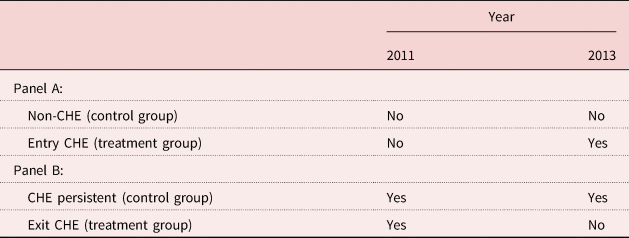
We use a difference-in-differences (DID) approach to detect the association between the incidence of CHE and the changes in HRQoL from 2011 to 2013 among rural and urban older adults, respectively. This quasi-experimental analytical approach is often used to track outcome changes due to policy effects over time. We divide all observations into two panels: Panel A compares the CHE entry group versus the non-CHE group, and Panel B compares the CHE exit group versus the CHE persistent group, as shown in Table 1.
The definition of the four catastrophic health expenditure (CHE) groups in the analysis

Specifically, in Panel A, participants who had CHE in 2013 but not in 2011 were defined as the CHE entry group (treatment) and those who did not have CHE in either year were defined as the non-CHE group (control). We expect the CHE entry group to have worse HRQoL compared to their non-CHE counterparts. In Panel B, participants who had CHE in 2011 but who no longer faced such expenditures in 2013 were defined as the CHE exit group (treatment) and those who had CHE in both years were defined as the CHE persistent group (control). We expect the CHE exit group to have better HRQoL than those in the CHE persistent group.
In the DID analysis, we estimate the possible effects of the incidence of CHE on changes in HRQoL between 2011 and 2013 for Panels A and B in rural and urban areas, respectively, by estimating the following linear regression equation:
 $$\Delta Y_i = Y_i^{13} -Y_i^{11} = \beta _0 + \beta _1T_i + \beta _2X_i + \varepsilon _i^{13} -\varepsilon _i^{11}. $$
We calculated the changes on component scores and denoted them as  $\Delta Y_i = Y_{13}-Y_{11}$. The DID estimator
 $\beta _1$ represents the average change in component scores in 2013 for those in the treatment group minus the average change in component scores in 2011 for those in the control group.
 $T_i$ represents the incidence of individual entry into or exit out of CHE (1 = individual i entered or exited CHE; 0 = did not enter or exit).
 $X_i$ is a vector of control variables for individual i, and
 $\varepsilon _i^{13} $ and
 $\varepsilon _i^{11} $ represent the random error terms for 2013 and 2011 data, respectively. We assume that no significant change was omitted or unobservable in either of the two compared groups before CHE. Similarly, we assume no unexpected event that might have affected the system in unobserved ways and which could further affect respondents’ HRQoL.
To understand the association between CHE and the specific HRQoL domains, we estimated the impact of the incidence of CHE on the changes in each domain of HRQoL for both years between 2011 and 2013. We replicated the equation while substituting in the changes in each domain of the physical and mental component scores as the dependent variable.
One of the major challenges of the study is the potential for reverse causality: poverty generated by unaffordable medical payments may affect one's HRQoL, just as poor health and chronic disease can induce poverty due to long-term unemployment and excessive care-giving needs. More importantly, the direction and extent of the association may be altered based on various coping behaviours and strategies, which are less likely to be captured fully in large-sample studies. Therefore, the estimates produced in this study should be treated as associational in nature and not causal. Future research using multiple waves of longitudinal data should be able to approximate causality better.
Results
Descriptive results
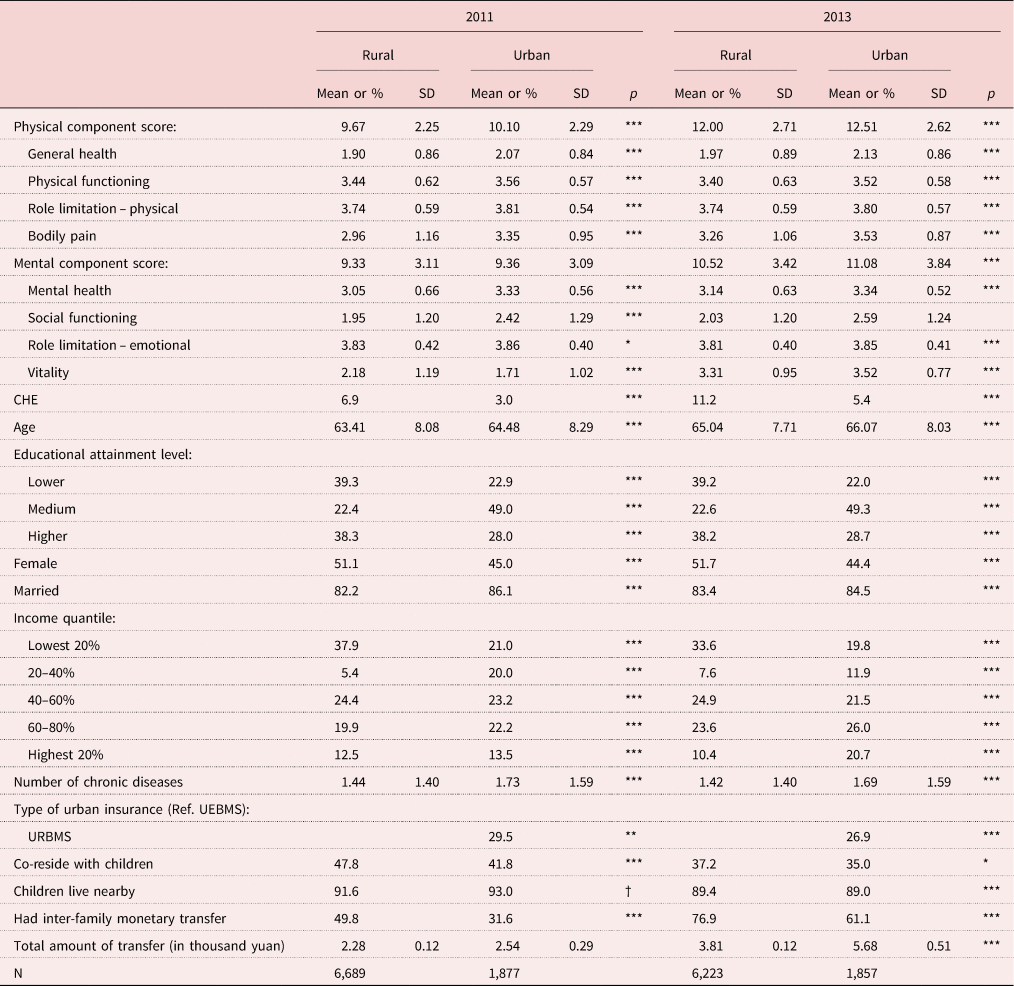
As Table 2 indicates, older adults had higher physical component scores and mental component scores in 2013 than in 2011, largely because fewer bodily pains and greater vitality were reported in 2013. The higher scores for both components represent better health, e.g. less bodily pain, greater vitality, and fewer physical-role and emotional-role limitations. Consistent with most geriatric studies, we found that between the two years, the means of older adults’ physical functioning decreased slightly, and the means of both physical- and mental-related role limitations increased. However, respondents in the sample reported better general health status, mental health status and social functioning in 2013 than in 2011. The mean scores for the physical components increased by 2.33 and 2.41 units for rural and urban older adults, respectively, while the mental component means increased by 1.19 and 1.72 units, respectively. Urban older adults had higher scores than their rural peers in almost all domains of HRQoL in both years, except the domain of vitality in 2011.
Sample characteristics by urban–rural household registration status in 2011 and 2013

Notes: SD: standard deviation. CHE: catastrophic health expenditure. UEBMS: Urban Employee Basic Medical System. URBMS: Urban Resident Basic Medical System. Ref.: reference group. We conducted cross-tabulation and chi-square tests for categorical variables; t-test for continuous variables. Wealth quintile was ordered within rural and urban older adults, respectively. Higher scores of health-related quality of life mean better health conditions (ranges from 1 to 4 for each domain and from 1 to 16 for component scores). The number of cases were unweighted. In our panel sample, in total 101 observations changed their status from rural to urban household registration, and 59 observations changed reversely. Given this fact, our descriptive results of means of age, distributions of gender and percentages of educational attainment varied across years.
Significance levels: †p < 0.1, *p < 0.05, **p < 0.01, ***p < 0.001.
The incidence of CHE was more prevalent in rural China than in urban China, increasing from 6.9 to 11.2 per cent and from 3.0 to 5.4 per cent for rural and urban older adults, respectively, between 2011 and 2013. The prevalence of CHE observed in the sample (aged 55+) using 20 per cent of household income as the cut-off threshold for CHE is lower than the result obtained by Li et al. (Reference Li, Wu, Xu, Legge, Hao, Gao, Ning and Wan2012), which reported that on average 13.0 per cent of older adults (aged 60+) in China had CHEs in 2008 using a 40 per cent cut-off point. However, similar to the finding of Li et al. (Reference Li, Wu, Xu, Legge, Hao, Gao, Ning and Wan2012), the prevalence of CHE in rural areas is notably higher than in urban areas. We additionally found a higher proportion of rural older adults (10.76%) entering CHE between the two years than urban older adults (4.43%). CHE exit showed the opposite: urban older adults had a higher proportion (82.86%) of exit than rural older adults (79.05%).
Consistent with prior studies, we found significant differences between rural and urban older adults in many aspects. Compared to the rural older adults in our sample, our urban sample was found to have higher educational attainment, a lower proportion of females and higher married rates, be more equally distributed to each income quintile, have higher numbers of chronic diseases on average, be less likely to co-reside with their children, have fewer occurrences of receiving inter-family transfers but transfer slightly higher amounts. It is also noted that the average age in our sample is one year older among urban older adults than their rural peers. These significant variations could affect the magnitude of the CHE effects on HRQoL among rural and urban older adults, which will be discussed later.
DID estimates
Overall, we found that entry into CHE was associated with poorer HRQoL while exiting CHE was associated with better HRQoL for older adults in China. The negative association between entry into CHE and HRQoL was more robust for physical health than mental health, while the positive association between exiting CHE and HRQoL was weak and sporadic for both physical and mental health. We also found the effects of CHE on HRQoL overall to be more consistent among rural older adults than urban older adults in China.
Table 3 presents the DID estimates for changes in the physical component score and the mental component score from 2011 to 2013 among older adults in the CHE entry group. After controlling for respondents’ demographic factors, number of chronic diseases, household wealth for all older adults, the type of health insurance for urban older adults, living arrangement and inter-family transfers, we found that entry into CHE was associated with a decreased physical component score for both rural and urban older adults, and exiting CHE was associated with an increased physical component score for rural older adults only. In Panel A, compared to the non-CHE group, rural older adults in the CHE entry group saw their physical component score decrease by 0.89 units, while urban older adults’ score decreased by 1.70 units. In Panel B, compared to rural older adults in the CHE persistent group, rural older adults in the CHE exit group saw their physical component score increase by 0.62 units, while the CHE exit effect on the physical component was not statistically significant for urban older adults.
Difference-in-differences results for 2011–2013 change in component scores of health-related quality of life among older adults entering and exiting catastrophic medical expenditure (CHE) in China

Notes: Robust standard errors are in parentheses. The reference group (Ref.) for Panel A is the outsider group who did not have CHE for both waves and for Panel B is the persistent group who had CHE for both waves. A higher score indicates a better health outcome. Control variables for both models include age, educational attainment, gender, marital status, household wealth and the number of chronic diseases for both rural and urban observations. Type of health insurance was also controlled for urban observations.
Significance levels: *p < 0.05, ***p < 0.001.
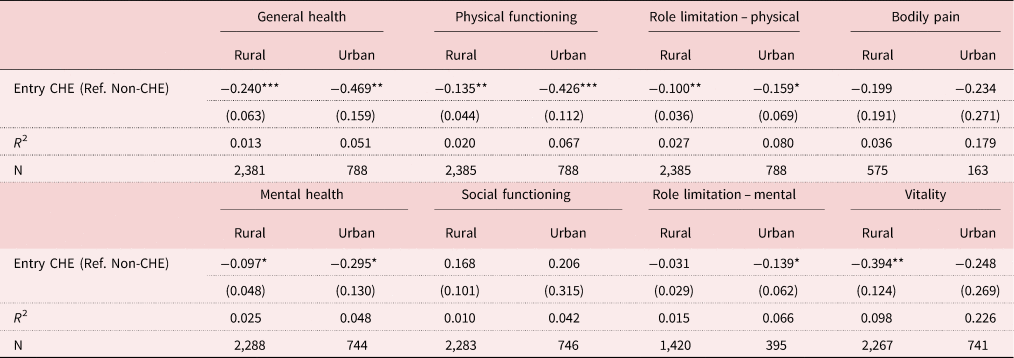
Table 4 further presents the effects of entry into CHE on each physical and mental domain. We found that all physical domains, except bodily pain, had significantly negative associations with entry into CHE. The absolute values of the coefficients were higher for urban older adults than rural older adults, indicating that the negative impacts of entry into CHE on physical components were greater among urban older adults than their rural peers. Compared to the non-CHE group, rural and urban older adults in the CHE entry group saw respective decreases of 0.24 and 0.47 units in their general health, 0.14 and 0.43 units in physical functioning, and 0.10 and 0.16 units in physical-related role limitations.
Difference-in-differences results for 2011–2013 change in detailed domains of health-related quality of life among older adults entering catastrophic medical expenditure (CHE) (Panel A) in China

Notes: Robust standard errors are in parentheses. A higher score indicates a better health outcome. The reference group (Ref.) is observations who did not have CHE for both waves. Control variables for both models include age, educational attainment, gender, marital status, household wealth and the number of chronic diseases for both rural and urban observations. Type of health insurance was also controlled for urban observations.
Significance levels: *p < 0.05, **p < 0.01, ***p < 0.001.
It is not entirely clear why entry into CHE was associated with greater decline in the physical health of urban older adults compared to their rural peers. We speculate that the main reason could be that urban older adults usually have better access to care and thus can obtain more specific diagnoses and monitoring of their physical health indicators after incurring CHE, therefore leading to greater decline in their physical HRQoL in comparison to rural older adults who also enter into CHE but may lack the follow-up diagnosis and monitoring. Another reason could be that, since CHE is measured by the respondent's monthly out-of-pocket medical expenditure as a proportion of monthly household income, and since urban household income is on average much higher than that of rural households, entry into CHE for urban older adults may indicate more severe illnesses and more expensive treatments, both of which are associated with worse physical health outcomes.
Despite little clear evidence in Table 3 that entry into CHE was significantly associated with the mental component score as a whole, the results for each mental domain narrated the impacts differently: with entry into CHE, mental health decreased significantly by 0.10 and 0.30 units for rural and urban elders, respectively; the mental-related role limitations increased by 0.14 units for urban older adults; and vitality decreased by 0.39 units for rural older adults. It is unsurprising that we find a more consistent and robust association between CHE and physical health than between CHE and mental health. In general, physical health is more frequently and robustly measured, whereas mental health measures are more subjective and often self-assessed relative to one's immediate peers and surroundings. In the Chinese context, most CHE occurs because of physical rather than mental health problems. Thus, it is reasonable that CHE is strongly and persistently linked with physical rather than mental health outcomes.
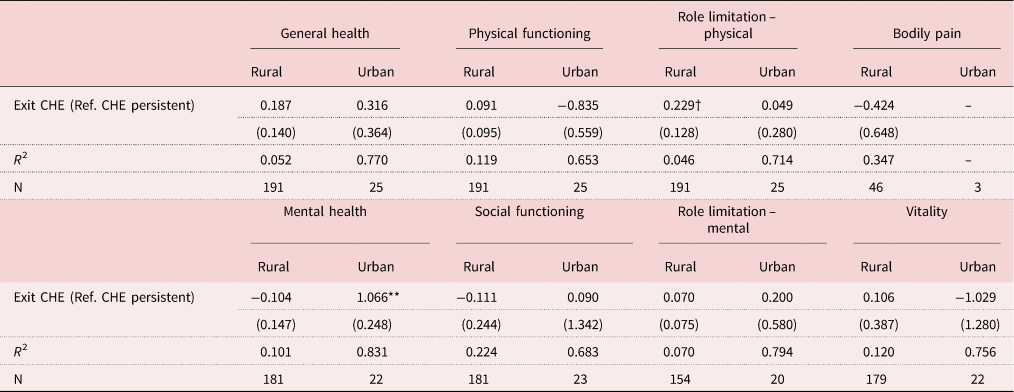
Table 5 presents estimates of the CHE association with each domain of HRQoL. Panel B of Table 5 suggests that compared to those in the CHE persistent group, rural older adults in the CHE exit group decreased their physical-related role limitations by 0.23 units. Urban older adults in the CHE exit group increased their mental health by 1.07 units. These results, however, are weak and should be interpreted with caution, primarily because of the small sample sizes (e.g. fewer than 40 urban observations in the CHE exit group). The overfit model is more likely to describe the random error and misleading regression coefficients and p-values rather than an underlying association (Babyak and Babyak, Reference Babyak and Babyak2004).
Difference-in-differences results for 2011–2013 change in detailed domains of health-related quality of life among older adults exiting catastrophic medical expenditure (CHE) (Panel B) in China

Notes: Robust standard errors are in parentheses. A higher score indicates a better health outcome. The reference group is observations who had CHE in both waves. Control variables for both models include age, educational attainment, gender, marital status, household wealth and the number of chronic diseases for both rural and urban observations. Type of health insurance was also controlled for urban observations. Results of bodily pain for urban Chinese older adults are not estimated and thus not reported in this table because of the small sample size (N = 3).
Significance level: †p < 0.1, **p < 0.01.
Discussion
Using data from the 2011 and 2013 CHARLS and a DID methodology, we examined the association between CHE and HRQoL among Chinese older adults. We found that entry into CHE is indeed associated with poorer physical and mental health for both rural and urban older adults in China. In addition, entry into CHE is more consistently and negatively associated with physical health than mental health. Given the small sample size of urban older adults in the CHE exit group, the association between exiting CHE and HRQoL is less reliable for those urban dwellers than for rural older adults.
Although our results suggest that the prevalence of CHE is lower than prior studies in China (Li et al., Reference Li, Wu, Xu, Legge, Hao, Gao, Ning and Wan2012) and other middle-income countries indicate (Van Doorslaer et al., Reference Van Doorslaer, O'Donnell, Rannan-Eliya, Somanathan, Adhikari, Garg, Harbianto, Herrin, Hug, Ibragimova and Karan2007; Pal, Reference Pal2012), it is critical to understand the characteristics of this population that suffers from CHE, the determinants of CHE, and the outcome on health and wellbeing. A large proportion of overall medical expenditures occurs among this population, and, moreover, the medical impoverishment and other related expenditure-based poverty that they face may well continue to affect their subsequent generations.
From our descriptive analysis and DID estimates, we found that the prevalence of CHE among urban older adults was lower than among their rural peers. Meanwhile, entry into CHE was associated with greater declines in both physical and mental health component scores and specific domain values for urban older adults compared to rural older adults. This could be a result of rural older adults who persistently live in a relatively impoverished environment having developed a tolerance level that protects them from being impacted by CHE as greatly as their urban peers. The difference may also be due to the fact that both self-reported physical and mental health conditions of rural older adults were worse than their urban peers to begin with. The impacts of CHE may thus have diminished the health of the rural dwellers at a lower decreasing rate for the component scores or specific domains. These findings highlight the greater need for health-care facilities and services in rural areas compared to urban areas, as well as the importance of raising the rural livelihood level in general so that CHE constitutes a smaller proportion of rural household income. Our analysis results also present the factors which could mitigate the risks of entering CHE at the individual, household and policy level. At the individual level, reducing the probability of having chronic diseases or co-morbidities and increasing the educational attainment could reduce the risks of experiencing CHE. At the household level, establishing better inter- and intra-family relationships and therefore expanding financial resources when needed are helpful in reducing the probability of entering CHE. At the policy level, having the coverage of UEBMS also helps to reduce the likelihood of experiencing CHE. Besides the factors we have explored, other studies found that better health behaviours, such as using alcohol and tobacco less frequently (Bonu et al., Reference Bonu, Rani, Peters, Jha and Nguyen2005), and effective health intervention programmes aiming at boosting preventive care utilisations (Busch et al., Reference Busch, Yoon, Barry, Azzone, Normand, Goldman and Huskamp2013) can help to reduce the risks of CHE.
This paper, to our knowledge, constitutes the first to study the effects of CHE on both the physical and mental health of older adults using a nationally representative sample in China. We adopted a DID methodology to compare the changes at two time-points within four groups in two panels. The DID method partly helps to understand how changes in CHE might be associated with HRQoL, by capitalising on the longitudinal data. The study also compares differences between rural and urban older adults in China, which provides useful insights for policy and suggests some important social implications.
The study also has limitations that suggest paths for future research. First, the analysis did not address the problem of endogeneity (reverse causality) between CHE and HRQoL, although the DID method does potentially reduce the effects of extraneous factors and selection bias. Second, the reliability of the effects of exiting CHE was lowered by the small number of urban older adults in that group. In addition, the effects of exiting CHE may take time to show: patients and their family members may not be able to return to work right after exiting CHE. Therefore, the consequences of experiencing CHE may be longer than the period of one year which we adopted in our analysis. However, these limitations and potential explanations are not testable by using the current data-set. Future studies can explore the length of the impact of CHE, chronic poverty and temporary poverty on older adults’ HRQoL and other health outcomes. The endogeneity problem between CHE and HRQoL among Chinese older adults may be addressed in the future using additional waves of longitudinal data.
Beyond the individual- and household-level socio-economic factors we controlled for in our analysis, we were unable to include more macro-level socio-economic indicators, such as mean adult years of schooling and GDP per capita in each county. Because the publicly available CHARLS data-set does not contain such information or geographic information such as zip codes and the names of counties to protect the oldest-old who are easily identified, we were unable to match more macro-level socio-economic measures in administrative data into the CHARLS survey data-set. Macro-level socio-economic indicators, including income, gender inequality, gross national income, etc., have been found to be predictive of health conditions and life expectancy (Kim and Kim, Reference Kim and Kim2016, Reference Kim and Kim2017). Future studies can test the influence of these variables when community-level survey data are available.
Besides, it should also be noted that the different impacts of CHE on HRQoL among rural and urban older adults could be due to the variations in socio-demographic factors among these populations. Future studies could conduct decomposition analysis to explore the impacts of socio-demographic characteristics. One should also be cautious in using the prevalence of CHE obtained from this study to conduct cross-national comparative studies because we may have adopted different cut-off points of CHE from other studies.
One of the primary goals of health and social policies is to prevent, or at least alleviate, adverse consequences of CHE. To reduce the negative impacts of CHE on HRQoL among older adults in China, future policy reforms should consider the affordability, accessibility and availability of medical care. First, the prevalence of CHE could be used as a tool to measure the effectiveness of public health insurance (Naga and Lamiraud, Reference Naga and Lamiraud2011). Currently, rural older adults in poverty and urban older adults who do not have UEBMS need more-effective health insurance. The new reimbursement plan could consider decreasing the out-of-pocket liability and setting an annual limit on the maximum amount the insurer will pay per year (Essue et al., Reference Essue, Kimman, Svenstrup, Kjoege, Laba, Hackett and Jan2015).
Second, like many countries in the world which promote their health and social policies to reduce CHE by improving access to health-care services (Gorter et al., Reference Gorter, Grainger, Okal and Bellows2012; Korenman and Remler, Reference Korenman and Remler2013), policy makers in China could consider establishing more clinics and equipping more well-educated physicians in rural areas and low-income urban areas. The more-accessible health-care services, on the one hand, could increase the utilisation of free care and affordable care among low-income older adults. On the other hand, it could also reduce the financial burden related to transportation and accommodation in the event of illness and therefore help them to maintain their standard of living better by using the budget to meet other basic needs.
Third, another common health policy adopted in other countries to reduce the risks of spending a significant amount of money on treatment is to encourage the public to use preventive care. This has been found to be effective for both communicable diseases and non-communicable disease, including influenza vaccination (Simonsen et al., Reference Simonsen, Reichert, Viboud, Blackwelder, Taylor and Miller2005), human papillomavirus vaccination (Hariri et al., Reference Hariri, Markowitz, Dunne and Unger2013), cancer screenings (Elovainio et al., Reference Elovainio, Nieminen and Miller1997), and so on. In China, more-affordable and high-quality preventive care should be made available to older adults with higher risks of CHE, which could help reduce the likelihood that they become trapped by medical poverty.
Finally, professional social work services, especially at the community level, should be implemented and expanded to improve older adults’ HRQoL based on different demands in urban and rural settings. Current social programmes which promote older adults’ community participation mainly target those who have higher physical and mental functioning capabilities and fewer morbidities in urban areas. It calls for increased efforts to involve more social workers in communities, nursing homes and hospitals to narrow the gaps for older adults to participate in social activities and get access to preventive care and timely health care. Furthermore, compared to older adults in urban areas, rural older adults have to overcome more challenges, including asymmetric information related to eligible social service programmes, inadequate available social services within an acceptable distance and barriers to obtaining social resources. Therefore, social work services are more urgently needed in rural than in urban areas across both health-care and community settings to meet the needs of the rapidly growing ageing population and their families in China.
Data
The data that support the findings of this study are available from Peking University. Restrictions apply to the availability of these data, which were used under licence for this study. Data are available at http://charls.pku.edu.cn/zh-CN with the permission of Peking University.
Acknowledgements
We are grateful to Heidi Allen and Sophie Mitra as well as the editor and anonymous reviewers for providing valuable comments and suggestions, which helped strengthen this paper.
Conflict of interest
The authors declare no conflicts of interest.