Introduction
Parasitism is a common phenomenon in many insects (Gullan and Cranston Reference Gullan and Cranston2004). Parasites can exert strong selection pressures on their hosts and can affect their population dynamics and life-history traits (Futuyma Reference Futuyma2005). Despite this importance, parasitism is one of the least researched subjects in many insects.
Current knowledge of parasitism in ground beetles (Coleoptera: Carabidae) is scattered and mostly based on single observations (Thiele Reference Thiele1977; Holland Reference Holland2002). Fungi, Protozoa, Nematoda, Acari, Hymenoptera, and Diptera have been reported as parasites of Carabidae (Thiele Reference Thiele1977; Holland Reference Holland2002). Among these, parasitoid wasps (Hymenoptera) are considered to be the most important because of higher parasitism rates compared with other taxa of parasites (Rivard Reference Rivard1964; Critchley Reference Critchley1973) and because of negative effects on host fitness (e.g., death and parasitic castration). Although several reports have described parasitism by Hymenoptera on Carabidae (Musebeck 1936; Watanabe Reference Watanabe1954; Rivard Reference Rivard1964; Luff Reference Luff1976c; Loan and Holliday Reference Loan and Holliday1979), most of these have focused on parasitoid taxonomy and diversity and only three studies have addressed the importance of the parasitoids to host ecology.
Critchley Reference Critchley(1973) examined seasonal variation in the rates of parasitism by two species of Phaenoserphus Kieffer (Hymenoptera: Proctotrupidae) on larvae of eight species from seven carabid genera (Carabus L., Nebria Latr., Notiophilus Dumeril, Loricera Latr., Pterostichus Bonelli, Calathus Bonelli, and Agonum Bonelli). Luff (Reference Luff1976a) examined parasitism by the same parasitoids on larvae of Nebria brevicollis (Fabr.). In these two studies, observed parasitism rates were relatively low (<10%) in most species but varied seasonally and among localities in some (e.g., N. brevicollis), sometimes by over 20%. Luff (Reference Luff1976b) examined parasitism of adult Harpalus rufipes (Degeer) carabids by Microctonus caudatus (Thomson) (Hymenoptera: Braconidae: Euphorinae) and observed seasonal variation in parasitism rate (0%–27%, mean 8.4%) and parasitic castration by the parasitoids. These studies have provided valuable information but only for a limited number of parasitoid and host species.
Here, we report on the parasitism of adult Poecilus versicolor (Sturm) (Coleoptera: Carabidae) by endoparasitoid hymenopteran larvae. We first determined the parasitism based on live male and female hosts. Second, we examined the percentage of adult P. versicolor parasitized by Hymenoptera at several localities. Third, we identified the larvae through DNA sequence analysis because they could not be identified by morphology further than the order level. This is the first study to report parasitism by Hymenoptera in a species of Poecilus Bonelli (Larochelle and Larivière Reference Larochelle and Larivière2003; Thiele Reference Thiele1977) and to demonstrate the utility of DNA barcoding to elucidate host–parasite relationships in Carabidae.
Materials and methods
Sample collection
The observations of live parasitoids were based on examination of the reproductive tracts of live hosts collected in Funato, Kashiwa-shi, Chiba Prefecture, Japan (35°55′33″N, 139°57′46″E) on 16–17 May 2005 using pitfall traps (Sasakawa Reference Sasakawa2006, Reference Sasakawa2007). This period is within the host's reproductive season (Habu and Sadanaga Reference Habu and Sadanaga1961). Beetles were collected, transported to the laboratory, dissected, and observed on the same day. After dissection, all parasitoid larvae were placed in Petri dishes lined with moistened filter paper to obtain adults for identification. However, most larvae died and the remaining live larvae were preserved in 70% ethanol and stored at room temperature until October 2009 when DNA analysis was performed.
To determine parasitism rates, we collected 64 males and 62 females in Chiba Prefecture on 7–8 April 2005; 11 males and 29 females in Usagi-zawa, Ôhata-machi, Mutsu-shi, Aomori Prefecture (41°23′57″N, 141°09′03″E), on 19–20 July 2005; and 15 males and 68 females in Uchino, Fujioka-machi, Tochigi-shi, Tochigi Prefecture (36°14′00″N, 139°41′08″E), on 10–11 May 2009 (all from Japan). Immediately after collection, beetles were preserved in absolute ethanol and stored at room temperature (Chiba and Aomori specimens) or at −30°C (Tochigi specimens) until October 2009, when dissection and DNA analysis were performed.
Identification of parasitoids by DNA barcoding
We initially attempted to identify parasitoid larvae based on morphology. Some larvae were mounted on slides using gum-chloral fluid and observed under a light microscope. Mouthpart morphology showed that the larvae belonged to Hymenoptera, but they could not be identified further than to order. Thus, subsequent identification was performed by DNA analysis.
We analyzed partial sequences of mitochondrial genes for cytochrome c oxidase subunit I (COI), the standard DNA barcode for animal species (Hebert et al. Reference Hebert, Cywinska, Ball and deWaard2003), and 16S ribosomal RNA (16S), useful for family-level phylogenetic analysis of Hymenoptera (e.g., Derr et al. Reference Derr, Davis, Woolley and Wharton1992; Dowton and Austin Reference Dowton and Austin1994). Our analysis proceeded in three steps. We first constructed a phylogeny of the sampled larvae and most extant lineages (family or superfamily) of Hymenoptera based on the combined data of COI and 16S sequences and identified the larvae to family (family-level analysis). Second, based on the COI sequences of our samples and those of members of the identified family available in GenBank (NCBI) or Bold Systems (Ratnasingham and Hebert Reference Ratnasingham and Hebert2007), phylogenetic trees were constructed to identify the larvae to genus (genus-level analysis). Third, we compared genetic distances of COI sequences between our samples and putative congeneric species and tested whether our genus-level identification was compatible in terms of genetic variability.
We used several larval abdominal segments for DNA extraction; thus, the head, thorax, and last abdominal segment of each specimen (morphologically important for larval taxonomy) were undamaged. We used a QIAGEN DNeasy Blood & Tissue kit (QIAGEN, Valencia, California) for the extraction. The COI and 16S fragments were PCR-amplified using the following primers: LCO1490 (forward), 5′-GGTCAACAAATCATAAAGATATTGG-3′ and HCO2198 (reverse), 5′-TAAACTTCAGGGTGACCAAAAAATCA-3′ (Folmer et al. Reference Folmer, Black, Hoeh, Lutz and Vrijenhoek1994; Hebert et al. Reference Hebert, Cywinska, Ball and deWaard2003); 16S.Sh (forward), 5′-AGATTTTAAAAGTCGAACAG-3′ and 16SWb (reverse), 5′-CACCTGTTTATCAAAAACAT-3′ (Dowton and Austin Reference Dowton and Austin1994). For the PCR thermal regime, we followed Hebert et al. Reference Hebert, Cywinska, Ball and deWaard(2003) for COI and Dowton and Austin Reference Dowton and Austin(1994) for 16S. PCR products were purified using ExoSAP-IT (Amersham Pharmacia Biotech, Uppsala, Sweden). Sequencing reactions were performed with a CEQ DTCS Quick Start Kit (Beckman Coulter, Fullerton, California), and the products were purified using ethanol precipitation and electrophoresed using a CEQ8000 Genetic Analysis System (Beckman Coulter).
For the family-level analysis, 42 sequences representing 30 hymenopteran families and a sequence from one dipteran species (outgroup) were used (Appendix A). This data set covers 20 of 22 superfamilies of Hymenoptera (Sharkey Reference Sharkey, Zhang and Shear2007). Except for Megalyroidea, the data set was composed of combined 16S and COI sequences from the same species (for unidentified species, from the same specimens). For Megalyroidea, the sequences from two unidentified species from the same subgenus were combined because both sequences were not available from a single species.
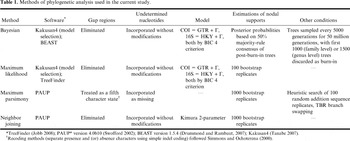
Sequence alignments were performed using Clustal X version 2.0 (Larkin et al. Reference Larkin, Blackshields, Brown, Chenna, McGettigan and McWilliam2007) with default parameter settings. For COI sequences, the obtained alignments were inspected visually and the obvious misalignments were corrected manually using BioEdit version 7.0.5 (Hall Reference Hall2005). The 16S sequence was highly variable in length and sequence alignment required gaps. In some taxa (e.g., one of the collected parasitoids), available sequences were somewhat shorter than those of other species; in such cases, unavailable sites at end(s) were coded as “missing” and included in the data set. Phylogenetic trees were constructed by Bayesian, maximum-likelihood (ML), maximum-parsimony (MP), and neighbor-joining (NJ) methods. Details of the phylogenetic analysis methods are summarized in Table 1.

* TreeFinder (Jobb Reference Jobb2008); PAUP* version 4.0b10 (Swofford Reference Swofford2002); BEAST version 1.5.4 (Drummond and Rambaut, Reference Drummond and Rambaut2007); Kakusan4 (Tanabe Reference Tanabe2007).
† Recoding methods (separate presence and (or) absence characters using simple indel coding) followed Simmons and Ochoterena Reference Luff(2000).
Genetic distance was analyzed among genera, among species within each genus, and among individuals within each species by means of pairwise comparisons using the Kimura 2-parameter model. For each species, two to five sequences were used, depending on data availability. Sequences of species that were not identified to genus (i.e., “Genus sp.”) were used for the analysis among genera but not for analysis among species and among individuals. Missing sites were included, and undetermined nucleotide sites were used without modification. All analyses were performed by Arlequin version 3.5 (Excoffier et al. Reference Excoffier, Laval and Schneider2005). Specimens used in DNA analysis will be deposited in the collection of the Laboratory of Forest Zoology, the University of Tokyo, as voucher samples.
Results
Observation of live parasitoids
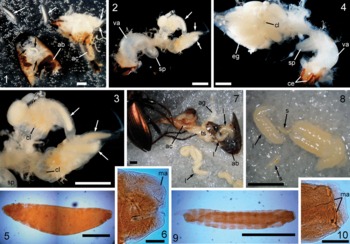
Two parasitized beetles were observed, one male and one female. Parasitism of the female was discovered during dissection to examine post-copulation spermatophore morphology (the copulating male was not parasitized). From this female, 33 parasitoid larvae were found, 29 from the abdominal cavity (Fig. 1) and 2 from each lateral ovariole (Figs. 2–3).

In the female a large spherical spermatophore was found in the vagina (Fig. 2; see also Sasakawa Reference Sasakawa2006, Fig. 1B), distinct corpora lutea were observed in the ovarioles, and muscles around the vagina and spermatheca and eggs in ovarioles were absent (Figs. 2–3). The spermatophore and distinct corpora lutea were the same as those of non-parasitized females (Fig. 4). The absence of muscles and eggs was unique to the parasitized female: in non-parasitized females, the vagina and spermatheca were covered with a thick muscular layer and ovarioles were filled with mature eggs (Fig. 4). We suspect that the parasitoids consumed these components of the parasitized female. Morphological observation revealed that all parasitoid larvae from the female had the same weakly sclerotized, blunt mandible morphology (Figs. 5–6), and they were subsequently referred to as “type-A larvae.”
Parasitism of the male was discovered during dissection to examine its internal reproductive organs. Two distinct size classes of parasitoid larvae were found, comprising 22 relatively large individuals that were about three times larger than 3 smaller individuals (Figs. 7–8). All larvae were found in the abdominal cavity. Testes and the accessory gland of the host were undamaged and seminal substances were observed within these organs. Unfortunately, subsequent death and decomposition of the small-sized larvae rendered them unsuitable for morphological observation and DNA analysis. All the large-sized larvae had the same sclerotized sharp mandible morphology (Figs. 9–10), noticeably different from that of larvae collected from the female, and were subsequently referred to as “type-B larvae.”
Percent parasitism
Among the samples from the three localities, parasitism was found only in the Chiba specimens. Three females and one male (3.2% of individuals) from this locality were parasitized by numerous type-A larvae (cf. Figs. 5–6). The number of parasitoids per host was 27, 24, and 17 for females and 9 for the male. Parasitoids of each host were all of one size class.
Identification of parasitoids by DNA barcoding
We determined 540–584 bp COI sequences and 363–505 bp 16S sequences from four type-A larvae (GenBank accession numbers AB563731–AB563738): Larva_id3, from a parasitism rate study female; Larva_id4 and id5, from the parasitism rate study male; and Larva_id8, from the live parasitoid study female. These larvae were obtained from hosts collected in Chiba Prefecture in May (Larvae_id8) or April (all others) 2005. Despite several attempts, we were unable to amplify DNA from other parasitoid samples, including type-B larvae. We believe this was because of poor preservation conditions, such as temperature and alcohol concentration (see Materials and methods).
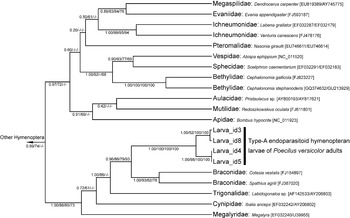
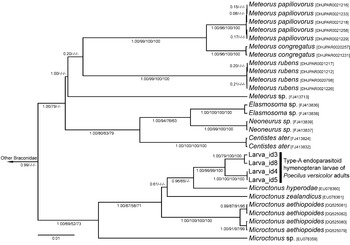
All trees resulting from the family-level analysis showed that the parasitoid larvae fell within a clade containing Braconidae, with high nodal supports (Fig. 11). Thus, the subsequent genus-level analysis was performed with 509 sequences representing 169 genera of Braconidae (Appendix B), plus the four parasitoid samples and one outgroup species (Venturia canescens (Gravenhorst) (Hymenoptera: Ichneumonidae); GenBank accession number FJ478176). Bayesian, ML, MP, and NJ trees all showed that the parasitoid larvae formed a monophyletic clade within Microctonus Wesmael and were further divided into two clades, one containing Larva_id4 and id5 (from the male host) and the other containing Larva_id3 and id8 (from female hosts); relationships were supported with high nodal confidence (Fig. 12).


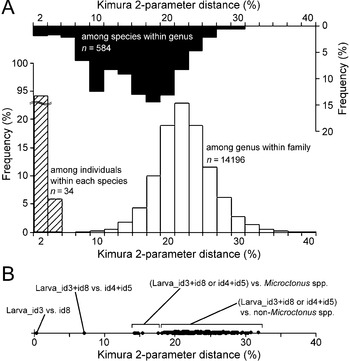
Within Braconidae, genetic-distance analyses (Fig. 13A) showed that distances among genera ranged from 6.4% to 38.5% (average 21.4%). Among species within each genus, distances ranged from 0.34% to 29.4% (average 14.6%). Among individuals within each species, distances ranged from 0.068% to 3.9% (average 0.61%). Larvae_id4 and id5 (which probably were siblings) had identical sequences. The genetic distance between Larva_id3 and id8 (which came from different hosts but were sisters in all resultant trees) was 0.34% (Fig. 13B), suggesting that these two larvae belong to the same species. The distance between the two clades Larva_id3+id_8 and Larva_id4+id5 was 7.1%, a value larger than the maximum intraspecific sequence difference in Braconidae (3.9%). Although the sample size was small, these data suggest that the two clades represent different species within a genus. Two clades of our parasitoid samples and three Microctonus species differed by genetic distances of 14.2%–17.6%; these distances are smaller than those between our parasitoid samples and species in other genera (18.2%–31.8%). In comparison with genetic variability within Braconidae, this suggests that our parasitoid samples belong to species of Microctonus.

Discussion and conclusions
Our results are notable in two respects. First, our work with hymenopteran endoparasitoids in P. versicolor is apparently the first report of parasitism by Hymenoptera in Poecilus Bonelli (Larochelle and Larivière Reference Larochelle and Larivière2003; Thiele Reference Thiele1977). Second, our results are the first demonstration of the utility of DNA barcoding for determination of host–parasite relationships in Carabidae. We performed DNA analysis, including COI barcoding, to identify larvae that could not be identified by morphology further than the order level. Although our results require further confirmation, using molecular techniques we identified the genus of some of the parasitoids and revealed two putative species among the parasitoids (Larva_id3+id8 and Larvae id4+id5).
Dissection of live hosts and subsequent observations revealed several interesting features regarding parasitism by Hymenoptera larvae in adult P. versicolor. In the parasitized female, although eggs were absent (parasitic castration), distinct corpora lutea were observed, indicating that oviposition had occurred. (Whether or not the beetle was parasitized at the time of oviposition is unknown.) Luff (Reference Luff1976b) reported parasitic castration (reduced and nonfunctional ovarioles) of female Harpalus rufipes by larval Microctonus caudatus but did not mention whether corpora lutea were observed.
We observed that the testes and accessory gland of the parasitized male were undamaged. Similarly, Takami Reference Takami(2004) reported that an adult male Carabus kimurai (Ishikawa) endoparasitized by larval Zaira cinerea (Fallen) (Diptera: Tachinidae) copulated normally and formed a spermatophore 6 days before dying. Overall, our results suggest that endoparasitism causes incomplete loss of reproductive ability in male and female P. versicolor. This finding, together with our observation of low parasitism rates (0%–3.2%) in all populations examined, indicates that parasitism of adult P. versicolor by Hymenoptera has little effect on the population dynamics of this ground beetle.
We found two size classes of parasitoid larvae in the single male P. versicolor. Luff (Reference Luff1976b), Arndt and Costa Reference Arndt and Costa(2001), and Takami Reference Takami(2004) also have mentioned variation in body size of parasitoids found from single specimens of Carabidae. Arndt and Costa Reference Arndt and Costa(2001) reported observations similar to ours: they found different-sized larvae of Anthrax gideon F. (Diptera: Bombyliidae) on individual larvae of Oxycheila tristis (F.). Arndt and Costa Reference Arndt and Costa(2001) suggested a possible explanation for this observation: competition among siblings may result in larvae at various developmental stages on a single host. Another possible explanation is the presence of multiple individuals of one (superparasitism) or several (multiparasitism) parasitoid species (Gullan and Cranston Reference Gullan and Cranston2004). Our data are insufficient to allow a decision among these options; future studies using additional specimens and a DNA-based approach (e.g., microsatellite analysis) would provide further insights into this issue.
DNA analyses showed that type-A larvae belonged to the braconid genus Microctonus. This result was unsurprising: within Hymenoptera, braconids, almost exclusively species of Microctonus, are the only recorded parasitoids of adult Carabidae (Muesebeck Reference Muesebeck1936; Watanabe Reference Watanabe1954; Luff Reference Luff1976b; Thiele Reference Thiele1977; Loan and Holliday Reference Loan and Holliday1979; Holland Reference Holland2002). (Luff (Reference Luff1976c) reported Centistes nasutus (Wesmael) parasitizing a carabid.) Nevertheless, our genus-level identification requires further confirmation because our data set did not cover close relatives of Microctonus.
Two lines of future research would be fruitful. First, a reanalysis of our specimens with a data set covering all genera of Euphorinae would enable a definitive genus-level identification. Second, a comparison of DNA sequences of our specimens and adult Microctonus that may occur in the Chiba Prefecture collection site may enable species-level identification of our specimens.
Acknowledgements
We thank two anonymous reviewers for their helpful comments and Kyôhei Watanabe (Kobe University, Hyogo, Japan) for information on literature. This study was partly supported by the Japan Society for the Promotion of Science (Research Fellowship for Young Scientists 20-11227 to K.S.) and National BioResource Project (NBRP), MEXT, Japan, to M.I.
Appendix A
Accession numbers of sequences used in the family-level analysis (COI/16S; when complete mitochondrial genome sequences were used, single numbers are provided). The data in Fig. 11 are not included.
Anaxyelidae: Syntexis libocedrii, EF032234/AY206796. Argidae: Arge cyanocrocea, EF032221/AY206783; Sterictiphora furcata, EF032222/AY206784. Blasticotomidae: Runaria reducta, EF032212/AY206774. Cephidae: Cephus pygmaeus, EF032228/AY206790; Calameuta filiformis, EF032229/AY206791. Cimbicidae: Corynis crassicornis, EF032220/AY206782. Diprionidae: Diprion cf. pini, EF032279/EF032169; Monoctenus juniper, EF032278/EF032168. Megalodontesidae: Megalodontes cephalotes, EF032227/AY206789. Orussidae: Orussus minutus, EF032284/EF032174; Orussus abietinus, EF032236/AY206798. Pamphiliidae: Acantholyda posticalis, EF032226/AY206788; Onycholyda amplecta, EF032223/AY206785. Pergidae: Perga condei, EF032238/U06953; Lophyrotoma analis, EF032281/EF032171. Siricidae: Xeris spectrum, EF032283/EF032173; Tremex columba, EF032233/AY206795. Stephanidae: Neostephanus sp., EF032289/EF032181; Schlettererius cinctipes, EF032237/AY206799. Tenthredinidae: Aglaostigma lichtwardti, EF032275/EF032165. Vanhorniidae: Vanhornia eucnemidarum, DQ302100. Xiphydriidae: Xiphydria prolongata, EF032235/AY206797. Xyelidae: Macroxyela ferruginea, EF032211/AY206773; Xyela sp., EF032210/AY206772. Diptera: Drosophila melanogaster, NC_001709.
Appendix B
Accession numbers of COI sequences used in the genus-level analysis and genetic distance analysis. The data in Fig. 12 are not included.
Acanthormius: sp., AY935381. Acantorhogas: sp., DQ498975. Acrisis: brevicornis, AY935410. Acrophasmus: exilis, DQ498976. Adelius: sp., FJ413815. Aivalykus: arawak, AY935398; cornicoxa, EF645789. Aleiodes: aestuosus, EU979573; apicalis, EU979575; apiculatus, EF115455/EU979576; aterrimus, EU979577; barnardae, EF115443–46; basutai, EF115442; nr. borealis, EU979578; cameron, DHJPAR0021061–64; circumscriptus, EU979579; compressor, EF115458/EU979580; coxalis, EF115459–60/EF115462; dissector, EF115471–73; esenbecki, EU979581; gasterator, EU979582; grassator, EU979584; kanyawarensis, EF115450; kasenenei, EF115451; leptoca, DHJPAR0023538–39/DHJPAR023542–44; mubfsi, EF115447; nigricornis, EU979585; nigrist, DHJPAR0028034–35/DHJPAR0028027–29; pallidator, EU979586; pictus, EF115464–65/EF115467; punctipes, EU979587; ruficornis, AY935367/EF115477–78; seriatus, AY935368/EU979588; similis, EU979589; testaceus, EF115454; trevelyanae, EF115448–49; unipunctator, EF115456. Allobracon: sp., AY935391. Allorhogas: sp., DQ498959. Alphomelon: bromeliphile, EU395982–86; disputabile, EU396150–52; melanoscelis, EU396153–57; nanosoma, EU396168–72; talidicida, EU396176–80; xestopyga, EU396220–24. Alysia: spp., FJ413634–37. Andesipolis: sp., AY935411. Apanteles: ensiger, GU141046–47; petrovae, GU141076; polychrosidis, FJ413496/GU141077. Aphelopsia: striata, DQ498974; colemani, FM210125–FM210128. Aphidius: ervi, FM210129–FM210133; matricariae, EF077526; picipes, EU819392–93; rhopalosiphi, EU819401–EU819405; uzbekistanicus, EU819386. Artocella: askewi, AY935379. Asobara: japonica, AB456690–AB456694; pleuralis, AB456707; rossica, AB456708; tabida, AY935342. Aspidobracon: sp., AY935357. Aspilodemon: sp., AY935413. Atanycolus: hicoriae, GU173825; simplex, GU173831; ulmicola, GU173828/GU173832–33. Barbalhoa: licina, DQ498968. Bassus: sp., DHJPAR0028139. Binodoxys: communis, FJ798201; sp., FJ798202. Bitomus: sp., AY935348. Blacus: spp., FJ413709/FJ413742/FJ413704–05. Bracon: spp., FJ413706/FJ413767/FJ413830/FJ413750/AY935353. Bulborogas: sp., AY935372. Caenopachys: hartigii, AY935401. Caenophanes: sp., DQ498961. Cedria: sp., AY935390. Chaenusa: sp., FJ413724. Chelonus: spp., FJ413765/FJ413842/FJ413855/AY165727. Chorebus: spp., FJ413856/FJ413858–60. Clinocentrus: sp., AY935378. Coeloides: sordidator, AY935355. Colastes: sp., AY935350. Colastomion: sp., AY935370. Conspinaria: sp., EU979611. Cotesia: acuminata, AY333872–73; bignellii, AY333889–92; cynthiae, AY333883; glomerata, DQ411831–32/EU143658–60; kariyai, AB515342; koebelei, AY333888; melitaearum, AY333874/AY333876–77/AY333879–80; rubecula, DQ411829–30; vestalis, FJ154897; xylina, GU141130–32/GU141135–36; yakutatensis, FJ413888/GU141137–39. Cratospila: sp., AY935341. Curtisella: hansoni, DQ498977. Curtiselloides: sp., EF645795. Cystomastax: spp., EU979613/AY935369. Dacnusa: sibirica, FM210145–47; spp., FJ413963–66. Dendrosoter: protubera, EF645775; spp., EF645776/EF645774. Diachasma: alloeum, EU881512/EU881515/EU881519/EU881527/EU881529; ferrugineum, EU881682. Digonogastra: sp., GU173829. Dinotrema: spp., FJ413978–82. Diolcogaster: spp., GU141140/FJ414054. Distatrix: spp., EU397626–27. Dolichogenidea: spp., EU398009–11. Doryctes: heydenii, DQ498945; spp., AY935399/GU173830/DQ498946/FJ361239. Doryctoproctus: africanus, EF645778. Ephedrus: californicus, AY935416; plagiator, EU819390. Euaphidius: spp., FJ413779/FJ414067–68. Eubazus: sp., FJ414069. Euscelinus: sarawacus, DQ498952. Exotela: sp., AY935346. Gnaptogaster: spp., AY935363/AY935343. Gnathopleura: spp., DHJPAR0028038–41. Gyroneuron: testaceator, EU979614. Habrobracon: sp., DHJPAR0028977. Hansonorum: aff. pauli, DQ498967. Hecabolus: sp., AY935400. Heerz: lukenatcha, EF645793. Hemidoryctes: carbonarius, DQ498953. Heterogamus: dispar, EU979605; fasciatipennis, EU979609; spp., EU979606–07. Heterospathius: sp., EF645794. Heterospilus: prosopidis, AY935396; spp., DQ498958/EF645786/FJ413795. Hormius: sp., AY935385. Hydrangeocola: sp., AY935412. Hypomicrogaster: sp., EU396869. Ichneutes: sp., FJ413707. Idiasta: spp., FJ414712–13. Illidops: sp., GU141223. Ipodoryctes: sp., DQ498949. Johnosonius: sp., DQ498972. Katytermus: sp., EU979624. Labania: sp., AY935397. Lamquetia: marshi, DQ498971. Leluthia: sp., EF645787. Leptorhaconotus: sp., AY935406. Liobracon: sp., AY935394. Lysiphlebus: testaceipes, EU294100–01/FM210176. Macrocentrus: camphora, GU097656/FJ617011–15/FJ617018. Masonius: sp., DQ498966. Maxfischeria: tricolor, FJ361242; spp., FJ361243–45. Megacoeloides: sp., AY935360. Megaloproctus: sp., AY935393. Megarhogas: maculipennis, EU979615. Merinotus: sp., AY935358. Mesostoa: kerri, AY935415. Microgaster: canadensis, GU141226. Microplitis: mediator, DQ411833–34; plutellae, GU087007–11; varicolor, FJ413567/FJ414761. Mirax: spp., DHJPAR0026056/DHJPAR0026075/DHJPAR0026486. Monitoriella: sp., AY935387. Monoctonus: pseudoplatani, AY935417; spp., FJ413736/FJ413771/FJ414763–64. Myocron: sp., EU979616. Neodoryctes: sp., EF645772. Nervellius: exquisitor, EF645785. Noserus: flavicola, AY935384. Notiopambolus: depressicauda, AY935389. Notiospathius: spp., EF645792/EF645791/AY935404. Odontobracon: sp., AY935395. Oncophanes: sp., AY935407. Ondigus: sp., DQ498970. Ontsira: imperator, DQ498951. Opius: sp., AY935347. Orgilus: spp., FJ413711/FJ413738/FJ413752/FJ413769–70. Osmophila: sp., EF645796. Pambolus: sp., AY935388. Parachremylus: sp., EU979625. Paradelius: sp., FJ413717. Parahormius: sp., AY935386. Parapanteles: spp., EU398002–03/EU398005–06. Pedinotus: sp., DQ498969. Pentatermus: sp., AY935383. Percnobracon: cf. stenopterus, DQ498960; spp., FJ414861–65. Phanerotoma: flava, GU097654. Pholetesor: ornigis, GU141341–44/FJ414877; salicifoliellae, FJ414873/GU087129–32; viminetorum, FJ414872/FJ414874–76/GU141374. Platyspathius: sp., DQ498948. Plyctes: sp., EF645771. Polystenidea: sp., AY935374. Polystenus: rugosus, EF645788. Praon: gallicum, EU574906/EU819398–400; humulaphidis, EU574905; occidentale, EU574903; unicum, EU574904; volucre, EU819394–97. Proavga: sp., AY935414. Protapanteles: spp., GU141378–80/FJ414733–34. Pseudodoryctes: sp., DQ498954. Pseudognaptodon: sp., AY935362. Pseudophanomeris:unicolor, AY935351. Pseudopraon: spp., FJ413670/FJ413675/FJ413756/FJ413789/FJ413825. Pseudorhysipolis: sp., AY935377. Pseudoshirakia: sp., AY935359. Psyttalia: concolor, EU761020–24; cosyrae, EU761039–42; humilis, EU761026–30; lounsburyi, EU761036–38/GU725008/GU725016; perproxima, EU761032–EU761035; phaeostigma, EU761045/EU761015–18. Rhaconotus: emarginatus, DQ498947; mennipus, AY935392; spp., EF645767–69/DQ498950. Rhysipolis: temporalis, AY935376. Rhyssalus: clavator, AY935409. Rinamba: opacicollis, DQ498955. Rogas: spp., AY935364/DHJPAR0023532/DHJPAR0021201/DHJPAR0021189/DHJPAR0021194. Sathon: sp., GU141385. Schlettereriella: spp., EF645777/AY935405. Semirhytus: sp., DQ498962. Shawiana: spp., FJ413707–08/FJ413735/FJ413745/FJ413764. Spathiomorpha: aff. longipalpis, DQ498956. Spathius: agrili, AY920284–85; brevicaudis, AY920286–88; generosus, AY920290. Spinadesha: sp., AY935361. Spinaria: spp., EU979623/AY935371. Stenocorse: sp., AY935402. Stephanospathius: sp., EF645779. Stiropius: sp., AY935373. Symphanes: sp., FJ414988. Syngaster: lepidus, DQ498963. Tarasco: sp., DQ498964. Tebenotoma: sp., AY935380. Tetratermus: sp., AY935382. Tobiason: pronotalis, AY935408. Toxares: deltiger, EU819391. Triraphis: sp., EU979621. Vipio: sp., AY935354. Xenarcha: abnormis, AY935352. Yelicones: spectabile, AY935375. Zombrus: sp., EF645784.