Planning to respond to the aerosolized release of anthrax is a complex task requiring the coordination of medical countermeasure (MCM) logistics and the efficient allocation of limited resources (eg, equipment, personnel, infrastructure) in order to initiate and complete mass prophylaxis of the entire population within only 48 hours. Reference Avchen, Le Blanc and Kosmos1 Because failures or delays in MCM distribution or dispensing activities are likely to be measured in lives, it is imperative that response planners have the ability to leverage data-driven systems to enable them to quickly quantify resource demands across their jurisdictions in order to build and maintain solid, functional plans to effectively respond to such contingencies. 2 Further, planners must be able to quickly revise their plans to adapt to unfolding circumstances during plan activation. In recognition of these needs, scientists at the University of North Texas (UNT) Center for Computational Epidemiology and Response Analysis (CeCERA) have been collaborating with public health planners since 2008 to devise data-driven methods to address challenges faced by public health planners and to translate these newly devised methods to practice. CeCERA scientists have constructed a planning tool called the Response Plan Analyzer (RE-PLAN) to simplify complex resource allocation, location allocation, and logistics problems inherent in MCM distribution and dispensing planning by making data-driven tools accessible without the need for special technical training or expertise. The RE-PLAN software has been deployed at public health departments in Texas and California, which are collectively responsible for planning for a population of approximately 25 million. RE-PLAN has fundamentally changed the way public health planners approach challenging resource distribution and logistics problems by enabling planners to leverage available data to achieve significant, measurable improvements in plan efficiency.
METHODS
Although other projects have sought to provide data-driven tools to public health planners, Reference Burel3-Reference Dean, Bagwell and Dora6 the unique approach that has made this project successful centers around regularly held collaborative planning sessions where public health practitioners work directly with computer scientists, geographers, and epidemiologists from academia. These collaborative sessions have led to a synergy between scientists from academia and practitioners from public health agencies, which has proven critical in driving research and development activities. This synergy is invaluable due to the complexity of problems faced by planners and the significant cross-domain language barriers that must be overcome to facilitate fruitful collaborative activities. Without such close collaborations, tools developed by scientists are unlikely to truly fulfill the needs of planners due to potential misunderstandings between scientists and planners regarding planning constraints and requirements.
RE-PLAN has been designed to enable planners to create, verify, and/or enhance a community’s MCM plans and response. Planners can either import their existing response plans into the system or create entirely new response plans. RE-PLAN enables planners to assess and verify their selected point of dispensing (POD) placements with respect to estimated throughput demand and access for vulnerable populations. Plans are visualized using interactive maps and graphs to translate results of data-driven methods for consumption by practitioners. The system provides planners with capabilities to analyze and easily modify their response plans in order to allocate resources and personnel to PODs based on estimated demand that each POD would experience during plan activation. Further, planners can use RE-PLAN to engage in needs-based vulnerability assessments to ensure inclusion of special, vulnerable, and at-risk populations in response activities. Reference Ramisetty-Mikler, Mikler, O’Neill and Komatz7 Once POD locations have been selected and resources distribution requirements have been estimated, planners can use RE-PLAN to explore routing options in order to complete the delivery of MCMs to PODs from regional receiving, staging, and storing (RSS) sites as quickly as possible under resource constraints (eg, number of delivery vehicles available, number of security escorts available). When combined, these features provide planners with the holistic view of the response process required to construct solid, functional plans based on realistic capabilities to complete distribution and dispensing within only 48 hours.
BACKGROUND
In 2008, public health planners from Tarrant County, Texas, approached scientists from UNT CeCERA seeking assistance in interpreting a highly technical report they had received from a consultant regarding the feasibility of their aerosolized anthrax response plans. After the scientists and planners had reviewed the report together, they concluded that assumptions made by the consultant did not match real-world planning requirements and constraints. For example, CeCERA scientists identified parking lots of many POD facilities as being bottlenecks, which would likely increase roadway congestion and drastically decrease POD throughput estimates. Armed with an understanding of these requirements and constraints, CeCERA scientists began collaborating with planners from Tarrant County to investigate how computational methods could be used to assess the efficiency of the county’s response plans.
Initial questions posed by Tarrant County planners focused on understanding how plan activation could affect roadway traffic congestion. Over the next year, CeCERA scientists began exploring methods that could be used to answer these questions. Once they devised methods to estimate geospatial catchment areas to define the population that each POD would serve, they constructed models to analyze traffic stemming from plan activation and estimate requirements of each POD’s parking lot. Reference O’Neill, Indrakanti, Schneider and Mikler8 Initial findings included the identification of roads likely to congest as a consequence of plan activation, which could limit the ability of individuals to travel to PODs in a timely manner. Further, estimations of parking requirements at each POD revealed potential problems that could significantly impede plan efficiency.
In response to findings from the analysis, Tarrant County planners began revising their response plans to overcome the limitations identified through the collaboration. Once the revisions were complete, they contacted CeCERA scientists for assistance in analyzing the revised plans. However, because the analysis of the initial plans was such a lengthy process, the scientists began constructing a system to automate the methods they had developed in order to streamline the analysis process. By 2010, this collaboration led to the creation of the RE-PLAN software, which was specifically designed to enable public health planners to leverage data-driven methods to engage in evidence-based response planning without the need for specialized technical expertise. The RE-PLAN software enabled planners to directly access the data-driven methods to analyze their own response plans, thus reducing each iteration of the plan development-analysis-revision cycle from approximately 12 months to roughly 15 minutes.
A pilot project commenced in 2010 to examine whether the RE-PLAN software would be successful at translating these data-driven methods into practice. Local public health planners and Strategic National Stockpile (SNS) stakeholders were introduced to the RE-PLAN software, and the software was deployed at the Tarrant County Department of Public Health in Fort Worth, Texas, in September 2010. Following this deployment and through 2011, planners leveraged the ability to quantify the requirements of each POD in their jurisdiction to extensively revise the county’s response plans. Specifically, once population distribution estimates among PODs could be quickly calculated, planners were able to move many PODs to more suitable locations, to transition many PODs from a walk-up to a drive-through model, and to estimate staffing requirements at each POD. A workshop organized by public health planners at Tarrant County and held in collaboration with CeCERA scientists during this pilot project was awarded a Certificate of Promising Practice by the National Association of County and City Health Officials (NACCHO) in 2012 in recognition of its outstanding contributions to public health practice.
In 2011, CeCERA scientists received funding (NIH 1R15LM010804-01) to support the modification of the RE-PLAN software to facilitate cross-county planning and collaboration. Therefore, the software was modified to support the analysis of plans for the four largest population counties of the Dallas-Fort Worth Metroplex. These new features were applied during cross-county public health planning meetings in late 2012 to demonstrate the advantages of regional collaboration and resource sharing. This funding also supported the creation of new methods to optimize the placement of PODs with respect to regional population distributions based on Centers for Disease Control and Prevention (CDC) guidelines. Reference Jimenez, Mikler and Tiwari9 These new methods led to features of the RE-PLAN software that empowered planners to quickly create new response plans.
CeCERA scientists received funding (NIH 1R01LM011647-01) in 2013 to devise new computational methods to minimize access disparities during biological emergency response by identifying and mapping vulnerable populations. Per-POD, needs-based vulnerability analyses methods were constructed that enable local health departments to minimize access disparities by targeting the allocation of special resources (eg, pediatric medications, non-English language resources) to specific populations that need them. Following a suggestion from the program director for the NIH grant, RE-PLAN was further extended to facilitate planning for any set of counties in the United States, thus making RE-PLAN applicable to any region of the country. Further, this funding supported the organization of a sequence of 4 software usability testing sessions. During each session, between 4 and 10 users who had not used RE-PLAN previously were asked to perform a series of specific response planning tasks using the system. CeCERA scientists compiled notes regarding their observations during these sessions and summarized feedback from participants in order to identify and implement specific modifications to improve user interface (UI) and user experience (UX) elements of the software.
In 2014, CeCERA scientists began collaborating with public health planners from the Texas Department of State Health Services (TXDSHS) Region 2/3 to analyze and refine aerosolized anthrax response plans for 15 counties. This collaboration was driven by Cities Readiness Initiative (CRI) requirements that jurisdictions develop capabilities to complete the dispensing of MCMs to the entire target population within only 48 hours after the decision to do so. Reference Willis, Nelson and Shelton10,Reference Chervenic11 Planning sessions using the RE-PLAN software were facilitated by CeCERA scientists who also participated in the sessions with state and county planners to gain a better understanding of planning constraints, limitations, and processes. Further, observations of how planners interacted with the software were used to continue to improve the UI and UX of RE-PLAN. By 2015, planners from TXDSHS Region 2/3 had begun exploring the potential to use RE-PLAN to analyze and refine response plans for the entire 49-county region. This led planners to seek assistance from CeCERA scientists to devise routes to support timely RSS-to-POD MCM deliveries. Specifically, planners started by asking the question, “How many delivery vehicles need to be secured in order to complete the delivery of MCMs from regional RSS sites to all PODs within acceptable time limitations?” Over the next 2 years, CeCERA scientists worked closely with planners to build solutions to RSS-to-POD related problems and to integrate them into the RE-PLAN software.
Participatory Development of Data-Driven Methods
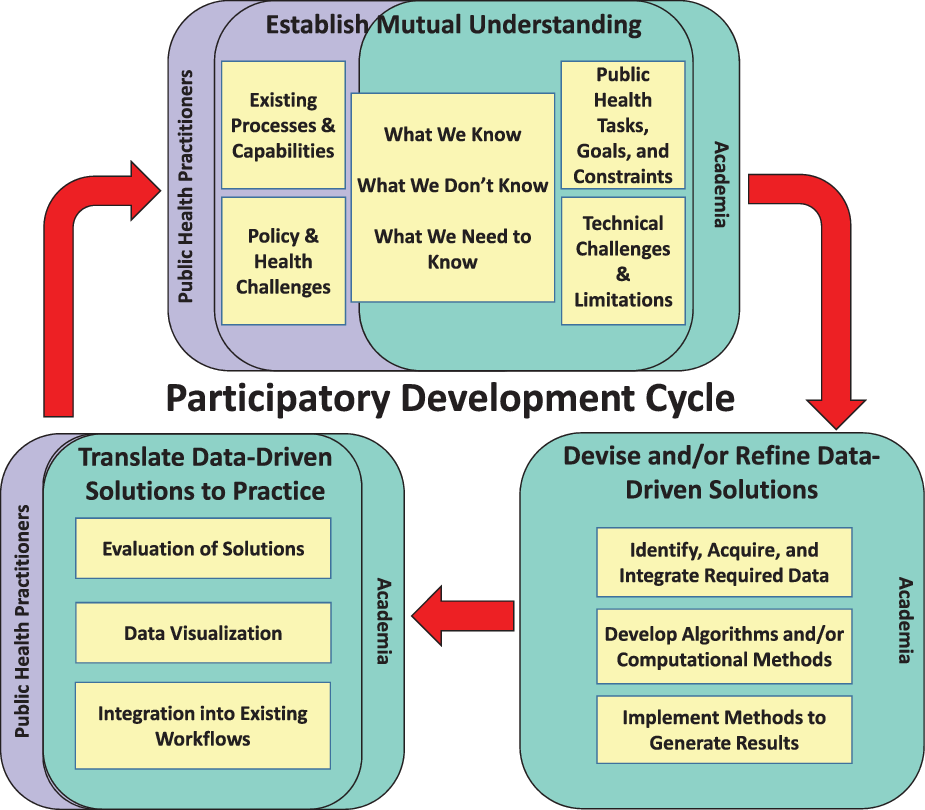
Public health practitioners face challenging, potentially high-consequence, problems that require computational support. However, available computational tools may not adequately fit these problems, thus leaving public health practitioners to rely on qualitative estimates when making critical decisions. Further, the complexity of problems, processes, and capabilities in public health requires computational and quantitative scientists to fully understand planning goals and constraints before they can construct data-driven solutions that match problems faced by public health practitioners. In spite of previous efforts to build computational tools to solve public health problems, misunderstandings between public health practitioners and computational scientists have often led to a mismatch between public health problems and the data-driven tools constructed to solve them. During collaborations with public health practitioners, CeCERA scientists have established a participatory development cycle to avoid mismatches between public health problems and data-driven solutions that could impede advances in the state-of-the-art of public health.
It is imperative that computational and quantitative scientists from academia seeking to build computational support tools within a complex domain, such as public health, establish a mutual understanding with practitioners in this domain regarding problems they are seeking to solve. Reference Smith, Wilkins and Marshall12 Existing processes and capabilities must be considered in the context of public health tasks, goals, and constraints to identify specific aspects of planning that need to be improved. Further, policy and health challenges must be considered in the context of technical challenges and limitations in order to devise realistic, practical solutions to public health problems. The ultimate goal of establishing this mutual understanding is for both practitioners and academics to achieve a unified view of the following three aspects of a problem: what we know; what we don’t know; and what we need to know.
Once this mutual understanding has been established, computational scientists can proceed to identify, acquire, and integrate data to facilitate the development of data-driven methods. Reference Gwalani, Mikler, Ramisetty-Mikler, O’Neill, Wohlgemuth, Fuchs-Kittowski and Wittmann13 This development has its heart in meetings where students and faculty explore ideas on paper and on whiteboards, discussing how available data can be leveraged to solve public health problems. Once a promising idea has been identified, a proof-of-concept is implemented. If the proof-of-concept seems promising, mapping and visualization techniques are used to translate results for consumption by public health practitioners who evaluate the efficacy of the solution toward solving specific problems. If this evaluation is favorable, scientists work with practitioners to integrate the new methods into existing public health workflows, Reference Kellermann, Hatchett and Smith14 thus modifying existing processes, enhancing existing capabilities, and leading to the next iteration of the participatory development cycle depicted in Figure 1.
Participatory Development Cycle.

RESULTS
The following questions typically arise during a disaster response: “What things do I need?”; “How many do I need?”; “Where do I need them?”; and “When do I need them?” RE-PLAN enables planners to answer these questions for an anthrax incident by quantifying resources needs (eg, POD facilities, number of dispensing lanes, and number of trucks) prior to the incident. Because contracts and memorandums of understanding (MOUs) are likely to have broad and/or vague language to provide support during a disaster, being able to provide specific types, amounts, locations, and delivery times of resources enables planners to work with government and community partners to develop primary and contingency plans to acquire these resources.
Using the RE-PLAN software, public health planners in the TXDSHS 2/3 were able to reduce the total number of POD locations by over 29% (242 sites to 171 sites). This reduction has led to a decrease in POD staffing requirements across the region, reduced transportation needs, and reduced security requirements. Due to decreased staffing requirements, significant cost-savings would be achieved during plan activation in TXDSHS 2/3. A conservative projection of these savings has been calculated to be in excess of 2.5 million dollars. This cost-savings estimate is due to staff reductions alone and does not include savings that would be expected to occur due to decreases in region-wide facility operating costs inclusive of equipment and supplies. Further, the remaining PODs have been vetted and/or relocated to ensure that the facilities hosting them are capable of supporting the population demand that would be placed upon them during a plan activation.
The population that each POD would need to serve has been estimated by RE-PLAN to enable planners to allocate resources (eg, staff, volunteers, signage, materials) to PODs based on population demand. Without an ability to easily customize each POD individually based on local requirements, planners often resort to maintaining uniform PODs designed to fulfill broad, regional requirements. The ability to map PODs and visualize specific resource requirements has proven invaluable toward enabling local planners to estimate the overall needs of their jurisdictions. Further, RE-PLAN has empowered planners to conduct needs-based analyses of the specific special, vulnerable, and at-risk populations that would be served by each POD. This has enabled planners to explore any special resource requirements of their populations and to target these resources to specific PODs and/or populations.
RSS-to-POD routing features of the RE-PLAN software were employed by planners in TXDSHS Region 2/3 to determine the total number of delivery vehicles that would need to be secured to complete the delivery of MCMs within time constraints. RE-PLAN’s novel routing methods enabled planners to identify routing options that could eliminate an entire RSS site from the region’s plans. Further, Region 2/3 planners have used RE-PLAN to expand the use of multi-county alpha PODs (ie, hubs) to reduce the number of locations that would receive delivery directly from the RSS, thus reducing the total number of delivery vehicles required by TXDSHS.
In July 2017, the CDC worked with TXDSHS to organize and conduct a tabletop exercise in TXDSHS Region 2/3 (which includes the Dallas-Fort Worth Metroplex) to assess response capabilities for the aerosolized release of anthrax. Using RE-PLAN, planners at TXDSHS Region 2/3 were able to quickly provide resource and time estimates required to coordinate crucial inter-agency activities for the exercise. Following this tabletop exercise, planners at TXDSHS Region 6/5S (inclusive of the Houston – The Woodlands – Sugar Land Metropolitan Statistical Area) began collaborating with scientists from UNT CeCERA to replicate the successes of Region 2/3 in their own jurisdiction.
Although the data-driven methods developed for RE-PLAN have been generalized to work on any region of the United States, each jurisdiction has its own characteristics and planning constraints. In TXDSHS Region 6/5S, a significant amount of planning is done at the city level rather than at the county or state level. Therefore, RE-PLAN has been modified to allow planners to create and manage planning scenarios at the city level. This has enabled city, county, and regional planners to work together using a unified planning framework to share resources and delineate specific responsibilities.
A full-scale exercise (FSE) of aerosolized anthrax response plans was scheduled and conducted for TXDSHS 6/5S in October 2019. This FSE involved 12 counties and 11 health departments performing real-life drills at a single RSS facility and approximately 29 POD sites. Eleven RE-PLAN workstations were deployed across Region 6/5S at city, county, and regional planning offices to build plans in preparation for this exercise. Regional planners worked with CeCERA scientists to install 1 of these workstations onto a mobile cart which was transported to the RSS during the exercise to make just-in-time revisions to regional plans to respond to conditions that could not have been predicted in advance. Delivery time estimates and POD throughput requirements calculated using RE-PLAN were used to establish realistic and achievable benchmarks Reference Pagaoa, Leblanc and Renard15 for exercise participants. Following the exercise, planners and CeCERA scientists analyzed observations from the exercise together to continue to devise and revise data-driven methods for public health through the participatory development cycle.
DISCUSSION
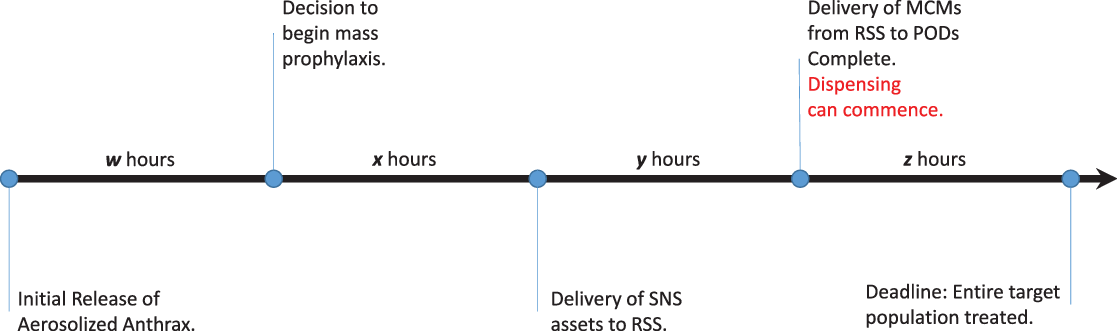
In the simplified timeline depicted in Figure 2, it would be desirable if w + x + y + z ≤ 96 hours because antibiotic treatment of inhalation anthrax is most effective within 96 hours of initial exposure. Reference Chervenic11 However, to meet CRI requirements, planners must strive to ensure that x + y + z ≤ 48 hours for their jurisdictions. Therefore, a decrease in the number of hours required to complete a distribution of MCMs to PODs would increase the amount of time that could be allocated to dispensing. This increase in dispensing time could decrease the total number of PODs required for a region, thus also decreasing staffing and security requirements.
Simplified Timeline Depicting Response Activities for an Aerosolized Anthrax Event.

The RE-PLAN software provides planners a holistic view to help them understand the balance between distribution and dispensing that must occur in order to complete dispensing within the 48-hour goal. Too many direct deliveries from the RSS can increase the total distribution time, thus decreasing time that could be allocated for dispensing. On the contrary, allocating too much time for dispensing can leave too little time to complete a delivery of MCMs to PODs without exceeding resource constraints (eg, number of delivery vehicles available, number of security escorts available). Therefore, it is imperative that planners be able to find a compromise between distribution and dispensing in order to meet CRI requirements.
Before obtaining access to RE-PLAN, planners in TXDSHS Region 2/3 suspected that the number of PODs that would receive direct delivery from regional RSS sites was prohibitively large in consideration of regional resources and CRI time requirements. However, lacking adequate evidence, regional planners responsible for RSS-to-POD distribution found themselves at odds with local planners who did not want to decrease the number of PODs in their jurisdictions. Regional staff used RE-PLAN to produce compelling evidence that the number of deliveries needed to be reduced in order to fall within time and resource constraints. RE-PLAN enabled regional planners to provide technical assistance to local planners to ensure that each jurisdiction was adequately represented in response plans. Further, having fewer primary POD sites meant that fewer relationships had to be maintained with facilities, fewer plans had to be written and revised, fewer drills and exercises needed to be conducted, and fewer trainings had to be organized. This has yielded more time for both regional and local planners to focus on fine-tuning their plans.
CONCLUSIONS
Decreased Public Health Emergency Preparedness (PHEP) Cooperative Agreement funding, loss of full-time positions, and high turnover rates create a challenging environment for public health preparedness planners. Reference England16 RE-PLAN can be used to address these challenges by enabling planners to quickly and efficiently build response plans that consider their jurisdiction’s strengths, weaknesses, capabilities, and requirements. RE-PLAN enables newly on-boarded employees to visualize existing plans, manipulate these plans, and actively learn how modifying different aspects of these plans can affect operational efficiency, thus expediting the transition of new team members from being organizational outsiders to being organizational insiders. Reference Bauer, Erdogan and Zedeck17 Having the ability to make just-in-time adaptations to existing response plans enables planners to respond to unfolding circumstances, thus transitioning their jurisdictions from a state of preparedness toward a state of readiness.
Data-driven methods to enhance jurisdictional MCM distribution and dispensing capabilities must be made both available and accessible to public health emergency planners. Tools that are either unavailable or inaccessible to planners will have little, if any, impact on real-world planning and response capabilities. Therefore, it is critical that existing processes and capabilities be considered in the context of technical limitations; data availability; and public health tasks, goals, and constraints before the creation of data-driven tools has commenced.
The current version of the RE-PLAN software requires a dedicated workstation for execution. This requirement has impeded the adoption of RE-PLAN by public health departments unable to allocate resources specifically for a dedicated workstation. To overcome this barrier to the availability of RE-PLAN, the system is currently being migrated into the cloud to enable practitioners across the country to access RE-PLAN via a web-based interface. RE-PLAN has been developed at CeCERA as a research project with 2 primary goals: (1) to provide a research platform to enable students and faculty to explore computer science research problems in the context of public health emergencies; and (2) to achieve societal impact by advancing the state-of-the-art of public health preparedness. RE-PLAN has been developed as a project for which research and development costs needed to be recovered, rather than a product that is sold or purchased. Therefore, rather than restricting access to new RE-PLAN features or modules to only the single agency that funded their development, these features are freely shared with other agencies that are participating in the project in order to increase overall societal impact. Thus far, support for the RE-PLAN project, inclusive of the activities outlined in the participatory development cycle, has been provided by the National Institutes of Health, the TXDSHS, Los Angeles County, and Tarrant County, Texas.
Unfortunately, the same disconnect Reference Brownson, Eyler and Harris18 between academia and public health practitioners that had previously led to a mismatch between planning requirements and the tools constructed to meet them also complicates requests for research funding to explore new ways to advance the state-of-the-art of public health practice. Reviewers from outside of computational science often do not have the technical training to assess the complexity of the algorithm development research required to build these new tools. On the other hand, few computational scientists have a familiarity with existing public health practices and policies required to appreciate complexities and intricacies of public health problems. This may lead to the dismissal of research funding requests as being simply implementation projects that fall outside the scope of traditional funding programs. Although programming and implementation are involved, they are very much an afterthought to the thousands of hours of research on whiteboards and meetings with practitioners, which constitute the core of research activities. Unless addressed, this disconnect between public health and the more quantitative sciences is likely to continue to impede the kind of progress in public health practice that had led to advances in many other domains over the past 2 decades.
Financial Support
Support for work described in this publication came from the National Institutes of Health (2R56LM011647-03, 1R01LM011647-01, and 1R15LM010804-01); Texas Department of State Health Services; Los Angeles County; and Tarrant County, Texas.
Conflict of Interest Statement
The authors have no conflicts of interest to declare.