1. INTRODUCTION
The technological breakthrough in ultrashort intense laser development due to chirped pulse amplification technique (Strickland & Mourou, Reference Strickland and Mourou1985) has led to the generation of terawatt and petawatt class femtosecond lasers (Mourou & Umstadter, Reference Mourou and Umstadter2002; Liang et al., Reference Liang, Leng, Wang, Li, Lin, Zhao, Jiang, Lu, Hu, Zhang, Lu, Yin, Jiang, Lu, Wei, Zhu, Li and Xu2007), which have opened new fields of extreme nonlinear optics and physics from strong field laser-matter interactions and at the same time provide basic laser sources and tools for further generating attosecond (as) or even zeptosecond (zs) electromagnetic (EM) pulses in completely different ways (Farkas & Toth, Reference Farkas and Toth1992; Paul et al., Reference Paul, Toma, Breger, Mullot, Augé, Balcou, Muller and Agostini2001; Hentschel et al., Reference Hentschel, Kienberger, Spielmann, Reider, Milosevic, Brabec, Corkum, Heinzmann, Drescher and Krausz2001; Sansone et al., Reference Sansone, Benedetti, Calegari, Vozzi, Avaldi, Flammini, Poletto, Villoresi, Altucci, Velotta, Stagira, De Silvestri and Nisoli2006; Esarey et al., Reference Esarey, Ride and Sprangle1993; Lan et al., Reference Lan, Lu, Cao and Wang2005; Pukhov et al., Reference Pukhov, Gordienko and Baeva2003; Gordienko et al., Reference Gordienko, Pukhov, Shorokhov and Baeva2004, Reference Gordienko, Pukhov, Shorokhov and Baeva2005; Tsakiris et al., Reference Tsakiris, Eidmann, Meyer-ter-Vehn and Krausz2006). The first and well established way to generate as pulse trains and isolated pulses is via spectral synthesis of high-order harmonics (HOH) radiation from the interaction of fs pulses with atoms (Farkas & Toth, Reference Farkas and Toth1992; Paul et al., Reference Paul, Toma, Breger, Mullot, Augé, Balcou, Muller and Agostini2001; Hentschel et al., Reference Hentschel, Kienberger, Spielmann, Reider, Milosevic, Brabec, Corkum, Heinzmann, Drescher and Krausz2001; Sansone et al., Reference Sansone, Benedetti, Calegari, Vozzi, Avaldi, Flammini, Poletto, Villoresi, Altucci, Velotta, Stagira, De Silvestri and Nisoli2006) and has been successfully demonstrated in the laboratories and well explained in the framework of the three-step model (Corkum, Reference Corkum1993; Lewenstein et al., Reference Lewenstein, Balcou, Ivanov, Huillier and Corkum1994). However, due to the limitation of susceptible laser intensity of atoms, it is impossible to generate intense pulses much shorter than 100 as. Second, as and zs X-ray bursts can be produced by a laser synchrotron source, based on nonlinear Thomson backscattering (NTBS) of intense laser pulses by free electrons (Esarey et al., Reference Esarey, Ride and Sprangle1993; Lan et al., Reference Lan, Lu, Cao and Wang2005). The attractiveness of NTBS is that as and zs X-ray bursts can be generated, and particularly the X-ray energies have good tunability from hundreds eV to very high energy (>10 keV) by adjusting either the electron energy or the laser intensity (Bessonov et al., Reference Bessonov, Gorbunkov, Ishkhanov, Kostryukov, Maslova, Shvedunov, Tunkin and Vinogradov2008). High-density electron beams are now available for generation of bright ultrashort X-ray pulses through NTBS by using table-top laser-plasma accelerators (Mangles et al., Reference Mangles, Murphy, Najmudin, Thomas, Collier, Dangor, Divall, Foster, Gallacher, Hooker, Jaroszynski, Langley, Mori, Norreys, Tsung, Viskup, Walton and Krushelnick2004; Kulagin et al., Reference Kulagin, Cherepenin, Hur, Lee and Suk2008). This kind of X-ray source based on NTBS will be very useful for diagnostics of warm dense plasmas (Cao et al., Reference Cao, Uschmann, Zamponi, Kaempfer, Fuhrmann, Foerster, Hoell, Redmer, Toleikis, Tschentscher and Glenzer2007; Riley et al., Reference Riley, Khattak, Saiz, Gregori, Bandyopadhyay, Notley, Neely, Chambers, Moore and Comley2007). Besides these two schemes, direct coherent HOH generation from fs relativistic laser interaction with plasma targets has recently attracted more and more attention and been proposed to generate as X-ray pulses with unprecedented efficiency and brightness (Pukhov et al., Reference Pukhov, Gordienko and Baeva2003; Gordienko et al., Reference Gordienko, Pukhov, Shorokhov and Baeva2004, Reference Gordienko, Pukhov, Shorokhov and Baeva2005; Quéré et al., Reference Quéré, Thaury, Monot, Dobosz and Martin2006; Tsakiris et al., Reference Tsakiris, Eidmann, Meyer-ter-Vehn and Krausz2006; Plaja et al., Reference Plaja, Roso, Rzazewski and Lewenstein1998; Naumova et al., Reference Naumova, Nees, Sokolov, Hou and Mourou2004; Bulanov et al., Reference Bulanov, Naumova and Pegoraro1994; Linde & Rzazewski, Reference Linde and Rzazewski1996; Lichters et al., Reference Lichters, Meyer-ter-Vehn and Pukhov1996; Bulanov et al., Reference Bulanov, Esirkepov and Tajima2003, Varró, Reference Varró2007). Fascinating theoretical work (Pukhov et al., Reference Pukhov, Gordienko and Baeva2003; Gordienko et al., Reference Gordienko, Pukhov, Shorokhov and Baeva2004, Reference Gordienko, Pukhov, Shorokhov and Baeva2005; Tsakiris et al., Reference Tsakiris, Eidmann, Meyer-ter-Vehn and Krausz2006; Bulanov et al., Reference Bulanov, Esirkepov and Tajima2003) has predicted that ultrahigh intense EM fields toward the critical Schwinger limit required for observing nonlinear quantum electrodynamic effects could be generated by focusing HOH at reasonable laser energies. The latest observation made by Dromey et al. (Reference Dromey, Kar, Bellei, Carroll, Clarke, Green, Kneip, Markey, Nagel, Simpson, Willingale, McKenna, Neely, Najmudin, Krushelnick, Norreys and Zepf2007) has shown for the first time, that HOH generated from petawatt class laser-solid interactions extends to multi-keV (harmonic order n > 3200) and the conversion efficiency is as high as 1 × 10⁻⁵ for hν > 1 keV. This will be a revolutionary step to produce ultraintense as X-ray sources and highlight the enormous potential for applications of HOH in science and technology.
Although the idea of using laser-solid interactions to generate intense as X-ray sources is brought up early (Plaja et al., Reference Plaja, Roso, Rzazewski and Lewenstein1998), the progress lags behind compared to the great achievements in producing as X-ray sources from laser-atoms interactions (Farkas & Toth, Reference Farkas and Toth1992; Paul et al., Reference Paul, Toma, Breger, Mullot, Augé, Balcou, Muller and Agostini2001; Hentschel et al., Reference Hentschel, Kienberger, Spielmann, Reider, Milosevic, Brabec, Corkum, Heinzmann, Drescher and Krausz2001; Sansone et al., Reference Sansone, Benedetti, Calegari, Vozzi, Avaldi, Flammini, Poletto, Villoresi, Altucci, Velotta, Stagira, De Silvestri and Nisoli2006). This is mainly because plasmas are generally considered as unstable media and the manipulation is much more difficult. However, due to the advent of ultrashort intense laser pulses with high contrast ratio and plasma-mirror techniques developed to further increase the contrast ratio (Dromey et al., Reference Dromey, Zepf, Gopal, Lancaster, Wei, Krushelnick, Tatarakis, Vakakis, Moustaizis, Kodama, Tampo, Stoeckl, Clarke, Habara, Neely, Karsch and Norreys2006; Thaury et al., Reference Thaury, Quéré, Geindre, Levy, Ceccotti, Monot, Bougeard, Réau, d'Oliveira, Audebert, Marjoribanks and Martin2007), the required manipulation of plasmas becomes available. The idea of HOH based on the “oscillating mirror” (OM) model was first proposed by Lichters et al. (Reference Lichters, Meyer-ter-Vehn and Pukhov1996) and developed by Pukhov et al. (Reference Pukhov, Gordienko and Baeva2003), Gordienko et al., (Reference Gordienko, Pukhov, Shorokhov and Baeva2004, Reference Gordienko and Pukhov2005). The HOH cut-off at 4γ2 − γ, that means the largest relativistic factor of the plasma surface–predicted by this OM model based on the Doppler effect, has been revised to extend to  , based on the similarity model (Gordienko et al., Reference Gordienko and Pukhov2005; Baeva et al., Reference Baeva, Gordienko and Pukhov2006). The similarity theory states that laser-plasma interactions with different a 0 and n e/n c are similar as soon as the S parameter S = n e/a 0n c is constant for these interactions, where a 0 = eA 0/m ec 2 is the normalized laser amplitude, n e is the electron density, and n c is the critical density. However, a good understanding of HOH generation from laser-plasma interaction is still lacking.
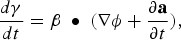
In this paper, we present the idea of intensified as X-ray generation based on NTBS of an intense laser pulse by electrons trapped in the steep plasma-vacuum boundary. Two frequency up-conversions due to the relativistic Doppler effect and longitudinal γ-spike effect are analyzed, respectively. Using the OM model to calculate the motion of the trapped electrons, we have found that relativistic resonance heating conditions should be satisfied for the experimental design to obtain efficient HOH and energetic electrons generation at relatively low laser intensities. The idea to generate an isolated as X-ray burst without spectral filtering has been analyzed by proposing a detuned second-harmonic to shape the laser field.
2. OSCILLATING MIRROR MODEL AND RELATIVISTIC RESONANCE EFFECT
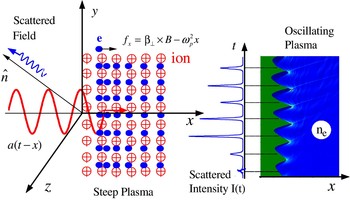
Let us consider that an ultrashort intense laser pulse with high contrast ratio impinges upon the surface of steep high-density plasma at normal incidence (see Fig. 1). The plasma only expands by a small fraction of the light wavelength during the interaction, and thus behaves as a high-flatness mirror. The laser field moving into the +x direction can be represented by the normalized vector potential a(t − x). As assumed in the OM model (Plaja et al., Reference Plaja, Roso, Rzazewski and Lewenstein1998), the motion of the surface corresponding to the electrons in the layer in the direction perpendicular to the surface is governed by the following equations in terms of scaled dimensionless quantities (Esarey et al., Reference Esarey, Ride and Sprangle1993; Lan et al., Reference Lan, Lu, Cao and Wang2005; Lichters et al., Reference Lichters, Meyer-ter-Vehn and Pukhov1996)

(Color online) Schematic diagram showing the Thomson scattering of an intense laser field by electrons trapped in Plasma-Vacuum Boundary. The plasma surface oscillates with twice laser frequency. After every half cycle when the electrons move backward from the plasma to the vacuum at the largest velocity, an attosecond pulse is emitted.

where β = v/c is the normalized electron velocity, 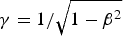 , p = γβ is the normalized electron momentum, and
 is the restoring electric field caused by the space-charge electrostatic potential due to the longitudinal oscillation of electrons in the laser field, where
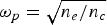 is the normalized plasma frequency, x = x êx is the normalized longitudinal displacement of the electrons by λ/2π. In the Coulomb gauge,
 , implies az = 0 for a plane light wave in one-dimension (1D). Planar symmetry provides conservation of the canonical transverse momentum p⊥ − a⊥ = p⊥0, the initial transverse momentum p⊥0 = 0 for a cold plasma. A simple equation for βx can thus be obtained
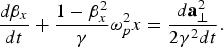
This stands for the motion equation of an oscillator with eigenfrequency  driven by an external force. Let us assume a(t − x) = a 0f(t − x) sin(t − x)êy for a linearly polarized laser field, the pulse profile is described by a smooth function f(t) with a pulse duration T(T >>T 0, T 0 = 2π is the oscillation period of the laser field). In the case of weak relativity (a 0 < 1), βx2 <<1, and γ ≃ (1 + a2/2) ≃ 1, by using Fourier transformation of each term in Eq. (3), βx and x can be approximately calculated as

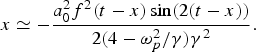
Different from the figure-8 trajectory of a free electron in the drift frame of a 02ct/(a 02 + 4) in an ultrarelativistic laser field, the electrons here are trapped in the plasma-vacuum boundary and the longitudinal drift is prevented by the restoring force. Once the orbits of the electrons are calculated, the radiation power of one electron per unit solid angle in the far field in the direction  can be calculated by
 (Jackson, Reference Jackson1975), and

where Ret means the retarded time τ = t − · . The radiation power from all the electrons on the surface of plasma is the coherent summation of each electron's radiation. In the case of the 1D approximation, planar symmetry implies that only backward and forward radiation can be observed for normal incidence. The 1D approximation for calculating electrons' motion is reasonable as long as the laser focus spot size on the solid target can be considered to be infinite in comparison with the thickness of the produced plasma. However, as long as the detection distance is much greater than the focus spot size, the radiation from all the electrons can be detected in an arbitrary direction. It can be calculated by integrating the radiation field of each electron over the laser focus area. In the following, we only discuss the NTBS field of electrons in the reflection direction. The NTBS spectra can be calculated directly by Fourier transformation of A(,t) (we calculate the NTBS spectra by this way in this paper). It can also be analyzed by calculating
 . where βy(t − x) = a(t − x)/γ. As analytically discussed by Esarey et al. (Reference Esarey, Ride and Sprangle1993; Lan et al., Reference Lan, Lu, Cao and Wang2005; Lau et al., Reference Lau, He, Umstadter and Kowalczyk2003), the NTBS spectra are only composed of a series of odd harmonics ω = (2n + 1)ω0, ω0 is the oscillation frequency of laser field. The conversion efficiency of HOH depends on the amplitude of βx or x.
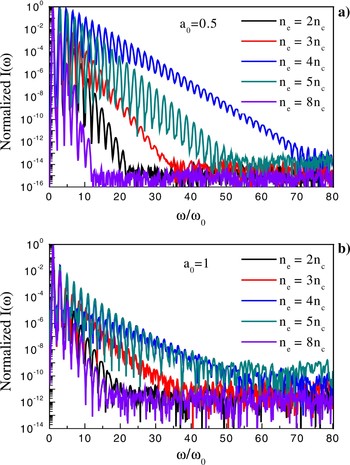
When the electron density n e is much lower or higher than 4γn c, electrons trapped in the plasma-vacuum boundary move back and forth from plasma to vacuum with 2ω0 in a laser field. Electrons obtain a maximum longitudinal momentum each time when electrons move back and forth to the boundary at x ≃ 0. In this process, a very small part of electrons that have the highest energy when they come back from vacuum to the boundary are bound to overrun most of the electrons and no longer feel the strong restoring force and the laser field owing to plasma screening. This process is the relativistic vacuum heating mechanism of electrons. The maximum longitudinal velocity βxm = a 02/((4 − ωp2/γ)γ2) depends on the laser intensity and especially on the plasma frequency. Resonance enhancement takes places if n e is close to 4n c, βxm can obtain a large value even at a low laser intensity. By numerically calculating the electrons' trajectories using Eq. (1), the NTBS spectra at different electron densities of n e/n c = 2,3,4,5,8 are calculated and shown in Figure 2a, respectively. In the calculation, a 0 = 0.5, f(t) = cos4 (πt/10T 0)(−5T 0 < t < 5T 0). It can be seen that the resonance enhancement is conspicuous and the cut-off frequency at n e = 4n c is the highest. Resonance enhancement can also be observed at a higher n e > 4n c because the plasma frequency will decrease due to the γ effect. There exists a transition from relativistic vacuum heating to relativistic resonance heating in this case. Therefore, by selecting suitable laser intensity and electron density to meet n e < 4(1 + a 02/2)n c, the resonance effect can be made use of to manipulate the laser-plasma interaction in order to obtain an efficient HOH generation. Employing the 1D3V PIC code (Lichters et al., Reference Lichters, Meyer-ter-Vehn and Pukhov1996), similar simulations have been made and confirmed the resonance effect as shown in Figure 2b.
(Color online) (a) Calculated NTBS and (b) HOH spectra at different electron densities by the OM model and 1D3V PIC code, respectively.

Since the OM model here addressed is an idealized model in which all electrons in motion are assumed to have the same velocity and absorption of laser energy is neglected, the calculated HOH has a higher cut-off frequency in comparison with the PIC simulation at the same laser intensity. In fact, after every half cycle of the laser field, some electrons are bound to escape the boundary and propagate deeply into the plasma due to the relativistic vacuum or resonance heating processes. This is the main cause of the generation of high-energy electrons in the forward direction. Besides that, there is an important difference between these two calculations. In the OM model, HOH is calculated in the far field by NTBS. However, PIC simulated HOH is evaluated by the reflected field in the near field. However, due to the propagation, the HOH spectral intensity in the far field should be scaled up as I(ω)ω2, I(ω) is the spectral intensity in the near field. That is why the detected cone angle of X-ray emission is considerably less than the laser cone angle (Dromey et al., Reference Dromey, Kar, Bellei, Carroll, Clarke, Green, Kneip, Markey, Nagel, Simpson, Willingale, McKenna, Neely, Najmudin, Krushelnick, Norreys and Zepf2007).
3. FREQUENCY UP-CONVERSION AND AS PULSE GENERATION
It will be very helpful to analyze the backward radiation power in the time domain.

where βx can be described as βx(t − x) = −βxm cos(2(t − x)), and βy(t − x) = a 0 sin(t − x)/γ. There are two relativistic effects in the radiation field: The first included in the numerator is the frequency shift caused by the relativistic Doppler effect. The second is included in the denominator (1 + βx)−3 and plays a dominant role if βx = −βxm is close to −1 in the strong relativistic regime. Owing to the longitudinal oscillation of electrons (γ-spike effect), only at the instant time t i when the electrons move backward from the plasma to vacuum at the largest velocity −βxm, the strongest radiation can be generated. Since d tβy = a 0 cos(t − x)(1 − βx)/γ, and βyd tβx ≃ 0 around t i, the maximum upshift frequency due to the relativistic Doppler effect can be calculated as

ωufD = 4γm2 if βxm → 1, where γm2 = 1/(1 − βx2m). The second relativistic effect determines the pulse duration of HOH radiation. We can expand βx around t i in Taylor series as βx = −βxm(1 − 4(1 + βxm)2 (t − t i)2). The backward radiation power can thus be expressed as

The full width Δτ at half maximum of |A(t)|2 can be calculated as

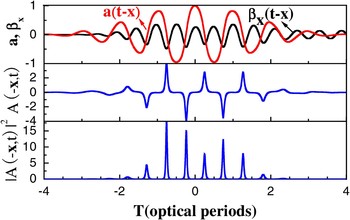
Back to the time unit,  . For example, Δτ ≃ T 0/37 ≃ 72 as (for λL = 800 nm) if βxm = 0.5 (γm = 1.15). Generation of subattosecond pulses needs γm = 4. Since the electrons oscillate around the boundary with 2ω0, they emit an as pulse around −βxm every half cycle of the laser field. In Figure 3, we show the calculated evolution of βx(t − x), |A(,t)|, and |A(,t)|2 in a laser field a(t − x) with a 0 = 1, T = 10T 0, and n e = 3n c. Attosecond pulse trains are generated, and shortest duration is 90 as. HOH spectra can also be understood by the spectral interference of these pulse trains with an interval of T 0/2, which determines a frequency spacing of 2ω0. Considering ΔτΔω ≃ 4 ln 2 for a Gaussian pulse, the spectral width of one as pulse
 , and the cut-off frequency can thus be estimated as ωcf = ωufD + Δω. The maximum intensity of as pulse may be presented by I m(t i) ∝ a 02(1 + βxm)3/(1 − βxm)3 = I 0(1 + βxm)6γm6, I 0 is the radiation intensity in the case of βx = 0. Therefore the as X-ray intensity in the far field can be amplified by a factor of ~64γ6(βxm → 1) compared with the reflected fundamental laser intensity.
(Color online) Calculated evolutions of βx(t − x), |A(,t)|, and |A(,t)|2 respectively in a laser field a(t − x) with a 0 = 1, T = 10T 0, and n e = 3n c.

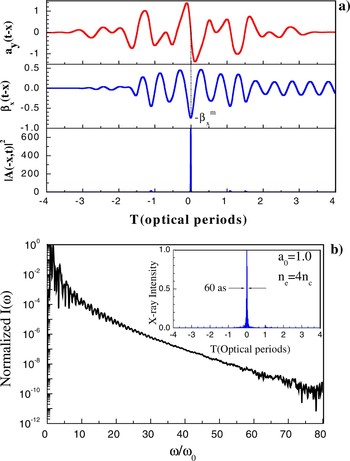
For a circularly polarized laser pulse, d ta⊥2 = a 02d tf 2(t) ≃ 0, the longitudinal oscillation of electrons is prevented and thus no HOH can be generated. The similarity of HOH generations from laser-plasma and atoms interactions implies that polarization gating and two-color fields techniques (Sola et al., Reference Sola, Mével, Elouga, Constant, Strelkov, Poletto, Villoresi, Benedetti, Caumes, Stagira, Vozzi, Sansone and Nisoli2006; Merdji et al., Reference Merdji, Auguste, Boutu, Caumes, Carré, Pfeifer, Jullien, Neumark and Leone2007; Baeva et al., Reference Baeva, Gorgienko and Pukhov2007) can be employed here to produce a single as pulse. The point is to excite one cycle of electrons' oscillation with the largest −βxm and suppress the rest by shaping the laser field. Here for this purpose, we propose a detuned second-harmonic to synthesize such a laser field, a(t − x) = a 0f(t − x)(sin(t − x) + sin(1.7(t − x)))êy, a 0 = 0.75, T = 10T 0, and n e = 4n c. The calculated evolutions of βx(t − x), and |A(,t)|2 are shown in Figure 4a. An isolated pulse with 21 as without spectral filtering is generated around the peak laser intensity. This idea to produce a single as pulse is confirmed by our PIC simulation result that is shown in Figure 4b. Compared to the discrete spectra in the single-color field, supercontinuum spectra in the range of 20–70ω0 that support a single 60 as pulse, as the inset graph shows, are generated.
(Color online) (a) Calculated evolutions of βx(t − x) and |A(,t)|2 respectively in a synthesized two-color laser field a(t − x) = a 0f(t − x)(sin(t − x) + sin(1.7(t − x)))êy, a 0 = 0.75, T = 10T 0, and n e = 4n c. (b) HOH spectra calculated in the near field by the 1D3V PIC code. The inset shows a single 60 attosecond pulse generation in the range of 20–70ω0.

4. DISCUSSION AND ACKNOWLEDGEMENT
For oblique incidence, the movement of electrons can be analyzed as normal incidence in the moving frame (Lichters et al., Reference Lichters, Meyer-ter-Vehn and Pukhov1996) with an initial electron velocity β0 = −êysinα, α is the incidence angle. The Eq. 3 becomes

For a p polarized field, the external force includes two oscillation terms with ω0 and 2ω0. Therefore there exist two resonance enhancements that take place at n e = 1× and 4 × n c cos2α, respectively.
Generally, the solid plasma density (~1023 cm−3) is much higher than 4n c (6.4 × 1021 cm−3 for 800 nm) required for resonance condition. In this case, it will be very difficult to generate HOH with shorter wavelength if the laser intensity is relatively low and if one considers the range of weak relativity (a 0 ≃ 1). One option is to employ a short-wavelength (3ω0) driving laser field. However, since a 02 = IλL2, the order of harmonics does not increase with the same laser intensity if the resonance does not take place. Nevertheless, the cut-off frequency is three times higher. The other option is to design a low-density target like the CH polymer or foam target. An ultraintense as pulse can be generated at relatively low laser intensities if the resonance condition is satisfied.
ACKNOWLEDGMENTS
This work was supported by the Chinese National Natural Science Foundations (Contract No 10674145) and the National Basic Research Program of China (Contract No 2006CB806000).