Introduction
Psychotropic drugs (PDs) are prescribed for the treatment of neuropsychiatric symptoms (NPS) in dementia (Selbaek et al., Reference Selbaek, Kirkevold and Engedal2007; Wetzels et al., Reference Wetzels, Zuidema, De Jonghe, Verhey and Koopmans2011). However, there is substantial evidence on the risks, side effects, and long-term inefficacy of PDs (Zuidema et al., Reference Zuidema, De Jonghe, Verhey and Koopmans2007; Ballard et al., Reference Ballard2009). That is why guidelines recommend a restricted, short-term use of PDs (Smalbrugge et al., Reference Smalbrugge2008). There is some literature available supporting the hypothesis that the duration of PD prescription is too long (Gustafsson et al., Reference Gustafsson, Karlsson and Lövheim2013), with sometimes duplicate prescriptions (Wetzels et al., Reference Wetzels, Zuidema, De Jonghe, Verhey and Koopmans2011; Gulla et al., Reference Gulla, Selbaek, Flo, Kjome, Kirkevold and Husebo2016), and without a proper indication (Lucas et al., Reference Lucas2014). Other aspects that relate to the broader concept of appropriateness have previously not been studied. Different appropriateness measurement instruments that relate to the broader concept have been developed, e.g. STOPP/START criteria (Gallagher et al., Reference Gallagher, Ryan, Byrne, Kennedy and O'Mahony2008) and Medication Appropriateness Index (MAI) (Hanlon et al., Reference Hanlon1992). However, these are not specifically developed to measure the appropriateness of PD prescriptions for NPS in dementia.
Recently, we developed the Appropriate Psychotropic drug use In Dementia (APID) index, which was derived from the MAI and was validated on a sample of (Dutch) nursing home patients with dementia (van der Spek et al., Reference van der Spek2015). The APID index measures the appropriateness of PD prescriptions for NPS in patients with dementia with a sum score that encompasses seven different domains of appropriateness: indication, evaluation, dosage, drug–drug interactions, drug–disease interactions, duplications, and therapy duration. The APID index sum score showed to be reliable and is valid for measuring appropriateness of PD prescriptions for NPS in dementia in nursing homes. Using the APID, we also found that the appropriateness of PD prescriptions and the frequency of PD use are unassociated, and thus independent concepts (van der Spek et al., Reference van der Spek2016).
Frequency of PD use varies considerably among nursing homes and units (Chen et al., Reference Chen, Briesacher, Field, Tjia, Lau and Gurwitz2010; Zuidema et al., Reference Zuidema2011), which is only partly explained by the different prevalence rates of NPS among patients (Zuidema et al., Reference Zuidema, de Jonghe, Verhey and Koopmans2010; Smeets et al., Reference Smeets2014). The variation in PD use is also found to be related to differences in drug prescription policies (Wood-Mitchell et al., Reference Wood-Mitchell, James, Waterworth, Swann and Ballard2008), staff distress/workload (Zuidema et al., Reference Zuidema, de Jonghe, Verhey and Koopmans2010), physical environmental factors, and the bed capacity (Zuidema et al., Reference Zuidema2011).
Although several studies (Kamble et al., Reference Kamble, Chen, Sherer and Aparasu2009; Zuidema et al., Reference Zuidema, de Jonghe, Verhey and Koopmans2010) investigated factors associated with PD use, we only found one study that reports about the factors associated with the appropriateness of PD prescriptions in dementia; it was found that the presence of behavioral symptoms and female gender were associated with more appropriate indications of benzodiazepines (Stevenson et al., Reference Stevenson2011).
Recently, we formulated a conceptual framework with four categories of factors with which the frequency and/or appropriateness of PD prescription were hypothesized to be associated, i.e. factors related to patient and non-patient factors (physician, nurse, and physical environment) (van der Spek et al., Reference van der Spek2013).
Furthermore, in a previously conducted analysis about the appropriateness of PD prescriptions, the results indicated that the appropriateness of use differ per class of PD (van der Spek et al., Reference van der Spek2016), and thus the factors related to appropriateness may also differ per class of PD, which compelled us to analyze antipsychotics (AP), antidepressants (AD), anxiolytics, and hypnotics separately. Some guidelines do not recommend benzodiazepine use (e.g. NICE guideline, 2016) and others do (e.g. BPSD guidance-NHS Cumbria; Holmes and Badrakalimuthu, Reference Holmes and Badrakalimuthu2015). Benzodiazepines (oxazepam and lorazepam) are recommended for a maximum duration of four weeks in the Dutch guideline for NPS in patients with dementia, i.e. for agitation, anxiety, and as adjuvant in case haloperidol has an insufficient effect on delirium. In addition, temazepam and zolpidem are recommended for sleep disorder for a maximum duration of two weeks (Smalbrugge et al., Reference Smalbrugge2008). The aim of the study was, therefore, to identify which patient and non-patient factors were associated with the appropriateness of prescriptions regarding four groups of psychotropic drugs.
Methods
Design, setting, and sample
This study is part of the PROPER I study (Prescription Optimisation of Psychotropic drugs in Elderly nuRsing home patients with dementia), which is a cross-sectional mixed methods study that aims to identify the prevalence and appropriateness of PD prescriptions and its underlying factors. The study was conducted from January to June 2012. Thirty-six Dementia Special Care Units (DSCUs) divided over 12 nursing homes were needed based on our sample size calculations. The full study design is described elsewhere (van der Spek et al., Reference van der Spek2013).
The local Medical Ethics Review Committee “CMO Region Arnhem-Nijmegen” reviewed the study (number 2012/226) and pronounced that it was in accordance with the applicable rules in the Netherlands concerning the review of research ethics committees and informed consent. The study was conducted in accordance with the Declaration of Helsinki.
Measurements
Appropriateness of psychotropic drug prescriptions
Appropriateness was explored using the APID index. This index sum score ranges from 0 to 102.8 where a lower score indicates a more appropriate PD prescription. The APID index sum score is based on seven domains, i.e. indication, evaluation, dosage, drug-–drug interactions, drug–disease interactions, duplications, and therapy duration, which are weighted for their contribution to the construct (van der Spek et al., Reference van der Spek2015).
PD prescription was grouped according to the Anatomical Therapeutic Chemical (ATC) classification into the following: antipsychotics (APs) (N05A), antidepressants (ADs) (N06A), anxiolytics (N05B), and hypnotics (N05C) (Nordic Council on Medicines, 1990).
Factors associated with appropriate psychotropic drug use
The PROPER-I dataset contained 115 possible variables (including subscores) associated with frequency and/or appropriateness. Because it was estimated that a maximum of 28 factors could be included in the analyses, 28 variables were selected as guided by our framework (van der Spek et al., Reference van der Spek2013). Based on the existing evidence for the factors being associated with the appropriateness of PD prescriptions and on their clinical expertise, the authors rated the relevance of the factors and reached consensus on what would be the 28 most relevant factors. It appeared that factors were selected from three of the four categories of the framework, i.e. patient-related factors, physician-related, and nurse-related factors. There were no physical environment-related factors selected as these factors showed lack of variation in the participating nursing homes.
The following instruments were used to assess information about these factors clustered within three categories:
1. Patient-related factors
Twelve patient-related factors were selected. We collected data about age, sex, length of stay at DSCU, and dementia type (i.e. Alzheimer's dementia (AD), Vascular Dementia (VaD), mixed AD/VaD, and other dementia (including “not otherwise specified”).
The severity of NPS was assessed using the Neuropsychiatric Inventory Questionnaire (NPI-Q) (Kaufer et al., Reference Kaufer2000). The 12-item NPI-Q evaluates the severity of 12 NPS in the previous month on a 4-point scale ranging from 0 (absent) to 3 (severe). Symptoms were grouped into five clinically meaningful categories similar to what was done for this instrument's nursing home version (Zuidema et al., Reference Zuidema2011), i.e. psychosis (hallucinations and/or delusions), agitation (agitation, disinhibition, and/or irritability), depression, anxiety, and apathy.
Agitation/aggression was further assessed with the Cohen-Mansfield Agitation Inventory (CMAI) (Zuidema et al., Reference Zuidema, De Jonghe, Verhey and Koopmans2007; Zuidema et al., Reference Zuidema2011). The CMAI consists of 29 agitated behaviors to be scored for the frequency of occurrence in the previous two weeks on a 7-item scale ranging from 1 (never) to 7 (several times per hour). We grouped the symptoms into three categories: physical aggression (range 8 to 56), physically non-aggressive behavior (range 7 to 49), and verbally agitated behavior (range 4 to 28) (Zuidema et al., Reference Zuidema, De Jonghe, Verhey and Koopmans2007).
2. Physician-related factors
Five physician-related factors were selected. The attitude of physicians toward caring for people with dementia was measured with the Approaches to Dementia Questionnaire (ADQ) (Lintern, Reference Lintern2001). The ADQ contains 19 statements to be scored on a 1 to 5 Likert scale, resulting in a total score ranging from 19 (negative attitude) to 95 (positive attitude). Additionally, we registered the number of years working as a physician. The physician's availability in minutes per patient per week, the number of patients per physician, and the physician's reported time spent weekly on patient care.
3. Nurse-related factors
Eleven nurse-related factors were selected. The experienced nurse distress was assessed with the 12-item NPI-Q, which measures distress and NPS simultaneously, in the previous month on a 4-point scale ranging from 0 (absent) to 3 (severe). The symptoms were, again, grouped into the above-mentioned five clinically meaningful categories. The staff strain with regard to caring for patients with dementia was measured with the Strain in Dementia Care Scale (SDCS) (Orrung Wallin et al., Reference Orrung Wallin, Edberg, Beck and Jakobsson2013). The SDCS consists of 27 items on personal situations, thoughts, or feelings. Items are weighted in terms of frequency (on a 4-point scale), multiplied by the amount of stress (on a 4-point scale); the total score, which was used for this study, is calculated by dividing the total summarized score with the amount of items included (possible range: 1–16). In addition, the Satisfaction with Patient Contact subscale from the Maastricht Work Satisfaction Scale for Healthcare (MAS-GZ) was assessed (Landeweerd et al. Reference Landeweerd, Boumans, Nissen, Van Beek, Van Dorsten and Stam1996), which consists of three items on mutual liking between patients and nurse, each ranging from 1 (very unsatisfied) to 5 (very satisfied) and a mean subscore (range 1 to 5). To measure the attitude of nurses toward caring for people with dementia, the above-mentioned ADQ was used. The nurses’ workload was assessed with a Dutch scale on job strain (Werkdruk de Jong) (de Jonge and Landeweerd, Reference Jonge and Landeweerd1993). This instrument consists of eight statements regarding the presence of demanding aspects of the job with a 5-point response scale resulting in a total score ranging from 1 (never) to 5 (always).
Furthermore, we obtained the nurse/patient ratio during the day (morning, afternoon, and evening) and the total number of different caregivers (e.g. nurses, supporting personnel) at the DSCU for assessing continuity in care.
Procedures
Variables were either collected per individual patient (PD prescriptions, patient characteristics, NPI-Q, and CMAI) or per DSCU (all other variables). PD prescriptions were retrieved from the actual medication list, patient characteristics from the patient's charts, and nursing home characteristics (nurse/patient ratio, number of patients per DSCU, and number of different caregivers) were retrieved from the DSCU's team manager. All other data were collected web-based and completed by physicians or nurses. The maximum time window between the appropriateness measurement of PDs and the measurement of possibly related factors was six weeks.
Statistical analyses
Sample characteristics were calculated, i.e. age, sex, number of patients that had a PD prescription, DSCUs, nursing homes and physicians, dementia diagnosis, number of PDs used in total, and range of APID index sum score.
Both unilevel and multilevel multivariate linear regression analyses were performed with the APID sum score as a dependent variable. Prior to analyses, to control for (problems of) multicollinearity (in analysis and interpretation), factors were analyzed for multicollinearity and if so, factor analysis was applied to find underlying latent variables.
The APID sum score was calculated separately for the four different PD groups. If patients used more than one prescription in one of the four PD groups, the APID index sum score was averaged.
Using all 28 preselected variables in a multivariate multilevel modeling would result in overfitting for each of the PD groups (i.e. results would likely be too specific for this dataset and hence not generalizable). To avoid overfitting, we used the 10-patients-per-predictor (N = 10) rule of thumb (Harrell, Reference Harrell2015) to determine, for each type of PD, the maximum number of predictors to be used.
To reduce the 28 preselected variables to this maximum number of variables, the following pragmatic approach was taken, for all four types of PD separately, with multivariate unilevel preselection:
Step 0: We fitted a model with all 28 predictors (the benchmark model), acknowledging that this would result in an overfitted model (and should therefore not be interpreted), but would at least give the maximum amount of variance (the benchmark) that could be explained for the type of PD considered. In subsequent steps, we tried to come as close as possible to this benchmark, while keeping the number of predictors below the maximum allowed by the N = 10 rule of thumb.
Step 1a: We preselected independent variables with the most influence in a unilevel (i.e. on patient-level) linear regression model via stepwise backward likelihood ratio selection with entry p < 0.05, removal p < 0.10. If Step 1a resulted in a model with too many variables according to the N = 10 rule of thumb or if Step 1a resulted in a model with a significantly worse fit compared to the “benchmark model” we then applied Step 1b. The occurrence of a worse fit was guided by a more than 10% lower R2 (explained variance) compared to the benchmark (model) and/or statistical significant worse fit by using the 2-loglikelihood ratio test.
Step 1b: Best subset unilevel linear regression was used to choose a selected number of variables not based on the p-value of individual variables but by comparing the fit of subsets (combinations of the 28 variables). For each amount of variables (1, 2,. . ., 28 variables), the combination (subset) with that number of variables that has the highest R2 was identified (“best subset” with that amount of variables). Out of the best subsets with 1, 2,. . ., 28 variables, the smallest subset of variables explaining 90% or more of the R2 from the benchmark model (see step 0) was considered as a model having good fit and no overfitting.
Step 2: The preselected variables were put together in the final multilevel linear regression model.
For all analyses, we used IBM SPSS Statistics, Version 22.0 and SAS 9.2 (SAS Institute, Inc., Cary, NC). Variables that had 10% or more missing cases were excluded from the analyses.
Results
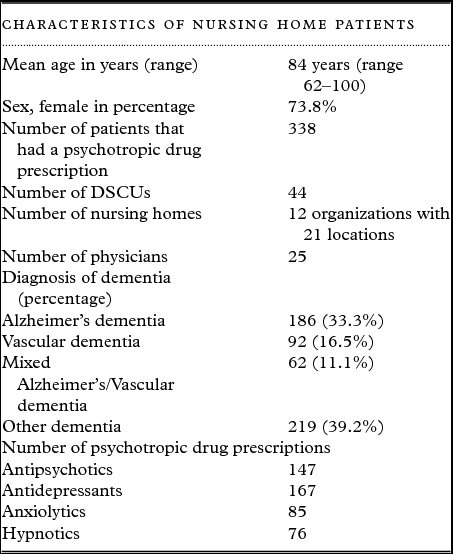
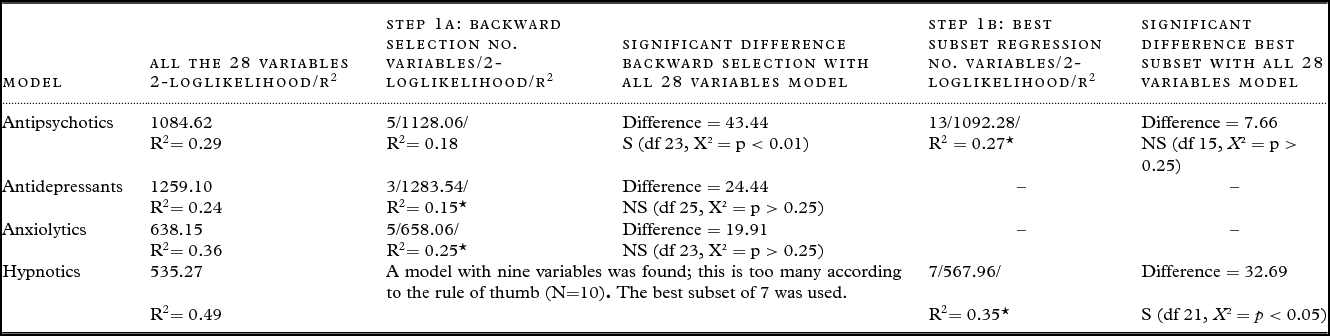
PDs were prescribed to 338 patients (see Table 1 for sample characteristics) in duplicate prescriptions: 147 APs, 167 ADs, 85 anxiolytics, and 76 hypnotics were used (van der Spek et al., Reference van der Spek2016). When applying the N = 10 rule of thumb (1 factor/determinant per 10 incident cases) on the prescriptions per patient (Smeets et al., Reference Smeets2017), 14, 16, 8, and 7 variables could be used in the final models, respectively. In Table 2, the above-mentioned multivariate unilevel preselection method of variable reduction was described, the final models are shown in bold. The APID index sum score ranged from 0 to 68.6.
Sample characteristics

Unilevel preselection method of variable reduction in a multivariate regression model. Based on unilevel linear regression modelling via stepwise backward selection (Step 1a) and best subset regression (Step 1b) a selection of variables for multilevel analyses were made for four psychotropic drug group models (final models with asterisk)1

*Final model, R2 = explained variance, S = significant, NS = not significant, no. = number.
1 For the four different models R2 and 2-loglikelihoods were calculated and analyzed for significant difference with the hypothetical full models with all 28 variables:
– For antipsychotics, stepwise backward selection resulted in a model that was significantly different from the hypothetical full model and, therefore, best subset regression was performed; that resulted in a model with 13 variables and was found not significantly different from hypothetical full model.
– For antidepressants, stepwise backward selection resulted in a model with three variables, which was found to be not significantly different from the hypothetical full model.
– For anxiolytics, stepwise backward selection resulted in a model with five variables, which was found to be not significantly different from the hypothetical full model.
– For hypnotics, a model with seven variables was chosen considering the 10-patients-per-predictor rule of thumb, but this model was significantly different from the hypothetical full model.
Multilevel analyses
No multicollinearity was found between variables. Multilevel analyses with levels DSCU and location (Step 2) were performed for antipsychotics, antidepressants, anxiolytics, and hypnotics.
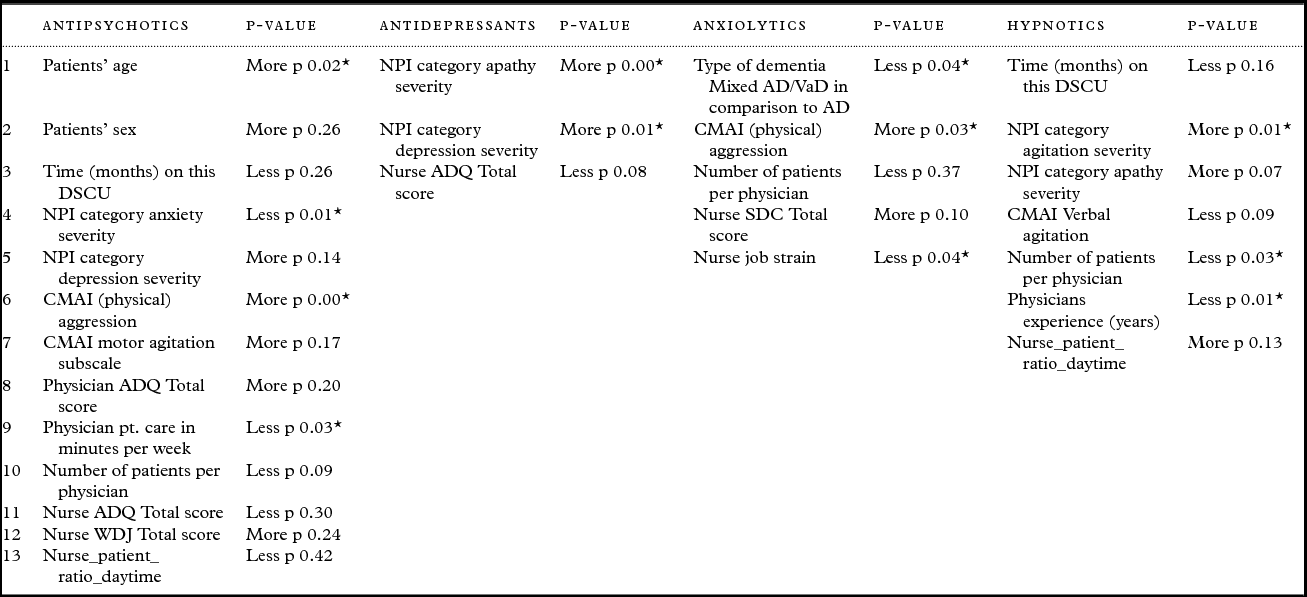
In the antipsychotics group, the following statistically significant associations were found: High CMAI physical aggression and older patient age were associated with low APID index sum scores; high NPI anxiety severity and physician patient care in minutes per week with high APID index sum scores. For the antidepressants group, high NPI apathy severity and high NPI depression severity were associated with low APID index sum scores. For the anxiolytics group, high CMAI physical aggression was associated with low APID index sum score; type of dementia other than Alzheimer's dementia and high job strain of nurses were associated with high APID index sum scores. Finally, for the hypnotics group, high NPI agitation severity was associated with low APID index sum score; high number of patients per physician and more years of experience for physicians were associated with high APID index sum scores (Table 3).
Multilevel models on the factors of the appropriateness of psychotropic drug use for antipsychotics, antidepressants, anxiolytics, and hypnotics. Variables are presented by patient-related, physician-related, and nurse-related from top to bottom. More indicates a lower APID index sum score, thus a factor associated with more appropriateness. Less indicates a higher APID index sum score, thus a factor associated with less appropriateness

In bold with asterisk = a significant effect was found, Neuropsychiatric Inventory-Questionnaire (NPI-Q), Cohen–Mansfield Aggression Inventory (CMAI), Approaches to Dementia Questionnaire (ADQ), Strain in dementia Care (SDC), the Maastricht Work Satisfaction Scale for Healthcare “Maastrichtse Arbeidssatisfactie Schaal voor de Gezondheiszorg” (MAS-GZ), AD= Alzheimer disease, VaD= Vascular Dementia, DSCU=Dementia Special Care Unit.
Discussion
Main findings
To our knowledge, this study is the first that investigates the factors associated with the appropriateness of PD prescriptions for NPS in nursing home patients with severe dementia on a broad range of appropriateness indicators summarized in one index score. We found that patient factors particularly influence appropriateness. Psychotropic drugs were more appropriately prescribed in patients with higher levels of NPS, older age, and other types of dementia than Alzheimer's dementia. Patient factors accounted for eight out of twelve of the found associations in the four different PD groups.
Regarding antipsychotics, the severity of aggression was associated with appropriate prescriptions, in antidepressants this was the severity of apathy and depression, in anxiolytics it was the severity of aggression, and in hypnotics it was the severity of agitation. Since the inappropriateness of a prescription is mainly based on poor indications, evaluations, and therapy durations (van der Spek et al., Reference van der Spek2016), these findings signify that when NPS were less pronounced, appropriate indications for these symptoms were missing, while evaluations of these prescriptions are lacking and the therapy continues.
Next to patient factors, of the several non-patient factors, one physician- and one nurse-related factor appeared to be associated with the appropriateness of PD prescriptions.
In the hypnotic group, prescriptions were less appropriate when the prescribing physician had a higher caseload. In the anxiolytic group, we found that prescriptions were less appropriate when nurses experienced more workload. This latter finding is in line with previous studies indicating that physicians feel more pressure to prescribe when the burden of nurses is high (Zuidema et al., Reference Zuidema2011; Smeets et al., Reference Smeets2014), which may result in less appropriate prescriptions. Additionally, when the workload is high, the pharmacological treatment of NPS compared to psychosocial treatment, which is the recommended intervention (Smalbrugge et al., Reference Smalbrugge2008; Seitz et al., Reference Seitz2012), could be considered as less time consuming. Therefore, pharmacological treatment is often preferred, while there is less time to appropriately evaluate and stop these prescriptions.
Nevertheless, other factors associated with the appropriateness of PD prescription were counter-intuitive, and possibly a result of multiple testing: In the antipsychotics group, severe anxiety and physicians’ time available per patient were associated with less appropriate prescriptions. Moreover, it was found that the more experience a physician had, the less appropriate the hypnotics were prescribed.
As mentioned before, little was known on this topic. Recently more relevant research has been published and it was found that large numbers of physicians working in one organization could result in an inappropriate prescription of antipsychotics (Laffon de Mazières et al., Reference Laffon de Mazières, Lapeyre-Mestre, Vellas, de Souto Barreto and Rolland2015). Another study found that after long-term care admission, new antipsychotic use was just as strongly associated with social factors as clinical factors (Foebel et al., Reference Foebel2015). However, these studies did not address a large variety of potential patient and non-patient factors associated with the broader concept of appropriateness, i.e. on multiple items of appropriateness and in different PD groups.
Methodological considerations
A limitation of this study was that including all the possibly relevant factors, as collected for the PROPER-I study (van der Spek et al., Reference van der Spek2013), led to a large number of factors compared to the number of patients, which could lead to an overfit of the statistical models. In order to control for this, we had to make a selection. Due to this selection, 28 of the in total 115 collected factors were used for analyses. Many of the for PROPER I collected factors were not included, considering that these were less relevant or were covered by other measures based on a conceptual framework. In this process, relevant factors might have been lost, e.g. physical environment-related factors. Additionally, this selection was performed by a sample of clinical experts from one single country, which can also be concerned as a limitation.
Furthermore, as mentioned before, we used multiple tests on the selected variables, which could have resulted in factors found coincidentally. Therefore, these associations might be clinically irrelevant and should be interpreted with caution.
This Dutch study was performed on so-called DSCUs with trained elderly care physicians as the responsible physician, therefore the results should be generalized to other healthcare systems with carefulness. In addition, the dependent variable was the APID index sum score. Prior to this study, the same patients’ records were used, by the same research team, in the development and validity study of the APID index. Therefore, uncertainty exists about the generalizability of the results to other samples, which could be considered as a limitation of the study; the APID index should be used in other samples to test the external validity of the results.
Furthermore, DSCUs are specialized in treating patients in advanced stages (Global Deterioration Stages 4–7, primarily 6–7) of dementia. In this study, only patients residing on these units were included, therefore, patients included in this study all had severe levels of cognitive impairment. Although inappropriate prescriptions are likely to affect cognition (Bottiggi et al., Reference Bottiggi2006). Due to the assumed floor effect (insufficient variance), we did not include an instrument to detect cognitive impairment and therefore did not obtain information about the association between cognitive impairment and the appropriateness of PD prescriptions. Moreover, the stage of dementia and thus the level of cognitive impairment is unlikely to predict the appropriateness of PD prescriptions independent of behavior, which compelled us to obtain information about the extent of NPS.
This study was conducted in single country and 12 nursing homes, that only involved people with severe dementia, which is typical for Dutch nursing homes. However, the appropriateness of PD prescriptions is a worldwide challenge (Kröger et al., Reference Kröger2005; Cioltan et al., Reference Cioltan2017), potentially, these results may be generalizable to other countries with similar healthcare systems.
Conclusions and clinical implications
We found that there is an association between more pronounced NPS and more appropriate PD prescriptions in patients with severe dementia, which implies that physicians should be especially aware of the appropriateness of prescription when NPS are less manifest. Carefully recording and regularly evaluating these prescriptions could prevent inappropriateness. Obviously, patient factors influence PD prescription. Physician and nurse factors seem to also influence the appropriateness of PD prescriptions, and thus guideline adherence regarding appropriate indications, evaluations, and therapy durations. However, some of these findings are counter-intuitive and thus unclear; more research on the topic is recommended.
To minimize these influences, standardization and thus guideline adherence is advised.
Conflict of interest
None.
Description of authors' roles
All authors declare that they have made a substantial contribution to (1) conception and design, acquisition of data, or analysis, and interpretation of data; (2) drafting the article or revising it critically for important intellectual content; and (3) made the final approval of the version to be published.
Acknowledgments
This study was funded by The Netherlands Organization for Health Research and Development (ZonMw). The sponsors had no role in the conception, design, analysis, or interpretation of data or in the drafting, review, or approval of the manuscript.