


In the past two decades, the field of international relations has witnessed a burgeoning of research on the relationship between regime type and war, as exemplified most clearly in the vast literature on the democratic peace. In this research, scholars have proposed a wide array of regime-type attributes to explain the conflict propensity of different regime types, but little or no consensus has emerged on the importance or predictive power of these attributes. As the field increasingly recognizes the fruitfulness of shifting the explanatory locus to leaders, we introduce a hitherto unexplored set of regime-type attributes, specifically how war and regime type combine to affect the fate of leaders. From these attributes, we build a new theory to explain the conflict propensity of a broad array of potential regime types that generates an intuitive explanation for the democratic peace.
Taking these two features into consideration, our model predicts that peace prevails when the cost of replacing the leader—and therefore his or her survival probability—depends relatively little on the war outcome and when the net gain of staying in office is relatively small. The logic is as follows. Any leader understands that he or she could induce his or her counterpart to prefer peace if he or she makes enough concessions at the bargaining table, but also realizes that such concessions affect his or her own survival. The size of the concessions he or she is willing to make depends on the sensitivity of his or her survival to the share of the pie obtained internationally (either peacefully or through war) as well as on the cost of losing office. Because the evidence suggests that the survival of dictators is more sensitive to the outcome of war than that of democrats and that the consequences of losing office are more punitive for dictators, the model predicts that peace is most likely when two countries are democracies.
We take advantage of the fact that our theory is built on two observable regime characteristics to demonstrate its applicability to a broader array of regime types. To that end, we examine the sample of nondemocracies post World War II, using Cheibub and Gandhi's (Reference Cheibub and Gandhi2004) classification. We show that although different types of dictators do not systematically differ in their sensitivity to the war outcome, they do differ systematically in their post-exit fate. Civilian dictators fare significantly better after they lose office than do military dictators and monarchs. The theory therefore predicts that civilian leaders should be least warprone, a pattern that is confirmed in the data.
We proceed as follows. The next section reviews the literature on the democratic peace, both theoretical and empirical, and highlights the challenges we face in building a satisfactory explanation of the empirical record. The third section discusses our theoretical approach, focusing on fundamental differences in the cost of replacing leaders by regime type. The fourth section presents an informal discussion of our argument (the formal model is presented in the Appendix). The next section discusses the implications of our model for a variety of regime types, and the final section concludes.
LITERATURE REVIEW
Most of the literature on regime type and war revolves around the democratic peace. To structure our discussion, we use this vast literature as a reference point.
According to Kant (Reference Kant, Kleingeld and Colclasure2006), democracies spread a culture of “liberal peace” and are unlikely to fight because citizens, who bear the cost of war, will be careful to avoid war if possible. Following his lead, explanations of the democratic peace typically fall into two camps: cultural/normative and institutional/structural explanations (Maoz and Russett Reference Maoz and Russett1993). Cultural/normative explanations stress that leaders should apply the norm of peaceful conflict resolution they employ domestically to other states. Democracies tolerate internal opposition peacefully, and so should attempt to solve conflict with other democracies similarly peacefully (Dixon Reference Dixon1994; Doyle Reference Doyle1983; Russett Reference Russett1993; Weart Reference Weart1994). Structural explanations argue that democratic leaders should be constrained in their use of force because they must obtain the consent of legislators and, eventually, the electorate (Russett Reference Russett1993). Put differently, in a democracy, the interests of the population (who bears the cost of war) are aligned with those of the decision maker (Babst Reference Babst1964; Kant Reference Kant, Kleingeld and Colclasure2006).
Rational choice theorists have made significant process in formalizing institutional/structural arguments, building on the assumption that democratic leaders are more constrained, less biased, and more sensitive to the war outcome (Baliga, Lucca, and Sjostrom Reference Baliga, Lucca and Sjostrom2007; Bueno de Mesquita and Lalman Reference Bueno de Mesquita and Lalman1992; Bueno de Mesquita et al. Reference Bueno de Mesquita, Morrow, Siverson and Smith1999, Reference Bueno de Mesquita, Smith, Siverson and Morrow2003; Filson and Werner Reference Filson and Werner2004; Jackson and Morelli Reference Jackson and Morelli2007).Footnote 1 Arguably the most influential piece in this literature is the seminal work of Bueno de Mesquita et al. (Reference Bueno de Mesquita, Morrow, Siverson and Smith1999, Reference Bueno de Mesquita, Smith, Siverson and Morrow2003). In their setup, regimes differ by the relative size of their winning coalition (i.e., the set of people who must support a ruler so that he or she remains in power) as a fraction of the selectorate (i.e., the set of people with political power). Leaders offer a mix of private and public goods to their supporters and must thwart the threat of a challenger. Members of the current winning coalition run the risk of losing their access to private goods by supporting the challenger. The bigger is the winning coalition, the more likely they are to be included in the challenger's winning coalition. Therefore, rulers with a larger winning coalition enjoy a smaller incumbency advantage in the provision of private goods and must survive through the provision of public goods. Assuming that the war outcome is a public good, such leaders are reluctant to enter into conflict unless they are certain to win. Moreover, they are unlikely to be chosen as targets because they expend a lot of effort in war. Taken together, Bueno de Mesquita et al. (Reference Bueno de Mesquita, Morrow, Siverson and Smith1999, Reference Bueno de Mesquita, Smith, Siverson and Morrow2003) claim, these factors explain the democratic peace.
Let us explore this argument in more detail. The timing of their game is as follows: (1) leader of nation A chooses between war and peace and, if war is selected, picks a war effort gA; (2) leader of nation B observes the leader of nation A's action and chooses how hard to fight (picks gB); (3) nature determines the outcome of war; and (4) domestic audiences in each country decide whether to retain their leader or defect to a political rival. Then, Bueno de Mesquita et al. (Reference Bueno de Mesquita, Morrow, Siverson and Smith1999, Reference Bueno de Mesquita, Smith, Siverson and Morrow2003) claim that members of the winning coalition support the incumbent if and only if

where Ri is the amount of resources in country i, redistributed among the winning coalition (of size Wi) if the leader stays in power and redistributed randomly among the whole selectorate (of size Si) if the challenger comes to power, ci is the expected quality of the challenger, μi is the performance of the leader on all policy dimensions, and Vi(z) is the utility from the war outcome z. We see that if Wi/Si is large, the incumbency advantage in the provision of private goods is small and the survival of the leader depends to a large extent on the war outcome z.Footnote 2
This approach raises some difficulties. First, it is debatable whether the war outcome is a public good, and it would be preferable to rely on an explanation that does not make such an assumption. Second, by the time members of the selectorate make their decision, the war effort has already been expended and the war outcome realized. Therefore, in their model, there is no reason why the war should affect the decision to support the ruler for a rational (forward-looking) audience, particularly given that the war outcome is a public good, which is by definition nonexcludable.
Nevertheless, it may be worthwhile to keep the focus on the benefit of keeping victors (and ousting defeated losers). One story would be that victory demonstrates competence, defeat signals incompetence, and a domestic audience cares about keeping competent leaders. This is a sensible approach, but it does not answer why competence should matter more in a democracy, where power is less concentrated in the hands of the leader.Footnote 3 We believe that the conventional wisdom really builds on the fact that democrats are “more accountable” (i.e., easier to replace), than dictators. This suggests an approach where, instead of focusing on the benefit of replacing leaders by regime, we should focus on the cost of replacing them.
Taking this approach, we can in fact solve a puzzling fact for standard current theories of the democratic peace: it is difficult to order leaders in terms of their bias toward war. Take Jackson and Morelli (Reference Jackson and Morelli2007), for example. They model the intuition that the bias between a leader and the population may be lower in democracy, which then explains their lower likelihood to wage war. In their model, the “bias” of a country for war “is the ratio of the percentage that the pivotal decision-making agent stands to gain versus what he or she has at risk” from being involved in a war (Jackson and Morelli Reference Jackson and Morelli2007, 1357-58). Unfortunately, the conventional wisdom does not generate a clear prediction on the relative bias in dictatorships and democracies. Schultz (Reference Schultz2001a, 14-15) probably puts it best: “While the lack of institutionalized mechanisms for removing undesired leaders [in dictatorships] means that removal is relatively rare, it also means that the associated punishment can be quite severe. [. . .] Thus, institutions of accountability generate two countervailing effects, and it is not clear which dominates.” We address this shortcoming, instead showing that the two forces are not countervailing, but rather reinforcing. Before we present our explanation, we first discuss the evidence in more detail, to make explicit the fundamentals of our explanation.
Who is More Sensitive? The Empirical Record
The fundamental question of whether democrats or autocrats are more sensitive to the war outcome is, of course, an empirical one. Previous research claims to have found that democrats are more sensitive. On closer inspection, however, these claims turn out to be unwarranted.
First, the previous literature fails to distinguish between the unconditional likelihood of losing office and the probability of losing office conditional on the outcome of a war. Although it is plausible—and indeed empirically supported (Chiozza and Goemans Reference Chiozza and Goemans2004)—that democratic rulers are more likely to lose office in any year, it does not follow that they are more vulnerable to the outcome of a war.
Second, the current consensus is based on shaky empirical foundations. Scholars who argue that democratic leaders are more sensitive to the outcome of war invariably cite the seminal papers by Bueno de Mesquita, Siverson, and Woller (Reference Bueno de Mesquita, Siverson and Woller1992) and, particularly, Bueno de Mesquita and Siverson (Reference Bueno de Mesquita and Siverson1995). The results in those articles, however, do not warrant that inference. For example, the baseline equation estimated by Bueno de Mesquita and Siverson is

where TenureL is the logarithm of a leader's total time in office prior to the war (plus 1) and Demo is a dummy variable for democracy.Footnote 4
From this approach, Bueno de Mesquita and Siverson (Reference Bueno de Mesquita and Siverson1995) cannot conclude that democrats are more sensitive to the war outcome. Indeed, they impose by assumption that the war outcome has the same impact on the leader of any regime, by including a single variable (“win”) that does not interact the war outcome with the regime type. Second, they do not show that democrats are more sensitive to war. Indeed, they analyze a sample, including only leaders who have gone to war (with no leader who stayed at peace). By interacting regime type and prior tenure in office, they show only that democrats lose power at a faster rate. This is the unconditional likelihood of losing office, which is independent of the sensitivity to war and, we claim, irrelevant for the decision to go to war.
In more recent research on a sample of all leaders from 1919 to 2003, including both leaders who fought wars and leaders who stayed at peace, Chiozza and Goemans (Reference Chiozza and Goemans2004) came to a fundamentally different conclusion, contradicting the earlier claims of Bueno de Mesquita and Siverson (Reference Bueno de Mesquita and Siverson1995). Chiozza and Goemans (Reference Chiozza and Goemans2004) provide evidence that war affects the tenure of autocratic leaders—in particular, defeat in war increases the hazard of losing office—but war, no matter whether it ends in victory, defeat, or a draw, does not significantly affect a democratic leader's hazard of losing office.
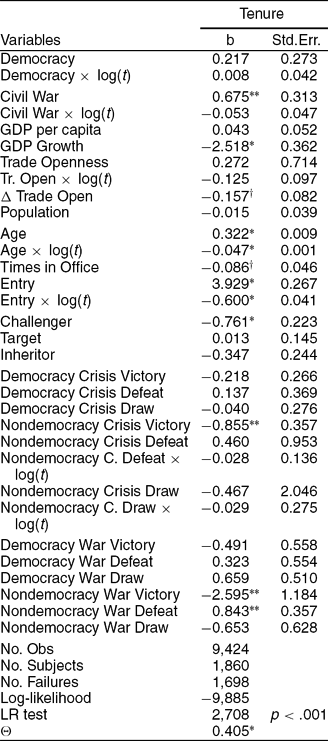
Rather than rely on competing claims in the earlier literature, we provide our own test of whether and how war affects the hazards of losing office for leaders of different regimes. Table 1 reports the results from a Cox proportional hazard model to empirically examine whether the tenure of leaders of democracies or nondemocracies is more sensitive to the outcome of war. We follow the approach presented in Chiozza and Goemans (Reference Chiozza and Goemans2004). Thus, our unit of observation is the leader-year (or leader-year-spell, if there was a change of leader in a given year). We also add a frailty term as an additional unmeasured covariate. The frailty parameter is conceptually analogous to a random effect that assesses whether some leaders are more likely to leave power, all the other measured factors being equal. Two components in the model, therefore, account for the variation in the risk of losing office among leaders, the explanatory variables and frailty, with the frailty term incorporating the unmeasured heterogeneity across units. In our specification, we cluster observations (i.e., leader-years) by country. In other words, the frailty term is assumed to be constant within country groups. We cluster on countries because leaders ruling the same country are likely to have chances of survival that depend in some general way on country-specific factors that go beyond the explanatory variables in the model. In addition, we also extend the Cox hazard model to account for nonproportional hazards (Box-Steffensmeier, Reiter, and Zorn Reference Box-Steffensmeier, Reiter and Zorn2003).
Conflict Outcomes, Regime Types, and Loss of Office

Note: The frailty parameter θ measure the variance of a gamma distribution with mean equal to 1.
* p < .01, ** p < .05, † p < .1.
With three minor modifications, we also rely on the same independent variables as do Chiozza and Goemans (Reference Chiozza and Goemans2004). First, we operationalize trade openness with new, updated data; second, we include a variable that measures how leaders entered office in the first place; and, third, we distinguish democracies from nondemocracies and thus collapse presidential and parliamentary democracies into one category. We estimate how the state-level variables Democracy (aggregating presidential and parliamentary democracies), the presence of a Civil War, GDP per capita (logged), GDP Growth, Trade Openness, the change in trade openness, Population size (logged) as well as the leader-level variablesFootnote 5 of the leader's Age at entry into office, the number of times the executive previously has been in office, and the manner of Entry (coded as 0 if by a regular process, as 1 if by an irregular or forcible process) affect the tenure of leaders. To examine how conflict affects the tenure of leaders, we rely on the most recent release of the ICB data (Version 7.0) to distinguish whether the leader was a Challenger (if so, coded as 1 for the duration of the entire conflict and 0 otherwise), a Target (similarly coded), or an Inheritor, which is a leader who inherits the conflict from a previous leader who was either a Challenger or a Target, but who was removed during the conflict. Finally, we interact the conflict outcomes with democracy and nondemocracy because these variables can then be easier assessed relative to the excluded category, peace.Footnote 6 Because tests revealed that several variables violated the proportional hazard assumption of the Cox model, we interacted these offending variables with log(t), as recommended by Box-Steffensmeier, Reiter, and Zorn (Reference Box-Steffensmeier, Reiter and Zorn2003). Tests revealed that multicollinearity is not a problem.
Because the effects of Civil War, GDP per capita, GPD Growth, Trade Openness, change in trade openness, Population size, the leader's Age at entry, and the number of times the leaders previously had held office in Table 1 basically reproduce the results in Chiozza and Goemans (Reference Chiozza and Goemans2004), we skip the discussion of the country and leader-level variables. For our purposes here, our main interest lies in the effect of war on the tenure of democratic and nondemocratic leaders. We separate crises and wars because crises are less costly than Wars and less likely to affect the leader's time in office. To exclude them, however, could be argued to bias results in our favor.
In Table 1, we find that the outcome of a crisis—be it victory, defeat, or a draw—does not affect the tenure of democratic leaders. Although victory in a crisis significantly decreases the risks of losing office for non-democratic leaders, the difference between victory and defeat is not statistically significant. Draws have a similar but more temporally circumscribed effect on the tenure of nondemocratic leaders. During their first 2.5 years in office, as well as after about ten years in office, a draw does not affect the tenure of nondemocratic leaders. In the interim, however, a draw significantly increases their tenure. Notably, the overall effect of the outcome of a crisis is not significantly different for democratic and nondemocratic leaders.
When we switch to our main focus, war, Table 1 reveals that victory in war decreases the hazard of losing office, whereas defeat in war increases the hazard of losing office for nondemocratic leaders. However, neither victory nor defeat in war significantly affects the tenure of democratic leaders. Wald tests show that the difference between victory and defeat is statistically significant for nondemocratic leaders (p<.010), but not for democratic leaders (p<.570), and that the difference between victory and defeat is significantly greater for nondemocratic than for democratic leaders (p<.078). When we execute a joint test and compare all three potential outcomes (victory, defeat, or draw), we again find that the fate of nondemocratic leaders is indeed significantly more sensitive to the outcome of war than democratic leaders (p<.099).
Of course, the consequences of losing office should also matter for leaders and there is reason to believe that they differ significantly by regime type. Anecdotally, democratic leaders, especially in modern times, can look forward to a profitable retirement. As President Bush put it when asked about his plans after he leaves the White House, “I'll give some speeches, just to replenish the ol' coffers” (“In Book, Bush Peeks Ahead to His Legacy,” New York Times, September 2, 2007, p. 1).Footnote 7 In contrast, nondemocratic leaders such as Saddam Hussein can and indeed do anticipate significant punishment when they lose office. Yet, previous research has not documented this information rigorously and has failed to incorporate it in their explanation of the democratic peace. We take a step in this direction, examining the relationship between regime type and the posttenure fate of leaders between 1919 and 2004 using the Archigos data set, version 2.9 (Goemans, Gleditsch, and Chiozza Reference Goemans, Gleditsch and Chiozza2009).Footnote 8
Table 2 confirms the intuition that autocrats face more severe punishment after leaving office. Only a few democrats (7%) but many autocrats (41%) suffered significant punishment in the year after they lost office. Additional tests (difference of means and ANOVA) show that the difference between nondemocratic and democratic leaders is statistically highly significant (p < .001).Footnote 9

Summing up, we conclude that autocrats are more sensitive to the war outcome and that they face more severe punishment than democrats after leaving office. On the first point, we note that the similar earlier results from Chiozza and Goemans (Reference Chiozza and Goemans2004) have not been taken at face value. To the contrary, these results have been argued to indicate that democratic leaders are more sensitive to the outcome of war because of selection effects. The current literature seems to suggest two arguments to explain away the insignificant coefficients of the outcomes of war for democratic leaders. We find neither of these counterarguments convincing.
First, Reiter and Stam (Reference Reiter and Stam2002) argue that democratic leaders select wars that they are likely to win. This would indeed introduce bias in our estimation, but it would bias the estimate of the underlying probability of victory in war, not the sensitivity of the leader's survival to the war outcome. In other words, if leaders pick wars that they are likely to win, then we would observe “too many victories,” but conditional on a war having been fought, we can still estimate the effect of the war outcome on the survival of leaders without any bias.
Second, it could be argued that leaders select themselves into wars based on how the outcome of war affects their tenure and that for some reason democratic leaders are better at this than nondemocratic leaders. Then, to paraphrase Schultz (Reference Schultz2001b, 32), strategic choice implies that the probability of observing such effects on the tenure of leaders is a function of their value. In other words, the greater the tenure punishment is for defeat, the less likely we would be to observe it, which might explain the insignificant coefficient of war defeat for democratic leaders. However, we should also be more likely to observe tenure rewards from victory. After all, if democratic leaders are somehow good at selecting themselves into wars, then they should select wars that would bring them increased tenure. Yet, the coefficient for war victory for democratic leaders is small and nowhere near significant. This finding casts significant doubt on any simple and straightforward selection mechanism.Footnote 10 Thus, to be convincing, those who would use a selection effects argument to reject our conclusion that democratic leaders are less sensitive to the outcome of war would need to offer two explanations. First, they would need to explain how democratic leaders pick their wars and why nondemocratic leaders cannot do the same. Second, they would need to explain why democratic leaders do not gain time in office as a result of victory, whereas nondemocratic leaders do. Until then, we believe that a relatively simple line of argument offers the most convincing explanation of these patterns. We present such an explanation, focusing on a fundamental difference in the process of replacing leaders by regime type: it is violent in dictatorships and nonviolent in democracies.
REGIME TYPE AND THE COSTS OF REPLACEMENT
Previous research on leaders and the democratic peace focused on the different benefits of replacing rulers in different regimes. In contrast, we focus on the different costs. We argue here that such an approach is in line with previous work on democratic theory and that it produces a simple theory that accords with the empirical evidence.
A Defining Feature of Democracy
The idea that the costliness of replacing rulers is a significant, if not the most significant, difference between dictatorship and democracy is not new. For example, Popper (Reference Popper1963, 124) states,
For we may distinguish two main types of government. The first type consists of governments of which we can get rid without bloodshed—for example, by way of general elections; that is to say, the social institutions provide means by which the rulers may be dismissed by the ruled, and the social traditions ensure that these institutions will not easily be destroyed by those who are in power. The second type consists of governments which the ruled cannot get rid of except by way of a successful revolution—that is to say, in most cases, not at all. I suggest the term “democracy” as a short-hand label for a government of the first type, and the term “tyranny” or “dictatorship” for the second.
It is clear that the “competitive struggle for the people's votes,” as emphasized in the traditional Schumpeterian definition of democracy, would be meaningless if candidates were not protected against the arbitrary power of the state (Schumpeter Reference Schumpeter1950). Riker (Reference Riker1982, 6, 7) argues,
Almost everything [. . .] that we think of as civil liberties (the rights of a speedy trial, habeas corpus, and security against unreasonable search and seizure, for example) originated to protect politicians who feared prosecution if and when they lost office. Thus the historic purpose of these fundamental democratic liberties has been not to provide freedom as an end in itself, but to render effective both political participation and the process of choice in voting.
In the same spirit, Przeworski et al. (Reference Przeworski, Alvarez, Cheibub and Limongi2000, 15) adopt a Schumpeterian definition of democracy and emphasize that regimes with no regularized competition among conflicting views enjoy a monopoly of power “buttressed by the threat or actual use of force.”
This defining feature of democracy, central in our model, was also emphasized by the early students of the democratic peace. Weart (Reference Weart1994) states, “If required to reduce it all to a single statement, we could isolate anocratic and authoritarian regimes as those where demands for loyalty are so concentrated on a leader (or family or clique) that any citizen who works to have the leader replaced is risking severe punishment” (308). Maoz and Russett (Reference Maoz and Russett1993) argue that, empirically, the treatment of political opponents (i.e., the annual number of violent political deaths and the number of political executions) is the single most important factor to explain the democratic peace, along with the “stability” of a regime (i.e., the length of that a political system or regime existed without fundamental change). This leads them to favor normative accounts of the democratic peace.Footnote 11 No rational choice theory of the democratic peace, however, has fully exploited this distinctive feature.
Sensitivity of Replacement Costs to the Outcome of War
Focusing on the cost of replacing leaders easily suggests why the survival of an autocrat is more, not less, sensitive to the war outcome. The process whereby a democratic leader loses office is well institutionalized and does not fundamentally depend on the outcome of conflict. Typically, democratic leaders lose office through elections and term limits. The length of a term of office and the timing of election are by and large exogenously determined and do not depend on the outcome of war.Footnote 12 Moreover, a wide range of factors other than the outcome of war typically plays an important role in democratic elections. Thus, even after Turkish Prime Minister Ecevit (Cyprus), British Prime Minister Churchill (WW II) and U.S. President George H.W. Bush (Gulf War I) led their countries to victory and supposedly signalled their foreign policy competence, all three lost the following elections.
In sharp contrast, nondemocratic leaders often lose office through violent means [rebellions, civil wars, and coups (Goemans Reference Goemans2008)]. In such cases, the outcome of conflict can fundamentally affect the process whereby nondemocratic leaders are removed from office by several paths. First, defeat in war affects the efficacy of the leader's repressive apparatus, and thereby diminishes his or her grip on power, making any attempt to overthrow the leader more likely to succeed. Second, defeat in war can affect attempts to coordinate the opposition. In case of (major) defeat, opponents of the current leader may expect that others will support them in an attempt to overthrow the leader, not just because of demonstrated incompetence, but because of a widespread belief that sufficient numbers will rise and protest will not be punished. The outcome of conflict can thus “tip” a largely passive populace into a mass uprising or coup attempt (Kuran Reference Kuran1991). Similarly, victory makes such coordination less likely and thereby diminishes the nondemocratic leader's probability of losing office.
We therefore argue that a theory based on the cost of replacing leaders gives a simple explanation of the sensitivity of rulers to the war outcome. We now explain how the sensitivity of leaders to the war outcome affects the likelihood of the outbreak of war.
DISCUSSION OF OUR ARGUMENT
In this section, we sketch the logic of our argument, with full details available in the Appendix. Our starting point is the canonical model of Fearon (Reference Fearon1995), the building block of a large literature on rational explanations for war. Assume that two countries, A and B, divide a pie of size 1, either peacefully or through war. War is an inefficient alternative to peaceful settlement, imposing costs on both countries, where the winning country extracts the full pie. Given this setup, the natural question is: why would countries rationally decide to go to war, when it is known to be an inefficient alternative to peaceful bargaining? Fearon answers the question as follows: war should be avoided if countries are unitary actors, they are risk neutral (or risk averse), and there are no bargaining frictions (more specifically, players are fully informed and there is no commitment problem).Footnote 13
Let us illustrate the statement mathematically and graphically. Write u i(zi) as the utility of player i from getting a share zi of the international pie. War corresponds to a lottery where country A wins the full pie with probability p, and country B wins it with probability 1 − p. This lottery imposes a cost ci to country i. Therefore, the utility of country A (B) for a peaceful settlement where he gets a share of the pie zA is uA(zA) (uB(1 − zA)), and the expected utility from war is puA(1) + (1 − p)uA(0) − cA for A (puB(0) + (1 − p) uB(1) − cB for B). Throughout this analysis, we assume that each decision maker wants to maximize his or her expected utility. The canonical model of Fearon (Reference Fearon1995) considers the following case:
Case 1 (unitary countries, either risk neutral or risk averse). uA(.) and uB(.) are continuous, increasing, and weakly concave.
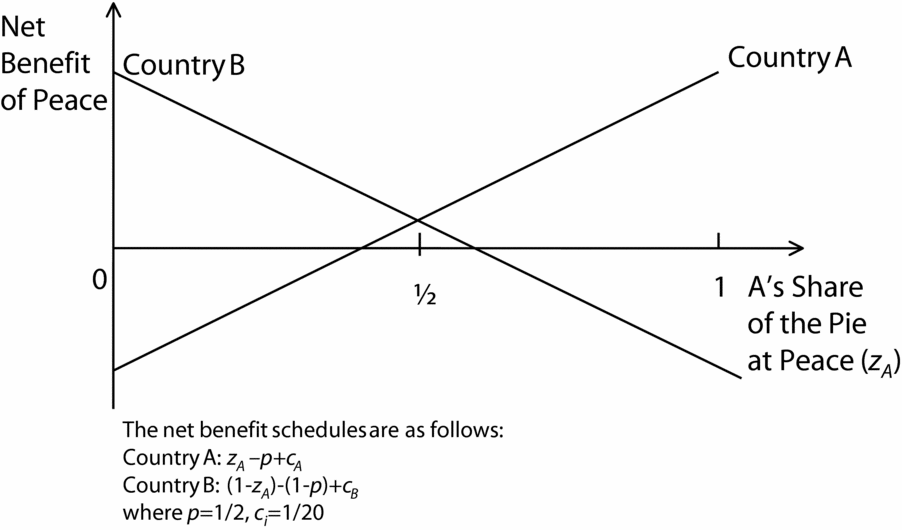
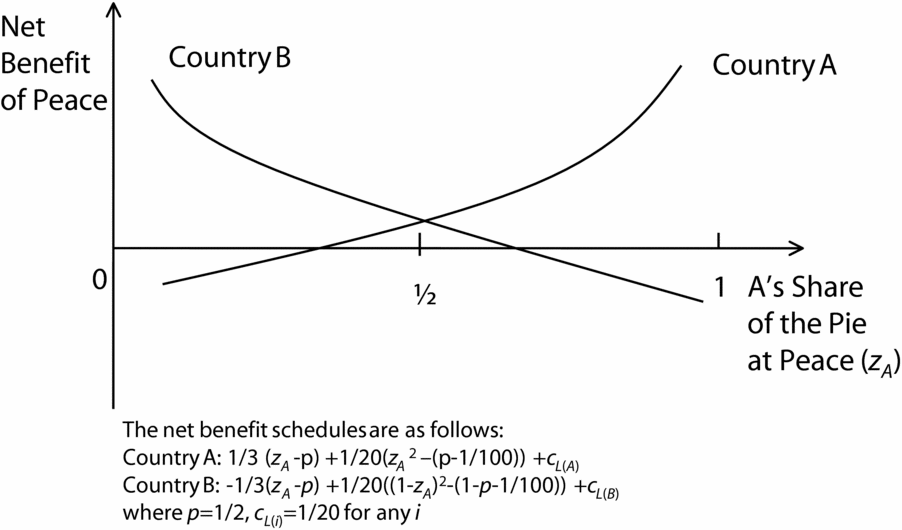
Figure 1 illustrates this case, plotting the net benefit of a peaceful settlement, where country A gets zA (and B gets 1 − zA). By net benefit, we mean the difference between the utility at a peaceful settlement and the expected utility of war (uA(zA) − (puA(1) + (1 − p) uA(0) − cA) for A, uB(1 − zA) − (puB(0) + (1 − p)uB(1) − cB) for B).Footnote 14 The net benefit for country A is increasing in zA, while for country B it is decreasing in zA. The logic is simple. Getting a greater share of the pie at peace makes peace more attractive, relative to war. We now ask whether a peaceful bargain can be struck. This depends on where the net benefit schedules intersect. If they intersect above zero, there is a peaceful bargain that both countries prefer to war because there is at least one peaceful settlement that gives both countries a positive net benefit of peace. If they would cross below zero, then there would be no such peaceful settlement. Any bargain that country A prefers to war (i.e., relatively high values of zA) would be worse than war for country B, and vice versa. In the case of unitary countries, either risk neutral or risk averse, the net benefit schedules always cross above zero. Therefore, if there is no bargaining friction, then countries should be able to avoid war (Fearon Reference Fearon1995).
Net Benefit of Peaceful Settlement as a Funtion of A's Share of the Pie: Unitary, Risk-neutral Countries

The Fearon (Reference Fearon1995) framework has given birth to a large literature, which attempts to explain wars by relaxing one or more of its assumptions. One natural candidate is to assume that countries are actually risk loving. In that case, countries may be willing to pay the cost of destruction so that they can run the risk of winning (and losing) the full pie. Mathematically, this model is represented as follows:
Case 2 (unitary, risk-loving countries). uA(.) and uB(.) are continuous, increasing, and strictly convex.
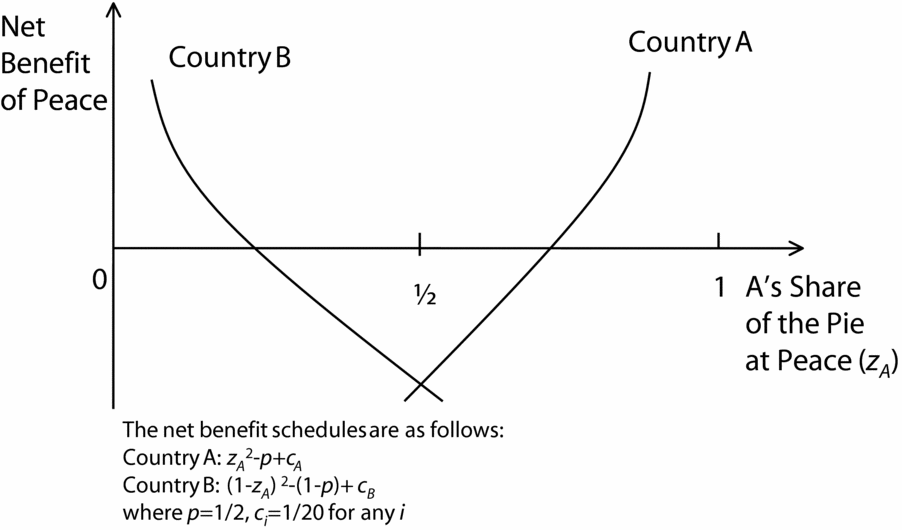
Figure 2 illustrates this case, showing that the net utility schedules may cross below zero.Footnote 15 Thus, even without bargaining friction, war may ensue. The challenge for this approach, however, is to justify general assumptions about the risk preferences of countries.
Net Benefit of Peaceful Settlement as a Funtion of A's Share of the Pie: Unitary, Risk-loving Countries

Instead, we relax the assumption that the state is a unitary actor and unpack the process by which the leader is removed from office. More precisely, we assume that after the outcome of the international interaction is realized, domestic audiences decide whether to replace the incumbent. Specifically, we focus the analysis on the consequences of losing office and the effect of the international interaction on the cost of removing the leader.
We proceed as follows. First, we model the direct cost of war as the leader's psychological or physical cost associated with the chaos of war [we write this cost c L(i)]. Second, we unpack the leader's benefit of war into direct and indirect benefits. Directly, the leader of country i values the share of the international pie obtained by his or her country at rate v L(i). It corresponds to the rents he or she extracts from his or her country's share of the pie if it is a private good or the valuation that he or she places on his or her country's share of the pie if it is a public good. Indirectly, the leader values his or her country's share of the pie through its effect on his or her likelihood of staying in office. Let I(t(i)) be the utility of remaining in office for the leader of country i of regime type t(i) and O(t(i)) be the utility of being ousted for the leader of country i of regime type t(i). We assume that the leader prefers to remain in office rather than being ousted (I(t(i))>O(t(i))).
Second, we assume that a greater share of the pie (zi) obtained on the international scene, everything else equal, increases the domestic cost d that the audience has to pay to remove the leader. d represents any effort expended and any personal risk incurred by the population in removing the ruler, as well as any economic loss produced in the transition from one ruler to the next. We assume that this domestic cost is increasing in zi. For example, more favorable terms could mean that the leader has more resources to expend in ensuring his or her survival or that he or she benefits from increased legitimacy. To gain traction, compare regime types and discuss the important dimensions of a leader's “accountability” for war involvement, we impose the following functional form:

where α (t(i)) and β (t(i)) are positive parameters and δ (zi, Iw) is differentiable and increasing in zi. Everything else being equal, a greater α (t(i)) means that there is a greater cost to replace the leader in regime t(i). A greater β (t(i)) means that the cost of replacement is more sensitive to the outcome of international bargaining in regime t(i).
In its decision to remove the leader, the population compares the cost of replacement to the benefit of supporting the challenger. We assume that this benefit follows a uniform distribution on [0,1], and this benefit is unaffected by the outcome of international bargaining. This benefit captures the fact that there are other political dimensions (e.g., the economy) on which the challenger may appear more attractive than the incumbent. Naturally, the population keeps the incumbent in office if and only if the benefit of supporting the challenger is less than the cost of replacing the incumbent. As a result, the probability that the leader of country i remains in office when he or she obtains a share zi of the pie through war or peace is

Taking stock, this model can be represented as follows:
Case 3 (nonunitary countries). Leaders bargain over the division of a pie in the shadow of domestic accountability. The utility for the leader of country i who receives a share zi of the pie is

As we had before, we see that the net benefit of peace for any leader is increasing in his or her country's share of the pie at peace. In this new setup, the argument underlying this relationship is richer. First, there is a direct benefit in that the leader enjoys having a greater pie (this is the first term in (4). Second, there is now an indirect effect, in that having more favorable terms increases the likelihood that the leader remains in office (this is the third term in (4). We now want to ask whether there is a peaceful division of the pie that both leaders prefer to war.Footnote 16
From the previous discussion, we know that, absent any effect of the international interaction on the likelihood that the leader remains in office, peace would always prevail. The key variable of interest is the function Pr (., ., .), which tells us how the outcome of international bargaining affects a leader's survival. We want to compare the probability that a leader remains in office for a peaceful settlement where zA = p to the probability that he remains in office after going to war because it is a natural candidate for a peaceful settlement and equates the direct benefit of war and peace (to pv L(i)). War produces a greater likelihood of remaining in office for A than the peaceful bargain where he or she receives p if p Pr(1,t(A), 1) + (1 − p) Pr(0, t(A), 1) > Pr(p, t(A), 0) or, using Equations (2) and (3),

War produces a greater likelihood of remaining in office for B than the peaceful bargain where he or she receives 1−p if p Pr(0, t(B), 1) + (1 − p) Pr(1, t(B), 1) > Pr(1 − p, t(B), 0) or, using Equations (2) and (3),

Whether Equations (5) and (6) hold is difficult to tell empirically, given how little we know about the technology of leadership removal.
To make progress, we impose a few conditions. First, we assume that the technology of leadership removal is symmetric, so that whenever two countries A and B interact, either both Equations (5) and (6) hold or neither condition holds.Footnote 17
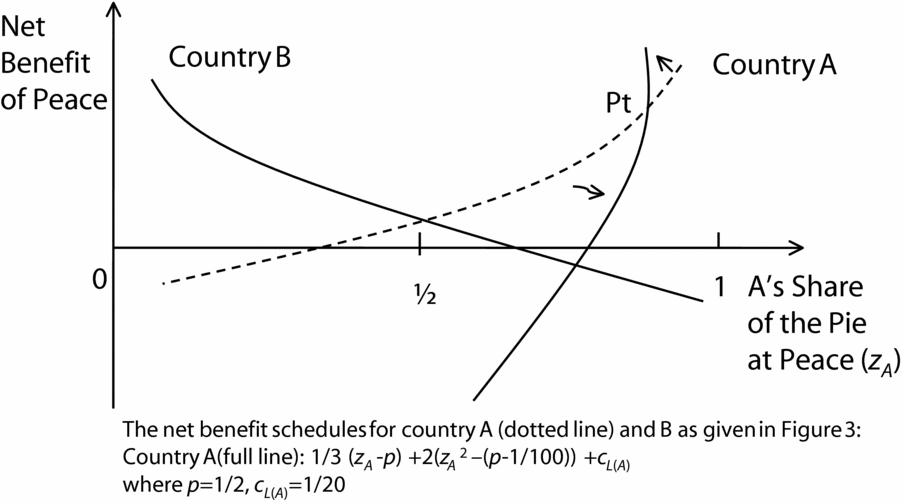
If neither Equation (5) nor Equations (6) holds, then it is clear that both leaders prefer a peaceful settlement where zA = p. At that settlement, peace offers the same direct benefit as war for both leaders, and it now offers strictly greater indirect benefits than war because it generates a greater probability of remaining in office. If both Equations (5) and (6) hold, war may occur.Footnote 18 Both conditions hold, for example, if the marginal cost of replacing the leader is increasing in the share of the pie that he obtains on the international scene.Footnote 19 When Equations (5) and (6) hold, it is impossible to produce a peaceful division of the pie where each leader gets the same probability of staying in office as he would get from going to war. Leaders must compromise. Can they find such a compromise? They want to avoid the direct cost of war (c L(i)), but making concessions means that peace generates smaller indirect benefits, reducing the leader's probability of staying in office.Footnote 20 The consequences of making a concession depend on the magnitude of the stakes of remaining in office (I(t(i)) − O(t(i))) and the sensitivity of the cost of replacement to the share of the pie obtained internationally (β (t(i))). As each increases, holding everything else constant, the greater are the consequences of making a concession (i.e., the faster the leader's net benefit of peace decreases), either because the consequences of losing office are worse or the probability of ouster increases faster.
Graphically, as represented in Figures 3 and 4, the net utility schedule becomes steeper as either quantity increases, pivoting around the point (Pt) that provides the same probability of staying in office as going to warFootnote 21 Therefore, holding everything else constant, the schedule of net utilities cross at a lower point, and may cross below zero (meaning that no peaceful division of the pie is preferable to war for both countries; see proposition 1 for a formal statement of this claim).
Net Benefit of Peaceful Settlement as a Funtion of A's Share of the Pie: Nonunitary Countries

Net Benefit of Peaceful Settlement as a Funtion of A's Share of the Pie: Nonunitary Countries

With most of the set-up of the model in place, we need to discuss only two additional features, which generate statements on the probability of war involvement of a given leader. We assume that the regime type of countries A and B and the direct cost of war for the leaders are independently distributed.Footnote 22 Then, given these two assumptions, and holding everything else constant, we get:
Claim 1. The probability that a country is involved in war increases in the leader's private stakes and in the sensitivity of his or her survival to the outcome of the international interaction.
COMPARING REGIME TYPES
Testing claim 1, we look for proxies of the private stakes of holding office (I(t(i)) − O(t(i))) and the sensitivity of the leader to the outcome of international interaction (β (t(i))). For the former, we use the evidence on the posttenure fate of leaders (i.e., whether they are okay, exiled, jailed, or killed). Next, we assume that a victory in war corresponds to a larger share of the pie than a defeat in war and that the outcome of war is, to some extent, instructive about the effect of changes in the peaceful bargain on a leader's survival (as we do in 3).
As we saw previously, democratic leaders have lower private stakes and are less sensitive to the outcome of war. Therefore, claim 1 predicts that democracies are less likely to be involved in war, a claim supported by the most recent scholarship (Russett n.d.). We discuss this result and how our model can generate a dyadic explanation of the democratic peace later in this section. First, we want to show how our model generates novel and broader predictions about regime type and war. To that end, we focus on the subsample of dictatorships.
Types of Nondemocracies
Although the comparative politics literature has long discussed the structural differences among nondemocratic regimes, the consequences of these theories for the outbreak of war has been relatively neglected.Footnote 23 For recent exceptions, see Peceny, Beer, and Sanchez-Terry (Reference Peceny, Beer and Sanchez-Terry2002), Lai and Slater (Reference Lai and Slater2006), and Weeks (Reference Weeks2010). In contrast to this literature, our work starts from fundamentally different premises and provides a theory linking the sensitivity of rulers to the war outcome and their posttenure fate to their probability of war involvement.
We disaggregate autocracies into different subtypes, according to the classification suggested by Cheibub and Gandhi (Reference Cheibub and Gandhi2004), which classifies autocracies (1946–96) as either monarchic, military, or civilian. To that end, we merge their data with Archigos (Goemans, Gleditsch, and Chiozza Reference Goemans, Gleditsch and Chiozza2009).Footnote 24 We assess these leaders on the two fundamental factors driving our model: their sensitivity to war outcomes and their post tenure fate.
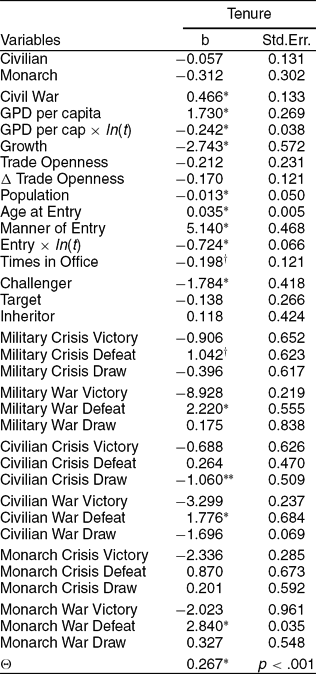
We first examine whether different types of autocracies were more or less sensitive to the outcome of war. Table 3 reports the results.Footnote 25
Conflict Outcomes, Autocratic Types, and Loss of Office

Note: The frailty parameter θ measures the variance of a gamma distribution with mean equal to 1.
* p < .01, ** p < .05, †p < .1.
Focusing on the sensitivity to the war outcome, we notice that although victory increases the tenure of leaders in all autocratic regimes, the effect is not significant. Defeat, however, significantly increases the hazard of losing office for leaders of all autocratic regimes. Wald tests show that the difference between defeat and victory is statistically significant for military dictators (p < .001), civilians (p < .026), and monarchs (p < .020). This difference, however, is not statistically different among the three regime types. We also compare the effect of victory, defeat, or draw for one type against the other and find no statistically significant difference. Hence, the sensitivity to the war outcome does little to distinguish the incentives of these types of autocrats for or against war.
We therefore turn to the posttenure fate of these leaders. Table 4 reports a simple cross-tabulation of the three types of autocratic leaders and their posttenure fate.

Table 4 shows that civilians are by far most likely to enjoy a safe retirement. Tests (ANOVA) revealed that the difference between civilians and military autocrats is indeed significant (p < .029). Although Monarchs seem tantalizingly different, there are two few instances (only 25 monarchs lost office in the sample) to draw any inference. Translating this into the language of our framework, we conclude that the private stakes of holding office are smaller for civilian dictators than they are for military dictators or monarchs. Therefore, consistent with claim 1, we propose:
Conjecture 1. The average probability of the outbreak of war should be significantly lower for civilian dictators than for military dictators and monarchs.
We test this prediction in Table 5, where we focus on the outbreak of war which is coded as 1 if a leader launched a challenge or became a target that year and 0 otherwise.
Nondemocratic Regime Types and Onset of War

Notes: Coefficients of each regime type must be interpreted relative to the excluded category, Military Autocrats. Standard errors are clustered on country code.
** p < .01, * p < .05, †p < .1.
The results from Table 5 show that civilian autocrats are indeed significantly less likely to become involved in war than military autocrats (p < .074, two-tailed test). Moreover, monarchs are not significantly different from military autocrats nor from civilian autocrats (p < .144). These tests provide corroborating evidence for the logic of our model. Moreover, they highlight the importance of considering the posttenure fate of leaders, which the previous literature has ignored.
Democracy vs. Nondemocracy
Although the study of nondemocratic regime types is in its relative infancy, much more has been said about the differences between dictatorships and democracies. In the discussion of the democratic peace, it remains debated and empirically inconclusive whether democracies are more peaceful overall or just toward other democracies (i.e., whether the democratic peace is monadic or dyadic). For example, some claim evidence of a “cats-and-dogs” effect, where democracy–nondemocracy dyads are more warprone than nondemocracy–nondemocracy dyads (Bennett and Stam Reference Bennett and Stam2004; Oneal and Russett Reference Oneal and Russett1997). However, more recent research seems to reject the “cats-and-dogs” effect (Bueno de Mesquita and Ray Reference Bueno de Mesquita, Ray and Diehl2004; Russett n.d.; Russett and Oneal Reference Russett and Oneal2001) and argue for a possible monadic effect.
As we discussed previously, our model straightforwardly generates an explanation for the monadic democratic peace in that it orders dyads from most to least peaceful: democracy–democracy, democracy–dictatorship, dictatorship–dictatorship. But we note that the logic of the model can also accommodate a dyadic version, whereby the democracy–dictatorship dyad is at least as violent as the dictatorship–dictatorship dyad.
Recall that claim 1 assumes that the costs of war are independently distributed between the two countries. It could be argued, however, that the distribution of the costs is a function of the regime types in the dyad. For example, democrats may reciprocate the nonviolent norm of conflict resolution, which they experience domestically, with their democratic counterparts. They may see the other government as legitimate and find it difficult to justify the use of force. However, democrats may be suspicious of autocrats and may be more willing to use force to settle their disagreements. This is essentially the argument proposed by normative explanations of the democratic peace. As Peceny, Beer, and Sanchez-Terry (Reference Peceny, Beer and Sanchez-Terry2002) and others argue, dictators may treat other dictators more favorably than they treat democrats.
Our setup can easily accommodate such arguments if we allow the distribution of the direct costs of war to be correlated. Then we show that if homogeneous dyads (democracy–democracy and dictatorship–dictatorship) produce the same distribution of costs, the democracy–democracy dyad is necessarily more peaceful than the dictatorship–dictatorship dyad for the reasons laid out in the preceding section. Mixed dyads would be more warprone than homogeneous dictatorship dyads if the leaders of mixed dyads are more likely to have a low cost of war than the leaders of homogeneous dyads (see claim 2 in the Appendix). Such an assumption seems reasonable, as noted previously.
Taking a step back, we view it as a strength of our framework that it can accommodate different viewpoints associated with the democratic peace. Nevertheless, we are reluctant to move away from the assumption of our main model (i.e., that the costs of war are independently distributed for the two leaders). We believe that it is difficult to justify, empirically, what should be the appropriate correlation of costs across a broad range of regime types. We also believe that it is important to ground our study, as much as possible, on observable characteristics of regime types to understand the conflict propensity of different regimes.
CONCLUSION
In this article, we explore the relationship between regime type, the fate of leaders and war. We focus on two hitherto unexplored attributes of regime type, the cost of replacing leaders and the consequences of losing office. Building on these assumptions, we explain the conflict propensity of a broad array of regime types. Although these are novel results, our setup is by no means limited to the study of war, and has broader implications to the study of international relations and comparative politics. Specifically, we argue that the leader's policy choice depends on how that specific policy affects his or her tenure, given his or her regime type. Thus, although democratic leaders may appear overall more accountable than nondemocratic leaders, this may well be the result of an “averaging out” effect of their likelihood to lose office as a result of a broad set of potential policies. In other words, democratic leaders may be more likely to be removed from office for (the failure) of one set of policies, whereas nondemocratic leaders may face a significantly higher probability of losing office as the result of (the failure) of another set of policies. Thus, policy concessions may be more painful for one or the other regime, depending on how that particular policy affects their tenure in office. To give some examples, it remains an open question whether democrats are more sensitive to their record on international trade, environmental policies, or redistributive policies, which would make them more or less willing to make concessions on these dimensions.
We believe, therefore, that a focus on leaders and their incentives holds great promise to explain the different policies and behavior of different regime types, not only in international relations, but also in comparative politics.
APPENDIX
This is a one-shot game with four players, leaders L(i) and populations P(i) in countries i ∈ {A, B}. Leaders divide a pie of size one in the shadow of domestic accountability. L(i) picks an action ai from a set Ai, producing either war (Iw = 1) or peace (Iw = 0). War is an inefficient alternative to peace, generating a direct cost cj to j. A war is won by country A (B) with probability p (1 − p). A country gets the full international pie if it wins a war. Write zi for the share of the international pie going to country i. j gets a direct benefit from his or her country's share of pie, valuing it at rate vj ≥ 0.Footnote 26
After the international pie has been allocated, P(i) decides whether to replace L(i). Write ri for the replacement decision, where ri = 1 means that P(i) replaces L(i) and ri = 0 means that it does not. Replacing L(i) imposes a (domestic) cost d(zi, t(i), Iw) to P(i), where t(i) is the regime type of country i, and brings a benefit bi. For tractability, we impose the functional form in Equation (2). bi is a preference shock that follows a uniform distribution U[0, 1], where the bounds 0 and 1 are “sufficiently wide.”Footnote 27 Write F for the cdf of bi. Finally, assume that L(i) receives a payoff O(t(i)) if he or she is ousted and I(t(i)) if he or she is kept in office, where I(t(i)) > O (t(i)). Assume that t(A) and t(B) are independently distributed [i.e., for any t′, t″ ∈ T, prob(t(B) = t′|t(A) = t″) = prob(t(B) = t′)].
Timing of the Game
1. Regime types (t(A),t(B)) and direct costs of war cj are realized and become public.
2. Leaders pick their action (aA and aB).
3. Countries get their share of the international pie (zA and zB).
4. The benefit of supporting the challenger bi is realized in each country i and becomes public.
5. Populations decide whether to replace their leader (picking rA and rB, respectively).
Payoffs and Solution Concept
The utility of L(i), i ∈ {A, B} is given in Equation (4), where Pr(zi, t(i), Iw) is the probability that L(i) remains in office. The utility of P(i) is

We solve for a subgame-perfect Nash equilibrium. We impose the following restrictions. First, we assume that war obtains if and only if there is no division of the pie (zA, 1 − zA) that both leaders prefer to war. We believe that this is a sensible solution concept that holds for a large array of bargaining protocols. As a result, we do not specify which actions ai are taken in equilibrium. Instead, we focus on the outcome of international interaction Iw.
Solution of the Model
We solve the game by backward induction. Clearly, the population does not replace its leader, or ri = 0, if and only if the costs are greater than the benefits:

Using the uniform distribution U[0, 1], a leader thus stays in power with probability

For tractability, we assume that the replacement technology, d(zi, t(i), Iw) = α (t(i)) + β(t(i))δ(zi, Iw), is symmetric [i.e., either (i) Equations (5) and (6) both hold; or (ii) neither Equation (5) nor Equation (6) holds. Then we can show:
Proposition 1. If neither Equation (5) nor Equation (6) holds, war does not occur. If both Equations (5) and (6) hold, then in equilibrium, for any L(i), and everything else being equal,
(a) There is a cut-off c ∈ ℝ+ ∪ {∞} such that war occurs if and only if the leader's direct cost of war (cL(i)) is strictly lower than c.
(b) Either (i) war happens for any value of the level of the replacement cost function α (t(i)), or (ii) war never happens for any α (t(i)).
(c) There is a cut-off γ1 ∈ ℝ+ ∪ {∞} such that war happens if and only if the sensitivity of the cost of replacement (β(t(i))) is strictly greater than γ1.
(d) There is a cut-off γ2 ∈ ℝ+ ∪ {∞} such that war happens if and only if the leader's private stakes (I(t(i)) − O(t(i))) are strictly greater than γ2.
Proof. Write Ni(zA, cL(i), t(i)) for the net benefit of a peaceful bargain where country A gets zA, for the leader of country i, given a cost of war cL(i) and a regime type t(i). We have

and

By assumption,

Therefore, if neither Equation (5) nor Equation (6) holds, Iw = 0 because NA(p, cL(A), t(A)) ≥ 0, NB(p, cL(B), t(B)) ≥ 0. Now assume that both Equations (5) and (6) hold.

Let us prove (c) for i = A [which is without loss of generality because both Equations (5) and (6) hold].
First assume that NB(0, cL(B), t(B)) < 0. From From 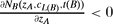 , we get NB(zA, cL(B), t(B)) < 0 for any zA and Iw = 1 ∀ β(t(A)). In other words, γ1 = ∞.
Second, assume that NB(0, cL(B), t(B)) ≥ 0. Then there exists zAB ∈ [0, 1] such that NB(zA, cL(B), t(B)) ≥ 0 ⇔ zA ≤ zAB. To simplify notation, extend δ(zA, 0) and NA(zA, cL(A), t(A)) to any zA ≥ 0 and define zAA such that

Given Equation (5), we have p < zAA and NA(zAA,cL(A), t(A)) > 0 ∀ β(t(A)).
If zAA ≤ zAB, then NB(zAA, cL(B), t(B)) ≥ 0 and Iw = 0 ∀ β(t(A)). In other words, γ1 = 0.
If zAA > zAB, then Iw = 0 ⇔ NA(zAB, cL(A), t(A)) ≥ 0. Given that  and the conclusion follows immediately.
The proof of (d) follows the same steps as (c).
We will assume that both Equations (5) and (6) hold from now because it is the assumption that does not produce a trivial prediction that peace always prevails. Alternatively, we could assume that either Equation (5) or Equation (6) holds, with some probability, or that neither Equation (5) nor Equation (6) holds, and we would get the same results.
Let fc(cL(A), cL(B)|t(A), t(B)) be the joint pdf of the costs of war and fc(cL(A)|t(A)) and fc(cL(B)|t(B)) be the marginal pdfs. We assume that the support of each marginal pdf is the set of positive real numbers ℝ+. We impose the following condition:
Condition 1. (Costs are Independently Distributed)} For every cL(A) ∈ ℝ+, cL(B) ∈ ℝ+,

Then we show that claim 1 holds, i.e., I(t′) − O(t′) < I(t″) − O(t″) or β(t′) < β(t″) imply that, for any i ∈ {A, B},

Proof. Let us prove the case i = A [the case i = B follows by the same logic because both Equations (5) and (6) hold]. Let us prove the comparative statics for β(t(A)) [the comparative statics for I(t(A)) − O(t(A)], clearly, follow the same logic. The probability that country A gets involved in war as a function of its regime type t′ is

Write c(t(A), t(B), cL(B)) for the cut-off c described in proposition 1 (a). From proposition 1 (c), c(t′, t(B), cL(B)) ≤ c(t″, t(B), cL(B)). Now note that c(t′, t(B), cL(B)) < c(t″, t(B), cL(B)) for a set of positive measure, i.e., whenever

Indeed, NB(p, 0, t(B)) < 0 given Equation (6). Next, NB(0, 0, t(B))> NB(p, 0, t(B)) because  . Finally, if Equation (13) holds, then zAB ∈ [0, p) and c(t(A), t(B), cL(B)) = − NA (zAB, 0, t(A)), which satisfies c(t′, t(B), cL(B)) < c(t″, t(B), cL(B)). We then have

where Fc is the cdf of fc. Thus, prob(Iw = 1 | (t(A), t(B)) = (t′, t)) < prob(Iw = 1 | (t(A), t(B)) = (t″, t)) because c(t′, t(B), cL(B)) ≤ c(t″, t(B), cL(B)), with the inequality being strict for a set of values cL(B) of positive measure, and the support of each marginal pdf is ℝ+. Equation (12) then follows immediately.
Democracy and Nondemocracy
Let the set of regime types T = {D, N}, where D stands for democracy and N for nondemocracy. Given the previous arguments, we have α(N) > α(D), β(N) > β(D), I(N) − O(N) > I(D) − O(D). Therefore, assuming Equation (1) (direct costs are independently distributed), claim 1 implies that a democracy has a lower rate of war involvement than a nondemocracy (prob(Iw = 1 | t(A) = D) < prob(Iw = 1 | t(A) = N)).
Now assume that costs are correlated between the leaders of country A and B. For simplicity, we consider the case where cL(i) belongs to a finite set C. Then we show:
Claim 2. Let

for any c′, c″ ∈ C. Then
(i)

(ii) There is a set C, a distribution of correlated costs and a distribution of regime types prob(t(i) = t) such that
(15)(16)


Proof. (i) Write c(t(A), t(B), cL(B)) for the cut-off c described in proposition 1 (a). From proposition 1 (c), (d), we have

Therefore,

where the second equality follows from Equation (14) and the inequality follows from Equation (17).
(ii) Let p = 1/2, C = {c, c}, where


and


with θ1 > θ2 > 0.
Note that Ni(1/2, c, D) = Ni(1/2, c, N) = 0. Given  , prob(Iw = 1|(t(A), t(B)) = (D, D)) = 0; prob(Iw = 1|(t(A), t(B)) = (N, N)) = θ2; prob(Iw = 1|(t(A), t(B)) = (D, N)) = θ1. (15) follows from θ1 > θ2 > 0. To prove Equation (16), note that

so that


and

 , c L(i) = 1/20 for any i.






Comments
No Comments have been published for this article.