

1. Introduction
In the search for balance between funding sustainability and the security of pensioners’ future income, UK private pension plans have progressively been shifting from Defined Benefit (DB) schemes towards Defined Contribution (DC) ones. DB pension schemes promise pensioners a pre-determined pension benefit, based on a formula that accounts for the individual’s earnings, age and years of service. Companies which sponsor DB schemes take on both the longevity (or demographic) risk, which is the risk that pensioners live longer than expected, resulting in more expensive pension liabilities, and the investment risk from their assets.
In Defined Contribution (DC) pension schemes, employers are relieved from demographic risk, and this is transferred to individual scheme members, along with the investment risk. DC scheme members therefore face greater uncertainty over their future pension income, compared to DB scheme members. DC schemes indeed pay a pension benefit at retirement which is based on the contributions paid by individual employees and on the investment returns that are earned on these contributions. The largely unexpected increases in the life expectancy of pensioners over the last few decades and the declining bond yields have caused serious financial sustainability issues for the sponsors of DB schemes and have led companies to set up alternative types of schemes both in the UK (Clark and Monk, Reference Clark and Monk2006) and worldwide (Conrad, Reference Conrad2012). The number of DB plan members in the UK has dropped by as much as 25% in the last 10 years (Cowling et al., Reference Cowling, Fisher, Powe, Sheth and Wright2017) while the number of active members in occupational DC schemes has soared in the private sector, reaching almost 20 million in 2020. Nevertheless, there are around 1 million active DB scheme members present in the UK (The Pensions Regulator, 2020).
This gradual shift towards a more financialised pension system, which has been a defining characteristic of the last 15 years, was the result of a complex interaction of policy interventions, union pressures, and changes in the regulatory framework, tax rules, and financial landscape (see Bridgen, Reference Bridgen, Heins, Needham and Rees2019). While relieving plan sponsors from solvency issues, financialisation has had profound consequences on the social protection of prospective pensioners (Bridgen and Meyer, Reference Bridgen, Meyer, Meyer, Bridgen and Riedmuller2007), and on gender and pension income equality (Lurie, Reference Lurie2018).
As a consequence, in the last decade, some UK policy-makers have started to question whether the well-known weaknesses of DC schemes can be ameliorated. These weaknesses include the complexity of the financial choices to which plan members are exposed, the investment risk that individuals have to bear, the downside risk of locking in a poor annuity rate at retirement and, ultimately, the risk of being left with too small a pension income. These features, despite being mostly consequences of the remarkable freedom of choice plans offer to members, make planning, both pre- and post-retirement, very difficult. Plan members may also face substantial stress and unnecessary costs. The Social Market Foundation has calculated that four in ten retirees who retire at the age of 65 risk running out of money by the age of 75 if they spend at the same rate as Australians (Keohane et al., Reference Keohane, Evans and Richards2015). It is also clear that wrong post-retirement planning choices will have, as a significant drawback, the consequence that a growing number of pensioners will have to rely solely on the State, because they will exhaust their private pension wealth before they die. For these individuals, pension incomes are likely to be inadequate. This may affect substantially their quality of life, impairing their “active ageing” process (Foster, Reference Foster2018).
To try and mitigate the shortcomings of both DB and DC schemes, recent proposals have introduced hybrid pension arrangements. Defined Ambition (DA) schemes are such an instrument, whose key principle is to substitute guarantees with ambitions, i.e. target levels of benefits that can then be adjusted according to the financial situation of the pension plan. DA schemes are meant to improve certainty for individuals on the one hand, while reducing risks for employers, via risk-sharing mechanisms, on the other. Substantial well-being improvements may be achieved if individuals face less uncertainty regarding their pensions, as documented by Olivera and Ponomarenko (Reference Olivera and Ponomarenko2017).
We focus in this paper on Collective Defined Contribution (CDC) pension schemes, which are a specific type of DA scheme. There are two crucial features of such schemes. First, in CDC schemes, contrary to what happens normally in DC schemes, investment assets are not individually handled, but are pooled across members. Plan members have no choice in how to invest their assets: they give up some freedom in choosing their investment strategies, to enjoy intra- and inter-generational risk sharing. There is evidence that different socio-economic groups within the same country have different attitudes towards solidarity principles (Jaime-Castillo, Reference Jaime-Castillo2013). This evidence supports the idea that offering to prospective pensioners the option of entering a CDC pension scheme is useful from a social policy perspective because it enables individuals to engage in greater risk-sharing at the level at which they are comfortable. Second, the employer does not have to guarantee the level of individuals’ pension benefits: pension benefits are defined not as formal targets, but as ambitions; they can be cut if the pension plan suffers from inadequate funding.
The introduction of CDC schemes in the UK was discussed during the 2000s (see Lewin and Sweeney, Reference Lewin and Sweeney2007), inspired by Dutch occupational pension schemes, which have had such risk-sharing arrangements for over 10 years at the time. However, the Department of Work and Pensions (DWP, 2009) did not actively pursue further the introduction of CDC schemes in the UK at that time. While the UK Pension Scheme Act in 2015 effectively enabled the development of DA plans and paved the way for possible legislation on CDC schemes in the UK in 2015, it was only in February 2018, when the Royal Mail (the UK postal service) and the Communication Workers Union expressed interest in establishing a CDC scheme for 140,000 workers that the UK Government was effectively pushed to take the initiative. The Parliament, as of October 2020, is discussing a bill to provide a framework legislation for CDC schemes (see Thurley and Davies, Reference Thurley and Davies2020). Many issues are at stake, from how far to go on legislating on the design of the specific arrangements, to whether and how to allow the transition from DB to the newly introduced CDC schemes.
A few studies have sought to assess how CDC schemes would perform if introduced in the UK. Wesbroom et al. (Reference Wesbroom, Hardern, Arends and Harding2013) conduct an historical analysis comparing the performance of CDC and DC schemes. Blake (Reference Blake2016) and Haan et al. (Reference Haan, Lekniute and Ponds2015) compare CDC scheme outcomes with Individual DC schemes through a simulation exercise, highlighting the performance smoothing capacity of CDC schemes, but also questioning their sustainability in the UK context.
In this work, we aim to provide first a succinct review of the strength and the weaknesses of CDC pension schemes with reference to the UK environment, benchmarking against international experience. We shed some additional light on the ability of CDC schemes to improve the stability of retirement income, while securing the funding of pensions. We complement and extend previous analysis by combining an historical and a projection-based assessment of the performance of a typical scheme for different cohorts, and by comparing this to DC schemes under different investment strategies. This highlights the potential benefits of CDC schemes to employers and employees in the UK.
The paper is structured as follows: firstly, we consider the characteristics of CDC schemes in the different countries in which they were introduced and we analyse the UK proposal; secondly, we discuss their advantages and drawbacks vis-à-vis individual pension arrangements; finally, we provide a quantitative assessment of the performance of the schemes in terms of expected income replacement rates and their volatilities, both retrospectively, using historical data, and prospectively, using a simulation approach.
2. CDC schemes: international experience and relevance to the UK
In this section, we discuss the key features of CDC schemes and the international experience concerning the operation of these schemes.
Management of assets
In a CDC plan, assets are pooled (hence the term “collective”). Members of a CDC plan have their retirement income paid from the scheme and cannot purchase an annuity on retirement nor have the flexibility of choosing an income drawdown approach: the CDC scheme manages both the accumulation (saving) and the decumulation (spending) phase of retirement planning.
Employer contribution
The contributions that are paid in a CDC scheme are defined: that is, pre-determined by a formula which is known by the contributing party. Contributions may then be fixed or variable within a pre-defined range.
Benefit design
The pension benefits payments that CDC scheme members receive are not directly linked to the amount of contributions paid in but are instead determined by a set formula, which makes them ultimately dependent on the scheme’s financial performance. Benefits are not guaranteed. They are usually divided into two components:
-
base benefits are ascertained as a percentage of a particular member’s revalued average earnings over her career;
-
ancillary benefits are a conditional additional benefit component, taking the form of an inflation-based revaluation of the base benefits, contingent upon the financial performance of the scheme.
Neither base nor ancillary benefits are guaranteed in principle; they depend on the scheme’s financial situation. The funding level is typically used as a measure of the financial position of the scheme. This is defined as the percentage of the fund liabilities that are backed by assets of the fund.
If the funding level is within a pre-defined range (above a lower limit and below an upper limit), then ancillary benefits can be uprated every year by a specified revaluation rate. If the funding level is below the lower limit, ancillary benefits can be uprated by less than the revaluation rate, or not uprated at all, so that liabilities increase more slowly, and the funding level can be restored to within the acceptable range. Adjusting the ancillary benefits may be deemed insufficient to restore the funding level to the desired position within a chosen recovery period, in which case base benefits can also be reduced. If the funding level is above the upper limit, ancillary benefits can be uprated by more than the revaluation rate. Thus, the ancillary benefits are adjusted to restore the funding level to the upper limit whenever the funding level is above the pre-determined range.
Smoothing of outcomes
Bringing together the contributions of a large number of members under a single entity allows a CDC plan to protect its members from sudden swings in the value of its assets. A CDC plan has the opportunity to smooth benefit pay-outs during large market movements. It does this by providing higher benefit revaluations when its investments over-perform, and lower benefit revaluations when investments under-perform. This is similar to with-profits life insurance policies. The smoothing horizon varies from 10 years in Dutch CDC schemes, to 75 or even 100 years in Canadian ones (Bonenkamp et al., Reference Bonenkamp, Meijdam, Ponds and Westerhout2017). The shorter the horizon, the lower the capability of absorbing shocks, but the more stable the funding level is.
Inter-generational risk-sharing
A CDC plan relies on the risk-sharing between different cohorts of members: namely, active members, deferred members and pensioners, and across different generations. The intergenerational risk-sharing nature of a CDC plan is a key lever which allows the smoothing of outcomes. The scheme rules should normally stipulate – or at least provide guidelines to – how much of the risks can be transferred between different cohorts. Welfare gains from risk sharing have been studied by Cui et al. (Reference Cui, De Jong and Ponds2011) and Chen et al. (Reference Chen, Beetsma, Ponds and Romp2016).
International experience
These general principles have been implemented in practice in different ways. The most notable examples of CDC schemes are found in the Netherlands, in Denmark and in Canada. In the Netherlands, most occupational second pillar (i.e. work-related) pension schemes have converted from DB to CDC in the first years of the new millennium (see Frericks (Reference Frericks2013) for a description of the Dutch institutional framework and of the impact of collective schemes). Indeed, unlike UK-based DB plans, the Dutch ones did not have benefit guarantees towards the plan members, thus making the transition feasible. These pension plans typically set their calculation formulas to reference career-average wages and they index benefits to inflation, conditionally upon the solvency of the pension fund (Bovenberg and Nijman, Reference Bovenberg and Nijman2009). These were also the features of the CDC schemes proposed for the UK in 2013 (Wesbroom et al., Reference Wesbroom, Hardern, Arends and Harding2013), and which we will analyse in this paper. In Denmark, since 1964, the ATP scheme is a first-pillar (i.e. state-sponsored) mandatory arrangement that has all the features of a CDC plan. Contributions are partly used to provide guaranteed pension benefits and partly go into a separate fund that is used to deliver ancillary benefits through indexation, conditional on exceeding a target funding ratio. This is sometimes regarded as a Collective Individual Defined Contribution scheme (Bonenkamp et al., Reference Bonenkamp, Meijdam, Ponds and Westerhout2014), because only this second slice of the contributions is collectively managed. A funded first-pillar CDC scheme was introduced in Canada as well, in an attempt to relieve pressure on the traditional state pensions, which are paid directly from contributions receipts. It is based on a fixed 9.9% contribution rate that gives right to career-average based benefits and ancillary benefits related to adjustments for inflation and early retirement. The experience of these three countries is useful as a guide for the possible introduction of CDC schemes in the UK, although the UK environment is different. First of all, CDC pension plans in the UK will provide second-pillar pensions and not first-pillar (state-sponsored) ones, as in Denmark and Canada. This is the main reason why the closest model that the UK government has used as a benchmark for its proposal is the Dutch one. Secondly, participation on the employees’ side is likely to remain voluntary, as it is currently. This constitutes a crucial feature of the UK pension legislation, and may prevent a wide take-up of CDC schemes, even if the automatic enrolment rule – which requires workers to opt-out explicitly from pension scheme membership – may partially offset this drawback. In the next section, we discuss this, together with other advantages and disadvantages of CDC schemes, having in mind the UK background.
3. Discussion of the advantages and disadvantages of CDC schemes
The features of CDC schemes we have described above lead to several advantages and disadvantages, which may depend on several factors that lie outside the pure design of the pension scheme. In this section, we discuss this, and point out the challenges that UK policy-makers will face when planning the rules of implementation of such schemes.
Fixed contribution rates
Both employers and employees in a CDC pension scheme pay contribution rates (as a proportion of salary) that are predictable and independent of the scheme’s investment performance, thus allowing better financial planning by all parties.
Scale
Scale is considered a crucial criterion in the success of CDC schemes, where they have already been implemented (Blake, Reference Blake2016). It ensures that a CDC plan benefits from a large number of members – broadly diversified by age, salary and other factors – among whom to share the investment and longevity risks. Furthermore, larger CDC schemes benefit from greater economies of scale (Broeders et al., Reference Broeders, van Oord and Rijsbergen2016) in terms of lower overhead costs and smaller investment charges. In the Netherlands, participation to second-pillar pension provisions is mandatory, guaranteeing scale to Dutch CDC schemes. Mandatory participation seems essential to maintain trust in the solidarity and intergenerational risk-sharing principles of CDC plans (Cui et al., Reference Cui, De Jong and Ponds2011; Gollier, Reference Gollier2008; Chen and Beetsma, Reference Chen and Beetsma2015). Also, Dutch occupational pension schemes pool assets across different employers, even in slightly different sectors or within the same industry. Contribution rates to Dutch pension schemes are fairly high, which enables their CDC schemes to reach a critical mass, in terms of assets under management, to benefit from cost reduction and economies of scale. Indeed, when trying to assess the success that CDC schemes may have in the UK, scale is likely to be a crucial feature, given that employees’ participation to second-pillar schemes is voluntary in the UK and that, moreover, the typical UK pension contribution rate is lower than in the Netherlands.Footnote 1
Riskier investments
Since a CDC scheme can effectively transfer risk across generations, its investment strategy can be tilted towards riskier assets as compared to an individual DC scheme. This, in the long run, should lead to higher income replacement rates on average than an individual DC scheme. Our analysis in the next section will give support to this statement. Still, although constrained by smoothing across time and generations, higher risk-taking may expose the scheme to underfunding, at least in the short-run. This can lead to cuts in pension benefits, because plan members are the ultimate bearers of solvency risk. Employers which sponsor CDC pension schemes for their employees are not liable for any scheme underperformance (unlike in DB pension schemes).
More stable outcome for members
A CDC plan is able to ensure smoother outcomes for its members by sharing risks across generations and pooling assets together under a single entity. A CDC plan shares some of the principles of with-profits life insurance policies whereby neither bumper nor mediocre scheme performance is entirely and immediately reflected in members benefits. Conditional indexation of pension benefits to inflation reduces the solvency risk of the plan and, consequently, the uncertainty that plan members may perceive in this respect. As noted before, since benefits are not guaranteed, the plan members remain exposed to downside risks, although in general these are less severe than in DC schemes.
Fees
Administrative and operational charges can have a deep impact on net investment returns and, ultimately, on the pension income of plan members. Indeed, a 1% difference in costs may induce a 27% difference in benefits (see Bikker and de Dreu, Reference Bikker and De Dreu2009). Collective agreements (see Bikker et al., Reference Bikker, Steenbeek and Torracchi2012) have been shown to have an edge over alternative pension fund types in lowering administrative costs. Also, based on the Dutch experience, a recent analysis (Alserda et al., Reference Alserda, Bikker and Van Der Lecq2018) finds that industry-wide (CDC) schemes display both lower administrative and investment costs, as economies of scale prevail over the lack of competitive pressure. Also, the smoothing of outcomes that we highlighted in CDC schemes may help reduce investment costs relative to DC schemes because of a lower rebalancing frequency. The last government proposal (see Thurley and Davies, Reference Thurley and Davies2020) advises that CDC schemes should be subject to the same rules of DC schemes, specifically with a cap on charges, although the international evidence discussed above suggests that CDC schemes may charge their members with lower fees than DC schemes.
Reduced decision-making complexity for plan members
A CDC pension plan manages the plan assets collectively, thus relieving members from any choice related to the investment strategy, which may be complex to undertake, especially for financially illiterate people. Moreover, the CDC scheme manages both the accumulation and the decumulation phases of retirement planning, and the individual is not exposed to the risks of annuitization timing (i.e. the risk of buying an annuity when annuity rates are low), because benefits are directly paid out from the CDC pension fund. However, this means that pension savers would need to give up their right to choose the investment funds and to decide their own contribution rates. It is worth noting that this loss of flexibility, in the UK case, concerns only employers’ contributions, because employees’ contributions, given current legislation, can be disposed freely, and, for instance, can be destined to DC plans of the employees’ choice. Indeed, the case for additional flexibility in individual choices within collective schemes has been raised also in the Dutch experience (Van Binsbergen et al., Reference Van Binsbergen, Broeders, De Jong and Koijen2014), as a means to better match individual optimal investment behavior.
Retirement choice flexibility
In the Netherlands, CDC pension members have a fixed retirement age. How to provide retirement choice within CDC schemes is still debated, given that flexibility in claiming retirement benefits starting from 55 was introduced in 2015 for DC schemes. Allowing such a feature in CDC schemes may impair their smoothing ability and jeopardize their feasibility. Also, CDC schemes are designed to handle both the accumulation and decumulation phase, so it is not intended that members will withdraw their accumulated pension wealth at the retirement date. This is an inherent constraint which is not consistent with the UK’s pensions freedom framework. On the other hand, since CDC pension benefits are less dependent on market conditions and annuity rates, it is less likely that plan members will need to postpone retirement. This is a positive feature both for individuals, who can base their retirement decision primarily on other non-financial factors, and for employers, who can better plan human resources and the finances of the CDC scheme.
Communication of benefits
In DC pension plans, a statement of account with an end-of–year balance or capital amount is communicated to plan members. In contrast, in a CDC pension plan, the level of benefits is expressed as a projected pension income, since this is not directly related to immediate investment performance, choices and fees. This type of communication is indeed more effective in making individuals able to plan for their future needs in retirement. However, it may be difficult to make plan members understand the conditional indexation mechanisms implicit in CDC shcemes and the fact that benefits are not guaranteed. It may also be argued that investment policies, benefit smoothing and inter-generational risk sharing lead to a loss of transparency (Aitken, Reference Aitken2014). In particular, the structure of intergenerational guarantees may be complex or difficult to understand (Van Binsbergen et al., Reference Van Binsbergen, Broeders, De Jong and Koijen2014).
Intergenerational risk-sharing and risk-pooling may be unfair
The nature of the cross-generational risk-sharing mechanisms may lead to different final outcomes across young and old plan members. CDC schemes’ smoothed outcomes can indeed be higher or lower than actual market performance, depending on the retirement date. However, many studies highlight the welfare optimality of risk-sharing based plans relative to optimal individual investment (see for example Cui et al., Reference Cui, De Jong and Ponds2011). Voluntary participation may indeed lead to different participation rates across cohort, possibly jeopardizing inter-generational risk sharing optimality. Also, low-earners are expected to cross-subsidise high-earners; low-earners contribute for longer, as they leave school and join the workforce earlier, but receive benefits for a shorter span of time, as they have a lower life expectancy. This is a side-effect of risk pooling, present in all insurance systems, whereby one group of members bears a greater proportion of the risk.
4. Modelling and comparing the performances of CDC and DC schemes
This section investigates, both with an historically-based and with a simulation-based approach, the performance of a typical CDC scheme compared with its natural contender, the DC scheme, which is currently the most common type of pension provision in the UK.
Methodology
We consider the case of a femaleFootnote 2 pension scheme member who joins the scheme at age 40 and retires at age 65, to model a member with a 25-year long contribution history. She pays a contribution into the scheme of 10% of pay every year. Pay increases every year at a constant rate of 3.5%, which matches the historical average wage increase of a private sector worker in the last 50 years. No expenses and fees are incurred. For simplicity, we assume that membership is stable. Unstable membership could have consequences not only to the stability of a CDC scheme’s finances, as mentioned earlier, but also to the adequacy of the retirement savings of the members, and this is especially relevant for low-income earners.
We seek to contrast the income replacement rates delivered by (1) a CDC scheme, which invests all of its assets in the UK stock market (UK equities), (2) a DC scheme which invests in UK equities only, (3) a DC scheme which invests in UK government bonds (gilts) only, and (4) a DC scheme which follows an age-phased or lifestyle investment strategy, gradually shifting the allocation from equity to bonds, and investing everything in bonds as from the time point of ten years prior to retirement.
The benefit design of the CDC scheme is the following. The base benefits are defined in terms of 1% of Career Average Revalued Earnings (CARE). Hence, post-retirement income from base benefits (BB) for an individual joining the plan at age x is given by the following formula:
 $$BB\,=\,1{\rm{\% }}\mathop \sum \limits_{k\,=\,1}^N Sal\left( {x + k} \right)$$
where N is the number of years of service, and Sal(x+k) is the salary earned at age x+k, with x the initial age of the worker. The index k ranges from 1 to N to account for the base benefits pertaining all the years of service. Pension benefits are therefore linked to salary, which is a valuable feature for plan members (Fernandez, Reference Fernandez2012).
The ancillary benefits consist of the revaluation of the base benefits. The revaluation rate is fixed at 2%, if the funding level (ratio of assets and liabilities of the fund) lies within the range 90–110%Footnote 3 . This range is called the funding gate. An automatic mechanism, which adjusts the level of ancillary benefits (or base benefits, if needed) resets the level of funding to 110% if the funding level is outside the funding gate. There is no smoothing, as re-adjustments are made by cutting end-of-year ancillary benefits (or base benefits, if needed).
The DC scheme member at retirement, instead, buys an inflation-linked annuity with her accumulated pension wealth. Thus, the pension benefits are the inflation-linked annual lifetime income the member obtains by this annuity.
In the historical analysis section, we compare the performance of the four schemes, using the yearly financial returns historically realized by the UK equity market and government bonds from 1930 to 2015 to compute the accumulated pension pots of pension scheme members entering the scheme in the different years. Data are taken from Barclays Bank (2016).
When computing the future expected performance of the DC and CDC pension plans over the period 2016 to 2065, we instead use a simulation approach. We set up a model that generates randomly future equity returns, bond returns and inflation. The model reproduces the observed characteristics of the variables in the period 1930-2015. We assume no salary or demographic risks. We simulate 1000 economic scenarios, i.e. 1000 possible realizations of the series of future returns, bonds and inflation, and compute, for each, the income replacement rates for our sample member for the four different types of pension funds. A technical supplement (available upon request) provides further details on our simulations.
Historical analysis
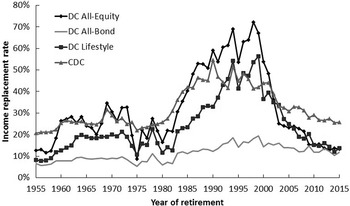
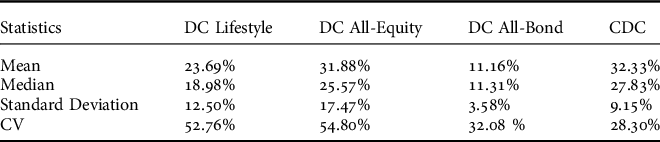
In this section, we analyse the income replacement rates at retirement that our pension member would have obtained by staying in a pension scheme until retirement (at the fixed age of 65). The rates are illustrated in Figure 1 for the CDC and the three DC schemes, with the corresponding statistics shown in Table 1.
Historical income replacement rate of a member of CDC vs. DC schemes, retiring at age 65 after 25 years of contributions, in the year reported on the horizontal axis.

Mean, median and volatility of income replacement rates obtained using historical data for the four different schemes

Figure 1 shows the income replacement rate obtained by a member who retires in different years (but always at the fixed retirement age of 65). The graph for the CDC scheme is always higher than that for the DC scheme following the all-bond strategy, and higher than the lifestyle investing DC, except for a few years during the late Nineties. Table 1 shows that the mean and median income replacement rates are higher in the CDC scheme than in all 3 DC schemes. The median outcome under the CDC plan is higher than the bond-based strategy by 2.5 times and the lifestyle strategy by 1.5 times. On average, the CDC scheme also outperforms the all-equity DC scheme (32.33% versus 31.78%), showing however a much less volatile outcome (9.15% versus 17.47%). Indeed, the coefficient of variation of the replacement rates, which is the ratio of the standard deviation and the mean and thus provides a measure of risk per unit of expected return, is lowest for the CDC scheme. Due to its inherent internal smoothing mechanics, the CDC benefit structure provides more stable outcomes.
It is worth noticing, from Figure 1, that this smoothing prevents the CDC plan from performing as well as both the all-equity and lifestyle strategies in years with a booming equity market: for example, in the 1990s. The converse is true in years when market conditions are bad or average: for example, in the early 2000s, after the dot-com crash. This is due to the fact that benefits in a CDC scheme are only adjusted when the funding level breaches the funding gate.
It is interesting to note how variable the income replacement rates can be for a member in the DC scheme, hence making retirement planning difficult. For example, Figure 1 shows that a member of the DC scheme following the life-style strategy who retires in 1999 would have enjoyed an income replacement rate of 56.3%, while a member retiring only five years later would have received a mere 27.2%, a fall of more than 50%, due to the much more adverse market conditions. Members of the CDC scheme retiring in the same years would have also experienced a fall in their income replacement rates, but not so severe (from 42.0% to 32.5%). The DC scheme member is indeed much more exposed to the whims of the markets compared to a CDC scheme member.
Table 2 displays the performance of the CDC scheme vis-à-vis the DC lifestyle scheme during the financial crisis of the late 2000s. Table 2 clearly shows that the mean outcome for the CDC scheme is higher throughout this period, while the volatility is always lower. It is interesting to point out that the CDC scheme does not suffer from considerable sudden jumps or falls in income replacement rates which can jeopardise the retirement planning of an individual member. Also, it is worth recalling that this result is reached following a very risky investment strategy, with all pension savings invested in the stock market. Indeed, the reported Liability Sharpe Ratio, which is a risk-adjusted measure of the performance of the scheme (namely, the mean income replacement rate as a proportion of its standard deviation) is always higher for the CDC scheme. Nonetheless, this leads to a lower volatility level than the DC lifestyle scheme and to the lowest coefficient of variation (a mean-standardised measure of dispersion, defined as the ratio of the standard deviation and the mean) among all alternatives.
Mean, volatility and a risk measure of the projected income replacement rates for the CDC and the DC lifestyle scheme for individuals retiring in the years spanning the financial crisis

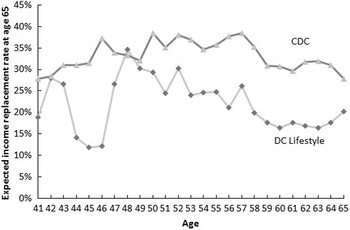
Figure 2 reports the expected replacement rates at retirement for an individual at each year-end from her enrollment in the pension scheme, until retirement at age 65 in 2009. This can be thought of as the expected pension income which is communicated to each pensioner. It is evident that the pensioner enrolled in the DC plan would have been told at some point during her working years that her income replacement rate would be drastically different to the one predicted just a few years before: at the age of 42 she could expect an income replacement rate of around 28%, but two years later her projected replacement rate was nearly half that amount. This graph exemplifies the unpredictability inherent in the outcomes from DC plans, which not only makes retirement planning difficult but also makes it harder for employees to chart their financial journey pre-retirement.
Expected income replacement rates for a member of CDC scheme versus DC Lifestyle scheme, who retires at age 65 in 2009, as projected at different ages.

The CDC scheme offers instead a smoother ride over the years, hence making retirement planning and all the associated decisions easier and more reliable. Nevertheless, we cannot ignore the fact that, during those four years, the CDC plan does show a difference between the starting and ending income replacement rate, although not drastic. We can attribute this to the fact that the plan in our model is exposed fully to the stock market, which was very volatile during the financial crisis.
To understand better the mechanism by which benefits are adjusted in the CDC scheme, we analyse the pattern of benefit adjustments over a long historical window, which starts in 1931 and ends in 2015. Out of a total of 85 years, benefits are fully increased 59 times, and cut or unchanged only at the beginning of the plan’s life. The benefit cuts occur mostly during the Great Depression and the ensuing years in the 1930s. As the scheme matures, there are virtually no cuts due to the risk-sharing feature of CDC plans and the build-up of the scheme’s assets.Footnote 4
The benefit adjustments for the CDC plan can be very sizeable and also volatile over the years. However, this is partly due to some of the simplifying assumptions we have made in our model. In particular, any shortfall or excess of the funding level in relation to our funding gate is corrected immediately by adjusting the benefits, while in practice they can be amortised over a period of time and hence follow a smoother pattern. Secondly, the nominal liability cash flows are assumed to grow with price inflation every year. This simplification implies that the pension plan assets grow faster than pension liabilities because contributions are assumed to grow with salary inflation, which is higher than price inflation. In practice, the liability cash flows will be closely linked to the contribution cash flows, implying a closer match and slower adjustment to benefits. Another reason why our model displays large and volatile benefit revaluations is that the present value of the liabilities in each year ignores the adjustments made in the previous year (due to funding level breaches) and is instead set to be the expected present value determined from the original unadjusted liability cash flows. This tends to understate (overstate) the scheme’s funding level at each point if the funding level was below (above) the lower (upper) limit, hence resulting in drastic decreases (increases) in benefit adjustments. Correcting for this simplification will result in a smoother benefit adjustment over time. Such simplifications do not undermine the fact that the CDC plan results in more positive than negative benefit adjustments.
Projected income replacement rates
In this section, we make use of simulations to evaluate the future projected income replacement rates for our plan member from 2016 to 2065. Modelling future behaviour, rather than back-testing on historical data, allows us to determine whether the CDC plan maintains its edge over the DC plan.
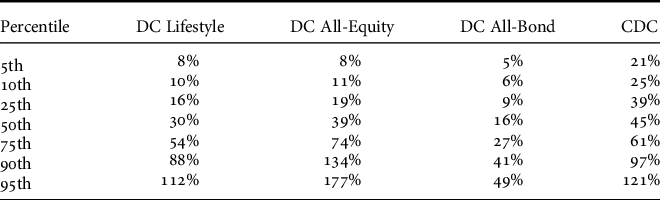
In Table 3 we contrast the distribution of the income replacement rates for individuals retiring with 25 years of service between 2041 and 2050. Our simulation leads to the generation of 10,000 income replacement rates per plan.
Percentiles of the distribution of the projected replacement rates for each scheme

The median outcome (50th percentile) for the CDC pension plan is higher than that of all the other DC schemes. In addition, the 5th–95th percentile range for the CDC plan is narrower than all but the DC All-bond plan, implying remarkable stability of outcomes. Also, the CDC scheme has by far the highest income replacement rate in the 5% worst-case scenario, depicted by the 5th percentile, which shows the highest value (21%). This indicates that the CDC scheme is the least exposed to downside risk: in the event of a very unfavourable economic scenario, it displays the highest performance, compared to all the DC schemes. The All-equity DC scheme has higher percentiles above the median, but it suffers from higher downside risks, more uncertain outcomes and a lower median.
These results hold when we extend the simulation horizon, from 2051 to 2065. We find that the CDC plan displays a higher average income replacement rate than the DC lifestyle plan in every single year. In addition, its 25th percentile outcome is always higher than the median of the DC lifestyle scheme across every single simulation year. The CDC plan not only provides a higher replacement rate on average, but it is also expected to provide a higher replacement rate for every projected year.
We identify only 39 instances of benefit cuts, out of a sample size of 25,000 simulated. Benefit cuts occur when the funding level of the scheme falls below the lower limit of the funding gate, set to 90%. Hence, a benefit cut is expected to occur with a probability of only 0.16%, which is small compared to the historical probability (2%) we have obtained in the previous subsection. This result seems to suggest that benefit cuts are expected to be very rare and to happen only under extreme economic conditions.
We acknowledge that we have made some simplifications. The individual is assumed to work with no career breaks, and enter the scheme relatively late in her lifetime (a situation which can reproduce a switch to a CDC from another scheme). Sensitivitiy analysis – which we leave to future work – may shed some light on how smoothing and risk-sharing work for different types of plan members.
Also, we have made some simplifying assumptions in the way that our schemes operate for ease of modelling. We assumed a stable membership for the CDC scheme, i.e. that the distribution by age of the plan population does not change over time. One might expect the CDC plan to operate optimally under such conditions. In practice, the distribution of members by age may vary over time: for example, in an industry where new technology may supplant new younger employees, resulting in a slowly maturing plan population. Nonetheless, CDC pension plans should have a fairly stable membership profile if they encompass a large number of employees, possibly diversified across many employers and industries. On the other hand, we also assumed, for the sake of simplicity, that the liability present values are adjusted within one year, whereas in practice the adjustment will happen over an amortisation period (10 years for the Dutch CDC schemes, for instance). Spreading the adjustments over a longer period of time, rather than just one year, will lead to smoother benefit adjustments. Also, we assumed full annuitization in our modelled CDC plan. The income replacement rates could be lower if members are given the ability to take a lump sum at retirement in exchange for a lower pension. The comparison that we draw is fair since we assumed full annuitization for the DC schemes as well. However, individuals’ reluctance to annuitize and preference towards lump sums at retirement (see Inkmann et al., Reference Inkmann, Lopes and Michaelides2010) may disincentivise membership of CDC schemes, which inherently constrain pension freedom by managing both the accumulation and decumulation of a member’s pension wealth.
5. Discussion and concluding comments
This paper discusses the characteristics and possible advantages of Collective Defined Contribution (CDC) plans, which have been proposed for pension provision in the UK. We described the most important features of CDC plans and we assessed, through a quantitative analysis exercise, their performance compared to DC pension schemes with different investment strategies.
Our illustrative analysis provides evidence that a CDC plan can be beneficial for both employers and employees. A CDC plan is able to provide higher and more stable pensions for its members by sharing risks across generations and by smoothing outcomes during unexpected market swings. The results hold true both looking at historical data and at forward projections using a scenario-generating model.
We also highlighted the main advantages of CDC schemes. CDC scheme members are relieved from difficult financial decisions, whilst employers are not burdened with any balance sheet risk because contribution rates are fixed and pensions are not guaranteed. With a large enough size, a CDC pension plan may take advantage of economies of scale, hence reducing investment costs and other overheads.
All in all, the CDC pension plan seems to fit in with the UK government policy aim of providing a half-way solution between the two polarised models currently existing: namely, the DB and the DC pension schemes. Although it is not perfect, the CDC plan appears to better fulfil the policy aim of making pensions less of a lottery for pension savers, as compared to a DC scheme.
While appetite for such schemes has been moderate until 2018, the interest expressed by Royal Mail in starting a large scheme covering 140,000 potential members served as a trigger for legislative action and CDC schemes are likely to become a viable option in 2021 or 2022. The question arises as to whether other DB schemes or DC ones will be interested in a transition to the CDC world. While it is likely that some remaining active private sector DB schemes may convert to the CDC model, it seems unlikely at the present time that DC schemes will transition. This may change in the future if pension poverty emerges from DC pension provision, especially for lower-income workers. It may also be the case that some public sector schemes may adopt CDC-like characteristics. An effective statutory and regulatory framework will be crucial in making CDC pension plans feasible and attractive both to companies which sponsor pension plans and to employees who save for their pensions. The UK’s legislative environment is now faced with the practical challenges of introducing CDC plans. Several issues are at stake, such as the amendment of the tax system, and the voluntarism of pension scheme membership, and these may hinder the success of CDC plans with sufficient scale in the UK.
Acknowledgements
Luca Regis gratefully acknowledges funding from the “Dipartimenti di Eccellenza 2018-2022” grant by the Italian Ministry of Education.