In Japan, there are only 7 burn centers in Tokyo (Kyorin University Hospital), Kanagawa (Tokai University Hospital and St. Mariana University Hospital), Chiba (Chiba Medical Emergency Center), Aichi (Chukyo Hospital), and Hyogo (Hyogo College of Medicine Hospital) and Fukushima (Ohta General Hospital) combined, and each of these centers can receive only a few severely burned patients. There are 39 advanced emergency medical service centers in Japan that also have burn care units and receive severely burned patients, as well as 284 standard emergency medical service centers in Japan that do not have burn care units but by principle will manage severely burned patients. In Shizuoka, there are 10 emergency medical service centers, including 2 advanced-care facilities (Shizuoka General and Seirei Mikatahara General Hospital).Reference Ishikawa, Yanagawa and Kato 1
According to a Nikkei report, there have been 5 fatal accidents due to chemical plant explosions in the past 10 years (Table 1) (https://www.nikkei.com/article/DGXMZO24138980R01C17A2000000/, Table 1). The main cause of chemical plant explosions was estimated to be the advanced age of factories built in a period of high economic growth. Japan has been relatively peaceful since the Tokyo subway sarin attack in 1995. Caution against terrorist attacks is increasing in urban areas as the 2020 Tokyo Olympics approach, but similar efforts are not being made in rural areas; these non-urban areas therefore tend to be underprepared and ill-trained to manage complex special disasters, such as chemical, biological, radiological, nuclear, and explosive (CBRNE) incidents.
Fatal Accidents Involving Chemical Plants

We herein report multiple patients with burn injury due to a chemical explosive accident managed by physician-staffed helicopters in a rural city.
INCIDENT REPORT
Fuji City is located in the foothills of the world-famous Mount Fuji, around 100 kilometers west of Tokyo, Japan. On December 1, 2017, the temperature was 7 °C, and the Fuji factory of Arakawa Chemical Industries in Fuji City suddenly exploded, resulting in a fire (Figure 1). The shock wave from this explosion broke the windows of residents’ houses near this factory. In Japan, residential houses cannot be built in exclusively industrial districts; however, these legal regulations were not applied in this particular area, leading to the situation of residential houses residing just next to this factory site. The Fuji factory had four floors and produced resin for printer ink and making paper and used volatile flammable chemicals, such as xylene and triethylamine. Dust that formed as a byproduct from the crushing and packing process of the resin for ink exploded on either the first or second floor of the facility; 6 workers were located on the first floor, and another 6 were located on the fourth floor. Xylene and trimethylamine are not believed to have been the cause of the explosion, based on information from the Fuji City Fire Department.
Explosive Fire Accident at the Fuji Factory of Arakawa Chemical Industries.

Within a minute of the explosion, at 8:26 AM, the Fuji City Fire Department received the first call from a resident regarding the explosion of the factory. The fire department initially dispatched 7 fire engines and 1 ambulance. They then requested the dispatch of a physician-staffed helicopter (known as a doctor helicopter [DH] in Japan) in eastern Shizuoka, which serviced Fuji City at 8:34 AM. The DH in eastern Shizuoka parked at our hospital, which also functions as a disaster base hospital and has an emergency medical service center with 577 beds and oversees the activities of the fire department at eastern Shizuoka as members of the Japanese Medical Association. The DH can transport 1 severely wounded or ill patient who needs to be kept in a supine position and 1 mildly injured patient who can maintain a sitting position. On this day, the number riding in the DH in eastern Shizuoka was increased from 2 (1 doctor and 1 nurse usually) to 5 (3 doctors and 2 nurses) to address this critical situation, as a mass casualty event was expected. They also requested the dispatch of the DH from western Shizuoka (although this DH could not be dispatched due to overlapping requests) in addition to those from Kanagawa and Yamanashi Prefectures, based on a preliminary assessment of the incident, in accordance with a neighboring prefecture agreement.Reference Ishikawa, Yanagawa and Kato 1
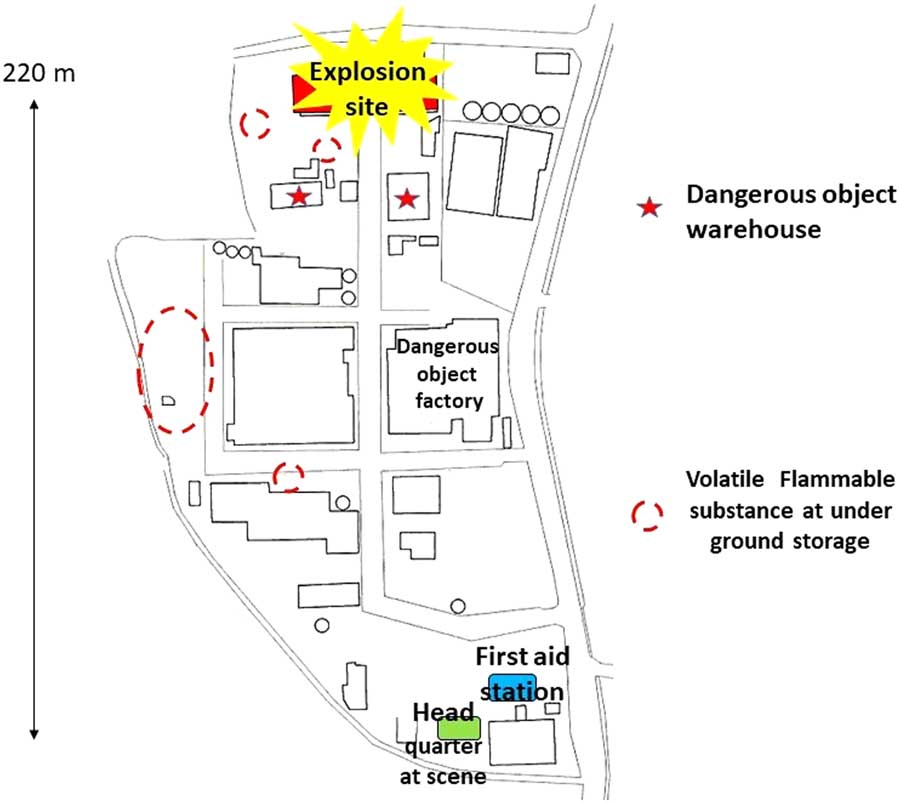
At 8:35 AM, the first party arrived at the scene and established a headquarters and first-aid station 220 m windward from the explosion site based on advance planning, without wearing any special protective equipment, and no chemicals and/or radiation were detected (Figure 2). However, this area was considered to be at risk of a second explosion, and therefore the advanced planning measures were thus deemed to be flawed from the start. As the number of firefighters present was too small to respond to the scale of the fire, a commander on the scene from the Fuji City Fire Department decided to increase the party size to 17 fire engines and 3 ambulances. Residents living within 100 meters of the factory were ordered to evacuate by the Shizuoka Local Government. The government also ordered local Shizuoka disaster medical assistant teams (DMATs) be ready for dispatch based on the dispatch criteria (when the presence of more than 20 moderately and/or severely wounded patients is expected); of note, this was the first order for the local Shizuoka DMATs and was canceled later after the incident was brought under control.Reference Yanagawa and Jitsuiki 2 The Japan Railway Company also temporary canceled service near the factory.
Schematic Illustration of the Fuji Factory.

Hyper-rescue units for special disasters in Shizuoka Prefecture were located over 1 hour away from the factory. Emergency medical technicians (EMTs) from the first party made contact with 7 burned patients, 2 of whom were categorized as “red” and 5 as “green” by triage, and escorted them to the first-aid station. They then checked the other 4 burned patients, who were able to walk, and categorized them as “green.” When 3 physicians from the DH of eastern Shizuoka arrived at the headquarters of the scene at 9:13 AM, there was no commander on site, because he had moved to another advance command post nearer to the explosion site to directly command the firefighters near the fire. The subcommander explained the details of the explosion, fire, and the burned patients at the first-aid station and the 1 missing person at the scene to the DH physicians. However, the subcommander later moved to the advance command post without notifying the physicians. The staff of the DH routinely treated patients at the scene of accidents under control of firefighting so that the staffs of the DH lost their firefighting’s commander.
One of the physicians of the eastern Shizuoka DH assisted in the management of the headquarters, and the other 2 physicians and 2 nurses performed re-triage for all 11 burned patients. As a result, the number of “red” patients increased to 3 and that of “yellow” to 2, whereas the number of “green” patients decreased to 6 (Table 2).
List of Patients

III: Full thickness burns
II: Deep dermal partial thickness burns
All of the burned patients worked in the factory that had exploded and subsequently had been contaminated by chemical materials. Responders at the scene noticed that some chemical materials were volatile during activities after obtaining information of the chemical materials from the DH control room; however, they did not have tools to measure the concentration of such volatile chemicals. Accordingly, when the staff of the DH asked the firefighters about the degree of contamination, they were unable to receive a satisfactory answer. The hospitals with burn care units and the standard emergency medical service centers without burn care units near the factory are shown in Figure 3. Two of the 3 severely burned patients (categorized as “red”) were transported to Shizuoka General Hospital by ground ambulance and Yamanashi Prefectural Central Hospital by the DH of Yamanashi Prefecture without decontamination. The physician, who smelled nothing unusual and escorted the severely burned patient by ground ambulance, complained of a headache due to the inspiration of volatile chemicals from the patient. The symptoms of this physician improved spontaneously, and there were no such complaints from other patients or firefighters. The third severely burned patient was accommodated at a local hospital that usually did not receive severely burned patients. They ultimately abandoned trying to treat the patient, instead only decontaminating him before transporting him to Tokai University Hospital via the DH of Kanagawa Prefecture (Table 2). One of the 2 moderately burned patients underwent dry decontamination and thereafter was transported to Saiseikai Shizuoka Hospital by the DH of eastern Shizuoka. The other moderately burned patient and the 6 patients with inhalation burns were transported without decontamination to two local standard hospitals that also did not generally receive such patients. Fortunately, all patients who were transported to medical facilities obtained a survival outcome. The one missing person was ultimately found at the scene, but he was already dead.
Layout of Major Hospitals Offering Burn Treatment Near the Fuji Factory.

DISCUSSION
Several points concerning our experience should be discussed, namely the preparation and first movement followed by command and control, safety, communication, triage, treatment, and transportation, which was settled by the Major Incident Medical Management and Support system in the United Kingdom.Reference Lowes and Cosgrove 3
Preparation
The preparation for CBRNE incidents was insufficient in this case. Shizuoka Prefecture is divided into 3 sections: western, middle, and eastern. Based on the population density, the western and middle sections have hyper-rescue units allocated for CBRNE incidents. However, there are no such units in eastern Shizuoka, which includes Fuji City. Although the Sunto-Izu Fire Department in eastern Shizuoka next to Fuji City recently trained for CBRNE incidents, Fuji City Fire Department did not participate.Reference Yanagawa, Ishikawa and Takeuchi 4 In addition, many EMTs in the Sunto-Izu Fire Department attended a mass casualty life support (MCLS) training program, and some attended an MCLS-CBRNE training program provided by the Japanese Association for Disaster Medicine, but no such systematic educational training was performed for the Fuji City Fire Department.Reference Yanagawa, Omori and Ishikawa 5 , Reference Yanagawa, Anan, Oshiro and Otomo 6 Physicians seeking to become staffed on the DH attend a lecture run by the Japanese Society for Aeromedical Services where they learn basic aviation medicine as well as the characteristics and safety of helicopters, how to use a radio, how to collaborate with the fire department and how to treat endogenous and exogenous diseases in a prehospital setting. However, they receive no training concerning CBRNE incidents. Accordingly, the young physicians of the DH also lacked training and experience in decontamination for CBRNE incidents. Such insufficient preparation for CBRNE incidents resulted in disharmonious activities that adversely affected the patients. The present case therefore suggests that physicians seeking to become staffed on the DH should receive education, specific training, and maintenance training concerning CBRNE incidents as early as possible.
First Movement
The fire department initially believed they were responding to a fire incident and did not recognize the incident as a CBRNE incident.Reference Bar-El, Tzafrir and Tzipori 7 , Reference An, Kullgren, Jarvis and Abergel 8 In CBRNE incidents, it is standard for the first responders to wear special personal protect equipment, such as a positive-pressure self-contained breathing apparatus with a fully encapsulating protective suit, and to detect or measure chemical, biological, radioactive, and/or explosive materials and then establish zones.Reference Bar-El, Tzafrir and Tzipori 7 , Reference An, Kullgren, Jarvis and Abergel 8 Because some types of terrorist attacks are more likely to be unsuspected or covert than others, a high suspicion for terrorism is important.Reference Koenig 9 However, this incident lacked such management. In the Tokyo subway sarin attack, the first responders from the fire department responded as though the incident were a normal explosive accident, and many of them consequently became contaminated and were injured by the sarin gas.Reference Okumura, Suzuki and Fukuda 10
Command and Control
The activities of the firefighters, police officers, DHs, the suffer faculty, and local government were well organized, respectively. However, the cooperation (control) among these organizations was poor. In Japan, mass casualty scenes, aside from terrorism events, are controlled by firefighters. However, the staff of the DH lost contact with the firefighter commander at the first-aid station and thus co-operated and negotiated with EMTs on how to treat and transport patients, as well as regarding the destination (hospital).
Communication
Face-to-face communication was used at the scene in principle. Handheld phones and portable radios worked well, facilitating communication within each organization. However, the responders at the scene did not use these communication tools among the organizations, because they did not know how to contact other organizations using these tools, nor did they know their own code or others’ names.
Safety
Self
See section on preparation.
Scene
The firefighters knew that they were working in a dangerous area because there were several warehouses of explosives and underground storage facilities located near the Fuji factory. However, there was no commander at the headquarters at the scene when the DH arrived, and no one mentioned the existence of the advanced command post to the physicians of the DH. As such, none of the physicians were able to contact the commander and therefore did not know that the headquarters and first-aid station at the scene were at risk of a second explosion. In general, medical teams such as DMATs work in a cold zone according to the regulations of the Japanese Ministry of Health, Labour and Welfare. Because the headquarters and first-aid station were located in a dangerous zone due to a flaw in the advance planning, the medical staff transported by the DH should have sought a safer area to treat the patients. During the September 11, 2001, attack on the World Trade Center, when police officials concluded that the twin towers were in danger of collapsing and ordered the police to leave the complex, fire officials were not notified due to an error in communication between the police and fire departments. As a result, large numbers of rescue workers were injured or killed by the collapse of the buildings. 11 With adequate emergency preparedness plans along with well-organized communication, any organization can deal with an emergency, preserve life and property, and possibly enhance its reputation in the public’s mind. As such, staff working in dangerous prehospital areas should try to establish effective communications with other organizations at the scene.
Survivors
Similar to medical staff responders, the survivors should have been evacuated immediately to a safe zone with dry decontamination. Instead, however, the survivors stayed at the dangerous first-aid station, which consisted of plastic sheets that had been spread on asphalt, and the patients were still wearing contaminated clothes due to the cold temperature at that time. In a hospital setting, medical staff at least perform dry decontamination when a patient is known to be contaminated. However, the EMTs and DH staff might have hesitated to remove the survivors’ clothing, given the low temperature and because they were in a public area.
Triage
Triage should have been performed as with a CBRNE incident. In principle, victims of CBRNE incidents should receive both pre- and post-decontamination.Reference Chan 12 Pre-decontamination triage aims to (1) ensure that severe casualties undergo early decontamination, in order for them to receive early definitive medical treatment post-decontamination; (2) provide basic life support measures, for example, stopping external hemorrhaging and instating a bag-valve mask ventilation, even before decontamination; and (3) enact the early administration of antidotes for organophosphate poisoning. However, in the present case, the first responders performed simple triage and rapid treatment (START) for the burned patients.Reference Burstein and Hogan 13 As a result, almost no patients received decontamination, and all patients who were able to walk were categorized as “green.” The DH physicians evaluated the severity of the patients’ burns and assessed the effects of chemical exposure but did not consider the explosion itself. Triage guidelines based on MCLS-CBRNE recommendations state that all symptomatic patients should be classified as “yellow,” even if they can walk, because delayed fatal symptoms may occur.Reference Anan, Otomo and Kondo 14 Chemical inhalation injury may progress to serious acute lung injury later.Reference Zhang, Zheng and Ma 15 Blast lung or intestinal injury due to an explosion also may deteriorate, even if the patients are initially asymptomatic.Reference Goh 16 Accordingly, the present patients who were categorized as “green” should have been categorized as “yellow.”
Treatment at the Scene
All patients received appropriate medical treatment in a prehospital setting.
Transportation
The final point of note was the selection of the receiving medical facilities. When determining dispersion transportation, the physicians selected local medical facilities that usually did not treat severely burned patients or patients with inhalation burn injury. Whether or not burned patients are transported to a burn center and the efficiency level of the hospital affect the outcomes of patients with severe and inhalation burn injury.Reference DeSanti, Lincoln, Egan and Demling 17 – Reference Kadri, Miller and Hohmann 19 Accordingly, all patients involved in the present incident should have been transported to at least acute critical care centers. However, in the Formosa Fun Coast explosion in Taiwan in 2015, there was a blast involving 495 casualties in total, with 253 patients receiving second-degree or deeper burns on >40% of the total body surface area.Reference Kuo, Yen and Fu 20 Many of the burned patients were transported to a local hospital and received initial appropriate resuscitation. As a result, no marked difference in the mortality was observed between those who received direct admission and those who were transferred to burn centers. Accordingly, even local hospitals may be capable of providing high-quality acute care to mass casualty burn victims, at least temporarily, provided the hospitals have received adequate training. In Japan, in unsafe zones in CBRNE incidents, all victims and assistant medical teams are temporarily sent to the nearest acute critical care center, at which point the victims receive dispersion transportation as planned by the Japanese Association for Disaster Medicine (https://jadm.or.jp/).
Not all disaster areas have access to the same resources, training, and exercises. However, to avoid confusion or unintended consequences of decisions made during preparations at the scene, first responders need to be taught and trained based on plans specifically concerning CBRNE management. After the present incident, following a discussion among the parties concerned, the importance of preparedness and training for CBRNE incidents was recognized. In addition, the importance of sharing information among the parties concerned was also recognized, especially with regard to safety information. The medical staff’s need to work in a cold zone was also recognized by the fire department.
In eastern Shizuoka, all of the members involved in this fire incident, including the firefighters, EMTs, and medical staff at the local and acute medical service centers, are now cooperating in preparation for subsequent CBRNE incidents by conducting a meeting to review this chemical explosive fire incident.
CONCLUSION
We herein reported a rare case of an explosive chemical fire in Japan. CBRNE incidents are rare but can be fatal for responders to this kind disaster. Therefore, all who work at this type of setting should be prepared and train adequately to ensure that they have the knowledge and skills to both manage patients and protect themselves from harm. Valuable management and treatment lessons were learned from this mass casualty chemical burn incident.
Funding
This research is supported by the Ministry of Education, Culture, Sports, Science, and Technology-supported Program for the Strategic Research Foundation at Private Universities 2015-2019 to establish a total research system for comprehensive disaster medical management in cases of wide-scale disasters.