Introduction
Infants and children with CHD face challenges in achieving optimal immunisation. Reference Murray, Lee, Brown, Saia, Gongwer and Nakamura1,Reference Remmele, Westphal and Unterleitner2 Only 60% of infants with CHD are fully vaccinated by one year of age, with cardiopulmonary bypass exposure emerging as a significant predictor of under-vaccination. Reference Murray, Lee, Brown, Saia, Gongwer and Nakamura1 This is likely due to the lack of clear guidelines for immunisation schedules in this high-risk group. There is also concern for avoidable adverse events, despite some limited evidence that immunisation does not lead to adverse events in this population. Reference McAlvin, Clabby, Kirshbom, Kanter, Kogon and Mahle3 Specific concerns for infants who have undergone procedures with cardiopulmonary bypass include reduced immunisation titres and the exposure to antibody-containing blood products while on bypass reducing immunisation efficacy. Reference Siber, Werner and Halsey4–Reference Vergales, Dean and Raphael6 However, limited data support these concerns or guides immunisation practices.
A recent study by Gal et al. Reference Gal, Cleveland, Vergales and Kipps5 characterising immunisation practices in the setting of congenital heart surgery found that 66% of paediatric heart centres surveyed deferred immunisations prior to surgery and 89% deferred for variable amounts of time after surgery with different practices for live virus vaccines. We sought to further characterise these practices specifically for infants (0–18 months) with single ventricle heart disease, as they are anticipated to have at least two procedures with cardiopulmonary bypass, long periods of hospitalisation, and increased morbidity and mortality.
Materials and methods
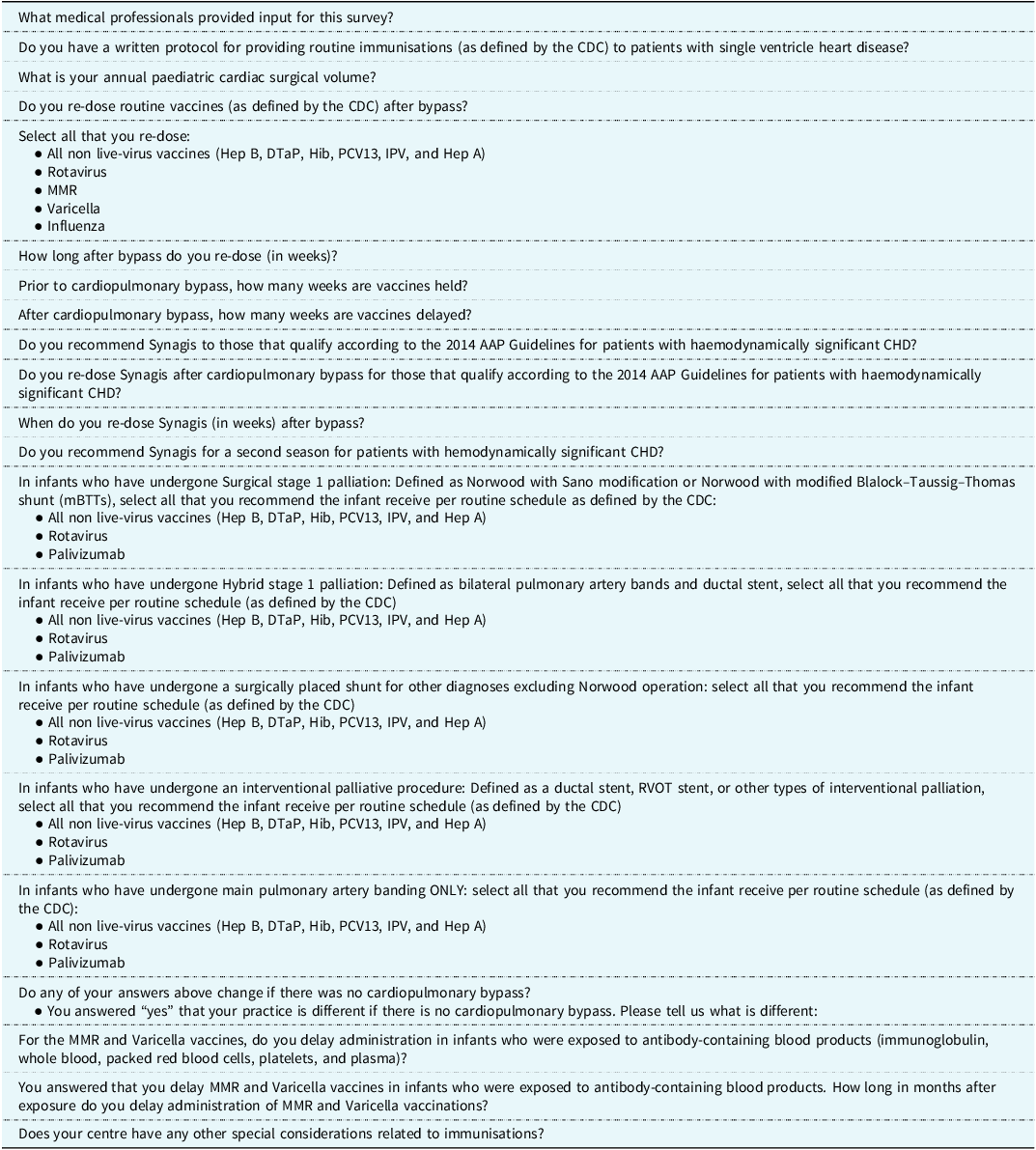
A qualtrics survey was sent to an email listserv of single ventricle programmes across the United States. Survey questions (Table 1) were sent via listserv with three reminders over four weeks. A single collaborative response per centre was requested. Duke Institutional Review Board deemed this study to be exempt, Pro00110663.
Survey questions

Responses were analysed based on centre size, procedure type, and immunisation type. The Society of Thoracic Surgeons definition of centre size by number of bypass cases per year was used to classify the respondent’s programme size (small: <150, medium: 150–349, large: ≥350). Procedures were classified into five categories: surgical stage 1 palliation, hybrid stage 1 palliation, surgically placed shunt, interventional palliative procedure, and main pulmonary artery banding. Immunisations were divided into three groups. The first group included all non-live virus vaccines (hepatitis B, diphtheria, tetanus, and pertussis, Haemophilus influenzae, pneumococcal conjugate; inactivated polio, and hepatitis A), rotavirus, and palivizumab. The second group included all non-live virus vaccines and palivizumab. The third group only included palivizumab. This study was conducted prior to nirsevimab availability. Hepatitis A vaccine was also included since our patient population comprised children aged 0–18 months. Practices around measles, mumps, and rubella and varicella vaccination were collected with regard to delaying and re-dosing around cardiopulmonary bypass.
Descriptive statistics were performed; categorical data are presented as frequency (percentage) and non-normally distributed continuous data as median (interquartile range, range). All analyses were performed using Statistical Analysis Software, version 9.4 (SAS Corporation, Cary, NC).
Results
Of 53 surveyed centres, 40 responded (33 complete, 7 partial). Among the 37 centres that reported programme size, 49% (18/37) were medium, 35% (13/37) were large, and 16% (6/37) were small-sized programmes.
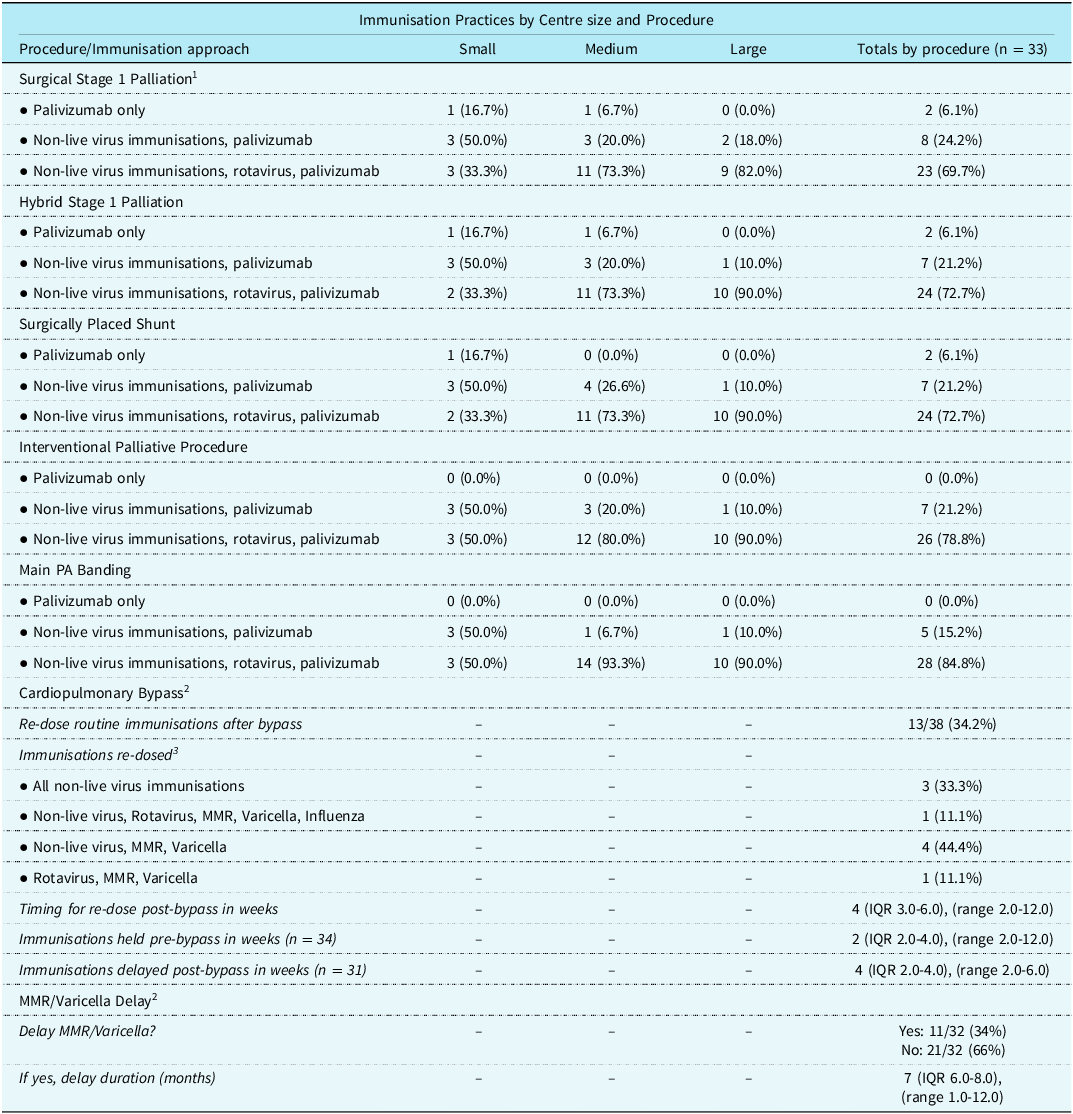
Immunisation recommendations are displayed in Table 2. Only 11% (4/38) of responding centres had a formal written protocol for immunisation recommendations in this population.
Immunisation recommendations

Centre size was determined by annual paediatric cardiac surgical case volume, with data presented as n (%). There were 32 responses for each procedure except for Surgical Stage 1 palliation where there were 33 responses. Additionally, 33 centres reported interstage immunisation recommendations specific to each procedure, with data represented as n (%). There were 32 responses to the questions about MMR and Varicella immunisations. Some responses were incomplete, accounting for discrepancies between centre size reporting by procedure and reporting by procedure alone.
1 Centre size n = 33 for Surgical Stage 1 Palliation and n = 32 for the remaining categories.
2 Data in these sections are not stratified by centre size.
3 Of the 13 centres that responded they re-dose immunisations; only 9 identified which ones and timing for dosing.
Practices for holding or re-dosing immunisations around cardiopulmonary bypass varied among centres (Table 2). Of the 34 centres reporting pre-bypass immunisation timing, 32 (94%) held immunisations before bypass (median delay 2 weeks, interquartile range 2–4 weeks, range 2–12 weeks), and 2 (6%) did not delay. Among the 31 centres reporting post-bypass practices, 30 (97%) reported delayed immunisations after bypass (median delay 4 weeks, interquartile range 2–4 weeks, range 2–6 weeks). Post-cardiopulmonary bypass, 34% (13/38) of centres re-dose immunisations, and 9 centres provided immunisation-specific details (Table 2).
For the centres responding about respiratory syncytial virus prophylaxis with palivizumab, it was recommended by 100% of centres (34/34). After cardiopulmonary bypass, 52% (17/33) of responding centres re-dose palivizumab and 82% (27/33) recommend palivizumab for a second season. Of the 32 centres that responded about MMR and Varicella immunisations, 11 (34%) reported they delay MMR and Varicella immunisations for a median of 7 months (interquartile range6–8 months, range 1–12 months). An additional 2 centres reported delaying all routine immunisations (except palivizumab) until after stage 2 surgery.
Six centres shared additional considerations in a free text response. Special consideration is given to patients at increased risk for immune compromise, such as patients with heterotaxy or 22q11.2 deletion syndromes. Those interventions included having immunology or infectious disease evaluations prior to giving live viruses or giving an extra meningitis vaccine. Two centres recommended scheduled, prophylactic acetaminophen for twenty-four hours post-vaccines. One centre reported limiting the number of vaccines given at one time.
Discussion
We found considerable variation in centre-level immunisation practices for infants with single ventricle CHD. Only 11% of centres have a written protocol for immunisations. Most centres held immunisations before and after cardiopulmonary bypass for a range of 2 to 12 weeks with varying practices regarding specific vaccinations. Infants with single-ventricle CHD undergo multiple surgical interventions, stacking periods of delay and prolonging vaccine preventable vulnerability. There are limited data to guide deferring and re-dosing immunisations for these high-risk infants leading to variations in practice evidenced by our survey responses. Further immunisation serologic titre studies are needed to guide deferral and re-dosing durations. Specific attention should be given to infants with single ventricle congenital heart disease, given their exposure to cardiopulmonary bypass and high morbidity and mortality. With increasing global access to surgical care, children with single ventricle physiology are especially vulnerable to severe outcomes from immunisation-preventable diseases, underscoring the urgent need for clear, timely immunisation protocols worldwide.
Acknowledgements
None.
Financial support
This research received no specific grant from any funding agency, commercial, or not-for-profit sectors.
Competing interests
None.