INTRODUCTION
In his recent book, journalist Peter Maass reflects on the apparent powers of oil: “Across the world, oil is invoked as a machine of destiny. Oil will make you rich, oil will make you poor, oil will bring war, oil will deliver peace.”Footnote 1 In discourses like these, oil is invoked as a singular force capable of producing singular effects – oil wars, oil addictions, and oil states. In one sense, this is a preeminent example of what Karl Marx called fetishism – that is, according material “things” a kind of autonomous power divorced from the social relations that make such “things” possible.Footnote 2 One (of many) confusions is that oil is invoked as a singular commodity. Yet a single commodity must have a specific material use value, and crude oil – in itself relatively uselessFootnote 3 – is valuable precisely because it is the antecedent of a multiplicity of use values. The complex hydrocarbon assemblage of crude oil is only commodified through the refining process, which by its very nature creates numerous petroleum products.
Indeed, much like commodity fetishism, oil fetishism obscures the complex socioecological processes through which crude oil becomes commodified. Refineries are an often invisible but massively consequential node of socioecological transformation and waste production. Refining inevitably leads to leaks, spills, and the flaring of greenhouse gases (and other air pollutants).Footnote 4 The process of crude transformation deploys highly flammable materials through intense amounts of heart and pressure, making deadly explosions and fires a necessary evil of operations.Footnote 5 The products and wastes of the refinery include known carcinogens such as benzene and arsenic that lead to severe burns, skin irritation, chronic lung disease, psychosis, and elevated cancer risks amongst workers and nearby communities.Footnote 6 The 150-mile stretch of refineries and chemical plants along the Gulf Coast, also known as “Cancer Alley,” has become the epicenter of the environmental justice movement where communities struggle to prove scientifically that the concentrated levels of cancer and death all around them are a direct result of oil and chemical pollution.Footnote 7 Refineries are also tremendously energy- and water-intensive. An estimate using United Nations data suggests that a single refinery in the United States consumes an amount of electricity equal to that of 30,633 households.Footnote 8 For cooling towers and steam generation it takes an estimated 1·53 gallons of water for each gallon of crude processed.Footnote 9
Despite these many problems, refineries remain a necessary site through which crude oil becomes useful in modern economic life. Singularizing oil distracts from one of the most potent narratives through which oil's embeddedness within everyday life is naturalized. From the beginning, the petroleum industry has consistently attempted to remind the public that their lives are saturated with not just one but a multiplicity of petroleum products. In this paper, I link the refining process with this particular cultural politics of “life” made possible through petroleum products. While it is increasingly commonplace to claim that oil is central to this “American way of life,” I further particularize this well-worn phrase as a neoliberal imaginary of “life” as purely a product of atomized private energies and choices. While the refinery process itself produces a distinct set of “fractions” distilled and cracked from a barrel of crude oil, petroleum products provide the supplementary materiality for the appearance of segmented lives, each tidily controlled within the private spaces of the home, automobile, and workplace.
This paper proceeds in three sections. First, deploying a Gramscian–Foucauldian approach, I articulate my own particular interventions within debates over “neoliberalism.” Second, I briefly review the basics of the refining process and suggest that the very nature of the process itself ensures multiple products. Third, I examine a specific cultural object produced by the petroleum industry that actively constructs an imaginary of petroleum-dependent life: an “educational” film for 6th–8th-graders prepared by the American Petroleum Institute titled Fuel-Less (a parody of the hit 1995 film Clueless).
ENERGIZING NEOLIBERALISM
We often think too much about the politics of energy – geopolitics, petro-states, oil-spill regulation – and not enough about how energized practices prefigure particular forms of politics.Footnote 10 If the textbook definition of energy is the ability to do material work, I pose a different question – can energy do political work? More specifically, I aim to interrogate the role of petroleum products in both powering and provisioning neoliberal forms of common sense.
Neoliberalism can be seen as a specific hegemonic political formation. Antonio Gramsci's conception of hegemony calls attention to the ideological aspects of social power that produce forms of “common sense.” As Gramsci describes, “Common sense is not something rigid and immobile, but is continually transforming itself, enriching itself with scientific ideas and with philosophical opinions which have entered ordinary life.”Footnote 11 Thus consent is secured only through a fractious struggle to produce commonsense sentiments that serve to reinforce existing power relations as natural and just. Yet it is important not to succumb to an idealist theory of hegemony. As Raymond Williams makes clear, hegemony is best theorized as a material lived process: hegemony “is a whole body of practices and expectations, over the whole of living: our senses and assignments of energy, our shaping perceptions of ourselves and our world. It is a lived system of meanings and values.”Footnote 12 Of course, energy is central to any understanding of “ordinary life” or the “whole of living.” Energy is the stuff of material life – the food, the fuel, the muscles, and the fire, soot, and smog emblematic of the fossil age. On the one hand, the geographies of life itself must be materially produced out of particular relations with energy – relations with food, heating fuel, transportation fuel, and so on. On the other hand, these historically sedimented and energized geographies themselves produce a particular cultural politics of “life.”Footnote 13 The cultural politics of life focusses on how wider narratives make normative claims about particular modes of living as a universal model. The materiality and cultural politics of life always invokes historically specific forms of spatial practice entangled with normative visions of what constitutes “the good life.”
In this essay, I aim to link the ecology of petroleum products to a specifically neoliberal cultural politics of life. Neoliberalism is understood as a coherent set practices, policies, and ideas including free-market ideology, deregulation, and the cutback of social services.Footnote 14 I offer three interventions to these debates. First, there has been a proliferation of accounts detailing the “neoliberalization of nature” – showing how neoliberal policies have, successfully, and unsuccessfully, commodified, privatized, and marketized various realms of biophysical nature, such as fisheries, wetlands, and forests.Footnote 15 Yet few have asked how nature–society relations are internal to the process of “neoliberalization” itself, a socioecological process entangled within particular regimes of resource, energy, and waste production. Thus I aim to shift attention away from the neoliberal politics of ecology (or nature) to a framework that considers the ecology of neoliberal politics.Footnote 16
Second, despite detailed accounts of neoliberalism's intellectual lineages, policy outcomes, and resistance,Footnote 17 there is still little work explaining why neoliberalism succeeded as a popular political project. As David Harvey puts it, “Neoliberalism increasingly defines the common sense way many of us interpret, live in, and understand the world. We are, often without knowing it, all neoliberals now.”Footnote 18 As Wendy Larner reminds us, the “complex appeal” of neoliberal tropes such as “freedom” and “choice” are not simply handed down by intellectual elites, but need to be understood as grounded in the daily practices that animate neoliberal subjectivities.Footnote 19
Third, although many “periodize” neoliberalism as emerging in the 1970s and 1980s, I contend that US neoliberalism is rooted in to the restructuring of capitalism – and everyday life – in the postwar period (itself a product of crisis and labor struggles during the 1930s).Footnote 20 I argue that a specifically neoliberal cultural politics of “life” grew during the postwar period only to become hegemonic during the 1970s and beyond to the present. As postwar accumulation was materialized through the construction of vast sprawling tracts of suburban housing, Keyensian ideas of government intervention and the social safety net were slowly transformed into an increasing politics of privatism. As many suburban historians have shown,Footnote 21 the political victories of the right in the United States (i.e. neoliberalization) depended upon the mobilization of a petty-bourgeois stratum of white suburban homeowners increasingly distrustful of government handouts, high taxes, and the redistribution of wealth. Underlying the suburban geography of private homeownership is what Evan McKenzie refers to as an “ideology of hostile privatism.”Footnote 22 The hostility itself emerges from what Edsall and Edsall call “conservative egalitarianism,”Footnote 23 which posits that everyone has an equal opportunity to work hard and succeed in life.
Here, as many have recognized,Footnote 24 Foucault's ideas provide a richer micro-political lens through which to view the macro-structural concept of hegemony. This suburban politics of life shows considerable overlap with Michel Foucault's 1978–79 lectures on neoliberalism recently published as The Birth of Biopolitics.Footnote 25 These lectures – given during the infancy of neoliberal hegemony – hold tremendous insight into the micro-politics of neoliberal subjectivity. According to Foucault, what distinguishes classical liberalism from neoliberalism is the latter's concentration on competition and the former's focus on market exchange. In an ideal neoliberal society governed by competition, Foucault suggests that the “enterprise form” will dominate the social body. According to postwar German strands of neoliberal thought, the materialization of this enterprise form is assured through private property: “First, to enable as far as possible everyone to have access to private property … the decentralization of the places of residence, production, and management.”Footnote 26 This requires constructing a particular “politics of life,” or Vitalpolitik, as Alexander Rüstow coined it, which means
constructing a social fabric in which precisely the basic units would have the form of the enterprise, for what is private property if not an enterprise? What is the house if not an enterprise? … I think this multiplication of the ‘enterprise’ form within the social body is what is at stake in neo-liberal policy.Footnote 27
Thus the private homeowner runs their house like a business. So-called “responsible” homeowners construct a family budget tracking spending against revenue, make investments with savings and pensions, and maintain a healthy long-term relation with credit markets. Thus it is up to the individual to make the right choices in the context of a competitive society. Individual responsibility fuses with an entrepreneurial outlook on the whole of living: “the individual's life itself – with his [sic] relationships to his private property, for example, with his family, his household, insurance, and retirement – must make him into a sort of permanent and multiple enterprise.”Footnote 28 Thus the construction of a propertied mass of homeowners – an ownership society, as George W. Bush called it – creates a situation where your own very life is seen as a product of your entrepreneurial choices. Your investment in education, your hard work, your competitive tenacity, all combine to make a life – to make a living – for yourself. As is becoming more and more common, we hear that we are “the CEO of our lives.”Footnote 29 And the product of a “successful” life is expressed through a set of material prerequisites – a home, a car, a family.
As an aside, this cultural politics of life differs markedly from Marx's vision of proletariat life. For Marx, the proletariat was defined by his/her propertlylessness – “the proletarians have nothing to lose but their chains.”Footnote 30 The question for a propertyless proletariat is, “how will I live?” The answer was, of course, to desperately sell your labor power in exchange for a wage. On the other hand, the question for the propertied mass of workers/entrepreneurs is, “what will I do with my life?” Of course, this question assumes that your life itself is purely a product of atomized choices and individualized efforts.
In what follows, I link petroleum to this view of entrepreneurial life. It was during the postwar period that petroleum became the critical material and energetic basis of everyday life centered on single-family homeownership, automobility, and the nuclear family.Footnote 31 And oil's imbrication within a vision of entrepreneurial life is not singular. It not only provided the gasoline to propel masses of atomized individuals through the dispersed geographies of social reproduction (home, work, school),Footnote 32 but also provided the material for much of this sociospatial infrastructure – asphalt for roads, vinyl siding for homes, countless plastic commodities to fill home. The petroleum industry has consistently crafted a narrative through which “life” is ultimately dependent upon not just one, but multiple products. In order to understand crude oil as itself as an assemblage of multiple potentialities, it is important to understand first the basics of the refining process.
REFINED LIVES
Crude oil is, of course, the product of millions of years of “fossilized sunshine” expressed in unoxidized marine plant life.Footnote 33 In addition to nitrogen and sulfur, crude oil is a complex assemblage of different kinds of hydrocarbon molecules that vary according to the type of crude extracted in a particular region. Refineries can be seen as particular expressions of the historically specific relations between petroleum and society. Key to the contemporary use of petroleum is the refining process of fractional distillation. Fractional distillation allows producers to segment a given amount of crude into a variety of hydrocarbon fractions from light gases with lower boiling points and fewer carbon molecules to heavy tar-like substances with extremely high boiling points and more carbon molecules.Footnote 34 Although the process of distillation has been traced back to ancient Egypt and China for lamp oil,Footnote 35 petroleum refining in the nineteenth century coalesced with modern chemistry to produce a certain kind of knowledge of distillation as a molecular process of chemical transformation. A Yale University chemist named Benjamin Silliman Jr. is credited with explaining in molecular terms how refining techniques could be applied to petroleum to produce high yields of the illuminant kerosene.Footnote 36
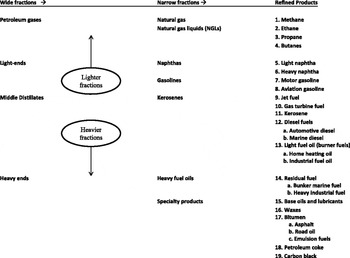
The majority of refiners set up rudimentary distillation towers to transform crude into kerosene as quickly and haphazardly as possible.Footnote 37 With kerosene representing a middle fraction in a given barrel of oil, the lighter fractions (gases, gasoline and naphthas) were simply flared off into the atmosphere and the heavier tar-like materials such as petroleum coke were disposed of in nearby water systems.Footnote 38 As the petroleum boom proceeded on a mountain of waste, chemists and engineers began to imagine a given barrel of crude as not simply a profitable means to kerosene, but rather as also a vertical hierarchy of different hydrocarbon molecules that each could be transformed into marketable products (see Figure 1). Indeed, Silliman claimed that the residual or waste products of the refinery process should not be ignored. He emphasized, “The crude product contained several distinct oils all with different boiling points … my experiments prove that nearly the whole of the raw product may be manufactured without waste.”Footnote 39 While kerosene – and later gasoline – was still the most profitable product, a given barrel of oil began to be imagined as containing not one, but hundreds of petroleum products. As early as the late 1870s, heavier fractions were being marketed as lubricants, waxes, petroleum jelly, and even chewing gum.Footnote 40
Crude as a vertical hierarchy of different hydrocarbon molecules that each could be transformed into marketable products. Adapted from Morgan Patrick Downey, Oil 101 (New York: Wooden Table Press, 2009), and drawn by the author.

Fractional distillation, however, only took the petroleum industry so far. Such a process was ultimately dependent upon the particular biophysical quality of crude oil itself. Lighter (and sweeter) crude oil produced higher yields of gasoline and heavier crudes produced less. Frustration with low yields for lower-quality crudes led to the development of “cracking” technologies that could break apart heavier hydrocarbon molecules into smaller, lighter ones more amenable to producing gasoline. During the 1920s alone, refiners in the US increased gasoline yields from 25 to 39 percent using thermal cracking.Footnote 41 The 1930s saw the first widespread development of the use of chemical catalysts (such as aluminum chloride) to allow hydrocarbon molecules to break up more quickly at lower temperatures (catalytic cracking).
Since catalytic cracking of heavier hydrocarbon molecules into lighter ones actually increased the octane rating of fuels, the federal government underwrote a mass 527 percent expansion of catalytic cracking capacity between 1941 and 1945 to expand the production of high-octane jet engine fuel for the war effort.Footnote 42 One of the major by-products of cracking are olefins (e.g. ethylene and propylene) that do not occur in nature and became the vital feedstock for the production of petrochemicals and plastics.Footnote 43 Thus, alongside the ramped production of high-octane jet fuel, came the rise of the petrochemical industry and the sprawling multiplicity of use values from plastics to pesticides and synthetic fibers.Footnote 44 It bears remembering that “war” sets the material conditions for a period called “postwar,” and, indeed, much of the postwar petroleum economy was built upon the war economy.
Much of the postwar vision of life, leisure and freedom depended upon the construction of geographies of everyday social reproduction outside the workplace. In the realm of life as opposed to work, individuals could construct their own privatized spaces of freedom. The petroleum industry was keen on tying oil to an overwhelming set of basic everyday products – food, plastics, medicine, clothing, and energy – to create a sense of the unavoidability of oil within that space of freedom. During the late 1940s and 1950s, the petroleum industry began to promulgate a narrative best summed up in Esso's (later Exxon) tagline of the early 1950s – “petroleum helps to build a better life.”Footnote 45 Life itself – always imagined as the life of white nuclear families in the suburbs – was seen as comprising multiple building blocks in which petroleum products were implicated at every stage. Indeed, the idea of an American standard of living came to be equated with petroleum consumption. A particular ad offered this fun fact: “Did you know – that a nation's progress (and their standard of living) can be measured pretty well by its consumption of petroleum?”Footnote 46 Petroleum, called a “chemical wonderbox” on a national television celebration of the seventy-fifth anniversary of Standard Oil in 1957,Footnote 47 became constitutive of a whole set of lived practices and visions of the good life.
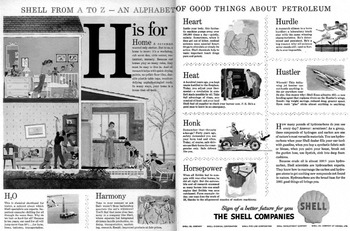
The reproduction of everyday life itself implies the repetition of practices. The material anchor of this vision of everyday life was centered upon the home and the automobile. Figure 2 reveals a 1950s ad campaign from Shell entitled “From A to Z – An Alphabet of Good Things about Petroleum.” Shell provided an exhaustive list of letter-specific things and practices linked to petroleum. One of the key aspects of this imagery is the succession of practices depicted, with the implication that each one is tied to some petroleum product. In the advertisement for H, H was for Hydrocarbon (we consume seventeen pounds a day!), Heart medicine, Heat, Horsepower, and the offshore frontier of H20 (a necessary frontier to satiate increasing demand, of course). The central message was that H was for “Home” – “Oil research helps with quick-drying paints, no-polish floor tiles, durable plastic table tops, and weather-defying asphalt-shingled roofs. In many ways, your home is a house that oil built.” If your home is the product of your own entrepreneurial efforts it is also a product of petroleum products.
1956 Shell advertisement.

The vision of “life” underwritten by the petroleum industry was contradictory. Life was constructed as a privatized (white) realm of social reproduction that was made possible through free competition and the individual (male) breadwinner's own entrepreneurialism. Yet this individual “life” was also perilously dependent upon not only petroleum, but also the petroleum industry. These ad campaigns actively sought to remind consumers that their lives – as singular, heroic, entrepreneurial projects – were only made possible through petroleum products.
In the wake of the 1969 Santa Barbara oil spill, the rise of the modern environmental movement, and the oil shocks, the dependence of life upon petroleum products was increasingly problematized. The crisis of stagflation and profitability slowdowns in the 1970s created the conditions for new policy consensuses based upon free markets, low taxes, and the demonization of government and the redistribution of wealth.Footnote 48 Nixon and Reagan perfected the southern strategy of harnessing votes from middle- and upper-income strata in the Sunbelt suburbs (among other suburbanized geographies) who found neoliberal discourses resonant and appealing.
The entrepreneurial logic of suburban life was fueled with and through petroleum products. Petroleum both powered and provisioned a particular lived geography – a “structure of feeling”Footnote 49 – that allows for an appearance of privatized command over space and life – or petro-privatism. Individuals are propelled from private homes in private automobiles to privatized workplaces and consumption locations. Notwithstanding the immense public investment that makes it possible, the lived geographies of oil consumption allow for a construction of a realm of “the public” as irrelevant and burdensome. Government programs were seen as “unfair” handouts to individuals who simply had not made the right choices “in life.” The language of “family values” also centered life upon the home and family as a privileged site for cultural cultivation and refinement against a hostile and degraded external culture. Contrary to some arguments,Footnote 50 family values centered on the home were not uneconomic – or purely “cultural” – values, but rather were absolutely fused with economic concerns with one's own entrepreneurial capacities to make a living, keep a job, and be responsible.
The petroleum industry benefited greatly from the neoliberal turn toward deregulation and free-market ideology. In 1981, Reagan immediately set up a task force to query industry about the most “burdensome” regulations, and environmental regulation of the chemical industry was atop the list.Footnote 51 The challenge for the petroleum industry was to remind consumers of their inextricable dependence upon the petroleum industry, but also to harness the logic of entrepreneurial life to reconcile the ecological contradictions of oil-fueled life. By the 1990s, oil companies had begun to construct a sophisticated “greenwashing” campaign that situated the solutions to environmental problems firmly in the hands of privatized, individually responsible actors. Next, I will examine a specific cultural object produced by the American Petroleum Institute (API) that attempted to reconcile the tensions between ecology and an oil-fueled life.
“ALMOST EVERYTHING I HAVE THAT'S REALLY COOL COMES FROM OIL”
The focus of the petroleum industry on the multiplicity of products constituting “life” has continued into the present. Yet it is important to understand how the politics of oil-based life have shifted into our current neoliberal era. As the perils of oil-dependence have intensified since the 1970s, the petroleum industry has had to more carefully construct a positive narrative of oil-saturated life and environmental responsibility. The American Petroleum Institute's educational film Fuel-Less (a parody of the hit film Clueless) attempts to reconcile these tensions not only through an emphasis on the unavoidability of petroleum products, but also by situating the appreciation of petroleum products as the basis of an entrepreneurial capacity to make contributions toward environmental sustainability.
The 1995 film Clueless could be seen as a kind of critique of the superficiality of neoliberal celebrations of the consumer. The story tracks the redemption of the main character, Cher, whose wealth and privilege shield her from recognizing the importance of friendship and social service. On the other hand, the film – released at the zenith of “end-of-history” neoliberal hegemony – reproduces the core of neoliberal visions of entrepreneurial life discussed above. Cher's low point is when she is denied the key material conduit of petro-privatism – she fails her driving test. Moreover, Cher's redemption is negotiated through an individualist vision of life – wealth and privilege had prevented Cher from making something of herself. Thus the film's happy ending presents a new Cher (fresh off a shopping binge) committed to a life of authentic relationships and volunteerist service to the community (she runs her school's disaster-relief effort).
The API's parody tracks the same plotline from privilege to redemption. The film begins with Crystal's narration amidst images of a materially comfortable suburban bedroom, “You're absolutely not going to believe this, but almost everything I have that's really cool comes from oil.” Immediately, Crystal discovers to her horror (she literally screams in terror) that all her petroleum-based products have disappeared. Deprived of makeup, clothes (she is forced to wear a potato sack), and a car, she is compelled to walk, “a whole six blocks to school.” At the outset, the film establishes a specific material vision of life and standard of living undergirded by a multiplicity of petroleum products.
Crystal has taken petroleum for granted. Her redemption is guided by her “extremely cool science teacher Ms. Watkins.” After hearing Crystal's story, Ms. Watkins easily concludes, “Crystal, it sounds to me like everything in your life that comes from oil is gone.” The film then proceeds to take Crystal on a journey through the petroleum commodity chain to discover the wonders of oil. The first lesson – at an oil well – is to establish oil's foundation in nature. Ms. Watkins teaches, “The oil coming out of this oil well comes from plant and animal remains which were buried beneath the earth's surface millions of years ago.” Crystal initially finds this “a bit gross,” but Ms. Watkins counters, “Gross? Are you kidding? Nature is elegant. You see these remains broke down into chemical compounds of hydrogen and carbon … hydrocarbons.” Crystal replies, “So oil is like natural?” Ms. Watkins then traces hydrocarbons to plastic shopping bags. Crystal replies, “Gee, I never thought of plastic as natural before.” The lesson serves to literally naturalize the presence of petroleum products in everyday life and deflect particular critiques of the toxicity and artificiality of plastics and other synthetic petrochemicals.
Crude oil is imagined as the ingredient in not only the material comforts of life, but also the multiplicity of medical technologies preventing death. “Today, relatively few Americans die of these ailments [tuberculosis, diphtheria, diarrhea], because of petroleum-based medicines such as sulfa drugs which helped to conquer these diseases. The vitamins you take and many of the medicines you use contain chemical constituents of oil.” One conclusion is that those who oppose the petroleum industry implicitly oppose the saving of lives through modern medicine.
But Crystal is impatient and eager to get her belongings back. Ms. Watkins reassures Crystal that her reunification with her oil-based belongings would be simple, “With a little bit of understanding and appreciation you'll get your belongings back.” Here is the API's prime message – although oil gets a bad reputation for causing environmental disasters, wars, and terrorism, consumers need to appreciate all the good things that oil brings to life. Only then will the public will recognize that all the good things we associate with life – mobility, home, family – are inextricably tied to petroleum products.
The next lesson takes Crystal and Ms. Watkins to the critical site of hydrocarbon transformation discussed above – a refinery. Crystal is introduced to a mullet-headed petroleum engineer who educates Crystal about the refinery process:
Crystal, the process we use to convert oil materials used in products like cosmetics is called fractional distillation. Essentially we take crude oil, and we place it into a large crock pot, technically called a fractionating column, and we cook it until it vaporizes and as the vapors cool, they separate out into gasoline, into heating oil, into lubricating oil, and into wax. This white glop – soon to become a football helmet – started out as oil. That's because when ethylene and propylene gases from the fractionating column are exposed to certain metals under high pressure and temperature, they turn into what we call polymers – you know them as plastics … Cool chemical wizardry also makes oil part of the recipe for toothpaste, telephones, TV sets, skateboards, shampoos, computers, CDs, contact lenses, cars, credit cards, you name it.
Crude oil is useless without the “cool chemical wizardry” that makes oil-based hydrocarbons the key ingredient of countless commodities. Again, it is the overwhelming multiplicity of products that helps craft the API's narrative of the unavoidability of oil.
Once Crystal learns of oil's connection to her most prized commodities – clothes – her educatory transformation intensifies, “I'm thinking something must really be wrong with me, because I'm beginning to find this stuff sort of interesting.” Yet her interest is still guarded with skepticism. Crystal questions the core paradox of oiled life – the relation between mass oil consumption and continued ecological crisis. Overwhelmed with the mountain of disposable oil-based products in the school cafeteria, she exclaims, “But, then look what happens – we just throw that stuff away.” Ms. Watkins concedes the point:
You're right. We sure don't want to pollute our water and use up our landfills with products from oil that could easily be reused. That's why it's so important to recycle plastics like our lunchroom cups, and to recycle used motor oil from your car … Fortunately, the earth isn't close to running out of oil anytime soon, but we need to be responsible about using what Mother Nature provides.
Thus it is upon the terrain of individual actions and choices that the contradictory relation between oil and life can be reconciled. Channeling the most powerful logics of entrepreneurial life – individual responsibility – the oil industry encourages us all to take individual control over our own private consumption decisions. As Ted Steinberg has recently argued, this form of “green liberalism” has more in common with neoliberal ideology than is often recognized.Footnote 52
Crystal is still worried about something consumers have little control over: “But then I remembered those oil spills I used to see on the news. That's responsible? What about oil spills?” In this case, Ms. Watkins assures Crystal that the industry itself has it under control:
Well there's no failsafe guarantee against oil spills, but there's a reason why you don't hear about them as much as you used to; because stricter standards for oil tankers and the people who pilot them have been adopted. At the same time, the oil industry is developing new ways to deal with oil spills.
Of course, if the API had simply waited three years (Fuel-Less is copyrighted in 2007), the notion that “we don't hear about” oil spills anymore would seem laughable in the face of the Deepwater Horizon disaster.
Finally, Crystal comes to the necessary epiphany, “You know, I think I get it now. You're right – nature is just as elegant as Armani – who was a very important designer. And, oil is like ‘neat’.” Immediately, her potato sack is transformed into an elegant business suit, and Ms. Watkins happily announces, “You've just gotten your things back which means you truly understand and appreciate the value of oil and how useful it is.” The film ends one month later and, like Clueless, Crystal has produced a new life for herself. She has taken charge of the school recycling program and committed herself to environmental responsibility. Ms. Watkins is quite pleased because it is efforts of these kinds – consumers and capital in tandem – that can reconcile oil-based life with ecology into the future:
Efforts like these enable us to continue doing the things we enjoy thanks to the products that oil provides … a large part of our future lies in the hands of people like you who really understand and appreciate the issues, and are willing to pitch in and help.
In this case, the effort to “pitch” in is negotiated on privatized terms – the choices of consumers and capital which aggregate into a sustainable future.
Crystal then neatly summarizes her profound transformation toward seeing her life as a singular heroic entrepreneurial project. “I knew that I could make a difference.” The film ends with classic imagery of suburban life: Crystal and some male suitors hanging out in a large driveway with an SUV Ford Explorer and a Volvo. The irony of an environmental message behind an image of fuel-inefficient automobility was apparently lost on the API.
Overall, the film reproduces the notion that lives – like specific petroleum fractions – are singular, fragmented and self-made entities. Yet the API seeks to make clear that lives are only made through petroleum products. However, the embedded nature of petroleum within the American standard of living – a standard that consumes nearly 25 percent of petroleum with only 4 percent of the global populationFootnote 53 – is by no means universal, and it takes political work to normalize this energy profligacy. Moreover, as it becomes clearer that it is precisely this profligacy that is driving continued geopolitical conflict, spectacular (and more everyday) pollution, and climate change, the oil industry has been forced to craft a narrative that reconciles oil-based profligacy with environmental responsibility. Clearly, the producers of Fuel-Less were keen on projecting a vision of environmental politics that ultimately conforms with neoliberal forms of politics that have been such a great boon to the industry.
CONCLUSION
We often think our “addiction” to oil is purely a material relation – urban spatial form, disposable plastics – but we need to think more deeply about how our relation to petroleum also shapes the way we think and feel about politics. The oil industry has consistently attempted to lodge petroleum products within a very powerful vision of “the American way of life.” In this paper, I have attempted to call attention the refinery process and the multiplicity of by-products from a given barrel of crude as being a key way through which the industry projects the unavoidability of oil in everyday life. This allows the oil industry to equate opposition to oil as opposition to cherished ideals of homeownership, freedom, and family. Yet the “American way of life” saturated in petroleum products is not simply about material profligacy, but is also about a specific vision of life best negotiated through market forces in opposition to any notion of public or collective solidarity. The construction of suburban spatialities of property ownership seemed to reinforce what Perry Anderson considers the core of capitalist consent: “the fundamental form of belief by the masses that they exercise an ultimate self-determination within the existing social order.”Footnote 54 With all the “work” (or energy) accomplished through taken-for-granted hydrocarbons, individuals could imagine themselves as masters of their own lives. Without the popular support of an energized suburban populism, neoliberal policies – including the kinds of deregulation that laid the basis for the Deepwater Horizon – could not be constructed as “commonsense” alternatives to the inefficacy of the public sector.
As the perils of petroleum-based life have become all too apparent, the petroleum industry has been forced to craft a “solution” to these problems firmly within the neoliberal logics of entrepreneurial life. As the story of Crystal illustrates, making a life for yourself requires not only “appreciating” the role of petroleum, but also taking responsibility to “pitch in” alongside the aggregated environmental efforts of privatized consumers and businesses. The underlying message is that petroleum-based life is sustainable through market forces, free choice, and individual responsibility.
Thus our oil addiction is perhaps most problematic not because we drive too far to work, but because it supplements an insidious ideology of privatism. Rather than see our energy crisis as solved through private consumer choices and cap-and-trade carbon market schemes, we need to imagine new ways of life and living that can once again construct popular resonances around notions of public solidarity and the viability of collective management of environmental problems.