Introduction
‘Could you, as far as your information of the depth of water enabled you to judge, have got near enough to those ships to have destroyed them?’Footnote 1 It was on this question that the court martial of Lord Gambier depended. He was accused of failing to follow up an attack on the French fleet at the Battle of the Basque Roads in 1809. A number of French ships had run ashore and Gambier feared for the safety of the British fleet in following them too close to the shoals, HMS Imperieuse having run aground on the night of 12 April.Footnote 2 This episode neatly demonstrates how the measurement of depth concerned not just navigation but also discipline: it was a means by which to assess negligence and instil obedience. Around this time, the character of discipline within the Royal Navy also underwent significant changes. Fear of punishment, the Admiralty felt, no longer acted as a sufficient deterrent. Despite the liberal application of the gallows following the mutinies of 1797, naval unrest continued throughout the Napoleonic Wars.Footnote 3 Political pressure favoured a shift in approach: one in which discipline relied not on the fear of punishment, but on the control of work.Footnote 4 Previous histories of depth sounding have tended to concentrate on the second half of the nineteenth century, during which the economics of seabed telegraphy play a key role.Footnote 5 In contrast, this paper reveals the relationship between work discipline and the early introduction of mechanical depth-sounding technology.Footnote 6
For much of history, the depth of the sea had been measured using lead and line. However, in 1802 the Staffordshire clockmaker Edward Massey patented a brass device he referred to as a ‘sounding machine’, an example of which sits in the Whipple Museum, Cambridge, UK (Figure 1).Footnote 7 This machine was designed to be attached to a standard lead and line and thrown overboard.Footnote 8 It consisted of a rotor which, when descending to the seabed, turned a perpetual screw connected to two numbered dials. One dial recorded intervals from zero to ten fathoms, the other from zero to 150 fathoms. It also featured a mechanism, activated on striking the seabed, which locked the dials on hauling the machine in. Whilst not the first mechanical sounding design, Massey's was the first to be widely adopted by the Royal Navy. In 1807, on the recommendation of the Board of Longitude, the Navy Board ordered five hundred of Massey's machines, followed by another 1,250 between 1808 and 1811. This equates to at least one machine for every Royal Navy ship in commission during the Napoleonic Wars.Footnote 9
Edward Massey's sounding machine, Wh. 2970, with permission of the Whipple Museum, Cambridge, UK.

Through a case study of this object, I argue that the developing system of discipline comprised three interrelated elements: individual accountability, the visibility of work and the division of labour. In making this argument, I develop two broader themes within the history of instrumentation.
First, I suggest that there is much to be gained by paying greater attention to the relationship between practices on land and at sea.Footnote 10 The early nineteenth century witnessed an unprecedented flow of men and machines between artisanal workshops, dockyards and the ocean. The new system of discipline itself was to operate continuously, whether enacted in a naval dockyard or on board a ship stationed in the West Indies.Footnote 11 This turned out to be more difficult than the Admiralty might have hoped. The maritime environment in particular presented distinct challenges. To appreciate this, we need to remember that the museum is a misleadingly placid environment (stationary, well lit, free from noise and moisture). Such an arrangement shrouds the circumstances in which navigational instruments were most often relied upon. Sounding is a case in point. In foul weather and low light, it was often the only means by which a navigator could determine the position of the ship at sea. Within around a hundred miles of land, the depth of water could, in principle, be plotted against common charts in order to determine a ship's position.Footnote 12 Errors or insubordination could prove fatal. Histories of scientific instruments therefore need to be grounded in environmental history just as much as they are currently grounded in the study of material culture.Footnote 13 By taking seriously these conditions I am able to demonstrate how noise, light and weather all mediated the relationship between instrument-makers on land and a new disciplinary regime at sea.Footnote 14
Second, by treating land and sea within the same frame, this paper better explains more general changes taking place within the British scientific instrument trade at this time.Footnote 15 The ‘small world’ of the ship cannot be separated from the big world beyond.Footnote 16 The Board of Longitude is an important institution in this respect. Founded by an Act of Parliament in 1714, it was initially charged with assessing proposals for accurately measuring longitude at sea. But towards the end of the eighteenth century, the Board of Longitude's remit was considerably expanded. A series of Acts of Parliament passed between 1769 and 1796 provided rewards for ‘other Useful Discoveries and Improvements in Navigation’.Footnote 17 The Board of Longitude then emerged as an institutional link between a range of artisans on land and sailors at sea. Massey was just one of hundreds of craftsmen, many of whom had never stepped foot aboard a ship, seeking the Board of Longitude's patronage. These were men like Henry Jennings, a London chemist and inventor of an improved ‘half-minute glass’; Robert Raines-Baines, a glass-worker from Hull and manufacturer of a ‘sea perambulator’; and Segismund Rentzsch, a London watchmaker who proposed an ‘instrument for measuring time by a current of air’.Footnote 18 These men, unlike eighteenth-century instrument-makers such as James Short, were not in a position to solicit the interest of the Philosophical Transactions. Instead, they discussed and promoted their designs in the new journals of natural philosophy alongside mechanics' magazines.Footnote 19
For all these craftsmen, times were tough. Towards the end of the eighteenth century, a combination of excise duties, free trade and the erosion of statutory apprenticeships put pressure on artisans, particularly watchmakers, to generate alternative sources of income.Footnote 20 Massey was no exception. His contact with the Board of Longitude is interspersed with unsuccessful petitions regarding designs for improved escapement mechanisms.Footnote 21 And whilst Massey completed a watchmaking apprenticeship under his father in the late eighteenth century, by the end of his life he listed his profession as a ‘nautical instrument maker’.Footnote 22
Early nineteenth-century navigational practices at sea therefore cannot be understood as distinct from social and institutional changes taking place on land.Footnote 23 The new disciplinary regime that I identify was part of a much wider transformation in attitudes towards the management of labour extending well beyond the Royal Navy.Footnote 24 Additionally, whilst the history of navigation in the eighteenth century centres on changes in astronomical practice alongside the development of marine timekeepers, early nineteenth-century artisans reconfigured much more basic navigational tools: the lead, the log and the compass.Footnote 25 Sailors and officers now struggled with an array of new instruments, inspired by a diversity of trades, from watchmakers to chemists. At the same time, these artisans constituted an emerging group of nautical instrument-makers, often with little previous experience of the maritime world. Massey's sounding machine is just one example of this much wider trend.
Sounding in silence
Samuel Bentham, younger brother of Jeremy, understood well both the importance and the difficulty of taking accurate soundings. Whilst apprenticed to a master shipwright at Chatham Dockyard in the 1770s, Bentham spent his free time sailing in the English Channel, a stretch of water which could prove treacherous without precise knowledge of the depth of water. When not at sea, Bentham worked in the dockyard repairing those ships which had not been so careful.Footnote 26 In landlocked Staffordshire, Massey's boyhood experience of the sea, or lack thereof, could not have been more different. What he did know about maritime practice he learned from reading The British Mariner's Guide.Footnote 27 And it was the local canal, rather than the open sea, which provided the initial testing ground for Massey's early designs.Footnote 28
Despite their varying experiences both Massey and Bentham were soon engaged in the Admiralty's broader vision to reform naval discipline. Following his return from a tour of the Continental dockyards, Bentham was appointed to the new position of inspector general of naval works in 1796. There he began to emphasize the importance of individual accountability for naval discipline. He claimed that, because naval practices were based on collective responsibility, there was a tendency to ‘find excuses for even the greatest mismanagement or abuse’. With this in mind, Bentham instigated a number of reforms in the dockyards designed to restore order. Principally, he made dockyard officers, rather than groups of workers, directly responsible for specific tasks, such as the sawing or veneering; if something went wrong, an individual would have to take the blame. This disrupted the ease of collective disobedience.Footnote 29 Still, the Admiralty was concerned that ill discipline might spread between the dockyard and the sea. Given the traffic of men between the two, this was not unreasonable. Reports in 1801 that artificers in Plymouth had been coordinating strike action with sailors aboard ships in the harbour seemed to confirm these fears.Footnote 30 In response, the First Lord of the Admiralty, also a de facto commissioner of the Board of Longitude, demanded a system of ‘military discipline’ which could be applied equally to the ‘seaman’ and ‘the civil branch of the navy’.Footnote 31 Massey's sounding machine was promoted to do just this.
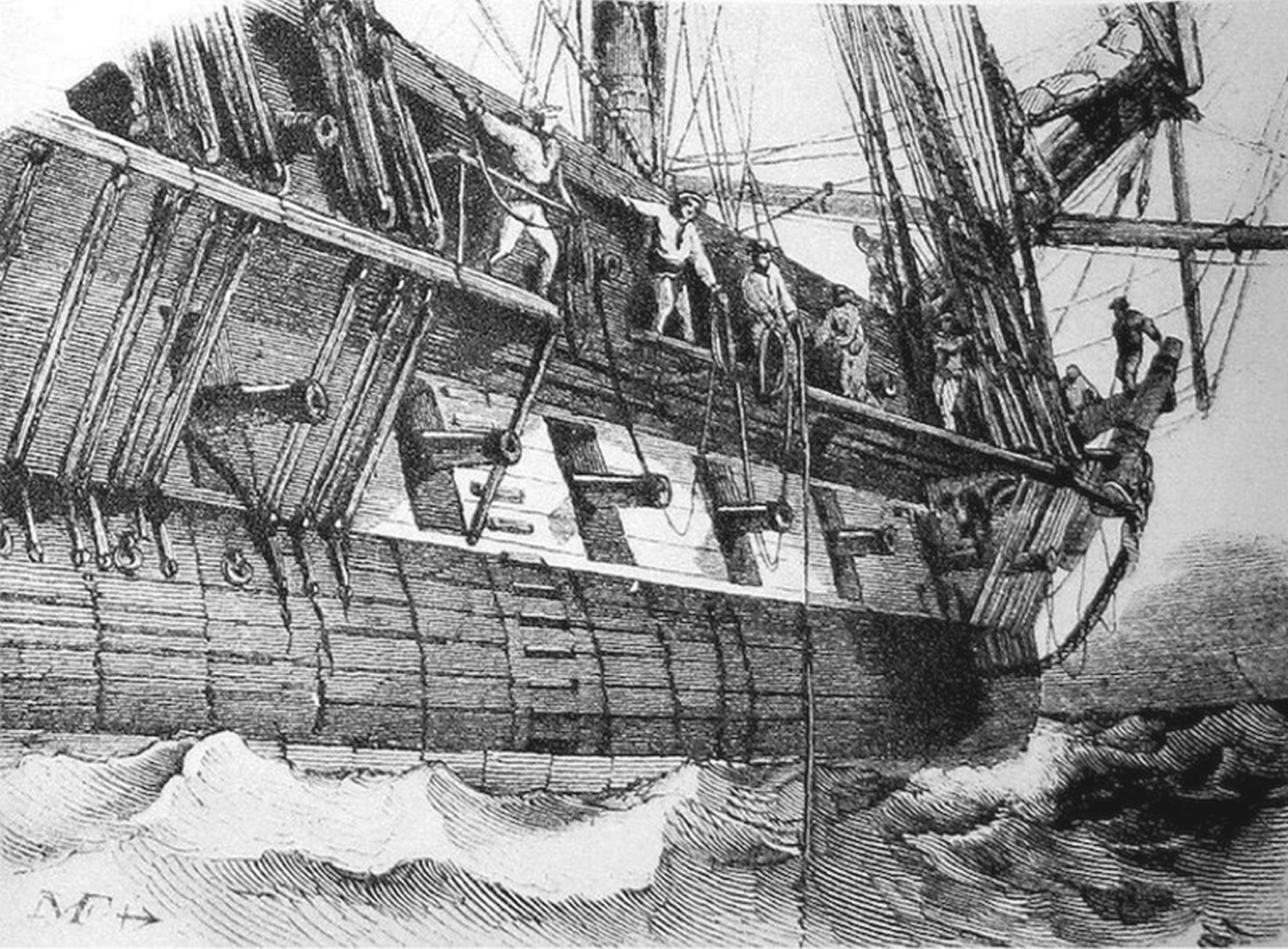
Like work in the dockyard, lead-and-line sounding at sea required the collective effort of the sailors. This made accountability ambiguous. To begin sounding, one sailor (the leadsman) moved towards the bow on the outside of the ship, taking with him the lead and approximately one fathom of rope. Three or four other sailors took up the rest of the line in coils and arranged themselves at intervals along the outside of the ship, from bow to stern (Figure 2).Footnote 32 This arrangement was necessary in order to compensate for the forward motion of the ship during sounding. By throwing the lead forwards of the ship, the sailors aimed to have the line perpendicular to the seabed when the lead reached the bottom. Only then would the sounding be accurate.Footnote 33 To achieve this, each sailor needed to call to the next (‘Watch ho, watch’) in order to provide a warning to prepare to release the next coil of line.Footnote 34 This practice needed to be timed correctly. If the sailor released the line too early, he might miss when the lead hit the seabed. If he released it too late, he could risk getting dragged overboard. But if something went wrong, it was not immediately obvious who was to blame: the sailor calling or the sailor listening? Ultimately, it was their collective responsibility to ensure the correct amount of line was released as the ship moved forward. This left the potential for disgruntled (or incompetent) sailors to disrupt sounding practice without taking personal responsibility.
Sailors, arranged on the outside of the ship, sounding by lead and line. Eugène Pacini, La Marine: Arsenaux, navires, équipages, navigation, atterages, combats, Paris: Curmer, 1844, p. 202.
Massey sold his machine as part of a practice which dismantled the collective responsibility of the sailors. In one of his pamphlets, forwarded to the Board of Longitude, he championed the fact that his machine did not require the coordinated release of line, stating that it could be operated ‘without any regard to the quantity of line paid out’.Footnote 35 Other petitioners writing to the Board of Longitude adopted a similar strategy. Jennings promoted his ‘improved log reel’ under the claim that navigational errors arose from practices ‘entrusted to several persons’.Footnote 36 By disassociating the length of line released from the accuracy of sounding, Massey hoped to diminish the collective responsibility of the sailors. He reinforced this, announcing on the packaging that the measurement relied solely on the ‘revolutions of the rotator’.Footnote 37 This attack on collective responsibility is also suggested in advertisements, one stating that lead-and-line sounding ‘employs a greater number of hands’ and therefore is more likely to produce ‘a result which could not be depended on’.Footnote 38 Keen to highlight the perceived complications arising from sailors working together, Massey again wrote to the Board of Longitude in 1814. Citing the testimony of the master of HMS Ville de Paris, Massey explained that ‘everyone knows the difficulty of passing a line forward and keeping it clear’.Footnote 39 To this end, the introduction of Massey's machine removed the need to coordinate the release of the line, the ‘Watch ho, watch’ call fading into silence.
The release of line was not the only aspect of lead-and-line sounding which promoted collective responsibility. Once the line was hauled in, the leadsman would either observe or feel for the number of knots on the line. Counting these gave him the depth in fathoms (one knot per ten fathoms). However, the leadsman did not record the measurement himself but rather relayed the depth to an officer on deck in the form of a song, repeating ‘By the mark ten’ (for ten fathoms) to which he added ‘and a half ten’ (for ten and a half fathoms).Footnote 40 Sounding was particularly important on approach to land during high winds, heavy rain and low light. Failure to communicate the correct depth could easily result in wreckage and loss of life. The ability to cut across a gale with a distinctive song was critical to successful sounding. But, as with the ‘Watch ho, watch’ call, this made responsibility hard to pin down. The leadsman and officer relied on one another to sing and listen respectively, accountability drifting away amidst the roar of a storm.
The introduction of Massey's machine shifted responsibility solely towards the officer on the quarterdeck. Critically, the average leadsman could not be relied upon to read the numbered dials on Massey's machine (Figure 3). This stemmed from his lack of familiarity with clocks rather than poor numeracy. The leadsman would have been comfortable working with numbers, counting knots in order to report the depth in fathoms to the quarterdeck. Studies of eighteenth-century European sailors have also revealed a markedly raised level of numeracy amongst the lower deck compared to the general rural population.Footnote 41 Despite the lack of universal education in England at the time, the leadsman's practical experience in counting knots, coupled with tuition from the ship's chaplain, ensured an adequate level of numeracy.
Dial on Massey's machine, Wh. 2970, with permission of the Whipple Museum, Cambridge.
Counting knots and reading a clock-like dial are, however, very different kinds of numeracy. As such, it helps to think of numeracy as a pragmatic property, one heavily influenced by the material culture surrounding the use of numbers.Footnote 42 The typical leadsman did not have experience in reading a clock or working with written numbers. Time on board ship was regulated via an intricate system of bells, flags and smells.Footnote 43 Some members of the lower deck did own private watches, despite the expense. However, changes in climate and location rendered these timepieces highly inaccurate. Owners rarely consulted them. Rather, expensive watches simply acted as an easily portable store of wealth.Footnote 44 Officers, on the other hand, were more likely to be recruited from gentlemanly backgrounds in which the use of private timepieces pervaded.Footnote 45 Clock-like devices, such as chronometers, also regularly featured in their working lives. The numbered dials on Massey's machine indicate that an individual officer would be expected to take responsibility for the accuracy of soundings. In fact, in testimonials, a number of officers directly refer to their personal use of the machine. Captain John Cummins, stationed off the coast of Denmark, wrote that ‘in sailing through the Cattegat in from 16 to 25 fathoms water … I could, by myself, get soundings with it’.Footnote 46 Given the North Sea fleet mutinies of the 1790s, this level of individual control no doubt appeared desirable.
In manufacturing a device which favoured the reading of depth by an officer, Massey played to the developing emphasis on individual accountability. He even wrote to the Board of Longitude in 1806 championing the fact that ‘any man … who can read the hour on the dial of a clock, is qualified to read the distance gone’.Footnote 47 By considering numeracy as a pragmatic property, it is clear that ‘any man’ here more readily refers to an officer. Moreover, as the machine could be read by the same officer responsible for recording the depth in the ship's logbook, there was no need for the leadsman's distinctive song. Works such as Christopher Biden's Naval Discipline later reconfigured singing as a purely recreational rather than functional activity.Footnote 48 In this light, the silence instigated by Massey's machine takes on added significance: it is indicative of an emerging form of discipline in which individual rather than collective responsibility is central.
Back in the dockyards, groups of workers were also learning to keep their mouths shut. The Treasonable Practices Act of 1795 had extended the law of treason to print and speech, whilst the Seditious Meetings Act banned gatherings of more than fifty people. Shortly after the passing of the ‘Two Acts’, an anonymous handbill posted outside Chatham Dockyard accurately summed up the situation when it complained that they would ‘completely deprive the People of the Liberty of speech’.Footnote 49 It was in this environment that Massey's machine flourished.
Sounding in the dark
In March 1777, John Aitken, the son of a Scottish tinsmith, was tried and hanged for attempting to set fire to Portsmouth Dockyard.Footnote 50 For the Admiralty, arson represented a particularly menacing form of disobedience. Most disturbingly, when committed at night, assailants often found it easy to slip away. A report on one such attack on Sheerness Dockyard noted that the superintendent had ‘heard a heavy footstep running … but, being dark, he could not see any person’.Footnote 51 Bentham therefore found the Admiralty ready to listen when he argued that all dockyard practices should be made visible to a superior officer. With this in mind, he created the post of timber master in 1801, a single worker charged with keeping account of all wood within the dockyard. Crafts could no longer work in relative secrecy, taking home wooden ‘chips’ as an informal method of payment.Footnote 52 What is more, it was with these very chips that radical dockyard workers started the fires, ‘fir shavings and birch-brooms cut open’ having been found at the scene in the case of Sheerness.Footnote 53 Bentham hoped that the physical and felt presence of the timber master would mitigate both this informal payment practice and the risk of arson.Footnote 54 This regime relied on the visibility of work, rather than punishment, as its chief deterrent.Footnote 55
At sea, lead-and-line sounding was antithetical to such a system. By requiring that sailors arrange themselves on the outside of the ship, the lead-and-line method obscured the visibility of sounding from the officers: the passing of the line, the passage of the lead and the counting of knots all occurred out of sight. In contrast, the engraved numbers on Massey's machine facilitated a transition, one in which the officers' view of sounding opened up as they took on greater individual responsibility. Most immediately, the numbered dials ensured that an officer could personally read the depth from the machine, rather than relying on the leadsman's song emanating from out of sight. Massey's sounding machine was just one of many to feature a brass dial or graduated scale in this period. A clockmaker by trade, Massey employed a familiar design when manufacturing his device. The clockmaker Rentzsch also opted for a ‘graduated circle’ on his ‘pneumatical chronometer’.Footnote 56 Rentzsch even developed his own dividing engine in order to mark the scale.Footnote 57 As watchmakers branched out, designs originally developed on land were transferred to the maritime environment: the clock-like nature of Massey's machine, particularly the dials, should be read as one such example.
Clockmakers were not the only artisans hoping to entice the Board of Longitude in this period. Other tradesmen employed a host of alternative designs. In fact, Massey's major competitor approached sounding from a very different perspective. In 1813 Peter Burt, operating out of the Commercial Road in East London, presented his ‘buoy and nipper’ device to the Board of Longitude (Figure 4).Footnote 58 The buoy and nipper consisted of a canvas bag (the buoy) attached to a spring-loaded wooden pulley block (the nipper). The bag would be inflated ‘by blowing with the mouth into the valve’ and trailed behind the ship. The line, with a common sounding lead attached, would then be released through the pulley. When the lead hit the sea floor, the spring-loaded pulley would ‘nip’ the line, indicating the depth in fathoms. In short, the buoy was designed to ensure that the lead fell perpendicular to the sea floor whilst the pulley helped to ensure that the leadsmen did not miss when the lead reached the bottom. Although Burt's own background is unclear from his letters, he was certainly not a clockmaker like Massey. In a number of letters he simply refers to himself as a ‘poor man’ and, by the 1820s, periodicals describe him as a ‘mathematical instrument maker’.Footnote 59 The design of his device also suggests that Burt had some previous experience in the dockyards, perhaps working with pulleys or canvas sails. Although not so successful at soliciting the support of the Board of Longitude, Burt's buoy and nipper were nonetheless widely adopted, with over 1,400 manufactured and sold between 1813 and 1830.Footnote 60
Peter Burt's buoy and nipper, detail from Report of the Superintendent of the Coast Survey, Showing the Progress of the Survey during the Year Ending November 1, 1857, Washington, DC: Cornelius Wendell, 1858, Plate 70.
Whether sounding with Massey or Burt's device, the maritime environment mediated practice. In particular, lighting on board ship helped to enhance the visibility of practice from the perspective of the officers. Massey repeatedly argued that his machine was of great utility when sounding in the dark, writing in 1805 that ‘the most inexperienced person may use this machine, without risk of error, in the most turbulent sea, and during the night’.Footnote 61 Burt made a similar claim when writing to the Board of Longitude in 1815, explaining that ‘no light is necessary in the night to see the results’.Footnote 62 Indeed, the value of sounding during night-time navigation was well recognized. However, on closer inspection it is clear that the numbered dials on Massey's machine would have been unreadable in the dark.Footnote 63 Officers also reported ‘taking the line to the binnacle light’ in order to inspect the mark made by Burt's nipper, although it was also still possible to haul the device in and count the knots by hand.Footnote 64 Access to light was clearly an important prerequisite for taking readings, particularly in Massey's case.
The average sailor, such as a leadsman, had extremely limited access to light on board ship. Due to social as well as safety concerns, lights were not kept below deck: the risk of fire was great and sailors were deemed too irresponsible to carry a lantern. The same rules applied in the dockyards. Officers, in contrast, kept lamps in their cabins and on the quarterdeck, their increased individual responsibility coupled to exclusive access to lighting.Footnote 65 Hence, in a very literal sense, the visibility of Massey's machine bolstered the individual accountability of the officer. In the lead-and-line method, the leadsman's lack of access to light mattered little: he could simply feel for the number of knots when hauling the line in. In contrast, Massey's machine employed no such tactile method: only an officer could read the dial in the dark.Footnote 66 The spatial nature of lighting further supported such a system of visibility. The position of lanterns meant that, once hauled in, Massey's machine moved to a position on the ship in which only officers presided: the cabin or the quarterdeck. This ensured that officers took personal responsibility for the depths recorded in the ship's logbook, an artefact they would sign and deliver to the Admiralty on return to Britain. In fact, by the mid-nineteenth century, Royal Navy regulations directly identified the captain as responsible for conducting soundings ‘whether the Master or Pilot think it necessary or not’.Footnote 67
Sounding with strength
Divisions of labour are often thought of in purely economic terms. However, the patterning of work served a diversity of ends. In the dockyards, Bentham championed divisions of labour in order to establish his broader system of discipline as much as he did to increase production. Prior to reform, shipwrights typically converted rough timber into component parts. This required a range of abilities from head to hand: muscular strength in order to saw, dexterity in order to fashion pulley blocks, and theoretical knowledge in order to fit components together. In contrast, Bentham stipulated that work should be divided into discrete skills (such as sawing or veneering) rather than crafts (such as that of the shipwright). By dividing crafts into analysable skills, Bentham could better implement his system of individual accountability and visibility: the timber master could, in principle, attend to every instance of a skill requiring wood.Footnote 68 Alongside the timber master, Bentham also introduced a machine for manufacturing pulley blocks in Portsmouth Dockyard. The patent, filed in 1793, claimed that the machines operated ‘independent in good measure … of attention and altogether of dexterity’.Footnote 69 Similarly, in 1811 the School of Naval Architecture separated the training of dockyard officers, both geographically and in terms of content, from the general workforce. The school, in wording akin to both Bentham's and Massey's promotional materials, emphasized mathematical analysis over the ‘imperfect experience’ of the naval carpenter.Footnote 70 This division of labour, between the mental work of the officers and the physical work of the men, was paralleled at sea. However, the maritime environment ensured a distinct set of social and technological developments.
In a letter of March 1811 Massey proudly set out the superiority of his machine on the basis that ‘no skill is necessary on the part of the person who takes the soundings’.Footnote 71 With little experience of maritime navigation himself, Massey cited William Nichelson's Treatise of Practical Navigation and Seamanship, arguing that lead-and-line sounding relied too much upon the ‘experience of the man who heaves’.Footnote 72 Despite Massey's claims, it is clear that his machine did not deskill the practice of sounding.Footnote 73 Handbooks of nautical surveying soon noted that it needed to be used ‘very carefully’ in order to take an accurate reading.Footnote 74 Burt also mounted a forceful attack on this basis, arguing that Massey's ‘mechanical and complicated’ machine was liable to ‘being dashed against the side, either through carelessness in being thrown overboard or hauled in’. The buoy and nipper, Burt claimed, were ‘less liable to be put out of order’ due to the ‘simplicity of its form and construction’.Footnote 75
In this respect, Burt was right. Bodies were still very much part of the machinery.Footnote 76 If anything, Massey's machine required more, not less, skill to operate. In adopting it, the Royal Navy imposed a new set of muscular demands on the leadsman. The accuracy of the machine relied on its constant descent through the water. If it was checked before it reached the seabed, the locking mechanism would activate and the reading would be incorrect. In order to ensure a smooth descent, Massey recommended ‘the lead never be less than 10 or 11 pounds’ and, where possible, heavier.Footnote 77 For very deep soundings, officers advocated attaching additional leads at intervals along the line in order to ensure a smooth passage.Footnote 78 Whilst the machine itself weighed comparatively little, its use required an increase in the weight and number of leads the leadsman needed to haul.Footnote 79 Moreover, the machine had to be thrown so as to land perpendicular to the water, requiring further muscular strength and dexterity from the leadsman. This ensured the release of the rotor from the locking mechanism, something made all the more difficult given the increase in the weights used. These additional muscular demands reinforced divisions of labour, cementing the leadsman's role as that of a physical worker rather than one requiring a broad range of abilities, from singing to counting. By the mid-nineteenth century, one marine magazine referred to sounding as ‘the drudgery of [its readers'] profession’.Footnote 80 Toil for certain workers, then, was not diminished by Massey's machine; it was one of the consequences.Footnote 81
Divisions of labour also served to reform punishment in favour of the developing system of discipline. In the old system of hangings and keelhauling, punishment had been an endpoint.Footnote 82 In contrast, the increased toil associated with practices such as sounding turned work itself into a form of punishment. Whilst attempting to sail through Hudson Bay in the 1820s, Captain George Lyon made the following report: ‘[The] cold was exquisitely painful to men who had been constantly exposed for two days and nights to the wash of a freezing sea … sounding with hands nearly raw, every half hour’.Footnote 83 It was −4 °C. As the winter progressed, temperatures could drop as low as −30 °C. Massey's brass machine would stick to and tear the skin when handled in these conditions.Footnote 84 The removal of rank therefore entailed increased manual labour and physical discomfort, not unlike the treadmill found in the prisons.Footnote 85 Hence work and discipline sustained each other, one naval treatise recommending ‘drudgery’ as ‘much more effectual in checking and preventing offences, than the infliction of the most severe corporal punishments’.Footnote 86
The division of labour also turned discipline into a self-reinforcing system. Dressed in distinctive uniforms from 1748 onwards, officers self-consciously adopted mental rather than physical work, thus assuming greater individual responsibility for the depths recorded in the ship's logbook.Footnote 87 In the face of individual scrutiny and fear of demotion, officers were particularly eager to ensure accurate readings and so insisted on additional weights during sounding, Captain Neve of HMS Hibernia writing in 1808 that, ‘with a strong breeze, going six knots’, the use of additional weights ‘is in such circumstances necessary’.Footnote 88 This completed the feedback loop, further polarizing the division of labour between the physical work of the leadsman and the mental work of the officer. From cotton spinning to depth sounding, mechanization embodied practices which both nurtured and relied upon developing social structures, such as the division of labour described above.Footnote 89 In the case of the Royal Navy, divisions of labour completed a self-reinforcing system of work discipline in which individual accountability encouraged obedience.
Sounding in motion
Bentham's most powerful disciplinary ideal, the panopticon, started life in Russia. In the 1780s, prior to his appointment with the Royal Navy, Bentham worked for Prince Grigorii Potemkin in Krichev. There he managed Potemkin's rope and textile factories, producing materials for the dockyards on the Black Sea. Once back in Britain, the panopticon, with its central watchtower and radiating cells, was taken up by Jeremy Bentham as a means to reform prison discipline. But despite the support of William Pitt the Younger, the ‘Inspection House’ that Bentham conceived for an aristocratic estate in Russia did not travel as easily as either he or his brother might have hoped.Footnote 90 The Millbank marshland purchased in 1799 for its construction was considered unsuitable, whilst political commitment wavered. Bentham's ‘model prison’ was never built.Footnote 91
Discipline at sea also faced the problem of shifting environments, but on a much greater scale. At the beginning of the nineteenth century, both the Royal Navy and the Board of Longitude had a truly global remit with theatres ranging from the Mediterranean to the Pacific. Institutions on land, often thousands of miles from the day-to-day practices taking place aboard ship, found it difficult to maintain order and administer justice.Footnote 92 The changing circumstances associated with travel also challenged obedience: for instance, court martials cited climate and ease of access to Caribbean rum as causes of lawlessness in the Lesser Antilles.Footnote 93 The developing system of discipline needed to be maintained in the face of global travel.
With respect to lead-and-line sounding, travel could often induce changes in practice detrimental to discipline. Massey identified many of these issues in his publications. For example, faced with the difficulty of sounding in certain locations, such as on approach to a lee shore or in regions with strong currents, ships often continued ‘without sounding at all’.Footnote 94 The loss of vessels due to negligent navigation presented a serious challenge for the Royal Navy at the time, with eighteen ships of the West Indies fleet lost to shipwreck between 1784 and 1812.Footnote 95 Furthermore, in his petitions to the Board of Longitude, Massey identified variability in practice as a significant obstacle to navigation, his pamphlets and advertisements claiming that the ‘difference of method and caprice in those who use them’ rendered consultation of charts useless.Footnote 96 In high winds, for instance, the lead would often be thrown from the windward side of the ship, passed round the stern, and hauled from the leeward side. This technique attempted to compensate for the movement of the ship without requiring that the sails be lowered. In contrast, a thick fog almost always necessitated the lowering of the sails before sounding.Footnote 97 Each practice, offsetting errors in different ways, introduced its own discrepancy between the depth measured and the chart to be consulted. Specific geographies tied each problem to travel – the East Indies distinguished by strong currents, the Irish Sea characterized by high winds, and the North Sea prone to heavy fog.Footnote 98
Massey also linked variability directly to discipline in one advertisement. A hypothetical scenario is given in which a captain faces court martial for the loss of a ship due to ‘an error in sounding’. The variable nature of lead and line is portrayed as inhibiting justice, the slippery captain absolved of responsibility. Massey's machine, in contrast, is introduced as ensuring that the captain takes individual responsibility for careful navigation. There is to be no excuse for error when furnished with his machine.Footnote 99 Critically, Massey presents his sounding machine as providing a universal standard: ‘though some of the machines answered their purposes tolerably well under certain circumstances, none of them were nearly correct under all circumstances'.Footnote 100 The search for measurements abstracted from geographic setting is a pervasive theme in the history of instrumentation, especially navigation.Footnote 101 In 1813 Rentzsch wrote to the Board of Longitude promoting his ‘pneumatical chronometer’ once again, this time under the assertion of it ‘not being liable to variation from change of temperature’. Similarly, Grimaldi wrote to the Board of Longitude in 1812 requesting a reward for developing a chronometer without a mainspring, allowing it to operate ‘in all climates … nearly the same’.Footnote 102
These were all problems with which the Board of Longitude was itself familiar, particularly having arranged trials of John Harrison's timekeeper in the 1760s.Footnote 103 But Massey's advertisement reveals the diversity of motivations behind such an enterprise. In this case, mechanized attempts to standardize sounding facilitated the system of discipline developing within the Royal Navy. Individual accountability could only be enforced if, irrespective of locality, the charts available to the officers corresponded to the depths measured. By abstracting sounding practice from locality, Massey's machine offered greater visibility to the court martials. They no longer needed to reconstruct the specifics of practice aboard a particular vessel. Rather, it could be assumed that charts accorded with the information available to the captain, acting as a window onto calamities in far-flung places. By 1862, Royal Navy regulations listed the production of the ship's logbook and charts as a necessary precondition for conducting a court martial, going on to identify how each should be compared.Footnote 104 Indeed, these regulations were pre-empted by Lord Gambier's 1809 court martial in which the logbook of HMS Imperieuse, along with her charts, was presented as evidence.Footnote 105 Massey's machine reinforced this shift. With an apparently universal standard in place, negligence, such as sailing too close to a lee shore, or cowardice, such as failing to follow up an attack, could be identified back on land post hoc.
Despite Massey's apparent success, the uptake of his machine did not go unchallenged. Burt continued to lobby the Board of Longitude for a reward of his own, promoting his ‘simple and very useful instrument’.Footnote 106 In making this argument, Burt tried to undermine the claim that Massey's sounding machine operated faultlessly in every maritime environment. Burt pointed out that ‘striking the bottom on foul rocky ground might much injure it, if not render it totally useless’.Footnote 107 This is a problem Massey's son later encountered himself when conducting a trial in the Irish Sea. On hauling in the line aboard HMS Trinculo, the leadsman reported that the machine had been lost.Footnote 108 Other navigators also found the central brass cylinder often buckled when striking the sea bed or under high pressure.Footnote 109 Burt even claimed that the Navy Board had been forced to pay Massey over £1,000 for repairs and replacements.Footnote 110 Getting an instrument to operate in different maritime environments therefore also meant considering its upkeep: chronometers required constant tinkering whilst even sextants were liable to jam. The expertise required to repair such precision instruments proved difficult to come by once aboard a ship halfway across the Atlantic.Footnote 111 Burt paid particular attention to this problem, in contrast to Massey, writing that his buoy and nipper ‘may be repaired on board or in a distant country by the common mechanic’.Footnote 112 It was the ‘simplicity’ of his design, Burt argued, that rendered it serviceable in climates ranging from the ‘British Channel’ to the ‘North Coasts of Java’.Footnote 113
Massey and Burt ultimately represent two alternative solutions to the problem of abstracting measurement from the environment. Captain Hawtayne aboard HMS Florida identified as much when he wrote that the two devices ‘bear no sort of analogy to each other’ and, consequently, he found it ‘difficult to declare a preference’.Footnote 114 Massey believed that the problem required increased mechanical intervention, modelling his device on a clock. In contrast, Burt believed that the solution required an instrument of ‘great simplicity’. Massey and Burt, both newcomers to the nautical instrument trade, clashed, not just because they represented distinct crafts, but also because they placed differing emphasis on mechanization. For historians of instrumentation, it is therefore all the more telling to learn how sailors themselves dealt with this problem. In May 1816 Captain Hawtayne reported that his crew found Burt's buoy and nipper most accurate in ‘shallow water when running fast’, whilst Massey's device was preferred in deep waters.Footnote 115 Despite the best efforts of Massey and Burt, sailors favoured different solutions in different circumstances.Footnote 116 Testimonials from numerous navigators also confirm that both devices were regularly found aboard the same vessel.Footnote 117 A different environment always demanded a different machine.
Conclusion
Edward Massey was just one of a range of new entrants into the scientific and nautical instrument trade in this period. Inspired by a variety of crafts, from watchmaking to glasswork, these artisans reimagined some of the most basic navigational tools, from the sounding lead to the compass. The Board of Longitude, particularly from the late eighteenth century onwards, acted as an intermediary, assessing designs and commissioning trials at sea. With the First Lord of the Admiralty present at the majority of meetings, disciplinary reform proved a powerful ideology. The Board of Longitude favoured instruments which, like Massey's, facilitated the development of a new disciplinary routine, one based around individual accountability, visibility and divisions of labour. But between the dockyards and the ocean, changing maritime environments allowed a variety of disciplinary and navigational practices to flourish. Long voyages to the Pacific, for example, imposed very different kinds of power relations to those found aboard ships stationed in the Atlantic. This was something both Captain William Bligh and the Board of Longitude learned the hard way when the crew of HMS Bounty mutinied after leaving Tahiti, taking the ship's chronometer with them.Footnote 118 In contrast, the new system of discipline was to operate irrespective of locality, whether in a London dockyard or traversing the Northwest Passage. It was precisely this tripartite concern over the relationship between discipline, instrumentation and travel which motivated Massey and his supporters within the Royal Navy. With this in mind, we are in a better position to account for Massey's relative success. His machine worked, in the broad sense, because it took on a dual role: it was both an instrument and a disciplinary tool. In the maritime environment, discipline enabled travel but travel also motivated new approaches to discipline. Massey's machine served both ends.