





Unhealthy dietary intakes are a leading contributor to the development of chronic non-communicable diseases, including CVD, some cancers and type 2 diabetes(Reference Afshin, Sur and Fay1). In high-income countries, such as Australia, the prevalence of these diseases and obesity is socioeconomically patterned, with people experiencing socio-economic disadvantage disproportionately affected(2). Supermarkets are the most common setting for food purchasing in many countries, and what they sell and promote can in turn shape what people eat(Reference Cameron, Charlton and Ngan3,Reference Pulker, Trapp and Scott4) . In Australia, two supermarket chains (Woolworths and Coles) dominate the grocery retail landscape, with a combined market share of 65 % in 2023(5). These supermarkets use similar marketing strategies – availability, prices, promotions and placements – to influence purchases(Reference Pulker, Thornton and Trapp6).
Price promotions include temporary reductions, member discounts, everyday low prices and volume-based offers(Reference Martin, Bauld and Angus7,Reference Bennett, Zorbas and Huse8) . These promotions are often highlighted through in-store displays and advertising. Evidence from narrative and rapid reviews suggests that retailers use price promotions to drive sales of certain products or brands and to attract customers to a particular store or supermarket chain(Reference Martin, Bauld and Angus7,Reference Hawkes9,Reference Boyland and Whalen10) . In the UK, greater discounts have been found to increase food and beverage purchases, especially unhealthy products(Reference Martin, Bauld and Angus7).
A systematic review of sixteen studies found that supermarket food and beverage price promotions are common in high-income countries, and that they are more common for unhealthy products compared with healthier options(Reference Bennett, Zorbas and Huse8). In Australia, a cross-sectional analysis of large-scale consumer panel data from 2019 found that price promoted products make up an estimated 40 % of all purchases of packaged food from supermarkets(Reference Davies, Coyle and Shahid11). In the same year, audits found unhealthy foods dominated key promotional displays in Australian supermarkets (66 % end-of-aisle, 88 % checkout)(Reference Grigsby-Duffy, Schultz and Orellana12).
The purchasing of food and beverages products on price promotion has been found to differ across population subgroups. In a cross-sectional study using national data from New Zealand, lower-income households were found to purchase more ultra-processed foods with a price promotion than higher-income households(Reference Zorbas, Eyles and Orellana13). Other research suggests shoppers who most frequently buy price promotions (i.e. high promotion shoppers) were more likely to be experiencing overweight or obesity compared with low promotion shoppers(Reference Coker, Rumgay and Whiteside14). Additionally, price is more important for low-income groups, raising equity concerns about supermarket price promotions on unhealthy foods(Reference Steenhuis, Waterlander and de Mul15).
Although implementation was delayed, the UK has legislated to limit unhealthy food price promotions, including restricting placement and volume-based offers(16). No other country has yet followed suit, but in Australia, the regulation of food and beverage price promotions has been identified in the National Obesity Strategy 2022–2032 as a potential strategy to reduce intake of unhealthy foods and beverages across the population(17).
While it has been demonstrated that supermarket price promotions are more commonly applied to less healthy food and beverage options in Australia(Reference Davies, Coyle and Shahid11,Reference Grigsby-Duffy, Schultz and Orellana12,Reference Riesenberg, Backholer and Zorbas18) , there has been no in-depth exploration of households’ perspective regarding the influence of supermarket price promotions on food and beverage purchasing behaviours. Additionally, there is limited investigation of Australian views on healthier promotion practices. Addressing these gaps will help understand low-income households’ perceptions and potential equity impacts of promotion restrictions.
This Australian study aimed to explore households’ perceptions of the influence of supermarket price promotions on food and beverage shopping behaviour and attitudes towards healthier price promotion practices and policies in supermarkets. A secondary aim was to explore differences in these perceptions and attitudes among households on lower compared with higher incomes. Such qualitative evidence can help provide a nuanced understanding of public support for potential policy adoption and to inform tailored policy design that can facilitate healthier food and beverage purchases and consumption in Australia.
Methods
Study design
We used a qualitative descriptive study design to conduct interviews with a sample of households with school-aged children across different income groups. We explored Australian shoppers’ perceptions and experiences of price promotions, including describing differences by household income levels. The study is reported according to the COREQ guidelines (see online supplementary material, Supplemental File 1)(Reference Tong, Sainsbury and Craig19).
Research team and reflexivity
The research team has expertise in qualitative research on Australian food retail environments and public health nutrition. Interviews were conducted by JM, a female research fellow with a nutrition and dietetics background. Thematic analysis was conducted by RB, a female food environment research fellow and primary grocery shopper for her household. Other members of the research team included senior research fellows and health promotion practitioners who lead programmes of work related to food pricing and marketing regulatory policies (CZ, KB, AC, GS, LW, LG and AS).
Theoretical frameworks
Our methodological approach was informed by two theoretical frameworks, including the model of community nutrition environments(Reference Glanz, Sallis and Saelens20) and dual process theory(Reference Evans21), which guided the development of the interview guide and data interpretation.
The model of community nutrition environments posits that eating behaviours are shaped by policy, environmental and individual factors, influenced by socio-economic position(Reference Glanz, Sallis and Saelens20,Reference Zorbas, Palermo and Chung22) . Consumer nutrition environments (e.g. supermarkets) include availability, price, promotion and placement of healthy foods, including in-store price promotions. At the individual level, purchasing behaviours and dietary patterns are influenced by socio-demographic and psychosocial factors in response to the surrounding nutrition environment. Dual process theory(Reference Evans21) explains food purchasing decisions via two cognitive systems: an automatic system and a deliberate system, capturing unplanned and planned purchases.
Participant selection and inclusion criteria
We aimed to recruit approximately twenty primary grocery shoppers from households with school-aged children, based on qualitative research guidance(Reference Wutich, Beresford and Bernard23). This population was prioritised because families are often targeted by promotional strategies and make food and beverage purchases at supermarkets(Reference Chung, Torkel and Dixon24). Participants were sampled from across Australia, with the intention to recruit half of these participants from low-income households. Low-income households were defined as weekly after-tax income <AU$1250, aligning with the second quintile from the Australian Bureau of Statistics National Survey of Income and Housing 2019–2020(25). Higher-income households were defined as those with a weekly household income that was greater than AU$1250 per week. Sampling was guided by considerations of information power, whereby recruitment continued until sufficient depth and diversity of perspectives were obtained to address the study aims(Reference Malterud, Siersma and Guassora26).
Participants were recruited using convenience sampling, through a market research company located in Melbourne, Australia. This enabled efficient, nation-wide recruitment and ensured inclusion of sufficient households in both income categories. Participants were informed that the research was aiming to understand how supermarket shoppers used price promotions. The email outlined that participants must meet the following inclusion criteria to participate in the study:
1. Be the primary grocery shopper for their household.
2. Be a parent or carer of a child or children aged 5–18 years (school aged).
3. Shop regularly (at least once every 2 weeks) instore at either of the two major Australian supermarkets (Coles or Woolworths).
Participants who met all inclusion criteria and expressed interest in participating were emailed a copy of the Plain Language Statement and Consent Forms. Following this, participants completed a socio-demographic survey on Qualtrics (including total weekly household income, sex identity, age, postcode, highest level of completed education and whether their household was a single- or double-income household). Participant postcode was converted to a Socio-Economic Indexes for Areas Index of Relative Socio-economic Disadvantage quintile to determine relative disadvantage(27). Participants were renumerated for their time with a AU$50 supermarket gift card. Prior to this study, no participants had any relationship with the research team.
Data collection
A semi-structured interview guide explored: (i) perceptions of supermarket price promotions, (ii) their influence on shopping behaviours for healthy and unhealthy foods and (iii) ideas for healthier promotion practices. Participants were provided with brief examples of ‘healthy’ foods (e.g. fruit and vegetables) and ‘unhealthy’ foods (e.g. chocolates, chips and soft drinks) at the start of the interview to establish a shared understanding of terminology. These examples were intended to be illustrative rather than prescriptive, and participants were encouraged to describe foods according to their own perceptions. An interview guide of core questions is available in online supplementary material, Supplemental File 2. The interview guide was used flexibly and refined iteratively during the early interviews to improve clarity and relevance of questions.
Interviews were conducted in November 2022, using Zoom software and recorded as an audio only file. Audio recordings were transcribed verbatim by a human transcription company and reviewed by one author (JM) for accuracy. Participants were provided with the opportunity to comment and/or correct their transcript via email before analysis.
Data analysis and reporting
Deidentified interview transcripts were imported into NVivo 14(28). Transcripts were analysed thematically using Braun and Clarke’s six-step approach(Reference Braun and Clarke29). Two researchers (RB and JM) independently coded three transcripts to familiarise themselves with the data and identify initial themes. Following this, the two researchers met to discuss their ideas and impressions of the data. One researcher (RB) then coded the remaining interviews and met at regular intervals with two researchers (JM and CZ) to discuss the coding approach and creation of themes. Researchers regularly reflected, revisited data and refined codes and themes, using participant quotations to illustrate findings.
To identify differences across socio-economic groups, interviews from participants in lower-income households were coded first, followed by interviews from higher-income participants. Given that there were similarities in the experiences described irrespective of household income level, income differences are explained within common overarching themes.
Results
Overview and participant characteristics
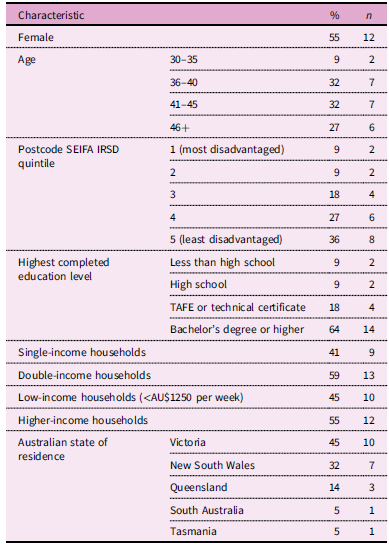
Interviews were conducted with twenty-two participants (see Table 1 for participant socio-demographic characteristics), with a mean interview time of 36 min. The mean age of participants was 43 years old, most were female (55 %), educated to a Bachelor’s degree or higher (64 %) and lived in less disadvantaged areas (64 %). Overall, 45 % of participants met our definition for lower-income households, and 41 % identified as being single income households.
Sociodemographic characteristics of 22 interview participants

Table 1. Long description
The table presents the socio-demographic characteristics of 22 interview participants. It has 10 rows and 3 columns. The columns are labeled Characteristic, %, and n. The table includes the following data: Row 1: Female, 55, 12. Row 2: Age 30-35, 9, 2. Row 3: Age 36-40, 32, 7. Row 4: Age 41-45, 32, 7. Row 5: Age 46+, 27, 6. Row 6: Postcode SEIFA IRSD quintile 1 (most disadvantaged), 9, 2. Row 7: Postcode SEIFA IRSD quintile 2, 9, 2. Row 8: Postcode SEIFA IRSD quintile 3, 18, 4. Row 9: Postcode SEIFA IRSD quintile 4, 27, 6. Row 10: Postcode SEIFA IRSD quintile 5 (least disadvantaged), 36, 8. Row 11: Highest completed education level Less than high school, 9, 2. Row 12: Highest completed education level High school, 9, 2. Row 13: Highest completed education level TAFE or technical certificate, 18, 4. Row 14: Highest completed education level Bachelor’s degree or higher, 64, 14. Row 15: Single-income households, 41, 9. Row 16: Double-income households, 59, 13. Row 17: Low-income households (<AUS1250 per week), 45, 10. Row 18: Higher-income households, 55, 12. Row 19: Australian state of residence Victoria, 45, 10. Row 20: Australian state of residence New South Wales, 32, 7. Row 21: Australian state of residence Queensland, 14, 3. Row 22: Australian state of residence South Australia, 5, 1. Row 23: Australian state of residence Tasmania, 5, 1.
Below, we describe the key themes from the interview data and differences between income groups, which were developed from sixteen major codes and 321 subcodes (available in online supplementary material, Supplemental File 3).
Theme one: Price promotions affect food affordability
Almost all participants across both income groups commented that price promotions helped improve the overall affordability of groceries. Participants described how price promotions helped them budget and stretch grocery spending. For both income groups, some participants also commented that due to budget constraints, price promotions had a large influence on what their family ate. Elaborating further, some participants explained how they planned their meals around what was ‘on special’, swapping components accordingly.
Despite similarities in experiences across income groups, more participants on lower incomes showed stronger awareness of pricing strategies. These participants were aware that similar products often ‘cycled’ between price promotions, sometimes alternating between the two major supermarkets, and reported waiting weeks to purchase items rather than paying full price. As one participant explained:
‘I’m driven to buying specials because you can always find what you want on special within a framework of two or three weeks.’ (Male, 65, lower income)
Regardless of household income status, participants consistently noted challenges from recent food price increases. Price was described as a key factor shaping food purchasing decisions, particularly for households managing tight budgets. As one participant explained:
‘Price is always a factor for me’ (Male, 47, lower income)
Many participants described examples of increases in staple food prices such as meat and fresh vegetables, with one participant on a lower income commenting:
‘Nothing is cheap anymore… you’re not getting a cheaper option’ (Female, 34, lower income)
Another participant on a lower income reflected that their diet is unhealthier now compared with what they had been eating in previous years because of the increased fresh fruit and vegetables prices.
There was also a common perception among all participants that supermarkets may be trying to ‘trick’ customers through their use of price promotions, suggesting that price promotions do not impact overall food affordability. A few participants, predominantly from higher-income households, questioned if the discounts shown for price promotions were genuine, or if usual prices were inflated and later discounted.
‘I often think specials aren’t always legitimate… you can’t believe that you could pay half [the price] of something that you would have paid the week before’ (Female, 53, higher income)
Generally, participants across both income groups perceived that supermarkets were more likely to place price promotions on unhealthy food and beverages compared with healthy options, with greater discount magnitudes also perceived for unhealthy products. Most participants thought that price promotions were applied to snack foods predominantly, like chips or chocolates, and rarely to staple foods such as eggs or vegetables. Generally, participants in both income groups reported that they felt less guilty about buying unhealthy foods and beverages when it was price promoted, compared with buying it when it was full price. Many participants said that they tried to only purchase snacks or ‘treat’ foods on price promotion, as one participant commented:
‘With sweets, we don’t ever pay the full price…. We only get them when they’re on special.’ (Female, 33, lower income)
Theme two: Price promotions influence shopping behaviour
Irrespective of household income, many participants discussed how price promotions were used to plan their grocery shopping. Some made use of supermarket catalogues to pre-plan their shopping and noted that the types of food and beverages most featured in the supermarket catalogue were unhealthy foods and beverages that ‘grab attention’. One participant explained how he planned his family’s grocery shopping:
‘I get the [supermarket catalogues] sent to my email… and then I’ll just basically browse it and jot down anything that I see that pops up that is of interest to the family. And, yeah, I must say I do actually always go straight to the half price stuff, for things like cereals and snacks.’ (Male, 47, lower income)
Multiple participants also commented that they planned to purchase unhealthy foods and beverages, such as savoury biscuits, after seeing them advertised on price promotion in either online or physical catalogues.
Differences were observed between income groups in relation to planning ahead for supermarket shopping. For example, several participants from lower-income households explained that they received physical copies of the weekly catalogue in the mail, and would write a shopping list with price promotions that they were interested in. These participants also described shopping at both major supermarkets to take advantage of different price promotions. In comparison, participants from higher-income households generally did not report planning grocery shopping as thoroughly, often locating price promotions as they browsed in-store. Additionally, list making was less commonly reported by higher-income participants. However, some participants from predominantly higher-income households also browsed price promotions online, especially for large discounts. Furthermore participants, predominantly with higher household incomes, also explained that they preferred to buy a branded product on price promotion rather than a generic (private label) brand as they perceived this to be better value for money. One participant described:
‘Sometimes there’s really good deals where I can get the name brand, because it’s on special – it might even be cheaper than the home brand. And then other times I want to buy the name brand, and it’s discounted, so I think, ‘Oh, even though it’s not cheaper than the supermarket brand, I’m going to get the name brand today.’’ (Female, 44, higher income)
Participants agreed price promotions influenced brand and product choices. Across both income groups, participants explained how they would plan to purchase an item, such as muesli bars, but would remain flexible about which brand to ensure that they could find a price promotion to reduce their overall spend. Some participants, mostly in higher-income households, also discussed trialling new products when they were price promoted that they otherwise would not have tried.
Participants from both income groups commented that they usually impulsively bought unhealthy foods and beverages after seeing them price promoted in-store. The in-store supermarket marketing of price promotions was discussed in relation to shelf tags, signage and end-of-aisle displays, which were perceived to draw their attention towards discounted products. Both groups of participants perceived that they needed to exercise willpower to resist buying unhealthy foods on price promotions, but found them ‘very tempting’ and often ended up purchasing these products despite their intentions to eat healthily, as one participant commented:
‘I’ve got the goals in my head, budget conscious and healthy but…I think they do well in making me compromise my values when I see something on sale. Especially these half price deals that you see all the time.’ (Male, 43, higher income)
Participants shared other insights around supermarket shopping as a family with school aged children. Across both income groups, participants indicated that their children were susceptible to in-store marketing and would repeatedly request them to purchase unhealthy foods and beverages that were price promoted. A few participants in lower-income households also commented how their children were able to recognise yellow shelf tags as meaning a product was price promoted and leverage this to pressure them to purchase it. As one participant noted:
‘I still say to them, ‘Just buy what’s on special.’ My youngest son, he’s pretty good, he’s only five but he’s pretty good at looking for the yellow [shelf labels]’ (Female, 37, lower income)
All participants reported using price promotions as a method to ‘stock up’ on certain food and beverage products. They discussed how items that had significant discounts (such as half price) would be purchased in bulk to store for later, after the discount period had ended. This behaviour was reportedly most common for unhealthy foods and beverages more than healthy alternatives, particularly to buy snacks and treats for children. Most participants acknowledged that they did not want to waste food, and so only stocked up on food and beverages that were non-perishable. Moreover, participants suggested that the greater the magnitude of discount, the greater the perceived influence on their purchasing behaviours. Some participants commented that price promotions influenced them to purchase more than usual, as one participant explained:
‘I tend to buy more than I normally would because you think you’re getting a good deal.’ (Female, 49, higher income)
Participants generally described their own purchasing decisions rather than comparing their behaviour with that of others. We did not observe a consistent tendency for participants to portray their own consumption more positively than that of others.
Theme three: Price promotions have a mixed effect on consumption behaviour
Participants had mixed views on how price promotions affected consumption. Most participants across both income groups believed that buying in bulk due to price promotions encouraged them to consume items faster, more frequently, or in greater amounts than if they did not have the items on hand in large quantities.
‘Actually, it would influence the amount we ate because if we’ve got 20 pizzas in the fridge, you’re more likely to eat two or three over the weekend as opposed to one if there was only one there…. I think I actually have noticed an increase when we do have extra of those in there, the kids don’t feel as bad about eating a lot more of it’ (Female, 45, higher income)
Some stored unhealthy foods they had stocked up on out of sight to moderate intake. This sentiment was shared among both income groups. Commonly, these participants explained that the presence of unhealthy food in the house prompted them to eat it beyond their intentions. One participant commented:
‘…for treats, the more we have in the house I think the more you consume. I try to put them away.’ (Male, 44, higher income)
Participants also tried to ‘space out’ or ‘ration’ how much unhealthy food they ate to control their consumption, sharing their awareness that the foods and beverages they usually stocked up on price promotions were unhealthy. Several participants identified concerns that their children were developing unhealthy dietary habits due to some of these stocked up purchases, as one participant explained:
‘Even though they’re in the cupboard, I really have to make sure that [my son] doesn’t eat them all in one go because he will.’ (Female, 40, higher income)
Many participants across both income groups suggested that buying unhealthy foods and beverages because of price promotions can influence the development of unideal dietary habits, with some criticising supermarket price promotions for encouraging unhealthy ‘lifestyles’ or ‘addictions’. As one participant explained:
‘The amount of specials in the junk food or in the unhealthier foods is enormous, enormous, and if you just follow the yellow tickets you’re going towards the path of destruction.’ (Female, 41, lower income)
However, there were also participants who did not feel that buying price promoted food and beverages affected their consumption habits. More participants from higher-income households described how their family’s consumption of food was routine-driven, and so having additional quantities of foods and beverages present from price promotions did not change what or how much they ate. Others described how products they had stocked up on when price promoted would replace other, future purchases, and so their overall consumption patterns did not change.
Theme four: Participants supported regulating supermarket price promotions to promote public health
Participants perceived that there were not enough healthy options available on price promotion and believed that increasing the proportion of healthy to unhealthy foods and beverages that are available on price promotion would support healthier dietary intakes. When asked about their opinions regarding who should regulate supermarket price promotions, most participants in both income groups were supportive of government action. Participants generally supported government regulation of unhealthy price promotions, including removing prominent displays. One participant explained:
‘That would certainly help me make a healthier choice on the day, for those spur of the moment random buys that you don’t intend to buy. I think I would love to see that sort of stuff in place’ (Female, 45, higher income)
When asked how changes to price promotions might affect their purchasing, some participants, predominantly in higher-income households, expressed that they would buy less unhealthy foods and beverages if they were price promoted less frequently. A few participants mentioned that government regulations could help to curb the influence that price promotions and in-store marketing had on their children. As one participant explained,
‘It’s probably a good idea, in some ways. Because then you’re going to have less…little kids seeing [that] stuff, most likely.’ (Male, 42, low income)
Moreover, participants in both income groups also linked a decrease in price promotions on unhealthy foods and beverages to potentially lower rates of obesity and reduced healthcare burden.
However, not all participants agreed with the concept of government regulation of food and beverage price promotions. In both lower- and higher-household income groups, there were a few participants that suggested that governments had more important priorities than regulating price promotions, that they should not interfere with business practices, and that instead of regulating price promotions for unhealthy foods and beverages they could focus on improving the affordability of healthy foods and beverages. Several participants from lower and higher-income households also suggested that government could focus on educating shoppers about how to choose healthier options at the supermarket.
When discussing potential regulation of price promotions, many participants expressed their frustrations with supermarkets’ perceived lack of consideration for their health. As one participant explained:
‘The amount of money and vigour that they use advertising rubbish food, they could put the same sort of effort and get the same [profit] if they promote healthier options for people like us’ (Male, 57, lower income)
Many participants perceived that supermarkets had a key role in determining the price of foods and beverages, and the healthiness of products available on price promotion, but were failing to use their ‘important position’ to support health. Across both income groups, there were perceptions that supermarkets were focused on their ‘bottom line’ and profits instead of supporting healthy eating.
Despite their frustrations with a perceived lack of supermarket action to support health, some participants in both income groups expressed that it was an individual’s responsibility to make healthy choices, and similarly that it was a parent’s responsibility to ensure that their children ate a balanced diet and knew what healthy foods were, as one participant explained:
‘I feel I’m so responsible for two kids who are going to be a part of this world… and I think it’s just my responsibility’ (Female, 38, higher income)
Discussion
This study is among the first to qualitatively explore Australian households’ perceptions of supermarket price promotions and their influence on healthy and unhealthy food purchases, with attention to differences by household income. We found that there were many shared experiences across both income groups. Most participants perceived that price promotions supported the overall affordability of foods and beverages, were prominently marketed to influence product awareness and purchasing (especially for unhealthy products), provided an opportunity to stock up on items, and were not sufficiently available for healthy options. Participants on lower incomes reported greater awareness and planning around promotions, while some participants with higher income felt promotions did not change their consumption rate. Overall, participants were generally supportive of government actions to regulate the availability of price promotions, not just on unhealthy foods and beverages, but with a view to improve the affordability of healthy options.
Our findings broadly align with existing qualitative literature on consumer perceptions of price promotions, particularly regarding the role of promotions in managing household food budgets. A 2023 qualitative study from the UK examining women’s perspectives on proposed restrictions on price promotions for unhealthy foods and beverages found that participants on tight grocery budgets reported relying on promotions to ‘make [their] money go further’ when feeding their families, and expressed concern that restrictions on promoted products could increase food costs(Reference Dhuria, Muir and Lawrence30). Similarly, participants in both the UK study and our study expressed a desire for more price promotions on healthier foods and perceived healthy options to be relatively expensive. Concerns about food affordability following restrictions on price promotions were also reported in a 2023 UK study involving academics, manufacturers, local authority enforcement officers and consumers who described how it is ‘far more expensive to fill up hungry children with healthy food’(Reference Muir, Dhuria and Roe31). This study also found that consumers who did not routinely use a shopping list reported feeling ‘tempted’ to make impulse purchases of unhealthy foods when price promotions were available, a behaviour also described by participants in our study(Reference Muir, Dhuria and Roe31). Together, these findings suggest that while consumers recognise the potential health benefits of restricting promotions on less healthy foods, concerns about affordability and purchasing flexibility remain central to public perceptions of such policies.
These experiences should be understood within the broader context of rising food prices in Australia. Since 2022, Australia has faced a cost-of-living crisis driven by global factors including geopolitical conflicts, the COVID-19 pandemic and climate change, affecting food supply chains, fuel, fertiliser prices and exchange rates(32,Reference Asadollah, Carmy and Hoque33) . At the end of 2022, the Consumer Price Index rose 9·4 % – the largest food price increase in two decades(34). National market research survey data also describe the pressure that food inflation has placed on household budgets. A 2022 National Australia Bank survey found 54 % of respondents switched to cheaper brands or shopped around(35), and 75 % reported groceries added to cost-of-living pressures(36). These findings align with the experiences shared by our participants, especially people on lower incomes, who described actively seeking price promotions and modifying their shopping behaviours to manage their household budget. The heightened reliance on purchasing price promotions among lower-income households is supported by previous research. A 2020 study analysing New Zealand purchase data from 2016 to 2017 (n 1778 households) found that a greater proportion of grocery purchases made by low- and middle-income households were price promoted compared with high-income households (P < 0·001)(Reference Zorbas, Eyles and Orellana13). This is further supported by an Australian analysis, of nationally representative household panel data (n 10 000) which found that lower socio-economic households consumed 18 % more energy from less healthy packaged products purchased on price promotion compared with higher socio-economic households (1141 v. 970 kJ/day/capita, P < 0·001)(Reference Davies, Coyle and Shahid11). However, our participants also expressed scepticism of whether supermarket price promotions were genuinely helpful in improving food affordability, or whether prices were artificially inflated before being discounted. Mistrust of supermarkets has also been noted in a previous qualitative study examining Australian parent’s experiences with online grocery shopping(Reference Bennett, Driessen and Zorbas37).
Aligning with the broader evidence, participants in our study perceived that healthy foods and beverages were more expensive than unhealthy options. Given that price promotions are more commonly applied to unhealthy foods and beverages(Reference Bennett, Zorbas and Huse8), this perception is understandable. However, the evidence regarding the relative price of healthy and unhealthy diets is mixed. A 2021 Australian study found healthy diets cost less than unhealthy diets, but both were unaffordable for low-income households, consuming up to 31 % of disposable income(Reference Zorbas, Brooks and Bennett38). Other Australian studies have also found that healthy diets are less expensive than unhealthy ones in regional areas(Reference Herath, Murray and Lewis39,Reference Love, Whelan and Bell40) . Participants in our study perceived healthy foods and beverages to be more expensive than unhealthy options, a belief that is widespread in population research and may influence purchasing decisions even when objective price differences are small(Reference Riesenberg, Backholer and Zorbas18,Reference Zorbas, Gilham and Boelsen-Robinson41) . Taken together, these findings suggest that the structure of supermarket price promotions may shape both perceived affordability and purchasing strategies, particularly among households managing tighter food budgets.
This pattern is particularly evident among lower-income households. Many study participants, particularly in lower-income households, reported stocking up on price promoted products and consuming them faster, a behaviour noted in past research(Reference Wahdat and Lusk42). Previous research has typically found that stocking up behaviour is most common in higher-income groups(Reference Hossain43), though we did not find this to be the case in our study. Purchasing larger quantities of discounted items may reflect a practical strategy to manage food costs rather than a deliberate increase in consumption. However, greater availability of promoted products in the home may influence dietary patterns over time, particularly where promotions are concentrated on less healthy options(Reference Riesenberg, Backholer and Zorbas18). Overall, these findings suggest that price promotions function not only as marketing tools but as structural signals that interact with household financial constraints to shape purchasing decisions, with potential implications for dietary equity across income groups. Participants did not explicitly report that purchasing larger quantities of discounted items limited their ability to purchase staple or healthier foods. However, this possibility warrants further investigation, particularly in the context of rising food costs and constrained household budgets.
Our interpretation of the results was underpinned by the model of community nutrition environments(Reference Glanz, Sallis and Saelens20) and dual process theory(Reference Evans21). The model of community nutrition environments highlights the role of structural factors such as price and promotion in shaping food purchasing behaviours, and our findings suggest that the widespread availability of promotions for less healthy products contributes to perceptions of affordability and influences purchasing decisions, particularly among households managing tighter food budgets. Dual process theory further supports interpretation of the behavioural patterns observed in this study, whereby participants described both deliberate planning behaviours (e.g. seeking price promotions to manage food costs) and more automatic responses (e.g. impulse purchases which are triggered by discounts). Together, these frameworks provided a useful lens for understanding how financial constraints and retail environments interact to shape food purchasing practices.
Policy and research implications
Participants in our study described the need for government action to achieve a more balanced availability of price promotions for healthy and unhealthy foods and beverages. This included reducing the use of price promotions on less healthy items and using pricing strategies to improve the affordability of healthier options.
A 2018 Australian qualitative study by Pulker et al., which explored parents’ experiences with supermarket food labelling, found that participants generally trusted supermarkets and, while they expressed ‘frustrations’, they did not report distrust or feelings of being misled by supermarket practices(Reference Pulker, Trapp and Foulkes-Taylor44). In contrast, many participants in our study expressed scepticism about supermarkets’ priorities, suggesting that supermarkets were more focused on profit than customer health.
This difference in perspectives may reflect changes in the broader economic and policy context over time. Rising food prices and ongoing cost-of-living pressures have heightened public sensitivity to grocery costs(Reference Taylor45), while recent public and policy scrutiny of supermarket pricing and market power may have contributed to greater awareness of the commercial drivers shaping retail food environments(46). Participants also emphasised that supermarkets occupy a central position in household food purchasing and therefore have a responsibility to use their influence, including pricing and promotion strategies, to support healthier food choices.
In 2023, the Australian Government instigated inquiries via a Senate Select Committee and the Australian Competition and Consumer Commission to investigate Australian supermarkets and determine their price setting practices and market power(46). These committees provided recommendations in 2024, recommended standardising promotional terms to prevent misleading discounts(47,48) . This recommendation targets potentially misleading shelf labels, such as those promoting a ‘discount’ when the price merely reflects a return to its usual level following a period of artificial inflation. With this being the only recommendation focusing on price promotions, there are no clear plans for the Australian Government to comprehensively regulate supermarket price promotions more broadly, including the extent to which they are available for unhealthy products and banning of volume-based pricing, as suggested by our participants.
In October 2025, restrictions on price promotions for unhealthy foods and drinks came into force in the UK under new legislation(49). Although the policy was estimated to impose costs on industry (approximately £300 million over the lifetime of the policy), modelling suggested substantially larger long-term health and economic benefits, with an estimated net social benefit of £2·75 billion(49). There are currently no policies at an Australian national or state level that addresses the saturation of price promotion on unhealthy foods. In the current cost-of-living climate, such policies risk perceptions of increasing grocery costs. Regulation may need to be paired with measures to lower food costs, particularly for healthy foods. Further research is needed to develop policy options that limit unhealthy price promotions while supporting healthy food affordability and food security.
Study strengths and limitations
Our study offers novel insights into Australian households’ perspectives on supermarket price promotions and regulation. A key strength of this study was the use of multiple theoretical frameworks to inform a more comprehensive and layered understanding of the factors shaping food purchasing behaviours. Using a paid recruitment company enabled the inclusion of participants from diverse geographical areas across Australia and from households with differing income levels and family circumstances, supporting the capture of varied perspectives. Additionally, we achieved a 45 % representation of men, who are often more difficult to engage in research compared with women(Reference Borg, Haritopoulou-Sinanidou and Gabrovska50). This contributed to a more balanced representation of household decision-making perspectives.
Whilst we aimed to recruit an even number of participants from higher- and lower-income households, our sample included slightly more higher-income households. Nevertheless, the in-depth nature of the data enabled comparisons across household incomes. Our sample may also be skewed towards participants who are interested in participating in research and may not represent a typical cohort of Australians who purchase price promotions. The reputable recruitment company used in this research only allows participants to complete one research project every six months, which likely mitigated this potential risk. Additionally, while interviews were conducted using a flexible semi-structured guide rather than a fixed script, some prompts may have been more directive than fully open-ended. Although interviewers used the guide flexibly and participants were encouraged to share their own perspectives, more neutral wording may have further supported an inductive exploration of participants’ experiences.
Conclusion
This study found that supermarket price promotions play a central role in how Australian households manage food budgets, particularly among lower-income households who reported greater awareness of and reliance on price promotions. While price promotions were widely viewed as a practical strategy to reduce food costs and stock up on essential items, participants also described how the greater availability of price promotions for less healthy foods and beverages may undermine efforts to purchase and consume healthier options. Participants generally supported government action to improve the balance of price promotions across food types but emphasised the importance of maintaining affordability. Policies to improve population diets should therefore consider how supermarket pricing and promotional practices can be regulated in ways that equitably support healthier purchasing by considering household budget constraints.
Supplementary material
For supplementary material accompanying this paper visit https://doi.org/10.1017/S1368980026103279
Data availability statement
Data used in this study is available upon reasonable request.
Authorship
R.B. was responsible for data analysis, drafting and reviewing of the manuscript. C.Z. and K.B. were responsible for study conceptualisation, methodology, data analysis and reviewing the manuscript. J.M. was responsible for data collection, methodology, data analysis and reviewing the manuscript. L.G-D., G.S., A.C., A.S. and L.W. were responsible for methodology and reviewing the manuscript.
Financial support
This project was funded by a project grant from the Australian Research Council (DP210102791). The study funders had no role in the study design, data collection, analysis, interpretation of data, writing of the manuscript, or decision to submit for publication
Competing interests
We have no conflicts to declare.
Ethics of human subject participation
This study was conducted according to the guidelines laid down in the Declaration of Helsinki, and all procedures involving research study participants were approved by the Deakin University Human Ethics Advisory Group in November 2022 with project code HEAG-H 130_2022. Written informed consent was obtained from all participants.


 Open access

