INTRODUCTION
Since “intangible cultural heritage” (ICH) became the new focal point in the global heritage discourse with the institutionalization of the Convention for the Safeguarding of Intangible Cultural Heritage in 2003 (UNESCO Convention), governments and scholars in many countries have begun to promote this new form of “immaterial” or “living” culture. Footnote 1 Governments worldwide now compete to have their countries’ ICH inscribed by the UN Educational, Scientific and Cultural Organization (UNESCO), which defines ICH as “practices, representations, expressions, knowledge, skills—as well as the instruments, objects, artefacts and cultural spaces associated therewith—that communities, groups and, in some cases, individuals recognize as part of their cultural heritage.” Footnote 2 To identify and promote ICH items, governments, academics, professionals, and other actors at the central and local levels have developed multiple strategies and adapted them to national contexts, resulting in considerable variations in ICH policies. The People’s Republic of China (PRC), which ratified the UNESCO Convention in 2004, has been one of the most active state parties, implementing the new scheme and adapting it to domestic discourses and practices, thereby opening new spaces for collective calls to promote cultural heritage and for negotiating its social value.
The UNESCO Convention, however, involves a certain tension between the normative claim to include local communities in selecting and nominating their ICH, on the one hand, and the functional requirements of ICH safeguarding, on the other. Footnote 3 Scholars such as Lucas Lixinski or Federico Lenzerini, for example, have applauded the Convention for emphasizing the active role of local actors in principle, but they have criticized it for leaving the responsibility for involving local communities to the state, potentially depriving them of their cultural human rights. Footnote 4 This tension has also been observed in the PRC. As Yu Hua has argued, ICH safeguarding “requires officials and experts who should know how to research, preserve, protect, promote, enhance, transmit, educate and revitalise various aspects of heritage to fulfil the requirements of their job,” making expert knowledge essential in ICH policy work. Footnote 5 However, this elite-driven approach also marginalizes vernacular understandings and practices of ICH safeguarding. Similarly, studies by Fan Li and Yan Haiming have pointed to a lack of involvement by local communities in the conservation of tangible heritage. Footnote 6 As Yan has noted, heritage conservation in China “privileges expert knowledge over local voices, while it empowers government by ignoring local residents’ capability within heritage conservation.” Footnote 7
Overall, given the expectations that ICH would give local communities a voice in this debate, the situation in the PRC appears to be a highly ambiguous one. On the one hand, there is a striking degree of variation in the ICH policies, governmental regulations and guidelines across administrative levels as well as a fascinatingly vibrant number of local initiatives spearheaded by local actors, in the field of ICH safeguarding and promotion. This pattern confirms that a growing number of new actors are entering the policy-making scene in China, leading to what has been described as a “fragmented authoritarianism.” Footnote 8 This conceptual framework dynamically analyzes how, in an authoritarian context, policies formulated at the national level become increasingly malleable by the interests and goals of lower-level agencies implementing these policies. On the other hand, when we look more closely at these new actors, we observe a dense web of symbiotic networks between local cadres and scholars, which suggests a highly elite-driven approach to formulating and implementing ICH policies. Footnote 9
While the dominance of the elite, per se, might not be surprising in the context of an authoritarian party state, we have to ask ourselves whether this increasing variety of new actors is indeed leading to the “increasing pluralization” of the Chinese policy-making process in the sense of creating spaces for “policy entrepreneurs” to voice open contestation, as predicted by Andrew Mertha. Footnote 10 An analysis of government-scholar co-operation in safeguarding ICH is therefore not only relevant because it adds to the understanding of growing pluralization in the Chinese policy process but also because it depicts a country-specific variation in implementing the UNESCO Convention.
This article aims to shed light on the role of local elite networks in the domestic implementation of the UNESCO Convention. It addresses the following questions: (1) what incentives exist for local officials and scholars to participate in networks within the field of ICH policies; (2) what contribution do scholars and other ICH experts make within these networks; and (3) what does the outcome of local ICH policies tell us about the functioning of fragmented authoritarianism and the prospects for pluralization versus the emergence of a new “expertocracy” shaping the discourse in this policy field? To answer these questions, this article conducts a comparative case study of Jiangsu and Fujian provinces. After familiarizing the reader with the Chinese academic discourse on ICH, it briefly outlines the Chinese policy process. By comparing four different local governments’ ICH policies in the area of ICH safeguarding and tourism, our findings demonstrate how ICH strategies diffuse horizontally and vertically, leading to variations in local ICH activities and location branding. One source of these variations, it is argued, is a symbiotic network between government cadres and scholars who co-operate for the sake of strategically positioning their locality vis-à-vis national and international audiences.
CHINA’S ADOPTION OF THE UNESCO CONVENTION
To establish a national identity, Western European countries began promoting the protection of cultural heritage in the eighteenth century, Footnote 11 a practice later manifested in UNESCO’s 1972 Convention Concerning the Protection of the World Heritage and Natural Heritage. In this Convention, UNESCO categorized cultural heritage into “monuments, groups of buildings and sites of outstanding universal value.” Footnote 12 However, as this Convention only included the protection of tangible forms of culture, it was increasingly criticized in the 1970s and 1980s, particularly by developing countries. Footnote 13 After preliminary attempts by the UNESCO to introduce ICH safeguarding in 1989 Footnote 14 and 2001, Footnote 15 albeit in legally unbinding forms, Footnote 16 the organization eventually established the UNESCO Convention in 2003. How to safeguard and further develop ICH and whether or not the ICH Convention achieves its aims, however, are still subject to debate, both internationally and domestically. Footnote 17
In the PRC, as elsewhere, international conceptualizations have triggered new domestic discourses on the protection of traditional culture. After the party state had loosened its grip over the cultural realm during the reform and opening up period, the concept of “cultural heritage” (wénhuà yíchǎn) gained currency during the 1980s and 1990s. Until then, the Chinese academia had pursued the concept of “folk culture” (mínsú wénhuà or mínjiān wénhuà), which refers to traditional cultural customs, including their tangible cultural manifestations and surrounding natural setting. Footnote 18 A content analysis of over 1,000 articles on the CrossAsia database conducted by the authors shows that the Chinese discourse on cultural tourism has also been framed in accordance with these two terms from the early 1990s onwards. “Folk culture tourism” (mínsú or mínjiān wénhuà lǚyóu) has been used to describe cultural tourism activities in historical districts or villages. Footnote 19 Initially, the concept of “cultural heritage tourism” (wénhuà yíchǎn lǚyóu) was only associated with UNESCO world heritage sites. After the PRC ratified the UNESCO Convention, a broader application of the concept of cultural heritage gained ground in China, especially in terms of “ICH” (fēiwùzhí wénhuà yíchǎn or wúxíng wénhuà yíchǎn), leading to adaptations and the blurring of the concepts of “cultural heritage tourism” and “folk culture tourism” in academic discourse. Footnote 20 Since 2006, studies have specifically concentrated on how to develop “intangible cultural heritage tourism” (fēiwùzhí wénhuà yíchǎn lǚyóu) provincially and locally. Footnote 21
INCENTIVES FOR LOCAL ACTORS UNDER FRAGMENTED AUTHORITARIANISM
The policy-making process of the PRC has commonly been characterized by fragmented authoritarianism. According to Kenneth Lieberthal and Michael Oksenberg, “what appears on paper to be a unified, hierarchical chain of command turns out in reality to be divided, segmented and stratified.” Footnote 22 This fragmentation of authority is the result of decentralization, which has provided the “local” level—that is, provincial, municipal, or county governments—with greater leeway in policy implementation. Fragmentation takes place along vertical lines of command (tiáo), as central policies are “watered down” during their top-down implementation within the administrative hierarchy, as well as along horizontal lines across various bureaucracies at the same level (kuài), which compete and negotiate with each other. Thus, despite nationally established agendas, local policies are shaped by local actors’ long-term interests. Footnote 23 In a variation of the fragmented authoritarianism model, entitled “fragmented authoritarianism 2.0,” Andrew Mertha emphasizes that while non-state actors are increasingly entering the local policy process, local levels also apply concepts and strategies developed at the national level to bolster local implementation schemes. Footnote 24 As this article shows, besides referring to domestic concepts, state and non-state actors also utilize international concepts and strategies to pursue local interests.
Within the framework of fragmented authoritarianism, localities have various incentives to compete with each other for support from higher-level governments, particularly from the national government. Strong incentives for local initiatives emerge, for instance, when the central government plans to engage in policy experimentation. Sebastian Heilmann has shown that the party state has developed new policies by letting local governments explore potential policy measures on a small scale so as to utilize successful policies on a larger basis. By issuing “experimental regulations,” allowing “experimental points” (models and pilot projects), or granting jurisdictions greater discretionary powers in an “experimental zone,” the PRC has engaged in policy “experimentation under hierarchy.” Local knowledge and initiatives are thereby rewarded within the cadre evaluation system that determines the career of party and government officials. Footnote 25
While this competitive feature of policy experimentation is a general incentive for the emergence of local expert networks across policy fields, more specific incentives can be identified in the field of ICH policy. The use of expert knowledge in ICH safeguarding is explicitly stipulated in UNESCO’s operational guidelines. Footnote 26 Looking at the literature, we find that scholarly expertise also plays a prominent role in local experimentation. While Marina Svensson and Yongjia Liang confirm that local experts have been significant in initiating innovative policies and highlighting cultural heritage in need of protection, Footnote 27 Xiamen scholar Wei Chengyuan holds a rather skeptical view. He finds scholarly influence to be quite limited due to the differing opinions of officials and scholars concerning the specific modes of protection. Footnote 28 Although cadres’ political considerations outweigh scholarly expertise in the bargaining process, Footnote 29 it would seem that fragmented authoritarian regimes create significant incentives for interaction between local cadres and scholars in the field of ICH policy.
Within the vertical dimension of ICH policy implementation, subordinate governmental levels rely on local expert advice to assist them in appropriating concepts and strategies from the national or international level. These concepts and strategies are then used to maximize their chances of success in competing for policy experiments and fostering the local economy. Within the horizontal dimension, local officials seek local ICH experts’ support through publications or interactions at conferences and research centers in order to bestow local policy making with a “scientific” aura of academic expertise. Notably, by adopting nationally promoted concepts and strategies into their recommendations, local officials may justify the pursuit of local (economic) interests while simultaneously legitimizing the official discourse. On the other side of this symbiotic relationship, ICH experts may themselves obtain social legitimacy through governmental recognition, thus reinforcing their networks.
To understand the role of these symbiotic government–scholar networks in formulating and implementing ICH policies, this study systematically compares two provinces: Jiangsu and Fujian provinces. These provinces have been selected because, first, both stand out in academic discourse in terms of the number of scholarly articles that have included them in their discussion of the safeguarding and promotion of cultural heritage and, second, both have played a special role in developing ICH policies in China. Whereas Jiangsu has been a forerunner in ICH safeguarding and promotion, Fujian province has developed local ICH resources catering to tastes of Taiwanese tourists. Two localities in each province, Nanjing and Changzhou in Jiangsu and Fuzhou and Quanzhou in Fujian, are comparatively examined. The four case studies have been chosen since (1) they are in close geographical proximity and subject to the same superordinate regulations and (2) they enable a comparison between a provincial capital (Fuzhou; Nanjing) and a regular municipality (Quanzhou; Changzhou) within the same province and across the two provinces. In addition to the spatial comparison, this selection also allows for a temporal analysis, which begins with the UNESCO Convention’s ratification in 2004 and ends in 2014. The scholarly publications analyzed were identified using full text searches of the China Academic Journals Network, available via CrossAsia. The government documents were retrieved from official government websites.
RESEARCH FINDINGS
The Vertical Dimension of the ICH Concept and Strategy Formulation
Since ratifying the UNESCO Convention, several national level agencies and ministries have produced guidelines for protecting traditional cultural heritage (TCH) and ICH, including its tangible environment. These bodies include the State Council, the Ministry of Culture (MOC), the State Administration of Cultural Heritage, and the National Tourism Administration (NTA). The State Council has issued a number of notices concerning folk culture (2005), cultural heritage (2004–05), and ICH (2006–08). Footnote 30 These documents stipulate why Chinese cultural heritage needs to be protected and which measures and national targets should be achieved by all subordinate governmental levels. Footnote 31 The State Council’s 2005 Interim Measures on the Management and Protection of Intangible Cultural Heritage specify local governments’ obligations to safeguard ICH, while ICH tourism is only mentioned for ICH development. Footnote 32 While they resemble the UNESCO Convention, these guidelines are also tailored to the Chinese political system—for example, by coinciding with 10-year plans (and later five-year plans) or by adopting measures that correspond to specific levels of government. Footnote 33
In addition, various subordinate ministries and affiliated organs, often jointly, issue guidelines for how to safeguard ICH, reconfirming and enlarging the scope of the State Council’s stipulations. While many ministries, such as the Ministry of Construction or the Ministry of Education, supervise certain aspects of cultural heritage-related work, it is mainly the MOC that supervises the nationwide safeguarding of ICH. Footnote 34 Subordinate organs create county, municipal, or provincial lists of ICH items that are to be considered by the MOC and the State Council for inclusion on the national list—a common prerequisite for later nomination to the UNESCO ICH representative list. Footnote 35
Strategies on ICH safeguarding diffuse vertically and horizontally through the Chinese party state. One of these strategies is the promotion of ICH tourism. In addition to promoting ICH safeguarding, the MOC also began to support the cultural tourism industry in 2009 by issuing a document entitled “Guidance on the Joint Promotion of Culture and Tourism Development.” Footnote 36 In this document, the MOC, together with the NTA, encouraged the promotion of nationwide cultural tourism. In particular, the document argues for creating cultural tourism theme years, festivals, and theme parks as well as tourist products. Footnote 37 One example of a national theme year is the campaign “Beautiful China” (Měilì Zhōngguó), which was launched in 2014, promoting various regional TCH and ICH activities. Footnote 38 The 2009 MOC document also mentions, for the first time, the use of ICH resources as the basis for cultural tourism. While simultaneously safeguarding ICH, “cultural environment protection experimental zones” (wénhuà shēngtài bǎohù shíyàn qū), Footnote 39 in which certain ICH policies can be explored to subsequently transform the area into a permanent protection zone, promote ICH-related activities. Footnote 40 Another experimental policy initiated by the MOC in 2010 involved the creation of “demonstration bases for productive ICH protection” (fēiwùzhí wénhuà yíchǎn shēngchǎnxìng bǎohù shìfàn jīdì)—that is, organizing facilities that produce ICH-related products on the basis of expert and industrial associations’ recommendations. Footnote 41 Finally, strategies to promote ICH as a tourism product have been included in the cultural industry’s national five-year plan, focusing on marketing ICH in the form of festivals, museums and tourism routes. Footnote 42
In addition to these various government organs, the Communist Party of China (CPC) has also stipulated measures and objectives, thereby also promoting ICH strategies. The 2011 CPC Resolution on the Promotion of Socialist Culture exemplifies this mandate. It calls for the protection of Chinese traditional and socialist culture domestically and the promotion of China’s “cultural soft power” abroad. China’s cultural soft-power strategy aims to increase the country’s cultural attractiveness internationally by exhibiting its traditional culture to a foreign audience. To achieve this goal, the document suggests recruiting university graduates who “are knowledgeable of their local culture … particularly those who carry on intangible cultural heritage.” Footnote 43 This suggestion again demonstrates the importance given to scholarly expertise on ICH in China.
Following the strategies of the party state on the national level, subordinate levels of government produce their own guidelines based on national provisions and regional circumstances. Until 2005, cultural heritage protection in Jiangsu province was mostly concentrated on TCH—for instance, the promotion of the province’s world cultural heritage (shìjiè wénhuà yíchǎn). Footnote 44 This emphasis changed in favor of ICH in 2005, when Jiangsu’s Bureau of Culture organized ICH exhibitions, conducted surveys, and established a pilot unit of experts (shìdiǎn dānwèi) that recommended specific examples of ICH to be listed nationally. Footnote 45 In 2006, the Bureau of Culture published its fundamental regulations on ICH safeguarding and development, Footnote 46 which were revised in 2013. Footnote 47 In these “ICH regulations,” the bureau also called for the inclusion of “expert consultation systems” (zhuānjiā zīxún zhìdù) in government decision making that concerned the safeguarding and advancement of local ICH. Footnote 48 Regarding the vertical implementation of policies, Jiangsu province complied with the national ICH policies by issuing its own ICH policies and establishing a scholarly consultation system.
Horizontally, Jiangsu province has competed with other provinces for the right to establish a pilot project that yields political power and financial support for the government. Following the implementation of regulations for the promotion of provincial ICH items, ICH inheritors, ICH museums and research institutes, Footnote 49 the Bureau of Culture obtained permission to establish a “provincial cultural environment protection experimental zone” (shěngjí wénhuà shēngtài bǎohù shíyàn qū) in 2013. Footnote 50 In this same year—one year before the national tourism campaign of the same name was launched—the bureau kicked off its “Beautiful Jiangsu” (Měilì Jiāngsū) campaign, which was aimed at promoting ICH as a part of its cultural heritage days, ICH exhibitions, and other publicity activities. Footnote 51 Furthermore, in 2014, the bureau also set up Jiangsu’s first “ICH research base” (fēiwùzhí wénhuà yíchǎn yánjiū jīdì), in which leading experts from universities and institutes engaged in ICH-related research. This concept is similar to the national “ICH protection research zones” (guójiājí fēiwùzhí wénhuà yíchǎn bǎohù yánjiū jīdì), which were established in 2013. Two “national ICH protection zones” from Jiangsu were selected, together with one from Henan and another from Fujian province. Footnote 52 The Bureau of Culture has also focused on cultural tourism since 2006. In its ICH regulations, the bureau specifies the use of ICH resources as a means for enhancing folk culture tourism services. Footnote 53 By competing for permission to establish experimental policy zones and incorporating expert knowledge into the policy process, Jiangsu province has attempted to use the fragmented authority within the system to strategically position itself domestically.
Similarly to the situation in Jiangsu, Fujian’s provincial Bureau of Culture has also developed its own strategies to foster local cultural heritage and implement superordinate policies. As early as 1999, the bureau published its Regulations for Safeguarding Intangible Cultural Heritage (Fújiàn shěng wúxíng wénhuà yíchǎn bǎohù tiáolì de yì'àn) Footnote 54 and subsequently adopted various national measures on folk culture and ICH promotion, being one of the first provincial governments to do so. In a national pilot project competition, Fujian province successfully gained permission to establish the first “Minnan cultural environment protection zone” (Mǐnnán wénhuà shēngti bǎohù) in 2007 Footnote 55 as well as several “demonstration bases for productive ICH protection” in 2011, Footnote 56 thereby winning political power and prestige in the horizontal competition between provinces.
Since 2003, Fujian’s Bureau of Tourism has explicitly promoted its cultural tourism industry. Footnote 57 In 2008 and 2009, ICH in Fujian, as well as in other provinces, was advertised nationally through a series of documentaries entitled the Beauty of China Footnote 58 and Beautiful China on China Central Television. Footnote 59 It was also part of the tourist campaign Beautiful Fujian, which began in 2012 Footnote 60 and anticipated, and perhaps served as a role model for, the ensuing nationwide Beautiful China concept. Footnote 61 These television series and tourism campaigns promoted the local tourism industry, which in turn served to enhance the municipality’s reputation and political power. Starting in 2011, Fujian province also explicitly mentioned the promotion of ICH tourism in its policy documents. Footnote 62 Fujian’s provincial government, thus, implemented numerous top-down policies on cultural heritage while simultaneously developing its own measures, which corresponded to province-specific circumstances and leveraged local resources. In doing so, it was also able to rely on academic research from Fujian province as well as other areas to generate and communicate its own “best practices” vertically and horizontally. However, what incentives did the subordinate governments have in order to formulate specific policies tailored to the local context? And how did local scholars contribute to the formulation and implementation of these policies?
The Horizontal Dimension of the ICH Concept and Strategy Formulation: The Role of ICH Official–Scholar Networks at the Local Level
The Nanjing Case (Jiangsu Province)
First and foremost, local governments have to adhere to certain ICH policies from above, such as the creation of ICH lists and an ICH inheritor system. In order to implement such a system, Nanjing established an expert group in 2006 to select ICH for local inscription. Additionally, an “expert steering group” (zhuānjiā zhǐdǎo zǔ) comprising local scholars in charge of leading, inspecting, and approving all ICH-related survey work was implemented, which possibly served to supervise the expert group. Footnote 63 To comply with superordinate policies, local governments relied on these experts to draft a local policy solution.
The ICH experts also assisted in recommending new ICH strategies. Nanjing municipality had undertaken various initiatives of its own. To promote its ICH nationally, it launched a television show called Jinling Folklore in 2007. Footnote 64 In 2011, the Bureau of Culture issued a Five-Year Cultural Development Plan that stipulated the establishment of a “municipal ICH cultural environment protection zone” (shì fēiwùzhí wénhuà yíchǎn shēngtài bǎohù qū) and the further promotion of ICH abroad via “China Culture Years.” Footnote 65 Although the development of cultural tourism was called for in 2005, Footnote 66 the use of ICH as a cultural tourism resource was not explicitly referred to until later governmental papers.
The case of Nanjing demonstrates how municipal governments can adhere to superordinate policy directives while also producing independent policies to promote the locality. Going beyond the requirements stipulated at the national level, the city independently promulgated the locality on a national level (television show) and on an international level (“China Culture Years”). Furthermore, Nanjing municipality seems to have focused separately on ICH safeguarding and cultural tourism. While the municipality promoted cultural tourism in 2005, Footnote 67 it was not included in the 2011 five-year plan, Footnote 68 even though the MOC’s policies explicitly addressed the advancement of ICH tourism in 2009. Footnote 69 Through the fragmented nature of the policy process, local governments were able to promote their locality vis-à-vis domestic or international audiences.
When local governments use their leeway to develop such independent policy approaches, they may rely on other localities’ experiences, which are communicated vertically and horizontally, or they may take expert knowledge into consideration. In its policy documents, Nanjing’s Bureau of Culture frequently refers to the inclusion of expert knowledge in the development of ICH safeguarding and tourism, which points to the existence of a scholar–government network. In addition to participating in government-organized expert steering groups, local experts have published recommendations to support the local government in developing local ICH. Wang Xi, a researcher at the Jiangsu Drama School in Nanjing, has proposed the establishment of a financial, legal, and administrative safeguarding system for developing ICH activities as a tourism resource. Government subsidies and a portion of ICH tourism industry revenues are to be used to promote the tourism industry and safeguard ICH legally. ICH safeguarding is to be enhanced through new laws and the clear definition of the legal responsibilities of all of the government departments involved. Furthermore, the local government is to establish a sound administrative safeguarding system that implements common procedures for ICH-related work. Thus, Wang argues for strengthening existing governmental institutions and procedures and, at the same time, legitimizing local politics. Moreover, Wang proposes further developing the performing arts, museums, and souvenir markets in order to finance these safeguarding systems, Footnote 70 thus leveraging her scholarly expertise as an economist to benefit the local government’s interest in advancing the local tourism industry. Finally, she recognizes the potential of ICH tourism revenue for ICH safeguarding, while emphasizing that this mutual benefit can only be sustained by effective legal and administrative measures. This latter recommendation confirms the government’s responsibility in generating revenues and promoting the local region.
An academic from the Communications University of China in Nanjing, Xu Congyao, concentrates on improving souvenir products to promote and safeguard ICH. She suggests developing products for daily use and with a distinct local style, as well as the creation of a distinct local brand and a marketing strategy that will develop brand consciousness. In her eyes, the local government can offer essential support by enhancing legal protection of ICH and cooperating with universities to ensure that more personnel trained in ICH safeguarding are “in reserve.” Footnote 71 By emphasizing governmental competencies and the possibility of generating revenue from tourism, Xu uses her expertise on location branding to legitimize her claim vis-à-vis the local government. Ultimately, both researchers contribute to the ICH strategies available to the government, thus presenting opportunities for the local government to advance its position domestically and internationally.
The Changzhou Case (Jiangsu Province)
In contrast to the provincial capital of Nanjing, Changzhou municipality has actively promoted tourism for ICH safeguarding from an early stage. While its earlier policies, in 2003 and 2004, concentrated on renovating historical streets, Footnote 72 Changzhou has issued numerous policies for safeguarding ICH since 2005. Initially, the city’s Bureau of Culture attempted to safeguard local ICH through safeguarding projects, Footnote 73 whereas its Bureau of Tourism focused on promoting tourism by demonstrating ICH in “cultural representative zones” (wénhuà dàibiǎoxìng jǐngqū). Footnote 74 Later, this emphasis on using tourism for ICH safeguarding shifted to a greater focus on cultural tourism in general, as exemplified by the launch of “Changzhou’s year of cultural tourism” in 2010. Footnote 75 From the available ICH strategies, Changzhou has thus opted for emphasizing tourism in its local ICH policy.
With the help of an expert committee established in 2005, Footnote 76 the Changzhou government not only set up ICH representative lists and an ICH inheritors system but also established an “ICH museum,” an “ICH protection project center” (Chángzhōu shì fēiwùzhí wénhuà yíchǎn bǎohù gōngchéng zhōngxīn), and an “ICH exhibition center” (Chángzhōu fēiyí zhǎnshì guǎn) within the University of Changzhou. Footnote 77 In 2011, focusing on the specific features of its local culture, the city founded a cultural industry zone in the Yunhe area. Footnote 78 And in 2012, Jiangsu province’s Bureau of Culture recommended that Changzhou establish “demonstration bases for productive ICH protection,” which the city has begun to put into practice. Footnote 79 Interestingly, in the same year, the municipality also announced its intention to enhance its cultural soft power by promoting its TCH and ICH abroad. Footnote 80 The Changzhou government has thus co-operated with experts in order to enhance its ICH-related policy work and to increase its competitiveness for provincial policy experimentation.
Although Changzhou has followed superordinate policies, many of them were adopted after the city had already issued its own comparable policies at an earlier stage. Its adoption of policies to promote ICH safeguarding through tourism in 2005 as well as its 2012 policies on ICH as a cultural soft power resource exemplify the municipality’s individual policy approach. Here again, the rationale seems to originate from the national and international promotion of the locality in order to enhance the city’s standing among China’s regions and provinces. This independent approach can again be potentially explained by government–scholar interaction, since the municipalities are obliged to organize expert committees and may use them for policy adoption and implementation. The fact that the city has adopted policies precisely fostering the Yunhe cultural area—a common recommendation in local academic articles—suggests that scholarly–governmental networks do in fact play a role in local decision making.
Alongside this type of policy development, Changzhou academics have recommended that the city’s traditional comb manufacture, which is listed at the national level, be utilized as an ICH tourism resource. In 2009, Liu Song, Ma Jingqing, and Lü Dongyang of the Changzhou Institute of Technology (School of Economics and Management) argued for greater governmental and industrial commitment in advancing ICH tourism. In their opinion, the government should enhance its leadership and promote an industrial development model by establishing a leading small group (lǐngdǎo xiǎozǔ) on ICH tourism and engaging in dialogue with stakeholders. In arguing for the establishment of a small group, the authors made use of official strategies to legitimize their claims vis-à-vis the local government. This recommendation seems particularly significant as the ad hoc creation of leading groups at the national and subnational levels has become an official instrument for tackling the horizontal fragmentation of bureaucratic interests and re-establishing vertical control. Finally, ICH safeguarding is also to be furthered by raising public awareness and enhancing participation in ICH-related activities, Footnote 81 a strategy frequently referred to in the UNESCO Convention. Scholars have thus attempted to enhance their standing vis-à-vis the government by legitimizing their expertise through the integration of official strategies as well as domestic and international discourses into their policy advice.
Song Bin, a researcher at Jiangsu Teachers University of Technology in Changzhou (School of Humanities and Social Science) has evaluated Changzhou’s traditional comb industry as a tourism resource. In his 2012 article, he highlights previous achievements of the municipal government in promoting Changzhou’s comb market and proposes further steps. Since 1987, the city has not only invested heavily in the Changzhou tourism industry but has also published an extensive five-year plan to further its traditional comb industry. According to this plan, the tourism bureau is to establish a new folk museum focusing on ICH and a “demonstration base for productive ICH protection,” which would see the municipality become a AA tourism site. Footnote 82 While Song applauds these governmental measures, he also proposes the appropriation of the national listing of combs and other local ICH in order to promote Yunhe River culture. Footnote 83 Song thus substantiates his claim and expertise by basing his recommendations on previous government activities and depicting ways to maximize the local government’s status in communal politics. Song’s article appears to indicate the existence of strong government–scholar networks since it promotes his own ideas by praising governmental actions.
The Fuzhou Case (Fujian Province)
In Fujian province, Fuzhou municipality launched a number of folk culture and cultural tourism activities during the first years of the century that mirrored Fujian province’s 1999 ICH regulations. Footnote 84 This resemblance changed in 2006, when Fuzhou’s municipality issued a document entitled “Fuzhou Municipality’s Executive Opinion on Strengthening Protection Work on Intangible Cultural Heritage.” In this document, the municipality, in addition to following national stipulations, independently outlined its “ICH tourism” promotion measures. Cultural tourism, which was to include tangible and intangible cultural resources, was to be promoted by creating a cultural tourism brand. Footnote 85 Notably, although the local government independently used the concept “ICH tourism,” the term ceased to be mentioned in subsequent governmental documents. From 2007 to 2012, Fuzhou promoted ICH safeguarding and tourism development by establishing a new art school, new municipal libraries, and new museums as well as by submitting more applications for entries to the national ICH list. Starting in 2008, the city advanced cultural tourism by advertising local Minnan culture in special tourism zones. Footnote 86 Finally, and in conformance with national government documents, Fuzhou took up the “ICH tourism” concept in its five-year plan on cultural industry development, which stated, among other things, that ICH tourism should be promoted through academic research and “cultural environment protection zones.” Footnote 87 Through focusing its local ICH policies on tourism, Fuzhou has promoted location branding.
ICH experts seem to contribute to the drafting of these policy variants. While many of Fuzhou’s ICH-related policies are derived from national directives, the 2006 regulations on ICH tourism are unique and could be based on scholarly recommendations. Since the concepts of folklore cultural tourism and ICH tourism have been discussed in scholarly articles but were absent from the superordinate strategies, this could point to the potential inclusion of concepts and strategies originating from within scholar–government networks. The local government has a number of recommendations from which to choose. Cai Chaoshuang, a junior researcher from Fujian Normal University, has been particularly vocal in recommending ways to use Fuzhou’s ICH resources to promote local cultural tourism, publishing a total of three articles on the topic in 2009, 2010, and 2011. In 2009, she and her co-author Bai Rushan applied the resources, markets, and products (RMP) method to explore the locality’s ICH resources, tourism market, and available tourism products. For the sake of sustainable tourism development, they recommended that authorities strengthen leadership, legal protection, and policies and that they reduce overlaps in responsibilities between governmental departments. Footnote 88
Cai and Bai thus based their claim on a scholarly concept of “economist expertise”—the RMP method—to legitimize local politics by calling for strengthened local leadership. One year later, Cai emphasized the employment of tangible and intangible cultural resources through the combination of a “static model” of ICH tourism focused on ICH museums with a “dynamic model” that promotes participatory activities. Footnote 89 In doing so, she made use of international concepts on ICH safeguarding to justify her claim. Footnote 90 In her 2012 article, Cai innovatively adapted social science concepts to argue for the creation of a public space and a private space separated by a “barrier.” In the private space, tourists could join ICH tourism activities, while the private space would be reserved for the sustainable safeguarding and development of ICH. Footnote 91 Cai’s articles make numerous innovative recommendations that simultaneously apply foreign and domestic concepts while also considering existing official strategies in local government directives. While she applies the RMP model, which is commonly found in Chinese academia, Footnote 92 to legitimize her claim regarding local government action, Cai’s appropriation of international research authorizes her claims on the basis of foreign concepts.
The Quanzhou Case (Fujian Province)
In Quanzhou, the municipal government has also been strongly engaged in promoting its ICH tourism industry from an early stage. Quanzhou individually issued regulations on ICH promotion in 2003 by referring to UNESCO’s Proclamation of Masterpieces of the Oral and Intangible Heritage of Humanity. Footnote 93 In 2005, the development of cultural tourism became the local government’s focus, with cultural activities such as festivals, museums, or the “Quanzhou culture week” promoted as a tourism resource. In 2007, Quanzhou succeeded in enlisting Nanyin music as an official UNESCO ICH item. A year later, the MOC selected the city to be part of the first “Minnan cultural environment protection experimental zone.” Since then, local government papers have frequently mentioned Minnan culture as a means of increasing “cultural soft power,” especially in relation to Taiwanese tourists. Footnote 94 Meanwhile, Quanzhou launched additional tourism zones from 2011 to 2012 and established an ICH research center in 2013. In the same year, the Quanzhou government published its first policy on “combining culture and tourism” by explicitly mentioning ICH tourism in what was a clear derivative of the 2009 MOC document. Footnote 95
The examination of Quanzhou exemplifies once more how local governments adopt national directives while, at the same time, using scholarly expertise to modify them. In this case, the early decision to promote regional cultural tourism demonstrates an independent attempt, potentially inspired by scholarly studies, to advance its locality. In addition, the Quanzhou government has individually applied concepts discussed at the national level—namely, “cultural soft power”—to promote its national standing by pointing out its value in enhancing cross-strait ties. Thus, Quanzhou’s policy variant has concentrated on the promotion and protection of Minnan culture for the sake of location branding and obtaining a good standing nationally.
In Quanzhou, a variety of local scholars have recommended the promotion of Nanyin music, supposedly one of the country’s oldest musical genres and listed with UNESCO, for local ICH tourism development. Examining this subject, Chen Jinhua, vice-director of the College of Tourism at Huaqiang University in Quanzhou, and Zhuang Zhibin, a researcher from the School for Environmental Planning in Kaifeng, Henan province, again use the RMP method to discuss practical strategies for promoting Quanzhou’s tourism resources, such as using Putonghua (standard Chinese) in Nanyin music. Furthermore, they repeat many of Cai’s “best practices”—for instance, creating tourism products such as tourist routes and souvenirs or increasing advertising. Footnote 96 Similarly to Cai, Chen and Zhuang apply a domestic scholarly concept, the RMP method, to substantiate their claim. In addition, they advocate the stronger commercialization of Nanying music to fully make use of its status for local tourism development—a goal that local governments avidly pursue.
In his article of 2010, Huang Yijun, a junior scholar at Quanzhou Normal University, reiterates some of the abovementioned claims but emphasizes the interactive and participative character of ICH tourism. By enabling tourists to participate in local ICH activities, the local government can establish an ICH tourism brand that could function as a pilot project for subsequent regional adoption. Footnote 97 In making this recommendation, Huang considers, on the one hand, the local government’s incentives to respond to superordinate initiatives in implementing its own creative measures such as a pilot project. In doing so, he demonstrates the value of his approach in helping the government maximize its standing in local politics. On the other hand, he supports his argument by alluding to international discourses on the participation and inclusion of locals and tourists.
In sum, while local governments do adhere to national stipulations, all the cases examined here have gone beyond these stipulations in order to successfully compete with other governmental units, both vertically and horizontally. Local scholars supply recommendations to local governments with the aim of maximizing local resources and standing. By interacting within symbiotic networks, officials and scholars have cooperatively utilized national and international incentive structures. When adopting national policies locally, subordinate government levels have employed officially sanctioned concepts and strategies to legitimize their own policies and/or to apply for pilot projects. Ultimately, they are seeking political power and financial support from the national government. In addition, local governments have frequently enhanced their reputation among foreign audiences, thus increasing their political power domestically. In their pursuit of power, they may have appropriated local knowledge to legitimize their activities through scientific expertise. In doing so, these local governments have exploited the “cleavages inside China’s structure of power” to develop their own strategies and policies, thereby blending national directives with scholarly recommendations. Footnote 98
Similarly, ICH experts have specific incentives to participate in local government activities. They offer scholarly expertise and thus gain social legitimacy themselves. These experts rely on well-known Chinese or international scientific methods as well as on official state frames to pursue their interests and legitimize their claims vis-à-vis the government. Footnote 99 Since scholars and government representatives both strive to secure legitimacy and power, they form highly symbiotic networks, and their claims mutually reinforce each other. The incentives for co-operation inside these symbiotic networks are both material and symbolic. On the one hand, scholars have a symbolic incentive to become members of governmental expert groups as they acquire prestige and social legitimacy. Moreover, this membership allows scholars with an intrinsic motivation to safeguard local ICH to participate in ICH safeguarding and promotion. On the other hand, the local government co-opts experts for its local ICH policy formulation and implementation, using the latter’s expertise to gain permission to establish pilot zones or to strengthen local tourism branding. Furthermore, the symbiotic network as a whole is a means with which to strengthen local governmental leadership vis-à-vis various other actors, both horizontally and vertically. In this sense, the co-optation of experts into the local policy process could also be regarded as a strategy to counter the side effects of China’s fragmented authoritarianism, including the frictions and overlapping competencies between various administrative levels and bureaucratic organs at the same level of the hierarchy.
Comparing the Strategies of Local Networks across the Four Cases
The use of expert knowledge in ICH-related policies is a strategy on the part of local governments for developing an independent approach and obtaining permission to implement “policy experimentation” zones. Nanjing municipality established an “expert steering group” in charge of ICH-related survey work in 2007, a concept that was also introduced by Changzhou in 2013. Footnote 100 Changzhou had also used local expertise previously to advance ICH safeguarding and tourism, establishing an expert committee in 2005 and co-operating with Changzhou University in ICH research centers. Such co-operation with universities and local research centers also took place in Fuzhou and Quanzhou. Footnote 101 Research centers, conferences, and meetings provide an arena for scholar–government networks to interact.
In their efforts to promote ICH safeguarding and development, local governments also applied nationally promoted models and benefited from local policy experimentation. The city of Changzhou benefited from being selected to establish a “demonstration base of ICH production.” The municipality’s policies clearly emphasized the “role model significance” (diǎnxíng yìyì) and “demonstrative value” (shìfàn jiàzhí) of the site. Footnote 102 Fuzhou and Quanzhou’s experiences have also affected surrounding localities such as Anhui County (Fujian province). Anhui has learned from Quanzhou’s successful “experimental zone” policies and drawn from the city’s experiences in order to improve its own ICH safeguarding measures and tourism planning. Footnote 103 Furthermore, the local Hakka tourism industry and Fujian’s cross-strait tourism have served as models (diǎnfàn) for reproduction elsewhere. Footnote 104 These findings suggest that municipalities not only function as competitors for national pilot projects but also serve as examples for subordinate levels. In local governments’ experiments with new policy measures, local expertise obviously has a specific value in determining what to protect and how, thereby impacting local decision making.
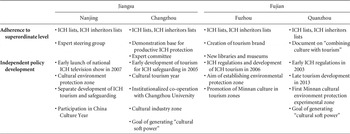
The similarity between many of the policies adopted by the four municipalities demonstrates that local governments have many incentives to adhere to superordinate governmental policies. In our comparison of the two provinces, all of the municipalities examined had adopted measures such as the ICH lists, the ICH inheritor program, and cultural heritage days since superordinate governmental levels have demanded their implementation. Despite their similarities, all of the municipalities examined have also developed their own strategies for ICH safeguarding. In Jiangsu province, Nanjing concentrated on promoting ICH safeguarding by launching a television series, while Changzhou focused on tourism development very early on. After stipulating the use of tourism for ICH safeguarding in 2005, Changzhou later promoted cultural tourism more generally. The strategies of both of the municipalities in promoting their culture internationally also differ. While Changzhou aimed at accumulating cultural soft power, Nanjing exhibited its traditional culture abroad during the “China Culture Years.” The two cities within Fujian province demonstrated similar individual approaches. While Fuzhou strove to establish an innovative ICH tourism-related policy in 2006, Quanzhou did not follow Fuzhou’s lead. It only published its first ICH tourism development plan in 2013. Meanwhile, Quanzhou has also taken up the concept of cultural soft power, which is not mentioned in Fuzhou’s policies. Table 1 provides a comparison of the four cases.
Comparison of policy outcomes across provinces and municipalities

Source: authors.
We can also observe variation across the provinces. While the municipalities examined in Jiangsu attempted to display Han Chinese culture for an international audience, Fujian’s municipalities pursued a different strategy. Here, ICH policies were tailored to Taiwanese audiences by highlighting Minnan culture. In addition, ICH safeguarding and tourism promotion appear to be more strictly separated, with the importance of the latter being stressed.
When we compare the two provincial capitals with the regular municipalities, the governments at the same administrative levels also display certain similarities. As provincial capitals, Nanjing and Fuzhou have focused on implementing protection zones and are marketing their locality towards a national (television) and international audience (“China Culture Years”; Taiwanese tourists). In contrast, both Changzhou and Quanzhou independently implemented ICH-related policies at a very early stage and referred to national targets such as soft power accumulation. These phenomena could possibly be explained, first, by the greater pressure on the provincial capitals to be creative and innovative in implementing new policies and, second, by the municipalities’ attempts to enhance their national and international standing.
CONCLUSION
Due to the growing fragmentation of the Chinese policy process, government representatives and scholars have formed a dense web of symbiotic networks that is based on common incentives influencing policy implementation and outcomes in the area of ICH safeguarding and promotion. While scholars have sought to support their own agendas by legitimizing them scientifically and via official discourses, local governments have pursued similar strategies to promote their locality domestically and abroad. In pursuing these two strategies, both are influenced by domestic and international incentive structures. Local governments have sought to obtain financial support, political power, and an aura of expertise, and scholars have used their membership in government–scholar networks to gain prestige and social legitimacy. As a result, both parties’ reciprocal claims to social and political legitimacy have mutually reinforced each other.
These government–scholar networks interact within expert steering groups, expert committees, conferences, and research centers, all of which provide a platform for local experts to advise local governments on local ICH policy implementation. In addition, scholars may make recommendations via their publications. As a consequence of this interaction, local governments obtain advice on how to advance and innovate local ICH policy implementation inside a highly competitive bureaucratic apparatus, which in turn fosters policy variation both horizontally and vertically.
Indeed, applying the “fragmented authoritarianism“ model to this case provides many answers to the question of why symbiotic networks are formed and what factors influence their strategies. This study has also shown, however, that the implementation of the UNESCO Convention has not removed the power asymmetry between elite and popular actors. Comparable to the recent findings by Yu, Fan, and Yan, the inclusion of experts into the safeguarding process appears to have reduced the incentives for local governments to include local communities. Footnote 105 Despite the growing variety of actors observed in the fragmented authoritarian regime of China, the functional requirements of identifying, nominating, and safeguarding ICH have generated new windows of opportunity for an elite-driven policy approach that is shaped by symbiotic, mutually legitimizing government–scholar networks at the local level. Judging from our case studies, the same fragmented authoritarian regime provides strong material and symbolic incentives for local cadres and scholars to interact in order to compete with other localities. By appropriating international and domestic ICH discourses, official party language, and scientific concepts, adapting them to the local context, and combining them with their own, more or less creative strategies, these government–scholar networks have striven to increase their localities’ competitiveness in the domestic and international race for ICH safeguarding.
We should note that there are certain limitations to this study. Although our findings show that symbiotic government–scholar networks exist, they do not reveal how decisions are reached, the specific impact scholars have on the policy outcomes, or who has the most decision-making power. More studies on scholarly–governmental interaction are needed in order to obtain deeper insight into how scholars support local governments’ activities and to what extent. Nevertheless, the local development of independent policies, especially in municipalities that are not as strongly influenced by top-down decision making as provincial capitals, suggests that scholarly recommendations do potentially influence local policy making in the field of ICH safeguarding.