Implications
From the breeders’ point of view, the relationship between egg quality and quantity is a major issue. Specific gravity can be a good estimator of the egg shell quality, because the egg shell weight, proportion, thickness or strength is measured after the eggs are broken. The egg-specific gravity has high heritability and highly positively correlates with most egg shell quality traits. Therefore, it can be concluded that the egg shell quality can be determined using the egg-specific gravity. Specific gravity may be the choice of selection criterion in multi-trait genetic evaluation of Japanese quail.
Introduction
In the Far Eastern and Asian countries, Japanese quail are reared mostly for egg yield, whereas meat production is the main focus in Europe and the United States. In some countries such as Turkey, Japanese quail are reared for both meat and egg production, generally at family type small-scale enterprises in villages (Narinc and Aksoy, Reference Narinc and Aksoy2012). In a survey study carried out with producers in the Antalya province of Turkey, poor egg shell quality was identified as having a negative impact on hatching results (Yapici et al., Reference Yapici, Aksoy and Narinc2006). Quality of hatching eggs is of great importance for efficient chick production (Roberts, Reference Roberts2004). Losses as a result of poor quality of eggs can be a serious problem for the layer or broiler breeder industry. It is also known that 6% to 7% of the broiler breeder eggs are lost due to shell damages. Poor egg shell quality and other reasons (uncollectable eggs, cracked eggs, under-grade eggs) may result in 20% losses before the eggs arrive at retail (Roland, Reference Roland1988).
The egg shell is of particular importance for both protection of egg contents from mechanical impacts and microbial invasion, while the egg shell also controls water and gas exchange through the pores during extra-uterine development of the chick embryo. Therefore, egg shell integrity is not only an economic issue but also a matter of human health safety. Moreover, egg shell quality affects the incubation weight loss of the egg, embryonic mortality, hatchability and early chick growth rates (Grunder et al., Reference Grunder, Hamilton, Fairfull and Thompson1989; Roberts, Reference Roberts2004). Another important aspect of the egg shell is that it acts as a packaging material and its quality affects the consumers’ selection (Rodriguez-Navarro et al., Reference Rodriguez-Navarro, Kalin, Nys and Garcia-Ruiz2002).
The term shell quality is often used synonymously for shell strength and implies the ability of egg shells to withstand externally applied forces without cracking or breaking (De Ketelaere et al., Reference De Ketelaere, Govaerts, Coucke, Dewil, Visscher, Decuypere and De Baerdemaeker2002). Egg weight, shell weight, egg shape index, specific gravity and shell ratio are some of the most important shell characteristics. In poultry breeding programs, shell strength is also one of the important traits for selection. Egg specific gravity is also a good indicator of shell weight, thickness and strength (Roberts, Reference Roberts2004). According to Grunder et al. (Reference Grunder, Hamilton, Fairfull and Thompson1989), specific gravity is an indicator of egg shell strength as it relates to resistance to breakage and is relatively simple to measure.
Studies on the shell quality of quail eggs are rare, and the majority of studies are focused on chicken eggs. External egg quality of poultry species exhibits high variation because egg formation and subsequent egg shell quality is a complex process that depends on several biomechanisms, which can be determined by both genetic and enviromental conditions such as species, strain, age of hen, feeding and management. The effects of selection, feeding and flock management on external egg quality of Japanese quail have been investigated previously (Minvielle, Reference Minvielle1998; Minvielle and Oguz, Reference Minvielle and Oguz2002; Sahin et al., Reference Sahin, Onderci and Sahin2002; Kul and Seker, Reference Kul and Seker2004; Al-Daraji et al., Reference Al-Daraji, Razuki, Al-Hayani and Al-Hassani2010; Alkan et al., Reference Alkan, Karabağ, Galic, Karsli and Balcioğlu2010; Nowaczewski et al., Reference Nowaczewski, Kontecka, Rosinski, Koberling and Koronowski2010).
Several reports are published estimating the heritabilities and genetic correlations for various egg quality traits, particularly for chicken hens (Grunder et al., Reference Grunder, Hamilton, Fairfull and Thompson1989; Hartmann et al., Reference Hartmann, Johansson, Strandberg and Rydhmer2003; Zhang et al., Reference Zhang, Ning, Xu, Chou and Yang2005), but few studies have been conducted to examine the genetic variability of egg shell quality characteristics in Japanese quail (Sezer, Reference Sezer2007; Lotfi et al., Reference Lotfi, Zerehdaran and Raoufi2012). Therefore, the objective of the present study was to estimate heritabilities and genetic correlations for egg shell characteristics in Japanese quail utilizing the multivariate animal model using the Bayesian approach via Gibbs sampling.
Material and methods
The experiment was carried out in the Poultry Research Units of Konya Selçuk University and Akdeniz University, Turkey. The care and use of animals were in accordance with laws and regulations of Turkey. In the present study, studied eggs of two consecutive generations of a breeder flock, which were reared at the Akdeniz University (Turkey), were used. More details about the genetic improvements of flocks are described by Narinc et al. (Reference Narinc, Aksoy, Karaman and Firat2014). Collected eggs were transported to Konya Selçuk University for measurement of egg quality characteristics. The pedigreed birds were reared in individual breeder cages. All birds had ad libitum access to water and feed. A starter diet containing 11.8 MJ DM/kg ME, 209 g/kg CP, 0.90% calcium and 0.40% available phosphorus was given between 0 and 35 days of age. This was followed by a breeder diet containing 12.3 MJ DM/kg ME and 180 g/kg CP, 2.56% calcium and 0.50% available phosphorus from the age of 36 days to the end of the experiment. Adult birds were kept under constant artificial lighting for 18 h/day. Eggs were collected in 3 sequential days from the two flocks at 12 and 16 weeks of age. Each collected egg was numbered according to its hen for pedigree index, and identified according to flock (generations 1 or 2), age (12 or 16 weeks of age) and hatch (hatch 1 or 2) for fixed effects. A total number of 5864 eggs (average six eggs from each hen) from 934 female quails from the two flocks (473 hens in flock 1, 461 hens in flock 2) were used to evaluate external egg quality traits. In total, the pedigree file consisted of 1576 birds (119 males and 363 females in the base population; 160 males and 473 females in generation 1; and 461 females in generation 2).
External egg quality traits including egg weight (EW), length (LE) and width (WE) of the egg, shape index (SI), specific gravity (SG), shell weight (SW), shell ratio (SR) and shell strength (SS) were measured. Before the measurement of egg external quality, the eggs were stored for 1 day at room temperature (20±2°C). Egg weight was measured using an electronic digital balance and was recorded to the nearest 0.01 g. The length and width of the eggs were measured using a micrometer caliper (accuracy 0.01 mm, Mitutoyo Corp., Kawasaki, Japan). Egg shape index was calculated using the following formula: egg shape index=(egg width/egg length)×100 (Aygun and Yetisir, Reference Aygun and Yetisir2010). Shell strength (kg) was measured with an Egg Force Reader (06-UM-001, Version B, Orka Food Tech. Ltd, Hong Kong, China). The assessment of the egg specific gravity was based on Archimedes principle (Wells, Reference Wells1968). Eggs were broken to separate the shell and the content of the egg. The egg shell was washed with tap water to remove the remaining albumen, dried at room temperature for 3 days and weighed. Shell weights included the shell membrane weights. Egg shell ratio was calculated using the following formula: egg shell ratio (%)=(shell weight/egg weight)×100 (Aygun and Yetisir, Reference Aygun and Yetisir2010).
Descriptive statistics, normality tests and significant test of fixed effects were obtained using Univariate procedure of SAS software (SAS Institute, 2009). All traits were normally distributed, as measured by the Kolmogorov–Smirnov test. An animal model was used to estimate the multi-trait genetic parameters for external egg quality characteristics with Bayesian framework using the Gibbs sampling algorithm. The linear mixed effects model was used in the analysis:
 $${\bf y}={\bf X\beta }{\plus}{\bf Zu}{\plus}{\bf e}$$
where y is the vector of observations, β the vector of fixed effects and u the vector of random genetic effects. X and Z are known design matrices relating phenotypic records to β and u, respectively. e is the vector of random errors (Mrode, Reference Mrode2005). It is assumed that the conditional distribution of y is multivariate normal:
 $${\bf y}\left| {{\bf \beta },{\bf u},{\bf R}_{0} } \right.\,\sim\,{\rm MVN}({\bf X\beta }{\plus}{\bf Zu},{\bf R}_{0} \,\otimes\,{\bf I})$$
Additive genetic effects were also assumed to follow a multivariate normal distribution:
 $${\bf u}\left| {{\bf G}_{0} } \right.{\bf \,\sim\,}{\rm MVN}({\bf 0}{\rm ,}{\bf G}_{0} \,\otimes\,{\bf A})$$
where I is the identity matrix, A the numerator relationship matrix, G 0 the additive genetic variance–covariance matrix and R 0 the error variance–covariance matrix. A non-informative prior was assumed for the fixed effects:
 $$p({\bf \beta })\propto{\rm constant}$$
The prior distribution assumed for G 0 and R 0 was an inverted Wishart (IW) distribution given as follows:
 $${\bf G}_{0} \left| {v_{G} ,{\bf V}_{G} } \right.\,\sim\,{\rm IW}(v_{G} ,{\bf V}_{G} )$$
and
 $${\bf R}_{0} \left| {v_{R} ,{\bf V}_{R} } \right.\,\sim\,{\rm IW}(v_{R} ,{\bf V}_{R} )$$
where v G , V G , v R and V R are the parameters for the prior distributions (Waldmann and Ericsson, Reference Waldmann and Ericsson2006). We chose a prior by replacing the diagonal elements with ‘0’ and the off-diagonal elements with the variances of the corresponding traits in the hyperparameters V G and V R and using v G =v R =8 for an eight-trait analysis. Analyses were performed via R package (R Development Core Team, 2010). In total, 10 000 samples of the parameters of interest were obtained running a single chain of 200 000 cycles. Burn-in period and the thinning interval were set to 20 000 and 18 cycles, respectively. Genetic parameters, heritabilities (h i 2) and genetic correlations (r g(ii')) were calculated from the posterior means of variance and covariance parameters as follows:
 $$h_{{^{i} }}^{2} ={{\sigma _{{ia}}^{2} } \over {\sigma _{{ia}}^{2} {\plus}\sigma _{{ie}}^{2} }}\quad r_{{g\left( {ii'} \right)}} ={{\sigma _{{ii'a}} } \over {\sigma _{{ia}}^{{}} {\plus}\sigma _{{i'a}}^{{}} }}$$
where i and i′ represents the trait(s) of interest, and
 $$\sigma _{{ia}}^{2} $$
and
 $$\sigma _{{ie}}^{2} $$
are the diagonal elements of G
0 and R
0 matrices, respectively. In addition, σ
ii'a
stands for the additive genetic covariance between the traits i and i'.
Results and discussion
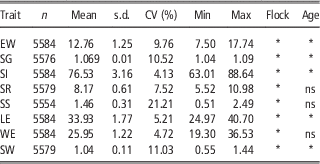
The descriptive statistics for EW, SG, SI, SR, SS, LE, WE and SW are presented in Table 1. The hatch did not have significant effects on all traits, not shown in Table 1. There were significant differences for mean values of EW, SG, SI, LE and SW traits between both flocks and ages, whereas no significant differences were found for SR, SS and WE traits at 12 and 16 weeks of age. The average egg weight in this study was 12.76 g (Table 1), which was lower than the 13.40 g reported by Khaldari et al. (Reference Khaldari, Pakdel, Mehrbani Yeganeh, Nejati Javaremi and Berg2010) and 13.25 g reported by Copur et al. (Reference Copur, Baylan and Canogullari2010). On the other hand, this average value for EW is in agreement with those reported by Erensayin and Camci (Reference Erensayin and Camci2002), Sahin et al. (Reference Sahin, Onderci and Sahin2002), Roshdy et al. (Reference Roshdy, Khalil, Hanafy and Mady2010) and Lotfi et al. (Reference Lotfi, Zerehdaran and Raoufi2012) of between 12.00 and 12.75 and also higher than the 10.27–11.43 g reported by Hassan et al. (Reference Hassan, Mady, Cartwright, Sabri and Mobarak2003), Kul and Seker (Reference Kul and Seker2004), Mielenz et al. (Reference Mielenz, Ronny and Schuler2006), Sezer (Reference Sezer2007), Alkan et al. (Reference Alkan, Karabağ, Galic, Karsli and Balcioğlu2010) and Al-Daraji et al. (Reference Al-Daraji, Razuki, Al-Hayani and Al-Hassani2010) for quails. Specific gravity (SG) measures the relative proportion of shell of the egg based on its density (Wolc et al., Reference Wolc, White, Hill and Olori2010). Higher embryonic mortality and lower hatching results were also observed in eggs characterized by lower egg SG (Nowaczewski et al., Reference Nowaczewski, Kontecka, Rosinski, Koberling and Koronowski2010). The mean value of SG in the present study was found to be 1.069 g/cm3, which is in line with findings by Sahin et al. (Reference Sahin, Onderci and Sahin2002) of 1.089 g/cm3, Hassan et al. (Reference Hassan, Mady, Cartwright, Sabri and Mobarak2003) of between 1.069 and 1.096 g/cm3, Sezer (Reference Sezer2007) of 1.066 g/cm3 and Nowaczewski et al. (Reference Nowaczewski, Kontecka, Rosinski, Koberling and Koronowski2010) of between 1.046 and 1.059 g/cm3. The average value of egg shape index (76.53%) was in agreement with those reported of between 74.90% and 79.60% in quails (Erensayin and Camci, Reference Erensayin and Camci2002; Kul and Seker, Reference Kul and Seker2004; Sezer, Reference Sezer2007; Nowaczewski et al., Reference Nowaczewski, Kontecka, Rosinski, Koberling and Koronowski2010; Roshdy et al., Reference Roshdy, Khalil, Hanafy and Mady2010). In divergently selected Japanese quail lines, Alkan et al. (Reference Alkan, Karabağ, Galic, Karsli and Balcioğlu2010) have reported that the egg shape index (SI) was in the range of 76.80% and 80.44%. Results in Table 1 show that the average egg shell ratio (SR) was 8.17%, which correlates with the findings by Mignon-Grasteau and Minvielle (Reference Mignon-Grasteau and Minvielle2003), Kul and Seker (Reference Kul and Seker2004), Sezer (Reference Sezer2007), Alkan et al. (Reference Alkan, Karabağ, Galic, Karsli and Balcioğlu2010), Nowaczewski et al. (Reference Nowaczewski, Kontecka, Rosinski, Koberling and Koronowski2010) and Lotfi et al. (Reference Lotfi, Zerehdaran and Raoufi2012) of between 7.37% and 8.78%. To our knowledge, the only research on egg shell strength (SS) in Japanese quails was reported by Lotfi et al. (Reference Lotfi, Zerehdaran and Raoufi2012). The value of 1.46 kg for SS in our study was higher than the value of 1.25 kg reported by Lotfi et al. (Reference Lotfi, Zerehdaran and Raoufi2012). The average values of egg length (LE) and egg width (WE) were found to be 33.93 and 25.95 mm, respectively (Table 1). These values are in good agreement with those reported for LE (30.02 to 34.71 mm) and for WE (23.56 to 27.13 mm) for the eggs of Japanese quail (Kul and Seker, Reference Kul and Seker2004; Sezer, Reference Sezer2007; Alkan et al., Reference Alkan, Karabağ, Galic, Karsli and Balcioğlu2010). As shown in Table 1, the average shell weight was 1.04 g. This value is in line with those reported by Lotfi et al. (Reference Lotfi, Zerehdaran and Raoufi2012), Sezer (Reference Sezer2007) and Alkan et al. (Reference Alkan, Karabağ, Galic, Karsli and Balcioğlu2010) of 1.04, 0.96 and 1.00 g, respectively. Lower values were also reported by Mignon-Grasteau and Minvielle (Reference Mignon-Grasteau and Minvielle2003) and Nowaczewski et al. (Reference Nowaczewski, Kontecka, Rosinski, Koberling and Koronowski2010) of 0.88 and 0.89 g, respectively. The average values of the external egg quality traits were generally within the range of that reported in previous studies, and the slight differences can be attributed to the differences in genetic structure, hen age, content of diet and flock managements (Sezer, Reference Sezer2007; Lotfi et al., Reference Lotfi, Zerehdaran and Raoufi2012).
Descriptive statistics of external egg quality traits

EW=egg weight, g; SG=specific gravity, g/cm3; SI=shape index; SR=shell ratio; SS=shell strength, kg; LE=egg length, mm; WE=egg width, mm; SW=shell weight, g; n=number of observations; s.d.=standard deviation; CV=coefficient of variation; Minto Max=minimum to maximum values of observations.
*P<0.01; ns=not significant.
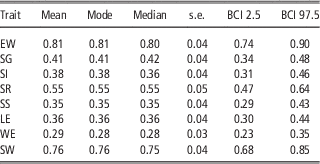
Summary statistics of the posterior distributions for heritability estimates are presented in Table 2. In the Bayesian approach, frequentist confidence intervals were replaced by Bayesian credible intervals (BCI). The interpretation of a 95% BCI is that the probability that the parameter falls into the given interval is 0.05 (Waldmann and Ericsson, Reference Waldmann and Ericsson2006). In our study, the heritability estimates of external egg quality traits were ranged moderate to high (Table 2). These results are in conformity with the earlier findings of Sato et al. (Reference Sato, Ida and Ino1989) and Sezer (Reference Sezer2007) in Japanese quails, and with Zhang et al. (Reference Zhang, Ning, Xu, Chou and Yang2005) in laying hens. Limited reports (Sato et al., Reference Sato, Ida and Ino1989; Minvielle and Oguz, Reference Minvielle and Oguz2002; Sezer, Reference Sezer2007; Lotfi et al., Reference Lotfi, Zerehdaran and Raoufi2012) are available on genetic parameter estimates of external egg quality traits in Japanese quail. As shown in Table 2, the heritability estimate of EW found in our study of 0.81 was fairly high, and the 2.5% to 97.5% BCI was narrow (0.74 to 0.90). Similar to our findings, many researchers have reported high heritability estimates for EW in Japanese quails (Minvielle, Reference Minvielle1998; Sezer, Reference Sezer2007; Lotfi et al., Reference Lotfi, Zerehdaran and Raoufi2012) and in chickens (Hartmann et al., Reference Hartmann, Johansson, Strandberg and Rydhmer2003; Dunn et al., Reference Dunn, Bain, Edmond, Wilson, Joseph, Solomon, De Ketelaere, De Baerdemaeker, Schmutz, Preisinger and Waddington2005; Zhang et al., Reference Zhang, Ning, Xu, Chou and Yang2005; Wolc et al., Reference Wolc, White, Hill and Olori2010). Heritability estimate for SG was found to be high (0.41, Table 2). Parallel to our finding, heritability of SG was reported as 0.31 in quails (Sezer, Reference Sezer2007) and 0.51 in chickens (Wolc et al., Reference Wolc, White, Hill and Olori2010). In the present study, estimated heritability for SI (0.38) was moderate (Table 2). Sezer (Reference Sezer2007) estimated a higher value (0.51) for heritability of SI in quail eggs, whereas Lotfi et al. (Reference Lotfi, Zerehdaran and Raoufi2012) estimated a slightly lower heritability of 0.14 for SI in quail eggs. Corresponding to our findings, heritability of SI in laying hens was reported as 0.40 by Zhang et al. (Reference Zhang, Ning, Xu, Chou and Yang2005). Estimated heritability for SR (0.55) in the present study was high (Table 2). Low (0.09) and moderate (0.31) heritability estimates for SR were reported by Lotfi et al. (Reference Lotfi, Zerehdaran and Raoufi2012) and Sezer (Reference Sezer2007) for quails. According to our findings (Table 2), SS is a moderately heritable trait (0.35). Similarly, Zhang et al. (Reference Zhang, Ning, Xu, Chou and Yang2005) have reported a moderate estimation (0.24) for SS in chicken eggs, whereas Lotfi et al. (Reference Lotfi, Zerehdaran and Raoufi2012) stressed a fairly low heritability estimate (0.07) in quail eggs. The current estimate of heritability for SS was close to previously published estimates for chickens (Zhang et al., Reference Zhang, Ning, Xu, Chou and Yang2005). In the present study, heritability estimates for LE and WE were 0.36 and 0.29, respectively (Table 2). Sezer (Reference Sezer2007) estimated fairly high heritabilities for length (0.72) and width (0.68) of quail eggs, which may be due to the difference in the sample sizes. The heritability estimate of SW was fairly high (0.76, Table 2), and in the range of previous reports (Sato et al., Reference Sato, Ida and Ino1989; Minvielle, Reference Minvielle1998), with values ranging from 0.60 to 0.84.
Posterior expectations, standard errors and credible intervals of the heritabilities for external egg quality traits

EW=egg weight, g; SG=specific gravity, g/cm3; SI=shape index; SR=shell ratio; SS=shell strength, kg; LE=egg length, mm; WE=egg width, mm; SW=shell weight, g; BCI=Bayesian credible interval (2.5%-lower bound, 97.5%-upper bound).
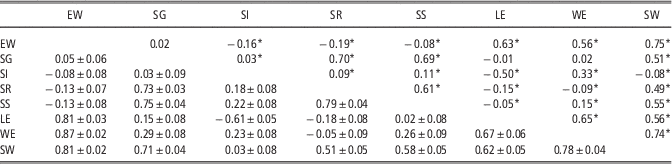
Genetic and phenotypic correlations among the traits are given in Table 3. Phenotypic relationships among all external egg quality traits are similar to genetic correlations and confirm these relationships. Heavier eggs are expected to have a higher shell size and weight, which is also confirmed by the strong genetic correlations of EW with LE, WE and SW ranging from 0.81 to 0.87. Phenotypic correlation between EW and SG was found to be insignificant. Similarly, fairly high genetic and phenotypic relationships of EW with LE, WE and SW (ranging from 0.68 to 0.94) have been reported by Sezer (Reference Sezer2007) and Alkan et al. (Reference Alkan, Karabağ, Galic, Karsli and Balcioğlu2010). In a previous study in laying hens, Zhang et al. (Reference Zhang, Ning, Xu, Chou and Yang2005) reported an estimate of 0.67 for genetic correlation between EW and SW. In this study, negative genetic correlation (−0.13) was found between EW and SR. Estimated genetic correlation between EW and SI (−0.08) was in agreement with the phenotypic correlation (−0.17) reported by Alkan et al. (Reference Alkan, Karabağ, Galic, Karsli and Balcioğlu2010) and with the genetic correlation (−0.13) reported by Sezer (Reference Sezer2007). According to Yannakopoulus and Tserveni-Gousi (Reference Yannakopolous and Tserveni-Gousi1986) and Alkan et al. (Reference Alkan, Karabağ, Galic, Karsli and Balcioğlu2010), depending on an increase in body weight or egg weight, a decrease in the egg shape occurs. Decreased SI with increasing egg weight was stressed by Reddy et al. (Reference Reddy, Reddy, Reddy and Rao1979). In this study, low genetic (−0.13) and phenotypic (−0.08) correlations determined between EW and SS are in agreement with those reported by Zhang et al. (Reference Zhang, Ning, Xu, Chou and Yang2005) in dwarf hen eggs of −0.19 (genetic) and −0.05 (phenotypic). Zhang et al. (Reference Zhang, Ning, Xu, Chou and Yang2005) stressed that both the phenotypic correlation and genetic correlation between EW and SS were low, which in turn inferred that larger eggs were not weaker than smaller eggs.
The genetic correlation estimates (below diagonal) and phenotypic correlations (above diagonal) among external egg quality traits

EW=egg weight, g; SG=specific gravity, g/cm3; SI=shape index; SR=shell ratio; SS=shell strength, kg; LE=egg length, mm; WE=egg width, mm; and SW=shell weight, g.
*P<0.01.
It can be clearly seen from Table 3 that the genetic and phenotypic correlations of SS with SG, SR and SW found in our study, ranging from 0.55 to 0.79, were fairly high. The strong genetic correlation found between SS and SG and SR denoted that specific gravity and shell ratio were major factors affecting egg shell strength. Positive and strong genetic relationships were found for SG with SR (0.73) and SW (0.71) (Table 3).
Specific gravity can be a good estimator of the egg shell quality, because the egg shell weight, proportion, thickness or strength is measured after the eggs are broken. Therefore, it can be concluded that the egg shell quality can be determined using the egg specific gravity values, utilizing its high heritability and the positive and fairly high correlations determined with most egg shell quality traits. In addition, Roberts (Reference Roberts2004) and Sezer (Reference Sezer2007) suggested that specific gravity is a more suitable trait to determine egg shell quality. Considering the genetic and phenotypic correlations of SG with EW and SI, it can be concluded that selection for specific gravity will not result in an antagonistic effect on egg mass or volume. In conclusion, rather than other external egg traits, SG may be the choice of selection criterion in quail breeding studies aiming to improve the egg shell quality as implied by its advantages. Specific gravity has already been reported as the best egg shell quality trait to use in selection programs in laying hens (Grunder et al., Reference Grunder, Hamilton, Fairfull and Thompson1989) and in quails (Sezer, Reference Sezer2007). From the breeders’ point of view, the relationship between egg quality and quantity is a major issue. Further studies are needed, however, to examine the effect of selection for egg shell quality on egg production in Japanese quails.
Acknowledgment
The eggs used in this study were obtained from eggs sold commercially by the Akdeniz University, Turkey.