INTRODUCTION
The analyzed archaeological samples were recovered from a cremation cemetery used by the Lusatian Urnfield communities, part of the great circle of Urnfield cultures, which covered most of Europe from the late fourteenth century BC. The similarity of ideas and lifestyles, which lasted for at least half a millennium, manifested itself primarily in the ubiquitous use of cremation in burial rituals and common economy (see Kaczmarek Reference Kaczmarek2017 and the references cited therein).
Brzezie has been known in the archaeological literature since the nineteenth century (Schwartz Reference Schwartz1876; Sadowski Reference Sadowski1877) as the place of discovery of a hoard of gold items of adornment and the largest thoroughly examined Lusatian cemetery in that part of Poland (Szczurek Reference Szczurek2012). Since the beginning of studies on the so-called Lusatian culture, attempts at clarifying the chronology of the archaeological record have encountered objective limitations, conditioned by the specificity of the sources. The problems stem from the “ceramic” character of most grave assemblages, on which all chronological schemes are based. Graves containing metal artifacts, which are reliable chronological markers, are a rare occurrence. We encountered comparable barriers when working on the archaeological record from the Pleszew settlement microregion (Wielkopolska-Great Poland). Although relatively abundant, the sources escape systematization. Therefore, attempts at giving the phenomena occurring within Lusatian urnfields a historical time dimension (Chochorowski Reference Chochorowski2007) through wider use of geochronometry are crucial.
Microregional studies on the chronology and periodization of the Lusatian urnfields using natural sciences methods appear to be a remedy for the problems identified over the years. However, due to the risk of contamination and other shortcomings of the radiocarbon method (Walanus and Goslar Reference Walanus and Goslar2009) even these efforts do not yield conclusive results. Therefore, we decided to use the archaeological record recovered from a Late Bronze Age and Early Iron Age cemetery (12th–early 6th BC) in Brzezie.
The results of thermoluminescence dating of the materials of the Tarnobrzeg Lusatian culture (Trybała-Zawiślak Reference Trybała-Zawiślak2012; Czopek et al. Reference Czopek, Kusiak and Trybała – Zawiślak2013) provided a new direction in the search for a way out of the impasse in the study of the absolute chronology of the Hallstatt period in south-western Poland. During the 2017 and 2018 excavations, several samples were collected for the thermoluminescence dating of the Brzezie assemblages. However, thermoluminescence dating in contrast to optically stimulated luminescence requires heating to high temperatures around 500°C which causes much larger changes in the sensitivity of the sample. Additionally, the shortcomings of radiocarbon determinations in the context of the Hallstatt plateau led to the supposition that the luminescence method may prove to be a satisfactory solution, enabling the clarification of the chronology of the Early Iron Age in Wielkopolska.
In this work we use two independent dating methods radiocarbon and optically stimulated luminescence (OSL). The combination of both methods is aimed at determining more reliable time constraints and answering the question: what period does this cemetery come from? In addition, there are challenges in both methods that arise from material types, and sediment structure. Our work will provide a cross verification for both dating methods.
SAMPLING SITE
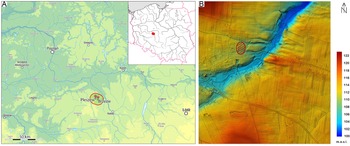
Brzezie, a small village in the Pleszew District, in southeastern Wielkopolska, was selected as a testing site (Figure 1). Excavations at the cemetery in the northeastern part of the village, on the terrace above the Ner River, the left-bank tributary of the Prosna River (Figure 1B), were conducted intermittently over 13 archaeological seasons between 1985 and 2018. They uncovered more than 400 graves (Szczurek Reference Szczurek2021), which makes it one of the best-excavated sites in the entire Odra river basin.
Location of Brzezie, Pleszew District, in southeastern Wielkopolska (A); location of the site on the left tributary of the Prosna river–the Ner river (B).

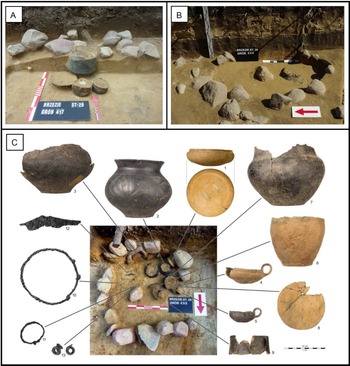
Many years of very careful exploration allowed us to discover ritual artifacts of Lusatian culture. The collected artifacts and samples, were documented from macro to microscale. A small sample of our work is shown in the Table 1 below. Figures 2A and 2B show typical graves with stones and vessels from different Bronze Age IV and V periods. Table 2C shows a very rich grave (from Halstatt C) with macro photos of artifacts after conservation and reconstruction treatments.
Dose rates and equivalent doses for investigated samples: depth, water content, radionuclide concentrations for ceramic and surrounding sentiments, dose rate, equivalent dose (CAM model), and final age. Dose rate is a sum of alpha, beta dose from ceramic objects, gamma dose from surrounding sediment and cosmic dose rate.

* 1 σ ranges are provided.
Brzezie, site 29. Photographic documentation of graves dated by radiocarbon and OSL methods; grave 417 (A), grave 425 (B), grave 435 (C).

Radiocarbon measurements calibrated using IntCal20 calibration curve (Reimer et al. Reference Reimer, Austin, Bard, Bayliss, Blackwell, Bronk Ramsey and Talamo2020), sample types and calibrated dates.

METHODS
Sampling
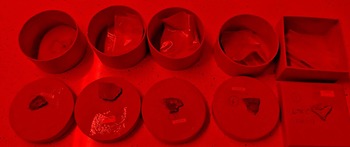
During archaeological excavations, five ceramic fragments for luminescence dating were collected from five different graves (see Figure 3). For each ceramics sample, an additional sample of sediment soil was collected from layers where ceramics were located. Those additional samples are necessary for external radioactivity dose rate determination, which is indispensable for dose correction of obtained dose rate for the ceramics.
All investigated ceramics samples Gliwice luminescence dating laboratory in red light condition. (Please see online version for color figures.)

Samples for radiocarbon dating were also collected from four graves. Our research material consisted of three samples of bones fragments and one sample of charcoal.
Radiocarbon Dating
Three burned human bone fragments, and one charcoal fragment were collected for radiocarbon dating. The methods of chemical pretreatment follow Oxford Radiocarbon Accelerator Unit procedures (Brock et al. Reference Brock, Higham, Ditchfield and Bronk Ramsey2010). Samples of charcoal (after mechanical removal of macroscopic contamination visible under binocular microscope) were treated with HCl (80°C, over 20 min), 0.025–0.1M NaOH, and then 0.25M HCl (80°C, 1 hr). The samples were then rinsed with deionized water to achieve pH=7. The step of NaOH treatment was repeated several times until no more coloration of the NaOH solution appeared.
All dated bones were cremated (calcined) and degraded material not suitable for 14C dating collagen was removed. These bones were discovered in geological layers with a composition that minimizes the danger of precipitation of secondary carbonates, so a fraction of apatite was used for dating.
In our case the organic fraction was removed by treating bones with 2% NaClO for 48 hr and the secondary calcite was removed in 8% CH3COOH for 48 hr (Lanting et al. Reference Lanting, Aerts-Bijma and van der Plicht2001). The outer layer of carbonate grains was then removed by quick rinsing with 8% HCl.
CO2 from carbonate samples was leached by concentrated ortho-phosphoric acid (H3PO4) treated in a vacuum line where the obtained gas (CO2 + water vapor) was dried and reduced with hydrogen, using 2 mg of Fe powder as a catalyst. The mixture of carbon and iron were pressed into a special aluminum holder (Czernik et al. Reference Czernik and Goslar2001).
The bone apatite and charcoal fragment were dated in the Poznań AMS laboratory (Goslar et al. Reference Goslar, Czernik and Goslar2004). Content of 14C in a sample was measured using the “Compact Carbon AMS” spectrometer manufactured by the National Electrostatics Corporation, USA (Goslar et al. Reference Goslar, Czernik and Goslar2004).
All measurements were performed by comparing intensities of ionic beams of 14C, 13C and 12C for each sample and for standard samples (modern standard: “Oxalic Acid II” and standard of 14C-free carbon: “background”). In each AMS run, 30–33 samples of unknown age were measured, 3–4 samples of modern standard, and 1–2 samples of background (represented by the sample IAEA C1).
Conventional 14C age is calculated using correction for isotopic fractionation (according to Stuiver and Polach Reference Stuiver and Polach1977), based on ratio 14C/12C measured in the AMS spectrometer simultaneously with the ratio 13C/12C (note: the measured values of δ13C depend on isotopic fractionation during CO2 reduction and isotopic fractionation inside the AMS spectrometer, and as such, they cannot be compared with values of d13C determined with conventional mass spectrometers on gas samples). Uncertainty of calculated 14C age is determined using uncertainty implied from counting statistics, and also spread (standard deviation) of partial 14C/12C results, whichever is bigger. Uncertainties of 14C/12C ratios measured on standard samples are additionally taken into account. The 1-sigma uncertainty of conventional 14C age, is the best estimate of the total uncertainty of measurement. 14C ages were calibrated using the OxCal program v4.4.4 (Bronk Ramsey Reference Bronk Ramsey2009) with the IntCal20 calibration curve (Reimer et al. Reference Reimer, Austin, Bard, Bayliss, Blackwell, Bronk Ramsey and Talamo2020).
Luminescence Dating
OSL (optically stimulated luminescence) dating was carried out in the Gliwice Luminescence Laboratory (Moska et al. Reference Moska, Bluszcz, Poręba, Tudyka, Adamiec, Szymak and Przybyła2021). Establishing the luminescence age of an archaeological object requires different types of measurements. The main two parameters are needed to determine the sample’s age: Age = D e/D r, where D e is the equivalent dose determined using a luminescence reader, and D r is the dose rate determined using radiometric or analytical methods.
Dose Rate Measurements
Dose rates for ceramics artifacts were calculated from alpha, beta, gamma, and cosmic dose rate components. Alpha and beta dose rates components were assessed from 238U, 232Th decay chains, and 40K measured in ceramics artifacts. This measurement was done with the μDOSE system (Tudyka et al. Reference Tudyka, Miłosz, Adamiec, Bluszcz, Poręba, Paszkowski and Kolarczyk2018) calibrated for 1.00-g samples with IAEA-RGU-1, IAEA-RGTh-1, and IAEA-RGK-1 reference materials from International Atomic Energy Agency reference materials. Approximately 1.5 g of each of the dated ceramics artifacts was carefully ground and measured. The gamma dose rate component was calculated from 238U, 232Th decay chains, and 40K measured in sediment that was surrounding each ceramics artifact. This measurement was done with high-resolution γ spectrometry (HRGS). The HRGS system was calibrated with the same reference materials i.e., IAEA-RGU-1, IAEA-RGTh-1, and IAEA-RGK-1. Approximately 100 g of each sediment sample were dried, placed in the measurement container γBeaker (Poręba et al. Reference Poręba, Tudyka, Walencik-Łata and Kolarczyk2020), and stored for about 4 weeks to ensure radioactive equilibrium in the uranium decay chain. Table 1 contains radionuclides measured in investigated samples.
The 238U, 232Th decay chains, and 40K contents were converted to dose rates with conversion factors provided by Cresswell et al. (Reference Cresswell, Carter and Sanderson2018). We assumed 10 ± 5% of 222Rn emanation. The a-value was set to 0.03 ± 0.02 (see Durcan et al. Reference Durcan, King and Duller2015 or Lai et al. Reference Lai, Zöller, Fuchs and Brückner2008 for typical values). Water content dose rate correction (Aitken Reference Aitken1985; Aitken and Xie Reference Aitken and Xie1990) for each ceramic artifact was assessed from measured laboratory and maximum water content. Surrounding sediment water content was assumed to be the same. Next, fraction correction for particles was applied following Brennan et al. (Reference Brennan, Lyons and Phillips1991) and Guérin et al. (Reference Guérin, Mercier, Nathan, Adamiec and Lefrais2012). Cosmic radiation was assessed from geographical location, elevation, and depth after Prescott and Stephan (Reference Prescott and Stephan1982) and Yokoyama et al. (Reference Yokoyama, Nguyen, Quaegebeur and Poupeau1982). Dose rate calculations were performed in μDOSE software which improves precision (Tudyka et al. Reference Tudyka, Bluszcz, Poręba, Miłosz, Adamiec, Kolarczyk, Kolb, Lomax and Fuchs2020) by including covariances (Table 1).
Equivalent Dose Determination
The most suitable fraction for OSL measurements for ceramics samples is fine grains of quartz (4–11 μm). Laboratory steps on how this fraction was obtained are described in Moska et al. (Reference Moska, Bluszcz, Poręba, Tudyka, Adamiec, Szymak and Przybyła2021). OSL measurements were performed using an automated Risø TL/OSL DA-20 reader fitted with a calibrated 90Sr/90Y beta source delivering about 6.0 Gy·min-1 to grains at the sample position, and a 6 mm Hoya U-340 filter was used for OSL detection. Equivalent doses were determined using the single-aliquot regenerative-dose (SAR) protocol (Murray and Wintle Reference Murray and Wintle2000).
Final equivalent dose (De) values were calculated for all samples using the Central Age Model (CAM) (Galbraith et al. Reference Galbraith, Roberts, Laslett, Yoshida and Olley1999) and the R package “Luminescence” (Kreutzer et al. Reference Kreutzer, Schmidt, Fuchs, Dietze, Fischer and Fuchs2012, Reference Kreutzer, Burow, Dietze, Fuchs, Schmidt, Fischer, Friedrich, Riedesel, Autzen and Mittelstrass2020). The overdispersion parameter in De values for all samples was very low, less than 5%. The De distributions were presented in terms of relative probability density functions (Figure 4) (Berger Reference Berger2010). The necessary information about OSL results is presented in Table 1.
Equivalent dose distributions for all investigated samples.

RESULTS AND DISCUSSION
From the point of view of luminescence methods, the dating of ceramic fragments should not be difficult, however, attention should be paid to certain aspects of determining the annual dose, which may mean these results are characterized by greater uncertainty than the equivalent dose distributions might suggest. In Figure 4 all equivalent dose distributions are presented. For all samples perfect unimodal distributions are observed, final equivalent doses which were calculated using CAM are characterized by extremely low uncertainty (from 1 to 3%).
Analyzing the final OSL results (see Table 1), we observed five independent results: GdTL-3220—2760 ± 230 years, GdTL-3221—2670 ± 320 years, GdTL-3222—2380 ± 250 years, GdTL-3223—2390 ± 240 years, GdTL-3224—2940 ± 330 years. The uncertainties obtained are in the range of 8–12%, which is much higher compared to the equivalent dose results, in which uncertainty is derived from dose rate estimation. For ceramics samples it is necessary to implement a correction for gamma radiation. That is why sediment samples were also investigated. The real factor increasing the uncertainty in this case is the determination of humidity for the investigated ceramic samples. In Table 1, it is clear that this value for each sample is different and they vary considerably.
The results of radiocarbon tests are summarized in Table 2. Calibrated radiocarbon results are characterized by higher uncertainty than expected due to the character of the calibration curve (flattening the curve) between 2700 and 2500 years (calBP).
The age of the pottery recovered, among others, from graves numbered 417, 425, and 435 during the 2017 and 2018 excavations were determined by both the 14C and OSL methods. The Poznań Radiocarbon Laboratory received samples from graves representing three stages of stylistic transformation of the Lusatian urnfields pottery: Bronze Age IV (grave 417), Bronze Age V (grave 425), and HaC (grave 435). Even though three of four of our samples were burned human bone fragments, it was possible to obtain the dating results. The bones had no collagen therefore this situation is not so obvious and bone apatite fraction was taken for radiocarbon measurements Some studies (Naysmith et al. Reference Naysmith, Scott, Cook, Heinemeier, Van der Plicht, Van Strydonck and Freeman2007) have shown that bone apatite provides acceptable radiocarbon dates, however, other authors have pointed out the risk of contamination with dissolved inorganic carbon (Van Strydonck et al. Reference Van Strydonck, Boudin and De Mulder2009) and carbon exchanges between bone apatite and fuels during cremation (Snoeck et al. Reference Snoeck, Brock and Schulting2014). Our OSL results and archeological evidence indicate that the 14C ages on samples of bone apatite obtained in our study are reliable. This is confirmed by the luminescence results and typology dating of archaeological artifacts belonging to the Lusatian culture.
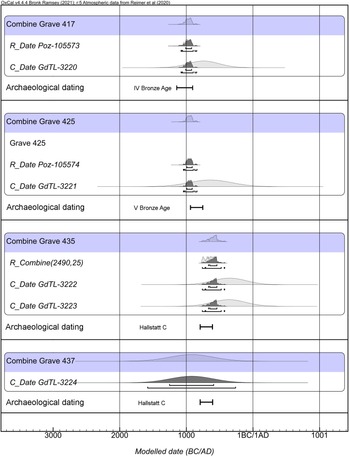
A joint analysis of luminescence and radiocarbon results can be carried out using the OxCal program. For this purpose, radiocarbon and luminescence dates were assumed to represent the same event although branches and ceramic objects might have different offsets of up to several tens of years for each method. Each grave date was combined in OxCal program v4.4.4 (Bronk Ramsey Reference Bronk Ramsey2009) using the Combine() function. In case of grave 435 carbon was probably exchanged between branches and bone apatite during cremation (Snoeck et al. Reference Snoeck, Brock and Schulting2014,) giving statistically the same radiocarbon dates. Those radiocarbon dates were combined using R_combine() function. A summary is provided in Figure 5.
Combining radiocarbon and luminescence dates for investigated graves. Combine (2490,25) is combined date from Poz-105575 and Poz-105392 14C dates from the same grave.

Our results show good agreement between radiocarbon and luminescence dates (Figure 5). The similarity of the dating is to us an indication that the results as presented are very reliable and clearly confirm the archaeological chronology of the cemetery for the period of the Lusatian culture 1000–500 BC range.
CONCLUSION
This is the first investigation at this site to use absolute chronology based on radiocarbon and luminescence dating. Our radiocarbon determinations confirmed the diachrony of the source materials established with typological-chronological analysis. The limitations of the radiocarbon method in dating Early Iron Age material, related to the distinct plateau of the calibration curve (Trachsel Reference Trachsel2004) and lack of collagen residues inside cremated bones, limit the progress in the study of absolute chronology of the Hallstatt period.
Our results show agreement between 14C, OSL and archeological evidences. Radiocarbon dates from grave 435 suggest that contamination with dissolved inorganic carbon should be negligible and that there might be possible carbon exchanges between bone apatite and fuels during cremation (Snoeck et al. Reference Snoeck, Brock and Schulting2014). This hypothesis is supported by 14C dates from grave 435.
This investigation shows that dating ceramics using the OSL method requires special attention in dose rate determination. It is necessary to perform separate measurements of radionuclides in artifacts and surrounding sediments. In our work we used an innovative µDose for assessing radionuclides in small ceramic fragments and HRGS for assessing radionuclides in surrounding sediments. This allowed us to improve the precision, which in our work was limited by water content and a-value. Both factors are very challenging to assess more reliably.
The OSL dating method was used for the first time ever to Late Bronze Age and Early Iron Age archaeological records from a Polish site. The chronometric sequence shown in the OxCal model (Figure 5) generally corresponds with the relative dating of graves based on the typology analysis of grave artifacts. Research results based on a more representative set of dates might yield more detailed findings regarding the transitional phases of cemetery use. There is no doubt that this research direction is worth continuing based on an increased number of collection sites. The results for the Brzezie cemetery lead us to conclude that, in general, the regional development of the Lusatian urnfields community was synchronous with the development of the culturally important region of south-western Poland, which yielded the most significant number of radiocarbon dates (the cemeteries in Domasław, Wrocław District—Goslar Reference Goslar2019; Gediga Reference Gediga2019, and Kietrz, Głubczyce District—Chochorowski Reference Chochorowski2007). To conclude, we need micro-regional studies on the chronology of Lusatian urnfields based on traditional archaeological methods. This is a desirable and, most likely the most promising, research direction.