The academic journal has been a key element of the scholarly world for some time and as a key component of this world it deserves historical examination. But this has not often been forthcoming, especially for regions of the world outside the Anglo-American core. In this article I examine the content of the early years of Philippine Studies. Founded in 1953, it has survived and prospered up to the present day as a vehicle for scholarly studies of the Philippines. It makes an admirable candidate for analysis not only because of this continuity through time, but also due to its ready availability in electronic form. And given the well-developed nature of social science and humanities research in the Philippines, it is an excellent choice for an exploratory study of academic journals published in Southeast Asia.
The origins of Western forms of academic inquiry in Southeast Asia are usually traced back to an era of colonial scholar-administrators: names such as J.R. Logan and R.O. Winstedt in British Malaya, J.S. Furnivall in Burma, George Coedès in French Indochina and G.A.J. Hazeu in the Dutch East Indies. Enabling these scholars (or enabled by them) were journals that served to create communities of those interested in local cultures and conditions, if not always scholarly by profession or inclination. The earliest of these was Logan's Journal of the Indian Archipelago and Eastern Asia (1847 to 1863). Soon afterwards, the Bijdragen tot de Taal-, Land- en Volkenkunde was founded by the Royal Netherlands Institute of Southeast Asian and Caribbean Studies (1853 to the present). Later still came the Journal of the Straits Branch of the Royal Asiatic Society (1877 to the present),Footnote 1 the Bulletin de l’École français d'Extrême-Orient (1901 to the present), and the Journal of the Burma Research Society (1911 to 1980). For the most part, these journals focused exclusively on the colony in which they were published.
In the Philippines, as noted by Alfred McCoy, the American colonial regime did not produce to the same extent as in the European colonies a class of scholar-administrators well versed in local languages and cultures.Footnote 2 However, it did produce a number of scholarly social science and humanities journals, although much later than the rest of the region and more closely tied to local universities. The earliest of these was Unitas (1922 to the present), an organ of the oldest European university in Asia, Santo Tomas. The University of the Philippines also published a journal, the Philippine Social Science Review (1929 to the present).Footnote 3
A second round of expansion of what may be termed the informational infrastructure dedicated to producing knowledge about, and to a lesser extent, within, Southeast Asia took place in the aftermath of the Pacific War. The conflict between the Soviet Union and the United States at that time found a key battlefield in Southeast Asia where most of the region experienced movements of resistance to the re-imposition of colonial regimes, many of which involved the use of armed confrontation. In the eyes of colonial governments and their American ally, these movements were ‘infected’ with communism requiring a prolonged effort at wiping out the ‘contagion’.Footnote 4 Part of this struggle was informational in nature and found expression in the United States in the creation and expansion of area studies programmes focusing on Southeast Asia, which had only just emerged as a recognised region since the time of the Pacific War.Footnote 5
The Philippines was only loosely connected to this newly emerged regime, its position being described as a ‘lesser satrapy’ by one scholar reflecting on the history of Southeast Asia as a field of study.Footnote 6 Nevertheless, the Cold War did not leave the Philippines untouched in terms of the development of informational infrastructure. One such development was the journal Philippine Studies, a direct product of the concern its founding editors and financial backers in the Philippine Jesuit order had over the perceived threat of communist revolution.
Today, the Philippines enjoys a reputation as having ‘a relatively more developed’ social science community.Footnote 7 This is in part due to the vibrant ecology of scholarly journals that have taken root in the country and which includes Philippine Studies.Footnote 8 At a time when the social sciences and humanities are enjoined to produce knowledge locally, the experience of the Philippines therefore bears study.
In this article I examine the content of the early years of Philippine Studies, specifically from 1953 when it was first published to 1966.Footnote 9 Before doing so, however, it is necessary to place the journal within the social and political context of the Philippines of the 1950s and 1960s, decades that saw much of the world caught up in the battle for global supremacy between the USSR and the United States—the Cold War.
Given its geographical location, the Philippines became a key front in this conflict, with the United States securing rights to naval and air bases within the country as part of its wider effort to contain the People's Republic of China and project its power more generally in the region. Local or regional concerns quickly became caught up in the conflict as a Luzon-based peasant movement (the Hukbalahap, or Hukbo ng Bayan Laban sa Hapon, People's Anti-Japanese Army), initially dedicated to fighting Japanese aggression during the Second World War, developed institutional capabilities powerful enough to prevent the return to the countryside of previously dominant economic classes after the end of the war.Footnote 10 Taking advantage of US fears of global communism and the need to secure its bases, these same classes were quick to label the Hukbalahap movement as vanguards of foreign communist invasion rather than a rational response to years of economic and social exploitation. As a result, the conflict in central Luzon became a Cold War front, with the United States sending military and economic aid as well as advisers to the government to restore the prewar status quo.Footnote 11
This set of shared interests between the country's economic elite and the US foreign and military policy establishment sets the context for the origin of Philippine Studies as a Jesuit publication. Several authors have noted the Catholic Church's position as a staunch enemy of communist movements before and after the Second World War. The Jesuits themselves were certainly cognisant of the issue and in many cases vocal in their opinions. Patrick McNamara tells us that one of the most famous Jesuits in the United States during the early 1950s, Edmund Walsh, was an acknowledged expert on international communism and author of the 1951 bestseller Total empire, a book that portrayed the Soviet Union and the communist world more generally in extremely negative terms. While not all Jesuits expressed Walsh's hawkish views (he advocated a pre-emptive nuclear strike in the case of war with the USSR), they were definitely not neutral in the debate over appropriate responses to perceived communist aggression.Footnote 12
Hence, it is not particularly surprising that Jesuits in the Philippines became concerned over developments within Philippine society that suggested to them that communist influence was increasing to a dangerous level. It appears that for at least some of these Jesuits the means to combat the communist spectre was the church's social teachings. As early as the late 1940s we see efforts to apply these teachings to the Philippine context in Walter Hogan's work with trade unions and the establishment in 1947 of the Institute for Social Order (ISO) as a ‘clearing house for ideas on social order’.Footnote 13 The future editors of Philippine Studies were involved in these efforts. Leo Cullum, the first editor, had given Hogan his initial instruction ‘to reduce the papal social encyclicals into practice’, while the third editor and long-time associate editor, Horacio de la Costa, was part of the ISO's organising committee in the early 1950s.
The early volumes of Philippine Studies can therefore be seen at least in part as a reflection of this struggle to combat communist influence by inspiring reform based on Christian principles. In this sense it was an attempt at intervention in the social life of the nation; an intervention aimed at creating readers imbued with a Catholic reformist sensibility and on guard against communist subversion. In his work for the ISO, de la Costa explicitly tied the promotion of research on the application of the church's social doctrine to communication of that work to a wider audience, ‘especially those sections of the community which exerted the greatest influence on the social order’.Footnote 14 A thorough reading of the articles published in the journal clearly provides evidence of this preoccupation, and the rest of the article will substantiate this claim. But before that, it is necessary to contextualise Philippine Studies a little more.
The origins of Philippine Studies
While Leo Cullum, future rector of the Ateneo de Manila University (1956–59),Footnote 15 edited and published the first issue of the journal in 1953, Philippine Studies was a product of the order's older tradition of producing learned work, a tradition that stretches back to its earliest days and which aimed to influence the elite and leaders of society.Footnote 16 Philippine Studies continued that tradition. It was not meant to be read by just anybody. The journal's editorial policy outlined the kind of reader it wanted: ‘We visualise as our reading public the clergy, doctors, lawyers, engineers, teachers, businessmen, government officials, and university and college students.’Footnote 17 In short, its readers comprised the professional class of the Philippines. That this class was the target of its attention is also demonstrated by a surviving list of subscribers as of June 1958, carefully tabulated in separate columns for various occupations — businessmen, doctors, lawyers, senators, teachers, as well as firms and organisations.Footnote 18 Clearly, the journal was following the Jesuit tradition of reaching out to society's most influential.
The editors were also concerned to build and maintain a reputation for sound and scholarly work. This concern was not only because of the nature of the imagined reader who was educated and not likely to tolerate inferior writing, but also for the sake of the Jesuit order itself. Francis Clark, the Philippine Provincial at the time, wrote to Miguel Bernad, who had replaced Cullum as journal editor in 1956, to remind him of his responsibility, as ‘Philippine Studies represents before the world the Society of Jesus’.Footnote 19 As a result, the articles in these early years were not crude opinion pieces or unreasoned propaganda. From early on the editor relied on a number of ‘consultors’ to help make decisions on whether to publish a particular piece or not and to correct factual errors.Footnote 20 Although it was made clear that Philippine Studies was ‘a Catholic magazine’ and that it would ‘be preoccupied to present the Catholic point of view’ this goal did not give writers a free hand to attack non-Catholic ideas or persons.Footnote 21 In one case, for example, the author of a manuscript on communism had to defend his work to the editor: ‘An article which is frankly propagandistic in nature, as this is, is bound to simplify its opponents’ views somewhat. … This explains the crudeness, jejuneness, and superficiality mentioned by the censors. I doubt if any deliberately slanted article could meet their obviously high standards of scholarship.’Footnote 22 Despite his justifications, the article was not published.
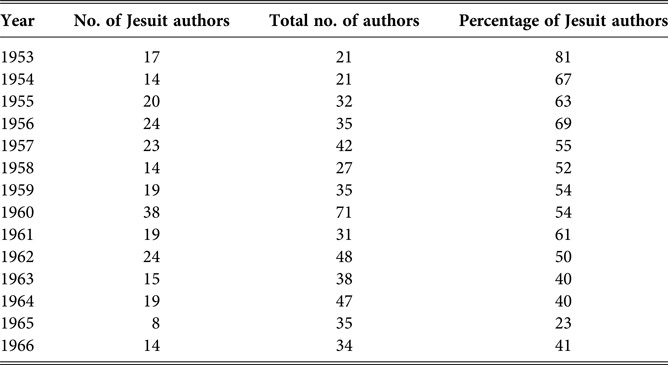
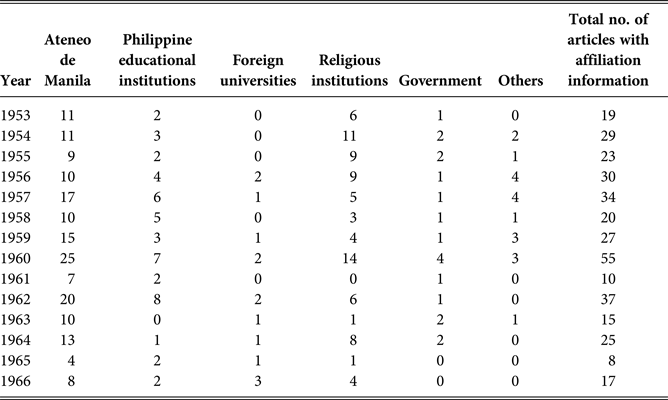
The early authors published in Philippine Studies were mostly from the ranks of the Jesuits themselves, but there was an overall downward trend in the ratio of Jesuit to non-Jesuit authors over the years (see Table 1). In the very first issue Jesuits wrote over 80 percent of the articles, but by 1966, the last year under consideration here, only 41 percent of the authors were Jesuits. In terms of affiliation, however, it is clear that authors from the Ateneo de Manila and other religious institutions (San Jose Seminary and the Congregation of the Assumption of the Immaculate Heart of Mary are two examples) dominated the early issues of Philippine Studies (Table 2).
Number of Jesuit authors published in Philippine Studies, 1953–66

Institutional affiliation (where available) of Philippine Studies’ authors (1953–66)

Within the scanty archival records, we find some evidence of the journal's early success. One article in particular seems to have helped cement its reputation — ’The Calatagan excavations: Two 15th century burial sites in Batangas, Philippines’, with Tom Harrisson of the Sarawak Museum writing in a personal letter to Bernad that it was ‘very fine’ and asking for six more copies.Footnote 23 And James J. Hennessey, a member of Ateneo's Physics Department, noted in a letter recounting a conversation with an Anglican minister that he was told the Ateneo was ‘the place which publishes the most scholarly journal west of San Francisco’ and that the excavation article would ‘put Philippine Studies in every worthwhile library which is concerned with Filipiniana’.Footnote 24
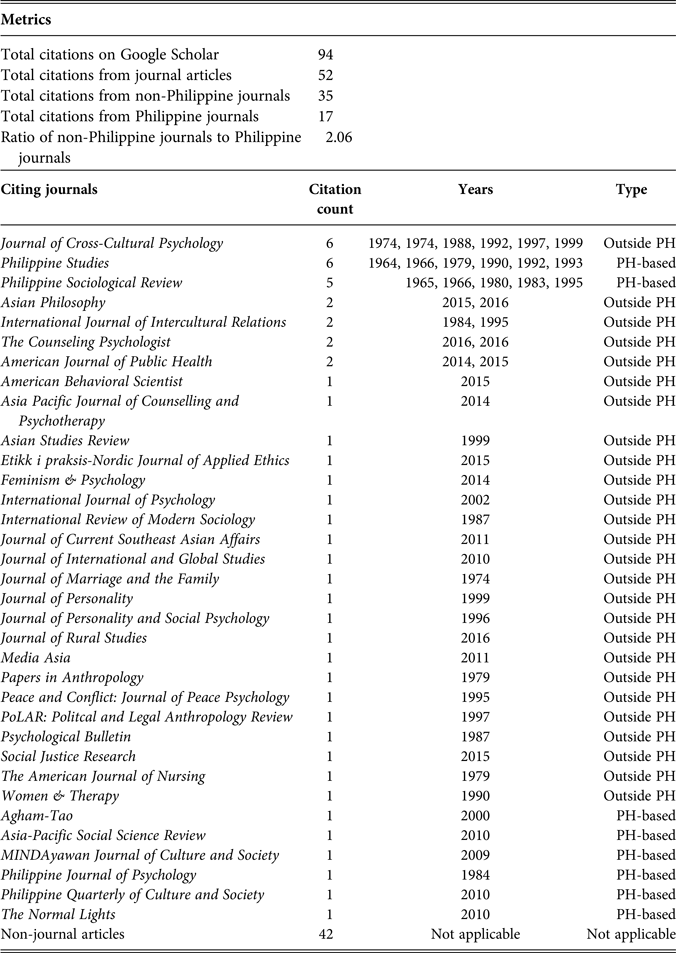
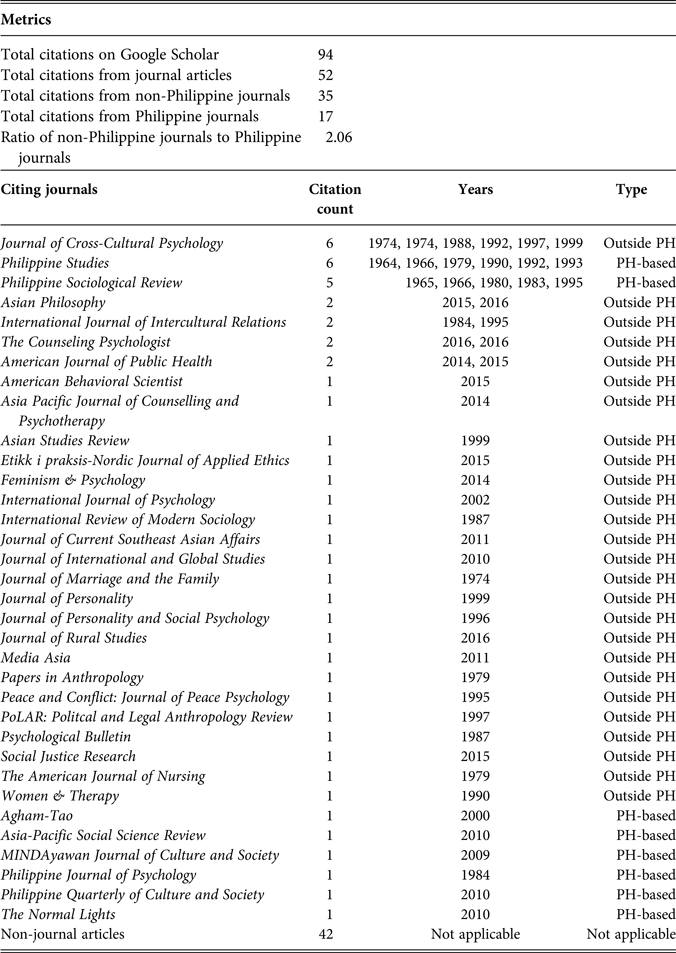
If we look at the top cited journal article for the period under consideration (J. Bulatao's ‘Hiya’, appearing in 1964), we get a further indication of the journal's influence, for of the 52 references to it in other journals 35, or 67 percent, are from outside the Philippines, the most recent being in 2016 (Table 3).Footnote 25
Bibliometrics on top-cited article (1953–66): Jaime C. Bulatao, ‘Hiya’, Philippine Studies 12, 3 (1964): 424–38
Other pieces of evidence that point to the journal's initial success are found in an editorial celebrating its first five years. The editorial noted that a number of large national libraries subscribed to Philippine Studies: the Library of Congress, the National Library of Australia, and the Bibliothèque Nationale of France. Also on the subscription list were numerous US colleges and universities as well as scholarly institutes in Switzerland, Japan, Russia, West Germany, and Thailand. The New York Public Library as well had just taken out a subscription.Footnote 26 But the very fact of its survival for the thirteen years studied here is perhaps the most eloquent testimony that Philippine Studies attracted the readers it desired — educated and intelligent professionals.
The rest of this article will focus on what these readers found when they opened the pages of the journal: warnings about communism, the nature and the necessity of social reform grounded on Catholic principles, but also more scholarly works of literary and historical studies and finally, towards the end of the period, a small number of social science works. As a whole all of these writings supported what must have been the key concern of the journal's early editors: the need for social reform in the face of perceived grave threats facing the country.
Warnings about communism
If the journal reflected the desire to advance a new social agenda in the Philippines based on Christian tenets, it also highlighted the nightmarish alternative that those who advocated Catholic social reform believed they faced: the takeover of the country by a communist-inspired mass movement.
On the pages of Philippine Studies communism was a monolithic, alien force that had no redeeming value and with which there could be no compromise. Such antipathy was of course part and parcel of Catholic doctrine as far back as 1846, but was heightened by recent events in nearby China, which saw the persecution, jailing, and eventual exile of a number of priests, including Jesuits, in the aftermath of the victory of the Chinese Communist Party.Footnote 27 The experience of these priests, some of whom eventually ended up in the Philippines, must have reinforced the journal editors’ outlook on communism. A few of these exiles contributed articles to the journal on various topics related to communism and the church in China.
Among these contributors was Charles McCarthy, who had worked as a journalist for Catholic newspapers in China until his arrest in 1953. McCarthy, while employed as an associate editor for the Hong Kong-based journal China News Analysis, wrote three articles for Philippine Studies between 1959 and 1961. All his articles may be read as warnings about the inhumanity of the Chinese Communists and by implication, their Philippine counterparts. In the first article McCarthy, using a China News Agency analysis, painted a bleak picture of the country's efforts at industrialisation, arguing that it had failed, and that even if it had succeeded, the cost in human terms would have been too high for any ‘government which has the welfare of its people at heart’.Footnote 28 His second article, published a year later, also dwelt on the high costs for any country or government foolish enough to embark on a communist path to development. He concluded his argument by stating that ‘if we bought Communism, we would pay for it with a most precious birth right, our human dignity’Footnote 29. In his last article McCarthy provided a more personal account of his experience with the communist system of justice, again with the aim of issuing a warning to readers.Footnote 30
The editors’ concern over communism would also have been stoked by recent events in the Philippines. The Huk insurgency was widely seen as the responsibility of the communists, and although it had been broken by 1953, many believed that they had merely shifted tactics from a rural to an urban front. In August 1958 Clark wrote to the editors that he had
come into possession of certain information concerning Communism in the Philippines. From reliable sources I hear that their current strategy centers on Manila, especially on universities and colleges and especially on the UP … [they] hope to concentrate here in Manila on an intellectual approach including also government officials and lawmakers. A very important part of their current approach is in publishing and they are concentrating much of their strategy now on articles in the press.Footnote 31
But it was only in 1960 that substantial analysis of the Philippine Communist movement appeared in Philippine Studies in the form of a series of articles, written mostly by members of the Ateneo de Manila faculty, dealing with ‘Political Transmission 15’ (PT 15), a document written by the Communist Party of the Philippines. This document outlined the party's view of the country's economic and political situation for the benefit of its membership. Articles on the economic, political, ideological, and strategic aspects of the PT 15 were published in Philippine Studies in response. Not surprisingly, these were extremely critical pieces. One article found the economic analysis of the PT 15 ‘a jungle of errors, garbled figures, deliberate misconceptions and bald, unsubstantiated assertions’.Footnote 32 The article on the political elements of the PT 15 declared the document to be deceptive in its self-portrayal of the movement as nationalist,Footnote 33 while the piece on the PT 15's ideology argued that it was aimed at the rank-and-file members of the party. ‘They are being brain-washed painlessly’, it concluded.Footnote 34
Throughout these articles, the tone was one of condescension: ‘Aside from a determined internal attempt to destroy the English language by bad example …’,Footnote 35 ‘[t]his intemperate and malicious propaganda is so lacking in sense and subtlety as to be unworthy of serious attention’.Footnote 36 Remarks such as: ‘PT15 is not principally for information but to keep the comrades in line. … It would seem to say that the great mass of communists here are enthusiastic rather than intelligent’, clearly suggested the disdain felt by the authors toward these intellectual products.Footnote 37
Nevertheless, the authors of Philippine Studies argued that the communists were a threat:
Probably the most important recent triumph of the Philippine communists … is to convince a considerable number of people that communism ceased to be a threat with the military defeat of the Huks. Anyone who thinks otherwise and says so immediately becomes a somewhat repellent figure of fun — a witchhunter, a ‘little brown McCarthy’. This is a great tactical victory.Footnote 38
Other contributors shared such a view, and there was concern that the communists’ new strategy was to find converts among those Filipinos attracted to organisations professing to advance the cause of nationalism. Enrique Victoriano, for example, wrote of his suspicion of these groups, noting that their leadership was ‘from a single tight inner circle’ and that ‘the groups are well organized and seem well supplied with funds’ so that although they could be merely political organisations to be used in the next elections there was also the possibility ‘that they are fronts for communistic activities’.Footnote 39
Put together, these writings about communism in Philippine Studies shared more than a united outlook on its perversity. They also shared a wish to warn Filipinos; to set their minds against the ‘communist menace’. Melchor Aquino revealed this mind-set when he wrote that the communist menace was so odious that it made nuclear annihilation a preferable option in the face of communist aggression as the alternative ‘would spell communist enslavement from which there would be no escape except genocide or death’.Footnote 40 But neither choice must have been appealing, hence the pressing need to develop an effective strategy to neutralise the threat. The editors and contributors to Philippine Studies shared the assumption that the teachings of the Catholic Church provided means to craft such a strategy in the form of a new focus on social reform.
Catholic social reformism
There are many articles in these early years of Philippine Studies of a purely religious nature, but these will not concern us here. Another genre of articles combined religion and social or economic policy. In these articles we can see the articulation of a Catholic-inspired social reform project.
The very first of these articles appeared in the second issue, a piece entitled ‘The modern voter and morality’, by Gerald Healy, professor of moral theology at San Jose Seminary. Healy was at pains to stress the duty of Catholics to vote wisely, as the franchise ‘is a weapon that free men use to protect their freedom’. Voting wisely meant, among other things, taking ‘into account the customs and traditions of the nation’ so that the elected official ‘should be a man who will have sympathy with the beliefs and aspirations of his Catholic subjects’.Footnote 41 In another passage the author suggests that a Catholic politician would be a better choice because he ‘has the high ideals of Christian life constantly presented to him by the Church, and the abundant supernatural aids of the sacraments and the Holy Sacrifice of the Mass. He has opportunities which non-Catholics are deprived of’.Footnote 42
Aside from voting, the editors of Philippine Studies published articles on a number of other facets of social reform: the rights of labour, the plight of the farmer, population control, and advertising in a developing country.Footnote 43 A reading of these articles suggests that their authors wished to raise awareness of the issue among the readership, that is, the influential professional class.
Jeremias Montemayor, for example, the founder of the Federation of Free Farmers (FFF), an organisation established to help small farmers and with close ties to elements of the Catholic Church, reminded readers that
the farmer is also the most neglected person in the country … our economy is anomalous: mansions in the city, nipa huts in the country. The tables of the wealthy groaning with food, the farmers (who produce the food) eating nothing but rice and salt.Footnote 44
John Carroll wrote more broadly, noting ‘indications of a growing concentration of income in the hands of a few’ and that this wealth was not being ‘invested as capital for productive purposes’ but rather ‘consumption — and not … infrequently into highly conspicuous consumption’ while ‘the burdens of development fall disproportionately on one group in the society … [the poor]’.Footnote 45 Healy wrote of the ruinous usury that reduced farmers to perpetual debt enslavement.Footnote 46 Rodolfo Tupas, a union activist, wrote of the so-called Magna Carta of Labor (Republic Act 875) that
we seem to have forgotten what ‘labor’ means. We seem to have forgotten that it means individual human beings who have different faces, who are weak and who are strong, and who have all the emotions and feelings that make them what they are.Footnote 47
Vitaliano Gorospe addressed the moral implications of advertising in a developing country and John Doherty the need for what he called responsible parenthood for ethical family planning.Footnote 48
As well as raising awareness of various social issues in the country, these articles presented the Catholic response. Gorospe's article on family planning, for example, stressed that although it was ‘here to stay’ it could not be done ‘at any price’, especially ‘at the expense of higher human and Christian values which are part and parcel of our Filipino way of life’.Footnote 49 The FFF presented to Leo Cullum ‘a Christian solution’ to the problems facing rural Philippine society.Footnote 50 That the FFF emphasised conciliation between tenants and landlords came about, according to Cullum ‘as a fruit of its Christian principles’ and its reliance on priests as spiritual advisers as a means to preserve the organisations’ ideals that otherwise could ‘easily deteriorate into selfish interest’.Footnote 51 Healy argued that those disadvantaged by strikes and labor unrest needed to bear in mind that it was possible to have a just strike ‘if [the worker] is held to be a human being made in the image and likeness of God, endowed by his creator with certain inalienable rights’, a view similar to that propounded in 1966 by Samuel Wiley, professor of canon law at San Jose Seminary, who dwelled on the pressing need for the country to address the issue of poverty because the poor ‘represent human beings, men whom God has called to the dignity of a Christian life and to the full participation of democratic citizenship’.Footnote 52
Providing the foundation for the Catholic response to all these social issues were, not surprisingly, the teachings of the Catholic Church and in particular the papacy. In some articles the popes were not mentioned specifically, but in others they were frequently cited. Rodolfo Tupas larded his article on the Magna Carta of Labor with references to their teachings: ‘to borrow the forceful words of Pope Pius XI’; ‘this practice was directly opposed to what Pope Pius XI plainly stated’; ‘in the words of Pope Pius XI’; ‘this philosophy is certainly in accordance with the teachings of Pope Leo XIII’ among many others.Footnote 53 Similarly, Healy justified Catholic intervention in politics by noting that ‘the recent Pontiffs have aimed at the restoration of all things in Christ, the complete reformation of society. This demands and supposes that the doctrine of Christ is brought into the forum as well as the marketplace’.Footnote 54 Gaston Duchesneau, one of the ISO's founding members, recounted the establishment of the institute and explicitly tied its mission to Pope Pius XI's encyclical Quadragesimo Anno (1931).Footnote 55 Gregorio Hernandez, secretary of education in the Magsaysay cabinet, justified the state's enforcement of compulsory education by appealing to Pope Pius XI's encyclical on the Christian Education of Youth.Footnote 56
A final and very clear example of the use of papal writings to argue for a particular, in this case economic, policy is Michael McPhelin's (1959) piece entitled ‘Economic freedom: Adam Smith vs. the Papacy’, which contrasted the views of eighteenth-century economic thinkers such as Adam Smith and Jeremy Bentham with those of the papacy. McPhelin, an economics professor at the Ateneo de Manila, accused these economists of stressing the freedom of the individual at the expense of the interests of society and argued that the papacy had consistently advocated a more balanced approach that could ensure that both the individual and society could thrive: ‘no economy has been completely free and none has been completely regimented. But not every blend of the two brings about the ideal of economic society as envisioned in the Encyclicals’.Footnote 57
Reading these early volumes of Philippine Studies and noting their frequent reference to papal encyclicals brings one to the conclusion that the journal was heavily inspired by changes in the church at a worldwide rather than local level. Jonathan Luxmoore and Jolanta Babiuch argue that in the face of an increasing polarisation between labor and capital in a rapidly industrialising nineteenth- and early-twentieth-century Europe the Catholic Church was gradually forced to outline its own position on the issues involved. This position was fundamentally rooted ‘on the need for a balance between component parts of the body politic’ so that ‘if abusive capitalism was the root cause of modern poverty and misery, socialist proposals — a community of goods, abolition of private property, a classless society — also violated Christian teaching and natural law’.Footnote 58 What was wanted instead, according to the church, was ‘the reaffirmation of the harmonious Christian order in which workers received a living wage and had their interests protected by associations or unions — a vision of the unequal but harmonious and just, social order for which Émile Durkheim and others coined the term “solidarism”’.Footnote 59 In other words, a third way that would preserve capitalism but set limits on its power was required.
In Quadragesimo Anno Pope Pius XI took these views that his predecessors developed and reaffirmed their importance to the contemporary world, mired as it was in the Great Depression. Quadragesimo Anno also provided the Pope's
blueprint for a harmonious society — ‘a community of communities’ which depended on neither liberalism nor socialism. Its main pillars would be voluntary associations, vocational groups, and ‘committed young men’ all interacting in the cause of social reconstruction according to the principle of solidarity.Footnote 60
It was just such a view that animated the pages of Philippine Studies — a middle path between liberalism and socialism/communism that could be achieved by creating a Christian society based on its members’ voluntary cooperation. If we look at the topics addressed by those articles in Philippine Studies that applied or utilised religion as a force to advocate social reform, we can see how they ultimately aimed to restore and maintain that ‘harmonious’ balance within society that was at the heart of Quadragesimo Anno. What the authors wished for was a middle path that avoided the twin extremes they associated with communism and saw around them in the capitalist society in which they lived.
But if the overall plan for social reform was not really of Philippine originFootnote 61 its implementation required knowledge of local conditions. Here, Philippine Studies made a further contribution by publishing the results of social science investigations. Among the most influential of these were the works on Philippine values by Frank Lynch and Jaime Bulatao.Footnote 62 Lynch and Bulatao's works, originally presented at the Fourth Annual Baguio Religious Acculturation Conference in 1960, found a more permanent home in Philippine Studies. As Glenn May has pointed out, these studies generated great excitement in the Philippine social science community, helping to set the path for future social science work throughout the rest of the decade and the 1970s. At the heart of this project of discovering Philippine values was the assumption that national cultures had their own distinctive sets of values and that these, if identified, would be of great use in social and economic development projects. According to May, Lynch believed that two values in particular stood out in the case of the Philippines: SIR (smooth interpersonal relationships) and shame/self-esteem. May argues that while not everyone agreed with his conclusions (he points to Felipe Landa Jocano who apparently found no evidence of the importance of such values in his own ethnographic studies as an example), it is clear that Lynch and his allied researchers did manage to establish Philippine values as the dominant perspective within the academy over the course of these years.Footnote 63
The identification of Philippine values was also acknowledged to be key to the achievement of not only ‘nation-building but towards a new Christian Philippines’ as ‘there is no reason why Filipino attitudes and values cannot provide the matrix or potential for maximum Christian renewal and spiritual maturity’ so that ‘the relevance of the social sciences to Christian moral education cannot be over-emphasized’.Footnote 64
But despite this recognition of the social sciences, in its early years Philippine Studies remained a journal of the humanities. However, this focus did not mean that the literary and historical studies that filled its pages did not contribute to the goals of reform inspired by the teachings of the Catholic Church. The next two sections will discuss these contributions.
Literary studies
The first article on literary subjects to be published in the journal was a commentary on the winning entries of the Philippines Free Press short story contest of 1952, written by Miguel Bernad. According to the editor, Leo Cullum, who seemed to have commissioned the piece, the article ‘will not precisely undertake to challenge this decision [of the contest committee] but to review and evaluate the stories so selected’. In so doing it served to highlight two major concerns that Cullum, Bernad, and many of the other contributors to the journal shared. The first of these concerns was the need for the country to develop an appreciation for its Catholic and Spanish heritage. Bernad sought to guide future Filipino writers:
The Philippines is predominantly a Christian, a Catholic country. It would be strange, with such a culture, if this Christianity were not reflected in our literature. … Our writers, if they did not reflect our basic philosophy and our basic theological orientation, would not be representative of us … [As a result] our literature would not fully mirror our life or our ideals, our history or our tradition; our literature would be leaving out the most important part of our heritage.Footnote 65
Other authors echoed this assumed need to develop an appreciation of the Spanish-Catholic heritage of the Philippines. Joseph Galdon wrote as part of his review of the Bayanihan Dance Troupe that a national literature could not ‘trade the best elements of a 500-year-old tradition for the deceptive will-o’-the-wisp of avant-garde popularity’.Footnote 66 Similarly Lourdes Busuego Pablo declared that Nick Joaquin, ‘by spotlighting certain valuable aspects of our Spanish past and its Catholic heritage, is performing a vital role in restoring a balanced national outlook’.Footnote 67
But there was a second key concern in that very first literary study of the journal; namely, the need for morality to be part of the evaluative criteria for literature. The editor, discussing a draft of Bernad's article, was quite explicit on this requirement: ‘I do not think that the article should omit some word about scandal. Therefore just at the end of no. 5, p. 12 of your ms., I will insert a paragraph on the danger of portraying evil seductively’.Footnote 68 Readers (and prospective writers) were hence given guidelines for when literature could be considered immoral. They were also warned about the social effect of their writing, that they ‘must have regard for the vulnerability’ of their readers rather than ‘look solely to canons of literary workmanship’.Footnote 69
Bernad's article set the tone for subsequent works in the journal that over and over again stressed the morality of literature and the need for a moral stance in literary studies. Cullum himself wrote a ‘review’ of the Diliman Review. His piece, which apart from the title, ‘The Diliman Review’, had little to say about the said journal but made a great deal about a particular article in its most recent issue, ‘Form and symbology in the fiction of Nick Joaquin’ by Ricardo Demetillo, writer and professor at the University of the Philippines.Footnote 70 Cullum found himself in fundamental disagreement with the author's use of Freudian analysis to portray ‘devotion to our Lady … [as] disguised lust’ in Joaquin's stories.Footnote 71 Galdon, reviewing a novel by Emigdio Alvarez Enriquez, wrote of Philippine literature more generally that it was still in its early days and that when the country's writers ‘no longer seek models in the sex themes and Freudian symbolism of modern American novelists, we shall have the beginnings of a great Philippine literature’.Footnote 72 An even more forceful annunciation of the need for morality in literature was supplied by H.B. Furay, who took issue with the treatment of ‘lust’ in Joaquin's work, noting that ‘the presence of sin is a gray miasma [over]whelming all; there is no relieving brightness whether by the consciousness of the lustrous medicinal sway of Grace or of the saving lift of simple human humor’, and concluded that ‘we object to the overall grim and emotional preoccupation with Sin, especially sensuous sin and its frequent grey triumph’.Footnote 73
Positive examples of writing that were up to par in terms of moral standards were to be found in the work of Bienvenido Santos: ‘a good story-teller’ who was ‘blessed … with an outlook on life that is basically sane’.Footnote 74 Gregorio Brillantes also found favour with Bernad as ‘a young writer who believes in the goodness of youth. He recognizes the evil in people but believes in their basic sanity. Above all, he believes in divine grace’.Footnote 75
Although the journal's mission was to publish works about the Philippines, there was much flexibility in the choice of topics that could be justified as worthy of inclusion.Footnote 76 This flexibility extended to religious themes and so the presence of religious elements such as grace therefore infused a third class of literary articles in Philippine Studies that stood alongside the concern over morality and appreciation of the country's Spanish and Catholic tradition. It includes a piece by Furay on ‘Sturge Moore as a mystic’, where the author intended to show that the poet ‘had the mystic élan’ but that his ‘lack of sound or firm religious conviction … doomed it [his spirituality] to failure’.Footnote 77 Bernad wrote a piece in which Hemingway's Old man and the sea was found to be ‘an affirmation of faith in human nature … an affirmation of faith in God … an affirmation of beauty of nature and the beauty of life’.Footnote 78 Bernad also published his own reading of T.S. Eliot's ‘Sweeney among the Nightingales’, emphasising the Christian elements of the poem:
But it is different in the convent of the Sacred Heart. There, one may find order, peace, serenity. There one may find devotion and consecration in contrast to the disloyalty and the selfishness found in the world of Agamemnon or of the nightingales or of Sweeney.Footnote 79
To sum up, this reading of the articles on literary subjects in Philippine Studies finds three major concerns at work. The first is the emphasis on the importance of the Spanish-Catholic heritage of the Philippines to the development of a national literature. The second is the stress on the need for moral standards in literary works. The third is the noting of religious themes in various works of foreign authors, perhaps as part of a wider pedagogical approach to literature. If these concerns were taken to heart by the readership the articles would have contributed directly to developing an intellectual atmosphere that would assume or accept the need for morality to guide its work and more specifically the right of Catholic morality, due to the cultural heritage of the country, to have pride of place. In the next section we will examine the articles on history, the other (traditionally) humanities discipline.
Historical studies
If the work on literary subjects stressed among other things the need for a wider and deeper appreciation of the Spanish-Catholic tradition, the historical articles provided a concrete basis for such an appreciation. Subjects on the Spanish era dominated the pages of Philippine Studies in these initial years. Only in 1959 do we find an article on the American period — ‘The Japanese way of life in pre-war Davao’ — and another four years were to pass before Theodore Friend's first article on American interests and Philippine independence appeared.Footnote 80 Thereafter the balance between historical eras tilts more in favour of the American period, but it is safe to conclude that the main focus of the journal at this time was the history of the Spanish Philippines. These articles were generally positive on the Spanish record; clearly their authors wished to combat what had been a dominant theme of US–Philippine colonial history — the Black Legend of Spanish colonialism.Footnote 81 Horacio de la Costa, in one of the first historical articles in the journal, argued in regard to the dilemma faced by the early Spanish state in the Philippines for the need ‘to make the native work for his new master without violating his rights as a man’ that ‘Spain appears to have been the only colonizing power that worried about this problem to any great extent in the sixteenth and seventeenth centuries’.Footnote 82
De la Costa was not alone in pointing out that Spain was not the tyrannical monster painted by some. Frederick Fox, then the director of the graduate school of the Ateneo de Manila, and Juan Mercader, in a series of articles reassessed the country's educational system under the Spanish regime. In the very first of these articles they were quite clear in what they aimed to achieve, writing that
our biases of national pride, religion, and time must be laid aside and the facts accepted as they are demonstrated to be by tested evidence. The occupation of the Philippines by the US in 1898 needs no longer to be justified by discrediting the Spanish administration.Footnote 83
The rest of their work went on to demonstrate not just the vitality of Spanish education in the Philippines, but, in a comparative sense, its superiority to public education offered in other ‘more developed’ countries. They concluded in another article that ‘[o]ur past is decidedly richer than we are sometimes inclined to believe’.Footnote 84 Similarly de la Costa concluded his own study of early Jesuit education in the Philippines by writing that it was ‘greater in extent, more varied in its offerings and more exacting in its standards than current textbooks and surveys … would lead one to suspect’.Footnote 85
But if the era of colonialism was defended, also to be upheld was the role of the Catholic Church in that history. De la Costa's article on Jesuit education was the first of these, but certainly not the last. Nicolas Zafra, in the process of critiquing Teodoro Agoncillo's historical methods, for example, wrote that his history would not give suitable acknowledgement to the ‘influence of Catholicism in the building up of the Filipino people into a nation’, while John Schumacher celebrated ‘the scientific mindedness of the Spanish Jesuits’ who despite their isolation ‘could be found, at least in meteorology, in step not only with Peninsular Spain, but with the more scientifically advanced countries of the world’.Footnote 86 An article on the history of the Manila Cathedral took as its ending point the Japanese Occupation when ‘the Philippines was overrun by a new enemy … [and] … Filipinos–Manileños were being tortured and killed because they would be free, as the Church had taught them to be’.Footnote 87 A similar attribution was made by historian Nicholas Cushner, who concluded that ‘the concepts of justice and equality’ were ‘basic to Christianity’.Footnote 88
But the journal was not content with presenting historical studies that could correct what its editors perceived as a bias against the country's Spanish-Catholic heritage. It also attempted to provide bibliographical tools to help other historians explore the past.
De la Costa expressed the motivations for this kind of work in a 1961 article where he argued that although a Filipino-centric history was an important goal of the historical profession ‘it assumes … that the materials are there to be interpreted [in a Filipino-centric way]’.Footnote 89 De la Costa was quite sure that much material for such interpretation did exist, but that it was not ‘usable … it simply has not been gathered and pieced together in such a way as to be usable evidence, capable of being studied in its entirety and thus provide a solid basis for accounts that shall be factual and not merely conjectural’.Footnote 90
Hence we find within the journal a number of bibliographic works that actually went beyond history to cover the gamut of intellectual work. Cullum and Bernad, for example, attempted to remedy the lack of tools for those interested to keep abreast of the scholarly works being published in the Philippines by providing brief reviews of books published over the course of the year.Footnote 91 Cullum and Berchmans Copin also compiled listings of periodicals being published in the country.Footnote 92 Cullum noted that the presence of such lists was more important in the Philippines than elsewhere because, among other reasons, ‘scholarly studies in many branches are still young and the tentative exploration which will eventually flower into full-sized works is being carried out in periodicals’.Footnote 93 In the case of the social sciences and humanities, which suffered from a lack of dedicated journals, much work ‘is buried amid entirely unrelated material in a score of miscellaneous publications’.Footnote 94 Cullum's idea was to put together a comprehensive list of periodicals containing scholarly material that could function as a basis for a standard periodical library and later, a periodical index.
But historical materials received the most bibliographical attention. One of the first of these was a finding aid for the ten volumes of Jesuit letters of Mindanao. It included a summary and overview of the kind of documents in the set and an index by place and group names.Footnote 95 It was the 1960s that saw the most of this kind of work in the journal. John Schumacher wrote review articles on recent overseas work on Philippine historical topics, noting ‘the large amount of work … being done abroad which Philippine scholars cannot afford to ignore’.Footnote 96 C.R. Boxer, the renowned English historian, published translations of three previously unpublished letters from Jesuit missionaries to a benefactor back in Spain, and de la Costa himself provided similar service for certain documents dealing with the British capture of Manila in the eighteenth century.Footnote 97 In 1963 Schumacher published ‘Some notes on Rizal in Dapitan’, noting that although ‘this account has been printed before but since it is relatively rare, it has seemed worthwhile to reproduce it here’, while Cushner published selected entries from the official diary of the Tamontaka Reduction.Footnote 98
Conclusion
This article has presented an analysis of the early volumes of Philippine Studies. It has argued that the content of the journal during this time reflected a desire for social reform in the Philippines to be based on the norms and values of a Christian society, as defined by the teachings of the Catholic Church. While many of its articles dealt directly with expounding the need for reform, and outlining how this could be achieved by means of Catholic social thought, the journal also published work on a variety of other topics. The problem (from the perspective of the journal's editors) of communism, the great but terrible competitor for the attention of the Philippine masses, was one such subject. The journal, though, published other scholarly works in the social sciences and the humanities. These works, however, were not divorced from the journal's animating desire to see born in the Philippines a truly Christian system of social justice. Literary studies called attention to the need of both Christian morality in literature and a recognition of the positive aspects of the country's Spanish-Catholic tradition. Similarly, most of the historical pieces in the journal specifically argued for a re-examination of the Spanish colonial era that would allow for the recognition of its contributions to the Philippines. All of this content may be seen as working together in an attempt to create within the minds of the journal's readership an awareness of the need for Catholic-inspired social reform in the face of the great threats perceived facing the country.