INTRODUCTION
The value of my existence ( ) depends on how much contribution I can make to others, or to the society, or to the whole human race. This probably is my core identity (
 )…. All other roles are just an extension of this core role as a contributor (
 ).
This excerpt of an interview with “Hu,” a young Chinese corporate lawyer, suggests a deeply public-regarding vision of the lawyer role. This article compares what being a “contributor” means to lawyers-in-training like Hu in the United States and China. To gain insights into globalized convergences around the civic dimension of professional identity, I focus on the elite corporate law sector where new lawyers have extensive contact with international norms and values. In China, the transnational corporate practice sector is evident in the numerous American and other foreign law firms as well as the major Chinese domestic firms, which largely import the structures and practices of foreign-firm counterparts (Liu Reference Liu2008, 786–87). Do new Chinese lawyers in these firms internalize and translate foreign norms of civic professionalism, or do they present a more distinctly Chinese model rooted in domestic politics and authoritarian legality? More generally, how do young lawyers’ accounts of professional identity reflect their bottom-up efforts to advance the public interest within the constraints of their national legal and political contexts? I address these questions through bilingual interviews and a cross-cultural identity-mapping methodology. Although exploratory and qualitative, examining only a slice of the bar in both countries and only a moment in the professional socialization timeline, my qualitative analysis provides insights and new directions for comparative research on the globalizing legal profession.
My findings suggest sharp differences in how US and Chinese respondents perceive the public-service value of corporate law practice and, more broadly, how they experience the civic dimension of professional identity. As I have described in previous writings on the US side of this study, American corporate-lawyers-in-training often experience “divided selves,” a personal and civic detachment from professional identity (Bliss Reference Bliss2017). This tension with respect to perceived constraints on public-interest expression is, I argue, a defining feature of the lived experience of civic professionalism among many US corporate-lawyers-in-training. I add this sense of civic constraint to what I take to be the existing definition of civic professionalism found in American legal profession scholarship, wherein lawyers have a professional responsibility to serve the public good as client-centered neutral partisans and as guardians of an independent legal system that moderates state power. While US respondents’ sense of constraint and sometimes alienation in their corporate law practice raises concerns about mental health and intrinsic job satisfaction, I argue that it can also support bottom-up legal reform efforts via the legal profession.
In contrast, Chinese respondents more often described corporate law practice in morally favorable terms. Their perception that corporate lawyers make positive civic contributions appeared to bring these lawyers a strong sense of purpose and personal investment in their early legal careers. Indeed, I argue that young corporate lawyers in the Chinese sample approximated a moderate “integrated cause lawyering identity,” wherein respondents generally located the lawyer role in the center of their identity maps and reported modest contributions to developing the economy and the rule of law (Bliss Reference Bliss2017, 872). Respondents rarely framed these civic commitments in the liberal rhetoric of promoting the profession’s independence, developing civil society and democratic political structures, or advancing legal and social change.
This stark variation between how US and Chinese corporate-lawyers-in-training think about civic professionalism is perhaps surprising given that, in many respects, they belong to the same transnational corporate bar. The Chinese respondents were employed either by foreign firms or domestic firms in the mold of foreign firms. They had proximity to foreign clients, foreign legal actors, and foreign legal concepts. Twelve of the thirty Chinese respondents studied abroad for master of laws (LLM) degrees. When asked about their general impressions of lawyers, they often cited foreign media images. Chinese law schools have undergone dramatic internationalization efforts (Wang, Liu, and Li Reference Wang, Liu and Li2016). Daily life in Shanghai, where all of the Chinese interviews were conducted, consists of a global mix of international people, business, products, food, and language. English is prevalent in the daily written and spoken language of these lawyers’ workplaces.
In spite of these internationalization trends, my findings suggest marked divergence in the US and Chinese samples. I conclude with a comparative analysis of the civic dimension of professional identity. In the US sample, professional identities were generally divided, constrained, and unstable, while the Chinese sample tended to present central, state-aligned, and stable professional selves. I label the Chinese model “pragmatic professionalism” to emphasize that it is an affirmatively civic vision of lawyer identity that lacks bottom-up frustration but, instead, draws on a pragmatic recognition of the limited role of lawyers in the legal and political order. I argue that evaluation of the competing merits of these country-specific models should avoid the ethical and empirical deficits (the “unwitting hegemonism”) behind US-led liberalization and rule-of law efforts (Alford Reference Alford2000). As the Chinese system of authoritarian governance and legality gains global prominence, the Chinese model of legal professionalism cannot be dismissed merely as a target for the diffusion of American norms.
IDEOLOGIES OF CIVIC PROFESSIONALISM IN THE US BAR
The standard US conception of the lawyer role emphasizes zealous advocacy for clients in support of the adversarial legal process. This client-centered vision is complemented by a tradition of (at least rhetorically) robust public commitments, where lawyers serve as “officers of the court” and “lawyer statesmen” (Kronman Reference Kronman1995). Lawyers are tasked with not only providing technical legal analysis but also judgment and wise counseling of clients (Wilkins Reference Wilkins1998, 1528). Practitioners are invited to pursue the lawyer role as a calling, either in the framework of cause lawyering, where the lawyer explicitly seeks to realize a personal vision of a good society, or in the framework of neutral-partisan client service, where the lawyer provides access to justice as a precondition for a functional democracy (Pepper Reference Pepper1986, 617; Spaulding Reference Spaulding2003).
This perspective on lawyer identity has deep roots in what Terence Halliday (Reference Halliday1999, 1052) refers to as an American tradition of “civic professionalism” drawing on lawyers’ “altruistic, prosocial, humanistic, and other-regarding motivations.” Historians trace civic professionalism to the early American legal profession before the Civil War, when lawyers were heavily represented in public office as well as serving as country attorneys who provided access to justice (Auerbach Reference Auerbach1977). This public-service tradition finds further support in American lawyers’ prominent roles as civil rights leaders, legal change agents in the common law system, and, more generally, “societal problem solvers” (Edley Reference Edley2012). These ideals are said to be reproduced through US legal education where students are socialized into a professional collective based on a shared identity and an obligation to serve the public.
Commentators have lamented the growing commercialization of legal practice and the decline of the lawyer-statesman ideal (Kronman Reference Kronman1995). This lament features prominently in the recent wave of research and commentary on US legal education, which stresses the importance of inculcating students in “civic professionalism” and a sense of duty to “the members of the public the profession is pledged to serve” (Sullivan et al. Reference Sullivan2007, 4). In sum, the ideal American professional identity presented to new US lawyers, and in some respects offered for export to developing countries, frames lawyers as public-regarding professionals who internalize a sense of civic purpose in their representation of clients and in their leadership in legal and social reform. As a collective, these lawyers are expected to work within the channels of the liberal legal order to provide a semi-autonomous alternative to the market and state.
IDEOLOGIES OF CIVIC PROFESSIONALISM IN THE CHINESE BAR
Western observers frequently suggest that legal professionalism in China is compromised by guanxi relations (reciprocal networks of relationships that span personal, legal, and political arenas) and state oversight, such that Chinese lawyers “have not developed a strong professional identity independent of the desire to get good work and stay out of trouble” (McMorrow Reference McMorrow2010, 1102). The state supervises legal practice, as evident in the required party cells in law firms, state control over bar associations, and the oath to the Chinese Communist Party (CCP) taken by new entrants to the bar. This supervision contrasts with the liberal notion of an independent, self-regulating collective of professionals. Lawyers’ neutrality is filtered through the “socialist rule of law,” creating a “fundamental conflict of interest between lawyers’ loyalty to the state and their loyalty to their clients” (Michelson Reference Michelson2006, 30). This conflict may be most visible among criminal defense lawyers and other lawyers who take controversial cases where they can face personal liability.
Some recent scholarship has highlighted emerging, but limited, norms of professional independence in the Chinese bar. These norms have been influenced by lawyers’ mobilization around recent cases where lawyers have been prosecuted (Alford Reference Alford, William, Winston and William2010; Liu, Liang, and Halliday Reference Liu, Liang and Halliday2014). In addition to defending the legal profession, these movements have included a growing commitment to pro bono practice, spurred by global markets and rhetorical campaigns and policies of the Ministry of Justice and the All China Lawyers Association (Dong Reference Dong2016). These pro bono contributions generally consist of charitable donations and education projects rather than legal representation (Dong Reference Dong2016), although pro bono legal representation within the framework of state legal aid initiatives is publicly celebrated (Stern and Liu Reference Stern and Liu2020, 241). As reflected in interview excerpts discussed below, Chinese lawyers are also frequently called on to provide informal pro bono legal services to friends and family (Stern Reference Stern2013, 155–56).
A great deal of scholarly and media attention has been paid to China’s cause lawyers or, as they are generally labeled, “rights protection” ( ) lawyers. These lawyers are often framed as the harbingers of political liberalization, although researchers offer a more modest portrait of their impact. It may even be strategically advantageous for Chinese cause lawyers to be moderate, politically embedded, and explicitly patriotic (Michelson 2007; Fu and Cullen Reference Fu and Cullen2008; Liu and Halliday Reference Liu and Halliday2011; Stern Reference Stern2013). Yet a minority of Chinese lawyers are “motivated by cause rather than cash” and attracted to the “idealistic identity” of being a “rights-defending hero” (Stern Reference Stern2013, 51). Lawyers who match this description appear to adopt a similar professional identity to US cause lawyers, who aspire to find in their careers “something to believe in” (Scheingold and Sarat Reference Scheingold and Sarat2004, 51).
While this body of literature has increasingly examined Chinese corporate law offices (Liu Reference Liu2006, Reference Liu2008; Li and Liu Reference Li and Liu2012; Liu and Wu Reference Liu and Wu2016; Stern and Li Reference Stern and Li2016; Liu and Wilkins, Reference Bliss, Liu, David and Cambridgeforthcoming), researchers have yet to empirically study how new lawyers in this sector are influenced by liberal understandings of civic professionalism. Foreign efforts to promote political liberalism in China via the legal profession have been fostered by development organizations, banks, aid agencies, private foundations, bar associations, universities, and US congressional, judicial, and executive branches, prominently President Bill Clinton’s 1997 China Rule of Law Initiative (Carothers Reference Carothers2006; Erie Reference Erie2009). Robust funding for these activities became available beginning in 2002 (Stephenson Reference Stephenson and Carothers2006). The development community behind these initiatives has been criticized for assuming that spreading the “legal language of globalization” will facilitate the rise of global capitalism and that reform in corporate law will “spill over” into the development of rule of law (Dezalay and Garth Reference Dezalay and Garth2011). Regarding China, this Trojan horse strategy is summarized by Matthew Stephenson (Reference Stephenson and Carothers2006, 199):
[T]he Chinese will adopt an initial set of legal reforms and legal education programs in order to achieve economic goals, and [those] reforms, once adopted, will take on a life of their own. The growth of legal methods for dealing with commercial disputes will foster a culture of legality that will spread beyond economic transactions to other areas. Because the same judicial institutions and legal profession that handle commercial issues also handle other types of legal issues, improving training and organization will lead to improvements in all areas, even if the original motivation is strictly economic. And the success of legal reforms in the commercial area will strengthen the hand of reformers in China who want to push for legal reforms in other areas.
Skeptics have long suggested that the Trojan horse model relies on an unrealistic assumption that the legal complex is a “machine that runs itself,” which will automatically “trigger a chain reaction transforming economic liberalization into political and social reform” (Silverstein Reference Silverstein2003, 427).
Trojan horse efforts may currently be losing potency as the Chinese model of law and politics ascends as a coherent vision of authoritarian legality (Gallagher Reference Gallagher2017). While the United States has sought to “plant seeds in patches of sunlight” through commercial law reform, the Chinese leadership has effectively set up “institutional firewalls” around areas of legal reform considered to be off limits (Stephenson Reference Stephenson and Carothers2006). As Sida Liu (Reference Liu and Halliday2011) notes, the narrative that the Chinese legal order is transforming from “the rule of guanxi” to “the rule of law” does not match the reality of what has become “a strong Chinese state underneath the structural outlook of a market economy.” This view is bolstered by Xi Jinping’s recent efforts to position China as a global epicenter, which rejects Western norms and, instead, pursues a “Chinese dream” ( ) and a Belt and Road foreign policy of increasing influence abroad. Taisu Zhang and Tom Ginsburg (2019) have argued that although President Xi frames himself as a “champion of law and legalization,” he does so primarily as a self-legitimating strategy while seeking to limit the rule of law in practice. In the legal profession, Xi’s rule has brought tightening control over lawyers’ independence and more explicit ideological training in the “socialist rule of law” and Party loyalty (Stern and Liu Reference Stern and Liu2020).
SAMPLE AND METHODOLOGY
Edited volumes compiling research on the legal professions of various countries have provided rich resources for comparative insights into the globalizing legal profession (see, for example, Abel and Lewis Reference Abel and Lewis1989; Sarat and Scheingold Reference Sarat and Scheingold2001; Dezalay and Garth Reference Dezalay and Garth2011; Cummings, De Sa e Silva, Trubek, Reference Cummings, De Sa e Silva and Trubekforthcoming). These volumes have included a substantial focus on the transnational corporate bar in particular (Wilkins et al. Reference Wilkins2017; Cunha et al. Reference Cunha2018; Liu and Wilkins Reference Bliss, Liu, David and Cambridgeforthcoming). Yet it is rare to include multiple legal professions within the same empirical study, drawing on the same research questions and methods to create direct comparisons. Such research designs face formidable challenges in dealing with cultural and linguistic differences, in addition to the wide range of confounding variables introduced when analyzing social phenomena across countries. For the primarily theory-generating purposes of this qualitative study, this broad scope of cross-national variation can be advantageous and can help shape narrower research questions for future inquiry. This article wades into these waters by employing cross-cultural methods: a visual identity-mapping exercise and a bilingual approach to research interviews and analysis.
China offers a strategic site for examining how professional identity formation is globalizing. Emerging economies have been a source of dramatic growth in the global legal profession. Nowhere has this growth been more pronounced than in China. The number of lawyers in the People’s Republic of China has multiplied roughly one hundred fold in the past four decades—from just three thousand in 1980 when the post-Mao legal profession was formally revived to nearly three hundred thousand in 2017 (Minzner Reference Minzner2013; Stern Reference Stern2013). I focus on the corporate law sector in both countries to support commensurability in the United States-China comparison, although I also discuss some structural variations in these firms’ training and advancement programs (Liu Reference Liu2008).
These elite corporate-lawyers-in-training are not representative of the full bar in either country. The US legal profession has long been characterized by a division into two hemispheres, one serving large organizations and the other serving individual clients (Heinz and Laumann Reference Heinz and Laumann1982). This division has become less distinct over time, yet the large-firm corporate law sector has increasingly departed from other practice settings in terms of compensation (Heinz et al. Reference Heinz1998). New lawyers in large firms earn roughly double the incoming salaries offered by small firms and triple what new lawyers earn in solo, government, public interest, and legal aid practice settings (Dinovitzer et al. Reference Dinovitzer2004).
The Shanghai respondents’ international orientation, elite educational credentials, and foreign-facing practice settings make them good candidates for investigating the globalization of professional norms. Yet these very traits distinguish them from the mainstream lawyers in the Chinese bar, many of whom suffer from acute “economic and institutional vulnerabilities” that are absent in transnational corporate practice (Michelson and Liu Reference Michelson, Liu and Li2010, 311). Throughout this article, my presentation of the US data is abridged, and I cite to my previous publications on the American sample for more detailed analysis (Bliss Reference Bliss2017, 2018). The Chinese portion of the study was designed as an extension of the US project, applying a Mandarin language adaptation of the same interview protocol and identity-mapping method. All interviews referenced in this article were conducted by the author.
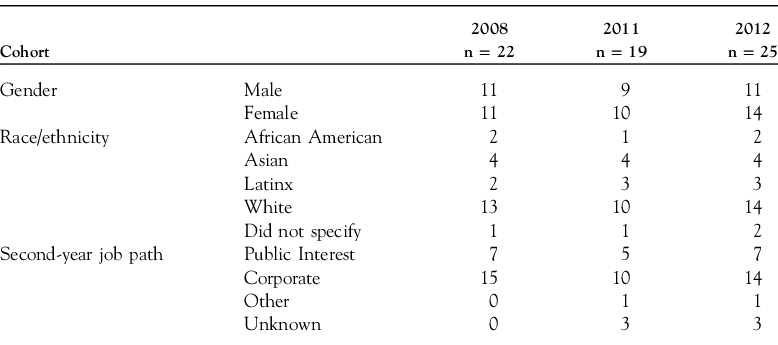
The US study draws on longitudinal interviews and identity mapping with three cohorts of law students and young lawyers. The earliest cohort was followed through their first three years of practice. These respondents all attended the same top-tier law school. While the study included respondents who pursued other career tracks, this article focuses on the thirty-nine respondents who interned at large corporate law firms, including respondents in the first cohort whom I continued to interview in their post-graduation jobs in large firms. Four respondents from the earliest cohort did not complete an identity map and so are excluded from any counts in the identity map analysis. Most US respondents were recruited by requesting their volunteer participation through in-person announcements in first-year classes. This approach was supplemented by a small amount of snowball sampling. Table 1 provides a breakdown of the sample characteristics. The sample is approximately reflective of the law school’s demographics and those of new lawyers across the US legal profession, but it may overrepresent women and racial minorities within the corporate category (Dinovitzer et al. Reference Dinovitzer2004).
US Sample characteristics

Note: The “second-year job path” is determined by students’ internships in the summer after their second year of law school and their aspirations for post-graduation employment. As evident in the follow-up interviews with the first cohort and, more generally, in the legal job market, students who take a summer internship in corporate law are highly likely to return to these firms after graduation.
The Chinese sample consisted of thirty corporate law associates who were in their first three years of practice at elite law firms in Shanghai. For this comparative extension of the US study, I initially considered sampling Chinese law students rather than young Chinese lawyers, given that my US data consists of more law student interviews (104) than post-graduation follow-up interviews (forty-nine). However, after conducting a pilot study, I concluded that focusing on legal education in China would miss most of the professional socialization process. Many young Chinese lawyers complete their legal studies at the undergraduate level, which focuses on black letter law with few experiential elements and little expectation that graduates will become practicing lawyers. For those who do become lawyers, their first substantial exposure to the profession occurs on the job. In contrast, US law students in juris doctor (JD) programs undergo a deliberate professional socialization program including experiential education and supervised legal practice opportunities. Comparing Chinese law students to US law students would likely prove unfruitful for a study of professional identity formation. Instead, I sampled new Chinese lawyers, who are undergoing on-the-job socialization, and US law students and new lawyers whose professional socialization begins in law school and continues in their first positions as lawyers.
The Chinese sample is evenly split between lawyers working for elite Chinese domestic firms (fifteen respondents) and those working for elite foreign firms (fifteen respondents). Respondents were employed by a total of five domestic firms and six foreign firms. Of the six foreign firms, two are headquartered in the United States, two are structured as multinational Swiss vereins, and two are headquartered in Europe. Firms in both categories draw top law students, offer attractive salaries, handle large entity clients, and have expertise in international legal matters. The domestic firms in many respects imitate foreign firms, as observed by Sida Liu (2008, 786–87): “From minor issues such as document settings and website design to more substantive aspects such as billing method and management structure, these Chinese law firms want to look similar to the Anglo-American mega-law firms in almost every way, even firm size.”
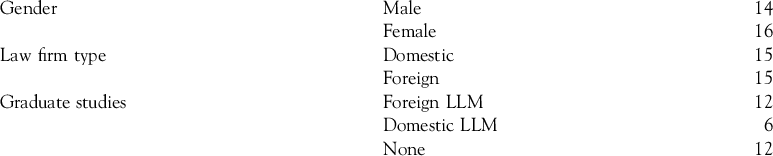
The Chinese interviews were conducted during two data collection trips to Shanghai in 2015 and 2016. Respondents were primarily recruited with the help of gatekeepers at law firms (generally law firm partners) and direct queries on lawyer-specific WeChat groups. The interviews were held in a confidential setting. Pilot interviews were conducted in respondents’ offices. The subsequent interviews for the study were mostly held in a meeting room at the Harvard Center Shanghai. As in the US study, interviews were recorded with respondents’ consent. The characteristics of the Chinese sample are summarized in Table 2.
Chinese sample characteristics (n = 30)

The semi-structured interview protocol in the Chinese study largely mirrored the US protocol, focusing on entrance into the profession, sense of professional purpose, civic contributions, legal education and training, and professional and personal identities. The Chinese interviews were conducted in Mandarin. Interview data was coded and analyzed by the author with research and language assistance from two law students at Koguan Law School and one at Harvard Law School. Midway through each interview, I introduced the identity-mapping exercise that I first developed in the US portion of this study (Bliss Reference Bliss2017). This method provides visual representations of how one’s professional role relates to one’s broader self-concept. Underlying this method is a Goffmanesque theory of role distancing and personal identity, which emphasizes the continual alignment of roles on a spectrum, some roles being more proximate, embraced, and central constituents of identity and others being more distant and detached (Goffman Reference Goffman1959).
The first step in the exercise is to list all of the roles one enacts in daily life. The only role that respondents were specifically asked to include was “lawyer.” I then handed the respondent a sheet of paper with a large circle representing the respondent’s identity. Respondents then drew and labeled smaller circles on this identity map representing each of their roles—placing roles that felt constitutive and self-expressive closer to the center and roles that felt less essential to one’s identity further from the center. This exercise was followed by a fifteen- to thirty-minute interpretive dialogue in which respondents discussed the placement and labeling of their roles. As evident in the examples below, this exercise provided visual cross-cultural data as well as helping to open interview discussions of abstract, personal, and somewhat politically sensitive questions about professional identity. All identifying references have been eliminated in order to maintain participant confidentiality. Respondents have been randomly assigned pseudonyms. For the Chinese sample, these pseudonyms are drawn from a list of common Chinese surnames.
US FINDINGS: CONSTRAINED, DIVIDED, AND UNSTABLE PROFESSIONAL SELVES
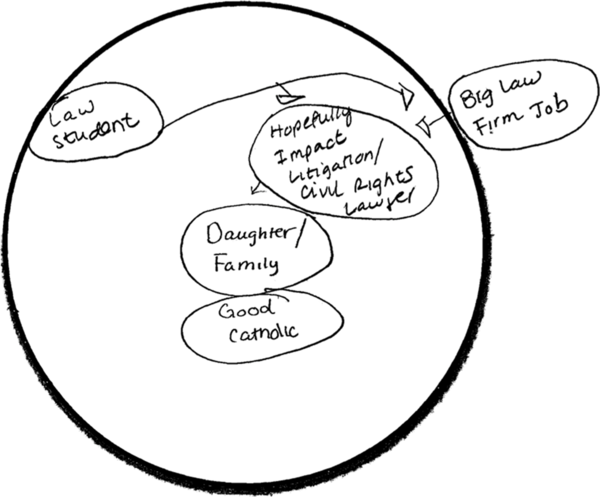
This part builds on my earlier published analysis of how US corporate-lawyers-in-training form their professional selves. Here, I concentrate on the civic dimension of professional identity (Sullivan et al. Reference Sullivan2007). Many US respondents in my sample entered law school with what I label a cause-lawyering identity profile, where the lawyer role was central in their identity maps and overlapping with personal and political roles. When describing their motivation for attending law school, these respondents emphasized their strong political orientations and the civic and social-change capacities of the legal profession (Stover Reference Stover1989; Granfield Reference Granfield1992). However, in their second year of law school, those respondents who had accepted positions in elite corporate law firms generally came to locate the lawyer role in a more peripheral position in their identity maps amid accounts of instrumental professional identity (Bliss Reference Bliss2017). Rather than pursuing a public-interest calling, they described their upcoming positions as primarily motivated by income. See, for example, Sara’s identity map from her second year in law school, after she had accepted an internship in a large corporate law firm (“Big Law”) that would lead to a post-graduation job at the firm (Figure 1). After paying down her debt for several years in a law firm, Sara hoped to return to what she labeled in Figure 1 as an “Impact Litigation/Civil Rights Lawyer.” Notice that the “Big Law” role is completely outside the identity circle. In the interview, she explained that this job lacks public-interest value and does not reflect her identity. Her “biggest concern” was that she would become “addicted to money” and find it difficult to leave corporate law practice.
US identity map: Sara.

This disappointment with the corporate law path was common in the US sample, particularly among students who began law school with public-interest sector ambitions. As these students met elite firm recruiters during the on-campus hiring program at the beginning of the second year of law school, they often moderated their judgment toward these firms, although some respondents continued to hold profoundly negative views (Bliss Reference Bliss2018, 2010–12). In spite of their reservations, many of these respondents took positions in large firms. Following the acceptance of these job offers, these respondents often adopted a pessimistic view of their upcoming professional identities, as one student concluded: “I don’t even want to be a lawyer anymore. Everything these [large-firm lawyers] do sounds unappealing” (2012).
Students who emphasized a lack of civic calling in corporate law practice generally continued to offer similar accounts in the post-JD interviews (Bliss Reference Bliss2018, 1981). When asked about their sense of professional purpose, these lawyers emphasized ethical contributions to clients and the legal system; however, these contributions often fell far short of their initial expectations for civic engagement. They emphasized political identities and a desire to contribute to large-scale social, political, and legal reform but felt that those values were disconnected from their current daily practice. Instead, many of these respondents suggested that their own emphasis on ethical client service was merely a post hoc rationalization for the decision to “drift” to a corporate law firm instead of starting their careers in public-interest practice settings (Granfield Reference Granfield1992). Thus, one respondent who cited the adversarial professionalism ideal for his decision to work in a large firm (that “everyone deserves a defense, even corporate clients”) quickly clarified: “That’s probably just a justification for myself so I don’t have to feel like a sellout” (Bliss Reference Bliss2018, 2020).
Pro bono opportunities seemed to alleviate some of this disappointment with the civic significance of working in corporate law. Amid the institutionalization of pro bono programs in large US law firms, associates are incentivized to meet pro bono hour targets (Cummings and Rhode Reference Cummings and Rhode2009). In this process, pro bono coordinators often put great care into matching associates to pro bono cases that suit the individual associate’s values and interests while avoiding “difficult” clients and legal matters (Bliss and Boutcher, Reference Bliss, Boutcher, Cummings, de Sa e Silva and Trubekforthcoming). However, respondents’ heavy emphasis on pro bono when discussing their civic contributions was often associated with their underlying view that their service to the firms’ paying clients was not socially beneficial.
Some of these frustrations were rooted in external constraints on associates’ civic professionalism resulting from their relative lack of autonomy, control over clients, and opportunities for pro bono service. But I also found evidence in the US sample of internal constraints on civic professionalism. Some respondents described their legal practice in transactional terms as business careers with primarily remunerative value. Others held onto an image of themselves as cause lawyers and planned to return to public-interest practice after a few years in large firms, but they explained that they had little interest in attempting to express their civic values in large-firm practice. Instead, they had developed “divided selves,” where the performance of a professional role was described primarily as a matter of passing time (and paying down student debt) in a corporate law environment until a future date when they could return to a more central professional identity as a public-interest attorney.
Other US respondents seemed to push back against external constraints on civic expression within corporate law practice, proactively seeking out opportunities to engage in, for example, pro bono, diversity, and environmental sustainability efforts. In the same spirit, some respondents emphasized their duty to steer powerful clients toward ethical and socially beneficial behavior. These bottom-up efforts from young lawyers may influence their firms’ continued priority on pro bono and corporate social responsibility. Indeed, large US firms often cite the civic dimension of corporate law practice as a key ingredient in recruiting and retaining talented young lawyers (Cummings and Rhode Reference Cummings and Rhode2009).
US respondents tended to express dissatisfaction with their current placement of the lawyer role, particularly when the lawyer role was located on the far periphery of their identity maps. This desire to move the lawyer role inward was made visually apparent in some maps, where arrows and others markings indicated an intention or hope that the role placement would change in the future (see, for example, Sara’s chronological arrows in Figure 1, which express her hope to inhabit a more central lawyer role when she later changes jobs). Respondents often explained this instability in their professional role alignments as a function of their lack of civic expression and intrinsically rewarding work.
In summary, US corporate-lawyers-in-training often struggled fundamentally with a tension between their desire for public-interest outlets and their limited opportunities for such outlets in their daily practice. To some extent, this struggle may reflect an inherent tension in the stated American ideals of professional identity, where lawyers are expected to serve as client agents while also playing a robust public role as officers of the court and lawyer statesman. This tension is heightened for young corporate lawyers who came to the profession seeking to reform market, state, and legal systems, but who feel that corporate law practice instead reinforces these systems. For some of these lawyers-in-training, frustration with the limited public-service outlets available in their daily practice can motivate bottom-up efforts to expand civic commitments in the corporate law sector. But these lawyers’ experiences of “divided selves” also raise concerns about job satisfaction, mental health, and the pipeline into these firms (Bliss Reference Bliss2017). This sense of constrained civic expression emerges from my analysis as a defining feature of the lived experience of civic professionalism among many US corporate-lawyers-in-training.
CHINESE FINDINGS: INTEGRATED, PRAGMATIC, AND STABLE PROFESSIONAL SELVES
The Chinese respondents did not generally present the tension with professional identity found in the US sample. In total, 90 percent of the Chinese sample (twenty-seven of thirty respondents) located the lawyer role in what I coded as a central and integrated cluster in their identity maps. Only 17 percent of US respondents who completed one or two identity maps located the lawyer role in a central cluster in any of their maps (six of thirty-five respondents). The Chinese maps were more stable than found in the US sample. When asked whether they hoped that their identity maps would change in the future, Chinese respondents generally expressed satisfaction with their current role alignments. This stands in sharp contrast to the unstable and dissatisfied professional self-portraits in the US sample. Among the multiple interpretations of this variation, respondents in both the US and Chinese samples emphasized their relationship to the civic dimension of professionalism. In contrast to the US experience of frustrated civic self-expression, the Chinese sample was largely satisfied regarding their degree of civic engagement. Chinese respondents offered a far more optimistic view of the public contributions of corporate law practice. In this part, I discuss their accounts of civic professionalism, as defined by contributions to clients, the legal system, and society (Heineman et al. Reference Heineman2014). I then discuss how these respondents described their internal constraints on civic expression.
Contributions to Clients
In the recent Chinese context, scholars suggest that the professional responsibility principles of neutrality and partisanship are filtered through the “socialist rule of law,” which requires that lawyers “serve the interests of the state above all else” (Michelson Reference Michelson2006, 30). According to the 1996 Lawyers Law, lawyers are not liable for opinions rendered as a client’s agent.Footnote 1 In practice, however, Chinese lawyers can run the risk of personal liability, especially when representing politically controversial clients (Liu and Halliday 2016). Young corporate lawyers in Shanghai may be somewhat exempt from these political interferences with client loyalty. When asked about their relationships to clients, respondents consistently described notions of neutrality, fiduciary duties, and confidentiality standards. My methods did not give me access to the actual relationships between these lawyers and their clients. Furthermore, young Chinese associates in foreign firms, in particular, have little contact with clients (Bliss, Reference Bliss, Boutcher, Cummings, de Sa e Silva and Trubekforthcoming). However, the consistent tendency of respondents in the Chinese sample to elaborate on client-centered legal ethics suggests sincere engagement with these values.
Chinese respondents generally downplayed the notion of governmental oversight in their daily practice. Guo, for example, explained the marginal role of the Party cell in his firm as follows: “We have a party cell ( ) … the head of [the Party cell] is an office manager and is not very powerful. She doesn’t care about politics…. The Party cell is not very active. Having a party cell is just to comply with the legal requirement.”
This lack of concern about political risks was also evident in respondents’ approach to the research interviews. Given how scholars and news media have reported on repression in the Chinese bar, it is perhaps surprising that all but one Chinese respondent consented without hesitation to being recorded for the research interviews. These respondents generally skimmed the Chinese language consent document and promptly signed. Unlike cause lawyers in China, who are subjected to “unpredictable flashes of repression [that] instill fear and amplify silence,” Chinese corporate lawyers appear to carry out their professional obligations to clients (or at least to conceive of such obligations) without a great deal of concern about governmental oversight (Stern and Hassid Reference Stern and Hassid2012, 1231). More generally, previous research has suggested that Chinese lawyers’ experiences of political and state supervision are contingent on their practice settings (Stern and Hassid Reference Stern and Hassid2012, 1245).
Contributions to the Legal System
In their discussion of client service, the Chinese respondents generally included broader considerations of their duties to the legal system. Wu, for example, expressed his faith that client-centered practice is vital to the legal order: “You have to put aside your personal values to be a good lawyer, and in this way justice as a whole will be served.” While the Chinese respondents emphasized some challenges in setting aside personal values, they strongly prioritized their commitment to contributing to the healthy functioning of the legal system. Hu explained: “Within the limits of the law, I would like to add my personal values to the legal advice I give to my clients. However, of course I would not distort what the law really means and tell the client the version of the law that I wish existed.”
Although I did not ask questions specifically dealing with corruption, several Chinese respondents mentioned their desire to counteract corruption in the legal system, as Huang explained: “Most lawyers in my firm feel that they have a role in reforming law … by interacting with judges in non-corrupt ways.” Some of these comments specifically cited a commitment to eschewing guanxi (reciprocal relationship networks). Following the privatization of the bar in the 1990s, scholars have suggested that “lawyers’ individual-level guanxi helped fill the void left in the wake of retreating organizational-level support … by mobilizing microlevel political connections” (Michelson Reference Michelson2007, 353). On this point, several respondents in this study distinguished Shanghai’s cosmopolitan corporate law practice as an exception to China’s generally relationship-based legal norms. Qian explained: “Shanghai is very advanced in the rule of law ( ); however in many other areas of China, it’s usually rule by people (
 ) rather than rule of law.” While this study does not provide empirical evidence of whether these respondents are accurate in their assessment of the Shanghai bar’s distinctive commitment to the rule of law, it is important to note that these respondents often included concerns for the legitimacy of the legal system within their conceptions of professional identity. These lawyers did not raise liberal rule-of-law reforms but, instead, seemed to emphasize incremental improvements in the non-corrupt functioning of the current system.
Contributions to Society
In contrast to the common perceptions among US respondents that corporate law firms provide little public-interest value, the Chinese sample presented a far more salutary sense of their civic engagement, emphasizing contributions to national economic development. In the interviews, these lawyers’ initial responses to questions about their professional goals ( ) and the purpose of lawyers in society (
 ) generally did not begin with claims of broad public contributions. They most commonly began by saying that they aspired to be successful as lawyers. However, most of the Chinese respondents were expansive when prompted with the question: “How important is it to you to make a public contribution” (
 )? The elaborate and elevated ideals expressed in response to this question reveals that these lawyers had previously reflected on these issues to a great extent. For example, Li explained: “[Lawyers help] to resolve society’s contradictions (
 ) and promote the development of business for the benefit of the economy, and to promote the perfection and development of law.” Li further emphasized that Chinese lawyers have a distinct capacity to contribute not only through their daily practice but also through legislative work: “Chinese law feels very incomplete. Not everything has specific regulations. Lawyers can participate in drafting and interpreting laws drawing on their legal experience.”
Developing the national economy was the primary focus of respondents’ claims to public contributions. These comments often specifically cited the international economic relations facilitated by Shanghai corporate law offices. The Chinese sample was near unanimous in expressing the belief that, as one respondent phrased it, “the globalization of the economy is good for the country.” Some respondents pointed to the work of more senior corporate lawyers in their own firms and similar firms, who constitute the first generation of the modern private bar. Respondents credited these senior attorneys with paving the way to the reform and opening up ( ) of the post-Mao economy, including the emergence and radical expansion of the middle class. These reflections locate respondents’ work in a patriotic tradition supporting China’s ascension as a world power, although respondents were often quite modest about their current contributions as junior attorneys. Zheng explained: “I would not say that my work makes a great contribution to society, but I do think that business lawyers in general are helping to improve the economy … [which is] the most important issue for our country.”
This emphasis on supporting the economy is well aligned with state policy and with the CCP’s long-standing claim to legitimacy on the basis of sustained national economic growth. But respondents consistently clarified that their support of the economy was conducted in a manner that distinctly reflected the values of the legal profession in contrast to the contributions of other business professionals. These accounts underscored the professional obligations of lawyers to supervise client behavior, as Wu explained: “Business people are driven more by profit and willing to do unlawful things for profit. But lawyers have to look out for the bottom line and the risks. Thus, lawyers make sure that business people conduct themselves in a lawful manner, while supporting their financial interests as well.”
When asked about pro bono practice, most Chinese respondents explained that pro bono was an important component of lawyers’ obligations to society. These accounts emphasized future contributions, as young associates had few pro bono opportunities in their current positions. Depictions of pro bono varied between domestic and foreign firms. Domestic firms are legally required to take pro bono cases assigned to them by local bar associations. Some respondents were aware of these requirements but suggested that other lawyers in their firms handled pro bono matters—in particular, lawyers specializing in litigation, senior partners who took high profile cases to gain prestige and political favor, and lawyers in flagging practices. Pro bono may also be employed as a strategy in times of “organizational slack,” when firms have spare resources and personnel (Sandefur Reference Sandefur2007).
In contrast, foreign firms in China are not legally permitted to represent clients in paid or pro bono capacities. Nevertheless, these firms generally have corporate social responsibility initiatives that reflect their international pro bono commitments. Such charitable contributions and volunteer work are common in domestic firms as well, constituting a “Chinese-style pro bono” (Dong Reference Dong2016). Three foreign-firm respondents described rendering pro bono service on behalf of foundations and nongovernmental organizations. One domestic-firm respondent described his firm’s efforts to provide clothing and education to rural children. Another respondent was working with her domestic firm on a program to provide goats and calves to farmers. Yet most Chinese respondents explained that their firms did not prioritize charitable work.
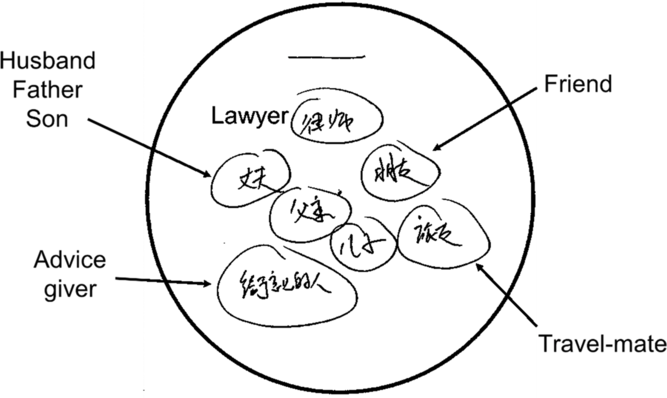
While formal pro bono opportunities were relatively uncommon, the Chinese respondents frequently described providing informal pro bono services to family and friends throughout their extended social networks. Because there are still relatively few lawyers in China, respondents found themselves in great demand. For example, Zhang’s identity (Figure 2) describes one of his core constitutive roles as being an “advice giver” ( ) for clients and for his broader community.
Chinese identity map: Zhang.

Zhang explained that providing pro bono legal advice for a great many people in his life is a professional responsibility integrated into his sense of lawyer identity:
Because I practice labor law, many friends call me up with questions that deal with law. When I’m not busy, I’ll give them advice. Maybe it is different from the United States. People around here, if they hear you are a lawyer, or if they know a person who knows you, they will directly give you a call. This kind of situation is common, where it is a friend of a friend. If it is not too distant of a connection, I usually can help them out.
In these accounts of “informal pro bono” (Mather et al. Reference Mather2001, 138–56) or “de facto pro bono” (Rhode Reference Rhode2005, 135), respondents typically emphasized a sense of personal obligation to their family and friends. Often, however, these young attorneys noted that they lacked the legal skills to help with many of the pro bono issues they encountered. This observation generally suggests a mismatch between their training in international corporate law and the legal needs that arise in informal pro bono matters. One respondent explained:
Especially if it is older people [who are asking for legal advice], they do not know anything about specialization in the legal profession. Most of the work I do is international law, business law, contract law, but most of what they ask me about is divorce law, criminal law. I do not understand those areas. … I can just know some basic legal principles. I can tell them, “Law is like this …” But there is a big difference between the theory that I learned in school and the practice that they need. I usually tell them they should really look for a more specialized lawyer. … If I have time I can help them look up legal information. But if I don’t have time I can recommend a more specialized lawyer.
This emphasis on volunteer practice, even when respondents acknowledged limitations on their effectiveness in providing pro bono services, suggests an internalized sense of civic duty and engagement.
Nine of the thirty Chinese respondents stated that they hoped to find opportunities to engage in rights protection ( ) cases later in their careers. These lawyers may find such opportunities in the future. While news media accounts often emphasize the small cadre of committed cause lawyers in China, public-interest legal causes in China are perhaps more commonly served by attorneys who take these cases on an occasional or part-time basis (Givens Reference Givens2013). When asked about their perceptions of full-time activist lawyers, respondents often expressed admiration for these lawyers’ personal risk taking but also cautioned that their tactics and large-scale reform goals were not realistic or pragmatic. Instead, the Chinese sample generally recommended that lawyers make smaller-scale, incremental public-interest contributions working within the current system.
Internal Constraints on Civic Professionalism
Although the Chinese respondents emphasized their civic contributions in corporate law practice, they also generally acknowledged that these contributions were very moderate. For example, Qian suggested that she highly prioritized civic values in her work, but she offered a very narrow view of her impact on society: “My main contribution is to share expertise with clients and young lawyers.” Tang explained that rather than seeking to change law, lawyers should strive to improve the functioning of the legal system: “The most important role for lawyers in society is to inform people of the law.” These narrow conceptions of civic impact, wherein lawyers share expertise and inform people of law, are not only shaped by external constraints—associates’ lack of autonomy within their firms and the broader lack of lawyer autonomy in the Chinese national context. These accounts also suggest internal constraints, whereby young lawyers do not robustly push back against limits imposed by the firm, the profession, and the state. Chinese respondents generally reported feeling satisfied with their degree of civic engagement. They characterized this incrementalist approach to civic professionalism in pragmatic terms as an affirmative strategy for moderately developing the legal system and the national economy.
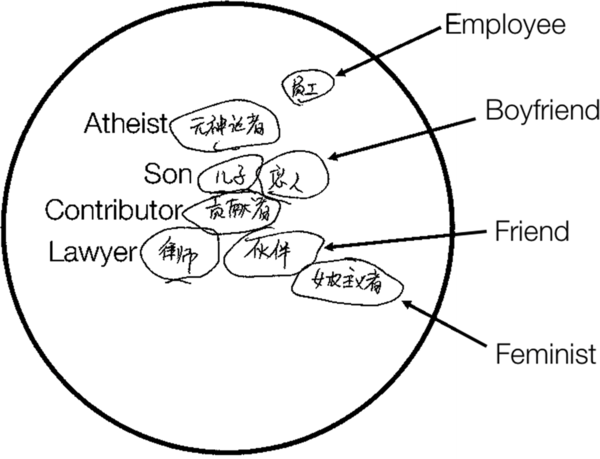
These themes can be illustrated through the example of Hu. As quoted at the beginning of this article, Hu expressed a particularly strong commitment to his public contributions: “The value of my existence ( ) depends on how much contribution I can make to others, or to the society, or to the whole human race. This probably is my core identity (
 )…. All other roles are just an extension of this core role as a contributor (
 ).” Hu explained that being a contributor was the top priority in shaping his legal career and that his corporate law position was the best vehicle for these civic aspirations: “I will change jobs if another job allows me to make a greater contribution to society.” This commitment was reflected in the centrality of the role labeled “contributor (
 )” in his identity map (adjacent to and slightly overlapping with his “lawyer” role) (Figure 3).
Chinese identity map: Hu.

Over the course of the interview, Hu narrowed this notion of civic contribution, clarifying that he does not seek to change society: “As a lawyer, the core of what we can do is [promoting] the rule of law. But of course I am not a radical activist ( ).” This notion of promoting the rule of law within the current system may reflect what many Chinese respondents characterized as a pragmatic stance on the value of nonradical legal practice in a context where lawyers generally have limited public impact. Later in the interview, Hu’s initial strong emphasis on civic contribution seemed to waver:
Interviewer: Can you talk about your sense of purpose as a lawyer?
Respondent: If being a successful lawyer counts as a sense of purpose, then I’ll say that.
Interviewer: Anything else? For example, what is the connection between being a “contributor” and your career goals?
Respondent: Contributor, this, umm, maybe it is, not that I, because … contributor is a broad idea, so it is not that you have an exact purpose that I want to be a contributor. It is an element hiding in the background ( ) when I engage in “decision making” [spoken in English]. … Maybe this is not an “exact purpose” [spoken in English].
Interviewer: Do you have a broader sense of career purpose?
Respondent: A broader career purpose? [twelve second pause] Perhaps all I can see now is becoming a successful lawyer. ( ).
Following the long, twelve-second pause near the end of this excerpt, Hu’s narrative of public contribution appeared to collapse. In a resigned tone (“perhaps all I can see …”), his turn to a careerist interpretation of professional purpose (“becoming a successful lawyer”) suggests a narrow conception of civic motivation.
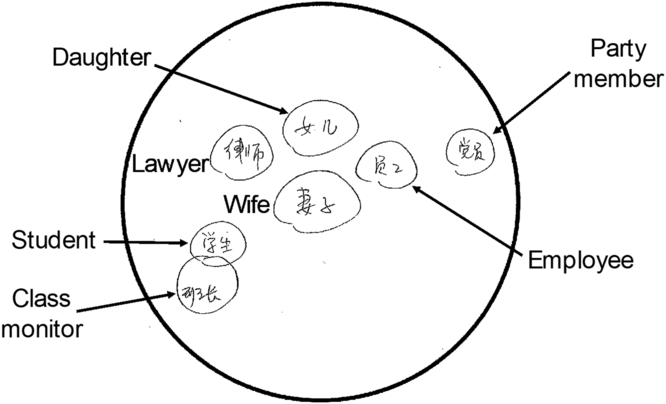
These internal constraints on civic expression were in some cases tied to respondents’ disinterest in politics. Only 14 percent (four of thirty) of the Chinese maps included what I coded as political terminology. These roles were labeled party member, feminist (twice), and contributor (from Hu’s map in Figure 3). While they did not generally identify with political roles, the Chinese respondents did tend to identify with the positive (but moderate) political significance of their work as corporate lawyers. In the US sample, political terminology was much more common under labels such as “Democrat,” “Republican,” “politics,” “activist,” and “social justice.”Footnote 2 The US respondents generally reported that their political identities found little expression in corporate law practice. In contrast, the Chinese respondents generally reported finding satisfactory expression of their moderate political goals.
The relative unimportance of politics in the Chinese sample is reflected in Qian’s identity map, shown in Figure 4. Although Qian is one of the few respondents to report party membership, she located the “Party member” role on the periphery of her identity map. Qian estimated that there were only ten party members in her firm’s office of roughly one hundred lawyers. When asked to explain this lack of party engagement, Qian noted: “Young people are not very interested in joining the Party. Law firms do not care about [party membership]. … You have to pay the fee, just a few RMB to join meetings [of the firm’s party cell].” Another respondent explained: “Party members are all technically included in the Party cell, but you are allowed to not disclose that you are a Party member so that you do not have to pay the fee.” Furthermore, no respondents mentioned membership in a CCP youth league ( ), whose more than one hundred million members range from the ages of fourteen to twenty-eight. Just as Chinese respondents generally did not prioritize involvement with the CCP, they also expressed little interest in strong anti-establishment politics (or at least they did not share such views in the interviews).
Chinese identity map: Qian.

In sum, respondents in the Chinese sample seemed committed to an affirmative, pragmatic account of civic professionalism. They emphasized their roles as public contributors who serve clients ethically, provide pro bono service, and advance the development of the economy and moderate improvements in the legal system. These contributions were consistently framed in state-aligned terms without liberal connotations of promoting democratic reforms, professional independence, and moderating state power. While these respondents described an unexpected sense of civic purpose in their careers, they did not appear to struggle against external constraints on the expression of these civic ideals in practice. Instead, they reported centrally integrated and stable professional selves.
DISCUSSION
In the US context, I found that many respondents bristled against constraints on the expression of their civic ideals in corporate law practice. In contrast, the Chinese respondents tended to present a central and civically invested professional self. The Chinese corporate-lawyers-in-training framed these public contributions in moderate terms. Rather than struggling against external constraints on civic expression, these lawyers generally appeared to adopt an affirmative sense of civic purpose in their work without the associated frustration and role distancing found in the US sample.
The brand of civic professionalism found among Chinese respondents is likely influenced by their globalized context of foreign firms, foreign law, foreign clients, foreign LLM education, foreign media images of lawyers, and foreign language. In the research interviews, this global context was reflected perhaps most prominently in respondents’ regular use of English terms in otherwise Mandarin conversation, as evident in the interview excerpts throughout this article. When I asked respondents about this practice, they consistently explained that they were not using English terms for my benefit as a non-native Mandarin speaker but, rather, they were following the everyday linguistic norms of their offices. Their English terms covered multiple areas of professional life including law firm structure (for example, “founding partner”), practice (for example, “conflict of interest”), business (for example, “mutual fund”), and career considerations (for example, “work-life balance”), in addition to grammatical and casual words (for example, “basically”). For some legal terminology, respondents explained that they did not know the appropriate Chinese words or that the English terms were what came to mind first.
Yet my findings suggest that these international influences in the Chinese corporate bar should not be exaggerated. Chinese respondents portrayed a model of civic professionalism that starkly contrasts with the US model. Even in the transnational corporate law sector, recent scholarship suggests that the arrival of foreign law firms in China does not entail the transplantation of a homogeneous global legal profession or the rise of “boundless connectivity” across national boundaries and legal systems (Stern and Li Reference Stern and Li2016, 22; Liu Reference Liu2008). Instead, the foreign-firm presence in China largely consists of relatively small outpost offices that are often unprofitable but serve a global branding function for multinational firms (Stern and Li Reference Stern and Li2016). Furthermore, Chinese lawyers may outwardly present signs of American-style professionalism in symbolic compliance with global norms while concealing local dimensions of legal practice (Liu Reference Liu2008). This continued divergence in the US and Chinese legal professions is not only evidenced by Chinese lawyers’ resistance to US transplantation efforts but also by Chinese innovations, including firms that are moving away from collegial partnerships (Liu and Wu Reference Liu and Wu2016).
My findings of cross-national variation in civic professionalism likely reflect country-specific understandings of how professions function within a political order. US professions are tasked under the traditional framework with providing an independent source of public benefit as a complement to, and check on, the power of the state. Thus, professional socialization serves to inculcate lawyers with commitments to serving the public interest in a bottom-up collective manner. In these respects, the Chinese system differs fundamentally. Rather than an alternative to the state, professions are folded into the state in explicit loyalty to, and supervision by, the CCP. Recent Party initiatives have sought to socialize lawyers in a “positive, affirmative vision of political participation” that is closely aligned with state programs and ideologies (Stern and Liu Reference Stern and Liu2020, 228). The economic value that corporate lawyers bring is paramount in the state’s priorities, as the CCP’s claim to legitimacy has largely relied on three decades of sustained national economic growth. Furthermore, the CCP’s legitimating narratives have recently taken a “turn toward law,” celebrating and moderately strengthening legal institutions, even while consolidating centralized power (Zhang and Ginsburg Reference Zhang and Ginsburg2019). These domestic mandates may help to explain why the US respondents struggled against constraints on civic expression while the Chinese accounts were more enthusiastic about moderately promoting economic and legal development.
These findings push back against the notion of an increasingly homogenized global professional identity among lawyers and, more specifically, the image of a far-reaching diffusion of American ideals within the Chinese corporate bar. The divergence between US and Chinese accounts suggests that civic professionalism should not be viewed as the exclusive domain of liberal legal-political contexts. Instead, my findings point toward distinct US and Chinese modes of inhabiting the lawyer role. The lived experience of civic professionalism in the US sample may be frustrating and deleterious for the well-being of some young lawyers. Many of these respondents’ accounts of role distancing and disappointment in corporate law as a “sellout” career path may contribute to the large-firm sector’s well-documented struggles with job satisfaction, intrinsic work motivation, and mental health (Dinovitzer Reference Dinovitzer2004; Sheldon and Krieger Reference Sheldon and Krieger2014). The Chinese respondents appeared to express greater intrinsic motivation, professional role centrality, and satisfaction with their civic contributions. These lawyers’ claims that their work incrementally improved the legal system are supported by the mandate of the Chinese legal profession to reinforce state legitimacy. Given this context, it is not surprising that many of these lawyers took a favorable view of their roles as civic professionals.
This cross-national variation may be influenced by country-specific constraints on lawyers’ ability to impact the public interest. In the United States, detachment from the professional role can reflect inherent tensions in the profession’s ideal image of lawyer identity, where the lawyer is expected to serve as a client agent while also playing a robust role in legal and political development. This tension can lead lawyers to disinvest from the civic dimension of their roles as corporate lawyers and, instead, focus on exit strategies to find a practice setting that offers more direct opportunities for public service. But this frustration can also manifest as a bottom-up tension that can (in some cases) be productive for promoting commitment to public service, particularly in large US firms where young attorneys have opportunities to shape pro bono practices. Thus, although an unstable and constrained professional identity may raise troubling accounts of professional detachment, it may also be associated with young lawyers’ proactive efforts to find and create civic engagement within their firms.
The Chinese sample’s more stable and integrated conception of civic professionalism could be read as acquiescence to Chinese lawyers’ marginal role in the authoritarian order. These respondents do not appear to urgently seek greater civic expression in their careers. The relative absence of identity tensions in the Chinese sample may suggest inertia in bottom-up movements for reform via young lawyers. But this moderate approach to public-interest engagement could instead be characterized as a pragmatic brand of civic professionalism, which promotes incremental reforms in a context of heavy external constraints. This state-aligned understanding of civic professionalism is perhaps central to what it means to be an effective public-regarding lawyer in an authoritarian state. In this context, the professional self is stable, not struggling to make dramatic shifts in one’s own self-concept or in the legal-political order. These lawyers instead adopt a patient optimism that reflects state signals about the profession (Stern and Liu Reference Stern and Liu2020, 242). They are perhaps a very moderate version of what Richard Abel and Philip Lewis (Reference Abel and Lewis1989, 19) described as “loyal opposition” lawyers who take a conservative approach to reform “within strict limits.” Thus, although this moderate view of civic professionalism may serve state interests, it is perhaps also an effective strategy for reform in a system where lawyers are generally marginalized.