

1. Introduction
This paper looks at the relationship between banking and cronyism in Egypt. A key puzzle that it tries to resolve is why private banks may lend in preferential ways to politically connected firms. In doing so, it tries to identify the causal pathways that link bank lending decisions to the corporate characteristics of politically connected firms.
It is easier to understand why banks lent so much to connected firms in the 1990s, as finance was then dominated by state banks, which directly supported the rise of crony interests. The banking sector was, however, liberalized in the mid-2000s, a period that saw the emergence of a seemingly competitive banking system, with several foreign banks entering the market. One would have expected that liberalization would reduce the borrowing advantages of politically connected firms. It would be surprising if deregulated banks, especially those in the private sector, could be influenced directly by politicians to lend massively to connected firms. Some state influence can still be exerted in deregulated environments since banking is a highly regulated industry, and thus, prone to political influence. Moreover, public banks—which retained nearly 35 percent of the credit market—did finance some of the large connected firms. But the magnitude of the share of loans going to politically connected interests, which we document in this paper, was so large that it is unlikely to be explained by these factors alone.
Our empirical analysis reveals that politically connected firms grew very fast between 2003 and 2011, and they became, by the end of the period, the dominant players in Egypt's formal private sector. Much of this expansion was financed by external funds, largely from the banking sector, but also from the equity market. By 2010, politically connected firms had on their books 92 percent of the loans that were held by the private firms included in the Orbis database.
As elsewhere in the world, there are four possibilities, not mutually exclusive, that can explain why private banks in Egypt found it profitable to lend disproportionally to connected firms.Footnote 1 First, profit-maximizing banks, primarily concerned with the risk-adjusted returns on their loans, may have perceived politically connected firms as the most creditworthy customers. The privileges received by politically connected firms may have translated into high profits and low risk of default. Moreover, since their market shares were rising fast, their competitors may have at the same time been perceived as being at high risk of failure. Second, non-connected firms may have had low demand for credit, either because they did not want to grow given the unfair competitive environment, and/or because they distrusted the legal system more than the connected firms, and as a result, they approached the credit market with a high degree of risk-aversion. Third, connected firms may have appeared to be intrinsically less risky, due to their privileged access to (implicit) government guarantees that they would not fail, or that they would be bailed out if they did. Finally, some of the private banks may have been controlled directly by politically connected families, and in turn, these banks may have lent primarily to connected firms.
Probing the possible drivers of lending to these politically connected firms, our results suggest that the considerable lending to connected firms is best explained by the coincidence of their large demand for funds and a preference by banks to lend to them. Non-connected firms—unlike connected ones—preferred to use retained earning to finance their operations, which suggests that they had less growth opportunities and/or that they found debt to be risky given the prevailing institutional arrangements. On the other hand, we found that the profitability of connected firms was on average slightly higher than that of non-connected firms, but that the variability of these profits was not lower. At the same time, we show here that the market valuation of connected firms implies that they were perceived as being less risky than non-connected firms, even though their profits were historically as variable as those of non-connected firms, which we interpret to indicate that they were perceived by the market to be implicitly guaranteed by the state. However, the (few) banks controlled by connected interests do not appear to have made loans at a loss compared to non-connected banks—in effect taking advantage of the deposit guarantee to transfer wealth to their connected shareholders.
This paper draws on recent work on cronyism in Egypt, which has identified a set of politically connected firms, evaluated the value of connections using an event study around the 2011 popular uprisings, documented several mechanisms that provide privileges, and showed that cronyism reduced competition and growth.Footnote 2 It is organized as follows. In section one, we describe the evolution of cronyism in Egypt, and we review the changes in the financial sector introduced by the market reforms that started in the early 1990s. In section two, we describe our corporate data, identify a group of large firms that were politically connected in Egypt during the 2000s, and show that these politically connected firms grew much faster than non-connected firms, and borrowed a disproportionate share of private sector credit to do so. In section three, we ask whether this was due to a higher demand for funds, or due to a higher supply of funds. Section four asks whether connected firms borrowed mainly from connected banks. Section five looks at whether this borrowing can be attributed to a perception by the markets that these firms had lower risk than that implied by their cash-flow behavior. Section six concludes.
1.1 Cronyism and banking in Egypt
The Middle East political economy literature contains rich analyses of how autocrats allowed corporate elites to dominate the business sector in exchange for support for their regime. Qualitative research has documented barriers to entry that excluded opponents and provided privileges to a small coterie of friendly entrepreneurs.Footnote 3 A peculiarity of the Middle East is the fast growth of crony capitalists after the market liberalization started in the 1980s. By the 2000s, the Ben Ali and Trabelsi families were monopolizing business opportunities in Tunisia, even expropriating the business holdings of traditional wealthy elites.Footnote 4 Similarly, insiders came to dominate the formal private sector in Algeria, Syria, and Yemen.Footnote 5 This politically favored organization of the private sector arose in response to economic but not political liberalization, which gave incentives to autocratic regimes to favor a dominance of the private sector by trusted allies, in order to deflect the potential growth of opposition forces.Footnote 6
In Egypt, the market based reforms initiated in 1991 led to a large expansion of cronyism. While Sadat's Infitah (market opening) advantaged a handful of private businessmen, Mubarak cultivated a larger group of cronies that took advantage of the withdrawal of the state from several sectors that were formerly considered as strategic to expand their business interests rapidly during the 1990s.Footnote 7 In the early 2000s, the country's policies shifted towards accelerated privatization and financial sector and trade reforms. Politically connected firms were able to capture much of the new opportunities created by liberalization.Footnote 8
Connected interests especially thrived in the “businessmen” cabinet headed by Ahmad Nazif from 2004 to 2011, as they managed to expand massively in real estate and construction, tourism, oil and gas, banking, and telephony, as well as in manufacturing and services serving the local market.Footnote 9 Government decisions were key in all of these areas—tourist resorts and housing projects were built on formerly government-owned land; investments in oil and gas required government approval; new factories in specific manufacturing sectors such as cement required government licenses; industrial firms needed ministerial approval to benefit from energy subsidies. Diwan, Keefer, and Schiffbauer (Reference Diwan Ishac and Schiffbauer2015) present evidence that in the 2000s, connected firms in Egypt enjoyed ample advantages including protection from foreign competition, better access to energy subsidies and land, and less exposure to the arbitrary application of business regulations, all of which boosted their profitability relative to non-connected firms. Connected businessmen were also well-placed to influence government economic policies: They were not only personally well connected with the political leadership, but they themselves also occupied important posts in government, the ruling party, parliament, and various influential boards and committees.Footnote 10 Trials of leading businessmen after the uprisings of 2011 have shed light on land appropriation at below-market prices; the manipulation of government regulations to stifle competition; subsidized borrowing from state banks; and privileged access to state subsidies and public procurement contracts.Footnote 11
The focus of this paper is on how these connected interests ended up carrying a disproportionate share of private credit, in an environment where the financial markets were seemingly liberalized. This is in sharp contrast to an earlier period, where the financial sector was closely guarded, and important financial decisions were made by the government. Pre-Nasser, private conglomerates dominated the banking sector and supported the country's industrialization along a German model of bank domination—Talaat Harb's Bank Misr played a prominent role in this expansion.Footnote 12 The nationalization of industry and banks in the early 1960s by Nasser was followed by a reorganization of production and finance in a centralized top-down manner, and by the establishment of four large public sector banks organized among sector lines, in addition to various smaller regional banks. After hesitant reforms in the context of Sadat's Infitah in the late 1970s, which allowed for the establishment of several joint venture banks—public sector and foreign interests—more important reforms had to await 1991, when facing financial crises and large foreign debt, Egypt undertook deep macroeconomic adjustment and structural reforms. One of the key reforms was concerned with the liberalization of bank deposits and lending rates, which managed over time to attract large amounts of remittances and return capital flight, playing a central role in stabilizing the balance of payments.Footnote 13 State banks were recapitalized, and the banks' regulatory framework was tightened by strengthening reserve requirements, increasing capital adequacy, and restricting lending to single borrowers, in an attempt to avoid the constitutions of large non-performing loans, as had been the case in the past. The capital markets were also revived.
But public banks remained dominant throughout the 1990s, and channeled much of their resources to either public sector entities or to politically connected interests. The four main public sector banks continued to dominate the banking scene, but they had low profitability due to their heavy lending to state-owned-enterprises; the Infitah banks had better returns on assets; and a few smaller private banks, which were partially owned by public sector banks, had mostly low returns and largely served connected interests.Footnote 14 There was a growing sector of Islamic financial institutions, which benefited from financial deregulation and especially from the differential exchange rate system, drawing on migrant remittances from the Gulf. This system was, however, badly hurt by repeated closures of firms connected to Islamic parties, and by efforts to tighten banking regulations in ways to reduce sources of finance for firms associated with the Islamic political opposition.Footnote 15
Until 2003, the reforms of the 1990s had only a limited impact on the way the financial sector worked. The reforms initiated in 2004 were more serious. The number of banks fell from sixty-two to thrity-nine (by 2008), foreign ownership increased and came to control fifteen banks, one of the four state banks was privatized, and public banks sold their interests in the private and joint-venture banks. By 2008, private banks controlled more than 50 percent of deposits, their lending constituted about 65 percent of total bank lending, and bank credit to the private sector rose to about 35 percent of GDP.Footnote 16
Moreover, the quality of banks' portfolios also improved. The share of non-performing loans in banks' portfolios, which by the late 1990s had reached 24 percent of banks' assets, fell to 15 percent, due to tighter quality controls, but also due to a large recapitalization of the system, which was partly funded by government bailouts to banks in difficulty. In 2004, the central bank law was changed to allow for out-of-court settlements, and a special unit was created at the central bank to lead the effort of reducing non-performing loans. Debt-to-equity swaps were negotiated with connected businessmen in the absence of any transparency. The financial press at the time was replete with suggestions that those deals benefitted handsomely some high-level indebted entrepreneurs.Footnote 17
Yet, in spite of the existence of a seemingly more competitive and liberalized credit system, we show, in the next section, that most of this credit went to politically connected firms. We then investigate, in the following sections, the mechanisms that permitted this.
1.2 Do connected firms borrow more? Evidence from the Orbis database
To examine the extent and nature of insiders' privileges, we first need a dataset of politically connected firms (PCFs hereafter) under the Mubarak regime in Egypt, and information about their borrowing and corporate performance. In Diwan et al. (Reference Diwan Ishac and Schiffbauer2015), we started by creating a list of thirty prominent, politically connected businessmen. We then matched the list of politically connected businessmen to firms listed in the Orbis database. The Orbis database includes information on the board members, managing directors, and major shareholders of 854 large firms in Egypt between 2003 and 2011. The names of the businessmen that we identified as connected unambiguously matched the names of board members, manager directors, or major shareholders of 104 firms. Since many of these firms owned shares in other firms, we used the Internet to identify the names of independent subsidiaries (up to two tiers), which were owned partially by these 104 firms. We then matched these with firms in the Orbis database. The process yielded a total of 385 firms that were controlled, directly or indirectly, by a connected businessman.Footnote 18
The politically connected firms that we identified are concentrated in tourism (hotel and restaurants, tour operators, transport), real estate, construction, wholesale and retail trade, mining, finance, business services, and manufacturing sectors. There was at least one PCF in about half of the 320 (non-arm) sectors of activity in Egypt (at the ISIC Rev.4 4-digit level of classification). Many large firms were not politically connected. In particular, out of the total of 122 large firms traded on the Egypt Stock Exchange, only twenty-two were connected.
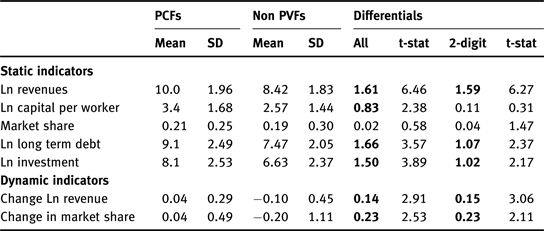
Table 1 compares the static and dynamic performance of PCFs and other firms in the Orbis database. The last four columns report the differences between the two groups overall, and controlling for the sector of operation and the corresponding t-statistics. The descriptive statistics confirm that on average, PCFs grew while other firms shrank and that, as a result, their market shares grew. They also invested more, were more capital intensive, and borrowed more. Differences between connected and non-connected firms decline after controlling for two-digit sector dummies, indicating that PCFs were especially active in capital-intensive sectors, but significance levels typically persist at the sector level.Footnote 19 By 2011, the PCFs employed only 11 percent of the formal sector workers, they had 55 percent of total corporate income, and they had contracted 92 percent of the outstanding net loans held by all the firms in the Orbis database. Clearly, this is an enormous advantage, considering their relatively modest size in the (formal) economy.
Performance differentials between PCFs and other firms 2003–11

Notes. Information from Orbis 2003–11. In the first panel, the variables are averaged over the period. Market share is computed by dividing firm's sales by the sum of all firms' sales in the 2-digit sector of operation; other variables are as reported in Orbis. Bolded coefficients are significant at the 5 percent level. The last two columns report the within-industry differentials (at the 2-digit level) between PCFs and unconnected firms.
Because several PCFs grew to become the largest corporations in the country, the trends described above are even more apparent among the largest firms, which were traded on the Egypt stock exchange (the EGX). The total assets controlled by twenty-two traded PCFs grew from 23.5 percent of the total assets of all the traded firms in 2002, to 43.4 percent in 2011. While by 2003, the median PCF listed on the EGX was 10 percent larger than the median non-connected firm, it was seven times larger by 2010. The 112 listed non-connected firms had an average debt to equity ratio of 55 percent in 2010, while that of the twenty-two PCFs was on average much larger, at 137 percent.Footnote 20
In sum, it is apparent that PCFs managed to take massively larger loans than unconnected firms, which, together with the other advantages they received, allowed them to grow much faster than non-connected firms. This poses the question of how they managed to establish their borrowing advantage in the liberalized financial market environment of the 2000s.
1.3 Profitability and the demand for and supply of funds
The debt advantage of PCFs could be due to preferential treatment on the supply of fund side, and/or to a higher demand for funds compared to non-connected firms. While we have no means of separating empirically demand and supply effects, we can infer several aspects of this in our dataset. First, we ask whether banks' supply of funds may have advantaged PCFs because of their superior profitability and/or lower risk, compared to non-connected firms. Second, we discuss the possibility that the demand for funds of non-connected firms was lower than that of PCFs. Finally, we estimate a reduced form model to test the relationship between debt and profitability more formally. While we found evidence of both these processes at play, there is also evidence that the PCFs's debt advantage cannot be explained by these considerations alone.
Supply side considerations
Many studies that have found that connected firms have higher debt that non-connected firms focus on lending to public sector banks which can be directly pressured by politicians to lend to politically connected firms, irrespective of profitability considerations.Footnote 21 In the case of Egypt, where lending was largely private in the 2000s, profit-maximizing banks that cared about the risk adjusted returns of their borrowers must have found that PCFs had systematically higher returns, and/or lower risks, than non-PCFs, a realistic possibility on account of the privileges they received. At the same time, banks may have had little interest to lend to non-connected firms (thus increasing the advantage of PCFs further), since their profitability, especially for those engaged in neck-to-neck competition with PCFs, must have fallen, together with their market shares, exposing them to greater bankruptcy risk. This is especially the case as, despite its creditor bias, the bankruptcy process in Egypt is, by all accounts, both costly and highly uncertain.Footnote 22
But it is not a given that PCFs would have higher profits and/or lower risks. Past research has found that in other countries, PCFs do not systematically out-perform non-connected firms.Footnote 23 PCFs tend to have obligations towards their political patrons, which reduce their profits. This can include the financing of electoral campaigns, the undertaking of particular social projects in politically important regions, or the employment of political clients. Moreover, connected businessmen tend to be selected on the basis of political loyalty, rather than on their business acumen. So, in theory, the net profitability effect could go either way, depending on the specifics of the bargaining between patrons and their clients.
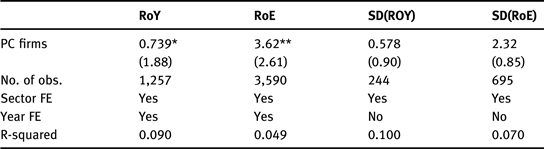
To get a sense of risk and return of PCFs and non-PCFs, we can compare the return on assets and on equity, and the historical standard deviation of these returns in the Orbis database. The return on revenues (RoY) measures overall profitability relative to a firm's revenue.Footnote 24 The return on equity (RoE) measures the return to equity-holders after debt service has been paid. As a measure of riskiness, we compare the historical variability of the RoYs and RoEs of PCFs and non-connected firms over the period of study. In doing this, we compare firms with others in their own (2-digits) sector of activity.
We find that in the Orbis data, PCFs had on average higher RoYs and ROEs than non-connected firms. But the different in RoYs is small. The difference in RoEs is larger, which suggests that PCFs' borrowing costs were low. Moreover, we do not find that, using historical returns, PCFs' returns were less variable than those of non-connected firms (see table 2). If anything, the standard deviation of the RoEs of PCFs is higher over all sectors, but the difference is not statistically significant. These results suggest that the preference of banks to lend to PCFs may be partly based on their superior profitability. But at the same time, the overwhelming PCFs' borrowing advantage cannot be explained solely by their small profitability advantage.
Return and risk: PCFs v.s other firms

Notes. Orbis data pooled across years (2003–11). We report the coefficient and t-statistic of the PCF dummy variable, from an OLS regression of the performance variable, on the PCF dummy variable, which is equal to 1 for PCFs and 0 otherwise. RoY is the return on revenue, which we compute by dividing profits by revenue. RoE is given by Orbis. SD is the standard deviation of these measures over 2003–11. Fixed effects are at the 2-digit level. ***, *, * indicate that the coefficients are significant at the 10 percent, 5 percent, and 1 percent level.
Demand side considerations
Another possibility is that the demand for loans by PCFs was high, relative to the demand of non-connected firms. For firms in sectors that include PCFs, this may be due to the expansion of PCFs, and the contractions of non-connected firms. More generally, it is notable that while the overall level of lending to the private sector (at 35 percent GDP) is comparable to other countries at Egypt's level of development, very few firms borrow in Egypt, preferring to finance their activity from retained earnings. The World Bank Enterprise Survey (WBES) of 2008, which covers a balanced sample of all formal firms in Egypt, reveals that only 5 percent of firms had a loan on their book around that time—the corresponding figure for lower-middle income countries is five times larger. There is also evidence of a large disconnect between firms and banks. Most firms with no loans on their books report in the WBES that they are not credit constrained.
The low demand for loans has been attributed to extreme risk aversion by borrowers. Legal rights are difficult to enforce in Egypt, increasing a firm's bankruptcy risk if its debt levels are high.Footnote 25 Moreover, the bankruptcy system itself magnifies these risks, given its exaggerated focus on debt repayment, and a lack of emphasis on restructuring and enterprise viability.Footnote 26 In such circumstances, growth opportunities tend to be financed largely by retained earning and equity, if they are not partially forsaken. In contrast, to the extent that PCFs can use their relationships in courts and during the bankruptcy process to their advantage, their demand for loans would be larger. A similar situation seems to occur in China. Li et al. (Reference Li2008) document how politically connected firms trust that the legal system will not discriminate against them, which boosts their demand for credit. At the same time, greater legal protection also boosts their creditworthiness in the eyes of lenders.Footnote 27
A simple model
In order to verify the relation between profitability and borrowing at the micro-level, we developed a model, which can be thought of as the final form of a full model specifying demand and supply considerations.Footnote 28
 $$\!\!\!\! Debt_{ij} = \beta _1PCF_{i,j} + \beta _2E_{ij} + \beta _3\,{^\ast}\,PCF_{i,j}\,{^\ast}\,E_{ij} + \beta _4\,{^\ast}\,connected_j\,{^\ast}\,E_{ij} + \beta _sS + \varepsilon _{ij}$$
where the dependent policy variable Debtij represents the debt of firm i in sector j; E ij is a measure of return of firm I; PCF is a dummy variable, which is equal to 1 for politically connected establishments and 0 otherwise; and Connectedj measures the number of politically connected firms in sector j. Both the PCF and Connected variables are also interacted with E ij to check if the debt ratios of non-connected firms, and of firms in sectors with PCFs, are related to profitability in different ways. S is a matrix of sector fixed effects. We measure debt by each firm's long-term debt to revenue ratio, and profitability by each firm's profit to revenue ratio, both calculated from the Orbis database.
The main question is whether PCFs enjoy a debt advantage commensurate with their higher profitability, or irrespective of their profit levels. Our prior belief is that higher profits should lead to lower demand for funds by non-connected firms, given their high-level of risk aversion, as this allows them to increase their share of self-financing. We also expect that firms in connected sectors receive less loans, as they should be seen as more risky by banks.
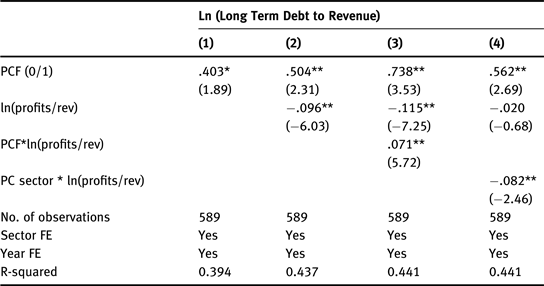
The results of the estimation of model 1 are in table 3. The first column confirms that PCFs have higher debt to equity ratios than firms without political connections that operated in the same two-digit sectors, with an advantage of 40 percentage points.Footnote 29 Column 2 shows that more profitable firms borrow less, which confirms the general preference for self-financing.
Borrowing and profitability

Notes. Profits, long-term debt, and revenue, as reported in Orbis's establishment database, with data pooled over 2003–11. We report the coefficient and t-statistic on an OLS regression. PCF is a dummy variable, which is equal to 1 for politically connected establishments and 0 otherwise. ***, **, * indicate that the coefficients are significant at the 1 percent, 5 percent, and 10 percent level. Sector fixed effects are at the two-digit level.
We then separate the effect of firms' profitability according to whether they are connected or not, and operate in sectors with or without PCFs. Column 3 reveals that PCFs behave differently, borrowing more than non-connected firms when they are more profitable at the margin. This means that either banks value profitability, and/or that PCFs tend to be less risk averse than non-connected firms, possibly because of their advantage in enforcing their property rights in court. But the PCFs debt-to-equity ratio advantage also becomes higher when we control for profitability—the extra leverage of 74 percentage points that they enjoy over non-connected firms is independent of their profitability.
Finally, column 4 reveals a sharp distinction in the borrowing behavior of non-connected firms in connected, and unconnected sectors. In sectors that do not include a PCF, firms do not borrow less when they are more profitable, in sharp contrast to firms in sectors that include PCFs. As we have seen in table 1, in such sectors, non-connected firms are on average losing market shares and profitability, which must lower both their demand for credit, as well as the supply of credit.
In sum, we have found that the credit advantage enjoyed by PCFs over non-connected firms is partly related to their superior profitability, and partly to the low demand for funds by non-PCFs. However, there is a large component of their debt advantage that cannot be explained by these variables. We are thus pushed to look for reasons other than profitability to explain why the supply of funds to PCFs was so much larger than to non-connected firms. Before exploring the possibility of implicit bailout guarantees as a key determinant of lending decisions, we investigate in the next section if their debt advantage could be due to the PCFs' direct influence on banks.
1.4 The role of politically connected banks
Did the PCFs have a direct influence on some banks? It is quite likely that the three large public sector banks continued to be a channel for state influence on business, even during this period.Footnote 30 There are indeed several known cases where large PCFs emerged due to financing by public banks. A prominent case is that of Ahmed Ezz, who built a steel empire that monopolized the Egyptian market, largely based on loans from public sector banks.Footnote 31
But lending by public banks cannot explain the whole story, given the PCFs' massive advantage in access to credit. A related question is whether some PCFs controlled directly some private banks. In our Orbis data, we could only find four such cases, out of the thirty-six private banks with information in the database. The main case is that of “Credit Agricole Egypt,” which belonged in parts to two large and well-connected families, Mansoor and Maghrebi, and which served their corporate interest well by allowing them to develop a mortgage market to finance their companies sprawling real estate businesses.Footnote 32
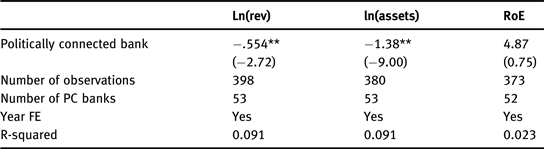
We can check in our Orbis database whether the financial institutions with some participation by connected interests are different from other financial institutions with no such interests. Our hypothesis is that politically connected banks take advantage of their implicit deposit guarantee to transfer value from the state to their owners, by providing underpriced loans to the connected firms associated with their owners. We do this again using regression analysis to summarize what the data says, by regressing various characteristics of banks on a connected bank dummy, and various banks' characteristics. The results, reported in table 4, suggest that these politically connected financial institutions tended to be smaller. However, they did not have a lower rate of return than non-connected financial institutions, unlike the situation described by Henry (Reference Henry1996) in the 1980s and 1990s, when connected banks took advantage of deposit insurance to lend cheaply to their corporate friends. In the main, this suggests that control over banks was not the principal strategy followed by PCFs to control access to bank finance.
Profitability of financial institutions and political connections

Notes. Orbis data, pooled across years (2003–11) and restricted to financial sector firms. We report the coefficient and t-statistic on the politically-connected dummy variable from an OLS regression of the performance variable on the dummy variable, which is equal to 1 for politically connected banks and 0 otherwise. We also control for size and age. *, **, *** indicate that the coefficients are significant at the 10 percent, 5 percent, and 1 percent level. We do not observe profits for banks in Orbis, and thus, we cannot generate the RoY series. The RoE ratio is from the Orbis database.
One explanation for the lack of interest of PCFs in controlling banks is that they had ample access to credit, and that their pyramidal structure allowed them to actively optimize the internal/external debt mix across their subsidiaries. Most of the PCFs in Egypt are part of conglomerates in the form of pyramidal structures.Footnote 33 Generous tax incentives were offered to encourage equity financing in the 2000s, boosting the use of initial public offerings.Footnote 34 Most PCFs raised funds through the EGX.Footnote 35 Pyramidal corporate structures are well suited for the purposes of connected families. They allow connected individuals to control lower tiers of subsidiaries with low levels of ownership, thus maximizing the impact of their political connections over cash flows.Footnote 36 Importantly for our purposes, such corporate structures are able to borrow more funds from banks. After the 2004 banking reform, lending to any single borrower was restricted to no more than 5 percent of bank equity, in order to limit the exposure of banks' balance sheets to individual firms. The pyramid structures must have helped in circumventing this restriction.Footnote 37
1.5 Implicit bail-out guarantees
If PCFs were not more profitable, or less risky than non-connected firms, based on objective historical cash flow measures, perhaps they were perceived to be less risky? The preferential access to policy-makers can reduce riskiness in a host of ways, from securing stable or rising market shares in an uncertain environment, to influencing policy in beneficial ways, to a bailout when the firm's attempt at expansion fails. There are many examples of such support received by connected interests in Egypt, which are well documented in the literature. This includes direct financial bailouts of private firms, as happened during the two waves of banking reforms in the early 1990s and the early 2000s.Footnote 38 This also includes policy changes that advantaged PCFs when their financial situation weakened—a good example, among many others, is the changes introduced in trade policy and in the anti-monopoly laws, to advantage the Ezz Steel empire when its financial returns declined.Footnote 39
A few studies have looked at bailout guarantees as a central mechanism of privilege by documenting how connected firms exhibit higher default rates and receive more frequent bailouts.Footnote 40 In particular, Facio, Masulis, and McConnell (Reference Faccio, Masulis and McConnell2006) study the performance of 450 politically connected firms in thirty-five countries over the period 1997 through 2002, along with a set of matching firms. Connected firms are shown to make greater use of debt financing than do their non-connected peers.Footnote 41 The authors show that, after controlling for other factors, politically connected firms were also more often bailed out than their non-connected peers.
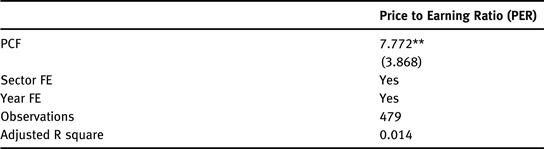
The question here is whether we can infer that banks in Egypt—or at least the financial markets—perceived that the PCFs were implicitly guaranteed by the state. In particular, one can look at the stock market valuation of a firm's “price to earnings ratios” to check if PCFs were priced at a premium in ways that suggest that the market perceived them to be less risky than non-connected firms. The price to earnings ratio (PER) is defined as the market value of the firm (which we evaluate at the average quarterly price) divided by total yearly earnings. A high PER indicates that the market perceives a firm to be either less risky, or to possess superior growth opportunities in the future. In order to verify whether PCFs systematically had higher PERs than non-connected firms, we run a descriptive regression of PERs over various firms' characteristics. Table 5 below show that the PCFs traded at a considerable PER premium of 7.7 points during the period 2007–10, controlling for sector and for firm's size.
In a recent paper, Chekir and Diwan (Reference Chekir and Diwan2015) construct an event study around the 2011 uprising event. During the event window, the stock market was closed, and President Mubarak was unexpectedly removed from power, sending the market value of political connections to his regime to zero. Chekir and Diwan show that when the market reopened, the twenty-two PCFs which were traded on the EGX lost on average 13 to 16 percent of their value on account of their political connections.
Price earning ratios and political connections

Notes. OLS, t-statistic in parentheses. The PER is the price to earnings ratio, calculated at the median stock price during the year. Sector fixed effects are at the two-digit level. We also control for firms' size. *** p < .01, ** p < .05, * p < .1
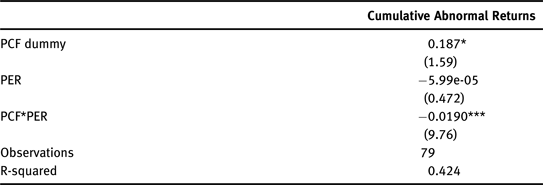
The question that interests us here is how much of the value that was lost in the 2011 event was due to the pricing premium enjoyed by the PCFs until that date. To estimate this, the same event study methodology can be adapted to evaluate the extent to which the value lost by PCFs included a positive market assessment of bailout guarantees (or growth potential) by including, instead of a dummy variable to identify the PCFs, their PER as well as its interaction with the PCF dummy, in the following form:
 $${\rm CAR}_{\rm i} = \hbox{a PER}_{\rm i} + \hbox{b PCF}_{\rm i} ^{\ast}{\rm PER}_{\rm i} + \hbox{c Sector} + \hbox{error}$$
Where: CAR is the cumulative abnormal return starting five days before the market closed on 23 January 2011 and five days after it where reopened on 23 March 2011. The PERs are taken at the median stock price during the year just before the event date.
The results are shown in table 6. They reveal that stock prices fell more for PCFs that had a higher PER before the event. This then suggests that these CFs were traded at a PER premium before the event, and that some of the value that was lost in the 2011 event was the pricing premium enjoyed by the PCFs until that date. For the market, the loss in values was then partly driven by the loss of implicit guarantees, or growth potential, due to the demise of the Mubarak regime.
When valued at the median PCF, the loss on the PER adds up to a decline in the value of these stocks of about 17.0 percent (–0.019*13). This is a very large effect, of the same magnitude than the overall market price drop for PCFs in the 2011 event.
Decomposing the 2011 market reaction

*** p < 0.01, ** p < 0.05, * p < 0.1
Notes: Ordinary least squares with sector fixed effects. t-statistic in parentheses. CAR is the cumulative abnormal return starting five days before the market closed on 23 January and five days after it reopened on 23 March. The PER is the price to earnings ratio, calculated at the median stock price during the previous year.
Our educated guess is that much of this loss must have been due to a loss of bail-out guarantee, rather than to a loss of future growth opportunities, given that PCFs were already much larger than their competitors by 2011. The collapse of the PERs of connected firms after the 2011 uprisings, when these political connections were severed, is thus a clear indication that PCFs were perceived to be less risky by the market, which suggests that they were perceived to be guaranteed by the state.
1.6 Conclusion
In Egypt, the bulk of bank loans during 2003–10 went to politically connected firms. At the same time, the banking sector was liberalized and recapitalized, and it increasingly operated around competitive and profit-maximizing principles.
Using a rich corporate dataset, our results demonstrated that PCFs tended to have slightly higher profitability, but similar levels of riskiness than non-connected firms, in spite of the valuable privileges they enjoyed, when these variables are evaluated using historical data. However, PCFs were perceived to be less risky, as reflected by their higher PERs. In addition, PCFs had a much higher demand for loans to finance their extraordinary growth during this period. As a result of this coincidence between a high demand for funds, and a high supply of funds, by the end of the period, the PCFs ended up absorbing most of the loans that went to the private sector.
The case study thus confirms that a competitive banking system may be necessary to fuel a dynamic economy, but it is not sufficient. When firms are perceived to possess advantages that non-connected firms do not have, they are likely to attract a disproportionate share of credit even in a liberalized capital market, because their privileges make them more attractive to private banks, either directly, when these boost their profitability, or indirectly, when these advantages are perceived by the market to include state insurance against corporate failure.