Introduction
The worldwide production of farmed mink (Neovison vison, earlier Mustela vison) is over 50 million pelts per year (Finnish Fur Breeders’ Association, 2008). Most farmed mink are juveniles born in the spring and pelted in the early winter. The whole population of mink kept on farms is much larger, more than 60 million if breeding animals and individuals that die before pelting are included. Thus, any improvements in the housing of the mink would affect the welfare of a great number of animals.
Traditionally, the juvenile mink are raised from weaning (at the age of 6 to 8 weeks) onwards in pairs, in cages where the only enrichments are another mink and a nest box with wood shavings or straw as bedding material (European Commission, 2001). Juvenile mink may also be housed singly (Nimon and Broom, Reference Nimon and Broom1999). However, pair-housed mink grow better (Møller, Reference Møller1991) and show fewer and later developing stereotypies (Damgaard and Hansen, Reference Damgaard and Hansen1996) than singly housed mink and therefore pair housing has been considered to be better for the mink. Despite these benefits, the traditional pair housing is not necessarily the optimal way of housing mink. Even the pair housing system has been considered to be rather barren, and it has been argued that additional enrichments should be offered to the mink to improve the welfare of these animals (Nimon and Broom, Reference Nimon and Broom1999).
Housing in larger cage systems in groups of more than two animals could be one way of enriching the cage environment of mink. A larger cage system, required for a group of animals, makes it possible for all the animals in the group to utilise the larger space, and also provides room for a more complex environment, e.g. tunnels, removable walls, possibility for climbing and other enriching objects (as suggested in the recommendations of the European Convention (1999) and the report of the European Commission (2001)). Furthermore, when there are several animals in the same cage system, different social contacts could also act as enrichment. Although mink are regarded as solitary in the wild (Birks, Reference Birks1986; Dunstone, Reference Dunstone1993; Niemimaa and Pokki, Reference Niemimaa and Pokki1997), juvenile mink have been raised successfully on farms in pairs or triplets for decades (Joergensen Reference Joergensen1985).
Group housing of mink has, in principle, been enabled by both European recommendations (European Convention, 1999) and Finnish National Legislation (Ministry of Agriculture and Forestry, 1999). The recommendations of the European Convention (1999) state that the area of a cage of a mink pair must be at least 2550 cm2, and each additional animal must have at least 850 cm2 additional space. These space allowance recommendations are embodied in Finnish law as the animal welfare requirements for fur animals that will come into force in 2010 (Ministry of Agriculture and Forestry, 1999). However, group housing should not be implemented before more experience of group housing at a research scale is gained. Scientific studies of group housing of mink are scanty and the results are not unambiguous. In some studies, the experiences are mainly promising with regard to production, and there have not been any major welfare problems (Jonge de, Reference Jonge de1996; Vinke et al., 2002). In other studies, mortality has been higher (Pedersen, Reference Pedersen1999; Pedersen et al., Reference Pedersen, Jeppesen and Jeppesen2004), aggressive behaviour more frequent (Hansen et al., Reference Hansen, Houbak and Malmkvist1997; Pedersen, Reference Pedersen1999; Pedersen et al., Reference Pedersen, Jeppesen and Jeppesen2004; Hänninen et al., Reference Hänninen, Mononen, Harjunpää, Pyykönen, Sepponen and Ahola2008) and body mass at pelting lower (Pedersen, Reference Pedersen1999; Lindberg et al., 2005) in group-housed than in pair-housed mink. On the other hand, group-housed mink may have lower adrenal mass, serum cortisol level (Hänninen et al., Reference Hänninen, Mononen, Harjunpää, Pyykönen, Sepponen and Ahola2008) and urine cortisol–creatinine ratio (Arts et al., 2004), less tail biting (Jonge de, Reference Jonge de1996; Pedersen, Reference Pedersen1999; Pedersen et al., Reference Pedersen, Jeppesen and Jeppesen2004; Hansen and Houbak, Reference Hansen and Houbak2005) and less stereotypies (Jeppesen et al., Reference Jeppesen, Heller and Dalsgaard2000) than pair-housed mink.
In this study, we compared a group housing system and the traditional pair housing of juvenile mink. The focus was on both the welfare and production of mink. The pairs were housed in standard mink cages and the groups in row cage systems consisting of three standard mink cages connected to each other. The welfare of the mink was evaluated by behavioural observations (stereotypies and social contacts), incidence of scars in the fleshed skins assumed to be caused by biting, and adrenal function (serum cortisol level after adrenocorticotropic hormone (ACTH) administration and adrenal mass). Feed consumption, pelt size, quality and price were used for comparing the two housing systems from the economic point of view.
Material and methods
Ethical note
The experiment was approved by the Institutional Animal Care and Use Committee of the University of Kuopio (Licence nos. 00-32 and 02-39).
Animals and housing conditions
The experiment was carried out at the Juankoski Research Station of the University of Kuopio. Data were collected during 2 years with similar experimental set-ups in both years. The study was carried out in an unheated animal barn with eight rows of mink cages. In May, the wild colour-type mink dams gave birth in standard mink cages with a wooden nest box (Figure 1) with straw as bedding. The nest box was situated in the front of the cage, i.e. nearest to the corridor between the cage rows. Twelve (the first year) and 14 (the second year) litters were selected for the study from the whole mink population of the farm (61 and 55 litters, respectively). The kits were weaned from their mothers at the age of 8 weeks. Three male and three female kits were randomly selected from each litter for the study, and extra kits were removed from the litters. Matched litter pairs were formed, by taking into account litter size and age of the kits, and were divided evenly into group-housed (GH, n = 6 and 7 litters) and pair-housed (PH, n = 6 and 7 litters) groups. There were a total of 156 kits (39 GH males, 39 GH females, 39 PH males and 39 PH females) in the experiment.
Schematic drawing of the experimental cages from above. PH: juvenile mink housed in male–female pairs (three from each litter) in standard mink cages, GH: juvenile mink housed in groups of three males and three females (all from the same litter) in row cage systems. Note that the corridor width is not to scale.

The kits were marked with subcutaneous microchips (Indexel, Digital Angel Corporation, USA) to enable identification of the GH individuals. The GH mink were moved as litters to row cage systems formed by connecting three standard mink cages (with nest boxes), and the mink had access to all three nest boxes (Figure 1). The PH litters were housed in the traditional way, i.e. in brother–sister pairs in standard mink cages with a nest box. The GH and PH animals were placed in adjacent cages in two rows so that each PH litter had its matched GH litter on the other side of the corridor separating the two cage rows, and on each cage row, there was always a GH litter after a PH litter.
Nest boxes with straw bedding were available in the cages of both groups throughout the study. The animals were fed ad libitum with fresh fur-animal feed twice a day until the end of September and once a day thereafter. The feed, containing fish, slaughter offal, grain, protein mixture, oils, water and vitamin-iron supplements, was manufactured according to the Finnish recommendations (Tuori et al., Reference Tuori, Kaustell, Valaja, Aimonen, Saarisalo and Huhtanen2000). The porridge-like feed was delivered on the roofs of the cages. In the GH group, the daily feed portion was divided evenly on the roofs of all the cages of each litter. Water was available in all cages ad libitum until it froze in November and thereafter it was served twice a day. The general health of the animals was checked daily.
Data collection
The behaviour of the animals was analysed from 24-h video-recordings made in August, i.e. during the dispersal time of mink in the wild (Niemimaa and Pokki, Reference Niemimaa and Pokki1997), and in November. The data were recorded using a video switcher (switching interval 50 s). The use of the nest boxes (‘in the nest box’, i.e. the animals that were not on the cage floor or platform) and the general activity in the cage (‘active in the cage’, ‘passive in the cage’) were analysed from the videotapes with instantaneous sampling (Martin and Bateson, Reference Martin and Bateson1993) with 3.5 to 4 min intervals (depending on the number of cameras in use). An animal was regarded as passive if it was lying down; other behaviours were regarded as active behaviour. If it was not possible to ascertain (because of darkness or other reasons affecting visibility on the videotape) whether an animal was in the cage or in the nest box, its behaviour was classified as ‘not known’. Individual animals could not be identified from the videotapes and therefore the behavioural analyses were done within litters, i.e. as the percentage of animals within each litter performing a certain behaviour at a sample point. The analyses were done within litters, i.e. for the six siblings also in the pair-housed animals, to obtain data that were comparable between the groups. Social interactions (including fights, threatening or biting another animal and social play) and stereotyped pacing in the cage were analysed with one–zero sampling (Martin and Bateson, Reference Martin and Bateson1993) for 50 s periods with 3.5 to 4 min intervals. Social interactions and stereotyped pacing were pooled within each litter, i.e. if one animal was performing a certain behaviour, that behaviour was recorded for the whole litter.
The dirtiness of the nest boxes and straw bedding in the box was scored every second week from August to November on a subjective five-point scale from zero (clean) to four (extremely dirty). The nest boxes were manually cleaned, dirty or wet bedding was removed and clean bedding added after every scoring.
The feed consumption of the litters was measured in September and again in November. The daily ad libitum portions and leftovers were weighed (accuracy ±1 g) during a two- (second year) or three- (first year) day period. The results were combined from these days and converted to daily feed consumption per animal for each litter (GH or PH) per day.
The kits were weighed (accuracy ± 1 g) in July (at weaning, when they were 8 weeks old), August, September, October and November (at pelting, when the kits were 30 to 32 weeks old). At pelting, the kits were injected (i.m.) with 0.06 ml synthetic ACTH (Synacthen-Depot 1 mg/ml, Ciba). This was an overdose (at least 0.023 mg/kg0.75) and ensured the maximal secretion of cortisol to blood (for the ACTH test, see e.g. Broom and Johnson, Reference Broom and Johnson1993; Terlouw et al., Reference Terlouw, Schouten and Ladewig1997). Two hours later, the mink were humanely killed with electrocution according to the recommendations of the European Convention (1999). Death was ensured by immediate neck dislocation after electrocution. Blood samples were drawn with heart puncture immediately after death. Serum was separated and stored at +4°C and analysed for cortisol (Coat-A-Count Cortisol Assay by Diagnostic Products Corporation, Los Angeles, CA, USA) within 1 week. The animals were pelted, and the carcasses were autopsied to measure the adrenal masses (accuracy ± 0.1 mg) as a second indicator of adrenal function (Selye, Reference Selye1950; Gómez et al., Reference Gómez, Lahmame, de Kloet and Armario1996; Hemsworth et al., Reference Hemsworth, Barnett and Campbell1996).
The pelted skins were fleshed and the incidence of scars, assumed to be caused by biting, was recorded from the leather side of the fleshed skins on a subjective scale from zero to five: 0 = no scars; 1 = one to three single small scars or red spots; 2 = more than three single scars or red spots; 3 = as 2, but in addition small areas of an incalculable number of scars or spots; 4 = large areas of an incalculable number of scars or spots; 5 = almost the whole skin covered by scars and spots (Hänninen et al., Reference Hänninen, Mononen, Harjunpää, Pyykönen, Sepponen and Ahola2008). The skins were dried in the traditional way by stretching and tacking the fleshed skin to a board and blowing air inside the skins (Joergensen, Reference Joergensen1985). The length of the dried skin, i.e. the pelt, was measured (accuracy ± 0.5 cm) from the tip of the nose to the base of the tail. The severity of fur chewing separately in tail and body was analysed from the pelts using a subjective scale from zero to five: 0 = no damage, 1 = really minor damage, 2 = minor damage, 3 = moderate damage, 4 = quite severe damage and 5 = severe damage (Hänninen et al., Reference Hänninen, Mononen, Harjunpää, Pyykönen, Sepponen and Ahola2008). The pelts were sent to an auction company, the Finnish Fur Sales Co., Ltd, and professionals of the company scored the ‘general impression’ of the pelt from 1 (poorest) to 10 (best) and recorded fur defects (feed stains, bites and wet belly). The prices of the pelts were also obtained from the Finnish Fur Sales Co., Ltd.
Statistical analyses and presentation of the results
The pooled data from 2 years were used to gain better statistical power and to enable better generalisability of the conclusions.
For each GH litter, there was a PH litter matched for litter size and age of the kits, so these matched litters were treated as dependent on each other in the statistical analyses. Littermates were, of course, not independent of each other. The data concerning body mass, pelt length, adrenal mass, serum cortisol level after administration of ACTH, scars, fur chewing, fur defects, general impression of pelt and pelt price were collected for individual animals, whereas the values of the remaining variables, i.e. behavioural data, dirtiness of nest boxes and feed consumption, originated from litters of six siblings. For these reasons, n (i.e. the number of experimental units) varies between statistical analyses, although the data came originally from 149–156 (some data missing) animals.
The effects of experimental group and sex on body mass, pelt length, adrenal mass, serum cortisol level, pelt price and fur defects were analysed with a linear mixed model (SPSS statistical software; SPSS Inc., Chicago, IN, USA) (n = 149–156). Litter and matched pair were used as random factors to take into account the dependence of animals within litters and matched pairs. The average pelt price of the auction was used as a covariate for pelt price to correct for the average price differences between the auctions. Body mass in December was used as a covariate when analysing the adrenal mass, serum cortisol level and pelt price. The pelt price was also tested without the covariate. The percentages of mink with fur defects within a litter and sex were calculated for comparisons between housing methods and sexes with the linear mixed model (n = 52). Data concerning social interactions and stereotyped pacing were analysed with the linear mixed model (n = 26) with post-hoc tests with matched pair as random factors. The feed consumption data were analysed with the paired-samples t-test (n = 13).
The other variables, i.e. scars, fur chewing, general impression, mortality, behavioural data and nest box tidiness, were tested with nonparametric tests. Because of the dependence between animals within each litter and each matched pair, the data from individual animals were combined by calculating mean values from the values of individual animals before testing for differences in scars, fur chewing and general impression. This was done separately for both sexes within each litter to enable gender comparisons. Thus, four dependent variables were produced for each of these parameters: GH males, GH females, PH males and PH females. The number of kits that died and the number of litters with deaths were compared between the housing systems with Fisher’s exact test. The fur chewing, scar score and general impression data were analysed with both the Friedman two-way analyses of variance (henceforth the Friedman test) test with post-hoc tests for pair-wise comparisons of the four groups (as presented in Siegel and Castellan, Reference Siegel and Castellan1988), and the Wilcoxon matched-pairs test (henceforth the Wilcoxon test) with Bonferroni correction to compare the two experimental groups (sexes pooled) and the two sexes (groups pooled). Activity and resting in the cage, and the time spent in the nest box were compared between the groups and between the months with the Friedman test. Pair-wise comparisons between groups within months and between months within groups were carried out with a post-hoc test as presented in Siegel and Castellan (Reference Siegel and Castellan1988). The nest box tidiness data were compared with the Wilcoxon test if the experimental groups were compared within months, and with the Friedman test if time trends (i.e. repeated measurements) were analysed. The number of experimental units, i.e. n, was 13 in all the nonparametric analyses.
The results are presented as estimated marginal mean ± s.e. of estimate (EMM ± Sy.x) or mean ± s.e. of mean ( ± s.e.). The level of statistical significance was set at the conventional 0.05, but to facilitate readers’ opportunities to do their own interpretations of the results, the exact P-values are indicated every time the value is between 0.05 and 0.1 (whenever this is possible); ns indicates non-significant differences (P > 0.1).
Results
Two GH females and one PH female escaped from their cages. Furthermore, two PH males and one PH female died, and in the autopsy they all were found to have fatty livers and stomach ulcers. One PH female had to be euthanised during the experiment because of a seizure of some kind. There was no difference in mortality between the groups (4/78 animals in 3/13 PH litters v. 0/78 animals in 0/13 GH litters, P > 0.1, Fisher’s exact test).
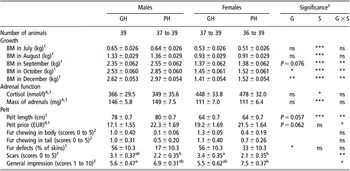
Sexual dimorphism could be seen in all size parameters (Table 1). PH mink were heavier at pelting than GH mink and their pelts tended to be longer than those of GH mink, in both sexes. There were no differences between the groups in adrenal function, i.e. serum cortisol level 2 h after ACTH administration or adrenal mass.
Growth, adrenal function and pelt characteristics in mink kits housed either in pairs (PH) or as litters (GH)

See Material and methods for the details of the variables.
BM = body mass, S = sex, G = group.
§ns (non-significant), P > 0.1, *P < 0.05, **P < 0.01, ***P < 0.001.
ABM in December as a covariate.
BAverage prices in auctions as a covariate.
1Linear mixed model (n = 52 in fur defects, n = 149 to 156 in other parameters, estimated marginal mean ± Sy.x).
2Friedman two way analyses of variance (n = 13, mean ± s.e., Friedman test results presented in G × S column and post-hoc results as lower case superscript letters: means with no common letter differ at P < 0.05 in scars and P < 0.1 in general impression).
The groups did not differ in the severity of fur chewing in tail or body when all four groups (i.e. GH males, GH females, PH males and PH females) were compared (Table 1), but the Wilcoxon test showed a weak tendency for a difference in fur chewing in the body between housing systems (sexes pooled within housing systems; GH = 1.1 ± 0.41 v. PH = 0.3 ± 0.09, P = 0.092, the Wilcoxon test). The general impression of the pelt tended to be worse in GH males than in PH females (Table 1). The GH females tended to have more scars in their skins than the PH females and PH males, whereas the GH males did not differ from any of these. The GH animals had worse general impression of the pelt (GH 5.6 ± 0.51 v. PH 7.2 ± 0.31) and more scars (GH 2.9 ± 0.25 v. PH 1.7 ± 0.21) in their skins than the PH animals (P < 0.05 for both, the Wilcoxon test), but there was no difference (P > 0.1) between the sexes in either of the parameters (general impression: males 6.2 ± 0.34 v. females 6.5 ± 0.32, scars: males 2.2 ± 0.22 v. females 2.3 ± 0.28). In most of the cases when the scar score was between one and three (i.e. moderate severity of scars), the scars were on the neck area. The GH mink had more fur defects than the PH mink (Table 1). The price of the pelts tended to be lower in the GH than in the PH animals (Table 1), but the difference disappeared when the body mass in December was used as a covariate.
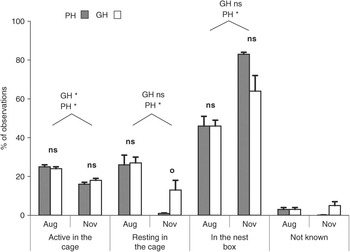
The extent of the use of the various parts of the cages did not differ between the groups in August, whereas in November the GH mink tended to spend more time resting on the cage (including the platform) than the PH mink (Figure 2). Both groups were more active in the cage in August than in November. The PH mink spent more time in the nest box and rested less in the cage in November than in August, while no such difference was seen in the GH mink.
Activity and resting in the cage and use of the nest boxes in pair- (PH) and group- (GH) housed mink in August (Ta = +10°C to +25°C) and November (Ta = −6°C to +6°C) (mean+s.e.). The differences between the groups within months are indicated above the columns in bold and the within-group difference between months above the brackets (Friedman two-way analyses of variance and post-hoc tests). ns, P > 0.1, oP < 0.1, *P < 0.05. Statistically n = 13, i.e. the number of matched litters, although the data are originally from 149–156 animals.

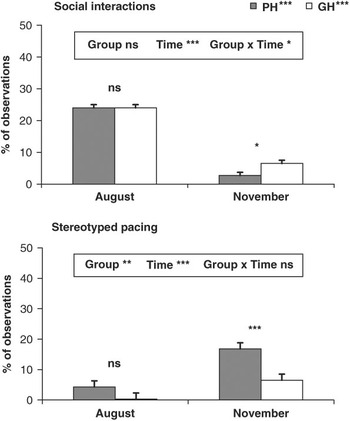
Taking both observation months together, there was no overall difference in the frequency of social interactions between the groups, but the frequency decreased more from August to November in pair-housed than in group-housed mink, leading to differences between the groups in November (Figure 3). The group × time interaction in social interactions disappeared (P > 0.1, linear mixed model with post-hoc tests) and the difference between the groups in November decreased to a tendency (P = 0.052) when activity in the cage was used as a covariate. The frequency of stereotyped behaviour increased from August to November and was more frequent in pair-housed than in group-housed animals, especially in November. The group × time interaction in stereotyped behaviour became significant (P < 0.05) when activity in the cage was used as a covariate.
Social interactions and stereotyped pacing in pair- (PH) and group- (GH) housed mink in August and November (estimated marginal mean ± Sy.x). The differences between the groups, and the effects of time and group × time interactions are presented in the plot areas, the differences between the groups within the months above the bars, and the differences between the months within the groups in the legend box (linear mixed model with post-hoc tests). ns, P > 0.1, *P < 0.05, **P < 0.01, ***P < 0.001. Statistically n = 52, although the data are originally from 26 litters, i.e. 149–156 animals.

The nest boxes were dirtier in the GH group than in the PH group in the late autumn, and the dirtiness increased with time in the GH group but not in the PH group (Figure 4) (for brevity, results from only four out of the nine recordings are presented). The PH animals had cleaner nest boxes than the GH animals, and the number of clean nest boxes decreased with time in the GH group but not in the PH group.
The number of clean nest boxes (bars, possible range zero to three) and the dirtiness score of the nest boxes (lines, possible range zero to four) in pair- (PH) and group- (GH) housed juvenile mink litters (mean+s.e.) The differences between the groups in the number of clean nest boxes (above the bars) and in the dirtiness score of the boxes (above the GH line) are indicated for each month (the Wilcoxon matched-pair test). The effect of time on the number of clean nest boxes and dirtiness score of the boxes (Friedman two-way analyses of variance) within each group are indicated in the legend box. ns, P > 0.1, *P < 0.05, **P < 0.01, ***P < 0.001. Statistically n = 13, i.e. the number of matched litters, although the data are originally from 149–156 animals.

Feed consumption of PH and GH animals was equal in September (311 g ± 14.3 g v. 289 g ± 10.4 g feed per animal per day, P > 0.1, paired-samples t-test, n = 13 matched pair litters), but the PH animals consumed more feed than the GH animals in November (285 ± 20.3 v. 225 ± 19.0 g, P < 0.01).
Discussion
Welfare
Both direct behavioural observations (Hansen et al., Reference Hansen, Houbak and Malmkvist1997; Pedersen, Reference Pedersen1999; Pedersen et al., Reference Pedersen, Jeppesen and Jeppesen2004; Hänninen et al., Reference Hänninen, Mononen, Harjunpää, Pyykönen, Sepponen and Ahola2008, the present study) and indirect observations based on skin and fur damages (Pedersen, Reference Pedersen1999; Hansen and Houbak, Reference Hansen and Houbak2005; Hänninen et al., Reference Hänninen, Mononen, Harjunpää, Pyykönen, Sepponen and Ahola2008, the present study) indicate that there is more aggression, or social encounters resulting in skin damages (see discussion below), in group-housed than in pair-housed mink. However, the severity of aggression varies greatly between the studies: in seven studies, aggression problems have been mild (Hansen et al., Reference Hansen, Houbak and Malmkvist1997; Hansen and Houbak, Reference Hansen and Houbak2005; Lindberg et al., 2007; Hänninen et al., Reference Hänninen, Mononen, Harjunpää, Pyykönen, Sepponen and Ahola2008, the present study) or not directly reported and therefore putatively absent or mild (Jonge de, Reference Jonge de1996; Vinke et al., 2002), whereas in two studies aggression led to high mortality rates (Pedersen, Reference Pedersen1999; Pedersen et al., Reference Pedersen, Jeppesen and Jeppesen2004). Interestingly, the two studies with major aggression problems were carried out with pearl and pastel colour types of mink, and all other studies with brown or wild colour type, except for Lindberg et al. (2007), which was with demi puff and half-sapphire. It is known that coat colour correlates with behaviour in mammals in general (see a review in Hemmer, Reference Hemmer1990) and also in mink (see a review in Voitenko and Trapezov, Reference Voitenko and Trapezov2001), but it remains to be elucidated whether the coat colour per se or temperament differences not related to the colour type between various mink populations is the primary reason for differences in aggressive behaviour.
On the other hand, no matter what the underlying reasons for these population differences are, the possibility of dramatic negative effects on the welfare of mink has to be born in mind when considering group housing as an alternative to the traditional pair housing. Group housing would necessitate better supervision of the animals on farms, and perhaps choosing less aggressive animals for breeding. This would be especially important if the stocking density was higher than two animals per standard cage. According to the European Convention (1999), it is allowed to keep eight mink in a row cage formed by connecting three standard cages to each other.
The reason that the higher frequency of seemingly aggressive behaviour in the group-housed animals compared with pair-housed animals has not caused higher mortality in most studies might be that the mink are actually (or at least partly) playing, not fighting. The so-called ‘social biting play’ (Vinke et al., Reference Vinke, van Leeuwen and Spruijt2005) may be easily confused with true fighting and it can probably also cause scars to the skin.
The fact that mink spend most of their time out of sight in nest boxes (Jeppesen et al., Reference Jeppesen, Heller and Dalsgaard2000; Pedersen et al., Reference Pedersen, Jeppesen and Jeppesen2004, the present results) may bias the results from behavioural observations. The difference in the frequency of social interactions observed in the present study in November lost statistical significance when total time spent active in the cage was used as a covariate in the statistical analysis. In other words, the analysis without the covariate may have exaggerated the difference between the groups. The nest boxes are certainly large enough to enable mink to fight (or play) in them. Accordingly, indirect measures of aggression, i.e. fur and skin damages, may be more reliable than behavioural observations based on the behaviour outside the nest box only.
Behavioural stress indicators have shown that stress levels are equal or even lower in group-housed juvenile mink than in pair-housed juveniles. Fur chewing and in particular tail biting can be regarded as self-mutilation, i.e. as an indicator of poor welfare in mink (Hansen et al., Reference Hansen, Houbak and Malmkvist1998). There is less tail biting and an equal level of fur chewing in groups compared with pairs (Pedersen, Reference Pedersen1999; Pedersen et al., Reference Pedersen, Jeppesen and Jeppesen2004; Hansen and Houbak, Reference Hansen and Houbak2005; Lindberg et al., 2007). The frequency of stereotypies, a sign of frustration and poor welfare (e.g. Mason and Latham, Reference Mason and Latham2004), has been reported to be equal in group-housed and pair-housed mink (Hansen et al., Reference Hansen, Houbak and Malmkvist1997; Pedersen, Reference Pedersen1999, Vinke et al., 2002; Pedersen et al., Reference Pedersen, Jeppesen and Jeppesen2004; Lindberg et al., 2007; Hänninen et al., Reference Hänninen, Mononen, Harjunpää, Pyykönen, Sepponen and Ahola2008) or even slightly lower in group than in pair housing (Jeppesen et al., Reference Jeppesen, Heller and Dalsgaard2000, the present study). However, the relation between stereotypic behaviour and welfare is ambiguous (Mason and Latham, Reference Mason and Latham2004). For example, in the present study, social tension may have hindered the development of stereotypic behaviour in group-housed mink.
In contrast to behavioural signs of stress, adrenal function results are less consistent between various studies: no differences between group and pair housing (the present study), lower adrenal mass and response to the ACTH in group housing (Hänninen et al., Reference Hänninen, Mononen, Harjunpää, Pyykönen, Sepponen and Ahola2008), and higher adrenal mass (Vinke et al., 2002) and higher level of plasma cortisol in female kits (Hansen and Damgaard, Reference Hansen and Damgaard1991) in group housing have been observed. These discrepancies between studies may reflect rather the problem of using adrenal function as a stress indicator in general (c.f. Rushen, Reference Rushen1991) and in mink (Hänninen et al., Reference Hänninen, Mononen, Harjunpää, Pyykönen, Sepponen and Ahola2008) than true differences in stress levels between the experimental groups in the various studies.
Production
The present results show that stress-related own-fur chewing was not statistically different in group- and pair-housed animals, whereas aggression or play-related damages are more frequent in group-housed than in pair-housed animals. The net effect on production is that pelts from group-housed mink have a higher frequency of fur defects (Hänninen et al., Reference Hänninen, Mononen, Harjunpää, Pyykönen, Sepponen and Ahola2008, the present study) and lower general impression (Lindberg et al., 2007, the present study). These differences did not, however, have a statistically significant effect on the prices of the pelts in the present study.
Besides pelt quality, another crucial factor affecting the prices of the pelts is pelt length. The body mass has been reported to be either equal in group-housed and pair-housed mink (Jonge de, Reference Jonge de1996; Vinke et al., 2002; Hänninen et al., Reference Hänninen, Mononen, Harjunpää, Pyykönen, Sepponen and Ahola2008) or slightly lower in group housing than in pair housing in males (Pedersen, Reference Pedersen1999) or in both sexes (the present study). Although the body mass may be lower to some extent in group-housed than in pair-housed mink, pelt length is equal (Pedersen, Reference Pedersen1999; Hänninen et al., Reference Hänninen, Mononen, Harjunpää, Pyykönen, Sepponen and Ahola2008) or the difference between experimental groups is minimal (2 cm in males and no difference in females; the present study) as compared to the 6 cm difference between the size classes in the auctions.
The lower body mass in group-housed mink results at least partially from group-housed mink consuming less feed than pair-housed mink (Hänninen et al., Reference Hänninen, Mononen, Harjunpää, Pyykönen, Sepponen and Ahola2008, the present study). Combined with the almost equal pelt length in pairs and in groups, this may indicate that pair-housed mink gather more fat than group-housed mink. In mink, most fat deposits are gathered as subcutaneous fat, which acts as additional insulation for this semiaquatic species (Nieminen et al., Reference Nieminen, Käkelä, Pyykönen and Mustonen2006). It is possible that this additional insulation is more important for pair-housed than for group-housed mink, since group-housed mink may have thermoregulatory benefits from being able to utilise huddling. For mink kits, huddling is an effective way of reducing energy loss, especially because of their short hair and elongated and thin body shape (Tauson et al., Reference Tauson, Chwalibog and Tygesen2006). Our earlier family housing experiment showed that mink housed in groups spent most of their time huddled together (mainly in the nest box) when the ambient temperature dropped to near or below zero (Hänninen et al., Reference Hänninen, Mononen, Harjunpää, Pyykönen, Sepponen and Ahola2008). Interestingly, the group-housed mink clearly keep at least one of their nest boxes clean and dry (Hänninen et al., Reference Hänninen, Mononen, Harjunpää, Pyykönen, Sepponen and Ahola2008, the present results). Nest boxes with dry bedding are an important prerequisite for successful behavioural thermoregulation in farmed mink (Korhonen and Harri, Reference Korhonen and Harri1984), and keeping typically only one nest box clean also in the present study (see Figure 1) may indicate that the mink rested in that nest box in a huddle. Unfortunately, this could not be confirmed from the video observations, because it was impossible to see into the nest boxes, where most resting and consequently also huddling occur. It could be hypothesised that the dirtiness of the nest boxes might have forced the mink to huddle together in only one nest box. On the other hand, the mink huddled together also when resting in the cage.
Conclusions
Although the incidence of scars showed that there might have been more aggressive behaviour among the group-housed than among the pair-housed mink, this was not observed unambiguously in behavioural observations, and, at least, aggression did not cause mortality or serious injuries to the animals. It is also possible that social biting play may be erroneously interpreted as aggression in mink. In addition, the housing system did not affect pelt size, and although the quality of the pelts was slightly lower in group-housed than in pair-housed mink, there was only a tendency for lower pelt prices. The lower pelt prices might even be partially compensated for by the group-housed mink eating 10% to 20% less in the late autumn, due to thermoregulatory benefits, than their pair-housed conspecifics. The group-housed animals were possibly less stressed than the pair-housed animals, but these results were not unambiguous.
Acknowledgements
This study was supported by the Finnish Cultural Foundation. We are grateful to Maija Miskala, Matti Tengvall and Rose-Marie Nybondas for their skillful assistance when taking care of the animals and collecting the data and for Seppo Kukkonen for performing the biochemical analyses. Finnish Fur Sales Co., Ltd is acknowledged for providing us with skin quality and price data. Two anonymous referees are acknowledged for their constructive comments on the manuscript of the present paper.