




No CrossRef data available.
Patterns of late rising in New Zealand English: Intonational variation or intonational change?
Published online by Cambridge University Press: 03 May 2005
Abstract
A combination of observational and experimental data from recent research into the intonation of New Zealand English highlights generational differences in rising intonation patterns. As well as a general increase in the incidence of rising intonation in statement utterances, the data reveal a shift from late rises in mid-age speakers to earlier rise onsets in younger speakers. These differences are discussed in the context of the intonational phonology of New Zealand English and in terms of the functional need for a distinction between question and statement rises.The author would like to thank participants at the 2003 UK Language Variation and Change conference for comments on an oral presentation of the data discussed in this article, and the Royal Society of New Zealand for financial support under Marsden grant VUW604. Special thanks go to Bob Ladd for insightful observations on an earlier version of this article.
Information
- Type
- Research Article
- Information
- Copyright
- © 2005 Cambridge University Press
To date, the most widely studied aspect of the intonation of New Zealand English (NZE) is undoubtedly the High Rising Terminal or HRT. This dramatic rising intonation pattern found at the end of statement utterances is a type of intonation that has been observed in many other varieties of English, being found also in the United States (Ching, 1982), Canada (James, Mahut, & Latkiewicz, 1989; Paddock, 1981), Australia (Allan, 1984; Dineen, 1992; Fletcher, Grabe, & Warren, 2005; Guy et al., 1986; Guy & Vonwiller, 1984, 1989; Horvath, 1985; McGregor, 1980; Steele, 1996), the Falkland Islands (Sudbury, 2000, 2001), and the United Kingdom (Cruttenden, 1995; Rait, 1997; Shobbrook & House, 2003). HRTs have been described in phonetic terms as tunes that “begin high on the accented syllable and keep rising to the end of the phrase”(Ladd, 1996:123) and that rise from the accented syllable to a pitch level approximately 40% higher than that of the nuclear accent itself (Guy & Vonwiller, 1989:23). However, and as with other intonation contours, the realization of the HRT shows considerable variation, to an extent dependent on the length and phonetic make-up of the material over which it is realized, that is, of the nuclear accent and the following tail of the tone group. Such variation is exemplified in one study of HRTs in NZE, which noted that these rises can cover material as brief as a single syllable or more than an entire word, can correspond to a rise in fundamental frequency (F0) that may be less than 50 Hz or more than 100 Hz, and can consist of late rises starting after the nuclear accented syllable, as well as rises from the accented syllable (Britain & Newman, 1992:4–8).
On distributional criteria alone the HRT probably does not warrant the attention it has received; one study indicates that it occurs in less than 1.5% of the tone groups of older NZE speakers, though its incidence increases to around 8.5% among younger women (Britain, 1992). The popularity of the HRT as a subject for study and comment in both scientific and lay publications arises because it is a particularly salient feature of intonation, not least because rising intonation is more widely associated with questions than with statements, leading to a potential for misinterpretation of the rising intonation on statements. Such misinterpretation might particularly be the case if, as has been maintained, “there is […] no phonetic difference that depends on whether the high-rising contour is used with syntactically marked questions or with statements” (Ladd, 1996:121). It is therefore not surprising that one early study of HRTs in the NZE spoken by Māori children (Benton, 1966) observed that the children frequently misconstrued the investigator's questions as statements. It is certainly because of this similarity with a question rise that the HRT has at times been somewhat negatively evaluated as indicating uncertainty or hesitancy: “rising intonation is about being unsure … you make a question rather than a statement because you are scared” (Rodenburg, 1996).
It has been argued quite convincingly on the basis of its distributional patterns that the negative construal of the HRT as a marker of uncertainty is ill-founded. Rather, the HRT has been described more positively, in terms both of its instrumental function and of its affective function. For example, Meyerhoff (1991) suggested an instrumental function for the HRT is in helping to overcome practical obstacles in the mutual construction of conversation (something like, “can I assume that you (know enough to) understand what I am saying?”). In addition, the HRT serves to build common ground between speaker and hearer, signalling a meaning that might be paraphrased as “can I assume that you and I share the same attitudes, beliefs, emotions, etc.?” (Britain, 1992; Meyerhoff, 1991). So HRTs appear to invite the hearer to contribute to the production of the interaction and their use emphasises the in-group membership of speaker and hearer (Warren & Britain, 2000). The purpose of this article is not, however, to explore further the nature of the meaning or function of the HRT. Instead, it looks more closely at the form of HRTs, and of rises more generally, that is, it deals with rises in both statements and questions in NZE. In particular, the research reported here aims to determine whether there is indeed the assumed formal equivalence of question and statement rises. As it turns out that there are, in fact, differences between rises used in questions and in statements, the research continues by exploring the nature and origin of these differences.
The initial impetus for this research comes from observations made while collecting speech material for the New Zealand Spoken English Database (NZSED) (Warren, 2002a, 2002b), that is, that there is a high incidence of very late HRT rises (similar to some of those noted by Britain & Newman, 1992), alongside more usual rises. In terms of the British tradition of intonation analysis (e.g., O'Connor & Arnold, 1973), which analyzes utterances into tone groups of one or more accent units, these late rises frequently start close to the end of a tone group, and some way downstream from the nuclear accent. An example of such a rise is given in Figure 1, which shows the speech wave, pitch track, and word-level labelling for the phrase “on the /LEFT-hand side,” taken from a map task recording (described later). The italicized portion of the example given constitutes an accent unit, in this case consisting of a nuclear accent shown in small capitals along with the tail of the tone group. The “/” is used as a transcription symbol to indicate a rising nucleus. Thus, the accented syllable is “left”, but as Figure 1 shows, the rise associated with that syllable clearly starts much later, on the syllable “side.” There thus appears to be a separation of the point of realization of the rise and the accented syllable with which it is associated.

Speech wave, pitch track, and orthographic transcription of the utterance “up the very ¯top | on the /LEFT-hand side,” male speaker.
A framework that lends itself well to the discussion of such phenomena is Autosegmental Metrical (AM) phonology (for a review of this and other frameworks, see Ladd, 1996). Unlike the British tradition, the AM framework treats pitch movements as sequences of pitch features, rather than as contours. Specifically, AM phonology characterizes English intonation in terms of pitch accents, phrase accents, and boundary tones (cf. Pierrehumbert (1980) for an early description of the intonation of English in this framework). Each of these tonal features can be high or low in relative pitch. This pitch height is marked in prosodic transcriptions by H or L. In addition, the symbols *, - and % respectively are used to show pitch accents, phrase accents and boundary tones (so H* indicates a high pitch accent, L- shows a low phrase accent, and so on). Generally, a pitch accent will be associated with a syllable that carries metrical prominence in the utterance, such prominence being lent to that syllable by features such as amplitude, duration, vowel quality, and rhythm. The AM framework analyzes the nuclear accent into a sequence of pitch accent, phrase accent, and boundary tone. For example, one type of falling nucleus can be analyzed as being a sequence of a high pitch accent (H*), a low phrase accent (L-), and a low boundary tone (L%), thus: H* L- L% (cf. Ladd, 1996:82 for a list of correspondences between the British-style nuclear accents and AM analyses of these tunes).
The appeal of this AM framework for the current analysis is that differences in rise starting positions may be described in terms of differences in the alignment of one of these intonational components, the phrase accent. The phrase accent is the focus of a treatment of intonational variation in a range of languages by Grice, Ladd, and Arvaniti (2000), who put forward a proposal that seems highly relevant to the NZE rise data discussed in this article, namely that,
Phrase accents are edge tones with a secondary association to an ordinary tone-bearing unit. These secondary associations can be to syllables which are at or near the periphery of the phrase (e.g. to the penultimate or final syllable). However, they can also be to syllables which are a considerable distance from the phrase edge, in which case the docking site is a stressed syllable. Such secondary associations give rise to tonal configurations that may resemble ordinary pitch accents, but do not signal focus or prominence in the same way, reflecting their essentially peripheral nature (Grice, Ladd, & Arvaniti 2000:180).
The stressed-syllable docking sites referred to in this characterization of secondary associations of pitch accents are essentially metrically strong post-nuclear syllables (or MSPNS, from Lickley, Schepman, & Ladd, forthcoming). A good example of this in the NZE data is seen in the example in Figure 1, wherein the syllable “side” is a MSPNS.
In other examples from the database, such late rises were also found to occur on unstressed final syllables, as in the word “godmother” in the phrase “the fairy /GODmother,” shown in Figure 2. In this case, the nuclear accent is again rising, and appears to be associated with the syllable “god,” but the rise actually occurs across the final syllable “ther,” that is, at the periphery of the phrase. The current article explores the nature of these late rise onsets in more detail, considering their alignment to peripheral and/or post-nuclear strong syllables, and investigates the possible functional difference between such late rises and rises starting at the nuclear accented syllable itself.

Speech wave, pitch track, and orthographic transcription of the utterance “the fairy /GODmother,” female speaker.
LATE RISES IN NEW ZEALAND ENGLISH
The initial impression one got when working on the database materials was that late rises were to be found mainly on statements, that is, in HRT contexts. It was in order to explore the possibility that this may entail a phonetic distinction between statement rises and question rises that Warren and Daly (2005) included in their “broad and narrow” analysis of NZE intonation patterns an investigation of the starting points of rises in map task data. It is in the nature of the map task that a wide variety of utterance types are used by participants, including questions about the content and layout of the maps, which differ for each of the two participants in a single interaction, as well as descriptions of and comments about the maps and the task, and instructions to the other participant. This makes it an appropriate source of data for comparing realizations of rises in statements and questions from the same speakers in a relatively spontaneous speech situation.
The map task data samples used in our analysis of statement and question rises (Warren & Daly, 2005) came from 12 young (16–19 years old) native speakers of NZE (6 males, 6 females), whose contributions were originally recorded as part of the INTONZE (INTOnation of NZE) project. For the map task, they were paired into same-sex dyads, with one participant taking a leader role, while the other was the follower. Our analysis focused on the rises in the data. Although fall-rise nuclear movements can also have a very dramatic HRT-type rise component in NZE, as also seen in Australian English (Fletcher & Harrington, 2001), these complex contours were excluded from our analysis, because they frequently convey a contrastive meaning, in addition to the meanings typically associated with HRT and question rises.
Warren and Daly (2005) presented an analysis of the polysyllabic accent units with rising nuclei in this sample, showing significant effects of both speaker sex and utterance type on how far into the accent unit the rises started. The polysyllabic data consisted of 94 question rises (71 from females, 23 from males) and 129 statement rises (83 from females, 46 from males). The data set included both questions and statements, but excluded a small number of utterances in which high rises were being used as part of a listing intonation (Ladd, 1980). The analysis measured the starting point of the rise as a proportion of the distance through the accent unit, where this distance was counted in syllables. So, for instance, a rise starting during the first syllable of alley in the accent unit in “Go round in front of the /BOWling alley,” starts during the third of four syllables (i.e., giving a proportional value of 0.75). Warren and Daly's (2005) rise starting points were determined by Nicola Daly from visual inspection of the pitch tracks for the relevant utterances, looking for “elbows” in the tracks. These were usually easily detectable, as seen in Figures 1 and 2. In cases of uncertainty, the two authors conferred and agreed on a rise start position, based solely on inspection of the pitch tracks.
Our analysis of these polysyllabic utterances showed that females, on average, started rising at a later point in the accent unit than males, and that statements had later rises than questions, but also that these two factors interacted.1
Analysis of Variance was performed on arcsine transformed proportion data (2 arcsine

), with speaker Sex and Sentence Type as factors. Both of these were significant (Sex: F[1, 219] = 16.50, p < .001; Sentence Type: F[1, 219] = 41.24, p < .001), as was their interaction (Sex × SentenceType: F[1, 219] = 6.61, p < .02).
The analysis showed that each of the main effects was significant. For Sex (G2 = 31.35, df 1, p < .001) this was because females used more rises than males; whereas the effect for Sentence Type (G2 = 6.11, df 1, p < .02) reflects the greater incidence of rises on statements than on questions. These two main effects are largely unremarkable, as they reflect a general tendency in the map tasks for females to produce more speaker turns than males, and for there to be more statements than questions. The main effect for Position (G2 = 8.44, df 2, p < .001) arises because there are more rises that start in both post-nuclear positions (i.e., on strong or weak post-nuclear syllables) than on the accented syllable itself. In percentage terms, the distribution is: nuclear 24%, MSPNS 38%, weak post-nuclear 38%. A significant interaction of Sentence Type and Position shows that there is a stronger tendency in statements than in questions for late rise onsets rather than onsets on the accented syllable (G2 = 25.74, df 2, p < .001, see Figure 3). The interaction of speaker Sex and Position of the rise onset shows that female speakers are much more likely than male speakers to have later onsets (G2 = 8.19, df 1, p < .01, see Figure 4). In addition, a near-significant interaction of Sex and Sentence Type (G2 = 3.82, df 1, p = .051) reflects the tendency for males to show a greater disparity in rise incidence between statements and questions (with twice as many rises in statements than questions, see Figure 5). The three-way interaction of Sex, Sentence Type, and Position of the rise onset did not reach significance.2
Note that the absolute incidence of rises shown in Figure 5 is influenced by the amount of talk from the different participants. Because the male participants had, on average, shorter interactions than the female participants, it might be expected that some of the differences noted for speaker sex may result from this difference. However, when the same statistical analysis was carried out on data normalized for the number of turns in the map task interactions, the same effects and interactions were significant, with the addition that the interaction of speaker Sex and Sentence Type now achieved conventional significance (G2 = 7.07, df 1, p < .01).

Distributions of rise onsets in questions and statements from young NZE speakers in the map task: on the nuclear syllable, a metrically strong post-nuclear syllable (MSPNS), or a weak post-nuclear syllable.

Distributions of rise onsets in female and male utterances from young NZE speakers in the map task: on the nuclear syllable, a metrically strong post-nuclear syllable (MSPNS), or a weak post-nuclear syllable.

Distributions of rises in female and male statement and question utterances from young NZE speakers in the map task.
It is noteworthy that almost all (98%) of the rise onsets that were aligned with a weak post-nuclear syllable were actually on the final syllable of the intonational phrase. This means that the overall distribution of post-nuclear rise onsets reflects Grice et al.'s (2000) observation for phrase accents, namely, that these tend to have secondary associations either to the periphery or to post-nuclear stressed syllables. Note, in addition, that there is a strong tendency for the rises starting on a weak syllable to be nearer the beginning of that syllable. Some 60% of such rises started on the onset consonant(s) of the syllable, the remainder being in the nucleus of the syllable (which in syllables with no or voiceless onsets, would also be right at the beginning of the syllable). This compares with 27% and 32% for rises starting on nuclear syllables and MSPNS, respectively, again with almost all of the remaining rises starting on the syllable nucleus. This is similar to a pattern reported by Lickley, Schepman, and Ladd (forthcoming) for Dutch. In the case of the NZE rises, the precise alignment of the rise start within the syllable does not seem to depend on the type of utterance or the sex of the speaker. It is possible that the difference between rises starting on MSPNS and those starting on weak post-nuclear syllables is not as categorical as the data presented in this section suggests, and that the differences among post-nuclear rises are realizational differences related to the phonetic structure of the material over which they are realized. What is striking, however, is that there is a pattern to the incidence of late rise onsets in the NZE data, regardless of whether these are on strong or weak post-nuclear syllables. Our previous study (Warren & Daly, 2005) and the new likelihood ratio analysis added here confirm that late rise starts are more typical of statements than of questions, and that women start their rises later than men. We will return to the issue of how best to characterize these late rises in the Discussion section of the article, once we have addressed two questions that remain unanswered by the data presented so far. One is whether the alignment difference between rise onsets in statements and questions has functional significance, a question that has been addressed in a student project (Zwartz, 2002; see also Zwartz & Warren, 2003) that will be reported briefly in the next section. The other question concerns the history of late rise starts in NZE, and in particular whether these late rise onsets observed in the speech of young New Zealanders are a recent innovation, perhaps arising out of a need to distinguish questions and statements, so that what may look like a phonetic variant may, in fact, represent a phonological contrast.
FUNCTIONAL VALUE OF ALIGNMENT DIFFERENCES
In a small-scale study of the interpretation of different rise types on the same segmental material (Zwartz, 2002; Zwartz & Warren, 2003), participants were asked to listen to a set of manipulated utterances, and to indicate for each utterance whether it was intended as a statement or as a question. They were also asked to rate their confidence in the choice they made, on a five-point scale.
Two sets of materials were used, one based on a male source utterance and one based on a female source utterance. The speakers providing these source utterances were young native speakers of NZE, a little older than the speakers described in the preceding section. Each speaker read the same short utterance “He'll be at the /BAsketball stadium,” keeping a flat but relatively high pitch over the first part of the utterance, and then rising over the nuclear accent unit (indicated by italic type) to a high pitch typical of the HRT tune. (In fact, the female speaker recorded the utterance several times, and the best exemplar for the purposes of the experiment was chosen from these recordings. Then the male speaker, who was the author of the student project, mimicked the chosen recording, so as to keep the female and male stimuli as similar as possible in terms of rhythm, etc.) The recordings were digitized and the pitch tracks manipulated using Praat (Boersma & Weenink, 2003). The pitch track of each source utterance was manipulated to produce, by resynthesis, two groups of five experimental utterances for each speaker. Over the accent unit “/BAsketball stadium” each manipulated pitch contour for each speaker had the same beginning point and the same ending point. That is, the F0 value at the onset of the accent unit and the (markedly higher) F0 value at the offset of the accent unit remained constant throughout the manipulations. Then, for each speaker, one group of manipulated materials was constructed by altering the starting point of the rise. The accent unit was divided temporally into five equal sections, and the beginning of each section provided one of five starting points. The pitch contour prior to the rise starting point remained level. Figure 6 gives a schematic representation of the accent units of these five stimuli, which will be referred to as the “gradient” stimuli. By changing the starting point of the rise, but keeping the end point of the rise constant, the contours range from a relatively shallow slope (stimulus 1) to a much sharper rise (stimulus 5). The text lines below the speech wave in Figure 6 show the start points for the manipulated rises, and the text of the utterance. Figure 6 is based on the female source utterance, and the alignment of starting points to utterance text was essentially the same for the male speaker.

Schematic representation of the “gradient” stimuli used in the perceptual experiment, time-aligned with speech data from the female voice.
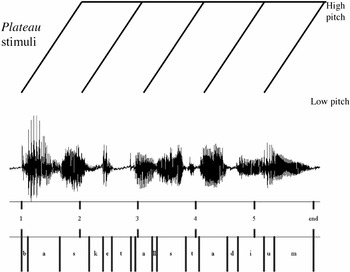
The other stimulus group for each speaker was constructed by varying the starting point of the rise in exactly the same way as for the “gradient” group, but for this group the rise took the same slope, namely, the sharpest rise (stimulus 5) from the “gradient” group. This manipulation therefore varies the alignment of the rise onset while at the same time varying the end point of the rising movement, so that there are differing lengths of pitch “plateau” at the high point of the movement. Accordingly, these stimuli are referred to as the “plateau” stimuli (see Figure 7). The purpose of the two contour types resulting from these manipulations was to investigate what is important in having an early or late rise—the point at which the rise starts or the amount of pitch information at the higher level.

Schematic representation of the “plateau” stimuli used in the perceptual experiment, time-aligned with speech data from the female voice.
Zwartz and Warren (2003) presented results from 19 native speakers of NZE (students at Victoria University of Wellington), who listened to randomly ordered stimuli presented over headphones. For each stimulus they made a forced-choice decision as to whether the utterance was intended as a statement or a question, and then indicated on a five-point scale how confident they were in that choice. The instructions to the subjects included two scenarios—in one of these it was shown that the sentence used to make the stimuli could be uttered as a question, in the other it was shown how it could be a statement.
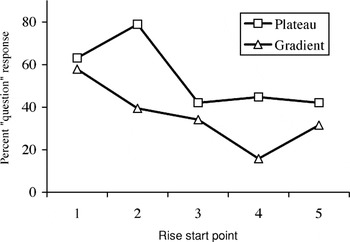
The data reported by Zwartz and Warren (2003) have been reanalyzed for this article, using the same hierarchical log-linear analysis employed in the analysis of rise start locations for the map task data presented previously. In the case of the forced-choice data, the dependent variable was the number of “question” responses for each stimulus (out of a maximum of 19), and the independent variables were the speaker Sex, the Contour type (gradient or plateau) and the Rise start point (1–5). The only significant effects in this analysis were the Contour type (G2 = 7.21, df 1, p < .01) and Rise start point (G2 = 12.95, df 4, p < .02). Figure 8 shows the percentage of question responses for each Contour type across the five start points, collapsing over the nonsignificant Sex variable. It is clear that the main effect of Contour type reflects the higher “question” response for the plateau stimuli than for the gradient stimuli, whereas the main effect of starting point arises because later starting points attract higher “statement” scores. The confidence ratings given by participants for their decisions support the patterns seen in Figure 8, with higher average ratings for the more frequently chosen responses, so that, for instance, “question” judgments for materials with a rise starting at point 1 were rated more highly than “question” judgments for material with a rise starting at point 5, and so on.

Percent “question” response scores in the forced-choice experiment, for gradient and plateau stimuli, collapsed across male and female speakers.
This small-scale study shows that early rises are more likely to result in question judgments, and late rises in statement judgments, reflecting the observed tendency in the production data presented by Warren and Daly (2005) and discussed earlier in this article. It also shows that this alignment difference is not associated only with male speakers, because the same pattern of results was found for both the male and the female voice used in this study (i.e., speaker sex was not a significant factor). Finally, the significant difference between the contour types indicates that it is not just the alignment of the rise start that is important, but also the shape of the rise. A common feature to these two results is, of course, the amount of high pitch information being conveyed. The plateau stimuli have a period of sustained high pitch, whereas for both contour types the early rises have a higher overall average pitch level than the late rises. (As an indication of how this varies, consider that the areas to the right of and below the pitch contours in Figures 6 and 7 vary according to the amount of high pitch information. This area measured for the first stimulus in the gradient series is equivalent to that for the third stimulus in the plateau series.) A possible cueing factor for question utterances therefore may be that there is a good amount of high pitch in the accent unit. Or conversely, the property that distinguishes HRT rises on statements is that they are late and dramatic. In terms of the response scores shown in Figure 8, it would seem that the best “question” rise would be one with a quick early rise (somewhere in the first two fifths of the accent unit) to a sustained high level, whereas the best “statement” rise is a late rise to the end point of the contour. As Figures 6 and 7 show, these later rises (start points 3–5) start on a post-nuclear strong or weak syllable in the sequence “-ball stadium.” These results from our perceptual study are clearly compatible with the production data from the map task.
CHANGE IN INTONATION
If differences in the rise starting points do indeed have the functional load indicated by this study, then it is tempting to argue that the difference observed in the map task data from young speakers is a difference that is developing to provide a means for distinguishing between question and statement rises. In other words, a pattern of change in NZE might be something like the following: time 1—rises signal questions only; time 2—a subset of the same rises are used (as HRTs) for certain statement types (this would be the situation observed by Ladd when he remarked on there being no phonetic difference between rises used for statements and for questions); time 3—a phonetic difference develops between statement rises and question rises, which may over time lead to a phonological contrast.
Notice that if this is a recent change, then the pattern of the young speakers' rises in the map task data suggests that the change is from late rises (found predominantly on statements and in female speech) to early rises for questions (to date, more evident for men than for women). There are two reasons why we might be suspicious of such an interpretation. One is that it implies that men are leading the change, whereas the majority of changes that have been observed for NZE have been instigated by women (Holmes, 1997), including the increased incidence in HRTs (Ainsworth, 1994; Britain, 1992; Warren & Britain, 2000). The other is that it suggests that the late-aligned rise is a standard rise shape, and the earlier alignment an innovation, whereas previous observations have been that Antipodean HRT rises climb from the accented syllable through to the end of the phrase (Guy & Vonwiller, 1989; Ladd, 1996). An alternative interpretation of the data is that the innovation is in the later rise, which is being used for statements (Figure 3) and predominantly by women (Figure 4).
To investigate these possibilities, we look now at data from older speakers, taken from the NZSED map task corpus. These data are taken from speakers in the “mid-age” group of the database (the 30–45 age range).3
NZSED also contains map task data for older speakers (in the 45–60 age range), but this sample produces too few rises for clear trends to be visible in comparison with the other groups.
Simple count distributions of rises in questions and statements produced by mid-age and young NZE speakers. Numbers in parentheses normalize the simple counts to account for differences in the overall number of speaker turns for each of the speaker groups (as defined by sex and age).

There are a number of notable features in the distribution of rises shown in Table 1. First, the female participants use more rises per turn than the males, following the pattern noted by Ainsworth and others for HRTs in both NZE and Australian English (Ainsworth, 1994; Britain, 1992; Guy et al., 1986), but in this case this also extends to question rises. Second, rises in the data are more likely to be found on statements than on questions. (Almost two-thirds of rises are statement rises. Many questions will, of course, also be syntactically marked as such, which may reduce the functional load of rising intonation for questions.) Third, rises are twice as frequent in the speech of the younger speakers, again reflecting previous findings (reviewed in Warren & Britain, 2000). These three main effects are highly significant in hierarchical log-linear analysis of the raw and normalized counts in Table 1. For the normalized data, Sex: G2 = 49.84, Sentence Type: G2 = 40.90, Age: G2 = 29.47, all with df 1, and p < .001. In addition, Sex interacted with Sentence Type, primarily because the difference in rise incidence on statements and questions was greater for the male speakers, who had only half as many rises on questions as on statements. The normalized data had 62 rises on male questions, 129 on male statements, 114 on female questions, and 161 on female statements: G2 = 24.31, df 1, p < .05.
The same statistical analysis was conducted on the mid-age group data as reported previously for the young speakers, that is, a hierarchical log-linear analysis with speaker Sex, Sentence Type, and rise onset Position (nuclear syllable, MSPNS, weak post-nuclear syllable) as factors, using the polysyllabic accent units as input data.4
Some caution must be exercised with this analysis, as the male data have zero frequencies for rises starting on the accented syllable.
For both this and the following analysis, the same significant effects were revealed in an analysis with data normalized for the differences in interaction length (numbers of turns) between males and females.

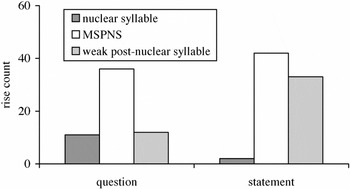
Distributions of rise onsets in questions and statements from mid-age NZE speakers in the map task: on the nuclear syllable, a metrically strong post-nuclear syllable (MSPNS), or a weak post-nuclear syllable.

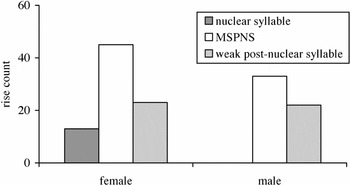
Distributions of rise onsets in female and male utterances from mid-age NZE speakers in the map task: on the nuclear syllable, a metrically strong post-nuclear syllable (MSPNS), or a weak post-nuclear syllable.
A statistical comparison was made of the polysyllabic rise data from young and mid-age speakers, in which the distributional data from the separate analyses were entered into a single analysis with speaker Age added to the three previously studied factors. This analysis showed significant main effects for all four factors. There are more rises from younger speakers than from mid-age speakers (G2 = 22.17, df 1, p < .001) and more from women than from men (G2 = 33.43, df 1, p < .001), the combined data set contains more statement rises than question rises (G2 = 8.41, df 1, p < .005), and rises are more likely to start after than on the nuclear syllable (G2 = 41.40, df 2, p < .001). Age interacted significantly with rise onset Position, largely because the younger speakers have a greater proportion of rises that start at the nuclear syllable, and fewer that start on a MSPNS, compared with the mid-age speakers (G2 = 18.55, df 2, p < .001). Sentence Type interacted with speaker Sex (G2 = 6.58, df 1, p < .01)—while both men and women are more likely to have rises on statements than on questions, this difference is more marked for the men, largely because they have fewer question rises. Sentence Type also interacted with rise onset Position (G2 = 33.27, df 2, p < .001)—the greater incidence of late rises particularly characterizes statement rises. The only other significant effect was the three-way interaction of speaker Age, Sex, and rise onset Position (G2 = 29.93, df 5, p < .001, compare Figures 4 and 10), which shows that although young and mid-age women have similar distributions of early and late rises, the men show a marked difference in the pattern between mid-age and young speakers, with the young speakers showing early rises and the mid-age speakers showing none.
This analysis shows a generational difference in the use and shape of rising intonation. In the mid-age sample we see that women alone have early rises and that apart from these early rises, which are mainly limited to questions, the norm appears to be for later rise onsets. In the younger group we found that early rises were more typical of the male speakers, especially of their questions (Warren & Daly, 2005). The simplest analysis of this pattern in terms of a change in the patterning of rises would appear to be that the norm for NZE is a late rise onset, that early rises were first introduced by female speakers, predominantly for questions, and that this pattern was subsequently taken up by males. This contradicts the argument presented at the beginning of this section, that the innovation is more likely to be one of late rises being used by women for statements, but is compatible with the data from both the mid-age and younger groups of speakers analyzed here.
DISCUSSION
The three sets of data reported in this article have tried to track variation and change in rises as an intonational variable in New Zealand English. The older generation of speakers represented in the analysis predominantly uses rises that start late, with rise onsets aligning with strong or weak post-nuclear syllables, in both questions and statements (Figure 9). The women in this mid-age sample additionally show a small number of rises on the nuclear syllable (Figure 10). Overall, the younger generation makes greater use of intonational rises (see Table 1), and compared with the mid-age speakers, this younger generation shows an increased proportion of early rises, especially in questions (Figure 3) and in male speech (Figure 4). The early rises are more readily interpreted as question rises than the later rises (Figure 8), for both male and female voices.
It appears from these data that the characterization of the HRT as a tune that rises steadily from the nuclear syllable may be too restrictive to describe these rises in NZE. Later-starting rises have, of course, been noted before. Thus, Watt (1994:28ff.) observed for his Toronto English data that the most prominent part of high rises (tone 2 of Halliday, 1970) occurred after the accented syllable, and referred to similar observations by Gussenhoven (1983) for British English. In some cases, Watt's late rises occur as part of a double rise, with either a small initial rise on the accented syllable or a slow gradual rise starting there, followed by a steep later rise, as noted also by de Pijper (1983) in an investigation of British English. Note though, that Watt's examples of late rises are question rises, and not statement rises. In the NZE data we appear to be seeing similar patterns to these also on statement rises, that is, on HRTs proper, as noted earlier by Britain and Newman (1992).
As indicated earlier, a useful framework for analyzing the NZE rise data is provided by AM phonology. Following Grice et al.'s (2000) analysis of a range of language varieties, including some intonation patterns for English, we can argue for a description of the early and late rises in terms of how a phrase accent is anchored. These authors included a discussion of fall-rise patterns in English, and write of the L- phrase accent in these patterns being “copied to two locations: the nuclear syllable and the final lexical stress in the phrase” (2000:171). For NZE rises, it seems that the anchor points for a phrase accent are the nuclear syllable and a post-nuclear syllable, which is a metrically strong post-nuclear syllable if one is present, but is otherwise the final unstressed (peripheral) syllable. The distinction between the late and early rises can thus be described in terms of whether there is a single anchor point for the phrase accent or two anchor points. In the case of two anchor points, a H- phrase accent is anchored to both the nuclear syllable and the later anchor point, whereas with a single anchor point it is only anchored to the later point. This results in a convex rising pattern for the double-anchored rise, and a concave one for the single-anchored rise. The convex early rise pattern seems to typify questions, whereas the concave late rise is associated more with statements.6
Watt (1994) used this concave/convex shape distinction in his description of Toronto English patterns, corresponding to Halliday's tones 2 and 3. However, the examples Watt gave to illustrate this difference suggest that the concave pattern is associated with questions and the convex pattern with statements, that is, the opposite pattern to that reported here for NZE.
Although this seems to provide a coherent account for the evidence reported in this article, it is clear that analyzing variation and change in intonation is not straightforward. One reason for this is that intonation conveys a range of linguistic and paralinguistic meanings. It is not simply used to distinguish questions and statements, but also to convey attitude and emotional involvement, and so forth. This makes the task of analyzing variation and change quite different from that involved in the analysis of segmental phonological variables. So, for instance, a distributional approach to segmental phonology, like looking for minimal pairs, will tell us that because [kæp] and [kæb] refer to different objects, an item of headwear and a mode of transport, respectively, [p] and [b] belong to different phonemes, which we might label /p/ and /b/. Having established the categories, we can then explore the variation within the categories (e.g., the amount of aspiration of /p/ in different contexts, both phonetic and social) and track the changes that occur both within and across categories, including mergers. Establishing the phonological categories for intonation is much more complicated. The minimal pair technique just illustrated for segmental phonemes depends on the Saussurian dichotomy of content and form, that is, a change in signified meaning is occasioned by a minimal contrastive change in form. When we turn to intonation, we find, as noted earlier, that the meanings are much more complex and less referential, and therefore more difficult to pin down. It is more difficult to identify the meaning that corresponds to a particular intonational contour or the meaning change that correlates with a difference between two intonational forms. On the form side, even establishing the formal intonational primitives is a complex task, on which there is disagreement among experts. There have, however, been some notable attempts to characterize some of the basic meaning-form relationships in intonation, such as the decomposition of intonation contours into meaningful parts within the AM framework (e.g., Pierrehumbert & Hirschberg, 1990).
There are a number of empirical approaches that intonational analysis can take, and has taken, to this problem of defining intonational properties and their variation. One is to try to limit the meanings investigated by asking informants to read prepared sentences that include minimally contrastive meanings. The IViE (Intonational Variation in English) project included sentence lists with this as an explicit goal (Grabe, Post, & Nolan, 2001), including such statement/question pairs as: He is on the lilo versus He is on the lilo? or You remembered the lilies versus You remembered the lilies? But even here the issue remains of what kind of question is intended by the speaker. Investigators might be assuming a decontextualized “neutral” question, but it is not clear that this is going to be the meaning intended by all participants equally, and additional overlaid meanings may help shape the intonation contours used. There is, of course, a long history of attempting to unravel the link between intonation and meaning (including attitudinal meaning), for instance, by asking speakers or readers to produce an utterance with an intended meaning or range of meanings (cf. Osser, 1964, referred to by Ladd, 1980) or by manipulating the intonation contour of utterances in resynthesis and then eliciting judgments of their meanings (cf. Lieberman & Michaels, 1972; Uldall, 1972). Current work on NZE applies similar techniques in an attempt to characterize the meanings conveyed by this variety, as well as its typical tunes (Vermillion, 2003).
Previous HRT studies have typically taken a broader approach, by identifying and tabulating the incidence of HRTs in larger, usually spontaneous, samples of speech. In some of this research there is an (implicit) assumption that the HRT has a common meaning, and that there is therefore a definable form-content correspondence. Although the distribution of HRTs with respect to text types and to the stages of the unfolding of narratives seems to support some common denominator to their meaning (Warren & Britain, 2000), there is clearly still scope for variation in aspects of meaning being conveyed alongside the features associable with HRT usage. This may leave the investigator uncertain as to whether any observed variation in HRT realization in spontaneous speech is a sociophonetic variable, or simply variation in other aspects of the meaning being conveyed. Of course, these two sources of variation may under certain circumstances be correlated, for instance, if women and men typically ask different types of questions from each other, they may consequently use different intonation patterns.
The present approach to the analysis of variation and change in intonation has been to use a combination of methods. Through the inclusion of experimental perceptual results alongside observational data, this article demonstrates that the relationship between rise alignments and sentence types in the data presented by Warren and Daly (2005) is more than a coincidence that might be better explained by reference to other sources of variation that may have influenced our young speakers' productions. The subsequent comparison of mid-age and young speakers allows a description of what appears to be a generational difference in intonational patterns. A framework within which an account for such a difference might be developed is the typology of intonational differences proposed by Ladd (1996), based on the framework for segmental differences developed by Wells (1982). Ladd described four ways in which the intonation of two languages or two varieties of a language might differ: semantic, systemic, realizational, and phonotactic.
Semantic differences occur where identical tunes in two languages or varieties have different meanings. Conveniently perhaps for the current discussion, the example given by Ladd is the HRT. As he is not aware of any phonetic difference between HRT rises and question rises (see the quotation to this effect earlier in this article), Ladd argued that the difference between English varieties that do and do not have the HRT (as a rise on statements) is essentially a semantic one, because the same intonation contour is used to convey different meanings depending on whether it is a statement rise or a question rise. The same tune has an additional meaning or function in HRT varieties.
Systemic differences arise when languages or varieties have differences in their inventories of phonologically distinct tunes, irrespective of whether the differences might also correspond to semantic differences. Again, Ladd referred to the HRT here, saying that it differs from the rise, described as a rise-plateau-slump, that is found in Urban Northern British (UNB) both in its form and its function (the UNB rise being a normal declarative contour, whereas the HRT rise is described as a request for feedback).
Realizational differences exist when phonologically identical tunes have different phonetic realizations. Ladd's examples here have to do with alignment differences, such as the position of a pitch peak associated with a final fall in English and Italian. Similar observations are found in research on English and German (Grabe, 1998).
Phonotactic differences are differences in the permitted structures of tunes. Ladd cited here an ideolectal difference. Whereas most speakers of English have a constraint that associates pitch accents with stressed syllables, one of Ladd's acquaintances often pronounced probably with an extra accent on the final syllable. Low and others have noted similar patterns of additional accents in varieties such as Singapore English (Low, 1998).
If this framework is applied to the patterning of rise alignments in NZE questions and statements, then I believe that we are witnessing not only a semantic difference between varieties (i.e., rises for both questions and statements in NZE, but only for questions elsewhere), but also a systemic difference for a particular subgroup of speakers (i.e., the younger NZE speakers who employ different rises for questions and for statements). (See Fletcher et al., 2005, for a discussion of differences between question and statement rises in Australian English.) The significant difference in the perceptual study between responses to the two continua suggests also that our study of rise alignment needs to be extended to include an analysis of the shapes of the rises (e.g., in terms of convex and concave patterns), and not just the point at which the rise starts. The fact that listeners in the perceptual study identify early rises as more likely to be indicators of questions suggests that the novel systemic pattern is quite well established, though clearly the responses shown in Figure 8 are not categorical, that is, an early rise is not guaranteed to result in a “question” response. It remains to be seen whether the pattern for the younger speakers becomes established for the NZE group as a whole, or whether it is a pattern difference that is associated with youth culture and which may therefore fade as the younger group moves into middle age.
Of course, even if the data presented in this article indicate that there is a change in progress, there is scope (for native speakers as well as for expert observers) to view variation in terms of realizational differences, and potentially therefore to interpret the differences as sociophonetic variation, particularly if the change is more noticeable in one social group than in another. Thus, one analysis of the rise alignment data presented by Warren and Daly (2005) might be that—in contrast to one stereotype of their sleeping habits—young New Zealand men rise early.
References
REFERENCES
Ainsworth, Helen.
(1994).
The emergence of the High Rising Terminal contour in the speech of
New Zealand children.
Te Reo
37:3–20.Google Scholar
Allan, Keith.
(1984).
The component functions of the high rise terminal contour in
Australian declarative sentences.
Australian Journal of Linguistics
4(1):19–32.Google Scholar
Benton, Richard.
(1966).
Research into the English language difficulties of Maori school
children 1963–1964.
Wellington:
Maori Education Foundation.
Boersma, Paul, &
Weenink, David.
(2003).
Praat—doing phonetics by computer (Version 4.0.51).
http://www.praat.org.
Britain, David.
(1992).
Linguistic change in intonation: The use of HR terminals in New
Zealand English.
Language Variation and Change
4:77–104.Google Scholar
Britain, David, &
Newman, John.
(1992).
High rising terminals in New Zealand English.
Journal of the International Phonetic Association
22:1–11.Google Scholar
Ching, Marvin.
(1982).
The question intonation in assertions.
American Speech
57:95–107.Google Scholar
Cruttenden, Alan.
(1995).
Rises in English. In
J. Windsor-Lewis (ed.),
Studies in general and English phonetics: Essays in honour of
Professor J. D. O'Connor.
London:
Routledge.
155–173.
de Pijper, Jan R.
(1983).
Modelling British English intonation: An analysis by resynthesis of
British English intonation.
The Hague:
Mouton.
Dineen, Anne.
(1992).
High rise tones and Australian English intonation: A descriptive
problem.
In
T. Dutton,
M. Ross, &
D. Tryon (eds.),
The language game: Papers in memory of Donald C. Laycock.
Canberra:
Department of Linguistics, Australian National University.
115–124.
Fletcher, Janet,
Grabe, Esther, &
Warren, Paul.
(2005).
Intonational variation in four dialects of English: The high rising
tone. In
S.-A. Jun (ed.),
Prosodic typology: The phonology of intonation and phrasing.
Oxford:
Oxford University Press.
390–409.
Fletcher, Janet, &
Harrington, Jonathan.
(2001).
High-rising terminals and fall-rise tunes in Australian
English.
Phonetica
58:215–229.Google Scholar
Grabe, Esther.
(1998).
Comparative intonational phonology: English and German.
Doctoral dissertation,
published as MPI Series in Psycholinguistics, 7, Max Planck
Institute for Psycholinguistics, Nijmegen.
Grabe, Esther,
Post, Brechtje, &
Nolan, Francis.
(2001).
The IViE Corpus.
Retrieved September 30, 2003, from
http://www.phon.ox.ac.uk/~esther/ivyweb.
Grice, Martine,
Ladd, D. Robert, &
Arvaniti, Amalia.
(2000).
On the place of phrase accents in intonational phonology.
Phonology
17:143–185.Google Scholar
Gussenhoven, Carlos.
(1983).
A semantic analysis of the nuclear tones of English.
Bloomington:
Indiana University Linguistics Club.
Guy, Gregory,
Horvath, Barbara,
Vonwiller, Julia,
Daisley, Elaine, &
Rogers, Inge.
(1986).
An intonational change in progress in Australian English.
Language in Society
15(1):22–52.Google Scholar
Guy, Gregory, &
Vonwiller, Julia.
(1984).
The meaning of an intonation in Australian English.
Australian Journal of Linguistics
4(1):1–17.Google Scholar
Guy, Gregory, &
Vonwiller, Julia.
(1989).
The high rising tone in Australian English. In
P. B. D. Collins (ed.),
Australian English: The language of a new society.
Brisbane:
University of Queensland Press.
21–34.
Halliday, Michael.
(1970).
A course in spoken English: Intonation.
Oxford:
Oxford University Press.
Holmes, Janet.
(1997).
Setting new standards: Sound changes and gender in New Zealand
English.
English World-Wide
18(1):107–142.Google Scholar
Horvath, Barbara.
(1985).
Variation in Australian English.
Cambridge:
Cambridge University Press.
James, Eric,
Mahut, Christopher, &
Latkiewicz, George.
(1989).
The investigation of an apparently new intonation pattern in Toronto
English.
Information Communication
(Speech and Voice Society and Phonetics Laboratory, University of
Toronto)
10:11–17.Google Scholar
Ladd, D. Robert.
(1980).
The structure of intonational meaning: Evidence from English.
Bloomington:
Indiana University Press.
Ladd, D. Robert.
(1996).
Intonational phonology.
Cambridge:
Cambridge University Press.
Lickley, Robin J.,
Schepman, Astrid, &
Ladd, D. Robert.
(forthcoming).
Alignment of ‘Phrase Accent’ lows in Dutch
falling–rising questions: Theoretical and methodological
implications.
Submitted to
Language and Speech.
Lieberman, Philip, &
Michaels, Sheldon.
(1972).
Some aspects of fundamental frequency and envelope amplitude as
related to the emotional content of speech.
In
D. Bolinger (ed.),
Intonation.
Harmondsworth:
Penguin.
235–249.
Low, Ee Ling.
(1998).
Prosodic prominence in Singapore English.
Unpublished Doctoral dissertation,
University of Cambridge, Cambridge.
McGregor, R.
(1980).
The social distribution of an Australian English intonation
contour.
Working Papers of the Speech and Language Research Centre
(School of English and Linguistics, Macquarie University)
2:1–26.Google Scholar
Meyerhoff, Miriam.
(1991).
Grounding and overcoming obstacles: The positive politeness
motivations of High Rise Terminals.
Unpublished manuscript,
Victoria University of Wellington,
Wellington, New Zealand.
O'Connor, J. D., &
Arnold, G. F.
(1973).
Intonation of colloquial English.
London:
Longman.
Osser, Henry A.
(1964).
A ‘distinctive features’ analysis of the vocal
communication of emotion.
Unpublished Doctoral dissertation,
Cornell University.
Paddock, Harold.
(1981).
A dialect survey of Carbonear, Newfoundland.
Urbana. IL:
American Dialect Society.
Pierrehumbert, Janet.
(1980).
The phonology and phonetics of English intonation.
Unpublished Doctoral dissertation,
MIT.
Pierrehumbert, Janet, &
Hirschberg, Julia.
(1990).
The meaning of intonation contours in the interpretation of
discourse.
In
M. Pollack &
P. Cohen (eds.),
Plans and intentions in communication and discourse.
Cambridge, MA:
MIT Press.
160–197.
Rait, Amy.
(1997).
The use of HRTs in British English.
Unpublished undergraduate dissertation,
University of York,
York, UK.
Rodenburg, Patsy.
(1996, March 19).
Quoted in an article entitled ‘Soap opera Australian-speak
raises the tone’.
The Times (London), p. 1.
Shobbrook, Katherine, &
House, Jill.
(2003).
High Rising Tones in Southern British English. In
M. J. Solé,
D. Recasens, &
J. Romero (eds.),
15th International Congress of Phonetic Sciences.
Barcelona:
Universitat Autonoma de Barcelona.
1273–1276.
Steele, Patti.
(1996).
A discourse approach to the function of Australian high rising tone
in narrative.
Unpublished B.A. (Honours) dissertation,
Australian National University,
Canberra.
Sudbury, Andrea.
(2000).
Variation and change in Falkland Island English.
Unpublished Doctoral dissertation,
University of Essex, Colchester.
Sudbury, Andrea.
(2001).
Falkland Islands English: A southern hemisphere variety?
English World-Wide
22(1):55–80.Google Scholar
Uldall, Elizabeth.
(1972).
Dimensions of meaning in intonation. In
D. Bolinger (ed.),
Intonation.
Harmondsworth:
Penguin.
250–259.
Vermillion, Patricia.
(2003).
The ups and downs of Kiwis: An experiment investigating tonal cues
used to identify NZE intonation.
Wellington Working Papers in Linguistics
15:17–30.Google Scholar
Warren, Paul.
(2002a)
New Zealand Spoken English Database, 2002,
from http://www.vuw.ac.nz/lals/nzsed.
Warren, Paul.
(2002b).
NZSED: Building and using a speech database for New Zealand
English.
New Zealand English Journal
16:53–58.Google Scholar
Warren, Paul, &
Britain, David.
(2000).
Intonation and prosody in New Zealand English. In
A. Bell &
K. Kuiper (eds.),
New Zealand English.
Wellington:
Victoria University Press.
146–172.
Warren, Paul, &
Daly, Nicola.
(2005).
Characterizing New Zealand English intonation: Broad and narrow
analysis.
In
A. Bell,
R. Harlow, &
D. Starks (eds.),
Languages of New Zealand.
Wellington:
Victoria University Press.
Watt, David L. E.
(1994).
The phonology and semology of intonation in English: An instrumental
and systemic perspective.
Bloomington:
Indiana University Linguistics Club.
Wells, John C.
(1982).
Accents of English.
Cambridge:
Cambridge University Press.
Zwartz, Joel.
(2002).
Lateness of rise as a factor in listener interpretation of
HRTs.
Unpublished Honours paper,
Victoria University of Wellington,
Wellington, New Zealand.
Zwartz, Joel, &
Warren, Paul.
(2003).
This is a statement? Lateness of rise as a factor in listener
interpretation of HRTs.
Wellington Working Papers in Linguistics
15:51–62.Google Scholar
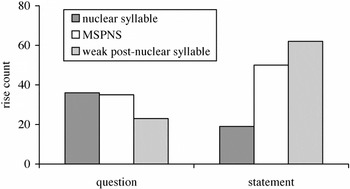
Distributions of rise onsets in questions and statements from young NZE speakers in the map task: on the nuclear syllable, a metrically strong post-nuclear syllable (MSPNS), or a weak post-nuclear syllable.
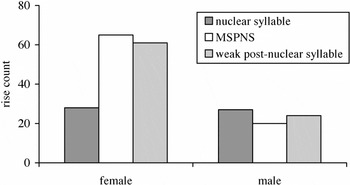
Distributions of rise onsets in female and male utterances from young NZE speakers in the map task: on the nuclear syllable, a metrically strong post-nuclear syllable (MSPNS), or a weak post-nuclear syllable.
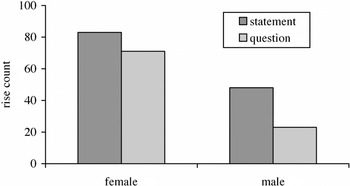
Distributions of rises in female and male statement and question utterances from young NZE speakers in the map task.
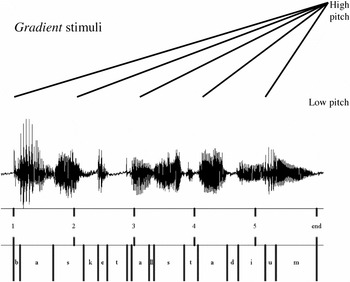
Schematic representation of the “gradient” stimuli used in the perceptual experiment, time-aligned with speech data from the female voice.
Schematic representation of the “plateau” stimuli used in the perceptual experiment, time-aligned with speech data from the female voice.
Percent “question” response scores in the forced-choice experiment, for gradient and plateau stimuli, collapsed across male and female speakers.

Simple count distributions of rises in questions and statements produced by mid-age and young NZE speakers. Numbers in parentheses normalize the simple counts to account for differences in the overall number of speaker turns for each of the speaker groups (as defined by sex and age).
Distributions of rise onsets in questions and statements from mid-age NZE speakers in the map task: on the nuclear syllable, a metrically strong post-nuclear syllable (MSPNS), or a weak post-nuclear syllable.
Distributions of rise onsets in female and male utterances from mid-age NZE speakers in the map task: on the nuclear syllable, a metrically strong post-nuclear syllable (MSPNS), or a weak post-nuclear syllable.
 You have
Access
- 46
- Cited by