

Introduction
Improvement of health-related quality traits like antioxidants, plant phenols, vitamins and anti-cancer compounds is a major challenge for potato breeding in the future (Van Gijssel, Reference Van Gijssel, Haverkort and Struik2005). Regarding their consumption, potatoes are considered as a significant antioxidant source in human nutrition (Lachman and Hamouz, Reference Lachman and Hamouz2005). Besides ascorbic acid, α-tocopherol and β-carotene, also plant phenols like caffeic acid and chlorogenic acid are efficient antioxidants (Byers and Perry, Reference Byers and Perry1992). When consumed in the diet, phenolic compounds have the ability to protect human cells against oxidative damage (Blomhoff, Reference Blomhoff2005). In view of health-related quality traits, wild potatoes are increasingly seen as an interesting gene pool in breeding.
In this study, two cultivated (Solanum tuberosum subsp. andigena, adg; S. phureja, phu) and two wild, tuber-bearing Solanum species (S. chacoense, chc; S. pinnatisectum, pnt), each represented by several accessions and genotypes, were examined for their antioxidant potential assessed as ascorbic acid (ACE) and trolox equivalent (TXE) as well as their contents of soluble phenols and soluble proteins.
Materials and methods
Seed tubers of cultivated and wild Solanum species, each represented by two accessions and several genotypes (Table 1), were introduced from the Leibniz Institute of Plant Genetics and Crop Plant Research, Potato Genebank, Groß Lüsewitz, Germany. The Solanum species were chosen according to (1) information about resistance properties to major potato diseases such as soft rot, blackleg, late blight etc. (Hawkes, Reference Hawkes, Bradshaw and Mackay1994), and (2) their ability to produce enough tubers with an acceptable size ( ≥ 10 mm in diameter) under conditions used in this work. The following species and accessions were involved in the test series: (adg) 31881, 34155; (chc) 30161, 30180; (phu) 31455, 31467; (pnt) 31598, 31606.
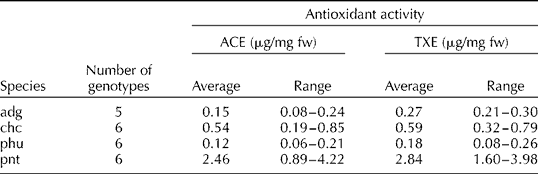
Concentrations of water (ACE) and lipid-soluble antioxidants (TXE) in tuber tissue of cultivated and wild Solanum species
Ten plants per genotype were grown in 130 mm diameter pots under a shelter from April to October 2008. After harvest, tubers were stored in a controlled environment at 5°C. The analyses described below were performed in duplicate with standard deviation ≤ 5%, and 20 tubers were randomly taken as an average sample for each genotype.
Assay of the antioxidant activity, i.e. ascorbic acid and trolox equivalent (TXE), was performed on a photochem instrument (Analytik Jena AG, Jena, Germany) as described by Wegener et al. (Reference Wegener, Jansen, Jürgens and Schütze2009). The amounts of soluble phenols in extract samples prepared from tuber tissue as detailed by Wegener et al. (Reference Wegener, Jansen, Jürgens and Schütze2009) were measured using Folin–Ciocalteu reagent (Sigma-Aldrich, Taufkirchen, Germany) according to Cahill and McComb (Reference Cahill and McComb1992). The quantities of soluble proteins were determined in tuber tissue extracts by means of a Bradford assay using RotiR-Quant reagent (Roth, Germany), according to the manufacturer recommendations.
Statistic analyses
The difference in phenol, protein and antioxidant contents between pnt and the other Solanum species was compared by means of t-test, and P < 0.05 was considered significant. Correlation coefficients were calculated between ACE and TXE, soluble phenols and antioxidants, and between proteins and the latter.
Results and discussion
The cultivated and wild Solanum species and genotypes varied notably in their antioxidant activities (Table 1) as well as in contents of soluble phenols and proteins (Table 2). Of the four Solanum species tested in this study, S. pinnatisectum exhibited on average the highest antioxidant potential, including water (ACE) and lipid- (TXE) soluble antioxidants (Table 1). Pnt also exceeded the other three Solanum species in quantities of soluble phenols and soluble proteins present in its tuber tissue (Table 2). Especially, pnt 31598-2 was outstanding in its antioxidant capacity with values of 4.22 μg/mg fresh weight (fw) for ACE and 3.98 μg/mg fw for TXE, and it also displayed the highest level of soluble phenols (2.84 g/kg fw) in its tuber tissue. This fact concurred with results of the years before, i.e. 2006/07 (Wegener and Jansen, Reference Wegener, Jansen, Feldmann, Alford and Furk2009). With it, pnt 31598-2 exhibited considerably higher amounts of phenols as current potato cultivars, e.g. Adretta (0.45 g/kg fw), Romance (0.68 g/kg fw) and Désirée (0.98 g/kg fw) analyzed in another work (Wegener et al., Reference Wegener, Jansen, Jürgens and Schütze2009).
Concentrations of soluble phenols and proteins in tuber tissue of cultivated and wild Solanum species
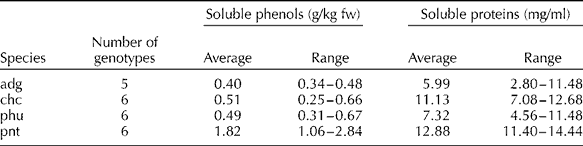
The differences between pnt and the other Solanum species in ACE (adg and phu, P < 0.01; chc, P < 0.05), TXE (adg and phu, P < 0.001; chc, P < 0.01), soluble phenols (all three, P < 0.01) and soluble proteins (adg and phu, P < 0.01) were statistically significant, except protein contents of the wild species chc, which did not differ significantly from those of pnt (Table 2). In addition, chc revealed higher protein values than the cultivated species adg and phu (both, P < 0.05), and it also differed significantly in its antioxidant potential including ACE (adg and phu, P < 0.05) and TXE (both, P < 0.01) from the latter (Table 1). Among the species tested in this work, S. phureja ranked on the lowest level of antioxidant potential (Table 1), and S. tuberosum subsp. andigena displayed the lowest amounts of phenols and proteins (Table 2) in its tuber tissue.
The ACE was correlated with the TXE (r = 0.94, P < 0.01, n = 23). Moreover, a significant correlation (P < 0.05, all) was observed between ACE and phenols (r = 0.93), ACE and proteins (r = 0.52), TXE and phenols (r = 0.96), and TXE and proteins (r = 0.57). It seems therefore that soluble phenols and soluble proteins accumulated in tuber tissue substantially contributed to the antioxidant activity of potatoes.
The results revealed that wild, tuber-bearing Solanum species, i.e. pnt and chc examined in this work, are indeed an interesting source for health-related quality traits like antioxidants, plant phenols and valuable proteins. Above all, an inclusion of S. pinnatisectum in breeding could be profitable for the enhancement of the antioxidant potential in new potato cultivars.



