




No CrossRef data available.
KAMINALJUYU STELA 10: Script classification and linguistic affiliation
Published online by Cambridge University Press: 19 July 2005
Abstract
This paper examines various lines of evidence for the classification and linguistic affiliation of writing at Late Preclassic Kaminaljuyu. The linguistic evidence for the ethnic composition of the Maya highlands and Pacific slopes during the Late Preclassic period points to contact among Ch'olan-Tzeltalan, Greater K'iche'an, and other non-Mayan languages, and to a dominant political economic role of Ch'olan-Tzeltalan. The epigraphic evidence supports classifying the script together with the Lowland Mayan script, and separately from the Epi-Olmec script, and hints at the presence of uniquely Ch'olan traits, some of which have been pointed out by other authors. A comparison with contemporaneous texts of unambiguous Lowland Mayan (Ch'olan or Yukatekan) affiliation suggests an overlap of orthographic, calligraphic, and semantic traits. Both lines of evidence support the hypotheses that Ch'olan-Tzeltalan speakers were the innovators of the Maya script, and that such a development perhaps took place in the Maya highlands. At the very least, the evidence points to a much closer relationship between the Maya highlands and lowlands during the Late Preclassic than previously thought.
Information
- Type
- Research Article
- Information
- Copyright
- © 2005 Cambridge University Press
During the past few decades scholars have made significant strides in the classification of the writing systems of pre-Hispanic Mesoamerica. Most scholars now agree that there are two major script traditions: the Oaxacan tradition, which gave rise to the Zapotec, Teotihuacan, Xochicalco, Mixtec, and Aztec scripts; and the Southeastern tradition, which gave rise to the Epi-Olmec, Izapa, El Sitio, Takalik Abaj, Kaminaljuyu, El Portón, Chalchuapa, and Lowland Mayan scripts (Coe 1957, 1976; Justeson 1986; Justeson and Mathews 1990; Justeson et al. 1985; Marcus 1976, 1992; Prem 1973; Taube 2000). But many questions remain to be explored in detail, such as the role of Olmec iconography and writing in the development of subsequent scripts, the role of diffusion between scripts, the languages represented in some of the still undeciphered scripts, and the degree of relationship between certain scripts.
This paper concerns the Kaminaljuyu script. Specialists have yet to agree on the classification and linguistic affiliation of the Late Preclassic Kaminaljuyu script. Four major positions exist on the matter (Table 1). Some see it as more closely related to the Classic Lowland Mayan script, perhaps even as its immediate predecessor (Ayala 1983; Fahsen 1987, 1988, 1995, 1996, 2001; Heath-Jones 1959; Justeson and Mathews 1990; Justeson et al. 1985; Marcus 1976; Mora-Marín 1996; Porter 1996; Prem 1973; Thompson 1965). Others see a closer affinity with the Epi-Olmec script and a likely Mixean affiliation (Coe 1976; Justeson and Kaufman 1993). Still others suggest a mixed Epi-Olmec and Lowland Mayan script and a mixed Mixe-Zoquean and Mayan affiliation (Kaplan 1995; Kaufman and Justeson 2001). And a few comment that it is simply premature to attempt to determine its classification and linguistic affiliation (Coe and Kerr 1998; Kaufman and Justeson 2004).
Summary of previous epigraphic proposals

Likewise, the linguistic affiliation of Late Preclassic Kaminaljuyu remains uncertain (Table 2). Some linguists have favored one of two ethnic groups (Campbell and Kaufman 1985; Kaufman 1976, 2000; Justeson et al. 1985): Mixean or Poqom. Other linguists have presented evidence for the presence of Ch'olan(-Tzeltalan) speakers in the Maya Highlands and Pacific slopes during the Late Preclassic period (Campbell 1978, 1984, 1998; Justeson and Fox 1989; Kaufman 2000). This evidence pertains to the diffusion of ritual vocabulary and grammatical traits suggesting that Ch'olan(-Tzeltalan) speakers were in close and intense contact with speakers of highland Mayan languages such as Poqom and with speakers of non-Mayan languages such as Xincan and Lencan, most likely during the Late Preclassic period, suggesting a possible presence in the Maya Highlands (Campbell 1972, 1998; Justeson et al. 1985; Kaufman 1989).
Summary of previous linguistic proposals

In this paper I discuss evidence for the classification and linguistic affiliation of the script and the sociolinguistic context of Kaminaljuyu and other highland and coastal sites. I conclude: (1) that the Kaminaljuyu script is more closely related to the Classic Lowland Mayan script; and (2) that a Ch'olan(-Tzeltalan) model for the linguistic affiliation of its texts is more likely than a Mixean, Poqom, or Xincan model. More tentatively, I hypothesize (3) that a subordinate Poqom ethnolinguistic majority and dominant Ch'olan(-Tzeltalan) ethnolinguistic minority may have inhabited the site during the Late Preclassic period. Before presenting this evidence, I provide a brief background to Late Preclassic Kaminaljuyu and its corpus of texts.
LATE PRECLASSIC KAMINALJUYU
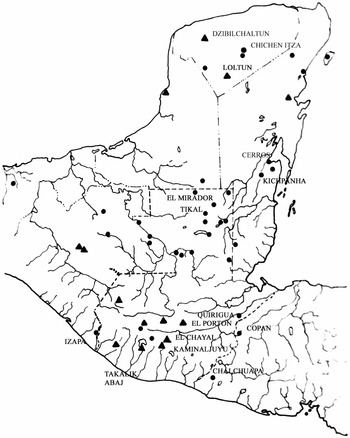
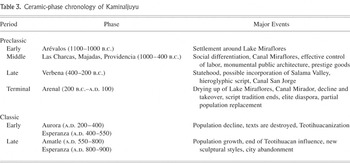
Kaminaljuyu, located in the Valley of Guatemala, enjoyed access to a variety of strategic mineral and agricultural resources (e.g., obsidian, jadeite, cacao) and interregional trade routes (Figure 1, Table 3). According to some authors, Kaminaljuyu developed into a state-level polity during the first part of the Late Preclassic period (ca. 400 b.c.–a.d. 100; Barrientos Q. 2000; Ponciano 2000; Valdés 1997; Valdés and Hatch 1996; but see Michels 1979 for a decentralized model of Kaminaljuyu structure), a process possibly marked by the extension of political control beyond the Valley of Guatemala, possibly incorporating areas such as the Salama Valley, by circa 400 b.c. (Sharer and Sedat 1973, 1987). It developed a diverse sculptural and scribal tradition with strong links to sites in the Pacific slopes of Chiapas, Guatemala, and El Salvador, and the Maya Lowlands. The earliest texts from the Maya area, El Portón Monument 1 (ca. 450–350 b.c.) and Kaminaljuyu Stela 10 (ca. 400–200 b.c.), postdate La Venta Monument 13 (ca. 600–500 b.c.) and are contemporaneous with the Epi-Olmec text on the Chiapa de Corzo sherd (ca. 300 b.c.). Then, during the Terminal Late Preclassic period (ca. a.d. 100–200), a combination of internal and external factors that might have included the drying up of Lake Miraflores and the circumscription by likely Greater K'iche'an groups arriving from the highlands to the northwest, resulted in the collapse of the site by circa a.d. 200. Kaminaljuyu's sculptural and scribal tradition with links to the Pacific coast and the Maya Lowlands came to an end.

Location of Kaminaljuyu with respect to other Late Preclassic sites in the Maya Highlands, the Pacific coast, and the Maya Lowlands.
Ceramic-phase chronology of Kaminaljuyu

Federico Fahsen (2000:2) has shown that several sculptures at Kaminaljuyu carved during this time show captive-display scenes, which he suggests could be evidence of the military conflict that may have led to the city's collapse. The sites of El Portón and Takalik Abaj experienced a marked decline, probably as a result of the events at Kaminaljuyu, and their scribal traditions also come to an end (Hatch et al. 2000). Evidence points to the outright systematic destruction of all glyphic texts at the site, possibly carried out by the invaders (Fahsen 2000), although internal conflict has also been suggested (Parsons 1986, 1988). If, as I propose later, Ch'olan and Greater K'iche'an (e.g., Poqom) speakers co-inhabited Kaminaljuyu, such internal conflict may have been of an interethnic nature. A major ceramic discontinuity is evident in parts of Kaminaljuyu, suggesting that part of the population was replaced; those who remained quickly assimilated culturally to the new occupants (Hatch 2000). What happened after this is not clear. Some suggest that the invasion of Kaminaljuyu resulted in an elite diaspora of sorts, with consequences felt in the Maya Lowlands and the Copan Valley. I revisit this topic at the end of this paper. Next I describe the corpus of texts at Kaminaljuyu, focusing on the characteristics of Stela 10.
CORPUS OF KAMINALJUYU TEXTS
The following texts make up the core of the Kaminaljuyu corpus: Stela 10 (late Verbena phase, 400–200 b.c.), Altars 1 and 2 (early Arenal phase, 200 b.c.–a.d. 1), Monument 65 (early Arenal phase, 200 b.c.–a.d. 1), Stelae 15 and 21 (late Arenal phase, a.d. 1–100), and a jade earring (Esperanza phase, a.d. 400–600). As I argue later, good reasons exist to suppose that the jade earring is an ancestral heirloom dating to the Late Preclassic period; thus, a more conservative range of circa 400 b.c.–a.d. 100 is preferable. For decipherment this corpus is inadequate for three reasons: (1) Most of the texts were intentionally destroyed, rendering them illegible; (2) Even if the texts were in pristine condition, the small sample size and the texts' brevity would preclude a full decipherment; (3) The evidence for the script has yet to be fully and adequately catalogued, documented, and published. It is possible that some of the known Late Preclassic portable texts may have originated in Kaminaljuyu, as suggested based on stylistic grounds by Michael Coe (1973) and James Porter (1996). Because of these obstacles, it is necessary to conduct comparisons between the best example of the Kaminaljuyu corpus—namely, Stela 10—and other early texts of known and unknown provenience from the Maya area. Here I use a drawing of the text on Stela 10 that I have prepared by tracing a rubbing and checking each glyph against the original monument and a cast of the original monument made by Ian Graham. Most of the conclusions I arrive at in this paper can be reached by using two of the previously published drawings of Stela 10.
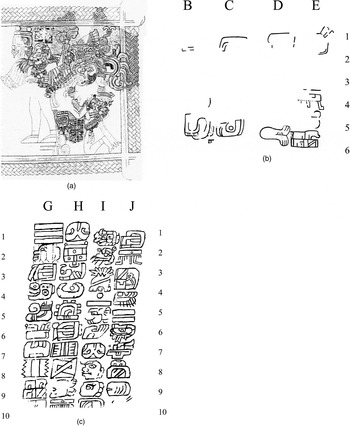
Of the small corpus, Stela 10 (Figure 2a) is the most useful text for four reasons. First, although it is incomplete, it has the longest text in the corpus, consisting of two glyphic panels. The upper-left panel probably contained about 21–25 glyph blocks, including the oversize day count (Figure 2b; oversize day count is seen in Figure 2a). The bottom panel (Figure 2c; oversize day count is seen in Figure 2a) is mostly legible, but incomplete. Taking into account the oversize day count (F1) and 40 glyph blocks in columns (G–J), and the room left below the tenth row of glyphs, it is likely that another 24 glyph blocks were once present. The monument as a whole may have had a total of about 90 glyph blocks. The fact that the bottom panel is incomplete will be an obstacle to any attempts at syntactic parsing of the text.

(a) Kaminaljuyu Stela 10 (drawing by James Porter, used by permission of University of California, Berkeley, and John Graham). (b) Upper glyphic panel on Stela 10: glyph columns B–E (preliminary drawing by the author). (c) Lower glyphic panel on Stela 10: glyph columns G–J (drawing by the author).
Second, more than half of the surviving text is legible. Only six of the glyph blocks in the upper panel are fully or partly legible (A1, B6, C6, E4, D6, E6). The rest of the blocks are damaged beyond secure legibility. In contrast, all but two of the glyphs in the second panel (G10, J10) are fully or partly legible. In total there are about 43 legible glyph blocks, some of which contain more than one sign, and by my estimate the total number of distinct signs is about 38. In other words, the surviving sign inventory is small. Given that it is quite likely that the script is logosyllabic, like Epi-Olmec and Lowland Mayan, one would expect the total sign inventory to be about 400–600 signs, although some typologically similar Old World scripts make do with fewer signs (e.g., Elamite, with 100–140 signs for any given period; Hieroglyphic Luvian, with 200–300 signs for any given period). The evidence from Stela 10 is less than 10% of the estimate of 400–600 signs. Such a small sign inventory also constitutes a major obstacle to decipherment.
Third, Stela 10 has calendrical data in the form of two oversize day counts (A1, F1), one distance number (G1–H1), and two possible additional day counts (I4–J4 and J5–J6). The oversize day counts are of problematic identification. It has been suggested that they correspond to 7-MULUK and 8-OK/IX (Fahsen 1995; Kaplan 1995). However, most of the first day sign is missing, and the remaining details are not obviously diagnostic of any known day sign, including MULUK. The second day sign most clearly resembles a gopher head (for MULUK) or a jaguar head (possibly for IX), but most definitely not a dog head (for OK). These could provide temporal constraints on the narrative and clues to the discourse structure and the semantic content of the text that could be exploited in the decipherment of the script and the text.
Fourth, the associated iconography (Miles 1965; Kappelman 1997; Parsons 1986) and the monument type (Kaplan 1995) could provide further semantic constraints on the subject matter of the text. Thus, the text most likely refers to the three depicted figures, and possibly even to the dedication of the monument itself. The fact that one of the portrayed figures is female should alert us to the likely presence of a female marker. And if the monument is mentioned in the text, one would expect a sign or sign sequence for “throne.” I describe the iconographic themes present on this monument later.
PREVIOUS EPIGRAPHIC AND LINGUISTIC PROPOSALS
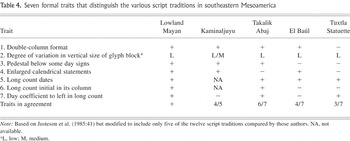
Table 2 presents the major epigraphic proposals for the classification and linguistic affiliation of Kaminaljuyu writing. They vary significantly in the methods used and traits compared, and some of them are mere suggestions that lack any supporting evidence. The proposal that I consider to be the most methodologically cautious and empirically supported is that by John Justeson and colleagues (1985). They classify scripts by taking into account shared formal traits that are not likely to be retentions from an ancestral script or to be independently innovated by different script traditions with no historical connection. They discuss seven formal traits that allow them to distinguish between Epi-Olmec writing and other script traditions in southeastern Mesoamerica (as opposed to the traditions from Oaxaca and central Mexico, which are likely derived from an ancestral Zapotec script), including: double-column format, degree of variation in vertical size of glyph block, pedestal below some day signs, enlarged calendrical statements, Long Count dates, Long Count initial in its column, and day coefficient to left in Long Count (Table 4). Of these, only some are attested on Kaminaljuyu Stela 10. Justeson and colleagues (1985) point out that Stela 10 shows a double-column format based on the sign sequence 15-MONTH at G1-H1, a distance number (Ayala 1983). This format is unique to Lowland Mayan writing; no other known script in the world shows this format. Therefore, it is unlikely to be an independent innovation, much less in two geographically adjacent cultural subareas (i.e., Maya Highlands and Lowlands). Also, Justeson and colleagues (1985) point out that, unlike Epi-Olmec texts, the text on Stela 10 shows a regularized glyph-block size found also at Takalik Abaj, El Baul, and in Lowland Mayan texts. And last, the oversize day counts on Stela 10 show day sign pedestals, a conventionalized design found only at Izapa, Takalik Abaj, and the Maya Lowlands.
Seven formal traits that distinguish the various script traditions in southeastern Mesoamerica

The results by Justeson and colleagues (1985), reanalyzed here due to additional data, show a degree of agreement between Kaminaljuyu and Lowland Mayan writing of 80% in the traits compared. By comparison, the Tuxtla Statuette, an Epi-Olmec text, only shows a 43% agreement with Lowland Mayan writing, and La Mojarra Stela 1, discovered after their monograph was published, would fare no better. In other words, based on purely formal traits that are unlikely to be historical retentions or independent innovations, the Kaminaljuyu and Lowland Mayan scripts can be said to be more closely related to each other than each one is to any other script, and they are likely the same script.
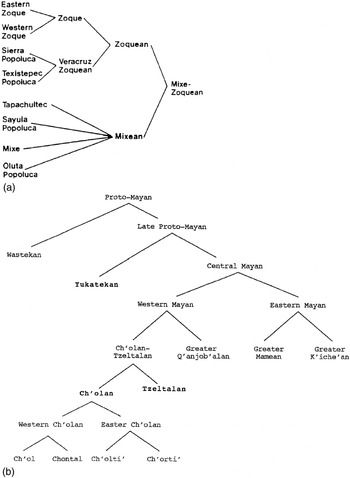
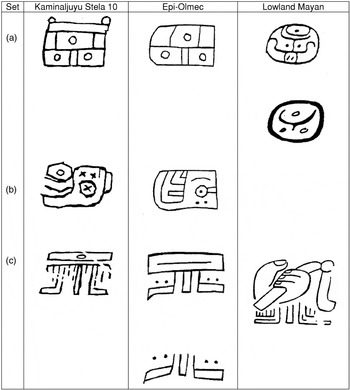
What about the language represented in the text? Because the same script can be used to represent different languages, we cannot make a priori assumptions based on script identity. Epi-Olmec texts represent an early form of Zoquean, a language subgroup belonging to the Mixe-Zoquean language family (Figure 3a; Justeson and Kaufman 1993, 1997; Kaufman and Justeson 2001, 2004). Classic Lowland Mayan texts represent languages that belong to only two of the six major subgroups of Mayan languages (Figure 3b; Justeson and Fox 1989; Justeson et al. 1985; Lacadena and Wichmann 1999, 2000): Ch'olan(-Tzeltalan) and Yukatekan. As already explained (Table 2), Terrence Kaufman (1976, 2000) proposes either Mixean or Poqom for the language spoken at Preclassic Kaminaljuyu based on distributional evidence. In addition, place-name distribution data discussed by Lyle Campbell (1972, 1998) suggest that Xincan speakers were present in parts of the central and eastern highlands and Pacific slopes of Guatemala and in contact with Mayan languages.

Language familes represented in Epi-Olmec and Lowland Mayan texts. (a) Mixe-Zoquean. (b) Ch'olan-Tzeltalan and Yukatekan.
Nevertheless, four lines of evidence exist for the presence of Ch'olan(-Tzeltalan) speakers in the Maya Highlands and Pacific slopes.
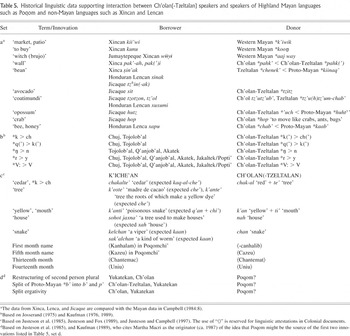
First, Xincan and Lencan languages borrowed most of their agricultural and commerce vocabulary from speakers of Ch'olan(-Tzeltalan) (Table 5, set a). Some of these terms are particularly suggestive of Ch'olan(-Tzeltalan) specifically, even when the term itself is pan-Mayan. For example, the term for “bean,” Proto-Mayan *kiinaq', is found in Xinca as

, in Jicaque as sinak, and in Honduran Lenca as tzhin(-ak). (Campbell [1984:8–9] uses the symbol

to represent a voiceless laminal retroflex fricative present in Xinca.) The initial fricative and affricate sounds in the Xinca

, Jicaque (/s/), and Honduran Lenca (/tzh/) forms are consistent with borrowing from a Ch'olan-Tzeltalan reflex of Proto-Mayan *kiinaq' in which the Ch'olan-Tzeltalan shift of *k to ch (Kaufman and Norman 1984:83–84) had already occurred. While no such term is present in Ch'olan, probably due to loss, it is reconstructed to Proto-Tzeltalan as *chenek', a form that attests to the *k > ch shift (in addition to showing a case of vowel assimilation). Given that Xinca, at least, has word-initial k, even in front of the vowel i, as shown by the loan kii'wi ‘market’, it is likely that it borrowed the term for “bean” from Ch'olan-Tzeltalan during a time when the Ch'olan-Tzeltalan *k > ch shift had occurred. Interestingly, Kaufman (2000) has suggested that Xincan borrowed its basic word order with the verb at the beginning of the sentence from Mayan speakers, though not necessarily from Ch'olan-Tzeltalans, since Proto-Mayan is reconstructed with verb-initial basic word order (England 1991). However, the likely Ch'olan(-Tzeltalan) loan words, and the implied political dominance of Ch'olan(-Tzeltalan) speakers, could suggest that it was Ch'olan(-Tzeltalan) speakers who provided the stimulus for that change.
Historical linguistic data supporting interaction between Ch'olan(-Tzeltalan) speakers and speakers of Highland Mayan languages such as Poqom and non-Mayan languages such as Xincan and Lencan

Second, various Highland Mayan languages may have borrowed phonological and grammatical innovations from Ch'olan(-Tzeltalan) (Table 5, set b; Kaufman 1976, 1989), such as the phonological shift of Proto-Mayan *r to y. While the non-Ch'olan languages invoked in Table 5, set b are from the northwestern highlands of Guatemala and into Chiapas, Mexico, they support the proposition that Ch'olan-Tzeltalan speakers were highly influential throughout the region. Nevertheless, some of the phonological changes mentioned in Table 5, set b (e.g., V: >

) are common and natural changes, from a cross-linguistic point of view, that may not need to be explained in terms of diffusion.
Third, various highland Mayan languages borrowed ritual and commercial vocabulary from Ch'olan(-Tzeltalan). Poqom borrowed several of its month names from Ch'olan(-Tzeltalan) (Table 5, set c; Justeson and Campbell 1997; Justeson and Fox 1989; Justeson et al. 1985). Among these are terms such as 〈Uniu〉 for the fourteenth month name, which reflects the Ch'olan phonological innovations of *oo > uu and *ee > ii, given that Q'anjob'al attests to onew (Justeson and Campbell 1997:48).
Fourth, Ch'olan(-Tzeltalan), as well as Yukatekan, may have borrowed or acquired certain grammatical innovations from Poqom starting in the Late Preclassic period (Table 5, set d; Justeson et al. 1985; Kaufman 1989; personal communication 1987 from Martha Macri to Terence Kaufman). These include the development of split ergativity, the split of Proto-Mayan *b' into *b' and *p', and the restructuring of the second person plural, as summarized in Kaufman (1989). (Even though Yukatekan could have served as an intermediary for the spread of these features from Poqom to Ch'olan[-Tzeltalan], the presence of Ch'olan[-Tzeltalan] loan words in Xincan and Lencan suggests that Ch'olan[-Tzeltalan] was in fact in the highlands and Pacific slopes and could have acquired the Poqom innovations directly. More research is needed to determine whether these innovations originated in Poqom and to test whether they were acquired first by Ch'olan-Tzeltalans or Yukatekans.) The Ch'olan(-Tzeltalan) loan words in Poqom and the possible grammatical borrowings of Poqom in Ch'olan (-Tzeltalan) suggest that Ch'olan(-Tzeltalan) speakers were in contact with these ethnic groups in the central and eastern highlands and Pacific slopes of Guatemala and northwestern El Salvador. In fact, J. Kathryn Josserand (1975) and Nicholas Hopkins (1985) make a good case for the presence of Ch'olan speakers at Chalchuapa based on strong ceramic ties between that site and the Floral Park complex in Belize during the Late Preclassic and Protoclassic periods. Furthermore, the transfer of Poqom phonological and morphosyntactic innovations into Ch'olan(-Tzeltalan) suggests that Poqom and Ch'olan(-Tzeltalan) were in very close interaction, possibly involving bilingualism, though this topic requires a great deal more research.
Interestingly, Hopkins (1985) has suggested that various features of Ch'olan that were apparently borrowed from Yukatekan could have resulted from a situation in which a fraction of the large population of Yukatekan speakers in the Maya Lowlands began to shift to Ch'olan, which was likely spoken by a small population that was nevertheless more politically influential. Thus, while Yukatekan speakers (political substratum) borrowed ritual and political terminology from Ch'olan speakers (political superstratum), Ch'olan acquired Yukatekan grammatical traits from Yukatekan speakers that shifted to Ch'olan.
It is possible that a similar process of substratum language shift could have resulted in the acquisition of Poqom phonological and morphosyntactic innovations by Ch'olan speakers at the same time that Poqom speakers were borrowing prestige terminology from Ch'olan speakers. If close contact between Poqom and Ch'olan(-Tzeltalan) speakers did take place, the most likely places for such interaction would be Kaminaljuyu and El Porton. In other words, given the direction of diffusion of the ritual vocabulary, it seems that Ch'olan(-Tzeltalan) speakers were more powerful than the Poqom speakers, suggesting highland communities made up of a superstratum Ch'olan(-Tzeltalan) elite minority and a substratum Poqom commoner majority. A fraction of this Poqom population may have shifted to Ch'olan(-Tzeltalan), transferring Poqom phonological and grammatical innovations into Ch'olan(-Tzeltalan) in the process, although it is possible that Ch'olan speakers borrowed those innovations from Poqom without Poqom-to-Ch'olan language shifting. In any case, the most likely hypothesis for the linguistic affiliation of Kaminaljuyu writing is a Ch'olan(-Tzeltalan) hypothesis. But is this hypothesis borne out by the epigraphic data?
NEW EPIGRAPHIC EVIDENCE AND IDENTIFICATIONS
As a matter of fact, the epigraphic evidence supports a Ch'olan hypothesis directly by the presence of possible Ch'olan phonological innovations in the text of Kaminaljuyu Stela 10, and indirectly by the presence of formal, stylistic, and graphemic correspondences between Stela 10 and other Late Preclassic texts. Some of these other texts are written in a Lowland Mayan (Ch'olan or Yukatekan) language but of unknown provenience, as well as Late Preclassic texts from the Maya Lowlands, which almost certainly represented a Ch'olan language. Here I present six major types of evidence, some of which I have discussed elsewhere (Mora-Marín 2001).
First, in what could amount to direct phonological evidence for a Ch'olan affiliation, David Stuart (personal communication 1999) has suggested that the sign sequence at J5–J6 could spell 10-chi-CHAN for 10 Chijchan or 10 Chikchan (Figure 2c), where the sign at I5 formally corresponds to T671, a Classic Lowland Mayan syllabogram chi also with the logographic value MANIK' ‘ritual day name.’ This term can be analyzed etymologically into Ch'olan chij ‘deer’ from Proto-Mayan *kehj, and Ch'olan chan ‘snake’ from Proto-Mayan

; the term chijchan means “boa constrictor.” In Highland Mayan languages generally, including Poqomchii', this day name is 〈Can〉. And Tzeltalan did not undergo the *ee > *ii > *i shift undergone by Ch'olan (Kaufman and Norman 1984), suggesting that this spelling points to a Ch'olan, not a Ch'olan-Tzeltalan, innovation. The parallel *oo > *uu > *u shift in Ch'olan is attested indirectly in the use of the T548 TUN/HAB' logogram with the Initial Series Introductory Glyph on Takalik Abaj Stela 2 (236–19 b.c.; Justeson and Mathews 1983; Mora-Marín 2001:253). The attestation of the *ee > ii > i shift on Stela 10 suggests this shift had taken place by circa 200 b.c. In other words, if Stuart's reading of chi-CHAN on Stela 10 is correct, Ch'olan-Tzeltalan had already split into separate Ch'olan and Tzeltalan branches by circa 300–200 b.c. Stuart also suggests that the sign sequence at I4-J4 could spell 6-?-IMIX. The sign at J4b indeed resembles T501 IMIX. Interestingly, if one counts five consecutive days starting from 6 Imix one reaches 10 Chikchan. Stuart's proposal thus has internal support. Also, in my opinion, the sign at J4a resembles T78 te/TE' and if so it could represent the numeral classifier =te'. (Stuart [personal communication 1999] regards the sign at J4a as T86 NAL and suggests that it was part of the spelling of the day name itself.) If correctly identified as representing =te', such a classifier supports a Ch'olan or Yukatekan affiliation but not an Eastern Mayan affiliation, given that it is only attested in Ch'olan and Yukatekan (Justeson and Campbell 1997:48). Interestingly, Poqomchi' attests to this classifier, though in the context of the month name 〈Chantemac〉, which was borrowed from Ch'olan and is intractable in Poqomchi' morphology (Table 5, set c).
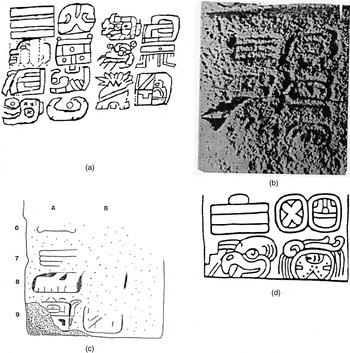
Second, regarding formal traits, Stela 10 (Figure 4a), Takalik Abaj Stela 53 (Figure 4b), and El Mirador Stela 2 (Figure 4c) show a regularized glyph-block size, a double-column format, and a light incision style. The double-column format for Takalik Abaj Stela 53 can only be presumed, since not enough of the texts on Takalik Abaj Stela 53 and El Mirador Stela 2 has been preserved to confirm it, but the regularized glyph-block size supports this assumption. Justeson and colleagues (1985) argue that Chalchuapa Monument 1 shows a double-column format. This is likely, they point out, because the text was inscribed on paired raised panels, each panel making up a glyphic column. However, the poor preservation of the text does not allow it to be confirmed. That the Takalik Abaj script was closely related to the Lowland Mayan script has also been demonstrated by Justeson and colleagues (1985), who point out that it agrees with Lowland Mayan writing in five of the seven formal traits compared (i.e., low degree of variation in vertical size of glyph block, pedestal below some day sings, long count dates, long count initial in its column, and day coefficient to left in long count). A few years after their writing, Takalik Abaj Stela 53, with the likely double-column format, was discovered (Orrego Corzo 1990). With this discovery, the Takalik Abaj script resembles the Lowland Mayan script in six of the seven formal traits compared (86% agreement). This suggests that—at, least formally—the same script was in use in the Maya Highlands, Pacific slopes, and Maya Lowlands during the Late Preclassic period. Stylistically, these three monuments also share traits: fine incisions, small glyphs, and the use of a whole glyph block to represent bar-and-dot numerals. There is at least one Early Classic Mayan text present on a carved bowl with a numeral expressed this way (Figure 4d), representing both an archaism and probably a shorthand notation strategy that was preserved in the Postclassic codices.

Late Preclassic monuments in addition to Kaminaljuyu Stela 10 with regularized glyph-block size, double-column format, and light incision style. (a) Detail of lower glyphic panel on Kaminaljuyu Stela 10. (b) Abaj Takalik Stela 53 (photograph from Orrego Corzo 1990). (c) El Mirador Stela 2 (drawing from Hansen 1991). (d) Example of Early Classic carved vase from Maya Lowlands (drawing from Berjonneau and Sonnery 1985).
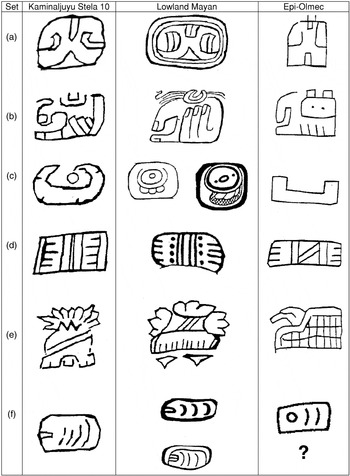
Third, regarding calligraphic and graphemic traits, Stela 10 shares more signs with Lowland Mayan writing (Figure 5) than with Epi-Olmec writing (Figure 6), and the calligraphic style of the signs shared with both scripts in general supports a closer affinity to Lowland Mayan. Porter (1996) states that “ten of these twenty six glyphs are identical to Classic Maya forms ([C3, D6, G1, G3, G4, G7, J4, I7, I8, and J9]),” but adds that “sixteen of the twenty six identifiable glyphs also appear in Macri and Stark (1993).” Kaufman and Justeson (2001:31) note that The “Kaminaljuyu script has some signs known from both Mayan and epi-Olmec writing, others from Mayan but not epi-Olmec, and still others from epi-Olmec but not from Mayan,” but they do not elaborate. I have pointed to several signs with Lowland Mayan and Epi-Olmec stylistic and calligraphic cognates (Mora-Marín 1996:90–102), but due to revisions of the drawing since then, I have changed my mind about a few of them. I now think that glyphs H1/I7, H3, H4, G5, H7, I1, I3, J3, I6, and J9 bear a closer correspondence with Lowland Mayan counterparts, while glyphs H2, G4, and H10/J2 bear a closer correspondence with Epi-Olmec glyphs. One of these, G4 (Figure 6b), was pointed out to me by Justeson and Kaufman (personal communication 1997) as resembling an Epi-Olmec sign.

Signs on Stela 10 that show a calligraphic style more similar to that of Lowland Mayan texts than to that of Epi-Olmec texts (drawings by the author).

Signs on Stela 10 that show a calligraphic style more similar to that of Epi-Olmec texts than to that of Lowland Mayan texts (drawings by the author).
It is possible that graphemic and calligraphic resemblances with Epi-Olmec signs could simply be the result of shared retentions from a common ancestral script or the result of diffusion. Indeed, several Late Preclassic unprovenienced portable texts that are clearly Lowland Mayan in script and language show close resemblances to Epi-Olmec calligraphic conventions. For example, several of the glyphs on the Dumbarton Oaks quartzite pectoral (Coe 1966, 1976; Mora-Marín 1996, 1997, 2001) show the characteristic angular and rectilinear traces of Epi-Olmec glyphs, as a comparison of the rendering of the mouth and eye of the glyphic head on Figure 7a with the Epi-Olmec glyph on Figure 7b shows. At the same time, some signs from the Dumbarton Oaks quartzite pectoral (Figure 7c,d) show curvilinear traces more characteristic of Lowland Mayan writing (Figure 7e). Moreover, the text on the pectoral shows a Ch'olan or Yukatekan affiliation (Figure 7f): among other pieces of phonological and grammatical evidence present in it, and which I describe in detail elsewhere (Mora-Marín 2001), it bears a spelling u-ya … for the third person prevocalic ergative prefix uy-, a Ch'olan and Yukatekan innovation not attested in any other Mayan language.

Curvilinear and angular/rectilinear calligraphic styles. (a) From Dumbarton Oaks quartzite pectoral (drawing by the author). (b) From La Mojarra Stela 1 (drawing by the author based on original monument). (c) From Dumbarton Oaks quartzite pectoral (drawing by the author). (d) From Dumbarton Oaks quartzite pectoral (drawing by the author). (e) From Pomona jadeite flare (drawing by this author). (f) From Dumbarton Oaks quartzite pectoral showing spelling u-ya-AK'(AB') for Ch'olan/Yukatekan uy-ak'(a)b'(-al) ‘his/its tongue//darkness’ (drawing by the author).
Interestingly, several glyphs present on Kaminaljuyu Stela 10 (Figure 8a–c), the Dumbarton Oaks quartzite pectoral (Figure 8d–f), and the Hatzcap Ceel diorite ax from Belize (Figure 8g) share a calligraphic trait that distinguishes them from Epi-Olmec glyphs (Figure 8h): the rectangular ear ornament on glyphic heads is centered rather than located along the base of the head. However, the Dumbarton Oaks pectoral (Figure 8f) and the Hatzcap Ceel ax (Figure 8g) attest to the circular elements associated with the rectangular ear ornament on the back of the head on the Epi-Olmec glyph (Figure 8h). These circular elements are likely representations of beads, as suggested by the glyph on the Pomona jadeite flare shown in Figure 8j. However, the Pomona flare, Hatzcap Ceel ax, and Dumbarton Oaks pectoral versions of this ear ornament motif lack the “smoke stacks” present on the Epi-Olmec cognate. Thus, the early texts from Kaminaljuyu Stela 10 and the Dumbarton Oaks quartzite pectoral show a much closer similarity to the Pomona jadeite flare, which is undeniably Lowland Mayan. It is possible to see from the examples how this trait evolved gradually during the Late Preclassic and Protoclassic periods in the Maya Highlands and Lowlands, and further paleographic research will benefit from examining these elements and motifs in more detail.

Comparison of ornamentation behind ear on glyphic heads from Kaminaljuyu Stela 10, Dumbarton Oaks quartzite pectoral, Hatzcap Ceel diorite ax, La Mojarra Stela 1, and Pomona jadeite flare. (a) H6 from Kaminaljuyu Stela 10. (b) I1 from Kaminaljuyu Stela 10. (c) I8 from Kaminaljuyu Stela 10. (d) Glyph from Dumbarton Oaks quartzite pectoral. (e) Glyph from Dumbarton Oaks quartzite pectoral. (f) Glyph from Dumbarton Oaks quartzite pectoral. (g) Glyph from Hatzcap Ceel diorite ax. (h) Glyph from La Mojarra Stela 1. (j) Glyph from Pomona jadeite flare (all drawings by the author).
As mentioned earlier, the jade earring from Kaminaljuyu found in an Esperanza-phase context is likely not Early Classic but Late Preclassic in age (Figure 9a). It is likely that the style of the glyphs on the earring predates the Esperanza phase, supporting the idea that it was an heirloom. While the form of T533 present in the Foliated Ajaw glyph on the jade earring (Figure 9b) is similar to that found on the Kendal jadeite ax from Belize (Figure 9c), it is essentially the same form as that on Kaminaljuyu Stela 10 (Figure 9d), if we take into account the fact that the latter version was made to fit into a very restricted horizontal space. It is possible that the Kendal ax dates to the Protoclassic period, possibly to circa a.d. 100–200; if it does, the form of the glyph on the Kaminaljuyu jade earring, which resembles more closely that on Stela 10 from the same site, is possibly earlier than that on the Kendal ax. In addition, the BIRD.HEAD glyph on the jade earring (Figure 9e) is present on the Late Preclassic Jade Musem (Costa Rica) jadeite spoon text and is shown in a similar calligraphic style in both (Figure 9e,f). Also, the jade earring mentions the name STEP-SHARK, as Nikolai Grube and Erik Boot pointed out to me independently (Figure 9g). If it is the same STEP-SHARK or EB'-XOK in Lowland Mayan known as the founder of Tikal (Figure 9h), then a date of circa a.d. 90–100 is possible (Martin and Grube 2000; Mora-Marín 2001:250). The jade earring is possibly a somewhat later product of the same scribal tradition that produced the Dumbarton Oaks pectoral, the Peabody Museum jaguar figurine, the unprovenienced clamshell pendant, and the Jade Museum jadeite spoon. If this is the case, then such a tradition most likely would have been Ch'olan, as discussed earlier (cf. Figure 7f).

Stylistic dating of Kaminaljuyu jade earring. (a) Kaminaljuyu jade earring with arrows pointing to T533 (drawing from Kidder et al. 1946). (b) Detail: T533 on jade earring. (c) Detail: T533 from Kendal ax in Belize (drawing by the author). (d) Detail: T533 within a cartouche on Kaminaljuyu Stela 10:J3 (drawing by the author); note the close resemblance between (a) and (c). (e) Detail: BIRD.HEAD glyph from Kaminaljuyu jade earring. (f) BIRD.HEAD glyph from Late Preclassic Jade Musem (Costa Rica) jadeite spoon text (drawing by the author). (g) Detail: STEP-SHARK (?EB'-?XOK) sequence on Kaminaljuyu jade earring. (h) STEP-SHARK (EB'-XOK) sequence on Tikal vase.
Fourth, an interesting question emerges at this point: is the script on the Dumbarton Oaks pectoral more closely related to that of Kaminaljuyu or to that of the Maya Lowlands? Part of the answer lies in a series of graphemic correspondences between the set of unprovenienced portable texts that are undoubtedly the product of the same scribal subtradition that produced the pectoral (Coe 1973, 1976; Mora-Marín 1996, 2001), on the one hand, and the texts on Kaminaljuyu Stela 10 and the Kaminaljuyu jade earring, on the other. Two unprovenienced portable texts share a sequence of signs with Stela 10 (Figure 10). The first of these signs represents a mountain with a cave underneath (Figure 10a–c), as supported by iconographic evidence (Figure 10d–f). Indeed, these signs share the following attributes: sprouting vegetation on the top; a single or double diagonal band; and an optional set of additional elements along the base, including striations and a concave element resembling a cave. These attributes are generally found in the representation of caves or platforms elsewhere in Mesoamerica (Figure 10e,f).

MOUNTAIN signs and related iconography. (a) MOUNTAIN sign on Kaminaljuyu Stela 10 (Glyph I3). (b) MOUNTAIN sign on unprovenienced Peabody Museum were-jaguar basalt figurine (on display at the Yale Art Gallery). (c) MOUNTAIN sign on Jade Museum (Costa Rica) jadeite spoon; zoomorphic version. (d) Sacatepequez Stela: MOUNTAIN pictogram topped by a pyramidal structure with vegetation motifs on the top corners; mountain itself is zoomorphic in nature (animated) and a cave is seen at its base (drawing by the author based on photograph in Schmidt et al. 1998). (e) Unprovenienced sherd from Oaxaca (drawing from Urcid 1993). (f) Building J Tablet, Monte Albán, Oaxaca, Mexico (drawing by Alfonso Caso).
I will stop for a moment to make an observation: the MOUNTAIN signs in the portable texts and those on Stela 10 are more similar to one another than any of them is to Epi-Olmec MOUNTAIN or Classic Lowland Mayan MOUNTAIN. In fact, there is no obvious way to demonstrate that this early MOUNTAIN sign develops into Classic Lowland Mayan T529 WITZ ‘hill, mountain,’ though I suspect that it did. The sign that typically follows this MOUNTAIN sign is an early form of the title T168:518 AJAW for Proto-Ch'olan *ajaw ‘lord, ruler’ (Figure 11). On Stela 10, interestingly, this second glyph is shown as T518.533, where T533 is also AJAW (Figure 11c), although elsewhere in the monument a form more reminiscent of the ones in the portable texts is repeated twice (Figure 11d,e).

Possible precursors of Classic Lowland Mayan T168:518 AJAW ‘lord, ruler’. (a) Glyph from Dumbarton Oaks quartzite pectoral. (b) Glyph from Dumbarton Oaks jadeite celt fragment. (c) Glyph J3 from Kaminaljuyu Stela 10, showing T518 rotated 90° counterclockwise followed by T533. (d) Glyph G9 from Kaminaljuyu Stela 10. (e) Glyph E6 from Kaminaljuyu Stela 10. (f) Glyph from Peabody Museum were-jaguar basalt figurine (on display at the Yale Art Gallery; all drawings by the author).
Thus, glyphs I3–J3 on Stela 10 read MOUNTAIN-LORD (Figure 12a), an epithet that is present on two unprovenienced Late Preclassic texts (Figure 12b,c) related to the Dumbarton Oaks quartzite pectoral. MOUNTAIN-LORD is a known epithet from Classic Lowland Mayan (Figure 12d) and Late Preclassic Epi-Olmec (Figure 12f) texts. In Classic Lowland Mayan texts it is usually preceded by the name of an animal such as “macaw,” “jaguar,” or “frog.” On Stela 10 one finds a sign at J2 (Figure 2c), immediately preceding the MOUNTAIN-LORD sequence, that is very similar to the Epi-Olmec sign MS101 si (Figure 6c; Justeson and Kaufman 1993), and a sign present on the Dumbarton Oaks celt fragment (Figure 6c), with which it shares a close resemblance also. At I2 one finds a sign that depicts a bird of prey, either a hawk (muwan) or a buzzard (usij; Figure 13a). At J1, one finds a sign of unclear iconic motivation, although it must depict an animal or human head, or possibly a skull, given that in its other occurrences in the text (G3, H6) it seems to wear a rectangular ear ornament (Figure 13b,c). (The sign at J1 is the most frequent sign in the surviving text, with three occurrences. This fact, and its distribution in the text, including its possible occurrence at F3 before a possible verbal logogram resembling Classic Lowland Mayan T710 CHOK ‘to throw down,’ are consistent with the hypothesis that the sign at J1 is a syllabogram u, which could represent the third person ergative prefix u-, a marker that is of high frequency in some pragmatic contexts. If I2 is in fact a buzzard, then it would be plausible that J1 could be a phonetic complement for the term usi[i]j ‘buzzard’ [i.e., u-USIJ], but for the moment this is merely speculation.) And at I1 one finds a glyph depicting the Rain God with a trilobed water lily eyelid and a shark's tooth (Figure 13d); this is the form of the Rain God that Karl Taube (1992) defines as a Sacrificer Rain God (Figure 13e,f).

(X-)MOUNTAIN-LORD compounds. (a) MOUNTAIN-LORD compound at I3-J3 on Kaminaljuyu Stela 10. (b) MOUNTAIN-?la-LORD compound on Peabody Museum were-jaguar basalt figurine (on display at the Yale Art Gallery). (c) MOUNTAIN-LORD-?li/la compound on Jade Museum (Costa Rica) jadeite spoon. (d) Classic Lowland Mayan MO'-WITZ-AJAW(-wa) ‘macaw hill lord’ (drawing by Linda Schele). (e) Classic Lowland Mayan MO'-WITZ … ‘macaw hill …’ showing zoomorphic or animated version of T529 WITZ ‘mountain’ similar to that on Jade Museum jadeite spoon. (f) Epi-Olmec compound on La Mojarra Stela 1 proposed by Justeson and Kaufman (1993) to read MOUNTAIN-LORD (all drawings by the author).

Possible glyphic components of a personage's proper name on Kaminaljuyu Stela 10. (a) Sign at I2: HAWK or BUZZARD. (b) Sign at J1: animal or human head or skull. (c) Sign at H6: animal or human head or skull with rectangular ear ornament. (d) Sign at I1: Rain God with a trilobed water-lily eyelid and a shark's tooth. (e) WATER.LILY icon with trilobed element. (f) Personage from Chichen Itza identified as ya-YAX WATER.LILY-la cha-ki, the full epithet of the Sacrificer version of the Rain God, Chahk, identified by Karl Taube.
Fifth, there is a strong case for the name phrase of the main personage portrayed on Stela 10 at I1–J3. One glance at the main personage on the monument shows him to be in the guise of this Sacrificer Rain God (Figure 14a), with attributes that are repeated in the glyph at I1 on Stela 10 (Figure 14b). A second glance at this main personage and at the reconstruction of the missing imagery below him shows that he was likely standing on a mountain or platform (Figure 14c), a possibility that could be related to the likely MOUNTAIN-LORD epithet at I3–J3 on Stela 10 (Figures 12a, 14d). A third glance at this personage shows that he is wearing a pectoral or waist head ornament in the form of a bird of prey (Figure 14e) with similar attributes to the one depicted glyphically at I2 (Figure 14f) as well as in other monuments and texts (Figure 14g,h). I hereby suggest that this personage named in the sequence of glyphs from I1 through J3 is the main personage portrayed on the monument. This is supported by Stela 8 from Kaminaljuyu, which, although badly effaced, shows a man in a pose like that of the main personage on Stela 10 (Figure 15a) actually standing on a platform or mountain (Figure 13b) like those seen at Monte Alban (Figure 10f), which are themselves very similar to the glyph at I3 (Figure 15c) and the Late Preclassic portable texts (Figure 10b,c). There are at least two other likely proper-name phrases in the text at D6–E6 FISH-LORD (Figure 2b) and at G9 with the title LORD (Figure 2c), but neither can be correlated with any of the personages in the pictorial scene. (Because of the incomplete state of the monument, we simply lack the syntactic constraints to test for a specific linguistic affiliation. All we know for sure is that the name phrase at H3–I3 ends a sentence, given that what follows it is a calendrical expression that most likely begins a new sentence. Such an arrangement—that is, a sentence–final noun phrase—could be found in either Epi-Olmec or Lowland Mayan texts, depending on the type of predicate [e.g., active vs. inactive, transitive vs. intransitive], as well as its pragmatic status [e.g., unmarked vs. topic/focus].)

(a) Detail showing head in profile view of main personage on Kaminaljuyu Stela 10 dressed in the guise of the Sacrificer Rain God; note shark's tooth, frizzy hair, trilobed eyelid, and ear-flare assemblage. (b) Glyph I1 on Kaminaljuyu Stela 10 showing a profile view of a person's head, as well as a shark's tooth, possible trilobed eyelid, and ear-flare assemblage. (c) Possible platform reconstructed by James Porter in his drawing of Kaminaljuyu Stela 10; note that reconstruction is based largely on surviving fragment of sprouting vegetation similar to that on the platform or mountain motif found on Kaminaljuyu Stela 8 (Figure 16). (d) Glyph I3 on Kaminaljuyu Stela 10 showing a mountain or platform sign with sprouting vegetation on the top, a diagonal band in the middle, a cave-like concavity centered along the base, and striations on either side of the base. (e) Detail from main personage on Kaminaljuyu Stela 10 showing his pectoral or waist belt head in form of hawk or buzzard; the possible feather crest on back of the head and frontal up-shooting feather on the forehead matches depictions of similar birds in other Late Preclassic art (drawing by James Porter, used by permission of John Graham). (f) Glyph I2 on Kaminaljuyu Stela 10 showing a bird's head resembling a hawk or buzzard; the drawing is probably not completely accurate, but traces of a possible feather crest on the back of the head and a possible up-shooting feather on the forehead are visible (drawing by the author). (g) Detail showing pictorial bird head on waist band of main personage on Kaminaljuyu Stela 11 (drawing by Ayax Moreno, New World Archaeological Foundation). (h) Glyphic bird head from Dumbarton Oaks pectoral (drawing by the author).

Justification for reconstruction of a platform or mountain motif on Kaminaljuyu Stela 10's pictorial scene. (a) Kaminaljuyu Stela 8 (drawing by Fernando Luin, provided by and used by permission of Federico Fahsen. (b) Better view of reconstructed platform or mountain on Kaminaljuyu Stela 10 (drawing by James Porter, used by permission of John Graham). (c) Glyph I3 on Kaminaljuyu Stela 10 showing possible mountain (drawing by the author).
Sixth, but of related interest, there is evidence for graphemic identities not only between texts at Kaminaljuyu and the Maya Lowlands, as in the case of the jade earring, but also between texts at Takalik Abaj and the Maya Lowlands. One example is found in the glyphic correspondences between one glyph on Takalik Abaj Monument 11 (Figure 16a) and two glyphs on the Kichpanha bone stylus (Figure 16b–d). The glyph at B2 on Takalik Abaj Monument 11 corresponds to the glyphs at A3–A4 on the Kichpanha bone stylus from Belize, which Kathryn Reese-Taylor and Debra Walker (2002:99–100) date to circa a.d. 159–238, their definition of the Protoclassic period. This is supportive evidence for the same sign inventory at Takalik Abaj and Late Preclassic or Protoclassic Kichpanha.

Evidence for script transmission between Takalik Abaj and Kichpanha. (a) Glyph on Takalik Abaj Monument 11 (drawing by James Porter, used by permission of John Graham). (b) Two glyphs on the Kichpanha bone stylus (drawing by Peter Mathews).
Takalik Abaj writing was undoubtedly Mayan. As independently noted by Justeson and Fahsen, an example of the LORD glyph on one of the sides of Stela 5 (Figure 17a) bears a phonetic complement T130 wa, showing that the word for “lord, ruler” was a descendant of the Proto-Mayan *aajaaw, which has reflexes in many Mayan languages besides Ch'olan. Also, there is a Late Preclassic unprovenienced portable text that can be linked stylistically to Takalik Abaj (Figure 17b,c): the Dumbarton Oaks celt fragment (Coe 1976; Mora-Marín 1997; Schele and Miller 1986). Dated to circa a.d. 120, the celt closely matches the style and iconography found at Takalik Abaj Stela 5, which has a dedicatory Long Count date of a.d. 125 (Justeson 2001; Mora-Marín 2001:247–248). The celt also has a sign at A1b and B1b that resembles the sign on Stela 10 at H10 and J1 very closely (Figure 6c). The script on this celt is unambiguously related to Classic Lowland Mayan, and its linguistic markers, including the preposition *ta/*tä, suggest it was written in Ch'olan-Tzeltalan specifically. Thus, this evidence strongly supports that the same script and sign inventory, and probably the same language, was in use in the Maya Highlands and Lowlands during the Late Preclassic period.

Takalik Abaj and an unprovenienced jadeite celt fragment at Dumbarton Oaks. (a) ?T168:?518-?wa or LORD-wa glyph (probably for *aajaaw ‘lord, ruler’) on one of the sides of Takalik Abaj Stela 5 (drawings by James Porter, used by permission of John Graham). (b) Front of Takalik Abaj Stela 5 (drawing by James Porter, used by permission of John Graham). (c) Dumbarton Oaks celt fragment, front view (drawing by Linda Schele).
THE COLLAPSE OF LATE PRECLASSIC KAMINALJUYU
It is now time to ask the question: what were the events that took place after the Terminal Late Preclassic phase at Kaminaljuyu? Fahsen (2000) suggests that the Kaminaljuyu elites may have migrated to the Copan Valley and possibly even settled the site of Copan after displacing (or subjugating) the likely Xincan local population (Campbell 1998:370). This is supported, according to René Viel (1998), by the ceramic and mortuary evidence from the Copan Valley (cf. Viel and Hall 2000); Viel (1998:429) even goes as far as to call Early Classic Copan the “New Kaminaljuyu.” If so, the timing of the possible collapse of Kaminaljuyu between about a.d. 100 and a.d. 200, the suggested migrations to Copan, and the retrospective dates of a.d. 159–160 for the founding of the Copan polity (Stelae 4, 17, and I) could not be more convenient (cf. Grube and Martin 2001; Guenter 2001a, 2001b). Viel and Jay Hall (2000:131) suggest that the Protoclassic phase (ca. a.d. 200–400) saw Copan's “Cholanization.” Viel and Hall (2000) note strong ties in hydraulic technology, ceramics, and mortuary practices between Copan and the highlands, perhaps established with the possible migrations from Kaminaljuyu. Interestingly, the evidence from the likely Late Preclassic jade earring suggests a possible connection between Kaminaljuyu elites and Tikal elites, specifically with EB'-XOK, by circa a.d. 90–100, possibly shortly before Kaminaljuyu's downfall by circa a.d. 100–200. If this is correct, what was the nature of this relationship? Did Tikal have anything to do with Kaminaljuyu's collapse? Did the connections between Copan and Tikal and Kaminaljuyu evident by circa a.d. 400, during the period of Teotihuacan influence, stem from events that took place during the transition between the Late Preclassic and Early Classic across the Maya area (e.g., El Mirador, Tikal, Copan, Kaminaljuyu, Takalik Abaj, Chalchuapa)? Future findings of Late Preclassic texts from the Maya Highlands and Lowlands may help provide some answers.
CONCLUDING REMARKS
The evidence I have presented in this paper points to the following conclusions.
- Kaminaljuyu writing and Lowland Mayan writing are probably one and the same script, as supported by formal traits and shared calligraphic conventions and graphemes.
- Kaminaljuyu texts were probably written in Ch'olan. Possible linguistic markers on Stela 10 point to one distinctive Ch'olan-Tzeltalan phonological innovations (*k > ch), and one distinctive Ch'olan phonological innovation (*ee > *i), as well as a distinctive Lowland Mayan innovation (i.e., =te' ‘numeral classifier’). This is supported by Ch'olan and Lowland Mayan linguistic markers present in a set of Late Preclassic unprovenienced portable texts found to be stylistically related to the art and writing from the Maya Highlands, including the jade earring from Kaminaljuyu.
- Ch'olan speakers at Kaminaljuyu were likely in close contact with Poqom speakers. The former group was probably in a position of greater political power, and the latter group was probably subordinate. Ch'olan was probably the dominant language of ritual and politics during this time in the Maya Highlands.
- The events of the Terminal Late Preclassic period may have resulted in the settlement of the Copan Valley by a group of Ch'olan speakers who would become Ch'orti' speakers. The links with Kaminaljuyu (or more generally, perhaps, Highland Guatemalan) architecture, ceramics, and mortuary practices found in the Copan Valley would suggest that these Ch'olan settlers came from Kaminaljuyu (Viel 1998). This would support the hypothesis of a linguistic affiliation of the elites at Kaminaljuyu (Fahsen 1996).
- Future archaeological and epigraphic evidence is necessary to test the hypothesis of a connection between Kaminaljuyu and Copan. Should new Late Preclassic texts be discovered at Kaminaljuyu, I predict that they will show strong similarities with the unprovenienced portable texts discussed in this paper, and further evidence of Ch'olan(-Tzeltalan) grammar. Indeed, they would shed some much needed light on the relationships between the Maya Highlands and Lowlands during this pivotal period in Mayan history.
RESUMEN
En presente artículo se propone examinar la evidencia para la clasificación y afiliación lingüística de la escritura del preclásico tardío de Kaminaljuyú. La evidencia lingüística concerniente a la constitución étnolingüística de las tierras altas y las planicies costeras de Guatemala y la región noroeste de El Salvador sugiere un contacto estrecho entre grupos de hablantes de ch'olano-tzeltalano, k'iche'ano mayor y otros idiomas no mayences como el xinca y el lenca. Esta evidencia también sugiere que grupos ch'olano-tzeltalanos ejercían un papel político y económico superior al de los demás grupos en la región durante esta época. La evidencia epigráfica apoya una clasificación de la escritura de Kaminaljuyú junto a la escritura de las tierras bajas mayas, pero más lejana de la escritura epi-olmeca; además, la evidencia apunta a la posibilidad de marcadores diagnósticos lingüísticos de un idioma ch'olano. También se hace un análisis comparativo con rasgos ortográficos, caligráficos y semánticos que sugieren una relación muy estrecha con la escritura empleada en textos portátiles contemporáneos de afiliación decisiva con los idiomas mayences de las tierras bajas (ch'olano y yukatekano). Ambos tipos de evidencia, por ende, apoyan las hipótesis de que fueron los ch'olanos o ch'olano-tzeltalanos quienes inventaron la escritura maya y que tal acontecimiento tuvo lugar en las tierras altas de Guatemala. Cuando menos, la evidencia sugiere que las tierras bajas y altas de la zona maya mantuvieron una relación mucho más estrecha de lo que se había supuesto con anterioridad.
ACKNOWLEDGMENTS
I thank Juan Antonio Valdés for the opportunity to work in the Kaminaljuyú-Miraflores II project during the summer of 1995; Federico Fahsen for supervising my work in the project and for sharing his ideas and research on Kaminaljuyu writing with me on various occasions; and the former director of the National Museum of Guatemala, Dora Guerra de González, for her interest in making the resources of the National Museum of Archaeology and Ethnology of Guatemala available to outside scholars. I am very grateful to John Hoopes for stimulating my interest in Kaminaljuyu and Late Preclassic Maya civilization and to Joyce Marcus, who in 1995 read a manuscript of mine (Mora-Marín 1997) and gave me suggestions on Kaminaljuyu writing and other early scripts from southeastern Mesoamerica. Joyce Marcus also read a previous version of this manuscript and offered many good suggestions and ideas for revision. I also thank Ian Graham and John Justeson, who let me use a cast of the lower text on Kaminaljuyu Stela 10 to revise my drawing, and John Graham, who provided me with photographs and drawings of Takalik Abaj Stela 5 and Kaminaljuyu Stela 10 and permission to use them. I am very grateful to John Justeson and Terrence Kaufman for sharing some of their ideas on possible graphemic connections between the Epi-Olmec and Kaminaljuyu scripts. Thanks also to Nancy Monterrosa and Carolina Sisniega for their assistance during my second visit to the National Museum. Finally, I thank Judith Maxwell for her constructive comments and suggestions for revisions, as well as William Fowler for his advice and patience. Part of the research for this paper was supported by Foundation for the Advancement of Mesoamerican Studies (FAMSI) grant 99049, a First Encounter Fellowship by the Institute of Mesoamerican Studies, the Harley S. Nelson Fund scholarship by the University of Kansas, and the Mark Kappelman Award by the Department of Anthropology at the University of Kansas.
References
REFERENCES
Ayala, M.
1983
Origen de la escritura jeroglífica maya. In
Antropología e historia de los mixe-zoques y mayas: Homenaje
a Frans Blom, edited by
Lorenzo Ochoa and
Thomas A. Lee, Jr., pp.
175–221.
Universidad Nacional Autónoma de Mexico,
Coyoacán, Mexico.
Barrientos Q., Tomás
2000
Kaminaljuyú: ¿Una sociedad hidráulica?
In XIII Simposio de Investigaciones Arqueológicas en
Guatemala, 1999, edited by
Juan Pedro Laporte,
Héctor L. Escobedo, and
Ana Claudia de Suásnavar y Bárbara
Arroyo, pp.
29–55.
Museo Nacional de Arqueología y Etnología,
Guatemala City.
Berjonneau, G., and
J. Sonnery
1985
Rediscovered Masterpieces of Mesoamerica.
Editions Arts, 135.
Editions Arts,
Brussels.
Campbell, Lyle
1972
Mayan Loan Words in Xinca.
International Journal of American Linguistics
38:187–190.Google Scholar
Campbell, Lyle
1978
Quichean Prehistory: Linguistic Contributions. In
Papers in Mayan Linguistics, edited by
Nora C. England, pp.
25–55.
Department of Anthropology,
University of Missouri, Columbia.
Campbell, Lyle
1984
The Implications of Mayan Historical Linguistics for Glyphic
Research. In
Phoneticism in Maya Hieroglyphic Writing, edited by
John S. Justeson and
Lyle Campbell, pp.
1–16.
Institute for Mesoamerican Studies, Publication No. 9.
State University of New York,
Albany.
Campbell, Lyle
1998
Historical Linguistics: An Introduction.
Massachusetts Institute of Technology Press,
Cambridge, MA.
Campbell, Lyle, and
Terrence Kaufman
1985
Mayan Linguistics: Where Are We Now?
Annual Review of Anthropology
14:187–198.Google Scholar
Coe, Michael
1957
Cycle 7 Monuments in Middle America: A Reconsideration.
American Anthropologist
59:597–611.Google Scholar
Coe, Michael
1966
An Early Stone Pectoral From Southeastern Mexico.
Studies in Pre-Columbian Art and Archaeology, Number 1.
Dumbarton Oaks, Trustees for Harvard University,
Washington, DC.
Coe, Michael
1973
The Maya Scribe and His World.
Grolier Group,
New York.
Coe, Michael
1976
Early Steps in the Evolution of Maya Writing. In
Origins of Religious Art and Iconography in Preclassic Mesoamerica,
UCLA Latin America Studies Series, A Book on Lore, Volume 31, edited
by
H.B. Nicholson, pp.
107–122.
Ethnic Arts Council of Los Angeles,
Los Angeles.
Coe, Michael, and
Justin Kerr
1998
The Art of the Maya Scribe.
Harry N.
Abrams,
New York.
England, Nora
1991
Changes in Basic Word Order in Mayan Languages.
International Journal of American Linguistics
57:446–486.Google Scholar
Fahsen, Federico
1987
Derivaciones históricas implícitas en la
evolución de la escritura Maya.
Anales de la Academia de Geografía e Historia de Guatemala
LXI.
Fahsen, Federico
1988
Artistas y artesanos en la evolución de la escritura
maya. Anales de la Academia de Geografía e Historia de
Guatemala LXII.
Fahsen, Federico
1995
La transición preclásico tardío-clásico
temprano: El desarrollo de los estados mayas y la escritura. In
The Emergence of Lowland Maya Civilization: The Transition from the
Preclassic to the Early Classic, edited by
Nikolai Grube, pp.
151–162.
Mockmuhl,
Germany.
Fahsen, Federico
1996
Paper on Kaminaljuyu writing presented at the Texas Maya
Meetings.
Fahsen, Federico
2000
Kaminaljuyú y sus vecinos. In
XIII Simposio de Investigaciones Arqueológicas en Guatemala,
1999, edited by
Juan Pedro Laporte,
Héctor L. Escobedo,
Ana Claudia de Suásnavar, and
Bárbara Arroyo, pp.
57–83.
Museo Nacional de Arqueología y Etnología,
Guatemala City.
Fahsen, Federico
2001
Who Are the Prisoners in Kaminaljuyu Monuments? Paper presented at
the Texas Maya Meetings, March, Austin.
Grube, Nikolai, and
Simon Martin
2001
The Coming of Kings. In
Notebook for the XXVth Maya Hieroglyphic Forum at Texas.
Art History Department,
University of Texas, Austin.
Guenter, Stanley
2001a
Foliated Ajaw and the Fall of El Mirador.
Abstract of paper presented at the conference Recapturing Mayan
Memories: Historical Representation in Text, Image and Ritual, 8–9
December 2001, University of Hamburg, Hamburg, Germany.
Guenter, Stanley
2001b
La Estela Hauberg y el Reinado Preclásico de Kan. Paper
presented at the XV Simposio de Investigaciones Arqueológicas en
Guatemala, 18 July 2001, Guatemala.
Hansen, R.D.
1991
An Early Maya Text from El Mirador.
Research Reports on Ancient Maya Writing 37.
Center for Maya Research,
Washington, DC.
Hatch, Marion Popenoe de
2000
Kaminaljuyú Miraflores II: La naturaleza del cambio
político al final del Preclásico. In
XIII Simposio de Investigaciones Arqueológicas en Guatemala,
1999, edited by
Juan Pedro Laporte,
Héctor L. Escobedo,
Ana Claudia de Suásnavar, and
Bárbara Arroyo, pp.
11–27.
Museo Nacional de Arqueología y Etnología,
Guatemala City.
Hatch, Marion Popenoe de,
Christa Schieber de Lavarreda,
Edgar Carpio Rezzio,
Miguel Orrego Corzo,
José Héctor Paredes, and
Claudia Wolley
2000
Observaciones sobre el desarrollo cultural en Abaj Takalik,
Departamento de Retalhuleu, Guatemala. In
XIII Simposio de Investigaciones Arqueológicas en Guatemala,
1999, edited by
Juan Pedro Laporte,
Héctor L. Escobedo, and
Ana Claudia de Suásnavar y Bárbara
Arroyo, pp.
159–169.
Museo Nacional de Arqueología y Etnología,
Guatemala City.
Heath-Jones (first name unrecorded)
1959
Definition of an Ancestral Maya Civilization in Miraflores Phase:
Kaminaljuyu.
Abstracts of Papers, 24th Annual Meeting of the Society for
American Archaeology, edited by
Dee Ann Suhm, p. 37.
Cambridge.
Hopkins, Nicholas
1985
On the History of the Chol Language. In
Fifth Palenque Round Table, 1983, edited by
Virginia M. Fields, pp.
1–5.
Pre-Columbian Art Research Institute,
San Francisco.
Josserand, J. Kathryn
1975
Archaeological and Linguistic Correlations for Mayan
Prehistory.
41st International Congress of Americanists Proceedings
1:501–510.Google Scholar
Justeson, John S.
1978
Mayan Scribal Practice in the Classic Period: A Test-Case of an
Explanatory Approach to the Study of Writing Systems.
Ph.D. dissertation,
Department of Anthropology, Stanford University,
Stanford, CA.
University Microfilms,
Ann Arbor, MI.
Justeson, John S.
1986
The Origin of Writing Systems: Preclassic Mesoamerica.
World Archaeology, Early Writing Systems
7:437–458.Google Scholar
Justeson, John S.
2001
Ancient Mesoamerican Computing Practices. In
Pre-Columbian Science, History of Science, vol. 3, edited by
Anthony F. Aveni, pp.
976–989.
Instituto della Enciclopedia Italiana,
Rome.
Justeson, John S., and
Lyle Campbell
1997
The Linguistic Background of Maya Hieroglyphic Writing: Arguments
Against a “Highland Mayan” Role. In
The Language of Maya Hieroglyphs, edited by
M.J. Macri and
A. Ford, pp.
41–67.
Pre-Columbian Research Institute,
San Francisco.
Justeson, John, and
James Fox
1989
Hieroglyphic Evidence for the Languages of the Lowland Maya.
Unpublished manuscript in possession of the author.
Justeson, John, and
Terrence Kaufman
1993
A Decipherment of Epi-Olmec Hieroglyphic Writing.
Science
259:1703–1710.Google Scholar
Justeson, John, and
Terrence Kaufman
1997
A Newly Discovered Column in the Hieroglyphic Text on La Mojarra
Stela 1: A Test of the Epi-Olmec Decipherment.
Science
277:207–210.Google Scholar
Justeson, John S., and
Peter Mathews
1983
The Seating of the Tun: Further Evidence Concerning a Late
Preclassic Lowland Maya Stela Cult.
American Antiquity
48:586–93.Google Scholar
Justeson, John S., and
Peter Mathews
1990
Evolutionary Trends in Mesoamerican Hieroglyphic Writing.
Visible Language
24:88–132.Google Scholar
Justeson, John S.,
William M. Norman,
Lyle Campbell, and
Terrence Kaufman
1985
The Foreign Impact on Lowland Mayan Language and Script.
Middle American Research Institute Publication 53.
Tulane University,
New Orleans.
Kaplan, Jonathan
1995
The Incienso Throne and Other Thrones from Kaminaljuyú,
Guatemala. Late Preclassic Examples of a Mesoamerican Throne
Tradition.
Ancient Mesoamerica
6:185–196.Google Scholar
Kappelman, Julia G.
1997
Of Macaws and Men: Late Preclassic Cosmology and Political Ideology
in Izapan-Style Monuments.
Ph.D. dissertation,
Department of Art History, University of Texas,
Austin.
Kaufman, Terrence
1976
Archaeological and Linguistic Correlations in Mayaland and
Associated Areas of Mesoamerica.
World Archaeology
8:
101–118.Google Scholar
Kaufman, Terrence
1989
Mayan Comparative Studies, Parts A–D.
Unpublished manuscript in possession of the author.
Kaufman, Terrence
2000
Notes on the Sociolinguistic Geography of Preclassic Mesoamerica.
Presentation with handouts at the Late Preclassic Workshop, March 12,
Austin.
Kaufman, Terrence, and
John Justeson
2001
Epi-Olmec Hieroglyphic Writing and Texts. In
Notebook for the XXVth Maya Hieroglyphic Forum at Texas, March
2001, edited by
Linda Schele, pp.
1–98.
University of Texas and Maya Workshop Foundation,
Austin.
Kaufman, Terrence, and
John Justeson
2004
The Epi-Olmec Language. In
The Cambridge Encyclopedia of the World's Ancient
Languages, edited by
Roger D. Woodard.
Cambridge University Press,
Cambridge.
Kaufman, Terrence, and
William Norman
1984
An Outline of Proto-Cholan Phonology, Morphology, and
Vocabulary. In
Phoneticism in Maya Hieroglyphic Writing, edited by
John S. Justeson and
Lyle Campbell, pp.
77–166.
Institute for Mesoamerican Studies Publication No. 9.
State University of New York,
Albany.
Kelley, David
1976
Deciphering the Maya Script.
University of Texas Press,
Austin.
Kidder, Alfred V.,
J.D. Jennings, and
Edwin M. Shook
1946
Excavations at Kaminaljuyú, Guatemala.
Carnegie Institution of Washington Publication 561.
Washington,
DC.
Lacadena, Alfonso, and
Søren Wichmann
1999
The Distribution of Lowland Maya Languages in the Classic Period.
Paper presented at the III Mesa Redonda de Palenque, 27 June–4 July
1999, Palenque, Mexico..
Lacadena, Alfonso, and
Søren Wichmann
2000
The Dynamics of Language in the Western Lowland Maya Region.
Paper presented at the 2000 Chamool Conference, 9–11
November 2000, Calgary.
Macri, Martha J., and
L.M. Stark
1993
A Sign Catalog of the La Mojarra Script.
Monograph 5.
Pre-Columbian Art Research Institute,
San Francisco.
Marcus, Joyce
1976
The Origins of Mesoamerican Writing.
Annual Review of Anthropology
5:35–67.Google Scholar
Marcus, Joyce
1992
Mesoamerican Writing Systems.
Princeton University Press,
Princeton, NJ.
Martin, Simon, and
Nikolai Grube
2000
Chronicle of the Maya Kings and Queens: Deciphering the Dynasties of
the Ancient Maya.
Thames and Hudson,
London.
Michels, Joseph W.
1979
Kaminaljuyu Social Structure.
Actes du XLIIe Congrès International des
Américanistes
8:161–177.Google Scholar
Miles, Suzanna
1965
Sculpture of the Guatemala–Chiapas Highlands and Pacific
Slopes, and Associated Hieroglyphs. In
Handbook of Middle American Indians, Vol. 3, edited by
Gordon Willey, pp.
237–275.
University of Texas Press,
Austin.
Mora-Marín, David F.
1996
The Social Context for the Origins of Mayan Writing: The Formative
Ceremonial Complex, Portable Elite Objects, and Interregional
Exchange.
Undergraduate senior honors thesis,
University of Kansas, Lawrence.
Mora-Marín, David F.
1997
The Origins of Maya Writing: The Case for Portable Objects.
In
U Mut Maya VII, edited by
Tom Jones and
Carolyn Jones, pp.
133–164.
Humboldt State University,
Arcata, CA.
Mora-Marín, David F.
2001
The Grammar, Orthography, Content, and Social Context of Late
Preclassic Mayan Portable Texts.
Unpublished Ph.D. dissertation,
State University of New York,
Albany.
Orrego Corzo, Miguel
1990
Investigaciones arqueológicas en Abaj Takalik. Reporte No. 1.
Año 1988.
Proyecto Nacional Abaj Takalik.
Instituto de Antropología e Historia,
Guatemala City.
Parsons, Lee Allen
1986
The Origins of Maya Art: Monumental Stone Sculpture of
Kaminaljuyú, Guatemala, and the Southern Pacific Coast.
Studies in Pre-Columbian Art and Archaeology, No. 28.
Dumbarton Oaks Research Library and Collection,
Washington, DC.
Parsons, Lee Allen
1988
Proto-Maya Aspects of Miraflores-Arenal Monumental Stone Sculpture
from Kaminaljuyu and the Southern Pacific Coast. In
Maya Iconography, edited by
Elizabeth P. Benson and
Gillett G. Griffin, pp.
6–43.
Princeton University Press,
Princeton, NJ.
Ponciano, Erick M.
2000
La concepción de Kaminaljuyú como una ciudad en el
altiplano central del Valle de Guatemala durante el período
Formativo. In
XIII Simposio de Investigaciones Arqueológicas en Guatemala,
1999, edited by
Juan Pedro Laporte,
Héctor L. Escobedo,
Ana Claudia de Suásnavar, and
Bárbara Arroyo, pp.
1–10.
Museo Nacional de Arqueología y Etnología,
Guatemala City.
Porter, James
1996
Kaminaljuyu Stela 10: Excavation, Relief Carving, Glyphic Text and
Place in Mesoamerican History. Available from:
http://mayaglyphs.net/books/kju-10/000.html
Prem, Hans J.
1973
A Tentative Classification of Non-Maya Inscriptions in
Mesoamerica.
Indiana
1:29–59.Google Scholar
Reese-Taylor, Kathryn, and
Debra S. Walker
2002
The Passage of the Late Preclassic into the Early Classic.
In
Ancient Maya Political Economies, edited by
Marilyn A. Masson and
David A. Freidel, pp.
87–122.
Altamira Press,
New York.
Schele, Linda, and
Mary E. Miller
1986
The Blood of Kings: Dynasty and Ritual in Maya Art.
George Braziller,
New York.
Schmidt, P.,
M. de la Garza, and
E. Nalda (editors)
1998
Maya.
Rizzoli,
New York.
Sharer, Robert J., and
David W. Sedat
1973
Monument 1, El Porton, Guatemala and the Development of Maya
Calendrical and Writing Systems. In
Studies in Ancient Mesoamerica, edited by
John Graham.
Contributions of the University of California, No. 18.
Archaeological Research Facility, Department of Anthropology,
University of California.
Sharer, Robert J., and
David W. Sedat
1987
Archaeological Investigations in the Northern Maya Highlands,
Guatemala: Interaction and the Development of Maya Civilization.
University Museum Monograph No. 59.
University Museum, University of Pennsylvania,
Philadelphia.
Taube, Karl A.
1992
The Major Gods of Ancient Yucatan.
Studies in Pre-Columbian Art and Archaeology, No. 32.
Dumbarton Oaks Research Library and Collection,
Washington, DC.
Thompson, J. Eric S.
1965
Maya Hieroglyphic Writing. In
Handbook of Middle American Indians, Volume 3, edited by
Robert Wauchope, pp.
632–658.
University of Texas Press,
Austin.
Urcid, Javier
1993
The Pacific Coast of Oaxaca and Guerrero: The Westernmost Extent of
Zapotec Script.
Ancient Mesoamerica
4:141–65.Google Scholar
Valdés, Juan Antonio
1997
El proyecto Kaminaljuyu Miraflores II dentro del marco
Preclásico de Kaminaljuyú. In
X Simposio de Investigaciones Arqueológicas en Guatemala,
1997, edited by
Juan Pedro Laporte and
Héctor L. Escobedo, pp.
81–91.
Museo Nacional de Arqueología y Etnología,
Guatemala City.
Valdés, Juan Antonio, and
Marion Popenoe de Hatch
1996
Evidencias de poder y control social en Kaminaljuyú:
Proyecto Arqueológico Miraflores II. In
IX Simposio de Investigaciones Arqueológicas en Guatemala,
1999, edited by
Juan Pedro Laporte and
Héctor L. Escobedo, pp.
377–396.
Museo Nacional de Arqueología y Etnología,
Guatemala City.
Viel, René
1998
La interacción entre Copan y Kaminaljuyu. In
XI Simposio de Investigaciones Arqueológicas en Guatemala,
1997, edited by
Juan Pedro Laporte and
Héctor L. Escobedo, pp.
427–430.
Museo Nacional de Arqueología y Etnología,
Guatemala City.
Viel, René, and
Jay Hall
2000
Las Relaciones entre Copan y Kaminaljuyu. In
XII Simposio de Investigaciones Arqueológicas en Guatemala,
1999, edited by
Juan Pedro Laporte,
Héctor L. Escobedo,
Ana Claudia de Suásnavar, and
Bárbara Arroyo, pp.
127–131.
Museo Nacional de Arqueología y Etnología,
Guatemala City.
Location of Kaminaljuyu with respect to other Late Preclassic sites in the Maya Highlands, the Pacific coast, and the Maya Lowlands.
Ceramic-phase chronology of Kaminaljuyu
(a) Kaminaljuyu Stela 10 (drawing by James Porter, used by permission of University of California, Berkeley, and John Graham). (b) Upper glyphic panel on Stela 10: glyph columns B–E (preliminary drawing by the author). (c) Lower glyphic panel on Stela 10: glyph columns G–J (drawing by the author).
Seven formal traits that distinguish the various script traditions in southeastern Mesoamerica
Language familes represented in Epi-Olmec and Lowland Mayan texts. (a) Mixe-Zoquean. (b) Ch'olan-Tzeltalan and Yukatekan.
Historical linguistic data supporting interaction between Ch'olan(-Tzeltalan) speakers and speakers of Highland Mayan languages such as Poqom and non-Mayan languages such as Xincan and Lencan
Late Preclassic monuments in addition to Kaminaljuyu Stela 10 with regularized glyph-block size, double-column format, and light incision style. (a) Detail of lower glyphic panel on Kaminaljuyu Stela 10. (b) Abaj Takalik Stela 53 (photograph from Orrego Corzo 1990). (c) El Mirador Stela 2 (drawing from Hansen 1991). (d) Example of Early Classic carved vase from Maya Lowlands (drawing from Berjonneau and Sonnery 1985).
Signs on Stela 10 that show a calligraphic style more similar to that of Lowland Mayan texts than to that of Epi-Olmec texts (drawings by the author).
Signs on Stela 10 that show a calligraphic style more similar to that of Epi-Olmec texts than to that of Lowland Mayan texts (drawings by the author).
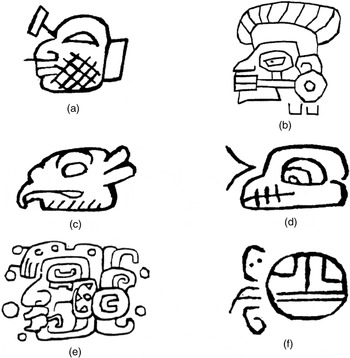
Curvilinear and angular/rectilinear calligraphic styles. (a) From Dumbarton Oaks quartzite pectoral (drawing by the author). (b) From La Mojarra Stela 1 (drawing by the author based on original monument). (c) From Dumbarton Oaks quartzite pectoral (drawing by the author). (d) From Dumbarton Oaks quartzite pectoral (drawing by the author). (e) From Pomona jadeite flare (drawing by this author). (f) From Dumbarton Oaks quartzite pectoral showing spelling u-ya-AK'(AB') for Ch'olan/Yukatekan uy-ak'(a)b'(-al) ‘his/its tongue//darkness’ (drawing by the author).
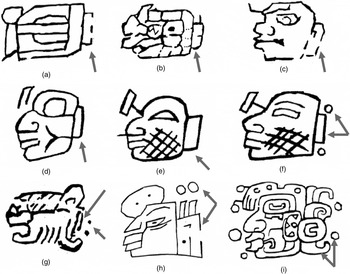
Comparison of ornamentation behind ear on glyphic heads from Kaminaljuyu Stela 10, Dumbarton Oaks quartzite pectoral, Hatzcap Ceel diorite ax, La Mojarra Stela 1, and Pomona jadeite flare. (a) H6 from Kaminaljuyu Stela 10. (b) I1 from Kaminaljuyu Stela 10. (c) I8 from Kaminaljuyu Stela 10. (d) Glyph from Dumbarton Oaks quartzite pectoral. (e) Glyph from Dumbarton Oaks quartzite pectoral. (f) Glyph from Dumbarton Oaks quartzite pectoral. (g) Glyph from Hatzcap Ceel diorite ax. (h) Glyph from La Mojarra Stela 1. (j) Glyph from Pomona jadeite flare (all drawings by the author).
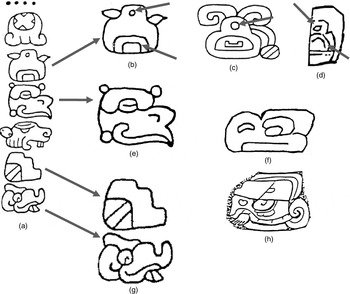
Stylistic dating of Kaminaljuyu jade earring. (a) Kaminaljuyu jade earring with arrows pointing to T533 (drawing from Kidder et al. 1946). (b) Detail: T533 on jade earring. (c) Detail: T533 from Kendal ax in Belize (drawing by the author). (d) Detail: T533 within a cartouche on Kaminaljuyu Stela 10:J3 (drawing by the author); note the close resemblance between (a) and (c). (e) Detail: BIRD.HEAD glyph from Kaminaljuyu jade earring. (f) BIRD.HEAD glyph from Late Preclassic Jade Musem (Costa Rica) jadeite spoon text (drawing by the author). (g) Detail: STEP-SHARK (?EB'-?XOK) sequence on Kaminaljuyu jade earring. (h) STEP-SHARK (EB'-XOK) sequence on Tikal vase.
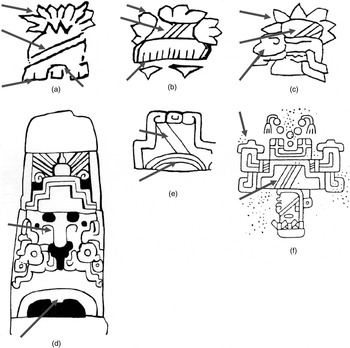
MOUNTAIN signs and related iconography. (a) MOUNTAIN sign on Kaminaljuyu Stela 10 (Glyph I3). (b) MOUNTAIN sign on unprovenienced Peabody Museum were-jaguar basalt figurine (on display at the Yale Art Gallery). (c) MOUNTAIN sign on Jade Museum (Costa Rica) jadeite spoon; zoomorphic version. (d) Sacatepequez Stela: MOUNTAIN pictogram topped by a pyramidal structure with vegetation motifs on the top corners; mountain itself is zoomorphic in nature (animated) and a cave is seen at its base (drawing by the author based on photograph in Schmidt et al. 1998). (e) Unprovenienced sherd from Oaxaca (drawing from Urcid 1993). (f) Building J Tablet, Monte Albán, Oaxaca, Mexico (drawing by Alfonso Caso).
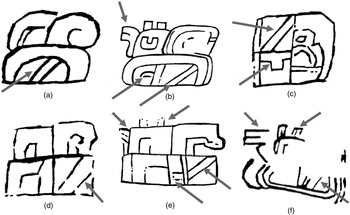
Possible precursors of Classic Lowland Mayan T168:518 AJAW ‘lord, ruler’. (a) Glyph from Dumbarton Oaks quartzite pectoral. (b) Glyph from Dumbarton Oaks jadeite celt fragment. (c) Glyph J3 from Kaminaljuyu Stela 10, showing T518 rotated 90° counterclockwise followed by T533. (d) Glyph G9 from Kaminaljuyu Stela 10. (e) Glyph E6 from Kaminaljuyu Stela 10. (f) Glyph from Peabody Museum were-jaguar basalt figurine (on display at the Yale Art Gallery; all drawings by the author).
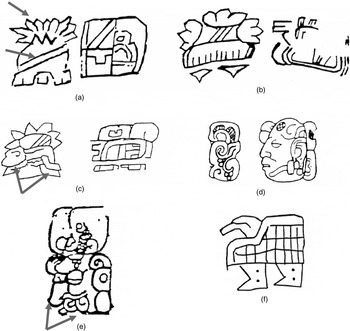
(X-)MOUNTAIN-LORD compounds. (a) MOUNTAIN-LORD compound at I3-J3 on Kaminaljuyu Stela 10. (b) MOUNTAIN-?la-LORD compound on Peabody Museum were-jaguar basalt figurine (on display at the Yale Art Gallery). (c) MOUNTAIN-LORD-?li/la compound on Jade Museum (Costa Rica) jadeite spoon. (d) Classic Lowland Mayan MO'-WITZ-AJAW(-wa) ‘macaw hill lord’ (drawing by Linda Schele). (e) Classic Lowland Mayan MO'-WITZ … ‘macaw hill …’ showing zoomorphic or animated version of T529 WITZ ‘mountain’ similar to that on Jade Museum jadeite spoon. (f) Epi-Olmec compound on La Mojarra Stela 1 proposed by Justeson and Kaufman (1993) to read MOUNTAIN-LORD (all drawings by the author).
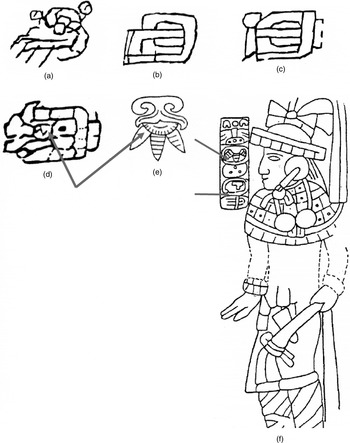
Possible glyphic components of a personage's proper name on Kaminaljuyu Stela 10. (a) Sign at I2: HAWK or BUZZARD. (b) Sign at J1: animal or human head or skull. (c) Sign at H6: animal or human head or skull with rectangular ear ornament. (d) Sign at I1: Rain God with a trilobed water-lily eyelid and a shark's tooth. (e) WATER.LILY icon with trilobed element. (f) Personage from Chichen Itza identified as ya-YAX WATER.LILY-la cha-ki, the full epithet of the Sacrificer version of the Rain God, Chahk, identified by Karl Taube.
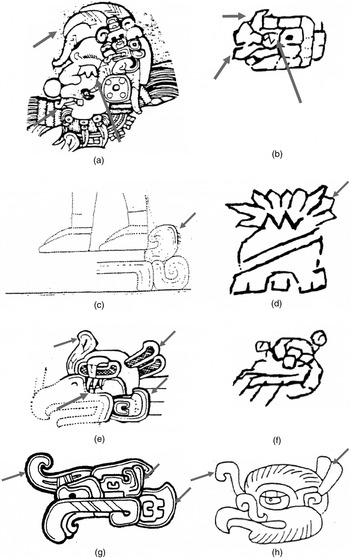
(a) Detail showing head in profile view of main personage on Kaminaljuyu Stela 10 dressed in the guise of the Sacrificer Rain God; note shark's tooth, frizzy hair, trilobed eyelid, and ear-flare assemblage. (b) Glyph I1 on Kaminaljuyu Stela 10 showing a profile view of a person's head, as well as a shark's tooth, possible trilobed eyelid, and ear-flare assemblage. (c) Possible platform reconstructed by James Porter in his drawing of Kaminaljuyu Stela 10; note that reconstruction is based largely on surviving fragment of sprouting vegetation similar to that on the platform or mountain motif found on Kaminaljuyu Stela 8 (Figure 16). (d) Glyph I3 on Kaminaljuyu Stela 10 showing a mountain or platform sign with sprouting vegetation on the top, a diagonal band in the middle, a cave-like concavity centered along the base, and striations on either side of the base. (e) Detail from main personage on Kaminaljuyu Stela 10 showing his pectoral or waist belt head in form of hawk or buzzard; the possible feather crest on back of the head and frontal up-shooting feather on the forehead matches depictions of similar birds in other Late Preclassic art (drawing by James Porter, used by permission of John Graham). (f) Glyph I2 on Kaminaljuyu Stela 10 showing a bird's head resembling a hawk or buzzard; the drawing is probably not completely accurate, but traces of a possible feather crest on the back of the head and a possible up-shooting feather on the forehead are visible (drawing by the author). (g) Detail showing pictorial bird head on waist band of main personage on Kaminaljuyu Stela 11 (drawing by Ayax Moreno, New World Archaeological Foundation). (h) Glyphic bird head from Dumbarton Oaks pectoral (drawing by the author).
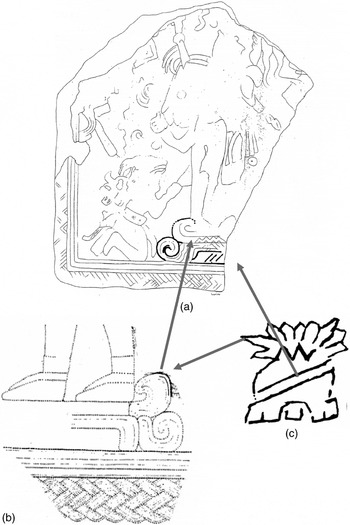
Justification for reconstruction of a platform or mountain motif on Kaminaljuyu Stela 10's pictorial scene. (a) Kaminaljuyu Stela 8 (drawing by Fernando Luin, provided by and used by permission of Federico Fahsen. (b) Better view of reconstructed platform or mountain on Kaminaljuyu Stela 10 (drawing by James Porter, used by permission of John Graham). (c) Glyph I3 on Kaminaljuyu Stela 10 showing possible mountain (drawing by the author).
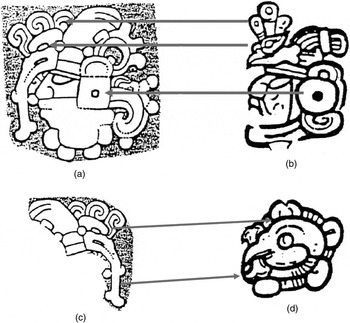
Evidence for script transmission between Takalik Abaj and Kichpanha. (a) Glyph on Takalik Abaj Monument 11 (drawing by James Porter, used by permission of John Graham). (b) Two glyphs on the Kichpanha bone stylus (drawing by Peter Mathews).
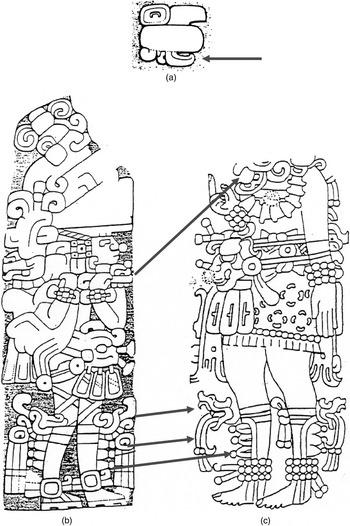
Takalik Abaj and an unprovenienced jadeite celt fragment at Dumbarton Oaks. (a) ?T168:?518-?wa or LORD-wa glyph (probably for *aajaaw ‘lord, ruler’) on one of the sides of Takalik Abaj Stela 5 (drawings by James Porter, used by permission of John Graham). (b) Front of Takalik Abaj Stela 5 (drawing by James Porter, used by permission of John Graham). (c) Dumbarton Oaks celt fragment, front view (drawing by Linda Schele).
 You have
Access
- 8
- Cited by