Introduction
Most debate around home ownership and risk has focused on mortgage debt: on the borrowings required to climb the housing ladder; on the predictors of mortgage default; and on the payment protection ‘gap’ that arises where private insurances replace state safety nets for borrowers in arrears. Some parts of the protection gap are more readily bridged than others – loss of employment is insurable, relationship breakdown is not – but there is little doubt that mortgagors are more vulnerable to structural shifts and biographical disruption now than they were ten years ago (Ford et al., Reference Ford, Burrows and Nettleton2001, Reference Ford, Quilgars, Burrows and Rhodes2004; Smith et al., Reference Smith, Easterlow and Munro2004). Although the risks of unsustainable debt cluster at the margins of home ownership, they merit ongoing attention because these margins are so wide. The mantra that owner-occupation contains the majority of the rich but more than half the poor may be well-worn (Burrows and Wilcox, Reference Burrows and Wilcox2000), but it underlines the fact that mortgage default can be widespread, especially in markets supported by subprime or non-conforming loans (Langley, Reference Langley2007; Munro et al., Reference Munro, Ford, Leishman and Karley2005; Pannell, Reference Pannell2006). The short step from default to bankruptcy, possession and abandonment is all too evident in the wake of the recent credit ‘crunch’.
While the credit risks associated with home ownership are well documented, surprisingly little attention has been paid to the equity side of the housing equation: to the risks home buyers face in settings where housing demands a high proportion of personal wealth, requires a property-biased investment portfolio, and links households' welfare disproportionately to the financial rewards, or investment returns, of owner-occupation. The individual and systemic risks of creating ‘home-ownership’ societies like the UK – where the dominant housing tenure is not only highly leveraged but coupled with an inflexible investment vehicle (the performance of a single property), itself positioned as an asset base for welfare – are rarely aired. The options for managing these risks are correspondingly under-explored.
This article draws from qualitative research with a cross-section of mortgagors in England to show why this second type of housing risk – overinvestment into a single asset, over-dependence on housing wealth, and vulnerability to the under-performance of housing assets – merits attention from the perspective of social (as well as economic) policy, and to consider how it might best be mitigated. The UK provides an apposite case study because it epitomises a growing number of societies whose economic and welfare regimes revolve around the wealth contained in housing. Such contexts are shaped by an ‘ethopolitics’ (a style of governance) that prioritises home ownership (Flint, Reference Flint2003; Smith, Reference Smith2008), a sustained if volatile history of house price appreciation which has turned housing into a major store of wealth for the majority of households (Smith, Reference Smith, Doling and Elsinga2006), and a programme of financial deregulation that, over a twenty-year period, loosened credit constraints and made housing wealth more fungible (more accessible or spendable) than ever before (Muellbauer, Reference Muellbauer, Davies and Shorrocks2006).
The data resources for this article are outlined next; the remainder of the discussion falls into four short sections. The first provides a lay perspective on the growing concentration of wealth into owned housing. The second documents the extent to which borrowers plan for and deploy these assets as a safeguard against financial (and other) uncertainty. Third, we show why this is a risky tactic, drawing attention to the limitations as well as the benefits of ‘banking on housing’. Finally, we turn to the question of whether households, communities or whole societies have any need, scope or appetite to mitigate the investment as well as credit risks associated with home ownership.
The study
This article is based on the experiences of 150 home buyers interviewed as part of the ESRC/AHRC-funded project ‘Banking on housing; spending the home’: a mixed methods study of the implications of housing wealth for consumption. In addition to a round-up of quantitative evidence (Smith and Searle, Reference Smith and Searle2008), new qualitative data were collected in two phases, spanning 18 months to the peak of the current housing cycle in June 2006 (see Smith et al., Reference Smith, Searle and Cook2007a).
Phase I comprises 150 interviews, completed by telephone, with a cross-section of mortgagors selected purposively from two extensive surveys: 100 households were recruited from a study of mortgage payment safety nets, itself based on a random sample of mortgagors from the Survey of English Housing (Ford et al., Reference Ford, Quilgars, Burrows and Rhodes2004); a further 50 participants were selected from the quasi-random CML/ODPM Survey of Flexible Mortgages (Smith et al., Reference Smith, Ford, Munro and Davis2002). Interviews were completed with a mix of first-time (27 per cent) and established buyers, holding a range of flexibleFootnote 1 (57 per cent) and more traditional mortgages. Participants also span income and home-equity tertiles, and evince a gender balance. Thirty-five participants – a spread of borrowers from a range of neighbourhood types – also hosted home visits during phase II of the research.
Both sweeps entailed wide-ranging qualitative discussions, guided by a checklist, recorded with participants' consent, transcribed, anonymised, agreed with each interviewee and coded for computer-assisted retrieval. Whole transcripts are also preserved, so that individual narratives as well as general coded trends can be drawn into the analysis. In this article, the number of participants who subscribe to particular views or describe particular experiences is given (where appropriate), to map the shape of the data.Footnote 2 Additionally, participants' own words are used to exemplify particular points, and to illustrate the motives and aspirations underpinning households' financial behaviours. Quotations have been selected to reflect the breadth and depth, but not necessarily frequency, of key themes.Footnote 3
Banking on housing
Whatever else I had done with the same amount of money, I would never have made the same return on my investment. [‘Housing investor’ whose home has tripled in value over 20 years]
Whether by accident or design, housing is the single most important component of personal wealth for the majority of ‘Banking on housing’ (Boh) mortgagors (98/150), as it is for their counterparts in most other countries (Muellbauer, Reference Muellbauer, Davies and Shorrocks2006), especially in the English-speaking world (Smith, Reference Smith, Doling and Elsinga2006). To consider the implications of this, Boh participants were grouped according to where these home assets fit into a wider wealth portfolio. Just under half (72/150) are ‘housing investors’; they conform to the British norm of holding their financial ‘eggs’ primarily in an owned housing ‘basket’, and they are conscious of its role in their financial affairs. There is a smaller group of ‘general-investors’ (n = 34) whose wealth portfolios are deliberately more diverse. The remainder, the ‘homebodies’ (n = 44), may (or may not) in practice concentrate their wealth into housing (26 of them do), but none explicitly attaches financial value to the meaning of their home.
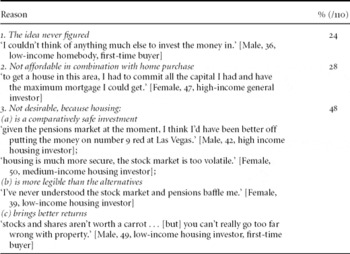
All three groups were asked whether they had considered spending less on housing and investing more elsewhere. The majority had not (n = 110); they offer three reasons why (Table 1). One in four – mainly homebodies – say it simply never occurred to them: their comments illustrate the extent to which investing into owned homes has become ‘normalised’ for UK households (see also Smith, Reference Smith2008). A larger group, almost one in three – investors and homebodies alike – point out that home purchase is costly: it demands a high proportion, if not all, their financial resources whether they want it to or not. But by far the commonest reason for prioritising housing over other investments – forwarded notably, but not uniquely, by housing investors – is the belief that owned homes not only produce the best housing services, but constitute the most logical, legible and reliable style of wealth-holding there is.
Why people did not spend less on housing and invest more elsewhere

That nearly half favour housing over other investments is not surprising, because housing has generally performed well: since 1971, the UK has, with Spain, topped the OECD league table for annual house-price appreciation (Catte et al., Reference Catte, Girouard, Price and Andre2004); and by 2007 the nation owned more than £2.5 trillion of unmortgaged housing equity. Notwithstanding its uneven distribution, and even in the context of volatile prices, housing is now the most widely dispersed class of assets, and the only significant wealth-holding, among the majority of British households. There is, as might be expected, a ‘feel-good’ factor attached to this, though (as we shall see) even before the current uncertainties it was not the unfettered exuberance that some commentators presume. A more striking finding in Boh is the extent to which housing wealth is celebrated as a ‘feel-safe’ resource. Portrayed as a shield, comfort zone, blanket, buffer or tool, it is hard to overstate the sense of security conferred on study participants by the possession of home assets. Particularly for established middle-aged owners – like this low-income woman, whose current loan-to-value is just 20 per cent – it is difficult to overrate ‘the comfort of knowing that you've got something that you can fall back on’. But even among those with significant mortgage debt and relatively little housing wealth, the general view is that: ‘should the unthinkable happen, there is that safety net available’; ‘whatever happens, I know I am going to be OK’.
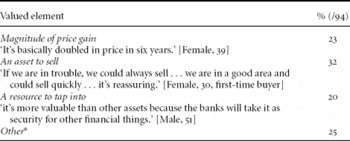
In short, for those who own any housing wealth at all, its role as a guarantor of financial security has moved to centre stage. This point is underlined in Table 2 where nearly two-thirds (n = 94) elaborate on what they most value about holding housing wealth. There is, perhaps predictably, reference to the ‘windfall’ effect that flows from price gains alone. But this is not the dominant theme; only two general-investors mention it at all. Instead, over half those whose views are captured in the table locate their sense of financial security in two less well-aired attributes of home equity: its liquidity (the option to sell up or trade down to release wealth) and its utility (as collateral to borrow against).
Why people value home assets

Note:* ‘Other’ mainly refers to the comments of ‘homebodies’; those who do not value housing for its financial worth.
Home buyers have a lot riding on the thought that their housing wealth can readily be sold or cashed in. Among housing investors and homebodies, this tactic is generally seen as a last resort; though for general-investors it can equally be a lifestyle option. Either way, for one in three of those whose views are represented in Table 2, owned housing is experienced as a financial buffer because it is a saleable commodity. A smaller cluster of study participants, especially housing or general-investors, also value their housing wealth as collateral – they prize it as a resource that can be borrowed against if the going gets tough. The following quotations reflect the way this aspect of the fungibility of housing wealth is recognised, respectively, across the low, medium and high socio-economic groupings in the study:
I've been able to remortgage it: it's got me through a divorce . . . it is there for my children. [Female, 39]
I value the fact that, if needs be, I can borrow more against it. [Female, 28, first-time buyer]
Once they brought in flexible mortgages, where it made it very easy to turn that tap on, that [the role of housing wealth as a safety net] was definitely the case. [Male, 49]
These study participants are all referring to the practice of mortgage equity withdrawal (MEW) – a method of borrowing against housing to fund other things, whose changing style and growing popularity mark a sea-change in how home equity works (Smith and Searle, Reference Smith and Searle2008). Years of financial de-regulation, growing competition among lenders, and a frenzy of product innovation in the early 2000s, explain why Boh mortgagors found it almost as easy, and nearly as routine, to roll equity out of housing as to pay off their loan. Housing wealth has entered day-to-day decisions around savings, spending and debt, smoothing over dips in income, supporting increased expenditures and helping tackle a suite of unexpected life events. In the period of this study, home assets were better positioned than ever before to provide a financial buffer; and borrowers came increasingly to depend on owned homes for this function.
The concentration of assets into housing is a hot topic among economists concerned with monetary policy and macro-economic stability (Muellbauer, Reference Muellbauer, Davies and Shorrocks2006). Likewise, the growing fungibility of home equity drives economic accounts of the way wealth (and debt) portfolios operate (Banks et al., Reference Banks, Blundell, Oldfield and Smith2004; Bridges et al., Reference Bridges, Disney, Henley, Bertola, Disney and Grant2006). Setting lay perspectives alongside quantitative indicators, our findings hint that housing wealth equally has a welfare dimension. This idea is not new, especially in relation to housing costs in older age and the changing role of inheritance (Lowe, Reference Lowe, Manning and Ungerson1990, Reference Lowe, Corden, Robertson and Tolley1992). But homebuyers in the early 2000s had more wealth in property than ever before, and exercised more options to spend from it then than they are likely see again. This enabled Boh participants to locate their sense of social and financial security – qualities once rooted in the institutions of the welfare state – in the possession of an increasingly spendable store of housing wealth. Home equity has acquired an ‘insurance’, as well as ‘investment’, dimension, and this is as much a challenge for social policy as a matter for economic management.
From housing wealth to welfare?
I'd be scuppered if I had a major expenditure to fund without drawing on the mortgage. [Low income, female, aged 50, whose mortgage has tripled in the last eight years]
Economic indicators testify to the growing importance, in practice as well as in theory, of home assets for the consumption of goods, services and experiences of all kinds. There is a steady (though by no means straightforward) flow of wealth from housing into the wider economy (Case et al., Reference Case, Quigley and Shiller2005). This is corroborated by social research which identifies a shift (albeit uneven) away from the idea that housing wealth is primarily a legacy for future generations towards the notion that it is a resource to spend across the life course (Rowlingson and McKay, Reference Rowlingson and McKay2005; J. Smith, Reference Smith2004; S. J. Smith, Reference Smith2008). In line with other studies, just two in five Boh participants expect to leave their housing wealth for inheritance; most plan to spend some (36 per cent) or all (20 per cent) of it before they die, either on high days and holidays, or to meet a more sobering array of welfare needs.
While it is likely that these needs, and the role of housing wealth in meeting them, vary across the life course, it is hard to establish precisely when, where and to what ends housing wealth is actually deployed. The major UK surveys, if they ask the relevant questions, use very broad response categories, none of which taps into welfare or subsistence spending (Smith and Searle, Reference Smith and Searle2008). Benito (Reference Benito2007) has, nevertheless, used data from the BHPS (British Household Panel Survey) to show that spending from MEW across a decade to 2003 is consistent with models predicting its use as a financial buffer. And the finer-grained approach in Boh shows that nearly half those phase I interviewees who rolled any money out of housing at all (45/94) channelled at least some of their spend towards financial services and welfare management. This includes providing funds for children (and parents) of all ages, consolidating debts, planning for the future, or using MEW as an income-smoothing mechanism.
At the same time, five of the 35 phase II participants – one in seven – had resorted substantially to the welfare role of home assets, allocating 10 per cent or more of their spend from MEW to ‘safety net’ items. This ranged from the 10 per cent set aside by this low-income borrower (whose loan-to-value now stands at 90 per cent) – ‘to give me a buffer’ which is gradually ‘whittled away’ – to the 30 per cent drawn down by high income households ‘as a way of covering our backs’, and the 50 per cent absorbed ‘just surviving’ by those who are income poor but who – as in this case – have a medium store of unmortgaged home equity to draw from, by way of a loan they can just about service. This, moreover, is only the tip of the ‘self insurance’ iceberg buoyed up by a sea of housing wealth.
Nearly a decade ago the government announced that benefit assistance with mortgage arrears would be of a type ‘encouraging home owners to make increased provision for unforeseen circumstances, reducing the burden on the state and rewarding responsible behaviour’ (DETR, 2000: 39). The idea was that private insurance would step in where state support bowed out. But mirroring wider trends, less than half the case study households have an income-support or payment-protection policy: they are (as we shall see) markedly insurance averse. Instead, the majority (27/35) expect to bridge payment gaps by combining the buffer function of housing equity with creative mortgage management, positioning home equity as the preferable, reliable, cost effective route to self-insurance:
I: Do you think reserving some of the equity in your home would be as safe as an insurance policy?
R: Safer, probably . . . The performance of insurance policies hasn't been brilliant. [Male, 51 medium-income, high-equity]
Drawing from housing wealth may well be a last resort: ‘a last ditch thing to save the home’ even among higher-income groups where loans-to-values are high – in this case nearly 90 per cent. But the presumption in the data is that it is nevertheless a resource that could be, and often is, deployed when necessary to manage uncertainty. Nearly half bought into owned housing precisely for this kind of security; and as many as two thirds of these case study interviews (25/35) contain the view that people − even middle-income people − should set some housing wealth aside, because: ‘you don't know what's going to happen in life’. In sum, the case study interviews suggest that while owner-occupation is popular for all kinds of reasons, it has come to occupy prime position in households' thinking about how to manage financial and other risks.
There is a growing debate, within and outside government, on the merits and limitations of asset-based welfare. While this often hinges around affordable credit and incentivised savings, harnessing housing wealth is clearly in the frame (Maxwell and Sodha, Reference Maxwell and Sodha2006). For example, the UK government's drive to expand owner-occupation (culminating in the idea of HomeBuy) makes it clear that owned homes ‘are not just places to live’, but rather tools ‘enabling people to share in increasing asset wealth’ (ODPM, 2005: 10). Debatable though this might be in theory, in practice the die is cast. The data in Boh indicate that, irrespective of acts of governance, borrowers already look to housing wealth to manage financial risks and meet welfare needs. By virtue of its monetary worth tomorrow and its spendability today, housing is, de facto, an asset base for welfare.
Managing a risky business?
There's so many things that can affect the state of the housing market but that are completely out of your control. [Female, 39, first-time buyer]
The strategies of ‘banking on housing’ and ‘spending the home’ documented so far testify to the centrality of home assets in households' wealth portfolios and to the role of housing wealth in meeting welfare needs. This role is enhanced both by the newfound fungibility of housing wealth, and by changes in the governance of welfare which increase individuals' reliance on their personal wealth-holdings. But while house prices generally perform well (at least in the long term), when viewed as a financial strategy, having so much wealth concentrated into housing amounts to a narrow, and therefore risky, investment portfolio. This is potentially problematic for borrowers wherever MEW is in vogue: any spend from housing wealth increases their dependence on home values, and underlines their exposure to house price, as well as credit, risks. However, the more central housing assets are as a welfare resource – the more people rely on such wealth for basic household needs – the more risky this tactic is for whole societies as well as for the individuals within them. Exposing owner-occupiers so systematically to the fortunes not just of a single class of assets (which, from a financial point of view is risky enough), but of one component of this – their owned home – is as questionable as excluding renters from the sector at all, and as challenging for the practicalities of social policy as it is for theories of financial management.
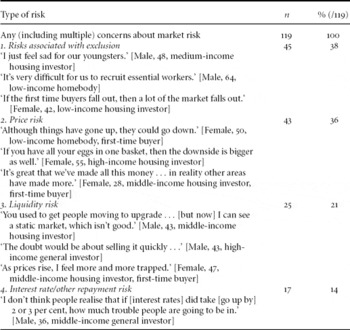
It is generally assumed that home owners are unaware of housing market risks: that they arrived at this position through their own ‘irrational exuberance’ (Shiller, Reference Shiller2005), irrespective of financial logic or active governance. But in fact, almost four in five (119/150) Boh participants temper the ‘feel-good’ element of their accumulating housing wealth with a much more cautionary tale. In response to a cluster of prompts about past, present and future price dynamics, home buyers express four main concerns, showing awareness (in Table 3) of a suite of systemic as well as individual risks, which some policy documents now acknowledge (Stephens et al., Reference Stephens, Whitehead and Munro2005).
The risks of ‘banking on housing’
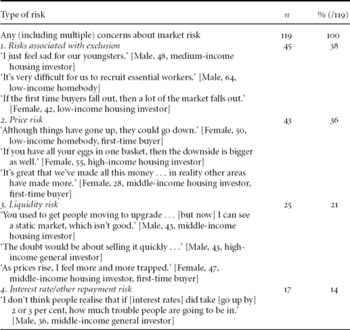
As well as flagging (in rows one and four), the destabilising effects of declining affordability, and a range of credit risks, mortgagors recognise two other questionable assumptions of their dependence on housing wealth: price and liquidity risk. Row two taps into a cluster of concerns around price risk. ‘Banking on housing’ is a tactic that depends on home values appreciating steadily, thus replenishing stocks of equity over time so that owned homes retain their credibility as security for MEW. But as recent trends indicate, house prices are volatile, in the short and long run (see also Banks et al., Reference Banks, Blundell, Oldfield and Smith2004; Catte et al., Reference Catte, Girouard, Price and Andre2004). Whether they constitute speculative bubbles by analogy with stock markets, or simply adjust around fundamentals, their downside can be problematic. Furthermore, placing the majority of financial eggs into a single housing basket presumes property will, on average, perform at least as well as other investments. This may be a fair assumption given the tax breaks on accumulating wealth through home ownership, but study participants themselves recognise that it is never true for every individual home. Even in buoyant markets, there are snakes as well as ladders (Hamnett, Reference Hamnett1999; Henley, Reference Henley1999), and the wealth gains from housing are spatially uneven and socio-economically unequal (Dorling et al., Reference Dorling, Rigby, Wheeler, Ballas, Thomas, Eldin, Gordon and Lupton2007; Thomas and Dorling, Reference Thomas and Dorling2004). Finally (row three), some Boh participants also recognise that housing markets are not always sufficiently liquid to allow people to release funds by the popular method of trading down. As prices peak, and equally, in the face of economic dips or shocks, prices are sticky, and housing markets slow (Case and Quigley, Reference Case and Quigley2008). So this style of equity withdrawal might be least available when it is most required.
It is not surprising that those homebuyers who are sensitive to housing investment risks seek to minimise them. ‘General-investors’, for example, give two key reasons for holding assets other than housing: spreading risks and maximising liquidity. At the same time, ‘housing investors’ who may have arrived at their current position more by accident than design, and who may have capitalised on this good fortune by borrowing against price gains, nevertheless note that: ‘If I'd pots of money, I wouldn't have all my eggs in one basket’; ‘over time, we'll diversify’. Diversification is, of course, a common tactic among investors: it is the foundational element of portfolio building; it brings better (and safer) returns than investments anchored on housing alone (Di et al., Reference Di, Yang and Liu2003). But it is not an option that many households have. As things stand, in order to buy the housing services they need, home buyers have also to purchase, in its entirely, an investment vehicle which is tied to the fortunes of a single property. Some borrowers may use MEW to rebalance that portfolio, borrowing against homes to invest in other things (Schwartz et al., Reference Schwartz, Hampton, Lewis and Norman2006), but this is expensive, involving a loan which has to be serviced. There is in theory a more cost-effective solution, which is able to address both the over-dependence of home owners on house price appreciation, and the exclusion of renters from any investment return on housing at all. However, the financial tools required – the secondary markets and risk-sharing instruments which are currently in place for almost every other class of asset – have only recently become available for housing.
Hedging housing risk
This thing where the value of house bounces up and down doesn't make for a secure, safe nation. [Female, late 50s, low income, little housing equity]
It is generally agreed that some kind of risk-sharing is necessary to stabilise housing markets and protect their occupants. An alliance of home buyers, lenders and government is, for example, at the heart of SHOP – the safe home-ownership partnership proposed by Ford and Wilcox (Reference Ford and Wilcox2005) to manage the (credit) risks of mortgage arrears and possession. Shared appreciation mortgages, equity share schemes and numerous other alliances designed to lever people into home ownership are also risk-sharing enterprises. But so far the options for spreading housing investment (price) risks have been limited,Footnote 4 and all financial risk-sharing in property has been based on relatively unsophisticated financial instruments. Most schemes have therefore been less cost-effective, less inclusive, less appealing to a range of risk-sharing ‘partners’, and less interesting for social policy, than they could be.
This contrasts with the generally accepted style of risk-sharing for the performance of commodities, equities, bonds and a host of other assets, which stems from the trade in derivatives that is managed by financial markets. In the past year, the idea of using derivatives to manage the housing economy has proved controversial, following the collapse of the market for mortgage-backed securities and the failure of complex credit derivatives to protect over-exposed investors. This is a problem rooted in poorly managed, and inadequately regulated, attempts to address the debt side of the housing equation by turning unpaid (perhaps unpayable) loans into quasi-assets. The wider economic crisis this has precipitated is too large (and too recent) a subject to embrace here. However, this paper is concerned with the equity side of housing, and if anything, the turmoil of 2008 adds to, rather than detracts from, the case for using housing (equity) instruments for risk mitigation (Belsky et al., Reference Belsky, Case and Smith2008; Smith, Reference Smith, Clark, Dixon and Monk2009a). It is therefore worth considering the relevance of financial instruments (contracts), whose values derive from the price of an underlying asset (or index), but which can be traded independently of that asset (because they effectively detach the investment dimensions of the asset from its ownership and use). Such instruments provide a means of transferring or managing market risk and they are routinely used by large institutions both to protect (hedge) positions that are over-exposed to particular prices, and to buy into the performance of assets which they do not physically hold. Since the value of such contracts (in the from of options, futures, forwards and swaps) can be many times greater than the global GDP. So it is surprising that barely any of this is anchored on housing, which is still the world's most valuable commodity.
Housing derivatives potentially enable actors to buy or sell the performance of a ‘basket’ of properties (usually in the form of a house-price index), irrespective of their ownership (or not) of the homes comprising this. Using these instruments, home buyers (as well as landlords, lenders and property developers) can sell some of their investment risk in return for lower housing outlays today or a guaranteed sale price tomorrow. At the same time, actors who are otherwise excluded from, or averse to, holding residential property (renters or their agents, insurers, pension funds, hedge funds and banks) can buy into price appreciation. The economic case for developing such instruments is persuasive (see Case et al., Reference Case, Shiller and Weiss1993; Englund et al., Reference Englund, Hwang and Quigley2002; Iacoviello and Ortalo-Magné, Reference Iacoviello and Ortalo-Magné2002; Quigley, Reference Quigley2006; as well as the essays collected in Smith and Searle, Reference Smith and Searle2009), and although derivatives generally tend to inhabit a financial world that is inaccessible to ordinary people (and often detrimental to their fiscal wellbeing), the economic imaginary inspiring housing derivatives has always been biased towards the small investor and linked to social ends. Caplin et al. (Reference Caplin, Joye, Butt, Glaeser and Kuczynski2003a), for example, dub housing derivatives ‘the human face of capitalism’ because they can potentially extend the benefits of modern financial instruments beyond large institutions and into the homes of ordinary households. Likewise, Quigley (Reference Quigley2005) cites housing derivatives as the answer to his own rhetorical question of ‘how to improve the welfare of European housing consumers at practically no cost’. In short, derivatives draw housing into what Robert Shiller calls a new financial order by harnessing ‘a radically new risk management infrastructure to preserve the billions of minor – and not so minor – economic gains that sustain people around the world’ (Reference Shiller2003: ix).
Whether housing derivatives will be used to these ends depends on several things. Firstly, there is the question of whether markets of any kind can or should be used to achieve social policy goals. This debate is foregrounded for housing by the credit crisis of 2007−08. Its outcome depends partly on whether markets can be sufficiently regulated and revised to accommodate an ethic of care; and it may be that they can (see Smith, Reference Smith2005). Secondly, it depends on the fledgling market for housing derivatives gaining traction – an outcome which seems likely because the financial logic is so strong (Labuszewski, Reference Labuszewski2006; Ratcliffe, Reference Ratcliffe2006), but which is not inevitable. Finally, it depends on a suite of ‘retail’ issues: how derivatives are packaged for housing institutions; whether policy makers, practitioners or households have an appetite for the result; and whether governments are able, willing and sufficiently imaginative to wrest social policy gains from financial market innovations (Smith, Reference Smith, Smith and Searle2009b). From a social policy perspective, however, a key question is the suitability, appeal and safety of derivatives-based solutions for home-occupiers.
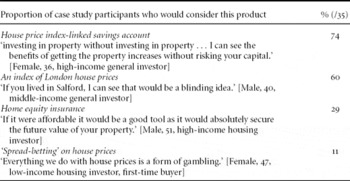
To consider this, participants in the case study phase of Boh (n = 35) were invited to comment on four different ways of balancing the ups and downs of their own home values with house price-indexed products (see Table 4). Obviously, this is a small group and their views – elicited at the peak of the current housing cycle – are indicative rather than definitive, but they are worth noting because there are so few consumer views recorded in the growing literature on thistheme.
Spreading the risks of having too many financial eggs in a single housing basket

The most widespread public face of housing derivatives takes the form of house price-linked savings accounts or bonds. More than 20 such products were launched in the UK in 2005 (Ratcliffe, Reference Ratcliffe2006). They provide consumers with a reasonably safe means of spreading housing investment risks (and gains) across a basket of prices, since they offer the upside of price appreciation with no risk of capital loss. For renters, moreover, they are a way of buying into house prices without incurring any other costs of ownership. As yet these savings vehicles lack the leverage or tax breaks of owner-occupation itself, but with a little political imagination they could provide a stepping-stone into home purchase, allowing buyers to delay entry to the market without the risk of being priced out over time. If based on a regional house price index, moreover, price-linked savings could assist labour mobility, allowing people to move between regions without being locked out by widening price differentials.
There is considerable enthusiasm for house price-linked savings vehicles among the mortgagors in the study: three in every four are attracted to the idea. Part of the appeal is a straight comparison between bank interest rates and house-price appreciation at the height of the housing cycle. But this is not the whole story: people who engage with the idea that returns on savings could be linked to a price index, rather than to interest rates, also appreciate the following qualities:
Legibility
You can't see what a portfolio is. It's just a portfolio. Whereas with house prices, you hear more about them. [Female, 36, middle-income housing investor, first-time buyer]
Manageability
an additional way to balance investment in property without necessarily actually investing in new property ownership . . . you don't have something else to manage and run. [Male, 51, high-income housing investor]
Safety
the worst that could happen would be that the interest rates would go down, and that's not the same as investing yourself in houses where the equity might go down. [Female, 47, low-income housing investor, first-time buyer]
Flexibility
If I could get out of the agreement quite quickly, then I would ride that wave for a while. [Male, 39, middle-income homebody, first-time buyer]
So there may be an appetite among home buyers, especially first time buyers and those with most of their wealth in their homes, for products designed to help diversify housing investments. Study participants were also asked whether they would buy products designed to help hedge their housing risks, to protect them against falling prices or slower-than-expected growth. Derivatives make this kind of protection feasible for the first time: it has never been possible to hedge housing risks in the past. The obvious way to package this is as a form of insurance: an idea which has already been applied in the USA, building from the theory in Shiller and Weiss (Reference Shiller and Weiss1994) to the practicalities of the Syracuse home equity protection scheme (Caplin et al., Reference Caplin, Goetzmann, Hangen, Nalebuff, Prentice, Rodkin, Spiegel and Skinner2003b). By guaranteeing capital values, home equity protection not only safeguards people's main financial buffer, but also offers policy makers an instrument to boost regeneration or prevent decline in whole neighbourhoods.
Intriguingly, home buyers' enthusiasm for this idea in our UK example is muted: just ten (of 35) Boh case study participants reacted positively to this suggestion. This may be because home prices were buoyant at the time of the interviews. However, even those acutely aware of their risky dependence on housing assets were sceptical about the insurance wrapper. Households are saturated with insurance options, many of which tackle a limited suite of (credit, building and contents) risks and are expensive. Housing derivatives enable cost-effective protection against a wider range of financial risks, and it is interesting that of the 25 who said they would not entertain this, more than half (14) were more averse to insurance as a product than to derivatives as a concept: ‘buying insurances policies is a bit like gambling’; ‘they always find a way of not paying you’. A few, like this high income ‘general-investor’, also regard insurance as a poor derivatives deal: ‘you're hedging against a fall but you don't get any of the upside’. The dominant message is that this ‘traditional’ (insurance) style of risk mitigation might not, in the UK at least, be the most effective means of protecting the housing assets of those who need them most.
There is an interesting contrast between mortgagors' views on insurance and their answer to a question asking whether they would be interested to use more directly an index of (say) London house prices, to balance the ups and downs of their own home price. There is a current of enthusiasm for this among three in five of those we spoke to: ‘it makes sense; it reduces your personal risk’ [Male, 50]. Even those who are cautious agree that ‘in principle it sounds like a good smoothing mechanism’ [Male, 40]. Some, of course, are less comfortable with the idea, arguing that the concept is:
Too risky
It's a gamble, isn't it? It's a risk . . . No, I just don't think I would entertain anything like that at all. [Female, 42, mid-income, housing investor]
Too much like the stock market
Sounds like shares . . . I wouldn't touch shares at all to be honest. [Male, 42, low-income, housing investor]
Not enough like the stock market
we have stocks and shares for that. [Female, 47, mid-income, housing investor, first-time buyer]
Easy to beat the index
If I was going to invest in that then I'd presumably have bought a second home, because I would feel I am confident enough about my knowledge of prices in different places. [Female, 42, middle-income, housing investor]
Requires too much skill
You've really got to be switched on for that . . . you'd really need to know where to invest . . . For a layman like me I think that I might be out of my depth. [Female, 50, middle-income, housing investor]
On the whole, however, it is less surprising to learn that people find these ideas challenging than it is to document their readiness and ability to engage with such debates at all. They may not like insurance, but could well be open to other ways of risk-sharing, perhaps by embedding housing derivatives into a new generation of price−index-linked mortgages (Liu, Reference Liu2006; Syz et al., Reference Syz, Vanini and Salvi2006).
Until recently, the investment component of home ownership has been neither divisible nor amenable to risk-sharing. Derivatives can alter this, but there are questions concerning the appropriate ‘delivery’ vehicles. For the most part, derivatives markets are geared (by virtue of the high value of contracts, and the skills required to handle them) to those large investors who might later package options, futures and swaps into mortgages, insurances and investment products, for the retail market. Some ventures challenge this ‘top–down’ formula, most notably Hedge Street in the USA (which is the only registered derivatives clearing organisation in the US catering to very small investors) and the UK spread-betting companies. Boh (case study) participants talked about this, sometimes giving the sense that ‘I'd rather have a bet than insurance’. However, the majority – 30/35 – would not entertain the idea: like most home buyers, they are generally risk averse; they subscribe to the widely held industry view that ordinary households should not dabble directly in derivatives.
A combination of mortgagors' openness to index-based hedging and investment schemes, and their healthy scepticism to the riskier (spread-betting) end of this market, suggests that as the trade in housing derivatives trickles down to individual households, there might be scope – either in commercial retail products, or via instruments harnessed by governments and housing institutions in the interests of affordability and sustainability – to implement safely some of the cost-effective risk management ideas that derivatives now facilitate. In principle, the risks offloaded onto the lay public in Ulrich Beck's (Reference Beck1999) vision of society could be re-acquired, redistributed or repackaged to better meet the needs of households, or to secure a range of other policy goals.
We have argued before that financial services are bought as often by canny consumers as by duped debtors (Cook et al., Reference Cook, Smith and Searle2006), and that people's approach to housing wealth can be as careful as it is competent (Searle et al., Reference Searle, Smith and Cook2009; Smith et al., Reference Smith, Searle and Cook2007b). So it is intriguing to note that while very few Boh participants are willing to borrow against the value of their home to secure the risk-management options outlined above, there is also a sense that this might be different if it were part of a more comprehensive risk-sharing enterprise: ‘I would be interested in investing in some sort of property portfolio investment but with a social purpose.’ According to this well-off middle-aged housing professional, using MEW to provide for people in housing need ‘would be justified in sort of moral terms, which would mean there would be more people to carry the risk. So it would feel right to me and therefore more attractive’. If national and local governments, social and other housing institutions were able to engage with such sentiment, it might yet be possible to use financial markets to meet some key social and housing policy goals.
Conclusion
There are two kinds of financial risk associated owner-occupation. Credit risks refer to those individual, institutional and systemic precursors of mortgage default which leave vulnerable households open to possession and have a bearing on the sustainability of owner-occupation, as well as on the stability of whole economies. The second kind of risk is borne by home-occupiers of all kinds, and is less widely aired. It stems from the normalisation of a housing-biased investment portfolio, in settings where prices are volatile, and housing wealth forms an asset-base for welfare. These risks, which pertain to both inclusion in, and exclusion from, home ownership, have a bearing on social wellbeing, and challenge the viability of entire societies.
This article addresses the second theme. We first note the accumulation of wealth into housing, and document the extent to which home buyers (and their governments) look to these assets as a financial buffer or safety net. We then argue that this is a risky strategy not just for owners exposed to price volatility but also for renters unable to buy into price gains, and for policy-makers looking to build a sustainable housing system. We point to both an appetite, and a need, to explore new ways of mitigating these risks, at a time when owner-occupation is both a housing service and a welfare resource. In particular, we reflect on the relevance of innovations in financial markets that are specifically designed to mitigate the systemic risks (and to disperse the skewed financial rewards) built into ‘home-ownership’ societies. Acknowledging that this is a controversial idea, we follow Caplin et al. (Reference Caplin, Joye, Butt, Glaeser and Kuczynski2003a) in suggesting that while today's privately owned housing systems may not be the ideal springboard into a fair, just and inclusive supply of shelter, it might on balance be better rather than worse if ordinary households could benefit from the financial instruments that large institutions already use to manage risks and secure assets.
Concentrating on the equity (rather than debt) side of the equation, we show that housing derivatives – a new generation of financial engineering – can be used to tackle two key problems associated with ‘banking on housing’: the ‘indivisibility’ of housing investments (their over-use by some and their unavailability to others); and the volatility of home prices. In tackling these dilemmas, derivatives lay the foundations for a tenure-neutral approach to housing resources – and to the practicalities of harnessing their financial and welfare implications. Broadly, our suggestion is that, as it becomes possible to separate the price dynamics of owned homes from the housing services they contain, there is a social policy argument as well as an economic imperative for doing so. Certainly, this is worth debating. The challenge then will be to determine how best to use the traditions and energies of social policy to engage with (manage, regulate, perhaps even transform) the world's financial markets, to ensure that the housing futures they envisage converge with, rather than diverge from, the material needs of home-occupiers.
Acknowledgements
The empirical research for this article was funded by the ESRC (RES 154–24-0012); Susan Smith also acknowledges the support of the ESRC professorial fellowship scheme (RES 051–27-0126). Earlier drafts benefited from feedback at the annual meeting of the RGS/IBG (London, September 2006) and the Think Tank on Housing Wealth (Durham Castle, February 2007).